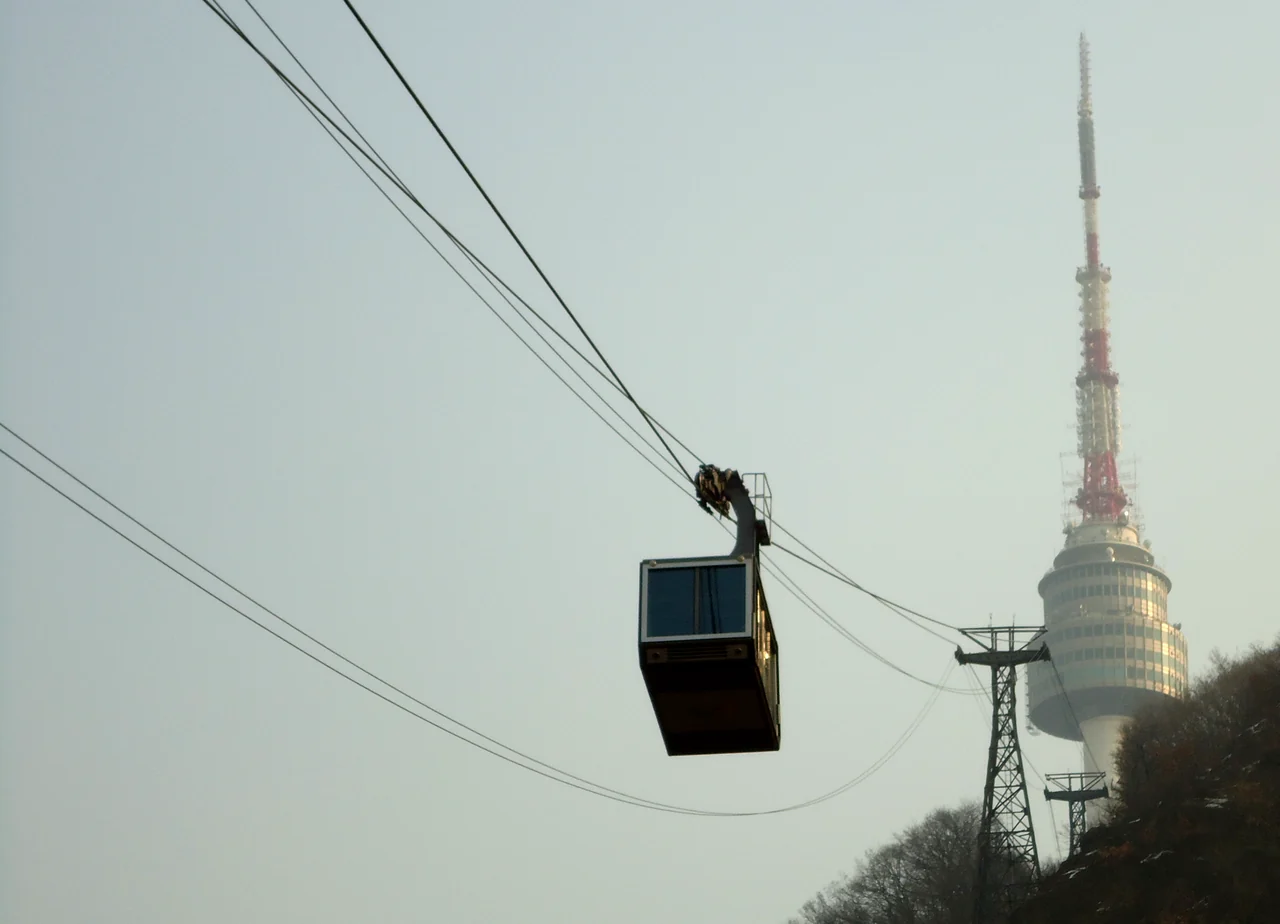
The Namsan cable car rises to the tower in about three minutes, the scenic way up from Myeongdong. Photo: Korail2012, CC BY-SA 3.0, via Wikimedia Commons.
1. The short answer
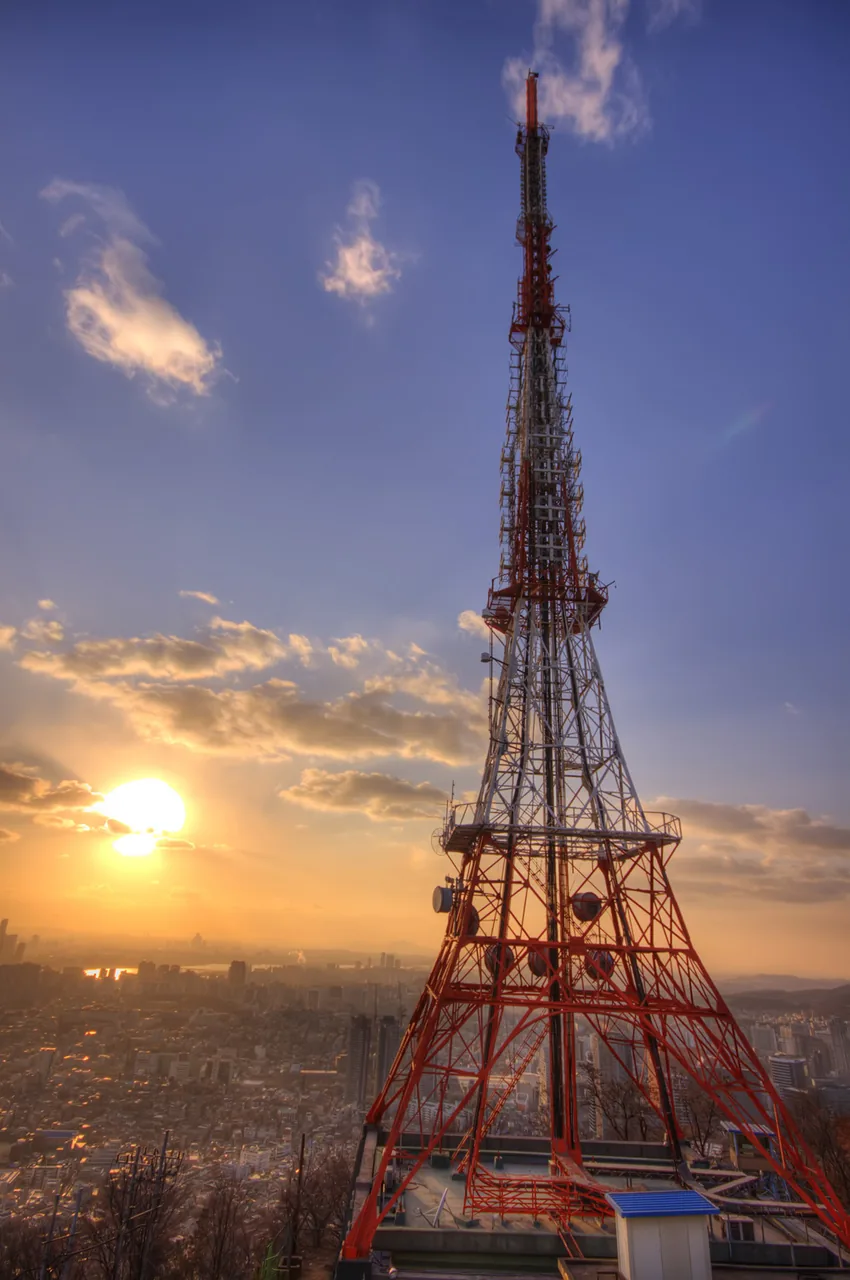
N Seoul Tower (also called Namsan Tower or N Seoul Tower on Namsan) is Seoul’s landmark observation tower, sitting on top of Namsan in the middle of the city. The structure is 236 m tall, and because Namsan itself is around 243 m, you look out over Seoul from roughly 479–480 m above sea level. The observatory costs ₩26,000 for adults, and you can reach the base by cable car, a free incline elevator, an indoor bus, or on foot.
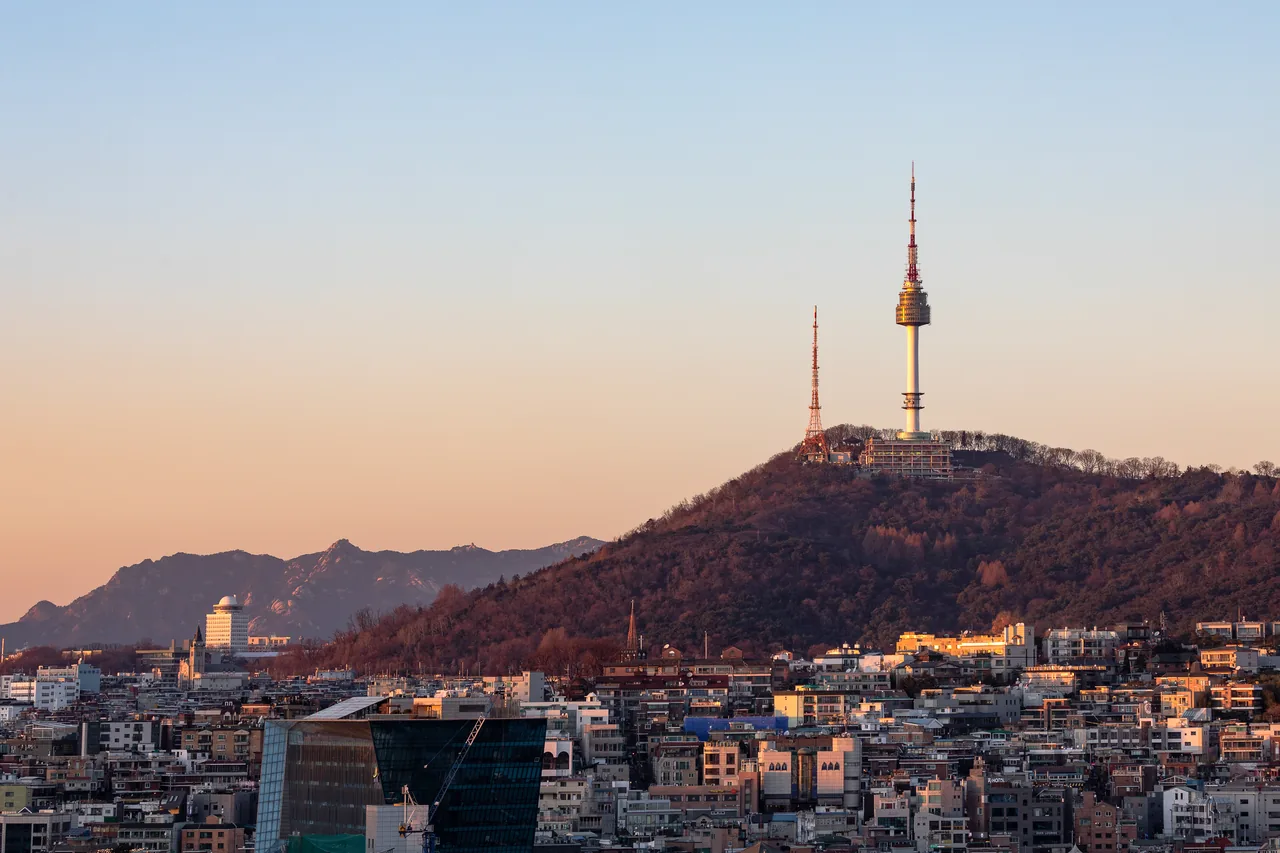
Most visitors come for the 360-degree city view, which is best around sunset and into the night. The tower is also famous for its love locks, its plaza attractions, and a quirky detail: its evening lighting changes colour to show Seoul’s air quality.
💡 Quick plan: Book the observatory online to save money and skip queues, ride the cable car or the free Namsan Oreumi elevator up, and time your visit for the hour after sunset.
2. What is N Seoul Tower?
N Seoul Tower is a communication and observation tower on the summit of Namsan, the wooded hill at the heart of Seoul. The address is 105 Namsan Gongwon-gil, Yongsan-gu, Seoul. 📍Map
The tower stands 236 m tall. Combined with Namsan’s roughly 243 m, the observatory puts you around 479–480 m above sea level, high enough to see the city spread out in every direction.
Construction began in December 1969, the upper tower was finished in 1971, and the observatory was completed in 1975. It opened to the public in October 1980 as Korea’s first integrated broadcast transmission tower.
The “N” was added after a 2005 remodelling and stands for New and for Namsan. Since then the tower has become one of Seoul’s defining symbols.
Height: 236 m structure, ~479–480 m viewing height above sea level
Opened: October 1980 (public opening)
Role: Korea’s first multi-broadcast transmission tower
Name: “N” = New / Namsan (from the 2005 remodel)
🏛️ Context: Namsan has been a signalling point for centuries. A Joseon-era beacon mound still sits nearby, which the tower’s guide covers in the City Wall section below.
3. The tower’s lighting: a live air-quality signal
One of the most distinctive things about N Seoul Tower is that its evening lights double as a live air-quality display for Seoul.
From dusk until 23:00 (22:00 in winter), the tower is lit, and the colour depends on that day’s fine-dust (ultrafine particulate) reading. You can glance at the tower from across the city and read the air quality without checking your phone.
Tower colour
Air quality
Blue
Good
Green
Moderate
Yellow
Bad
Red
Very bad
💡 Local trick: Seoulites use the tower’s colour as a rough forecast for whether to wear a mask. Blue or green means the air is clear enough for a comfortable evening out.
4. The observatory: floors, views, prices and hours
The complex has two parts. The lower N Plaza fills floors 1 to 4, and the upper N Tower occupies floors 3, 4, 5 and 7.
On the 3rd floor you’ll find the Digital Observatory, a 360-degree space where 32 LCD screens present Korean history, alongside the Korean restaurant HANCOOK. Floors 5 to T7 hold the main observation decks, the N Gift Shop, and restaurants and cafes that stay open year-round. Up on the rooftop terrace are the famous love locks.
Detail
Information
Adult (13+)
₩26,000
Child (3–12) / Senior (65+)
₩20,000
Under 36 months
Free (one per guardian)
Online booking
Often around ₩23,000–24,600 (varies, check before you go)
Hours
Roughly 10:00–23:00 daily (varies by day/season)
Last entry
30 minutes before closing (generally around 22:00–22:30)
If you have a reservation at n.Grill or HANCOOK, observatory entry is free with your dining booking.
Booking ahead saves money and cuts your wait. To buy a ticket in advance, you can reserve online here:
⚠️ Prices and hours shift: Official prices and opening times change with the season and with promotions, so confirm the current figures before your visit.
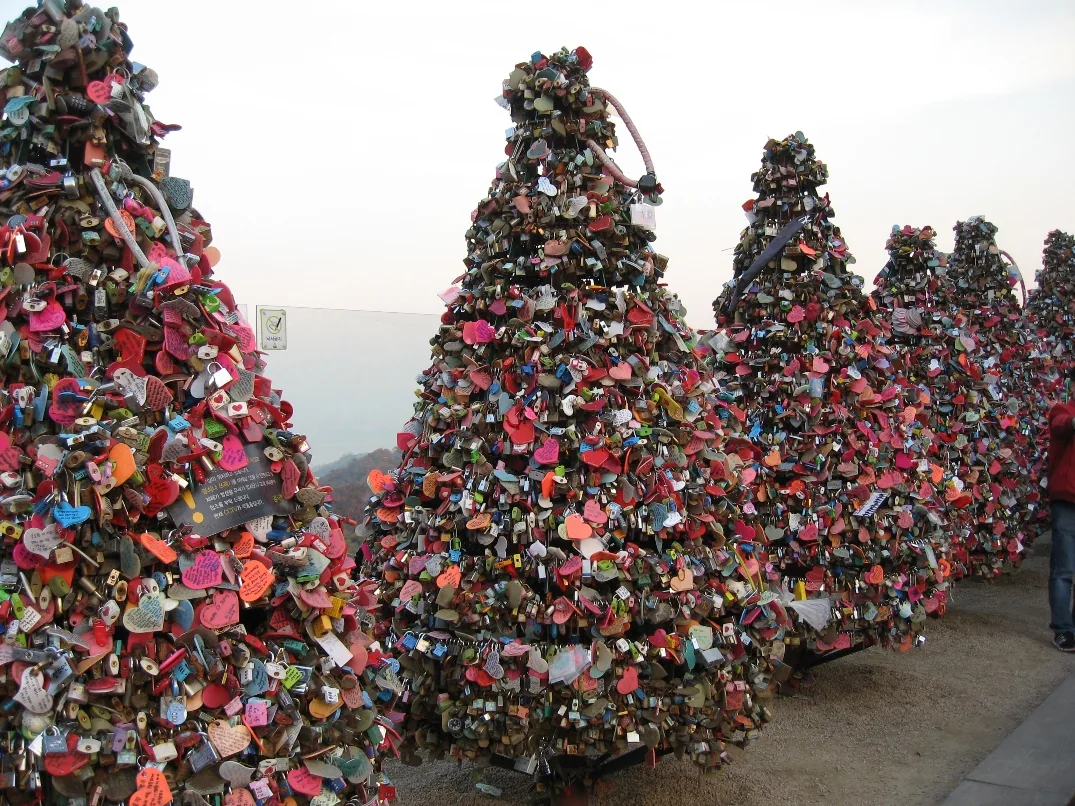
The love-lock terrace beside the tower, where couples have added padlocks since 2006. Photo: Michaela den, CC BY-SA 3.0, via Wikimedia Commons.
5. Ticket types compared
There is more than one way to buy in, and the right choice depends on whether you also want the cable car, the plaza attractions, or a city-wide transport pass.
Ticket type
What it covers
Rough price
Best for
Observatory only
Observation decks
Adult ₩26,000 (less online)
Just the view
Cable car + observatory combo
Round-trip cable car plus observatory
Bundle of both fares
Skipping the uphill walk and the view in one buy
Tower + Running Man + Alive Museum combo
Observatory plus two plaza attractions
Combined attraction price
Families and groups spending longer at the plaza
Hanbok Culture Experience
Hanbok rental, props, self-photo (separate from observatory)
From about ₩18,000
Photo-focused visitors
Discover Seoul Pass
Free observatory entry plus transport discounts and other sights
Multi-attraction pass price
Travellers hitting many Seoul attractions
Restaurant reservation
Free observatory entry with an n.Grill or HANCOOK booking
Cost of the meal
Anyone planning to dine at the top
💡 Pass tip: If N Seoul Tower is one of several paid sights on your itinerary, price out the Discover Seoul Pass, which includes the observatory. For a fuller Seoul plan, see Seoul 2-day itinerary guide.
6. Every way up: quick comparison
There are several ways to reach the tower, and each suits a different traveller, budget and weather.
Method
Rough cost
Time
Pros / cons
Cable car (+ free Oreumi elevator)
~₩15,000 round trip
~3 min ride
Scenic and fun; foreigners must buy on site; can stop in high wind
Circular bus (01A/01B, 02, 03)
~₩1,100–1,400 by card
15–18 min
Cheapest and fully indoor; runs in rain and wind; can be crowded
Walking + Seoul City Wall
Free
20–40 min uphill (wall route 2–2.5 hrs)
Scenic and healthy; needs decent shoes and stamina
Taxi
Metered short hop
Short
Easy with luggage, at night or in rain; costs more
💡 Combine them: A popular approach is to ride the cable car up for the views and take the indoor bus down, or vice versa if the weather turns.
7. Namsan cable car (and the free Oreumi elevator)
The Namsan cable car is the classic, scenic way up, gliding over the hillside in about three minutes.
Fares are roughly ₩15,000 round trip and ₩12,000 one way, with discounts for children and seniors, and it runs from 10:00 to 23:00. On-site prices can change, so confirm at the station. 📍Map
To reach the lower station, leave Myeongdong Station via Exit 3 and walk about 10–15 minutes uphill toward the Pacific Hotel. After you get off at the top, there are a few steps and escalators to the tower.
The uphill walk is steep, but there’s a free shortcut: the Namsan Oreumi, an inclined elevator. From Myeongdong Station Exit 4 it’s about an 8-minute walk, then a 2-minute ride brings you to the cable car station and skips the steepest climb. 📍Map
Cable car: ~₩15,000 round trip / ₩12,000 one way, 10:00–23:00, ~3 min
Access: Myeongdong Exit 3 for the cable car, Exit 4 for the Oreumi
⚠️ Buy the cable car on site: The Namsan cable car has no online booking, so buy your ticket in person at the station booth, and expect queues at busy times.
8. Namsan circular bus (fully indoor, good in any weather)
The circular buses are the cheapest way up and the most weather-proof, since you’re indoors the whole way. They’re the natural backup if rain or wind stops the cable car.
Bus
Hours
Fare (card)
Serves
01A / 01B (mint)
06:30–23:00
~₩1,400
Chungmuro, Dongguk Univ.
02
Daytime service
~₩1,100
Chungmuro, Dongguk Univ.
03
Daytime service
~₩1,100
Seoul Station, Itaewon, Yaksu, Dongguk Univ.
The 01A and 01B mint-coloured buses take about 15–18 minutes to reach the top.
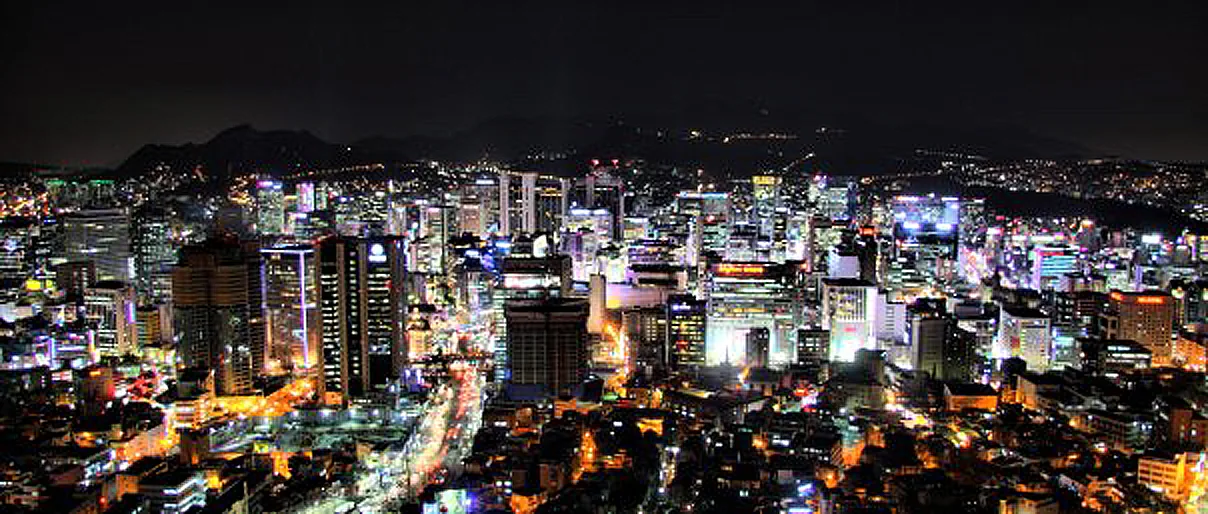
The night view from the observatory, best about an hour after sunset when the city lights peak. Photo: Evilbish, CC BY-SA 3.0, via Wikimedia Commons.
9. Walking up + the Seoul City Wall
If you’d rather earn the view, several trails climb Namsan on foot, taking about 20–40 minutes uphill from the Myeongdong, Chungmuro or Baekbeom Plaza sides.
The most rewarding route follows the Namsan section of the Seoul City Wall (Hanyangdoseong). It runs about 4.2 km and takes 2 to 2.5 hours at a moderate difficulty.
Along the way you pass the Mokmyeoksan Beacon Mound, built in 1423 and restored in 1993, which was the final destination of the Joseon-era beacon fire signal network. 📍Map You also reach the Palgakjeong pavilion.
City Wall (Namsan section): ~4.2 km, 2–2.5 hrs, moderate
Trail time on foot: ~20–40 minutes uphill from the base
🌸 Seasonal reward: The wall path is one of Seoul’s best-loved routes for cherry blossoms in spring and coloured leaves in autumn.
10. The love locks
On the terrace beside the tower sits Seoul’s most famous cluster of love locks.
The tradition began in 2006, and by 2018 the accumulated locks weighed around 82 tonnes. Couples write a message on a padlock and fasten it to the fences and trees, which has made the terrace one of the city’s signature date spots.
Started: 2006
Weight (2018): ~82 tonnes of locks
Where to buy a lock: On site at the tower
💗 Good to know: You don’t need to bring anything. Locks and pens are sold on the spot, so you can add yours during your visit.
11. Tower plaza attractions
Even before you go up, the lower N Plaza has enough to fill a couple of hours, much of it on the B1 level.
The Hanbok Culture Experience Hall on B1 has a Joseon theme, with a range of hanbok and photo zones. A session runs about 180 minutes and starts from roughly ₩18,000, covering the outfit, props and self-photography.
Next to it, the Running Man Theme Experience Hall and the Alive Museum (an optical-illusion art museum) are bundled with the tower in a combo ticket.
Hanbok Culture Experience: B1, Joseon theme, ~180 min, from ~₩18,000
Running Man + Alive Museum: combo ticket with N Seoul Tower
Also on the plaza: Gallery K, a Bodyfriend lounge, a game plaza, and a 55-inch OLED media-art display
🎭 Family tip: If you’re travelling with kids or a group, the Tower + Running Man + Alive Museum combo turns the plaza into an afternoon of its own.
N Seoul Tower on Namsan at dusk, when the tower’s lighting switches on to signal Seoul’s air quality. Photo: Seoul Tourism Organization, KOGL Type 1, via Wikimedia Commons.
12. Tower restaurants and cafes
Dining at the top is a draw in itself, and a reservation at either signature restaurant includes free observatory entry.
Venue
Type
Notes
n.Grill
French fine dining
Revolving restaurant at the top, 360-degree view; reservation includes free observatory entry
HANCOOK
Korean
3rd floor; signature charcoal-grilled hanwoo beef, course and about 30 à la carte dishes; reservation includes free observatory entry
Other outlets
Pasta, cafe, amenities
Open year-round
🍽️ Reserve ahead: Both signature restaurants are popular, especially at sunset, so book in advance to secure a window table.
13. A K-drama and K-pop landmark
N Seoul Tower is a pilgrimage site for fans of Korean pop culture.
It has appeared in many dramas, including My Love from the Star and Boys Over Flowers, and its love-lock tradition has cemented its reputation as a romance destination.
The tower also turns up in K-pop music videos and OSTs, such as Davichi and IU’s Love Wins All, which keeps it high on fans’ must-visit lists.
Dramas: My Love from the Star, Boys Over Flowers, and more
Music: K-pop videos and OSTs including IU’s Love Wins All
Draw: The love locks reinforce its romance-spot fame
🎬 Fan tip: Combine the tower with other Seoul filming locations for a K-culture day; the Seoul itinerary guide at Seoul 2-day itinerary guide can help you stitch stops together.
14. Best time to visit
The single best window is sunset into the evening, when the city lights reach their peak roughly 30 minutes to an hour after the sun goes down. The seasons add their own reasons to come.
When
Why go
Sunset into night
City lights peak ~30–60 min after sunset; the signature view
Spring (late Mar–early Apr)
Cherry blossoms on Namsan and the City Wall path
Autumn (mid-Oct–early Nov)
Namsan foliage turns red and gold
Weekday, early or late
Quieter; weekends, evenings and holidays are busiest
⚠️ Weather watch: High wind or heavy rain can suspend the cable car, so keep the indoor bus as a backup. For a rainy-day plan, see Seoul when it rains guide.
15. Photography spots
The tower photographs well by day and by night, and a few simple choices make a big difference.
By day, shoot upward from the base of the tower for a dramatic angle, or use the City Wall path as a leading line and backdrop.
By night, capture the city lights from the observatory, the love locks under the tower’s glow, and the lit tower itself from a distance across the city.
Daytime: looking up from below the tower; City Wall backdrop
Night: city view from the observatory; love locks; the lit tower from afar
Timing: shoot the night view right after sunset
📷 Glass glare: To avoid window reflections at the observatory, press your lens right against the glass.
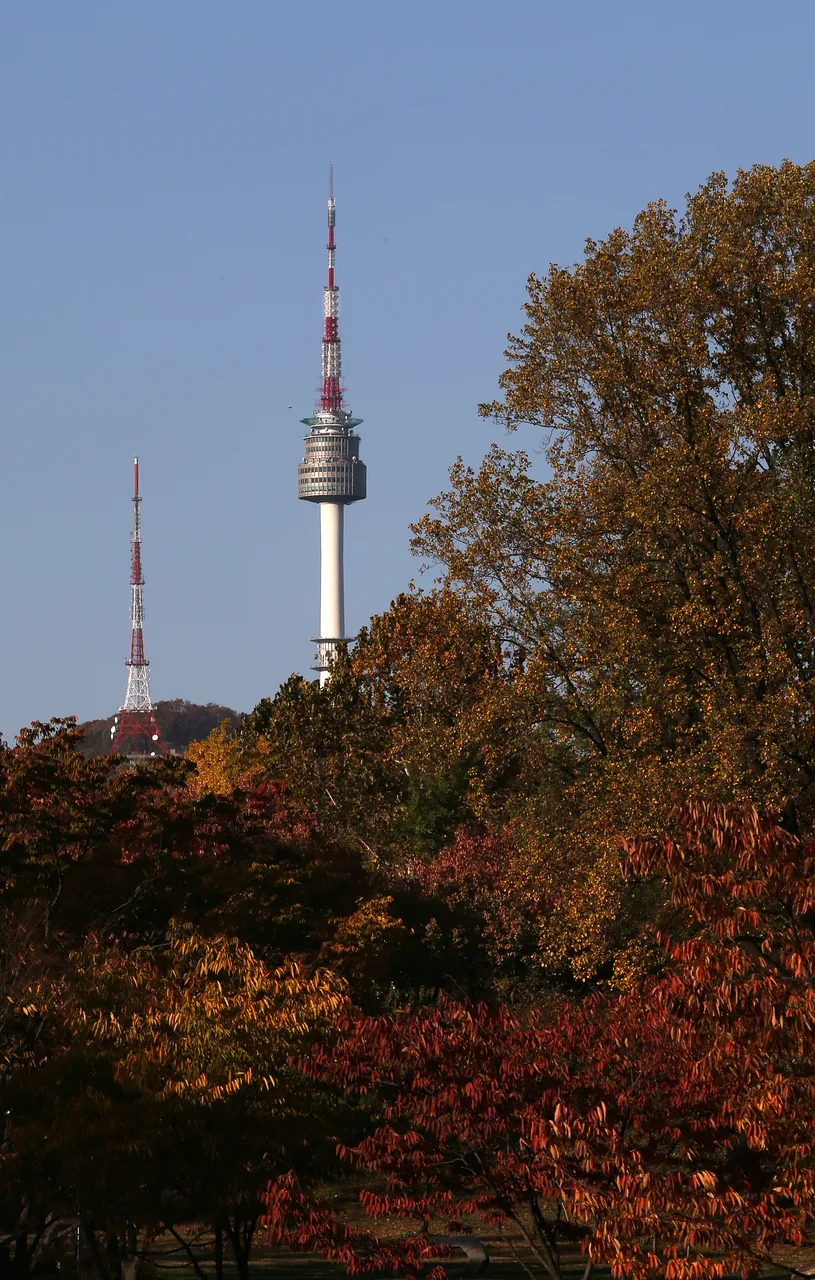
Namsan in autumn colour from mid-October to early November, a top time to walk up to the tower. Photo: Korea.net, CC BY-SA 2.0, via Wikimedia Commons.
16. Combine it with nearby sights
The tower slots neatly into a wider Namsan and downtown itinerary.
Myeongdong sits near the cable car and Oreumi base, with shopping and street food. Namsan Park has walking trails and Baekbeom Plaza.
Namsangol Hanok Village, near Chungmuro Station, gathers traditional hanok houses and is free to enter. 📍Map
Myeongdong: near the cable car / Oreumi base; shopping and food
Namsan Park: trails and Baekbeom Plaza
Namsangol Hanok Village: Chungmuro Station, traditional houses, free
A little planning makes the visit smooth for every kind of traveller.
The free Namsan Oreumi elevator and the tower’s internal elevators make the trip manageable with a stroller or wheelchair. There are lockers and Wi-Fi on site.
Wear comfortable shoes, since even after the bus or cable car there are a few steps up to the tower, and check the forecast so you can switch to the bus if the cable car stops.
Plan
Time needed
Observatory only
1–1.5 hours
Plaza, love locks and a meal
2–3 hours
Add a City Wall walk
Half a day
💡 Save money and time: Book the observatory online for a discount and shorter queues, and pay transport with a transit card; compare options at Climate Card vs T-money comparison.
18. Getting there + a half-day route
Here’s a simple half-day plan from Myeongdong that covers the highlights without rushing.
From Myeongdong Station, take Exit 4 and walk about 8 minutes to the free Namsan Oreumi incline elevator, then ride 2 minutes to the cable car station.
Buy your cable car ticket on site (foreigners cannot book online), and ride up in about 3 minutes.
Explore the N Plaza, add the love locks on the terrace, and go up to the observatory for the 360-degree view.
Time the observatory for the hour after sunset to catch the city lights at their best.
Take the indoor circular bus down (a good rain or wind backup), then finish with dinner and shopping in Myeongdong.
⚠️ Have a backup: If wind or rain closes the cable car, use the fully indoor circular bus in both directions.
19. The verdict
N Seoul Tower earns its status as Seoul’s signature viewpoint. The 360-degree panorama, the love locks, the air-quality lighting and the plaza attractions add up to more than a quick photo stop.
Go around sunset, book the observatory online, and pick your way up to match the weather, cable car and Oreumi for the scenic route, the indoor bus when the sky turns.
Do: visit at dusk, book online, keep the bus as a wet-weather backup
Consider: a combo or Discover Seoul Pass if you’re seeing several sights
Pair with: Myeongdong, Namsangol Hanok Village and the City Wall walk
The observatory is ₩26,000 for adults (13+) and ₩20,000 for children (3–12) and seniors (65+). Children under 36 months enter free (one per guardian). Booking online is usually cheaper, often around ₩23,000–24,600, though prices vary.
Q. What’s the best way to get up to the tower?
There’s no single best way, it depends on you. The cable car (about ₩15,000 round trip) is the scenic favourite, the circular bus (about ₩1,100–1,400) is the cheapest and fully indoor, and walking the City Wall is the most rewarding on foot. Many visitors ride up one way and take the bus down.
Q. Cable car or circular bus?
Take the cable car for the views and the experience, and the circular bus for price and weather-proofing. The bus is fully indoor, so it keeps running in rain and high wind when the cable car may stop. A common plan is cable car up, bus down.
Q. What is the Namsan Oreumi (free elevator)?
The Namsan Oreumi is a free inclined elevator that skips the steep uphill walk to the cable car station. From Myeongdong Station Exit 4 it’s about an 8-minute walk, then a 2-minute ride to the cable car station. It runs 9:00–23:00, with a Monday maintenance closure from 9:00 to 14:00.
Q. Can you book the Namsan cable car online?
No. The Namsan cable car has no online booking at all, so buy your ticket in person at the station booth. Expect queues at busy times, or take the indoor circular bus instead.
Q. Why does the tower change colour?
The tower’s evening lighting shows Seoul’s air quality. Blue means good, green moderate, yellow bad, and red very bad, based on the day’s fine-dust reading. It’s lit from dusk until 23:00 (22:00 in winter).
Q. Where do I buy a love lock?
You can buy a padlock on site at the tower, so there’s no need to bring one. Write your message, then fasten it to the fences or trees on the terrace, a tradition that started in 2006.
Q. When is the best time for the night view?
Aim for the hour after sunset. The city lights peak roughly 30 minutes to an hour after the sun goes down, which is the tower’s signature view. Weekday nights are less crowded than weekends and holidays.
Q. When can I see cherry blossoms and autumn leaves?
Cherry blossoms are usually late March to early April on Namsan and the City Wall path. Autumn foliage on Namsan peaks from mid-October to early November.
Q. If I reserve a restaurant, is the observatory free?
Yes. A reservation at n.Grill or HANCOOK includes free observatory entry, so the cost of your meal covers the view.
Q. Is the observatory free with the Discover Seoul Pass?
Yes. The Discover Seoul Pass includes free observatory entry along with transport discounts and other attractions, so it’s worth pricing out if you’re visiting several paid sights.
Q. Is it worth going in the rain?
Yes. The tower is enclosed and the circular bus is fully indoor, so you can visit comfortably in bad weather; just keep the bus as your backup if the cable car stops. For a full wet-weather plan, see Seoul when it rains guide.
Q. Is it okay for kids, strollers or wheelchairs?
Yes. The free Namsan Oreumi incline elevator and the tower’s internal elevators make it manageable with a stroller or wheelchair, and there are lockers and Wi-Fi on site.
Q. How long does a visit take?
Plan 1–1.5 hours for the observatory alone, 2–3 hours if you add the plaza, love locks and a meal, and about half a day if you also walk the City Wall.
Q. How do I get there from Myeongdong?
From Myeongdong Station, take Exit 4 and walk about 8 minutes to the free Namsan Oreumi elevator, then ride 2 minutes to the cable car station and go up (about a 3-minute ride). Alternatively, Exit 3 leads to the cable car base on a 10–15 minute uphill walk.
Images: Tower at sunset (featured image): Jimmy McIntyre, CC BY-SA 2.0. Namsan cable car: Korail2012, CC BY-SA 3.0. Love locks: Michaela den, CC BY-SA 3.0. Night view: Evilbish, CC BY-SA 3.0. Namsan at dusk: Seoul Tourism Organization, KOGL Type 1. Namsan in autumn: Korea.net, CC BY-SA 2.0. All via Wikimedia Commons.