
Gyeongbokgung Palace & Hanbok: How to Do Seoul’s Grandest Palace Right
A first-timer’s guide to Gyeongbokgung — the throne hall, the lake pavilions, the changing-of-the-guard, and the one trick (renting a hanbok) that gets you in for free and turns the whole visit into the best photos of your trip.
| What it is | Seoul’s largest and most important royal palace, founded in 1395 as the seat of the Joseon dynasty. The full-on, picture-postcard Korean palace — and the right one to see if you only visit one. |
|---|---|
| The hanbok trick | Rent a hanbok (traditional dress) nearby and you walk in free (normal entry ₩3,000) — and you’ll be glad you did the moment you see your photos against the throne hall. |
| Don’t miss | The Changing of the Royal Guard at the main gate (10:00 & 14:00), the Geunjeongjeon throne hall, and the Gyeonghoeru pavilion floating on its lake. |
| Hours | 09:00–18:00 most of the year (to 18:30 in summer, 17:00 in winter), last entry an hour before close. Closed Tuesdays. |
| Getting there | Subway Line 3 to Gyeongbokgung Station, Exit 5 — it comes up inside the palace wall. Line 5 Gwanghwamun (Exit 2) also works. |
| How long | Give it 2–3 hours for the palace, more if you’re doing hanbok photos, the two on-site museums, and the neighbourhood around it. |
1. First things first: is Gyeongbokgung worth it, and how do you do it right?
2. A 600-year story, in five minutes
3. Gwanghwamun: the gate, the guardians and the plaza
4. The grand axis: Geunjeongjeon throne hall and the king’s quarters
5. The two pavilions everyone photographs: Gyeonghoeru and Hyangwonjeong
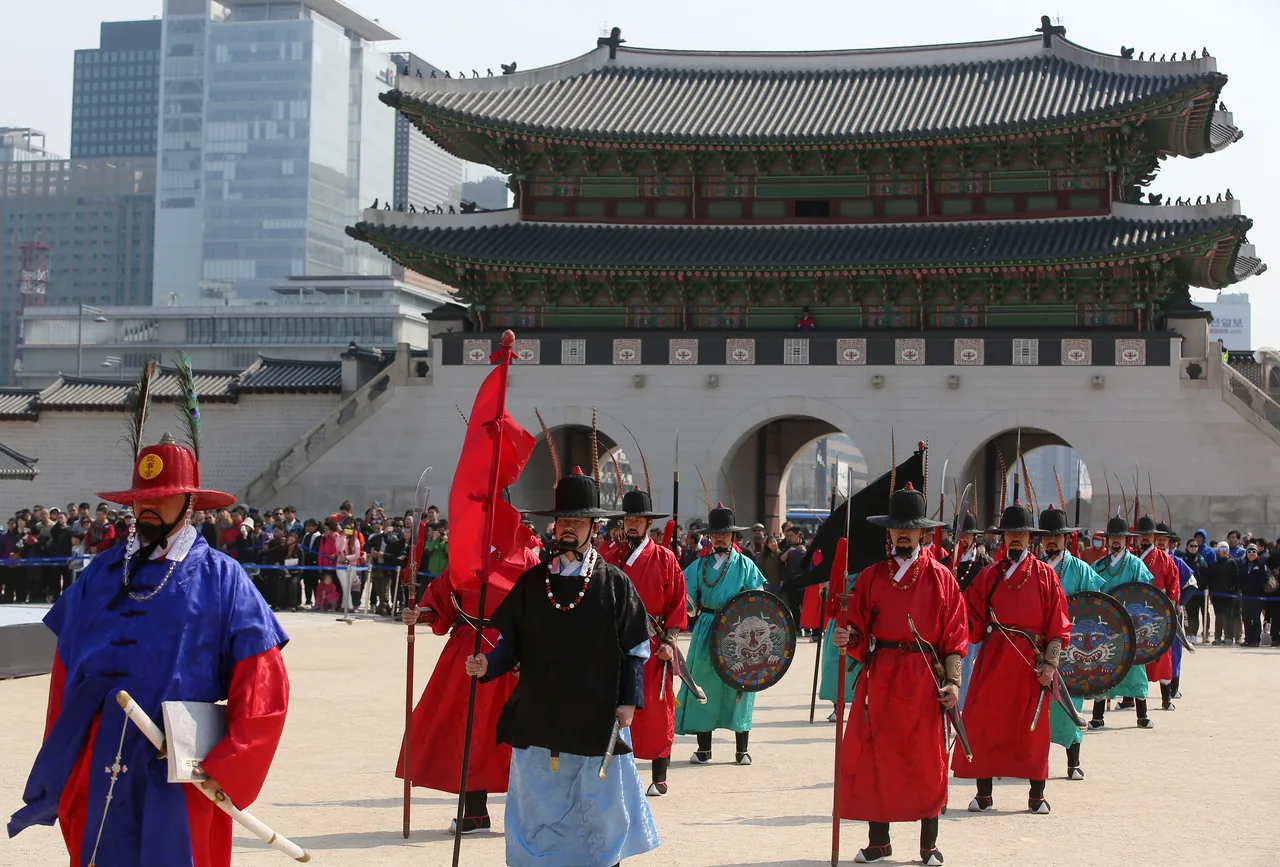
6. The Changing of the Royal Guard: don’t skip this
7. Two free museums on the grounds — worth an hour
8. Wearing a hanbok: free entry and your best photos
9. The best photo spots, mapped out
10. Plan your visit: tickets, hours, best time
11. Getting there, and what to pair it with
12. The other palaces, briefly — and how Gyeongbokgung fits
1. First things first: is Gyeongbokgung worth it, and how do you do it right?
If you see one palace in Seoul, make it this one. Gyeongbokgung (景福宮, roughly “Palace of Shining Happiness”) is the biggest of the city’s five royal palaces, the original home of the Joseon kings, and the one with the full set of showpieces — a soaring throne hall, a banquet pavilion sitting on its own lake, a guard ceremony with drums and flags, and the mountain, Bugaksan, framing it all behind. It’s the postcard, and it earns the title.
Doing it right comes down to three small decisions:
- Wear a hanbok. Rent the traditional dress from a shop by the gate and you get in free, and every photo you take suddenly looks like it belongs on a magazine cover. More on how below.
- Time it around the guard ceremony. It runs at 10:00 and 14:00 at the main gate — arrive a little before and you catch the whole thing.
- Don’t come on a Tuesday. The palace is closed, and so is the ceremony. This trips up more visitors than anything else.
2. A 600-year story, in five minutes
Knowing a little of the history changes what you’re looking at — the palace stops being pretty buildings and becomes the stage where a dynasty actually lived.
Gyeongbokgung was built in 1395, three years after the Joseon dynasty was founded, as its main palace — the seat of the king, the government, and the court. For two centuries it was the heart of the kingdom. Then, during the Japanese invasions of 1592, it burned to the ground and, remarkably, was left in ruins for nearly 270 years.
Its great revival came in the 1860s, when the regent Heungseon Daewongun rebuilt the whole complex on a massive scale — some 330 buildings. That golden age was brief: during the Japanese colonial period in the early 20th century, much of the palace was deliberately torn down and a colonial government building was planted in front of the throne hall. Since the 1990s, Korea has been steadily demolishing those additions and restoring the palace to its 1860s self, a project that’s still going.
So what you walk through today is part survivor, part painstaking reconstruction — and that long arc of destruction and recovery is, in a way, the story of modern Korea itself.
3. Gwanghwamun: the gate, the guardians and the plaza
You’ll almost certainly start at Gwanghwamun, the palace’s grand main gate, with its three arched openings and a two-tiered roofed pavilion on top. The centre arch was once reserved for the king alone. Flanking the gate are the haetae — mythical lion-like creatures that were believed to guard against fire and disaster, and which have quietly become a symbol of Seoul.
In front stretches Gwanghwamun Square, one of the city’s great civic spaces, anchored by two statues every Korean knows: King Sejong the Great, the beloved 15th-century ruler who created the Korean alphabet, Hangeul, seated in gold; and, further down, Admiral Yi Sun-sin, the naval hero who turned back those 1590s invasions. Walking from the square up to the gate, you’re moving along the ceremonial spine of the old capital.
4. The grand axis: Geunjeongjeon throne hall and the king’s quarters
Past the gates you reach the heart of the palace, laid out along a single ceremonial line. This is the part to slow down for.
Geunjeongjeon — the throne hall
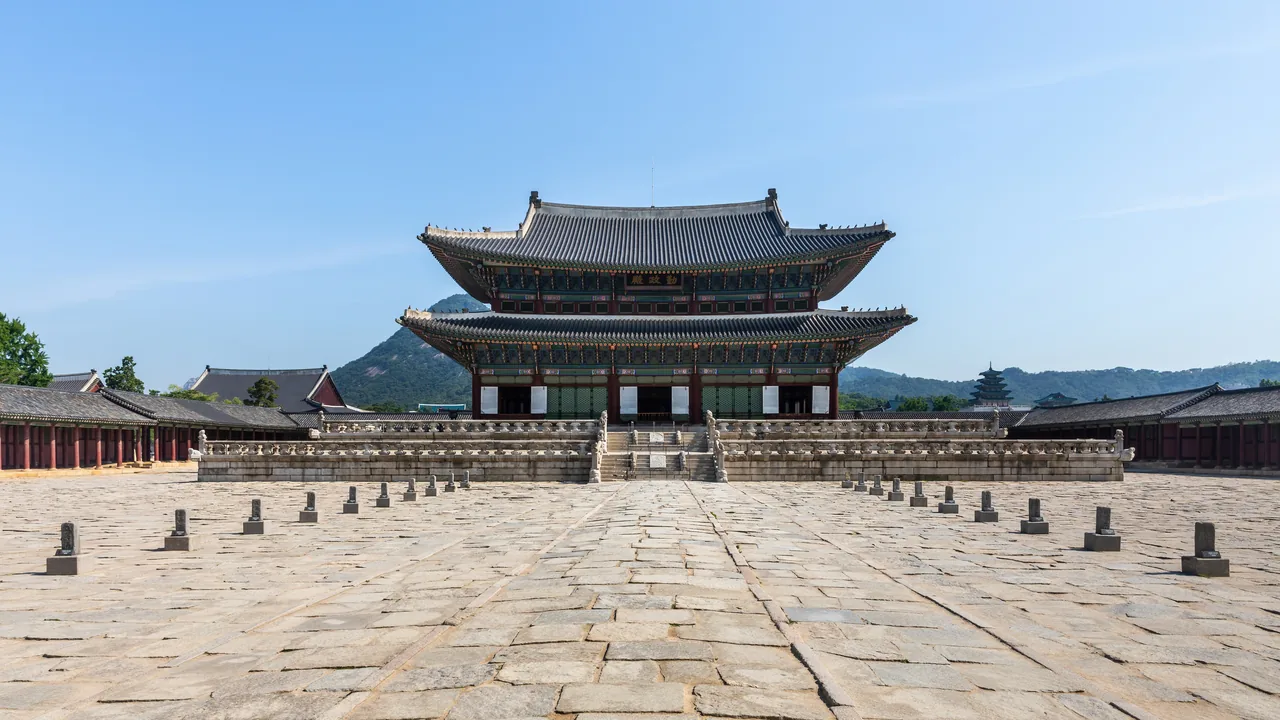
Geunjeongjeon is the showstopper: the largest wooden throne hall in Korea, sitting on a double-tiered stone terrace at the top of a wide, open courtyard. This is where kings were crowned, foreign envoys received, and great ceremonies of state held. Look for the rows of rank stones lining the courtyard — small markers that told each official exactly where to stand by seniority. Step up and peer inside at the throne, backed by the Irworobongdo, the painted screen of sun, moon and five peaks that symbolised the king himself.
Sajeongjeon and the living quarters
Behind the throne hall sits Sajeongjeon, the king’s everyday office, where he handled the real business of governing. Deeper in are the residential halls — Gangnyeongjeon (the king’s living quarters) and Gyotaejeon (the queen’s), notable for having no top roof ridge, a deliberate choice. Behind the queen’s hall, don’t miss Amisan, a small terraced garden with beautifully patterned chimneys — a quiet, human-scaled corner after all the grandeur.
5. The two pavilions everyone photographs: Gyeonghoeru and Hyangwonjeong
If the throne hall is the palace’s power, these two water pavilions are its poetry — and they’re the images you’ll have seen before you ever arrived.
Gyeonghoeru — the banquet pavilion on the lake
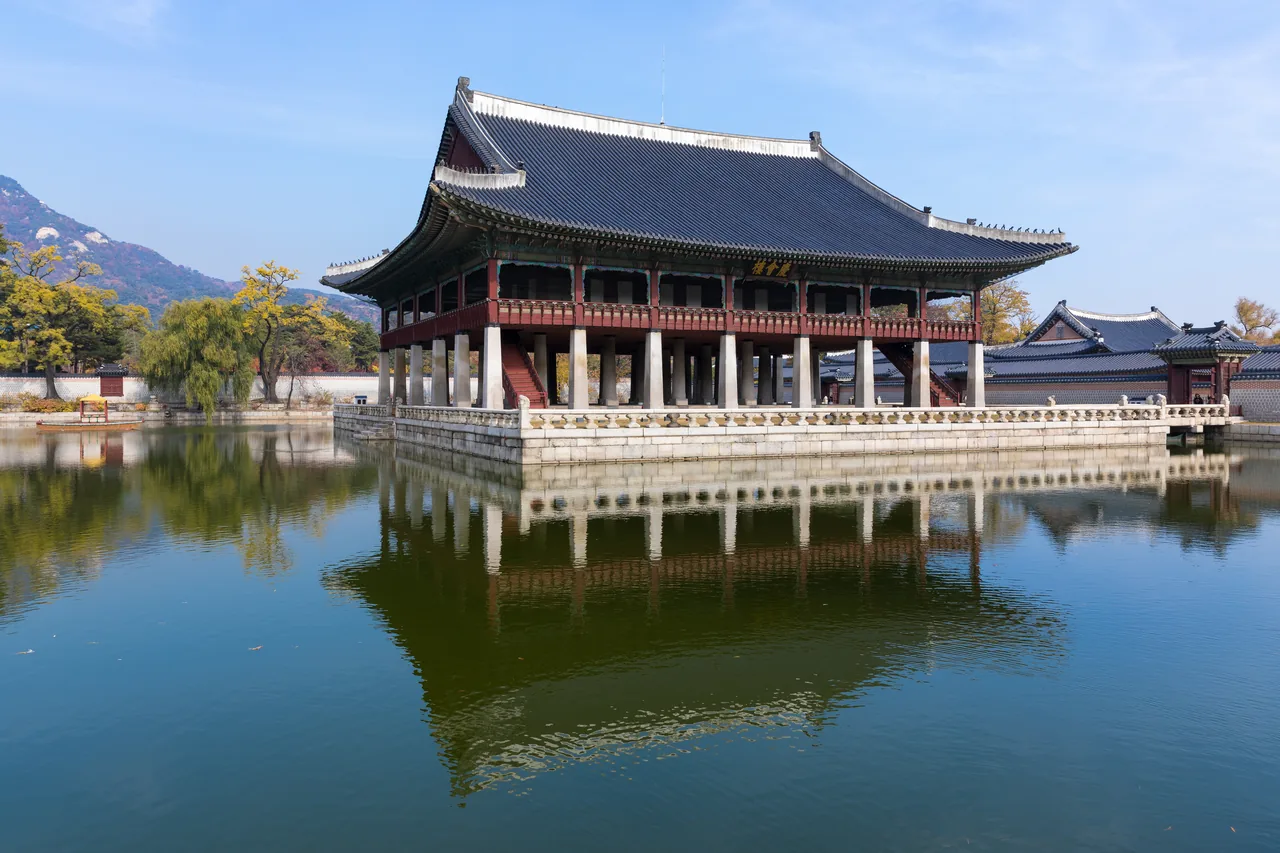
Gyeonghoeru is a vast two-storey pavilion raised on 48 stone pillars, standing on an artificial island in a square lotus pond. Kings held state banquets here for foreign envoys and celebrated good harvests, the open upper floor catching the breeze over the water. Reflected in the pond with the mountains behind, it’s the single most photographed view in the palace. You usually admire it from the bank; in some seasons the interior opens for special guided visits.
Hyangwonjeong — the island pavilion
Tucked toward the rear of the grounds, Hyangwonjeong is the smaller, more intimate one: a hexagonal pavilion on a little round island, reached by a slender wooden bridge across a lotus pond. Where Gyeonghoeru is grand and ceremonial, Hyangwonjeong is serene — it’s where you’ll want to slow down, especially when the lotus blooms in summer or the leaves turn in autumn.
6. The Changing of the Royal Guard: don’t skip this
Twice a day, the courtyard in front of Gwanghwamun fills with colour: men in vivid blue, red and yellow robes, carrying flags and ceremonial weapons, beating drums and blowing horns as they re-enact the changing of the royal guard — the centuries-old ritual of handing over the duty of protecting the palace gates. It’s free, it’s genuinely atmospheric, and it’s one of the easiest “wow” moments in Seoul.
- Times: the main ceremony runs at 10:00 and 14:00, lasting about 20 minutes each.
- Bonus rituals: there’s also a gate guard duty performance at 11:00 and 13:00, and an open guard-training display around 09:35 and 13:35 — so even off the main times, there’s often something on.
- Where: in the plaza between Gwanghwamun gate and the inner Heungnyemun gate. Get there 10–15 minutes early for a spot near the front.
- When it’s off: cancelled on Tuesdays (palace closed) and in heavy rain or extreme heat.
7. Two free museums on the grounds — worth an hour
Most visitors march straight past two excellent museums sitting right inside the palace complex, both free and both a great place to duck into if it rains or the heat climbs.
- The National Palace Museum of Korea, near Gwanghwamun, holds the royal treasures themselves — thrones, seals, robes, royal portraits, astronomical instruments and the ritual objects of the Joseon court. Go here to understand the people who lived in the halls you’re walking through.
- The National Folk Museum of Korea, toward the palace’s eastern side, tells the story of ordinary Korean life through the centuries — homes, farming, festivals, the rhythm of the four seasons — with an outdoor recreated street that kids love.
8. Wearing a hanbok: free entry and your best photos
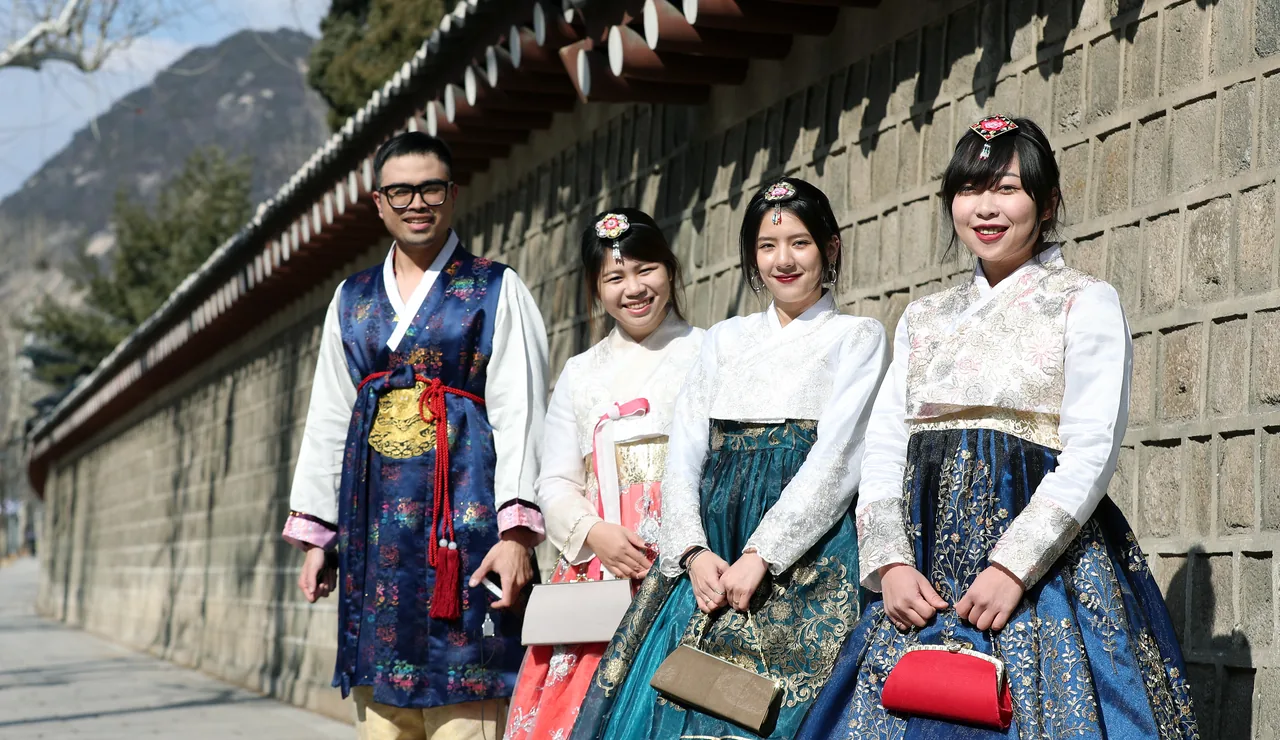
This is the one tip that changes the whole day, so here’s how to do it well. The hanbok is Korea’s traditional dress — flowing skirt or jacket-and-trousers in bright colours — and the deal is simple: wear one and you get into Gyeongbokgung for free (and into the other palaces too). But the real reason everyone does it is the photos. Against the palace’s painted eaves and stone courtyards, a hanbok turns ordinary snapshots into the highlight of the trip.
Where and how to rent
- Where: dozens of rental shops cluster right around the palace, especially toward Bukchon and the Gyeongbokgung Station exits. You walk in, choose, change, and you’re at the gate in minutes.
- How long: the standard rental is for a set number of hours (commonly 1–4 hours or a full day) — plenty for the palace and a wander through Bukchon.
- What’s included: the outfit plus a petticoat, and usually a choice of hair accessories and a bag for your own clothes. Many shops offer hair styling and fuller “traditional” or “royal court” sets for a bit more.
- What to pick: brighter, simpler colours photograph best against the palace; the more elaborate royal sets are fun but heavier. Comfortable shoes matter — you’ll walk a lot.
Booking ahead matters in peak seasons (spring blossom and autumn colour), when the best shops and sizes go fast.
9. The best photo spots, mapped out
If photos are part of why you’re here (and with a hanbok on, they will be), these are the corners worth seeking out:
- Geunjeongjeon throne hall — shoot from the courtyard with the double terrace and mountain behind; early morning means fewer people in frame.
- Gyeonghoeru pavilion — the classic reflection shot across the lotus pond; the long view from the southwest corner is the postcard.
- Hyangwonjeong — the little bridge to the island pavilion, dreamy in soft light and unbeatable in autumn.
- The painted corridors and gates — the dancheong (traditional multicoloured paintwork) under the eaves makes a vivid backdrop for portraits.
- Amisan’s chimneys — a quieter, more unusual spot behind the queen’s quarters.
10. Plan your visit: tickets, hours, best time
The practical details, in one place.
| Detail | What to know |
|---|---|
| Admission | ₩3,000 adults (foreign 19–64), ₩1,500 youth (7–18). Free for under-7s, 65+, anyone in hanbok, and everyone on the last Wednesday of the month (Culture Day). |
| Hours | 09:00–18:30 (Jun–Aug), 09:00–18:00 (Mar–May, Sep–Oct), 09:00–17:00 (Nov–Feb). Last entry one hour before closing. |
| Closed | Every Tuesday. (If a holiday falls on Tuesday it may open and close another day — check ahead.) |
| Integrated ticket | ₩6,000 for four palaces + Jongmyo, valid six months. The Changdeokgung Secret Garden is excluded. |
| Night opening | Special evening sessions run in spring and autumn (ticketed, limited) — magical, but book early. |
Best time to visit: spring (April cherry blossom) and autumn (October–November foliage) are the most beautiful — and busiest. Summer is hot and humid with sudden rain; winter is cold but quiet and stark against snow. Whatever the season, weekday mornings are the sweet spot. For a full month-by-month breakdown, see our best time to visit Korea guide.
11. Getting there, and what to pair it with
Getting there couldn’t be easier: take the subway Line 3 to Gyeongbokgung Station and use Exit 5, which surfaces right by the palace wall and the Palace Museum. Line 5 to Gwanghwamun, Exit 2, brings you out at the square in front. For how the subway and transit cards work in general, our guide to getting around Korea guide has you covered.
The real bonus is the neighbourhood — some of Seoul’s best sights are a short walk away, which is why a hanbok-and-palace morning slides so easily into a full day:
- Bukchon Hanok Village — lanes of traditional hanok houses on the hill just east; stunning in hanbok.
- Insadong — galleries, craft shops and tea houses, ten minutes south.
- Tongin Market — a beloved local market just west, famous for its “lunchbox café” you pay for with brass tokens.
- Cheongwadae (the former Blue House) — the old presidential compound right behind the palace, now open to visitors.
- Samcheong-dong — a stylish street of cafés and boutiques linking the palace to Bukchon.
12. The other palaces, briefly — and how Gyeongbokgung fits
Gyeongbokgung is the grandest, but it’s one of five Joseon palaces in central Seoul, and if you have time, a second one rewards you with a different mood:
- Changdeokgung — many people’s favourite, a UNESCO World Heritage site whose famous Secret Garden (Huwon) is visited by guided tour. Where Gyeongbokgung is formal and symmetrical, Changdeokgung curves gently into its hillside.
- Deoksugung — small, central, and unusual for its mix of Korean halls and Western-style stone buildings; lovely at dusk, with its own guard-changing ceremony at the gate.
- Changgyeonggung — quieter and greener, connected to Changdeokgung, with a beautiful pond and greenhouse.
- Jongmyo Shrine — not a palace but the royal ancestral shrine, solemn and UNESCO-listed; included on the integrated ticket.
If you see only one, Gyeongbokgung is the right call — biggest, most complete, the full ceremonial experience. If you add a second, make it Changdeokgung for its garden. Either way, the integrated ticket pays for itself fast.
🎡Things to Do9
🚇Getting Around4
🧭All-Korea essentials114
Gyeongbokgung & hanbok: FAQ
Plan the whole trip: read our complete Korea Travel Guide
Images: Hero: Republic of Korea / Korea.net, KOCIS (CC BY-SA 2.0) · Basile Morin (CC BY-SA 4.0) · Republic of Korea / Korea.net, KOCIS (CC BY-SA 2.0) · Frank Schulenburg (CC BY-SA 4.0), via Wikimedia Commons.