
Busan in March: When Cherry Blossoms Open, Plum Blossom Timing, Weather and What to Pack
Cherry blossoms open in Busan in late March. Plum blossoms come first, in the opening days of the month, and March 1 is a public holiday
| Cherry blossoms | They open in late March. The national forecast put the southern coast and the Yeongnam east coast between March 23 and 31. |
|---|---|
| Plum blossoms | These come first, in early and mid March. The Gijang plum grove opens free of charge on a handful of announced days only. |
| Festivals | Of Busan’s two cherry blossom festivals, the Samnak one starts in the last week of March. The Daejeo one runs in April. |
| Public holiday | March 1 is Independence Movement Day. In 2027 it falls on a Monday, so the weekend before it becomes a three day break. |
| Weather | Daytime highs reach 13.8C and nights drop to 5.3C. March ties April for the windiest month, and it rains on 8.3 days. |
| Hiking | The spring fire prevention period covers all of March, so parts of Busan’s trail network stay closed. |
1. Dates to check before you book March in Busan
2. Early March belongs to the plum blossoms
3. Mid March is the gap between the two flowers
4. Cherry blossoms open in late March
5. Samnak opens its festival in late March, Daejeo in April
6. Jinhae Gunhangje, the day trip from Busan
7. March 1 is a public holiday and some things close
8. The Gwangalli drone show moves an hour later in March
9. Part of Busan’s trail network is closed all through March
10. March is the windiest month on the Busan coast
11. Busan weather in March and what to pack
12. Yellow dust season starts in March
13. What to eat in Busan in March
14. Putting a March itinerary together
Early March and late March in Busan give you different things to look at. This page is part of the complete Busan travel guide.
1. Dates to check before you book March in Busan
March 1, 2027 is Independence Movement Day and it falls on a Monday, so February 27 and 28 join it as a three day break that ends on the first day of March. The month runs 31 days and the Saturdays are the 6th, 13th, 20th and 27th.
Early March has plum blossoms out and no cherry blossoms yet. Mid March has the plum blossoms finishing and the cherry blossoms still to come. Late March is when the cherry trees start, and the festivals open that same week.
The mountains stay the same all month. March sits inside the spring fire prevention period, so some trails are closed. There is a separate section on that below.
What is out in early, mid and late March
| Part of the month | Flowers | Events | Temperature |
|---|---|---|---|
| Days 1 to 10 | Plum blossoms are out | The three day holiday ends on the 1st | Still cold in the morning |
| Days 11 to 20 | Plum blossoms finish, cherry not started | No large events | Mild by early afternoon |
| Days 21 to 31 | Cherry blossoms start opening | Cherry blossom festivals open | You end up carrying your jacket |
Once you know which week you are coming, book the room first. The last week of March fills earlier than any other week in the month.
The March 2027 calendar in one table
| Date | What it is | What to check |
|---|---|---|
| Mon, March 1 | Independence Movement Day | Last day of a three day break that starts February 27 |
| Tue, March 2 | Jagalchi Market closed | First Tuesday of the month |
| Sat, March 6 | First Saturday | First drone show on the later summer schedule |
| Wed, March 17 | Day reaches 12 hours | Four days before the equinox |
| Sun, March 21 | Spring equinox | Daylight is already 12 hours 9 minutes |
| Late March | Cherry blossom opening | The 2027 forecast is not published yet |
2. Early March belongs to the plum blossoms
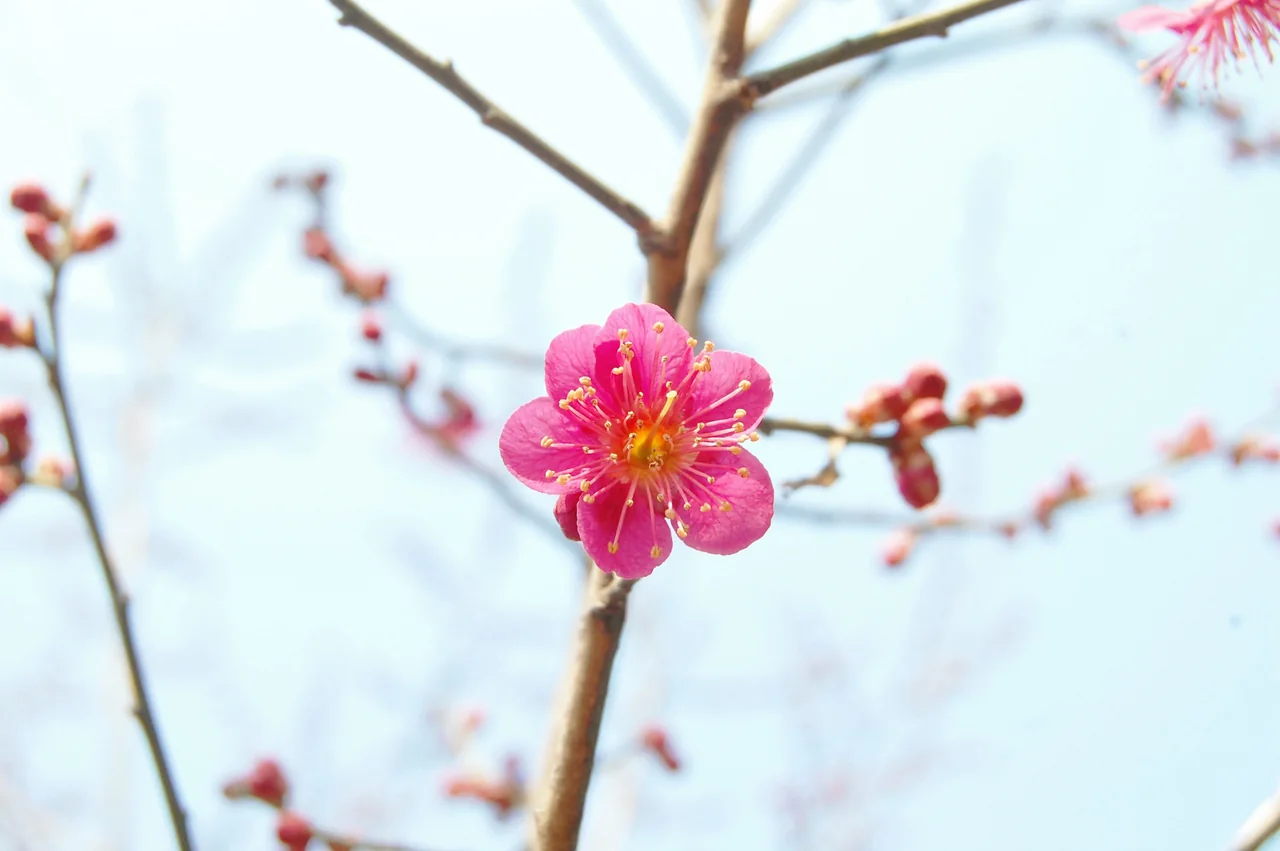
The flower you can see in Busan in early March is the plum blossom. It opens two to three weeks before the cherry trees, and Busan and the coast around it are among the earliest places in the country for it.
The Gijang plum grove opens on announced days only
The plum grove in Gijang County is private land. The owner opens it free of charge for a handful of days while the trees are in flower. It is not open year round. Hours run 10:00 to 17:00 and the last entry is 16:30.
At the most recent opening the dates were February 27 and 28, then March 1, 2, 6, 7, 8, 14 and 15. That is nine days in total, five of them in March. Most were weekends with a few weekdays mixed in. The 2027 dates have not been announced, so check before you travel.
The groveMap holds around 3,000 trees, with red and white blossom together. There are no toilets and no shop on site. Bring water and use a toilet on the way. If you drive, you will be parking along the roadside, so arriving in the morning of an open day is easier.
The old plum tree at Tongdosa
Tongdosa, the temple just north of Busan in Yangsan, has an old red plum tree known as Jajangmae. It is one of the earliest to flower in the region and opens between late February and early March. It stands in front of the Yeonggak hall inside the temple grounds, so it is not hard to find.
On weekend afternoons there is a queue of people waiting to photograph it. Weekday mornings are quiet. Getting there is covered in the Tongdosa day trip from Busan guide.
What to pair the plum blossoms with
Both the Gijang grove and Tongdosa sit outside the city centre. If you go to the grove, add Ahopsan Forest in the same county or carry on to the coast. If you go to Tongdosa, keep the afternoon for the city on the way back.
3. Mid March is the gap between the two flowers
From roughly March 11 to 20 the plum blossoms are finishing and the cherry trees have not started. In exchange there are fewer people, room rates sit lower, and the weather has eased from the first week.
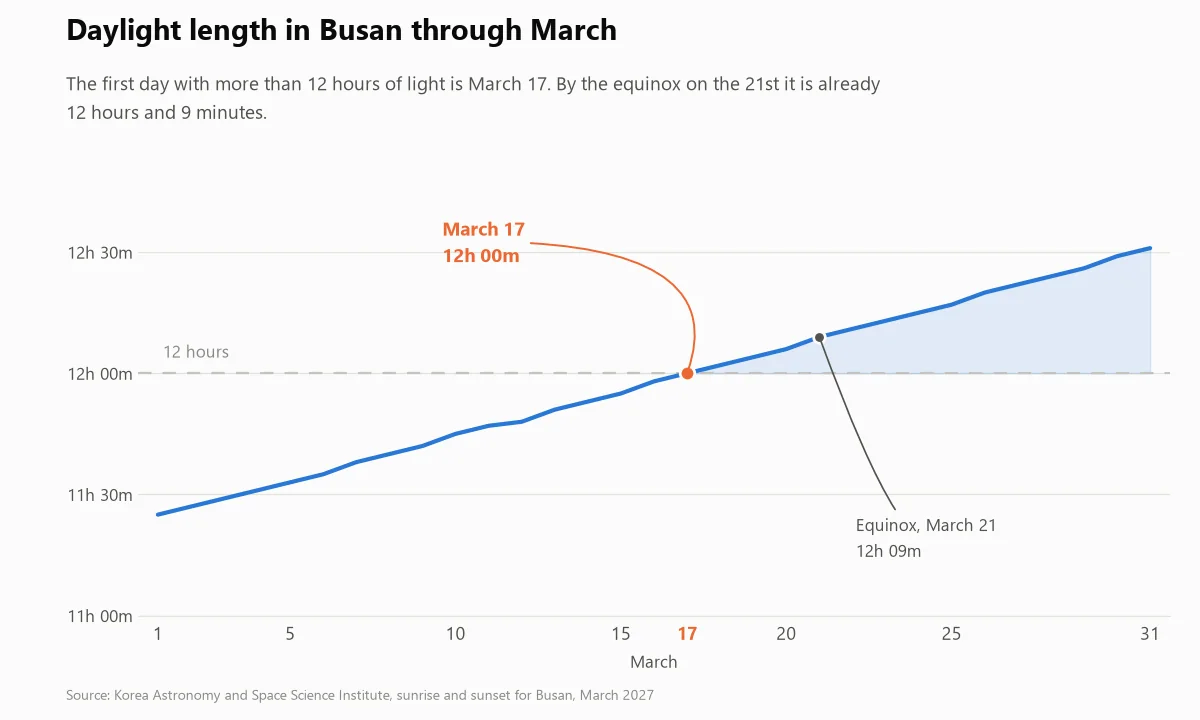
Day and night become equal on March 17, not on the equinox
People often say day and night are equal at the spring equinox. The actual date is a few days earlier. Using Korea Astronomy and Space Science Institute figures, daylight in Busan reaches 12 hours on March 17, when the sun rises at 06:33 and sets at 18:33. By the equinox on March 21 the day is already 12 hours and 9 minutes long.
This comes from how sunrise and sunset are measured. The moment counted is when the upper edge of the sun meets the horizon. On top of that the atmosphere bends the light, so the sun appears slightly earlier and stays visible slightly longer. Seoul reaches the same point on the same date.
| Date | Sunrise | Sunset | Daylight |
|---|---|---|---|
| March 1 | 06:54 | 18:19 | 11h 25m |
| March 14 | 06:37 | 18:30 | 11h 53m |
| March 17 | 06:33 | 18:33 | 12h 00m |
| March 21 | 06:27 | 18:36 | 12h 09m |
| March 31 | 06:13 | 18:44 | 12h 31m |
Daylight grows by 66 minutes over the month. Sunset moves 25 minutes later while sunrise moves 41 minutes earlier. If your plans involve early starts, the first and last weeks are not the same trip.
What this stretch is good for
With no flowers to chase, the walking is easier. Daytime highs are climbing and the number of freezing mornings is dropping. Long walks such as the Igidae coastal path and Oryukdo Skywalk or Gamcheon Culture Village are more comfortable now than in summer.
If it rains, move indoors. There is a list of indoor options in Busan when it rains. If a hot spring appeals, Busan spas and jjimjilbang covers the bathhouses.
4. Cherry blossoms open in late March
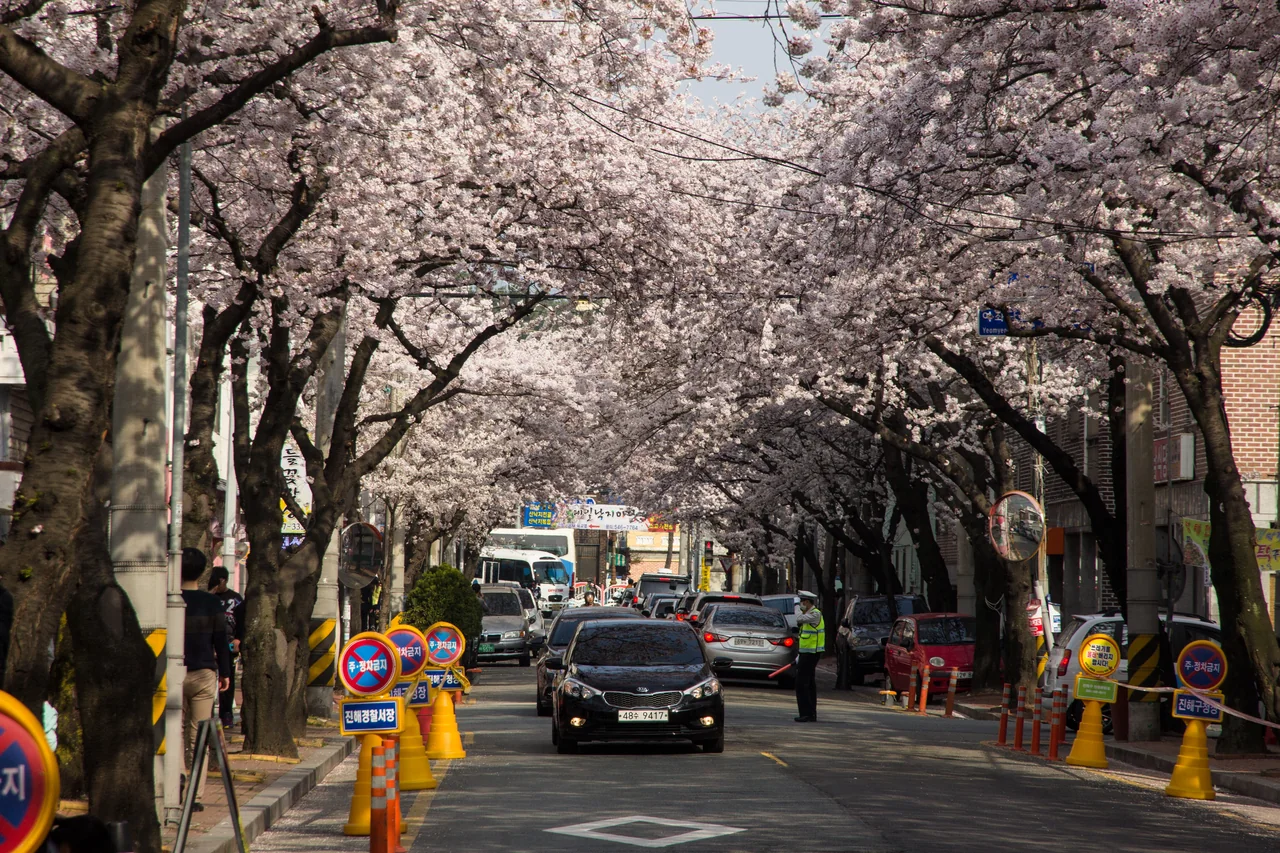
Busan cherry blossoms open in late March. The national forecast placed the southern region and the Yeongnam east coast between March 23 and 31. In the same forecast Seogwipo on Jeju started earliest on March 21, the central region and the east coast fell between April 1 and 10, and inland and mountain areas came after April 10.
Full bloom follows opening by about a week. In practice the best days in Busan land on the final days of March and the first days of April in most years. Arrive in the first week of March and you are looking at bare branches.
How the opening and full bloom dates are decided
The national weather service watches one designated tree in each area. The reference tree for Busan cherry blossom stands in front of the Namcheon 2-dong community service centre in Suyeong District, designated in 2015.
The opening date is the day three or more flowers on one branch of that tree are fully open. Full bloom is the day at least half the tree is open. News reports of blossom opening use this measure, and within Busan itself different spots run a few days apart from the reference tree.
The 2027 forecast has not been issued. It usually comes out during March. Check the official spring blossom page before you travel.
Where to see them inside Busan
| Place | Where it is | How to reach it |
|---|---|---|
| Namcheon Samik Beach cherry road | Suyeong District | Namcheon Station, Line 2 |
| Oncheoncheon stream path | Runs through Geumjeong, Dongnae and Yeonje districts | Oncheonjang or Myeongnyun Station, Line 1 |
| Dalmaji-gil | Coastal road from Mipo past Cheongsapo to Songjeong | Haeundae or Jung-dong Station, Line 2 |
| Samnak Ecological Park embankment | Sasang District | Sasang Station, Line 2 and the light rail |
| Daejeo Ecological Park | Gangseo District, where cherry and rapeseed flower together | Gangseo-gu Office Station, Line 3, exit 1 |
| Busan Citizens Park | Busanjin District | Bujeon or Seomyeon Station, Line 1 |
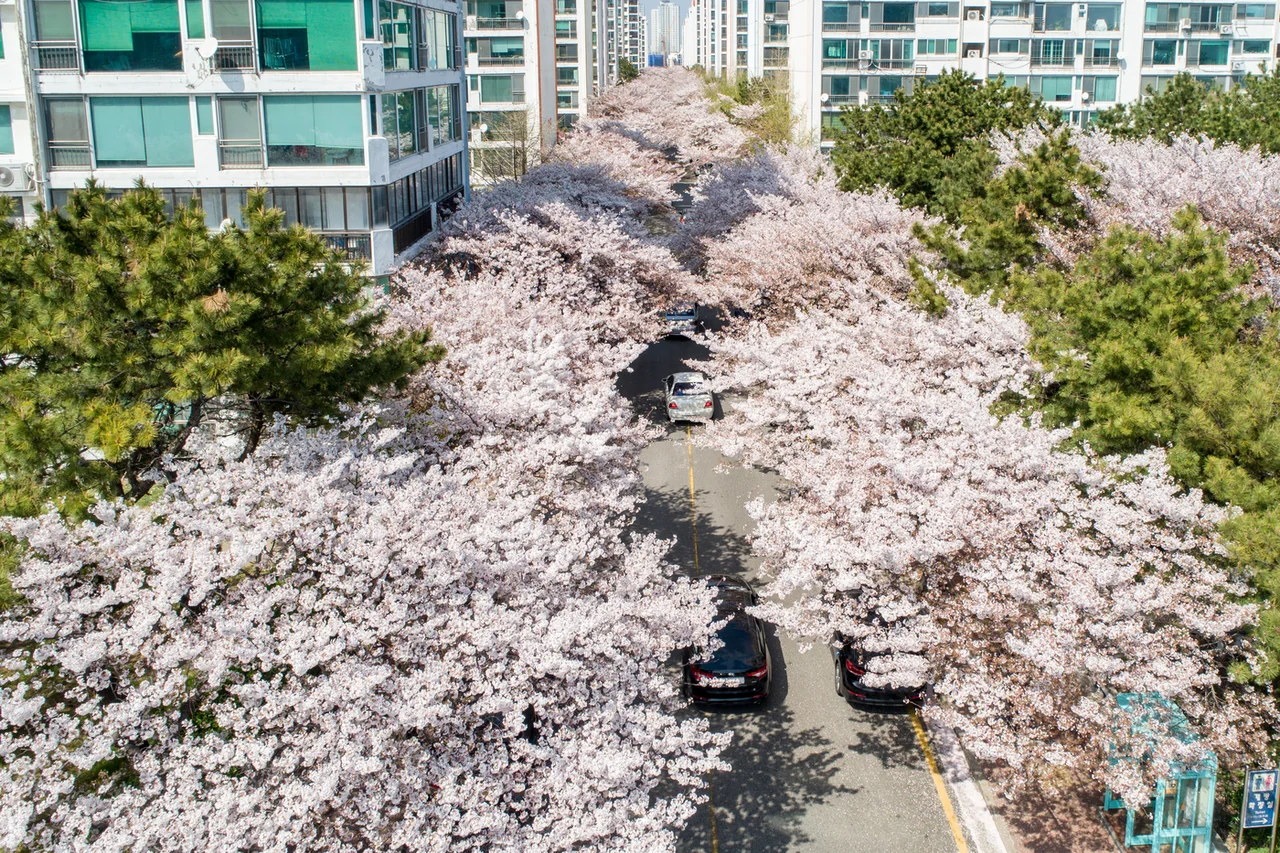
Namcheon-dongMap gets the first bloom reports because the reference tree is there. It is a road between apartment blocks rather than a park, so the scale is modest, but it sits right by the subway. OncheoncheonMap runs for kilometres along a stream, which spreads the crowd out. Some stretches are lit in the evening.
Dalmaji-gilMap is a driving road. Traffic backs up on weekend afternoons, so a weekday or an early start is easier. On foot, Mipo to Cheongsapo is enough. Haeundae Beach sits directly below it.
How this compares with Japan
Travellers choosing between Korea and Japan for blossom season often assume Korea runs later. On the southern Korean coast it does not by much. Busan opens in the last week of March in most years, which is close to the timing on Japan’s southern main island. The gap widens further north: Seoul runs about a week behind Busan, and inland mountain areas a further week behind that.
5. Samnak opens its festival in late March, Daejeo in April
Busan has two large cherry blossom festivals. The Sasang District one at Samnak starts in the last week of March, and the Gangseo District one at Daejeo runs in April. A March trip only overlaps with the first.
Nakdonggang Garden Cherry Blossom Festival, Samnak Ecological Park
The most recent edition opened on Friday March 27 and ran to Sunday April 12, seventeen days in total. It takes place along the Nakdong embankment cherry road inside Samnak Ecological Park. The busiest programme fell on the first weekend of April, with evening busking and lighting.
Samnak Ecological ParkMap is reached from Sasang Station, where Line 2 meets the Busan Gimhae light rail. Overflow parking opened at the Gamjeon retarding basin. The path runs a long way along the embankment, so there is no need to walk the whole thing. The crowd concentrates near the main stage and thins out within a few minutes of walking.
Gangseo Nakdonggang 30-ri Cherry Blossom Festival, Daejeo Ecological Park
The most recent edition was the ninth and ran Friday April 3 to Sunday April 5, three days. In March the festival has not started. The cherry road along the river is there all the same. Daejeo is the park where cherry and rapeseed flower at the same time, so the last days of March already give you something.
Daejeo Ecological ParkMap is reached from exit 1 of Gangseo-gu Office Station on Line 3. City buses 123, 127, 307 and 913 serve it. During the festival a free shuttle ran between Myeongji Transfer Centre and the park entrance, from 14:00 to 20:00 on the Friday and 10:00 to 20:00 on the Saturday and Sunday, at roughly 20 minute intervals.
Neither 2027 date has been announced. Both move with the bloom each year, so check the official Busan festival and event listing.
6. Jinhae Gunhangje, the day trip from Busan
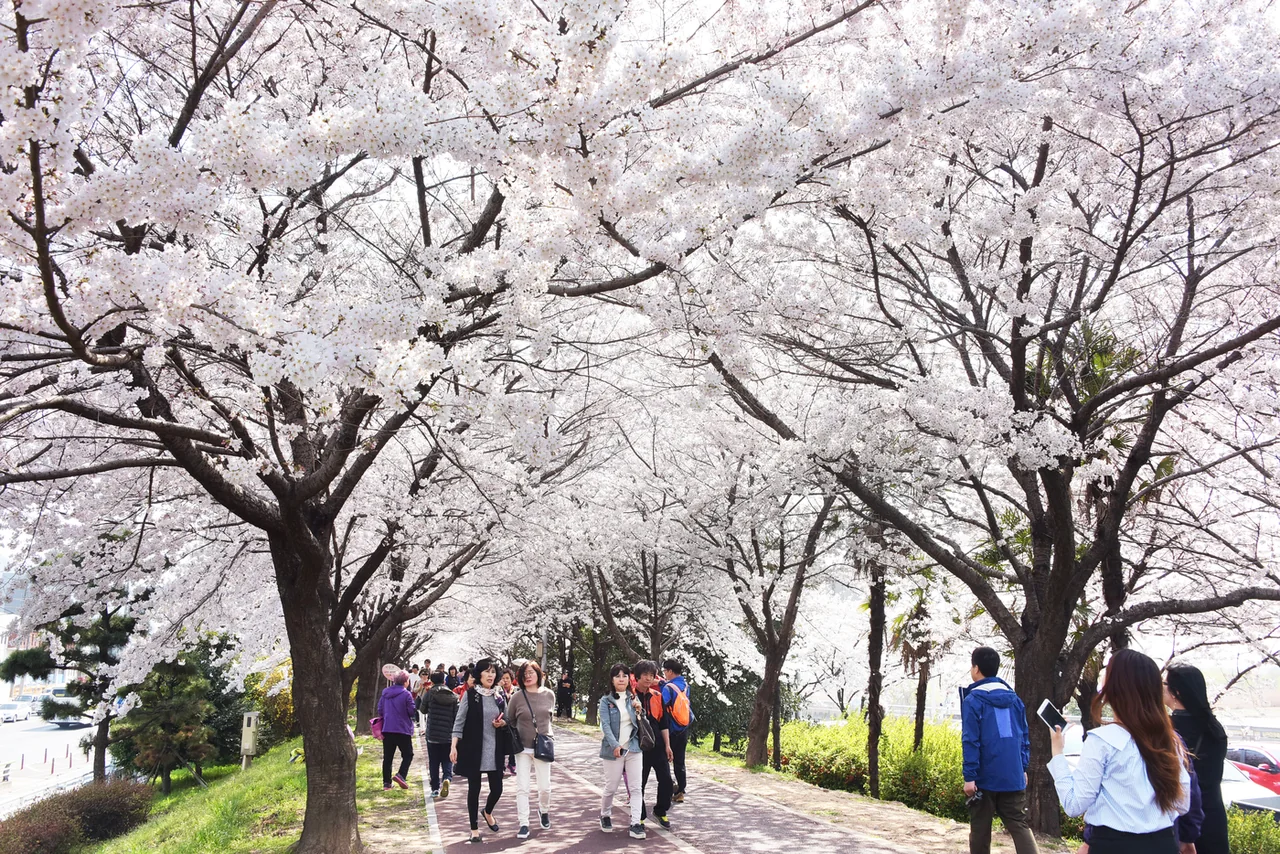
Jinhae Gunhangje takes place in Jinhae District in Changwon, not in Busan. From Busan you go by intercity bus. The most recent edition, the 64th, opened on Friday March 27 and ran to Sunday April 5, ten days in total. Entry is free, and only the Cherry Blossom Music Festival inside it sells tickets.
Getting there
Intercity buses to Jinhae leave from Busan Seobu Bus Terminal, which is attached to Sasang Station, so Line 2 and the light rail both bring you to the door. During the festival the roads into central Jinhae back up, which makes the bus the better choice over driving.
The festival grounds centre on Jungwon Rotary and Jinhae-ru. The two spots best known for blossom are the Yeojwacheon stream and Gyeonghwa Station. Both draw large crowds and both have photo queues. On weekend afternoons some bridges are managed as one way walking routes.
Which days are worth it
The festival opening date and the Busan bloom date sit only a few days apart. In some years the trees were still short of opening on the first weekend. In others they were already past their best by the closing weekend. Check the bloom status on the official festival site before you commit a day to it.
Weekday mornings are the quietest. If a weekend is your only option, arrive early, take Yeojwacheon in the morning and leave in the afternoon. The festival office number is 055-546-4310. The 2027 dates are not announced yet.
7. March 1 is a public holiday and some things close
March 1 is Independence Movement Day, one of Korea’s national holidays. In 2027 it falls on a Monday and follows the weekend, so it makes a three day break. That matters for a March trip mostly through what is open and how busy things are.
What stays open and what does not
| Type of place | On March 1 |
|---|---|
| Banks and government offices | Closed |
| Subway, buses, taxis | Running, on a holiday timetable |
| Department stores and large shopping centres | Usually open and busy |
| Public museums | Usually open, some with holiday programmes |
| Small independent shops and restaurants | Varies, some close |
| Beaches, parks, coastal paths | Open and busier than a normal Monday |
Domestic travel peaks across a three day weekend, so trains and express buses between cities fill up. If you are moving between Seoul and Busan around those dates, book ahead. Times and fares are in the Seoul to Busan KTX guide.
The old town walk
The Busan Museum of Modern History runs a public programme on March 1 each year. The most recent edition took 20 people per session in two sessions, 13:00 to 15:00 and 15:00 to 17:00, free of charge, booked by QR code on a first come basis. Each session paired an hour of guided walking outdoors with an hour in the permanent gallery on the third floor.
The walking route ran from the Baeksan Memorial Hall through Hansung 1918, the site of the old Busan city hall, the site of the old police station, the site of the Japanese residents association office and an air raid shelter, finishing at Yongdusan Park. Every stop is inside the old town and within walking distance of the next.
The museumMap is near Jungang Station on Line 1, and Yongdusan ParkMap is reached from Nampo Station. The programme is in Korean. You can walk the same route on your own at any time of year, though some stops are marked sites rather than standing buildings. The museum number is 051-254-2420 and the 2027 programme has not been announced.
8. The Gwangalli drone show moves an hour later in March
From March the Gwangalli M Drone Light Show runs at 20:00 and 22:00. From October to February it runs at 19:00 and 21:00. The official notice defines the later schedule as covering March through September.
When to turn up
Shows are on Saturdays. In March 2027 those are the 6th, 13th, 20th and 27th. Viewing is free and it takes place over Gwangalli BeachMap. If you want to look around the beach itself, there is a separate Gwangalli Beach guide.
On the first Saturday of March the sky finishes darkening at 18:48, and on the last Saturday at 19:06. The 20:00 show therefore starts in full darkness throughout the month. If you saw a winter show at 19:00, arriving on that same instinct in March leaves you with an hour to fill.
The centre of the beach faces the display directly. It also holds the most people. Walk a few minutes either way and there is space. On windy evenings the road behind the sand is less cold than the beach itself. There is more on viewing spots and cancellations in the Gwangalli drone show guide.
Other timings that shift this month
Sunset moves 25 minutes later across March, from 18:19 on the 1st to 18:44 on the 31st. Anything you plan around the view after dark starts at a different hour in the first week than in the last.
Some attractions change closing time by period, including the Songdo Marine Cable Car. The operator posts the day’s hours on the front page of its website rather than publishing a month by month table, so check on the morning you plan to go.
9. Part of Busan’s trail network is closed all through March
All of March falls inside the spring forest fire prevention period. At the most recent edition it ran from Tuesday January 20 to Friday May 15. The government moved the start forward by 12 days from February 1. For national parks the period runs from February 15 to May 15.
What closes
During the period local authorities close sections of trail and designate restricted entry zones. At the most recent edition Busan closed 160 trail sections totalling 227.5km, which was 32 percent of the city’s 439 sections and 711km. The restricted entry zones covered 12,770 hectares, or 36.1 percent of the 35,386 hectares of forest. Seven hundred fire watchers were posted.
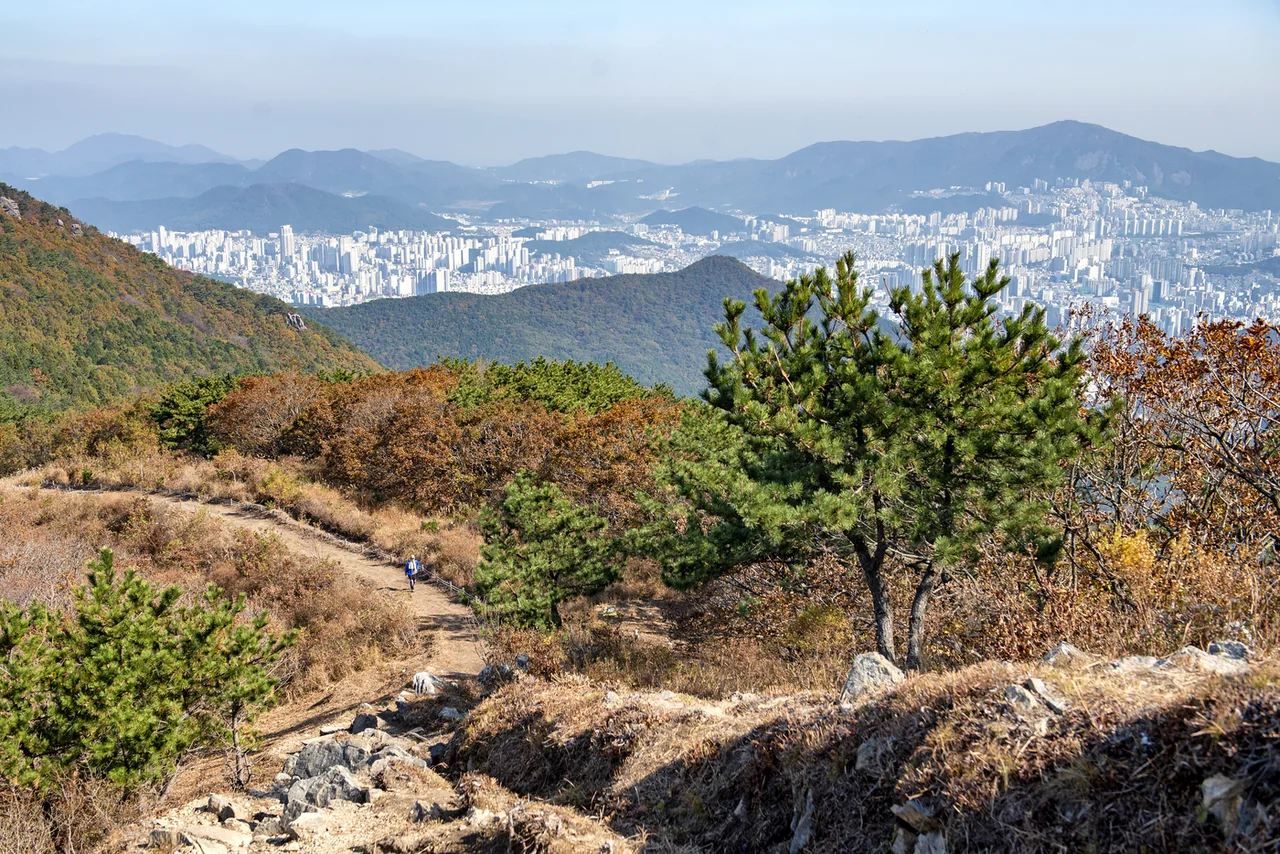
The closures include sections on Geumjeongsan, Jangsan, Baegyangsan, Hwangnyeongsan, Bongnaesan, Gubongsan and Eomgwangsan. Because the closures are by section, the same mountain can have open paths and closed paths at once.
Entering a closed trail without permission can bring a fine under the forest protection and natural park laws. Before you set out, check the open trails and restricted zones map and select Busan. It is run jointly by the Korea Forest Service, local authorities and the national park service.
Level walks that are not affected
| Where | What the walk is like |
|---|---|
| Igidae coastal path and Oryukdo Skywalk | Nam District. Boardwalk and rock along the sea |
| Taejongdae | Yeongdo District. A loop road you can walk or ride |
| Oncheoncheon stream path | Flat, running from Geumjeong down to Yeonje |
| Samnak and Daejeo Ecological Parks | Flat riverside ground beside the Nakdong |
| Ahopsan Forest | Gijang County. Bamboo paths |
IgidaeMap is a boardwalk beside the sea. There are steps and gradients, but no hiking gear is needed. Visiting Beomeosa Temple and coming back down is usually unaffected, though the paths continuing up Geumjeongsan behind it may be closed. The 2027 closures have not been published.
10. March is the windiest month on the Busan coast
March and April are the windiest months in Busan. The climate normals give a mean wind speed of 3.8 metres per second for both. October and November, the calmest months, sit at 3.1.
What that changes at the beach
A daytime high of 13.8C does not feel like 13.8C on an exposed beach. Wind takes several degrees off what you feel. If you plan long stretches at Haeundae or Gwangalli in March, bring a layer that stops wind rather than one that only holds heat.
The beaches are not open for swimming. Official beach season in Busan is in summer. In March the sea is something you walk beside. Haeundae, Songdo and Dadaepo all have open sand. To compare which beach to pick, there is a rundown of the best beaches in Busan. At Songjeong people surf through March, though the water is cold enough to need a wetsuit.
Strong wind stops cruise boats and cable cars on some days, and the decision is made on the morning. Keep those items off the front of your day so you can move them later if the operator suspends service.
Dadaepo in the morning and at sunset
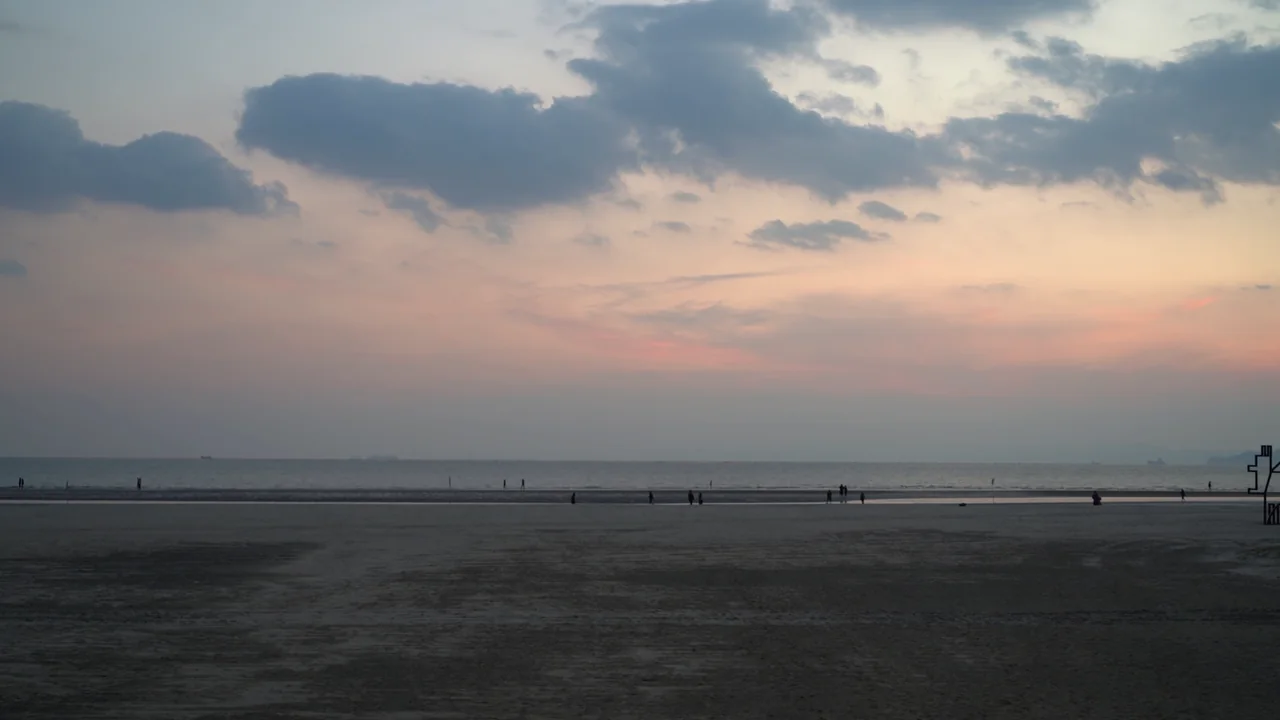
Dadaepo BeachMap exposes a wide flat of sand when the tide goes out. Morning temperatures in March keep the early hours quiet. In the evening the sun sets straight ahead of the beach, which draws a crowd for it. Sunset in late March is around 18:40.
11. Busan weather in March and what to pack
March in Busan averages a daytime high of 13.8C and a night low of 5.3C. These are the official climate normals for the Busan station covering 1991 to 2020. Mean temperature is 3.7 degrees higher than February.
The month in figures
| Measure | February | March | April |
|---|---|---|---|
| Daytime high | 10.2C | 13.8C | 18.2C |
| Night low | 1.5C | 5.3C | 10.1C |
| Days with rain | 5.9 | 8.3 | 9.2 |
| Rainfall | 49.6mm | 89.7mm | 140.9mm |
| Days with freezing | 14.7 | 4.7 | 0.2 |
| Mean wind speed | 3.5 m/s | 3.8 m/s | 3.8 m/s |
Two lines in that table matter most. Freezing mornings drop from 14.7 days in February to 4.7 in March. Rainfall almost doubles over the same step, from 49.6mm to 89.7mm. March gets warmer and wetter at the same time.
The temperature swings by more than 10 degrees within a single day on 9.3 days of the month, second only to February’s 9.4. Mornings are cold and afternoons are mild, so layers you can take off work better than one heavy coat.
What to bring
For the first ten days you want a proper coat. Morning lows still sit near 3C. From mid month a light jacket over long sleeves covers most days. By the last week you will be carrying the jacket for much of the afternoon.
With rain on 8.3 days, pack a compact umbrella. The wind makes large umbrellas awkward, and a hooded shell is more use than an umbrella on the beach or the riverside paths.
Compared with Seoul, March averages 9.1C in Busan against 6.1C, and 4.7 freezing days against 13.3. If you are coming down from Seoul you can drop a layer.
12. Yellow dust season starts in March
Busan records 1.4 days of yellow dust in March, up from 0.2 in February. April is the highest at 1.7 days and May is 1.1. From June the count is zero.
Almost the whole year’s dust falls between March and May. Coming in March means a higher chance of it than February, though still lower than Seoul, which records 2.2 days in March and 3.1 in April.
How to check
Look at AirKorea, run by the Korea Environment Corporation, before you travel and again on the morning. The phone apps worth having are listed in Korea travel apps. When levels are high the weather service issues a yellow dust advisory.
On a bad day, move outdoor plans indoors. For something like a blossom walk that cannot easily be swapped, the afternoon is sometimes clearer than the morning. Masks are sold in convenience stores and pharmacies everywhere in the city.
Indoor options are collected in Busan when it rains. A dusty day and a wet day send you to much the same places.
13. What to eat in Busan in March
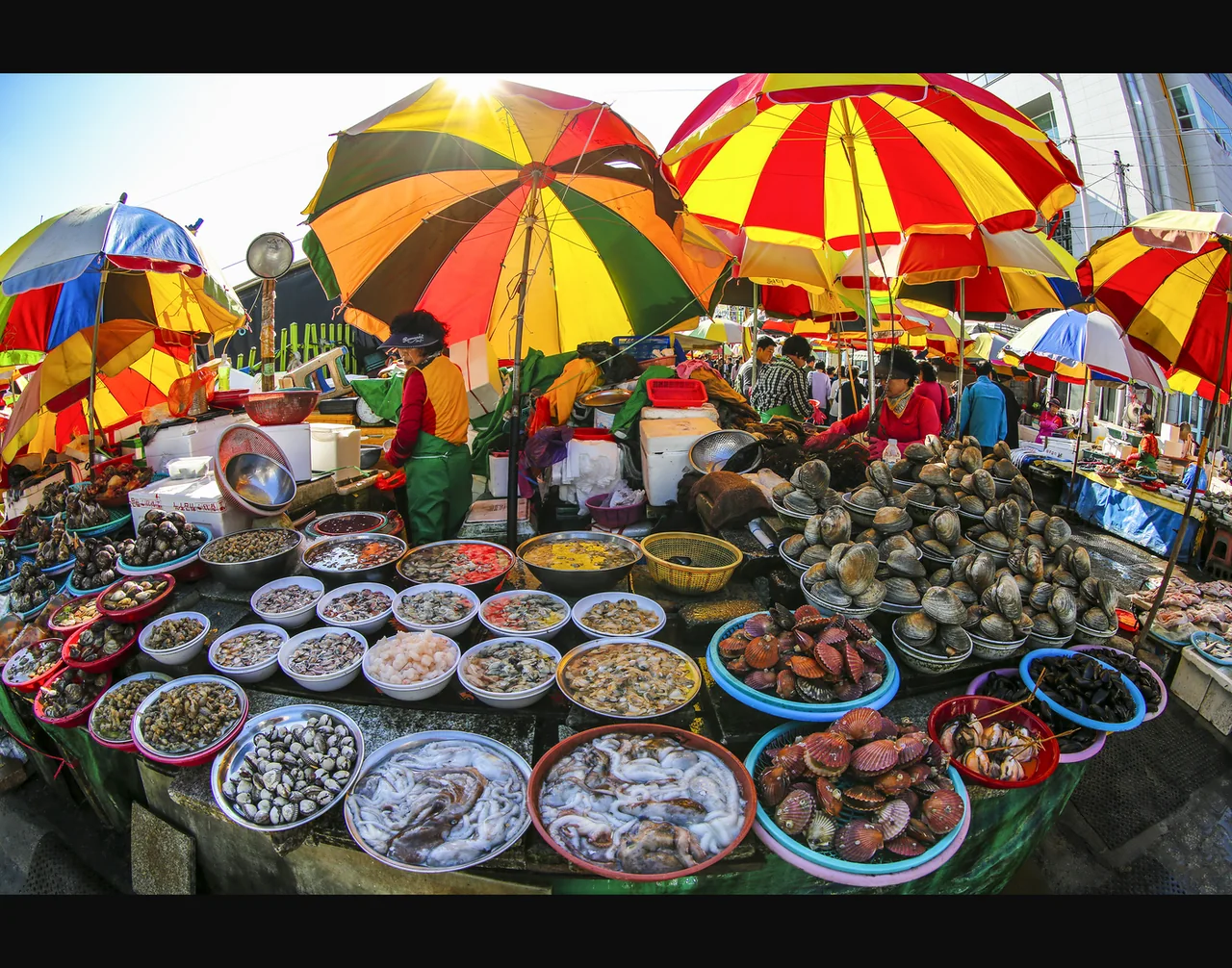
The March dish in Busan is dodari ssukguk, a clear soup of spring flounder and mugwort. March is when both are at their best.
Dodari ssukguk
Many places serve it in spring only. A restaurant you visited in winter may have changed the menu by March, so check before you make the trip. It turns up most around Yeonhwa-ri in Gijang, near Jagalchi and in coastal seafood restaurants. Prices sit in the middle range.
Jagalchi MarketMap opens from 02:00 to 22:00 and closes on the first and third Tuesday of each month. In March 2027 that means March 2 and March 16. It is a six minute walk from exit 2 of Nampo Station or exit 10 of Jagalchi Station, both on Line 1.
Gijang seaweed and anchovies
Gijang County is known for seaweed and anchovies. Spring anchovy fishing works out of Daebyeon Port, and if you go down to the harbour you can watch the crews shaking anchovies out of the nets. The boats come in early in the morning.
Gijang seaweed is dried at this time of year, and you will see it laid out along the coastal road. It fits naturally into the same day as the plum grove.
Food in Busan more generally is covered in what to eat in Busan, which includes the year round dishes such as dwaeji gukbap and milmyeon.
14. Putting a March itinerary together
Lead with plum blossoms and the old town in early March, with long walks in mid March, and with the cherry trees in late March. Below is a three day shape for each.
If you come in the first ten days
Give day one to the old town, starting at the Museum of Modern History and finishing at Yongdusan Park. Take day two out to Gijang for the plum grove and the coast, matching your date to an announced opening day. Keep day three for markets and indoor stops.
If you come mid month
There are no flowers, and there are also fewer people. Put the long walks first, Igidae and Oryukdo, then Gamcheon Culture Village. The Oncheoncheon path is good walking in this stretch too. On a Saturday evening the drone show is on, at 20:00 from March.
If you come in the last ten days
Put the blossom on your first morning. The trees change within days, and a day of rain takes a lot of the flower down. Start with somewhere central such as Namcheon-dong or Oncheoncheon, then head out to Samnak or Daejeo if you still have time.
| When you come | Day 1 | Day 2 | Day 3 |
|---|---|---|---|
| Days 1 to 10 | Old town and Yongdusan | Gijang plum grove and coast | Markets and indoor stops |
| Days 11 to 20 | Igidae and Oryukdo | Gamcheon and the old town | Oncheoncheon and a bathhouse |
| Days 21 to 31 | Namcheon-dong and Gwangalli | Samnak or Daejeo | Jinhae day trip |
Comparing with the months either side
April brings full bloom and rapeseed alongside it, with more people and higher room rates. Busan in April and Busan in February sit either side of this page, and the best time to visit Busan covers all twelve months.
For anything longer than three days, the Busan itinerary guide and the four day Busan itinerary lay out the days. Getting around the city is mostly subway and bus. Routes and fares are in getting around Busan. Which neighbourhood to base yourself in is covered in where to stay in Busan.