
UN Memorial Cemetery Busan: Opening Hours, Free Entry, Getting There and the Peace Memorial Hall
Free, open every day of the year. The Peace Memorial Hall across the road is not: it closes on Mondays.
| Admission | Free. No booking, no ticket. |
|---|---|
| Open | 09:00 daily. Closes 18:00 from May to September, 17:00 from October to April. |
| Last entry | 15 minutes before closing: 17:45 in summer, 16:45 in winter. |
| Closed days | None. Open 365 days. The Peace Memorial Hall opposite closes Mondays. |
| Getting there | Line 2 to Daeyeon Station, Exit 3, then a 15-minute walk. |
| Parking | Free for 90 minutes for vehicles of nine seats or fewer. |
1. Free, open daily, but entry stops before the gate does
2. Why the only UN cemetery in the world is in Busan
3. 2,339 graves, and the numbers per country look wrong until you know why
4. Thirty-nine Koreans and five unknown soldiers are buried here too
5. A walking order that does not double back
6. The gate was designed by Kim Chung-up
7. What is inside: the film, the flag, the small hall
8. The 392 with no grave, and 21 maple leaves
9. Twenty-two flags fly all year in the symbolic area
10. Flip-flops will not get you through the gate
11. The Peace Memorial Hall is a different place, and it shuts on Mondays
12. 11 November at 11:00, twenty-two countries turn toward Busan
13. Getting there, and where to leave a car
14. Half a day in Daeyeon-dong
15. When to come
16. Group tours, tributes and finding a specific grave
This is the only cemetery on earth administered by the United Nations, and it is a twenty-minute ride from downtown Busan. Part of our Busan travel guide.
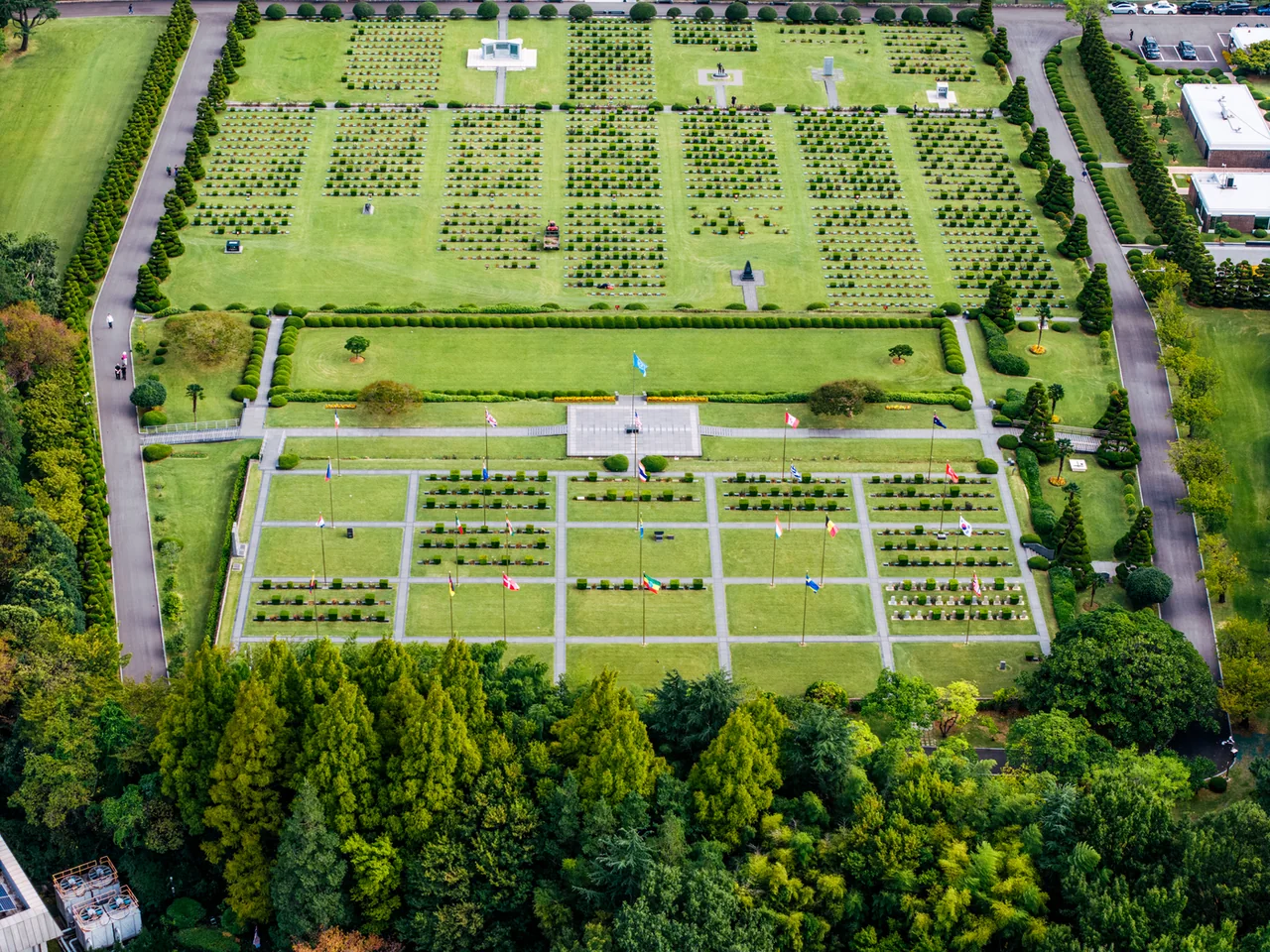
1. Free, open daily, but entry stops before the gate does
The UN Memorial Cemetery in KoreaMap charges nothing and opens every day of the year. There is no ticket office to queue at and nothing to book. It opens at 09:00 and closes at 18:00 between May and September, at 17:00 between October and April.
The detail that catches people out is the last entry time. The gate stops admitting visitors 15 minutes before closing, so 17:45 in summer and 16:45 in winter. The commission publishes opening and last-entry times as two separate figures; most pages online copy only the first one. If you are arriving after another stop, work backwards from the earlier number.
| Period | Opens | Last entry | Closes |
|---|---|---|---|
| Summer, May to September | 09:00 | 17:45 | 18:00 |
| Winter, October to April | 09:00 | 16:45 | 17:00 |
The switch happens on 1 October, which means the autumn colour season and the 11 November remembrance date both fall inside winter hours. An hour disappears from the afternoon exactly when most people plan to visit.
The address is 93 UN Peace-ro, Nam-gu, Busan. The telephone number is +82 51-625-0625. The grounds cover 176,486 square metres and were listed as Registered Cultural Heritage No. 359 in October 2007.
2. Why the only UN cemetery in the world is in Busan
The cemetery was made during the fighting, not after it. United Nations Command established it on 18 January 1951 to bury the dead of the war then being fought, and remains from temporary burial grounds elsewhere in the country were brought here.
What turned a wartime cemetery into a permanent one was a sequence of legal steps. On 17 November 1955 the National Assembly of the Republic of Korea offered the land in perpetuity and asked that it be designated sacred ground. On 15 December that year the UN General Assembly resolved that the United Nations would maintain the cemetery permanently, and in November 1959 Korea and the UN signed the agreement that governs it.
| Date | What happened |
|---|---|
| 18 Jan 1951 | United Nations Command establishes the cemetery for war dead |
| 17 Nov 1955 | Korean National Assembly grants the land in perpetuity |
| 15 Dec 1955 | UN General Assembly resolves to maintain it permanently |
| 6 Nov 1959 | Agreement signed between the Republic of Korea and the UN |
| 16 Feb 1974 | Management passes to the Commission for the UNMCK |
| 24 Oct 2007 | Listed as Registered Cultural Heritage No. 359 |
Since 1974 the grounds have been run by an international commission rather than by Korea. Its eleven members are the countries whose dead lie here: the Republic of Korea, Australia, Canada, France, the Netherlands, New Zealand, Norway, South Africa, Turkiye, the United Kingdom and the United States. That is also why there is no admission charge. This is a working cemetery, not an attraction.
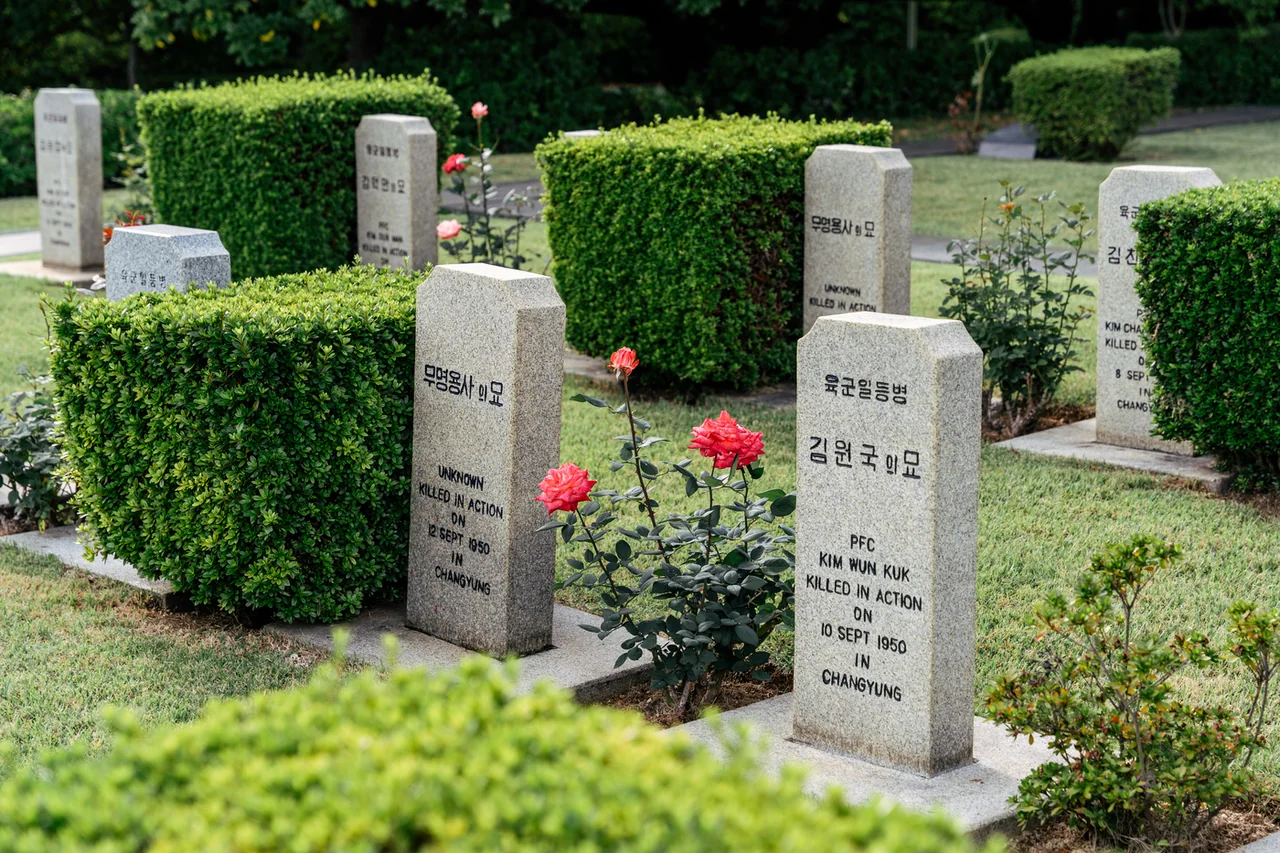
3. 2,339 graves, and the numbers per country look wrong until you know why
There are 2,339 burials. Put the national figures side by side and something looks off. The United States lost 36,492 dead in the Korean War and has 41 graves here. The United Kingdom lost 1,177 and has 892.
| Country | Served | Killed | Buried here |
|---|---|---|---|
| United Kingdom | 81,084 | 1,177 | 892 |
| Turkiye | 21,212 | 1,005 | 462 |
| Canada | 26,791 | 516 | 382 |
| Australia | 17,164 | 346 | 281 |
| Netherlands | 5,322 | 125 | 125 |
| France | 3,421 | 270 | 49 |
| United States | 1,789,000 | 36,492 | 41 |
| Republic of Korea | 39 | ||
| New Zealand | 3,794 | 41 | 32 |
| South Africa | 826 | 37 | 11 |
| Unknown soldiers | 5 | ||
| Colombia | 5,100 | 213 | 4 |
| Thailand | 6,326 | 136 | 3 |
| Belgium | 3,498 | 106 | 1 |
| Norway | 623 | 3 | 1 |
| Other | 11 |
The gap comes from repatriation policy. The United States brought its war dead home; the Commonwealth countries have long buried their soldiers where they fell. So the country that sent the most men has the fewest graves, and the British, Canadian, Australian and Turkish plots make up most of the main burial ground. Every one of the 125 Dutch dead is here.
Some countries lost men and have no graves at all: Greece with 186 dead, Ethiopia with 122, the Philippines with 120, Luxembourg with 2. Their names appear in the symbolic area instead, on monuments and in the line of flags. Deployment figures come from the 2023 Korean War statistical compendium; the fatality figures come from each country’s embassy in Seoul.
4. Thirty-nine Koreans and five unknown soldiers are buried here too
A cemetery for United Nations forces contains 39 Korean graves. These were Korean soldiers attached to UN units, and they were buried as UN war dead because that is what they were on the day they died.
Five graves hold unknown soldiers, men whose identity was never established. A further eleven burials fall outside the national figures in the table above.
Walk the plots and you will notice the headstones are not uniform. Each country uses its own form of marker. Names, ranks, units and dates of death are cut into the stone, and Korean graves carry the name in Hangul as well. Some markers carry a line chosen by the family.
If you are looking for one specific grave, the commission runs a searchable register of burials on its website, and you can find the plot reference before you travel. For families who cannot come in person there is an online tribute and a proxy flower-laying service.
5. A walking order that does not double back
The grounds divide into the entrance area, the main burial ground, the symbolic area and the green zone. This order works on a first visit and keeps you moving forward.
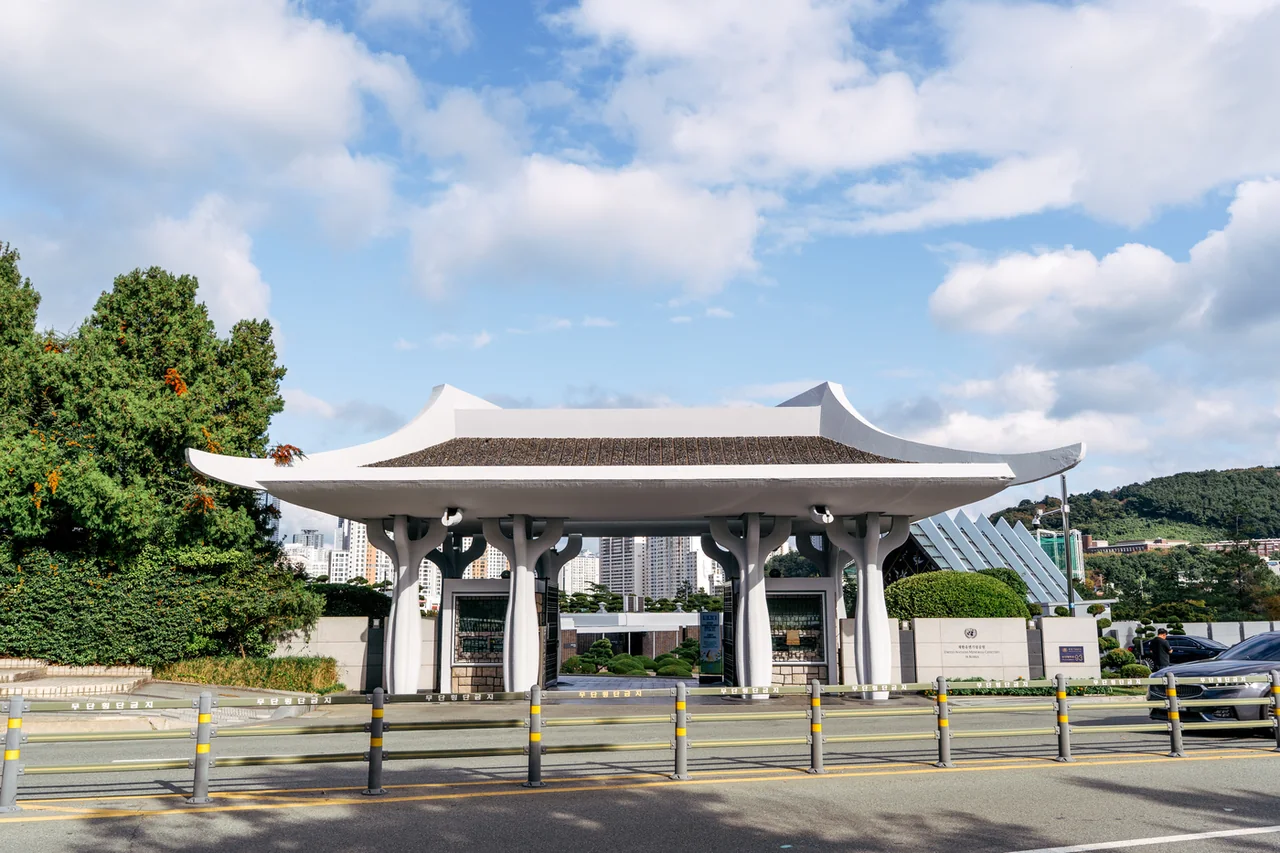
- Main GateBuilt in 1966 and designed by the architect Kim Chung-up.
- Gate plazaThe wall carries a plan of the burial plots and the register of burials. Two minutes here saves you walking the wrong way.
- Memorial Service HallBuilt by the UN in 1964. A Korean War documentary runs inside in six languages.
- Memorial Hall and Second Memorial HallPhotographs and objects from the war, in a 1968 building.
- Main burial groundSeven national plots: Australia, Canada, France, the Netherlands, Turkiye, the United Kingdom and the United States.
- Symbolic areaThe flags of the 22 participating nations, Korea and the United Nations.
- Daunt Waterway and the pondsThe narrow channel that separates the graves from the green zone.
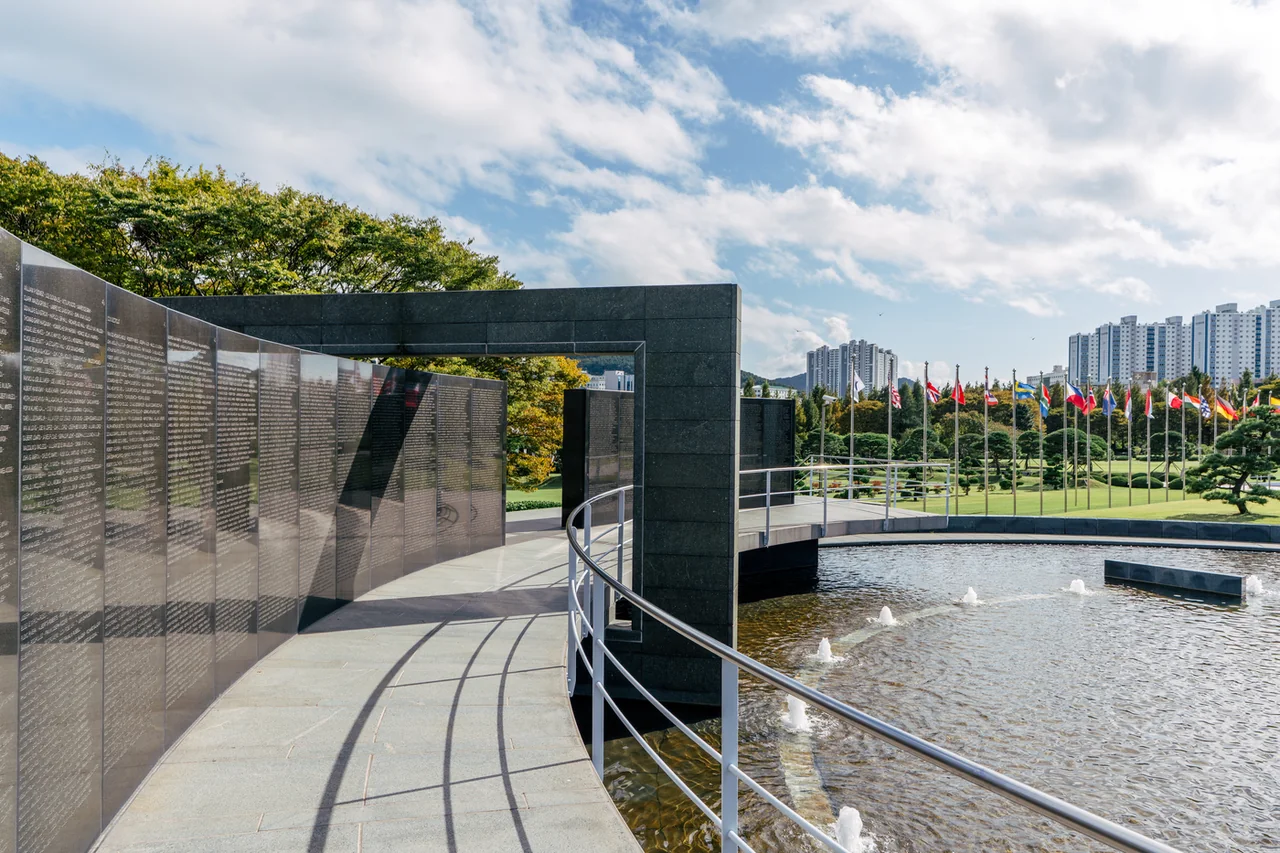
- Wall of RemembranceThe names of the UN dead, including those with no grave here.
The waterway is named after an Australian soldier, Private J. P. Daunt. It is 0.7 metres wide and 110 metres long, about two hundred koi live in it, and the commission describes it as the boundary between life and death.
A guided visit takes about an hour. On your own, allow a little more if you want to sit through the film.
6. The gate was designed by Kim Chung-up
The main gate went up in 1966 and was paid for and donated by the citizens of Busan. Kim Chung-up designed it; he is one of the defining Korean architects of the century.
Each element carries a stated meaning.
| Element | Meaning |
|---|---|
| Eight columns with bowl-shaped capitals | The moment and eternity |
| The four corners of the roof | Longing for home |
| The gutter | The tears of the UN forces |
Drivers usually miss it, because the car park entrance takes you past it. It is worth standing in front of the gate on foot before you go in.
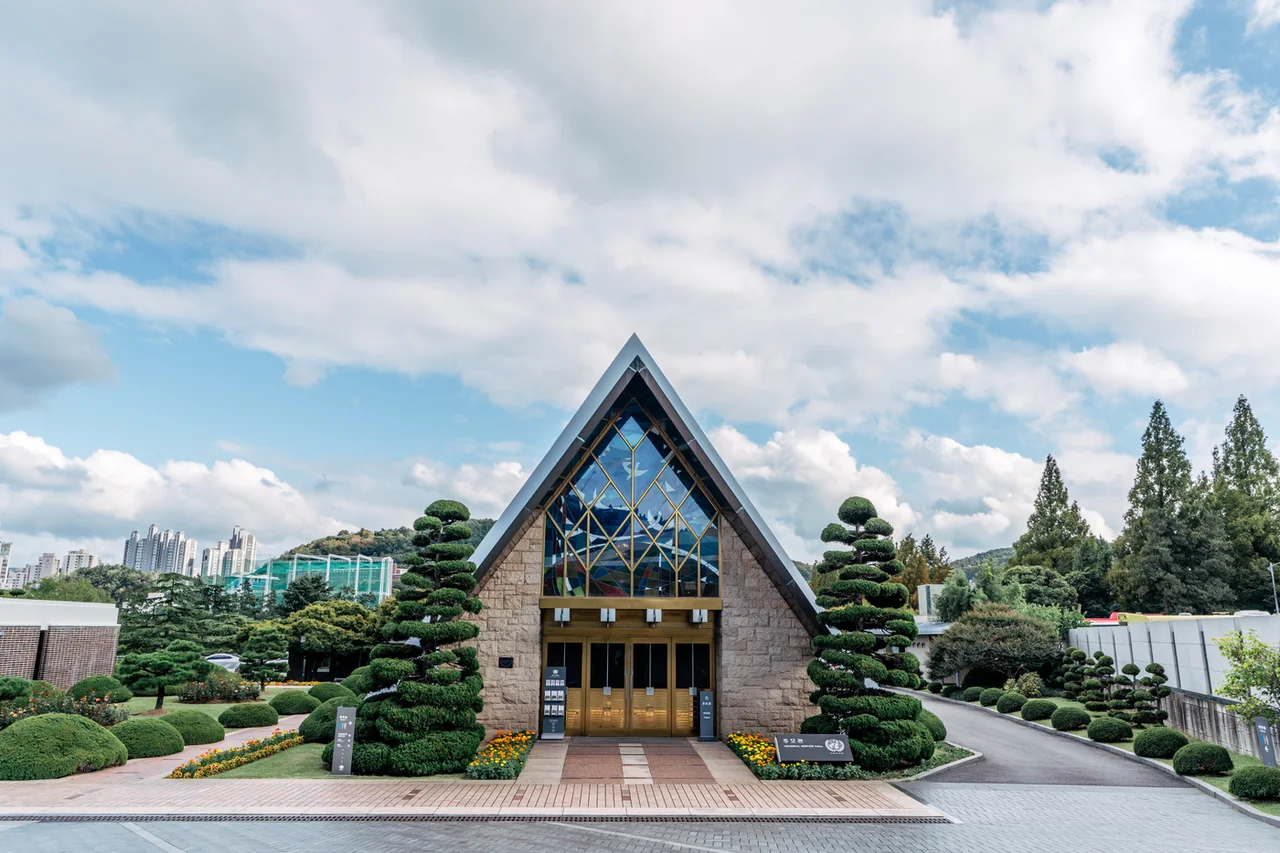
7. What is inside: the film, the flag, the small hall
Memorial Service Hall
Built by the United Nations in 1964. Six exposed beams and a triangular form, with stained glass set into the walls. The sixteen lines crossing the ceiling stand for the sixteen countries that sent combat troops. A documentary about the war now runs here in six languages, and the hall doubles as somewhere to sit out rain or heat.
Memorial Hall
A 1968 building holding wartime photographs and memorabilia. The first United Nations flag flown here is on display, alongside images of each participating nation’s part in the war and a record of state visits.
Second Memorial Hall
A single room of about 30 square metres with photographic panels of those buried here, plus small permanent and temporary displays.
To see all three indoor spaces, be through the gate an hour before closing. If you are hunting for indoor options generally, our guide to Busan when it rains has more.
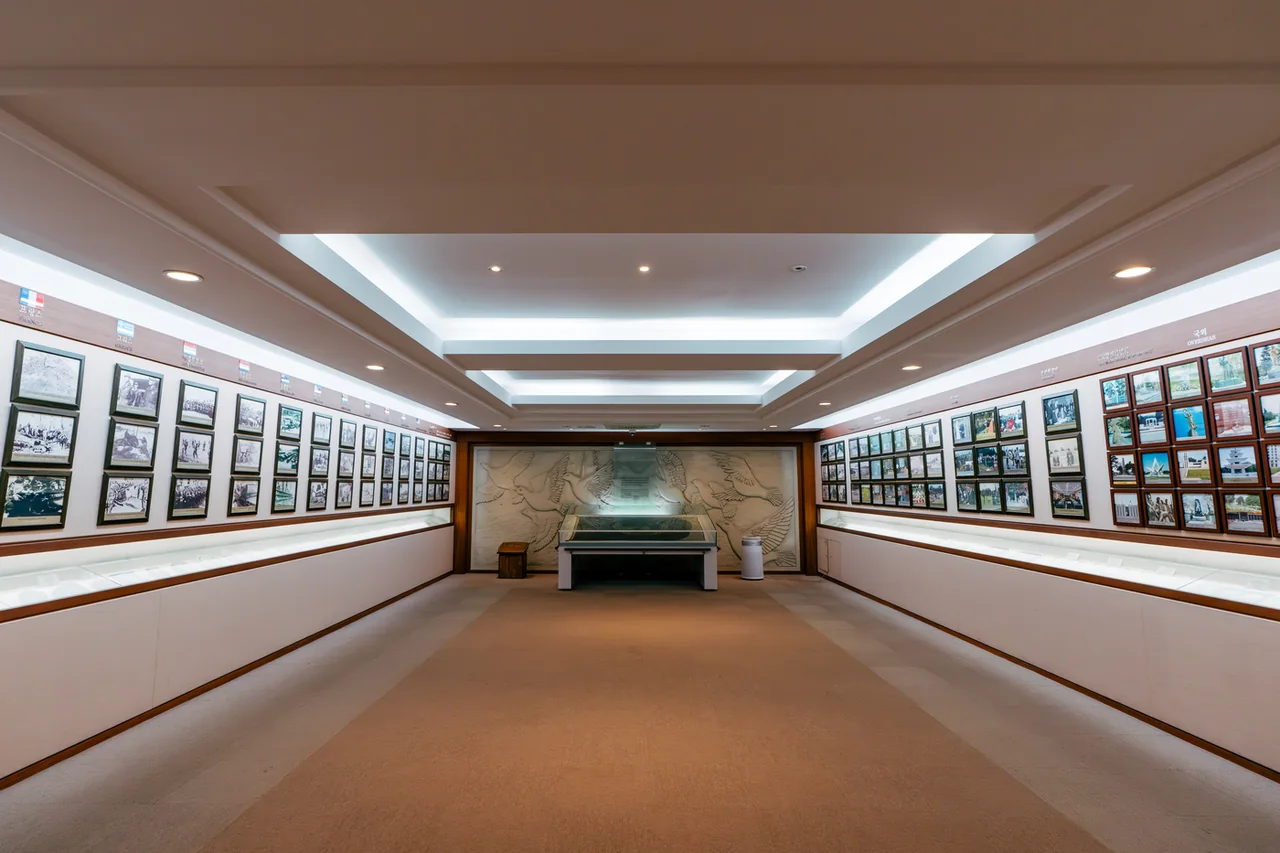
8. The 392 with no grave, and 21 maple leaves
Several monuments in the main burial ground are built around a number. Knowing what is being counted changes what you are looking at.
Commonwealth memorial
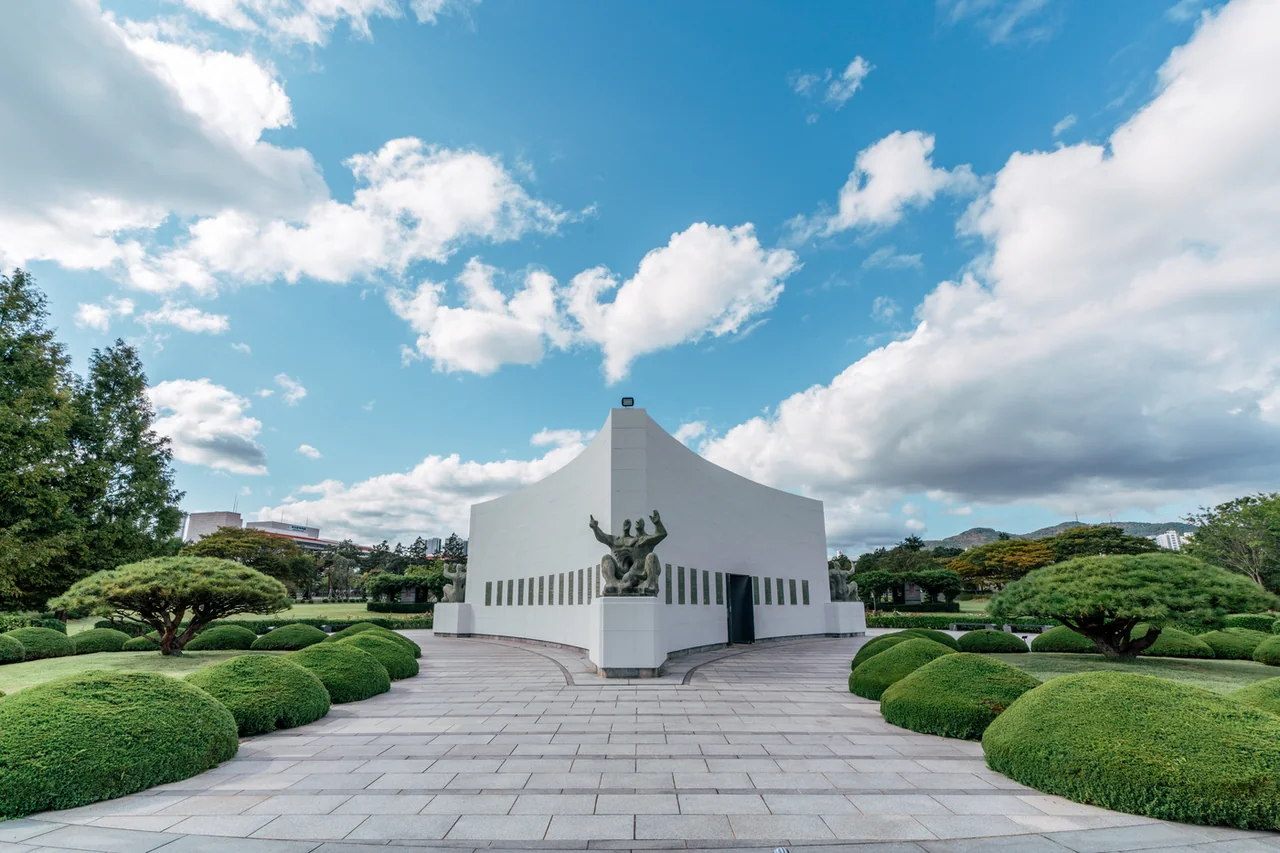
Erected by the British government in 1965 for the 392 men from Britain, Australia, New Zealand, Canada and South Africa whose remains were never recovered. It is a monument to the men who could not be buried.
Canadian statue
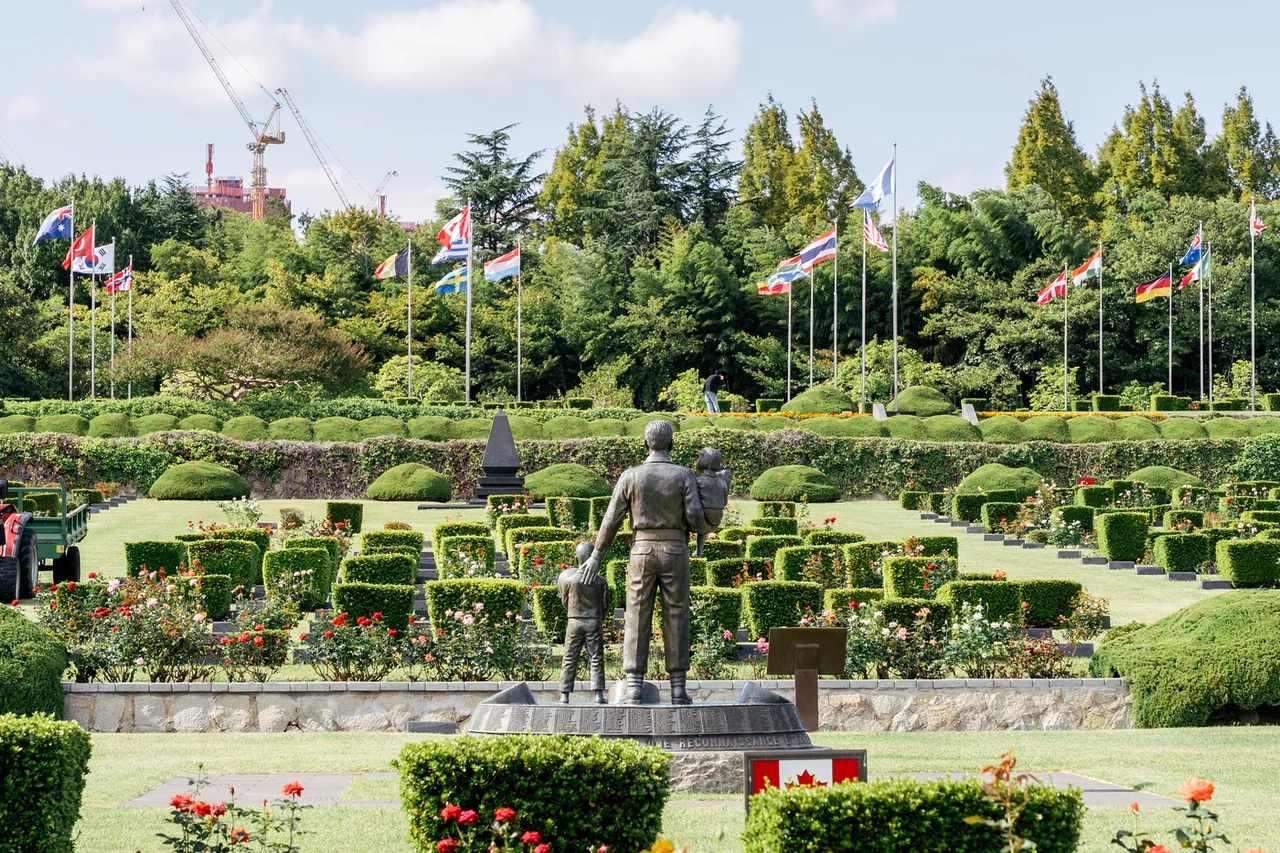
Placed by the Canadian government in 2001. Twenty-one maple leaves and a rose of Sharon are carved into it, the twenty-one standing for Canadian soldiers still listed as missing.
The national monuments
The Australian monument dates from 2010, replacing one first raised in 1998, and records the work of the Royal Australian Air Force. France followed in 2007, the United Kingdom in 2010, the United States in 2013 and Turkiye in 2014.
9. Twenty-two flags fly all year in the symbolic area
The symbolic area flies the flags of the 22 participating nations, the Korean flag and the UN flag, all year round. Remains from eleven countries lie in this part of the grounds, in whole or in part.
The monuments here were raised at very different times: the oldest in 1960, the newest in 2021.
| Monument | Raised | Record |
|---|---|---|
| Turkiye I | 1960 | To the fallen |
| Greece | 1961 | 186 dead, no graves here |
| Turkiye II | 1962 | To the fallen |
| New Zealand | 2005 | 6,000 served, 45 killed |
| Norway | 2007 | One grave here |
| Thailand | 2008 | 136 dead, three graves |
| Philippines | 2009 | 120 dead, no graves here |
| Colombia | 2021 | The only Latin American country to send combat troops |
Colombia sent 5,100 men, lost 213 and has four graves here. That its monument went up only in 2021 tells you this is not a finished place.
10. Flip-flops will not get you through the gate
There are rules, and they exist because this is a cemetery rather than a park. Two of them surprise visitors.
Slippers and flip-flops are not admitted. Visitors are asked to dress neatly. If you are coming straight from Haeundae in August, bring shoes.
| Rule | Detail |
|---|---|
| Dress | No slippers or flip-flops; neat clothing requested |
| Food and drink | Not permitted inside. The commission directs visitors to the sculpture park, the peace park and the arts centre plaza, all just outside |
| Photography | Personal photographs are fine. Filming for YouTube or with a drone needs prior agreement with the commission, and commercial shoots are not allowed |
| Flowers | There is a flower-laying platform inside; online and proxy tributes can be arranged |
If you have brought food, the green space immediately outside the gate is where to eat it.
11. The Peace Memorial Hall is a different place, and it shuts on Mondays
The names are close enough that people arrive expecting one building. The UN Peace Memorial HallMap is a separate institution, and its own visitor information says so in as many words: it is not the UN Memorial Cemetery. That sentence exists because the confusion is constant.
The distance is nothing. It sits opposite the cemetery, five minutes on foot. The problem is that the two keep different days and different hours.
| UN Memorial Cemetery | UN Peace Memorial Hall | |
|---|---|---|
| Hours | 09:00 to 18:00, to 17:00 in winter | 10:00 to 18:00 |
| Last entry | 17:45 / 16:45 | 17:30 |
| Closed | Never | Mondays, New Year’s Day, the day before and of Seollal and Chuseok |
| Admission | Free | Free |
| Parking | 90 minutes free | Free |
| Photography | Personal photos allowed | Personal photos allowed, no flash or tripods |
| Guided tours | Groups of 20 or more, booked ahead | Groups on request, foreign-language tours available |
| Telephone | +82 51-625-0625 | +82 51-901-1400 |
A Monday itinerary covering both does not exist. Only the cemetery is open. When a Monday is a public holiday the hall opens and closes the following day instead.
Late on a winter afternoon the problem reverses. After 16:45 the cemetery will not admit you, while the hall keeps taking visitors until 17:30. Arriving at four in December, do the hall first.
To reach the hall directly by public transport, take Line 3 to Motgol Station, leave by Exit 3 and pick up the Nam-gu 9 community bus.
12. 11 November at 11:00, twenty-two countries turn toward Busan
Every year on 11 November at 11:00, the 22 countries that fought in the Korean War observe a minute of silence facing Busan. The programme is called Turn Toward Busan, and the international ceremony is held at this cemetery by Korea’s Ministry of Patriots and Veterans Affairs.
It began with one man. In 2007 a Canadian veteran, Vince Courtenay, who had covered the war as a correspondent, proposed that veterans everywhere fall silent at the same moment, aligned to Korean time. What started as a private idea became a state occasion, and on 24 March 2020 the National Assembly passed the act on honouring UN veterans; it took effect on 25 September that year, making the UN Veterans International Remembrance Day an official commemorative day.
Expect the site to function as a ceremonial ground that morning: crowds, media and possible traffic restrictions nearby. For a quiet visit, come a few days either side. To attend, check the ministry and commission announcements first.
13. Getting there, and where to leave a car
Subway
Take Line 2 to Daeyeon Station and leave by Exit 3; it is a 15-minute walk. The commission’s own figure is 15 minutes and it is more honest than the ten minutes quoted elsewhere, because there is a gentle climb. Our guide to the Busan subway and transit cards covers fares and cards.
Bus
| From | Route | Notes |
|---|---|---|
| Seomyeon | 68 | |
| Busan Station | 134 | |
| Nopo Bus Terminal | 51 | Get off at the UN intersection, then five minutes on foot |
From Gimhae International Airport
Take the light rail to Sasang, change to Line 2 and ride to Daeyeon. Exit 3, then the 15-minute walk.
Parking
Ninety minutes free for vehicles of nine seats or fewer, charged after that. If you plan to watch the film and see both halls, keep an eye on the clock. Coaches need to arrange access with the commission in advance.
14. Half a day in Daeyeon-dong
The cemetery alone is a short visit, but the district around it is unusually dense with free institutions. Nam-gu designates the area a UN peace and culture district, and everything below is walkable.
Busan Museum
Next door to the cemetery. Free.
National Memorial Museum of Forced Mobilization
A national museum on colonial-era forced labour. Free.
UN Peace Park and Sculpture Park
Open green space outside the gate, and the place to eat what you brought.
Busan Cultural Center
Concert halls with a broad plaza.
UN Peace Memorial Hall
Five minutes across the road. Closed Mondays.
Kyungsung University area
One stop away, and where the restaurants and cafes are.
Opening hours differ from one institution to the next and national museums often close on Mondays, so check each before you set out. Our list of things to do in Busan shows how this district fits with the rest of the city.
15. When to come
There is no high season here in the usual sense. What changes through the year is the light, the heat and the closing time.
| Period | What changes |
|---|---|
| March to April | Cherry blossom around the grounds. Still winter hours, so the gate closes at 17:00 |
| May to September | Open until 18:00. Little shade, and midday is hot |
| From 1 October | Closing moves to 17:00 and last entry to 16:45 |
| 11 November | The international remembrance ceremony. The busiest day of the year |
Early morning is the quietest part of the day. School groups and organised delegations tend to arrive from late morning onward.
Visiting with children, as our Busan with kids guide covers, the free entry and the indoor film help. It is worth explaining beforehand that this is a place where running about is out of place.
16. Group tours, tributes and finding a specific grave
Groups of twenty or more can book ahead for a screening and a guided commentary. There is no charge and it takes about an hour. School visits and official delegations generally come this way. Book through the commission on +82 51-625-0625.
Flowers can be laid at the platform inside the grounds. For relatives abroad who cannot travel, the commission accepts online tributes and requests for proxy flower-laying. If you are visiting a particular grave, look up the plot on the commission’s burial register before you arrive rather than searching the rows.
The Peace Memorial Hall across the road also takes group bookings and can provide guides in foreign languages, which is useful if you are bringing visitors who do not read Korean.
🎡Things to Do48
🍜Food7
🏨Where to Stay3
🚇Getting Around10
🧭Travel Tips14
📌More3
🧭All-Korea essentials51
Frequently asked questions
Read the full Busan travel guide →
Images: All photographs from the Busan Tourism Archive (visitbusan.net/archive) under KOGL Type 1: Summertree and Shin Gyeong-min / Tourism Policy Division, Busan Metropolitan City.