
Choryang Ibagu-gil: Busan’s 168 Stairs, Ten Minutes on Foot
A hillside neighbourhood you can reach on foot from Busan Station. Since 2025 a free inclined lift does the climbing for you
| Where | Choryang, Dong-gu. About a ten-minute walk from Exit 7 of Busan Station on metro line 1. |
|---|---|
| Cost | Nothing. The path, the stairs and the inclined lift are all free. |
| Getting up | A twelve-person inclined lift has run since March 2025, so the climb is optional. |
| Closed days | The indoor spaces shut on Mondays and public holidays. The stairs and lanes are open at all hours. |
| Time needed | Forty minutes for the stairs alone, one and a half to three hours with the old buildings at the bottom. |
| Versus Gamcheon | Gamcheon needs a metro ride plus a village bus. This one has no transfer at all. |
1. The one hillside neighbourhood you can walk to
2. The way up changed in 2025
3. Why there are 168 steps and why they are this steep
4. Which stop you get off at decides what you see
5. The half hour before the stairs is the older part
6. Fukuoka’s mentaiko started on this street
7. Go on a Monday and you are only walking
8. After dark the street does something else
9. This or Gamcheon, if you only have room for one
10. With luggage and without, the route differs
11. Things worth knowing before you climb
There is a 168-step staircase directly behind Busan Station. This page is part of our complete Busan travel guide. If you have half a day rather than two hours, the Igidae coastal trail is a different scale of walk: 4.7km of sea cliff instead of city lanes.
1. The one hillside neighbourhood you can walk to
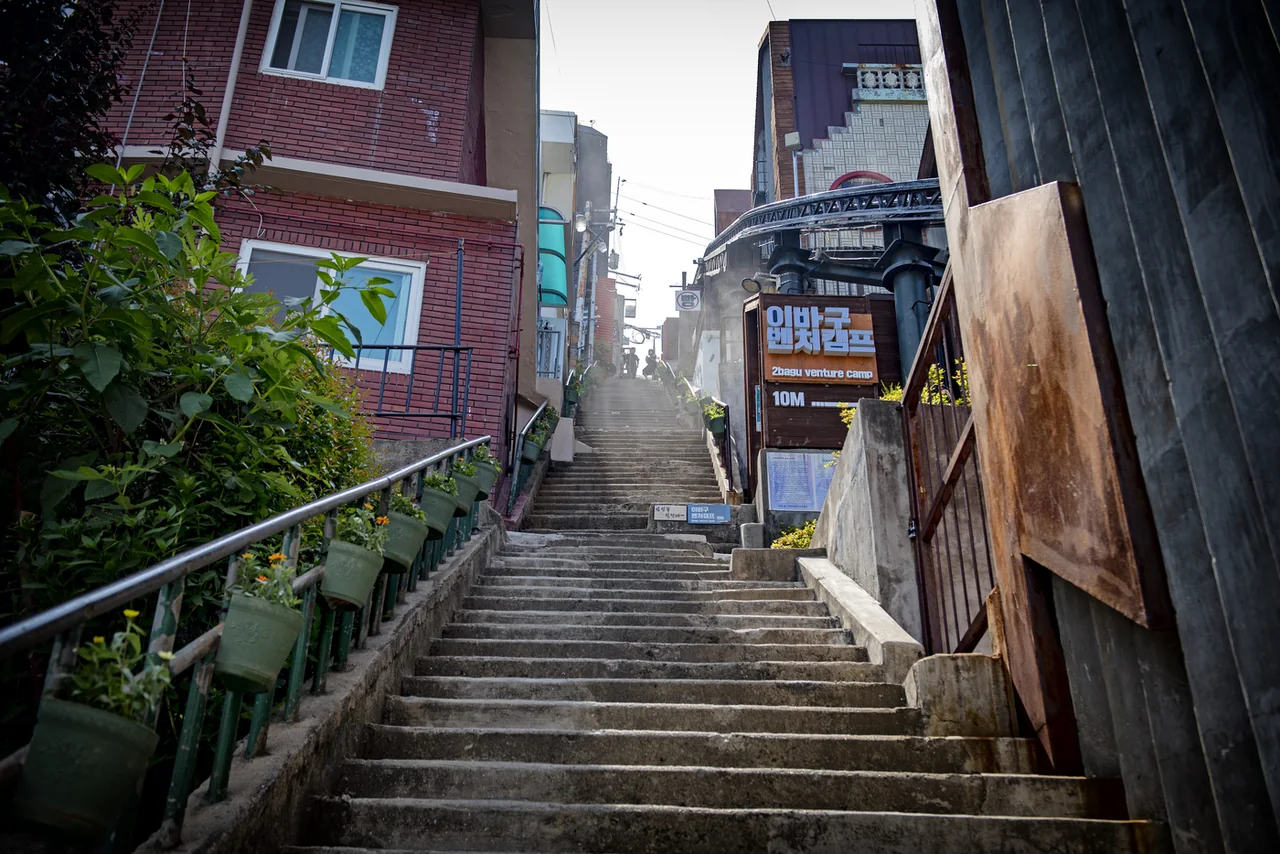
Come out of Exit 7 at Busan StationMap, cross the main road, turn into the lanes, and ten minutes later you are on the slope. No second metro ride, no village bus, no taxi.
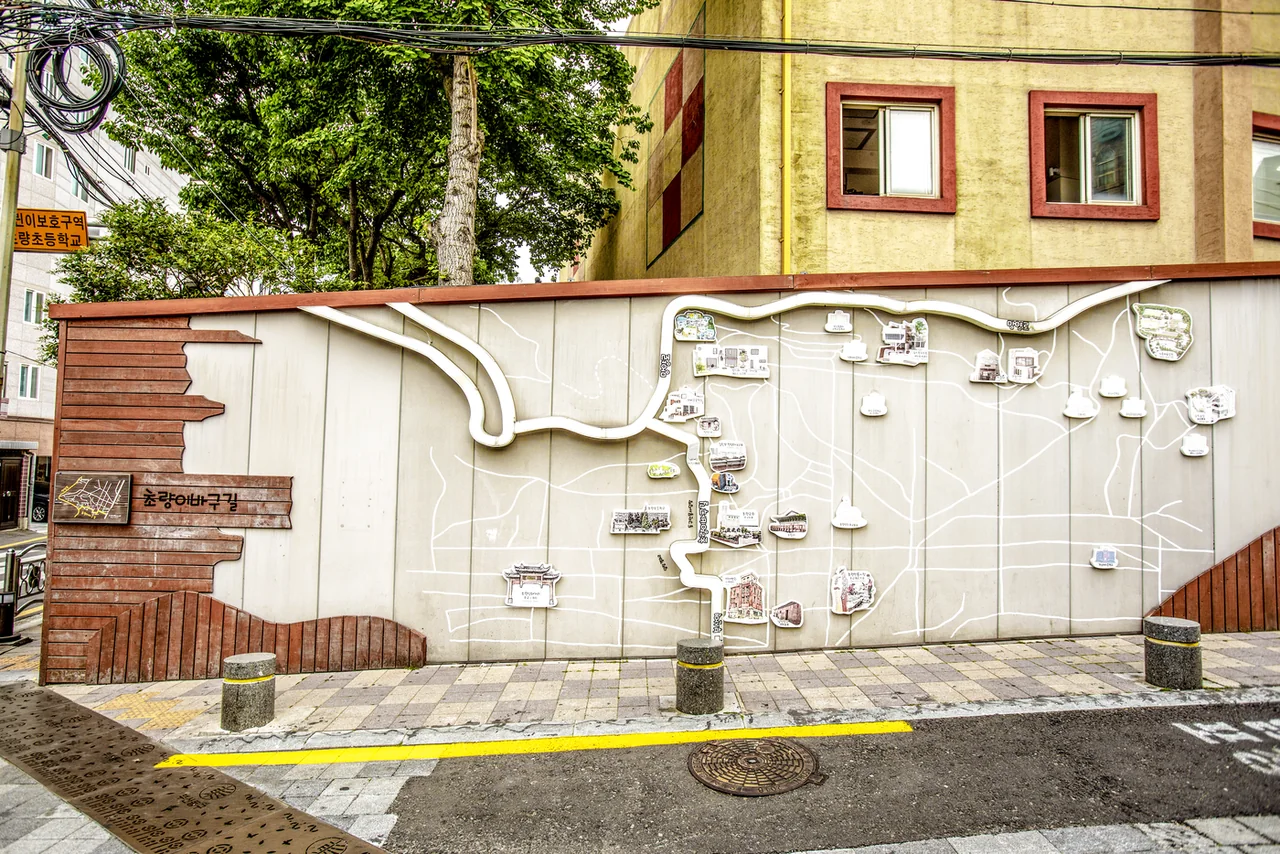
The route is called Choryang Ibagu-gil. Ibagu means story in the Gyeongsang dialect. It runs 1.5km from the site of the old Namseon warehouse up to the road that cuts across the hillside, and the 168 Stairs sit in the middle of it.
| Detail | |
|---|---|
| Getting there | Metro line 1, Busan Station, Exit 7, about 10 minutes on foot |
| Length | 1.5km, warehouse site to hillside road |
| Stairs | 168 steps at roughly 30 degrees |
| Lift | Choryang 168 Haneul-gil, 12 passengers, free, three stops |
| Entry | Free the whole way |
| Enquiries | Dong-gu district office, 051-440-4000 |
Busan’s hillside districts, the ones locals call sanbok-doro neighbourhoods, exist because of one year. In 1950 the city became the country’s temporary capital and its population roughly doubled. People built where there was space left, which meant straight up the slope, close enough to walk down to the docks and the market for work.
Most of those neighbourhoods are awkward to reach. Gamcheon Culture Village takes a metro ride and a village bus. This one starts behind the station, which makes it the natural answer to the most common gap in a Busan itinerary: the two or three spare hours between arriving and being able to check in.
2. The way up changed in 2025
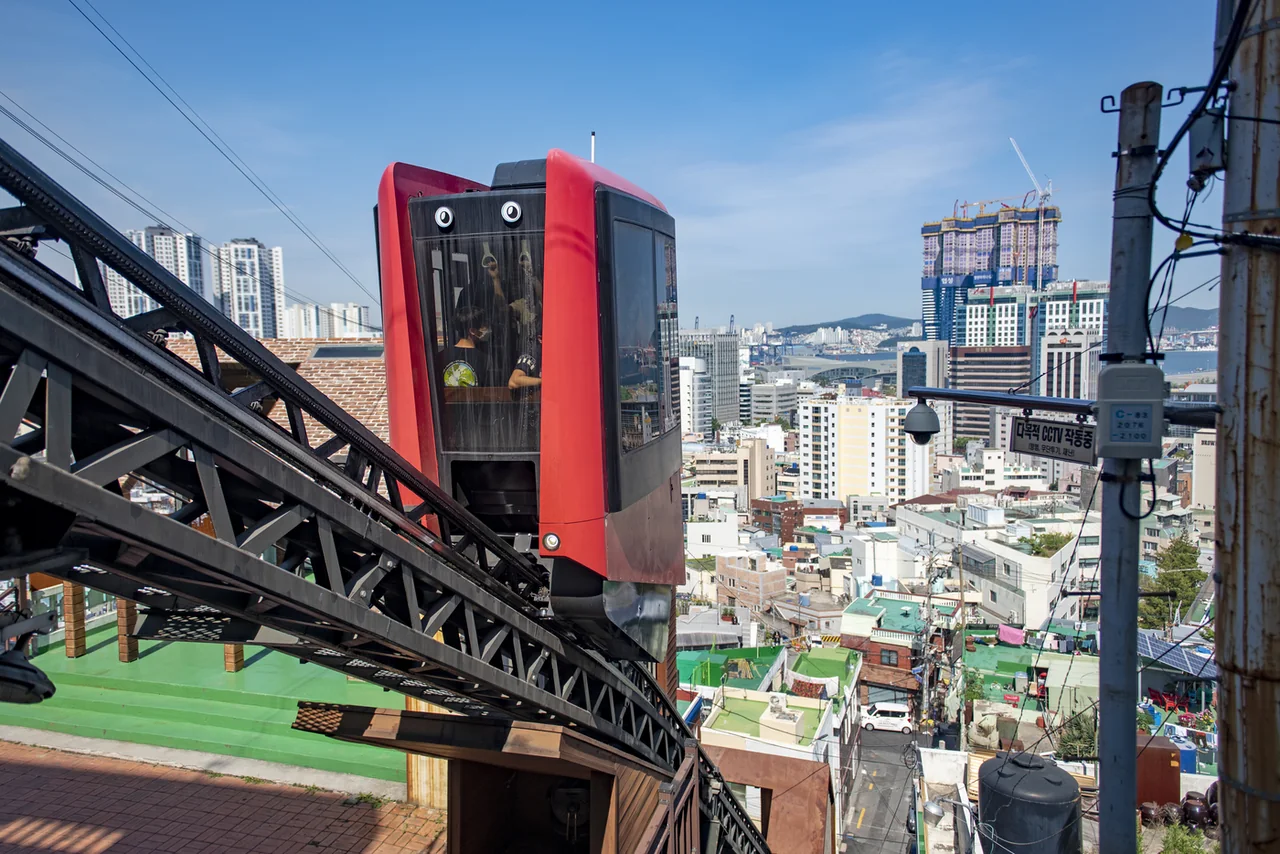
A twelve-person inclined lift now runs beside the stairs. It is called Choryang 168 Haneul-gil, a name picked by residents in a public vote, and it entered regular service on 11 March 2025. It costs nothing to ride.
Before that there was a monorail. It opened in 2016, broke down constantly, was declared unfit by the Korea Transportation Safety Authority in March 2023, and was dismantled in January 2024. A large share of the blog posts, videos and photos still circulating online show that monorail, which is why people occasionally turn up looking for a ride that no longer exists.
| Monorail (2016-2023) | Haneul-gil lift (March 2025 onwards) | |
|---|---|---|
| Capacity | 8 | 12 |
| Fare | Free | Free |
| Evening running | Limited by noise | Possible now that it is quieter |
| Length | About 60m | |
| Build cost | 2.328 billion won | |
| How it ended | Removed after failing a safety assessment |
Four extra seats matter more than they sound. On the monorail a family of four often had to split across two runs. Before the pandemic it carried 1,300 to 1,500 people a day; the lift has already had weekend days above 2,000.
Dong-gu has now won the same international prize twice for this kind of installation. Elevator World, the American trade magazine that has covered the industry since 1953, runs a global inclined-lift contest, and the 168 Stairs lift took first place. The district won it in 2017 as well, for a lift in the Jwacheon neighbourhood. Getting people up and down a slope is a long-running civic problem here, not a tourist gimmick.
3. Why there are 168 steps and why they are this steep
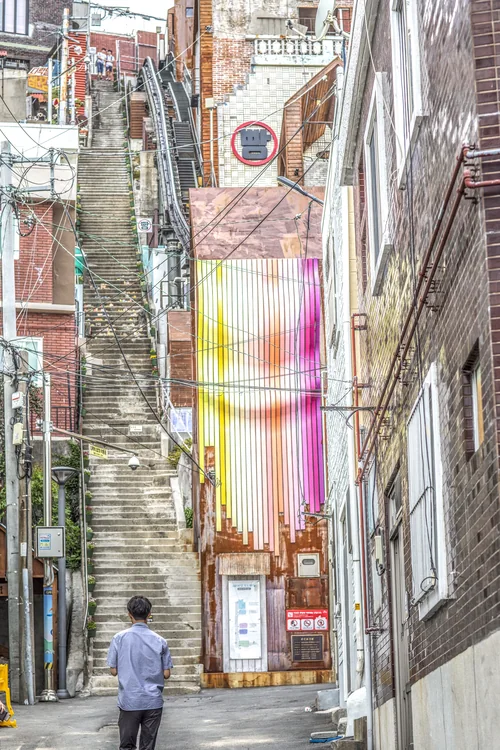
The staircase was not built for visitors. It was the only link between the lower town and the houses above it, and for years it was also the water route: there was a well at the bottom, and residents carried water up on their backs.
The number in the name is literal. There are 168 steps, at a gradient of about 30 degrees, which is the angle at which nobody lets go of the handrail.
The reason the staircase looks unusually wide today is an urban regeneration scheme that took it from 3m to 8m across, funded with 2.3 billion won of national and city money. The hillside road above it opened in 1964, and the Choryang section was finished in 1969. The houses came first and the road was cut through them afterwards, which is why the neighbourhood sits above and below the road rather than along it.
If you have seen the Huinnyeoul village on Yeongdo island, this is the same period of history on a different kind of edge: cliffs there, a staircase here.
4. Which stop you get off at decides what you see
The lift has three stops and they are three different places. Riding straight to the top and walking down is the common approach, and it skips the best of the three.
| Stop | What is there |
|---|---|
| Bottom | An exhibition space at the foot of the stairs, where the lane network begins |
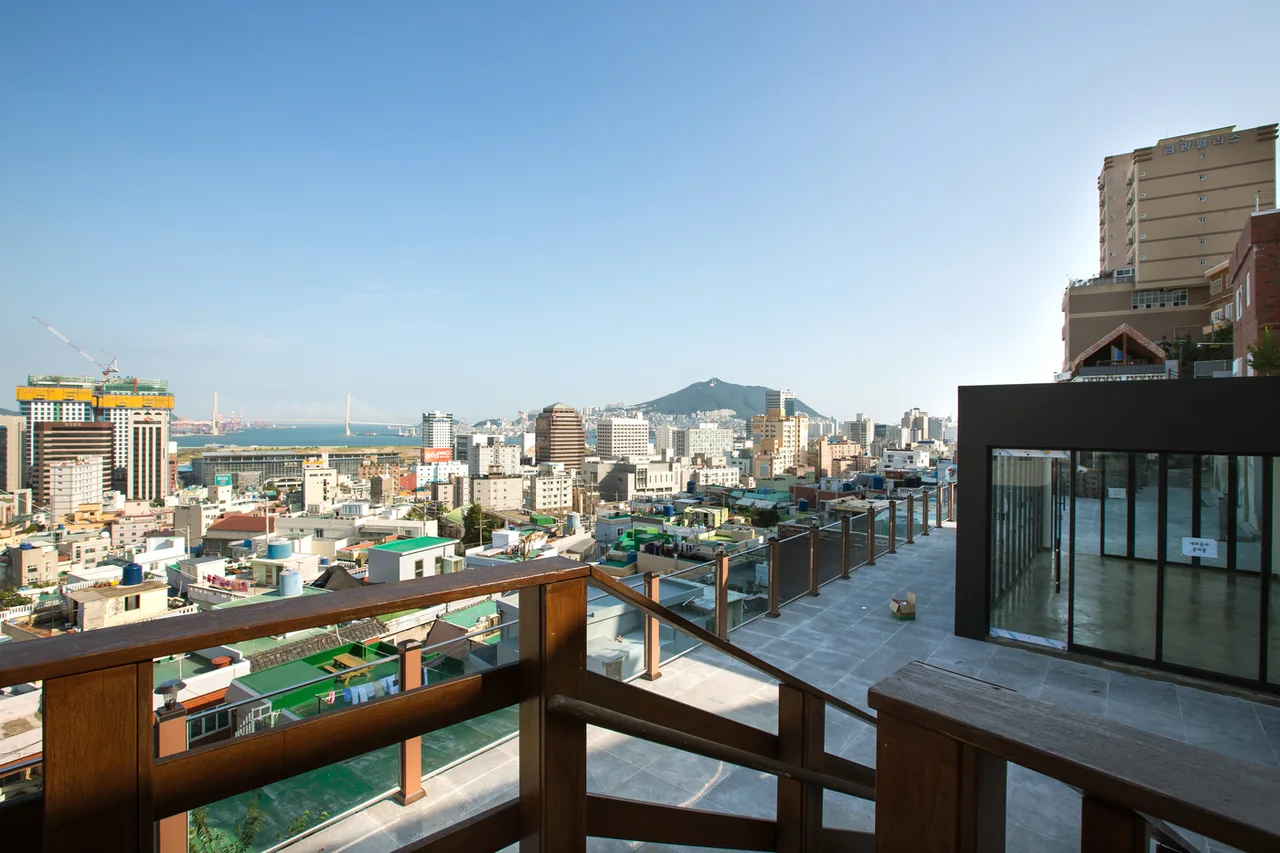
| Middle | Kim Min-bu Observatory, about four fifths of the way up. North Port, the Busan Harbour Bridge and the old town roofs all land in one frame |
| Top | The myeongnan centre, a row of small independent businesses, and the 168 The Deck viewpoint. It opens straight onto the hillside road |
The observatory is named after someone from these streets. Kim Min-buMap was born in 1941 in Sujeong-dong, the next neighbourhood along, won a national literary prize at sixteen, wrote for radio and left behind the lyrics to a song most Koreans of a certain age can still hum. He died in 1972.
For photographs, the middle stop is the one. From the top the view opens up but the roofs fall away; from the bottom the lanes are good but there is no water in the shot. That split is why this place turns up late in lists of photo spots in Busan despite being ten minutes from the station.
The businesses at the top sit in a municipal building that had been standing empty. Eight of them moved in when the lift opened: a shaved-ice shop, cafes, a Korean restaurant and a couple of craft studios.
5. The half hour before the stairs is the older part
The route starts on the flat, not on the slope. Two buildings from the turn of the last century stand at the bottom, and a visit that goes straight to the staircase misses both.
The old Baekje Hospital
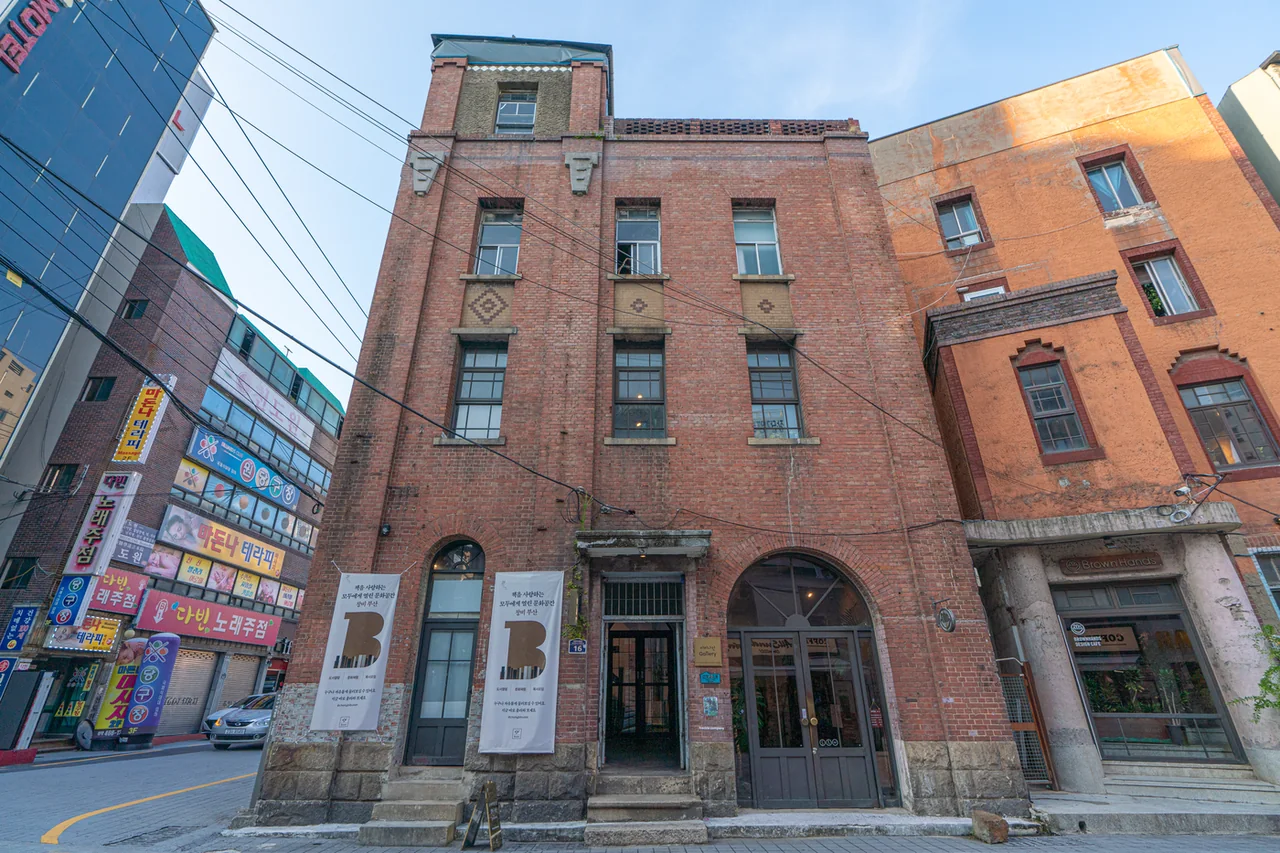
The old Baekje HospitalMap was built in 1922 by Choi Yong-hae, a Korean who had emigrated to Japan, and was the first modern private general hospital in Busan. It is four storeys of red brick and carries national registered heritage status, number 647.
What makes it worth five minutes is what happened after the medicine stopped. The hospital closed in 1932. The building then became a Chinese restaurant, then officers’ quarters for the Japanese army, then a civil police office after liberation, and later the consulate and temporary embassy of the Republic of China. One address, and the twentieth century runs straight through it. There is a cafe on the ground floor now, so you can go inside.
The Namseon warehouse site
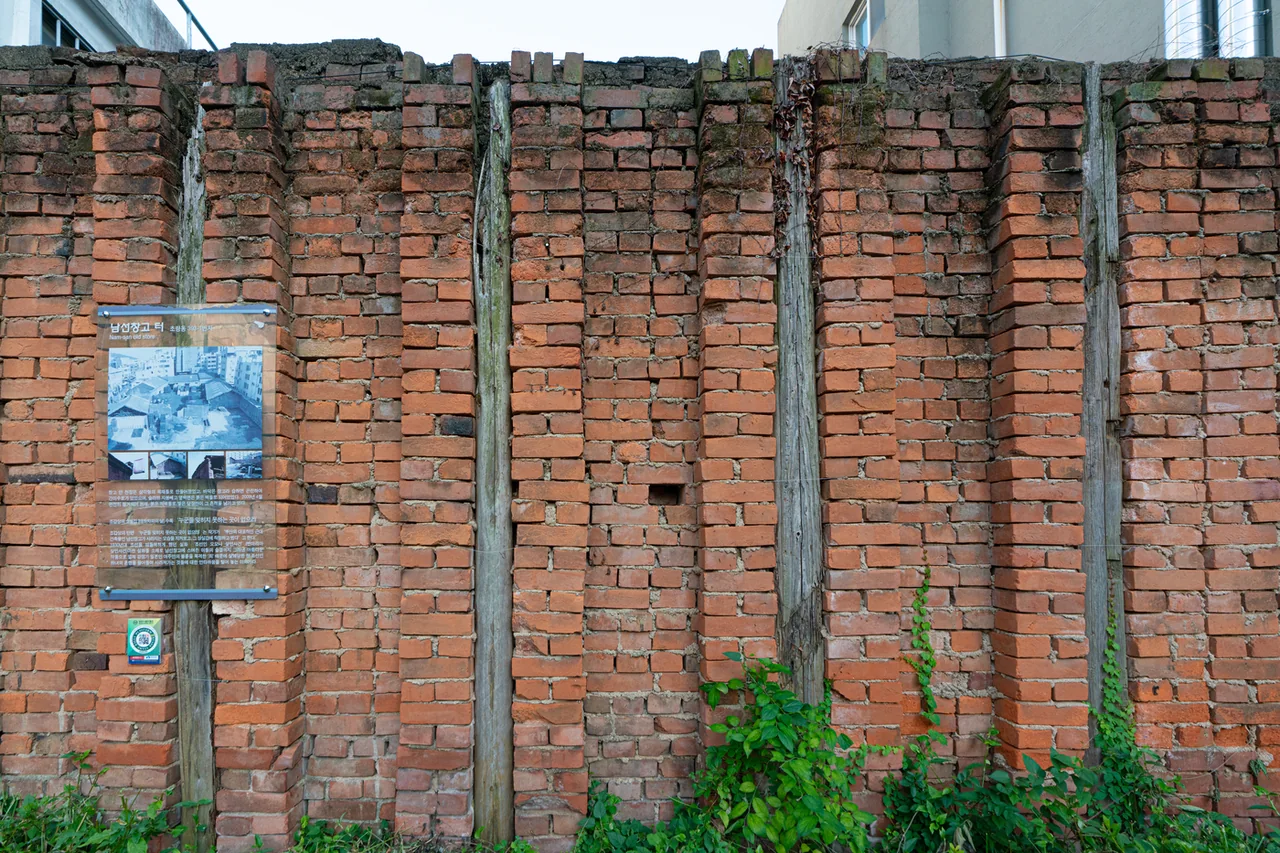
A short walk away, a red brick wall runs along the pavement. It is what is left of the Namseon warehouse, built in 1900 by the port’s merchant guild and generally described as the first modern logistics warehouse in Busan. It mostly held pollack shipped down from Hamgyeong province in the north, so locals called it the pollack store.
The building was demolished by its owner in April 2009. What survives is a stretch of wall, an information panel and a Busan Future Heritage plaque, with a supermarket where the warehouse stood. A single wall is a thin thing to detour for, until you know what came out of that fish.
6. Fukuoka’s mentaiko started on this street
The building at the top of the stairs is a research centre for myeongnan, salted pollack roe, and the name is not decorative. The warehouse at the bottom stored the fish and the neighbouring Choryang MarketMap sold the roe. A Japanese boy grew up beside that market.
Toshio Kawahara was born in Busan in 1913. Back in Japan after the war he worked from the memory of that flavour, and what came out of it was the spicy mentaiko now sold as the signature product of Fukuoka. His company, Fukuya, opened in the Nakasu district in March 1948 and put the roe on the counter on 10 January 1949. The story has since been made into a Japanese television drama and a film.
The centre is run directly by the district across five floors, with a restaurant, a shop and a cafe all built around the same ingredient. It opens Tuesday to Sunday from 10:00 to 19:00 and closes on Mondays and public holidays. For everything else the city is known for eating, see what to eat in Busan.
7. Go on a Monday and you are only walking
Every indoor space on this route closes on the same days: Mondays and public holidays. The stairs, the lanes and the observatory are unaffected. Everything with a door is not.
| Place | Hours | Closed |
|---|---|---|
| Myeongnan brand centre | Tue-Sun 10:00-19:00 | Mon and public holidays |
| Ibagu Workshop | Tue-Sat 10:00-19:00 / Sun 09:00-18:00 | Mon and public holidays |
| Hillside road exhibition hall | Tue-Sat 10:00-19:00 / Sun 09:00-18:00 | Mon and public holidays |
| Jang Ki-ryeo memorial centre | Tue-Sat 10:00-19:00 / Sun 09:00-18:00 | Mon and public holidays |
| Yu Chi-hwan’s postboxMap | Tue-Sat 10:00-19:00 / Sun 09:00-18:00 | Mon and public holidays |
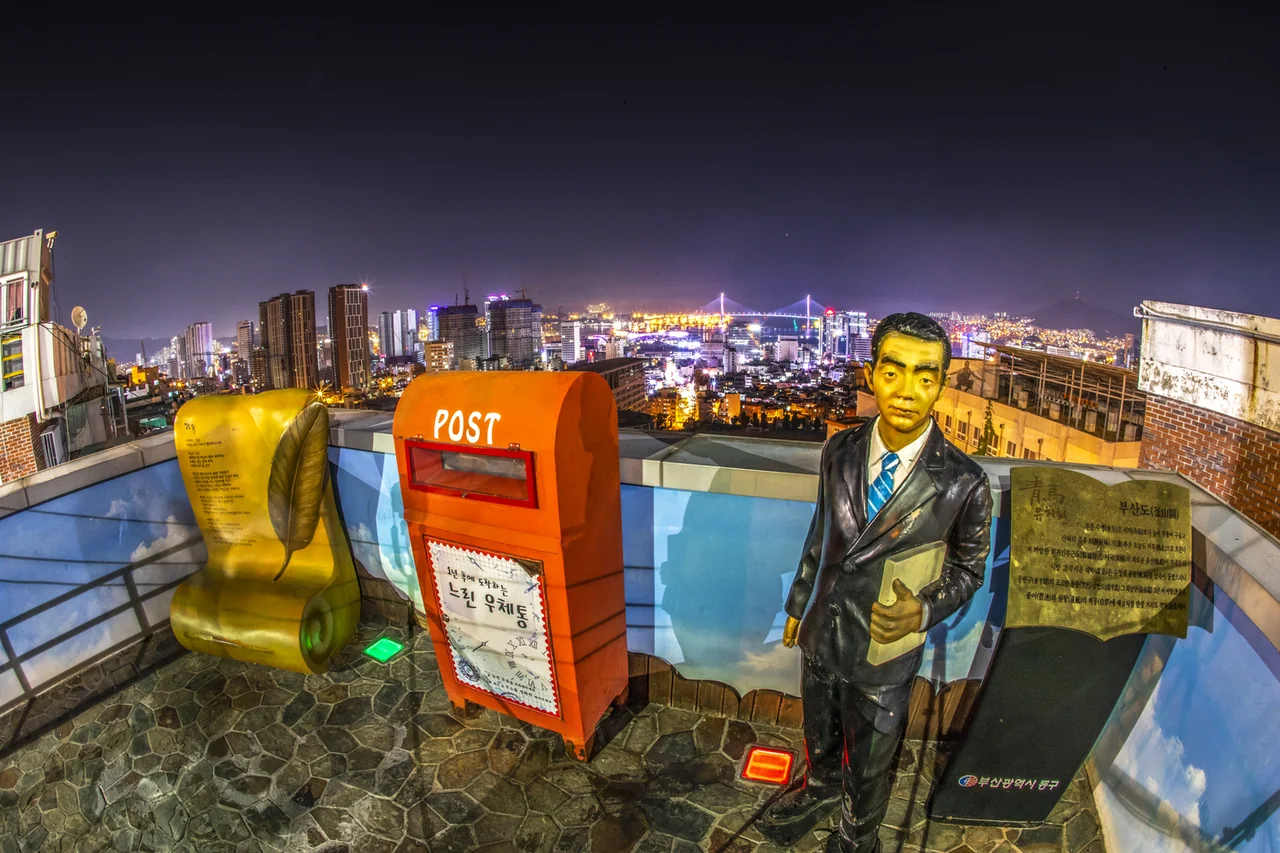
Anything you post in the Yu Chi-hwan postbox is delivered a year later. It is named after a Korean poet, and among the installations that turn up at viewpoints it is one of the few with an actual function: write a postcard on your trip, receive it at home twelve months on. Not on a Monday, though.
The Jang Ki-ryeo centre commemorates a doctor often called Korea’s Schweitzer, who set up the country’s first private health insurance scheme. The Ibagu Workshop holds household objects donated by Choryang residents, which is a more interesting museum than it sounds when the houses they came from are still standing outside.
Getting a guide
The district office provides free guides. Book on 051-440-4714 or through the district website at least three days ahead, choosing between this route and a second one along the old port. Whether guiding is available in languages other than Korean is not published, so ask when you book.
8. After dark the street does something else
By day this is a walk through recent history. After sunset it is a viewpoint. What sits in front of you from the upper stairs is North Port and the harbour bridge, and both improve as the light goes.
168 The Deck, at the top, is an open cultural space facing the water that runs outdoor film screenings. The first screening of the 2026 season started at 19:00 and sold out twenty seconds after booking opened. They hand out wireless headphones and put up a large screen outdoors, so the capacity is small and the schedule moves; check the district notices rather than turning up on spec.
The best-known night view here is from the postbox terrace. The awkward part is that the indoor section closes at 19:00 and the view is at its best afterwards, so you are choosing between going inside and staying for the lights, or making the climb twice.
9. This or Gamcheon, if you only have room for one
They are not substitutes for each other. Gamcheon is a whole hillside turned into an artwork. Choryang is a working street where the traces of the port trade and the refugee years are still in place. Photographs point you to Gamcheon. Spare hours near the station point you here.
| Choryang Ibagu-gil | Gamcheon Culture Village | |
|---|---|---|
| From Busan Station | 10 minutes on foot | Metro to Toseong, village bus, then 5 minutes walking |
| Character | Refugee settlement, early modern buildings, lived-in lanes | Terraced art village, murals and installations |
| Entry | Free | Free, stamp map 2,000 won |
| Getting up | Free inclined lift | On foot |
| Time needed | 1.5 to 3 hours | 2 to 3 hours |
| Crowds | Sections are empty even at weekends | Around 1.85 million visits in a recent year |
With one day in the city, do not attempt both. Two hillside neighbourhoods back to back is a lot of climbing for the same kind of photograph, and if a beach is on your list of things to do in Busan your legs will notice.
If the old town is your whole day, the natural continuation is not Gamcheon but Nampo-dong, two stops down the same metro line, where the street food and the fish market are.
10. With luggage and without, the route differs
If you have just come off a train, deal with the bags first. There is almost no flat ground to wheel a suitcase on, and the stops on the lift are connected by lanes you have to walk.
With luggage, about 2 hours
- Use the lockers at Busan Station. There are banks of them in the railway station and in the metro station below it.
- Walk out of Exit 7 to the start of the route, taking in the Baekje Hospital building and the warehouse wall. Around 30 minutes.
- Ride the lift to the middle stop and take the view from the observatory.
- Continue to the top stop for the myeongnan centre and the small businesses beside it.
- Walk back down the stairs to the station. The descent takes about 15 minutes.
Without luggage, about 3 hours
- Same sequence to the top.
- Follow the hillside road. The exhibition hall, the Jang Ki-ryeo centre and the postbox are all strung along it.
- Wait for the light to go and take the night view. In winter that means around 17:30.
- Come down for dinner in Nampo-dong or at Choryang Market.
In rain, reverse your priorities. The steps get slippery and the view disappears, so an indoor plan from Busan when it rains will use the day better.
11. Things worth knowing before you climb
This is a residential street before it is anything else. The houses either side of the staircase are lived in, and the courtyards and washing lines in the lanes belong to somebody.
Volume
Windows open directly onto the steps. A conversation on a landing is a conversation inside somebody’s room.
Photographs
Lanes and views are fine. Courtyards and people are not. An open door is not an invitation.
Toilets
There are none partway up. Use the station at the bottom or the businesses at the top.
Season matters too. In midsummer there is almost no shade on the staircase, and while the lift removes the climb, the lanes are still in full sun. In winter the early sunset brings the night view forward, but it is windy at the top.
Arriving from Seoul by train? Timetables and fares are in the Seoul to Busan KTX guide. Still choosing a base, or wondering whether the station area is the right one? Our where to stay in Busan guide is organised by neighbourhood.
🎡Things to Do48
🍜Food7
🏨Where to Stay3
🚇Getting Around8
🧭Travel Tips14
📌More3
🧭All-Korea essentials50
Frequently asked questions
Read the complete Busan travel guide →
Images: All photographs from the Busan Tourism Archive (visitbusan.net/archive) under KOGL Type 1. 168 Stairs and the former monorail (2020): Summertree / Busan Metropolitan City and Busan Tourism Organization. Former Baekje Hospital and the Namseon warehouse wall: Hyphen Group / Busan Tourism Organization. Wall gallery, stairs from below and Yu Chi-hwan’s postbox: Busan Tourism Organization. View from the observatory (2017): Busan Metropolitan City.