
Skiing in Gangwon: Nine Resorts, and How to Choose Between Near and Big
Gangwon has nine ski resorts. Pick by slope count alone and you lose a day to the drive. Here is how long each takes from Seoul, how big it actually is, and how the season and the lift tickets work.
| How many | Nine, and most of Korea’s ski resorts are in Gangwon. The rest are two in Gyeonggi and one in Jeollabuk. |
|---|---|
| The near ones | Three sit within about ninety minutes of Seoul by road, and all three are on the small side. |
| The big ones | The resorts with the most runs are in Pyeongchang, Jeongseon and Taebaek, which means two and a half hours or more. |
| By train | High1, one of the furthest by road, is the closest to a station. Vivaldi Park cannot be reached by train at all. |
| The season | Gangwon generally opens in late November and closes in March, but the opening date moves with the weather. |
| Lift tickets | They are sold by time of day, so decide when you will ski before you buy. Night tickets cost less than daytime ones. |
1. Gangwon has nine ski resorts
2. The close ones are small and the big ones are far
3. By train the order flips
4. When the season opens and closes
5. Early in the season only a few runs open
6. Lift tickets are sold by time of day
7. The mountain closes for a while each day
8. Discounts are for the ticket window, and you only get one
9. Renting gear
10. If it is your first time, take a lesson
11. What non-skiers do
12. Getting there without a car
13. Where the resorts are
14. Where to stay
15. How to choose
16. Fitting a ski day into a winter trip
Most people start by comparing slope counts. Put the nine resorts next to how long each takes from Seoul, though, and a different picture appears: the close ones are small and the big ones are far. This is the winter chapter of our Korea travel guide, and how you spend a snow day is decided right here.
1. Gangwon has nine ski resorts
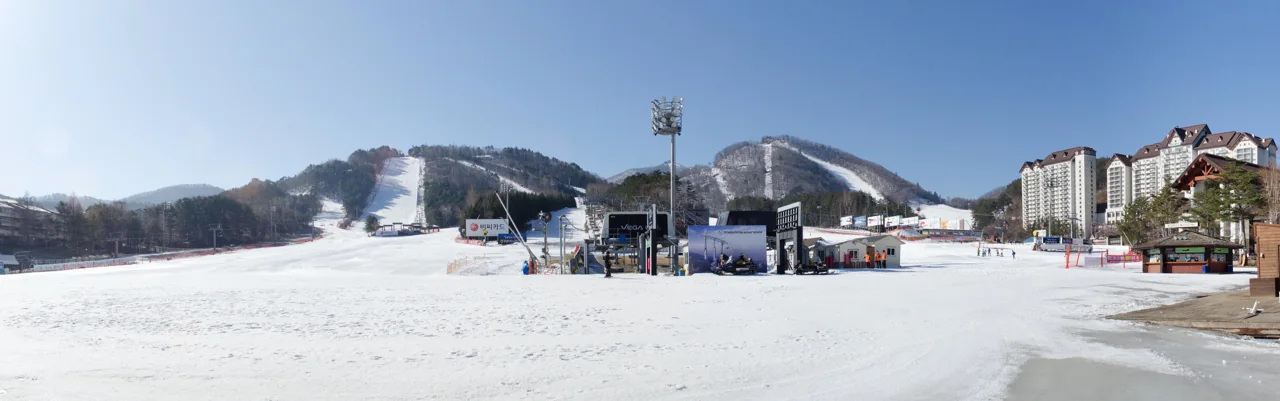
The Korea Ski Resort Business Association publishes a register by province, and most of the country’s ski resorts sit in Gangwon. The rest amount to two in Gyeonggi, just outside Seoul, and one in Jeollabuk.
Here are the nine, ordered by how long they take from Seoul Station by road.
| Resort | Where | From Seoul by car | Runs |
|---|---|---|---|
| Oak Valley | Wonju | About 1 hr 20 | 6 |
| Vivaldi Park | Hongcheon | About 1 hr 20 | 10 |
| Elysian Gangchon | Chuncheon | About 1 hr 20 | 10 |
| Welli Hilli Park | Hoengseong | About 2 hr | 18 |
| Phoenix Park | Pyeongchang | About 2 hr 10 | 16 |
| Alpensia | Pyeongchang | About 2 hr 30 | 6 |
| Mona Yongpyong | Pyeongchang | About 2 hr 40 | 28 |
| High1 Resort | Jeongseon | Almost 3 hr | 17 |
| O2 Resort | Taebaek | Over 3 hr | 12 |
Yongpyong is the oldest
The register lists registration dates too, and Yongpyong registered in the 1970s, earlier than anywhere else in Korea. The next one is a long way behind, in the 1990s. Nearly every resort in Gangwon today was built in the 1990s or 2000s.
These are registered figures
The association counts registered facilities, which is not the same as what actually opens in a given season. O2 Resort is registered with twelve runs and has opened fewer in recent winters. A resort described as having twenty-eight runs will not necessarily have twenty-eight open on the day you go.
What each one is like
- Mona Yongpyong. The biggest and oldest in Gangwon. Long runs, and a gondola up to the top.
- Welli Hilli Park. Two hours out but fairly large, which is the combination people look for when they want both.
- High1 Resort. Deep in the Jeongseon mountains, so a long drive, but a train station sits right below it. Snow lasts well here.
- Phoenix Park. In Pyeongchang, with plenty of lifts. Popular with snowboarders.
- O2 Resort. In Taebaek and the furthest of all. High up, so the snow holds.
- Vivaldi Park. Close to Seoul and open late into the night. A water park next door keeps it busy year round.
- Elysian Gangchon. The only one you can reach on a metro train. Small.
- Oak Valley. In Wonju, the quickest to reach, with few runs and few lifts.
- Alpensia. Small, in Pyeongchang, but sharing a site with ski jumps and other facilities.
Run counts mislead. Slopes can be subdivided, so the number goes up without the mountain getting bigger. Welli Hilli lists more runs than High1 while High1 has more skiable ground.
2. The close ones are small and the big ones are far
Read the table from the top and a rule appears. The three within about ninety minutes of Seoul are all small, and the ones worth going to for size all take two and a half hours or more. There is no resort in Gangwon that is both close and big.
So choosing here is really deciding which of the two you are willing to give up. Between the nearest and the furthest there is close to four hours of round-trip driving, and that comes straight out of your day.
The three near ones
Oak Valley, Vivaldi Park and Elysian Gangchon. They are so close together in travel time that the clock cannot decide it for you. Something else has to.
- Vivaldi Park is the largest of the three, with the most lifts and two gondolas. It cannot be reached by train.
- Elysian Gangchon is the only one beside a station on the metro network. Without a car, this is effectively the answer.
- Oak Valley is the quickest but has the fewest runs, and the fewest lifts, so queues build when it is busy.
Why anyone drives further
The distant resorts are worth it for size. Yongpyong alone is bigger than the three near ones put together. Over several days that difference is something you feel. For half a day on snow, the travel time matters more than the mountain does.
Alpensia is the exception to the rule: far away and not large. It makes sense as part of a Pyeongchang stay where you sleep in one place and ski at several resorts, rather than as a destination on its own.
3. By train the order flips
Driving order and rail order are not the same. Take the nearest station to each resort and the list rearranges itself.
| Resort | Nearest station | From the station |
|---|---|---|
| Elysian Gangchon | Baegyangni (Gyeongchun metro line) | Right beside it |
| High1 Resort | Sabuk (Taebaek line) | A few minutes by road |
| O2 Resort | Taebaek (Taebaek line) | About ten minutes |
| Alpensia | Jinbu (KTX) | About twenty minutes |
| Phoenix Park | Pyeongchang (KTX) | About twenty minutes |
| Mona Yongpyong | Jinbu (KTX) | Over twenty minutes |
| Oak Valley | Manjong | About twenty-five minutes |
| Welli Hilli Park | Hoengseong | Over half an hour |
| Vivaldi Park | None | Not reachable by train |
The long drive becomes a short ride
High1, almost three hours by car, is the closest of all to a station. Sabuk is a few minutes below the resort. Taking the Taebaek line turns the hardest resort to drive to into one of the easiest to reach. O2 Resort is similar from Taebaek station.
Vivaldi Park has no train
It is the second closest by road, but no railway serves Hongcheon. The nearest station is a long way off, so travelling there by train is not a plan that works. It is a car or a bus.
Elysian Gangchon is on the metro
Baegyangni is a station on the Gyeongchun line, part of the greater Seoul metro network. It is the one ski resort you can reach from central Seoul without changing to a coach or a taxi. The resort is small, but for a visitor without a car that single fact outweighs the rest.
4. When the season opens and closes
Everything from here changes year to year, but the shape of it repeats.
Gangwon resorts generally open in late November. Pyeongchang tends to go first, with Jeongseon and Taebaek following. Vivaldi Park starts making snow early and often opens ahead of the others. Closing happens in March, with the upper runs, where snow lasts longest, staying open to the end.
The opening date depends on the cold
Resorts announce a planned opening date, but it moves with the temperature. Snowmaking needs the nights to be cold enough, and that shifts by days from one winter to the next. If you are aiming for the first week of the season, check the resort’s notice before you book anything.
Season passes sell before the snow
Season passes go on sale well before opening and sales usually close around the middle of December. By the time it looks like winter, they are often gone. This matters only if you plan to ski repeatedly.
For one or two days on snow, skip the season pass entirely and buy a day ticket.
5. Early in the season only a few runs open
This is the part visitors most often get wrong. Open for the season does not mean open all over. In December most resorts run only part of their slopes, and the choice widens from mid-month. How skiing fits with the light festivals, Christmas and New Year’s Eve is in our Korea in December guide.
After opening day, runs come into service one at a time as snowmaking finishes. A resort with twenty-eight runs may have one or two open on its first day. The number climbs through midwinter, and in March the lower slopes start closing again. The full mountain is available for only a few weeks.
Which is why early tickets cost less
Yongpyong builds this into its pricing outright: the lift ticket costs a different amount depending on how many runs are open that day. One run open and several runs open are priced differently. Other resorts run opening promotions to the same effect.
Turned around, going early is cheaper but there is less to ski. A beginner spends the day on the gentle lower slopes anyway, so the loss is small. If you want to ski a variety of runs, aim for midwinter.
Check the day’s status before you leave
Most resorts publish which runs and lifts are open today on their website, updated live alongside the weather. Two minutes on that page saves a wasted journey.
6. Lift tickets are sold by time of day
A Korean lift ticket is not simply a day pass. Tickets are divided by when you ski, and priced accordingly. Names and hours vary between resorts, though they all divide the day the same way.
- Morning. From opening until early afternoon. The snow is at its best.
- Afternoon. From early afternoon until the light goes.
- Night. After dark into the evening. Cheaper than daytime.
- Late night. Some resorts run on into the small hours.
- Full day. The whole thing, which suits anyone planning a long session.
Night skiing is normal here
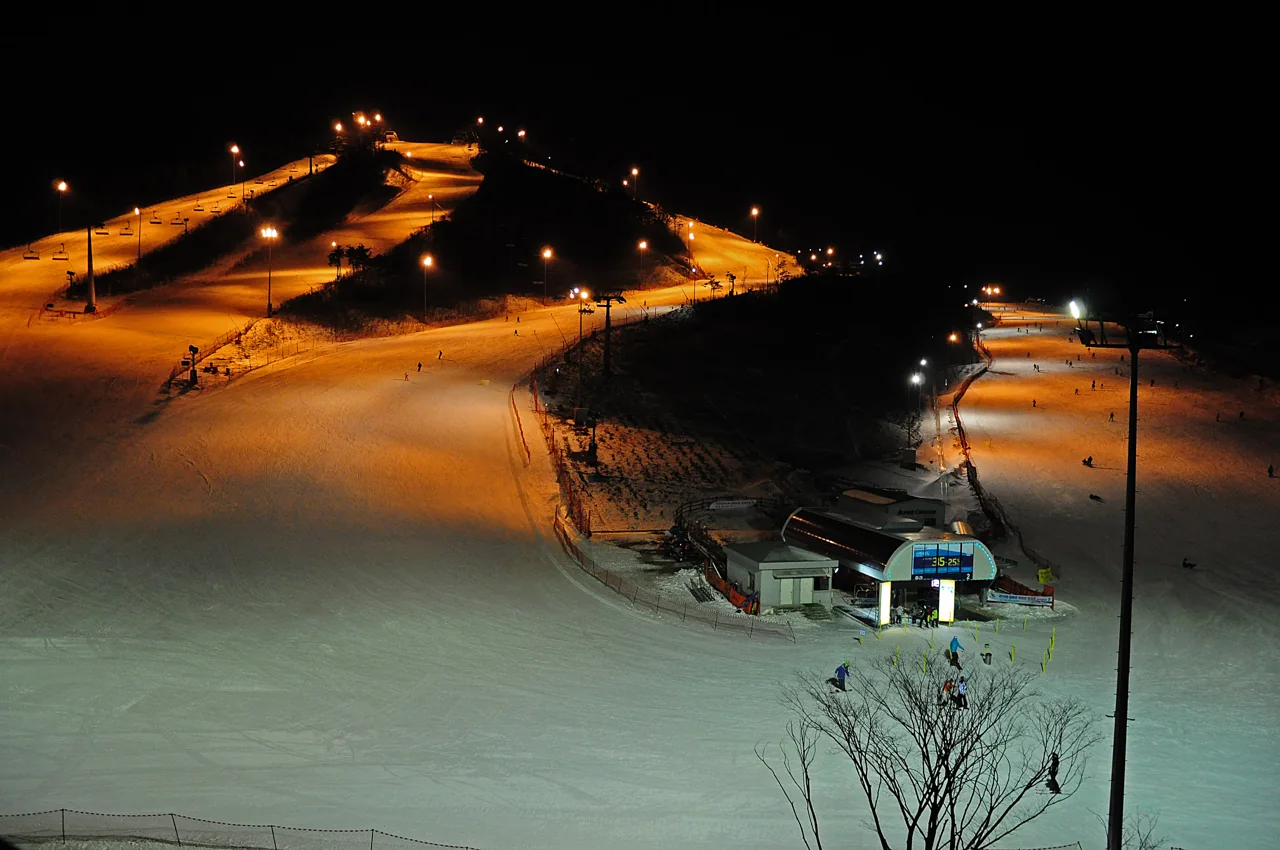
This surprises visitors from countries where the lifts stop at four. Vivaldi Park defines a day, in its own discount rules, as running from nine in the morning until three the following morning. Leaving Seoul in the evening, skiing at night and coming back before dawn is a thing people actually do.
That said, night and late-night operation differs by resort and can end partway through the season. If skiing after dark is the point of the trip, confirm that particular resort is running that night.
Which ticket to buy
If it is your first time, a morning or afternoon ticket often beats a full day. Beginners tire in two or three hours, and an unused afternoon is wasted money. Once you can ski, the full day wins, since you can break for lunch and go back out.
No prices here
Lift prices change every season, differ between weekdays and weekends, and differ again in the opening weeks. Anything printed here would be stale before winter. Learn the structure and check the amount against your date on the booking page.
7. The mountain closes for a while each day
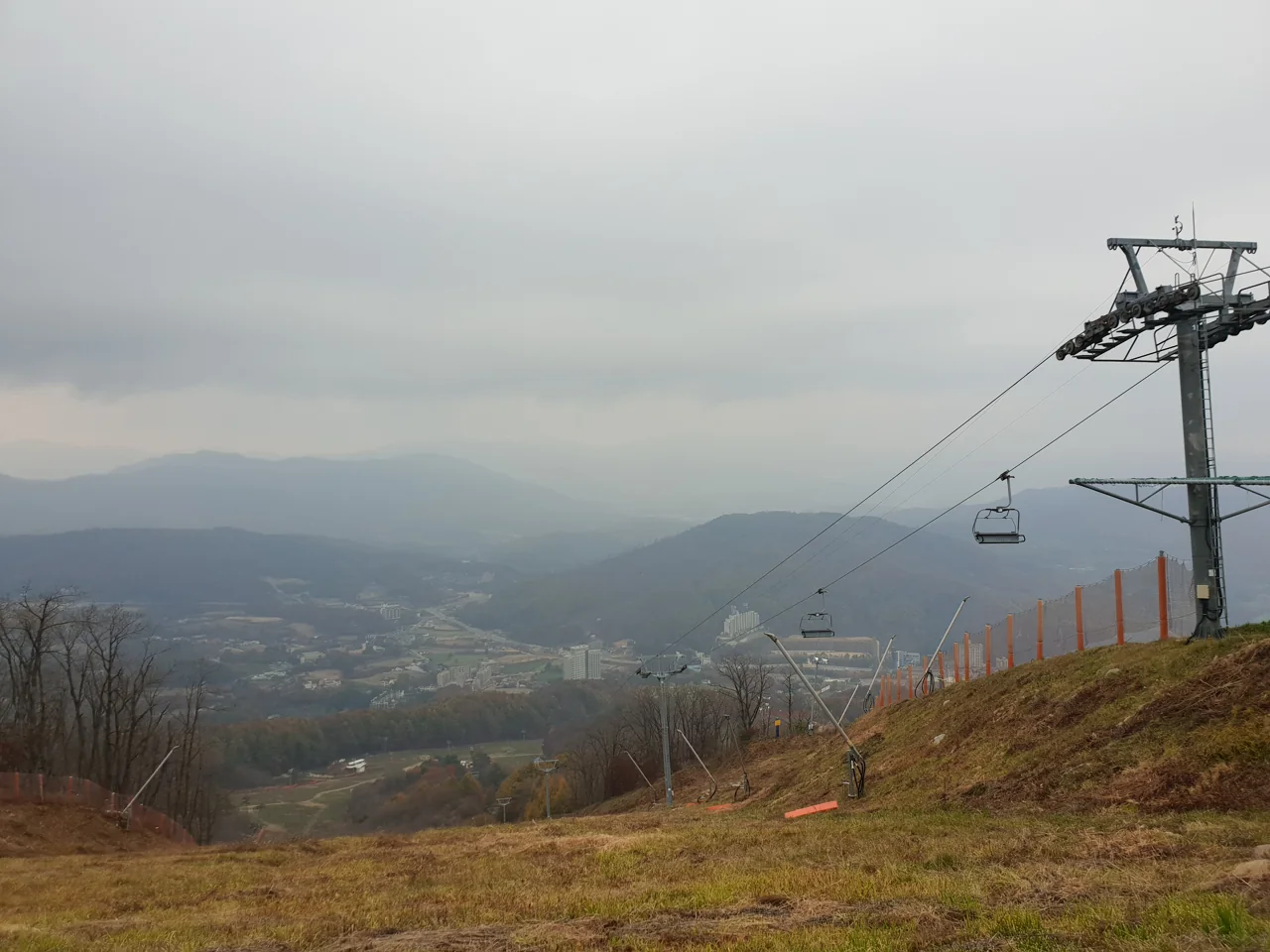
Lifts do not simply run from open to close. There is a grooming break, and the slopes shut while machines smooth and pack the snow. Turn up during it and the lifts are standing still.
High1 sets aside a couple of hours in the late afternoon for grooming and states that the slopes cannot be used then. Other resorts do much the same at much the same time. It generally falls between the end of the daytime ticket and the start of the night one.
Weather stops things too
Vivaldi Park says it operates normally in rain but suspends some facilities in lightning. High wind closes gondolas and upper lifts first, and it is far windier at the top than at the base.
So the useful question on a winter morning is not whether the resort is open but which lifts are turning today. That is on the resort’s website before you set off.
8. Discounts are for the ticket window, and you only get one
There are a lot of discounts and a consistent set of rules around them. Vivaldi Park spells them out, and other resorts work similarly.
- They apply to walk-up purchases at full price. An already discounted ticket does not get more taken off.
- They do not stack. Qualify for several and you get the largest one, not the sum.
- Once per person per day.
- You must show the card or document. Without it, no discount.
What kinds exist
Broadly: over-65s, disabled visitors and national-service veterans get the deeper reductions. Staying in the resort’s own accommodation discounts your whole party. There are card-issuer partnerships, and some resorts accept loyalty points as payment.
Worth knowing as a visitor: most of these need Korean documentation, so the ones you are likely to use are the accommodation discount and whatever the booking platform offers.
Booking online and discounting at the window are separate routes. Pre-booking gets you a lower advertised price; the window gets you the document-based discounts. You cannot have both, so work out which is larger first.
9. Renting gear
You do not need to own anything. Every resort has a rental shop that will kit you out completely. The order of operations is the part to know.
At Yongpyong, for example, you buy a rental voucher at the ticket office first, then take it to the rental counter to collect the gear. You do not pay at the counter itself. Most resorts work the same way, which catches people out who walk straight to the shop.
What you are renting
- Equipment. Skis or a board, boots and poles as a set. There are grades, and better gear costs more.
- Clothing. Jacket and trousers, rented separately from the equipment.
- Helmet and goggles. Wear the helmet.
- A locker for your clothes and bag. There is a charge if you lose the key.
What to bring yourself
Even renting the outerwear, bring your own base layers and thick socks. Cotton socks stay wet and leave your feet cold. Waterproof gloves, a neck cover and a hat make the difference between a good day and a short one.
Goggles can be rented, but if you wear glasses you need the kind that fits over them, which the rental stock may not include. Bring sunscreen as well; snow reflects more than people expect.
Mornings are slow
The rental counter takes everyone at once first thing. Collecting gear and changing eats a real piece of the morning. If you are day-tripping from Seoul, build that into the plan or the first half of the day disappears.
There are rental shops outside the resorts too, in the nearby towns and in Seoul. They cost less, at the price of carrying the gear yourself.
10. If it is your first time, take a lesson
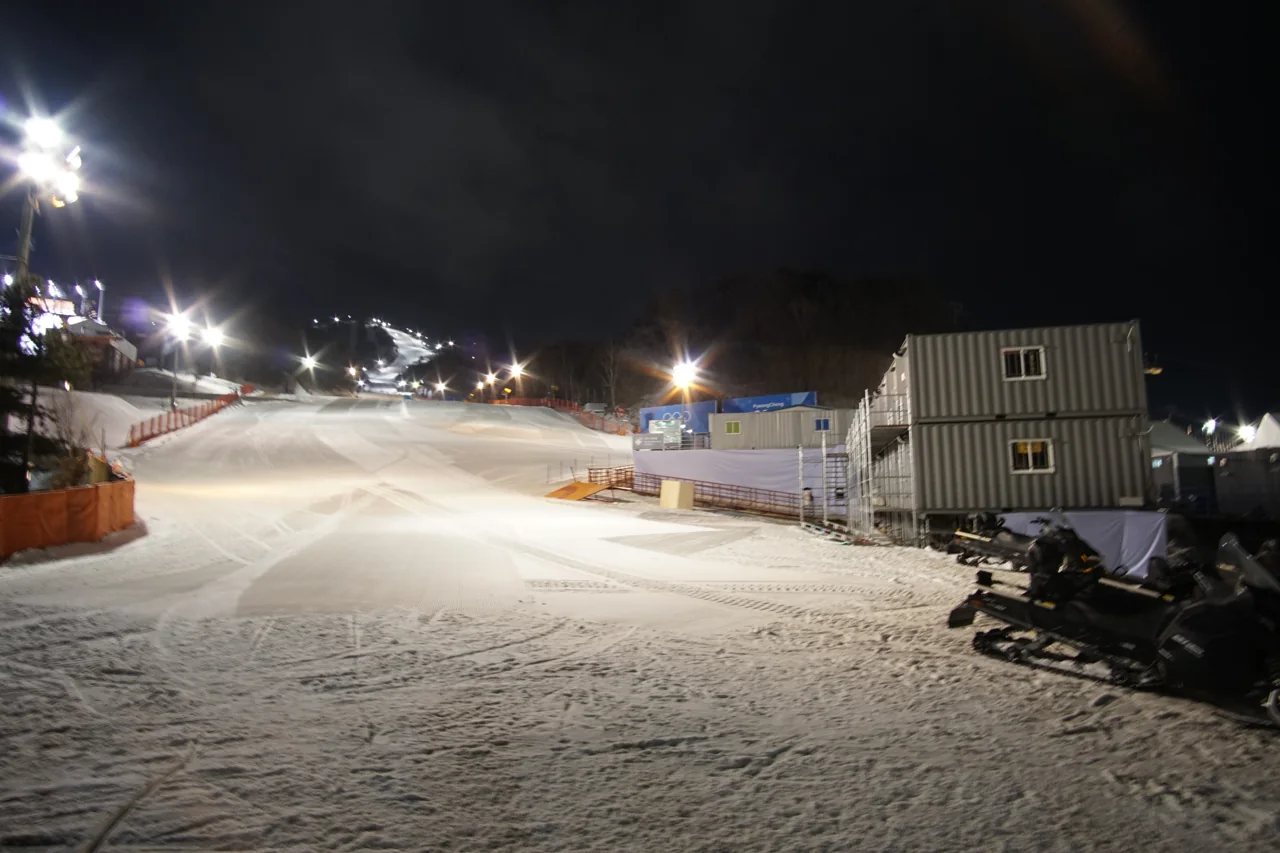
The common instinct is to turn up and work it out. But without knowing how to stop and how to fall, the first day mostly does not happen. Getting off the lift is the first obstacle.
Gangwon resorts run ski schools. Two-hour beginner sessions are standard, split into adult and children’s groups, with both resort-operated and independent schools on site.
What comes with a lesson
Some lesson tickets include lift access for the duration of the lesson, since beginners stay on the practice slope. Buying a lesson and a separate full lift ticket can mean paying twice, so check what is bundled.
English instruction
Larger resorts have instructors who teach in English, but availability is limited and weekends fill. Booking ahead rather than turning up is the difference between a lesson and a shrug. Some independent schools advertise foreign-language instruction specifically.
There is a beginner area
Every resort keeps gentle ground at the base with its own short lift. That is where a first day ends. Which means that for a first ski trip, six runs or twenty-eight makes almost no difference. Go to a close one.
What usually goes wrong
- The boots hurt. Tight is normal; painful is not. Ask to change the size rather than enduring it.
- Getting off the lift. People fall dismounting, not riding. Lessons cover this first.
- Going up too soon. The beginner slope looks dull, but there is no way down from an intermediate run except down it.
- Energy. Falling and standing up is tiring in a way that skiing is not. Take breaks.
With children, a lesson is effectively required. Children’s groups have limited places and weekend slots go early.
11. What non-skiers do
Groups usually contain someone who has no intention of skiing, and resorts are built for that. There is a full day available without ever putting on boots.
Sledding hills
Almost every resort has one. No equipment needed, and the ticket is separate from the lift pass. Sessions are split into morning, afternoon and full day, with evening hours at weekends in some places. With small children, this is a gentler first contact with snow than a lesson.
Note that evening sledding can finish partway through the season. High1 announces the last night of weekend evening operation separately. Check before planning around it.
Cable cars and viewpoints
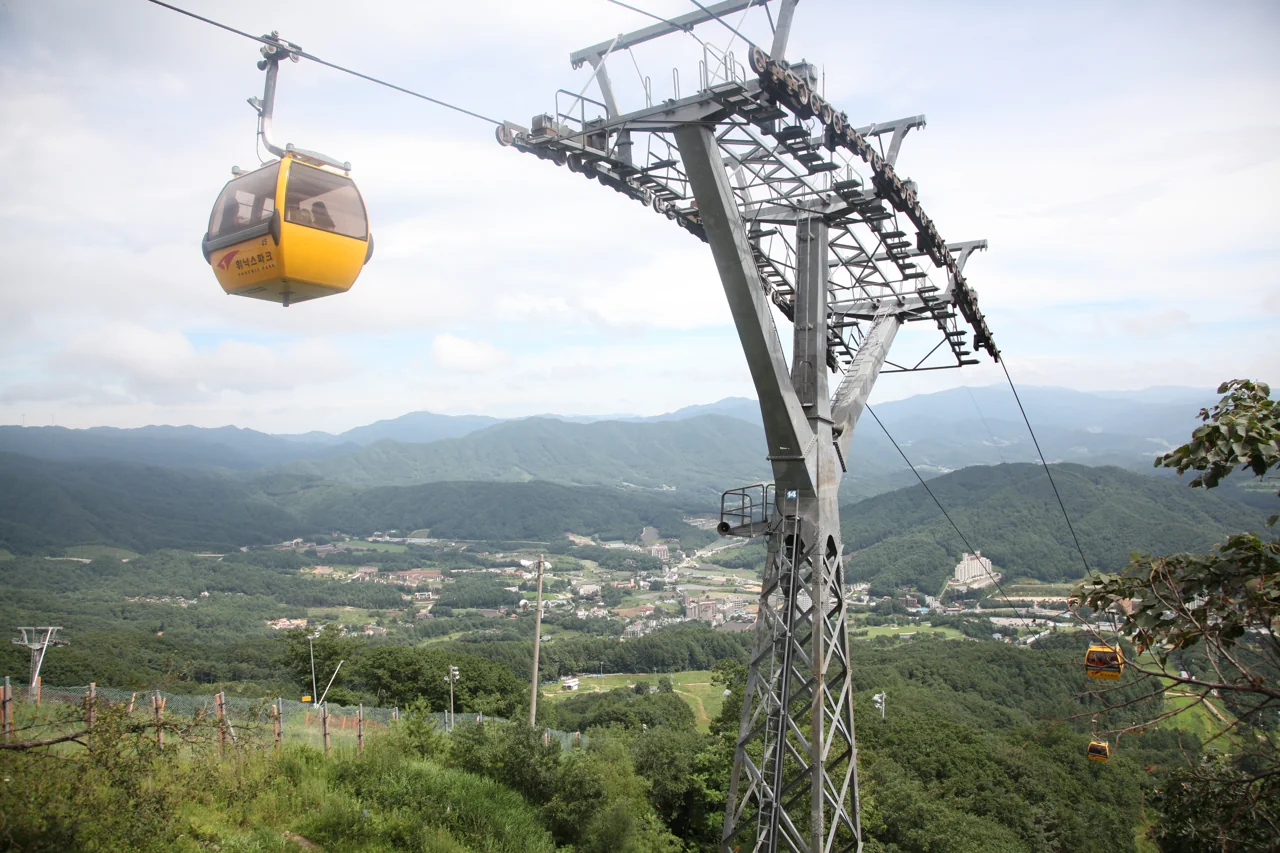
Several resorts run a cable car that takes non-skiers up the mountain. High1 operates one to an area at the top laid out for walking on snow. Some cable cars will not carry ski equipment, so a mixed group wanting to ride together should check first.
Bad weather or maintenance stops the cable car before anything else, and whatever sits at the top closes with it.
Water and hot springs
Vivaldi Park has a water park attached, so part of the group can spend the day in the water instead. Many resorts have a sauna or spa on site. After a day of falling over, that is useful to the skiers too.
These are all separate tickets. Sledding, cable cars and water parks are not in the lift pass. Budget for them per head.
12. Getting there without a car
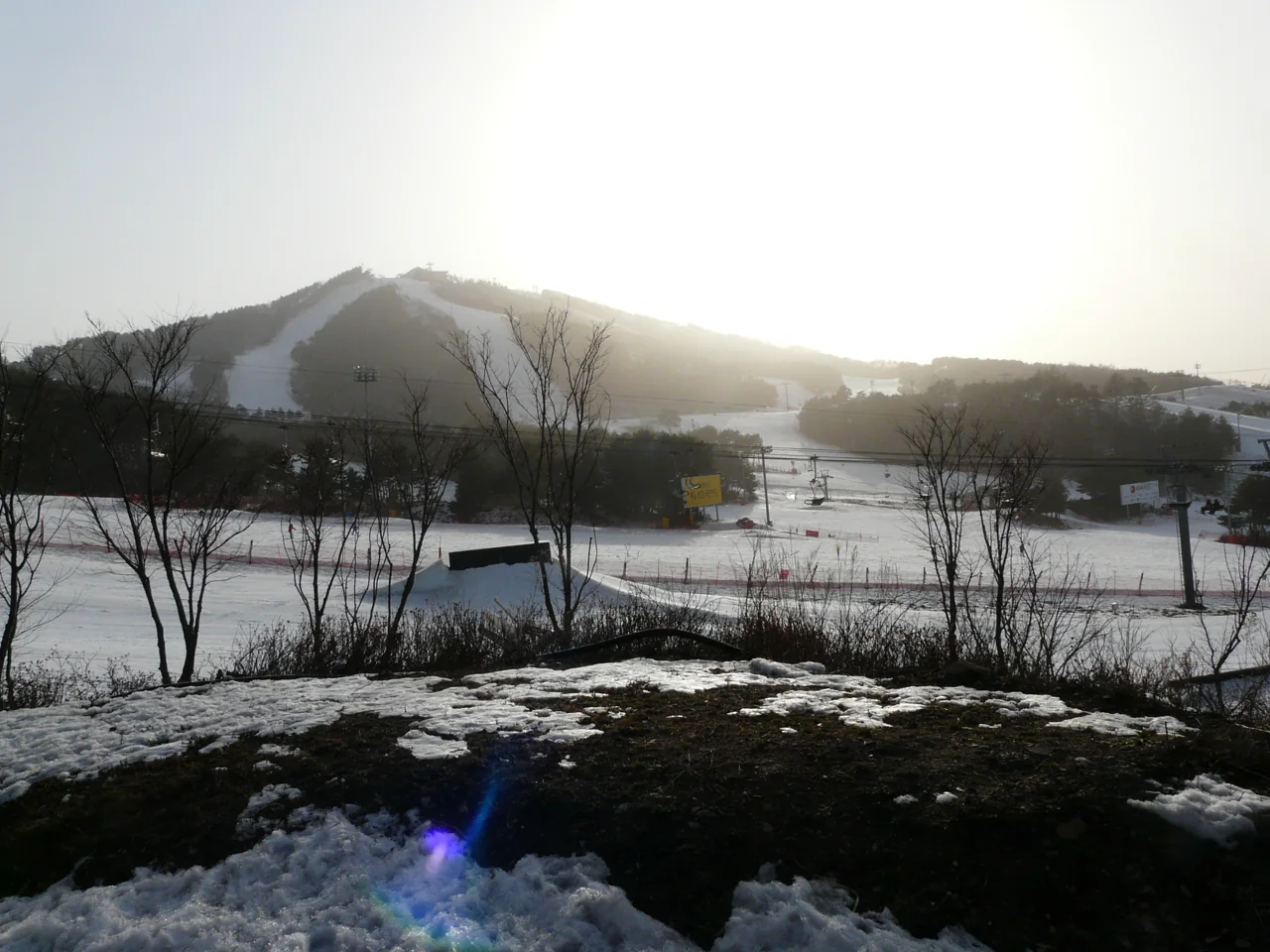
The split between reachable and not reachable by rail is sharp.
- On the metro. Elysian Gangchon only, beside Baegyangni station on the Gyeongchun line, direct from Seoul with no change.
- Near a train station. High1 and O2 Resort, on the Taebaek line at Sabuk and Taebaek.
- By KTX. The Gyeonggang line serves Pyeongchang. Get off at Jinbu or Pyeongchang for Yongpyong, Alpensia and Phoenix Park, then cover the last stretch separately.
- Not by train. Vivaldi Park.
Shuttle buses
Most resorts run shuttles from Seoul. Routes, fares and booking systems differ by resort and they operate in season only. Many are sold bundled with a lift ticket, rental or lesson. For a visitor without a car, this is often easier than the train, because it ends at the resort door rather than at a station.
What to check about a shuttle
First, where in Seoul it leaves from, and how long it takes you to reach that point. Second, what time it leaves the resort in the evening, since that fixes when you must return gear and change. Missing it is a long way from anywhere.
The last stretch from the station
Arriving by train leaves a final gap. Some resorts send a shuttle to meet the trains; elsewhere it is a taxi. Renting gear at the resort keeps you light enough for this to be easy. Carrying your own equipment changes the calculation.
13. Where the resorts are
Here is how the nine spread across the province.
Three of them are in Pyeongchang
Two of those, Yongpyong and Alpensia, share the Daegwallyeong area. Base yourself in Pyeongchang and you can ski several resorts from one hotel. Over several days that counts for a lot.
A front row and a back row
On a map, Chuncheon, Hongcheon and Wonju form a front row nearer Seoul, with Pyeongchang, Jeongseon and Taebaek behind. Hoengseong sits between them, and Welli Hilli Park gets the benefit of that middle position: much bigger than the front row, noticeably closer than the back.
14. Where to stay
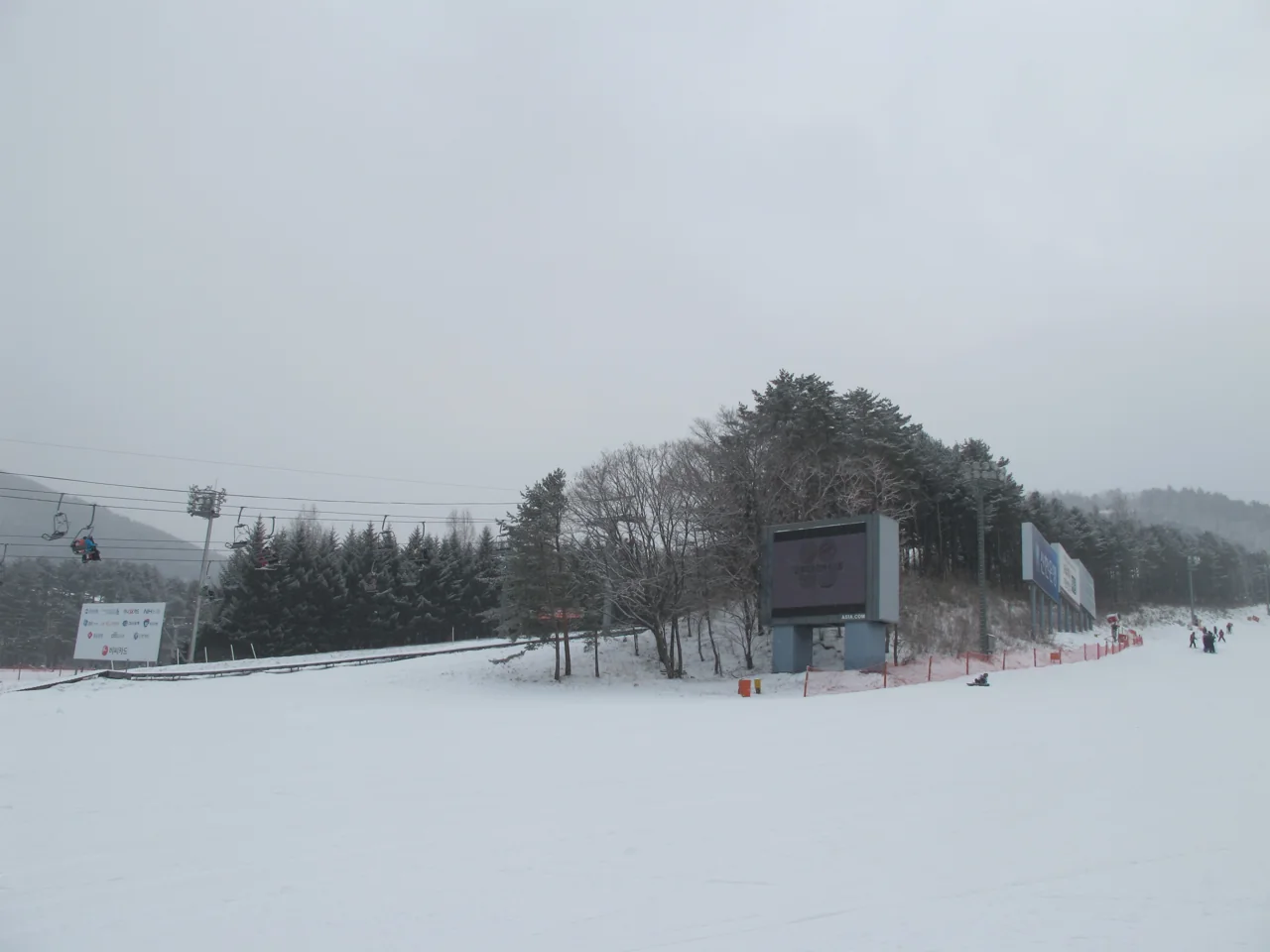
Unless you are day-tripping, you need a bed. Three options.
In the resort
Easiest by a distance. You walk to the slope, leave gear in the room, and the guest discount brings the lift ticket down, sometimes for your whole party. Winter weekend rates are high and peak dates fill months out.
In the nearby town
Pensions and small hotels cluster a few minutes’ drive from each resort, cheaper and more available. The cost is a commute at each end of the day, which needs a car to be comfortable.
Staying in Seoul
For the three close resorts, staying put in Seoul and going out for one day works well. No changing hotels, and the ski day slots into a Seoul itinerary. If the rest of your trip is in the city, this is the simplest arrangement by far.
Staying a few nights in Pyeongchang, you can come back via Gangneung or Sokcho and add the winter coast. The mountains are not far from the sea here.
15. How to choose
Everything above, sorted by what you care about.
| If you are | Go to | Because |
|---|---|---|
| Skiing for the first time | Any of the three near ones | Your day ends on the beginner slope, so size is irrelevant |
| Without a car | Elysian Gangchon | It is beside a metro station |
| Travelling by train | High1 Resort | Minutes from Sabuk station, and one of the larger resorts |
| Wanting variety | Mona Yongpyong | The biggest in Gangwon, at over two and a half hours |
| Wanting both size and speed | Welli Hilli Park · Phoenix Park | Much bigger than the near ones, closer than the far ones |
| Skiing several days | Pyeongchang | Three resorts from one base |
| Only free for half a day | The two in Gyeonggi | No need to reach Gangwon at all |
Gyeonggi counts as an option
There are two resorts in Gyeonggi, just outside Seoul. They are closer than anything in Gangwon and about the size of Gangwon’s smaller resorts. For half a day on snow, driving to Gangwon adds very little.
What Gangwon has, and Gyeonggi does not, is the big mountains. Wanting variety, or several days, takes you there. Wanting one afternoon does not.
16. Fitting a ski day into a winter trip
How a day on snow slots into the rest of a Korea itinerary.
Based in Seoul, out and back
Pick one of the three near resorts. Leave early and you get both morning and afternoon, returning to Seoul in the evening. Not changing hotels is the whole advantage. Without a car, Elysian Gangchon does it on the metro.
Do not forget the rental queue. Collecting gear and changing takes real time, and on a weekend morning that queue is long.
Based in Gangwon for several days
Settle in Pyeongchang and Yongpyong, Alpensia and Phoenix Park are all nearby. The first day loses half of itself to travel and you ski properly from the second. Below two full days of skiing, the travel is not worth it.
Skiing at night
A night or late-night ticket frees the daytime for something else: see other things by day, ski after dark. It also costs less than daytime. Confirm the resort runs at night on your date first.
Adding the winter coast
Gangneung and Sokcho are not far from Pyeongchang or Jeongseon. Two days of skiing and a last day on the East Sea is a common shape, and it does not take you far off the road back to Seoul. If you are building around a Seoul itinerary, ending at the coast fits naturally.
🎡Things to Do3
🧭All-Korea essentials135
Skiing in Korea: common questions
Images: Photographs via Wikimedia Commons: Kalatpadai (CC0), yeowatzup (CC BY 2.0), Steven Williams (CC BY-SA 3.0), Choi2451 (CC BY-SA 3.0), Piotrus (CC BY-SA 3.0), Mkckim (CC BY-SA 3.0), Albert Lee1 (CC BY-SA 4.0), Jinho Jung (CC BY-SA 2.0).