
Busan Fireworks Festival: The Complete Gwangalli Guide
Korea’s biggest fireworks show lights up Gwangan Bridge every autumn. Here’s when it’s on, the best free spots, how the paid seats work, when to arrive, and how to actually get home afterwards.
| What it is | Korea’s largest fireworks festival — a music-synced multimedia sea show of fireworks and lasers over Gwangan Bridge at Gwangalli Beach, drawing well over a million spectators. |
|---|---|
| When | Once a year, on a Saturday evening in late autumn (usually late October or November). The main show runs about 19:00–20:00 (~60 min). |
| Cost | Free to watch from the beach and the public spots. Reserved seats on the sand cost roughly ₩70,000 (S) to ₩100,000 (R). |
| Best free spot | The Gwangalli sand for the full frontal view (very crowded), or Millak Waterside Park for the whole bridge with a bit more room. |
| Getting there | Metro Line 2 to Gwangan Station (Exit 3 or 5), ~10 min walk. Expect heavy crowds and road closures; the metro is packed after the show. |
| Arrive by | Mid-afternoon (~14:00–16:00) to claim a free beach spot; by 18:00 if you hold a paid seat — late entry isn’t allowed. |
1. What the Busan Fireworks Festival is
2. A short history of the festival
3. When is it? Dates and times
4. What the show is actually like
5. Paid seats: zones, prices and how to buy
6. The best free viewing spots
7. Watch from the water: yacht & cruise
8. How to get there — and home again
9. When to arrive
10. Hour by hour: how to plan the day
11. What to bring
12. Where to stay for the festival
13. Photography tips
14. Make a trip of it
15. Busan vs Korea’s other fireworks festivals
16. First-timer mistakes to avoid
17. Is it worth it? Who it’s for
18. Plan your festival night
1. What the Busan Fireworks Festival is
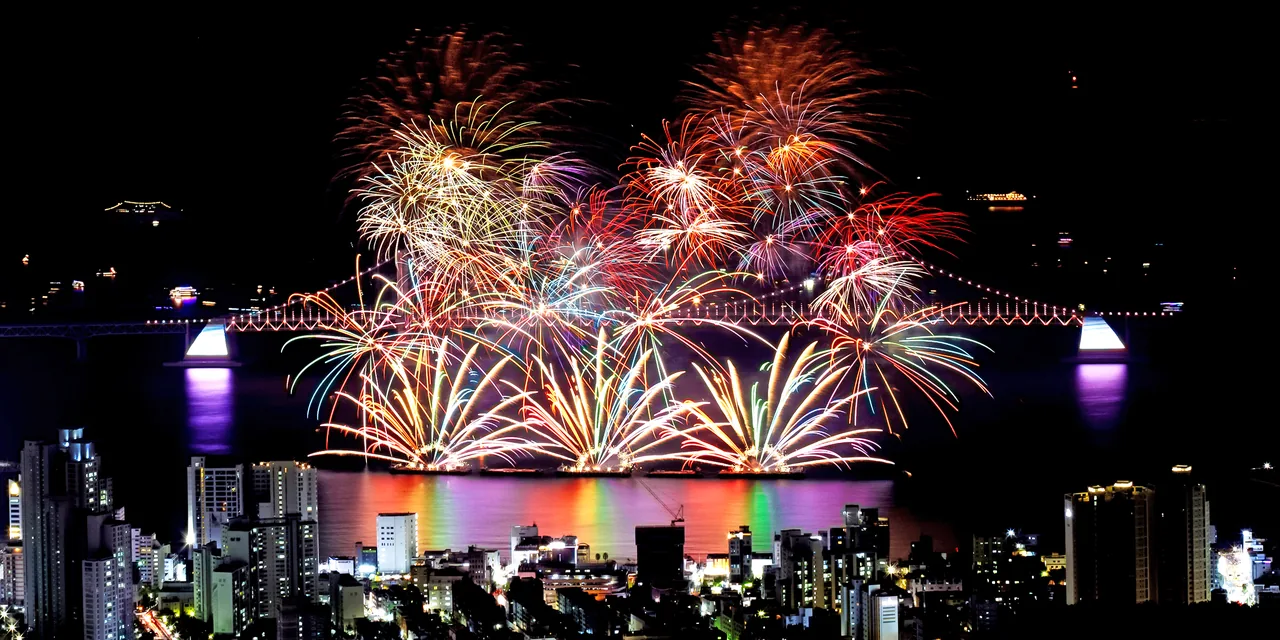
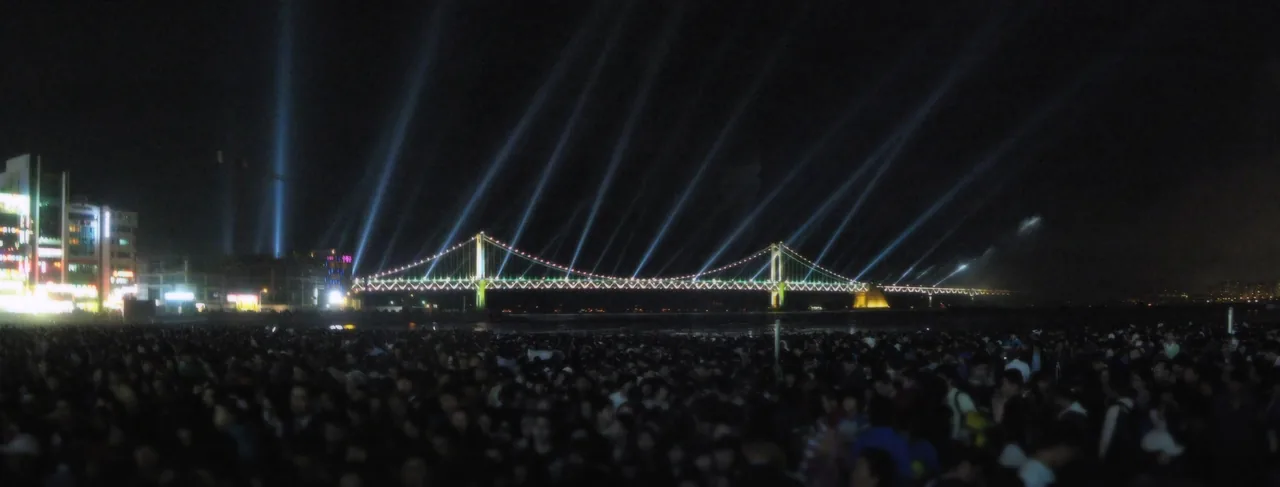
The Busan Fireworks Festival (부산불꽃축제) is the biggest event of its kind in Korea, and one of the largest in Asia. Once a year the city turns Gwangalli Beach and the Gwangan Bridge into a stage for a “multimedia sea show”: tens of thousands of fireworks fired from the bridge, barges and the beachfront, choreographed to theme music and laser light. It regularly pulls in over a million spectators in a single night — the 2025 edition drew about 1.17 million.
It started in the mid-2000s and grew fast once the city pushed it as an international draw; today it’s the headline date on Busan’s calendar. The setting is what makes it special: the fireworks burst over the long, lit Gwangan Bridge and reflect off the bay, so the whole curve of the beach becomes a natural amphitheatre.
2. A short history of the festival
The festival began in November 2005, launched as a multimedia sea show to celebrate the APEC summit that Busan hosted that year. It was an instant hit — around a million people turned out for that first night — and the city quickly made it an annual fixture and an international draw.
- From local to global: over two decades it grew from a one-off celebration into Korea’s signature pyrotechnic event, now in its 20th edition (2025).
- International guest teams: the program has long featured invited foreign pyrotechnicians — from China’s Fireshow in the early years to Japan’s celebrated Hibikiya more recently — each bringing its own style alongside the Korean display.
- Bigger every year: recent editions are the largest yet; the 2025 show spanned some 400 m of sky and drew about 1.17 million people.
3. When is it? Dates and times
The festival is held once a year, on a Saturday evening in late autumn — most often in late October or November. There’s no fixed calendar date; the city announces it a few months ahead, so check the official Busan tourism channels for the exact date of the year you’re visiting. The 21st edition is confirmed for Saturday 7 November 2026. Our guide to Busan in November covers that week, including the road closures and how to get out afterwards.
- Most recent edition: the 20th festival was held on Saturday, 15 November 2025.
- Main show: roughly 19:00–20:00, about a 60-minute finale-packed program.
- The day around it: the beach area and stages open in the early afternoon (around 14:00–15:00), with side events, food stalls and music before the fireworks.
4. What the show is actually like
This isn’t a quick municipal fireworks display. It’s a scripted, hour-long production — and knowing the shape of it helps you settle in rather than wonder when the big moment is coming.
- Multimedia, not just fireworks: the show layers fireworks, laser beams and lighting over the bridge, all synchronized to a soundtrack of theme music that plays across the beach speakers.
- The bridge is the star: shells launch from the 2.1 km Gwangan Bridge itself, from barges on the water and from the shore, so the fireworks frame and cascade off the bridge rather than just rising into empty sky.
- Built to a climax: it runs in themed chapters and builds to a wall-of-light finale that fills the whole bay — the moment the whole crowd is waiting for.
- Scale: tens of thousands of shells over the hour, reflected in the water, with the city skyline behind. It’s genuinely one of the best fireworks shows you can see in Asia.
Signature moments to watch for:
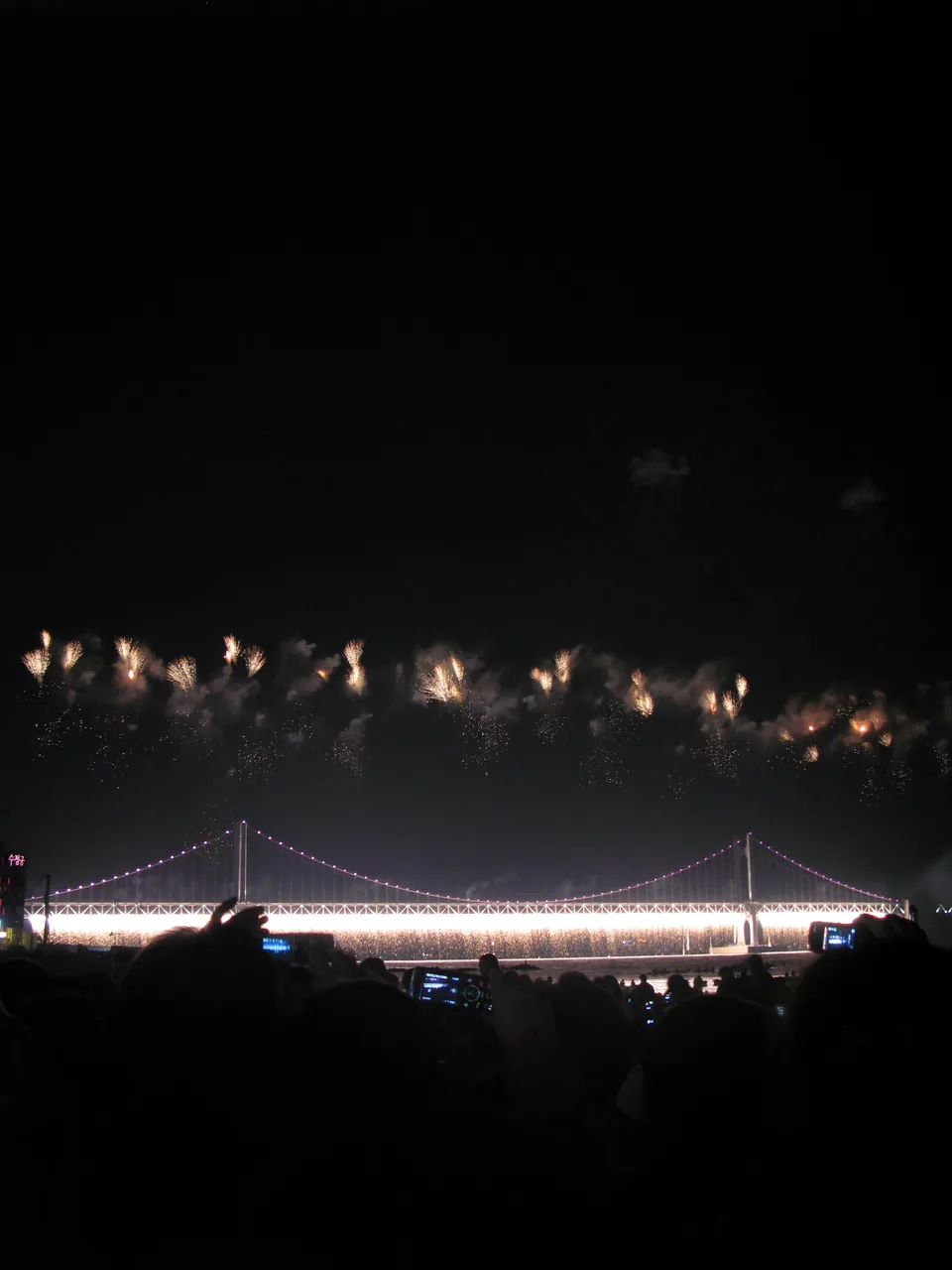
- The “Niagara Falls”: a curtain of golden sparks pouring off the full length of the bridge — the show’s most famous image, stretched to around 40 m in recent years.
- Giant shells: 25-inch ultra-large fireworks that fill the sky over the bay in a single burst.
- The bridge media façade: Gwangan Bridge’s own lighting is choreographed into the show, so the structure itself becomes part of the display.
- “Catch-ball” volleys: the bridge and offshore barges trade fireworks back and forth across the water.
- The golden finale: a relentless closing barrage that turns the entire sky over the bay molten gold.
5. Paid seats: zones, prices and how to buy
If you want a guaranteed spot with a clear frontal view, the festival sells reserved seats on the prime stretch of beach, between Hotel Aqua Palace and Homers Hotel. You don’t need a ticket to attend — the free areas are excellent — but seats remove all the stress of staking out ground hours early.
| Seat | What you get | Rough price |
|---|---|---|
| R seat | Chair plus a table (room for snacks; more space — good for families) | ~₩100,000 |
| S seat | Chair only, in the paid beachfront zone | ~₩70,000 |
The paid area is split into colour-coded zones (Purple, Red, Green, Blue) so you can pick where you sit. A few rules to know:
- Buy online ahead: tickets are sold through Yes24 Ticket and the Busan Bank (BNK) app, plus Busan Bank branches. They sell out, so don’t leave it late.
- Dongbaekjeon bonus: paying with Dongbaekjeon, Busan’s local digital currency, has come with an ~11% bonus on the ticket value (limited per ID) — worth it if you can set it up.
- Be seated by 18:00: the gates close at 6 pm on the day; late arrivals aren’t admitted and there’s no refund. Seats are reserved and you can’t move between them.
6. The best free viewing spots
Here’s the good news: most of the million-plus crowd watches for free, and the show is designed to be seen from all around the bay. Each spot is a trade-off between view and crowds.
| Spot | The view | Crowd |
|---|---|---|
| Gwangalli sand (centre) | Full frontal, fireworks dead ahead — the classic view | Extreme |
| Millak Waterside Park | The whole bridge side-on, great for photos | Heavy but roomier |
| Igidae Park | Coastal cliffs with the bridge and skyline together | Moderate |
| Dongbaek Island | Across the bay from Haeundae side, distant but calm | Lighter |
| Hwangnyeongsan Mountain | Panoramic, the whole bay from above | Lighter, but a climb |
- For the full effect: the Gwangalli sand near the centre — closest, loudest, with the music — but you’ll need to arrive in the early afternoon and sit tight.
- For photos: Map Millak Waterside Park gives you the bridge side-on with the fireworks above it, with a little more breathing room.
- To escape the crush: Map Hwangnyeongsan for a panorama from above, or Map Igidae and Map Dongbaek Island for a calmer coastal view.
- Cafés & rooftops: the Namcheon-dong cafés behind the beach and high floors with a bay view sell out and charge a premium, but get you a seat, a warm drink and a clear sightline. See more in Busan cafés guide.
7. Watch from the water: yacht & cruise
Want to skip the crowd entirely and see the show from arguably the best seat of all — the water? On festival night, yacht and cruise operators run special sailings out onto Gwangalli Bay, where the fireworks burst right overhead with nobody in front of you.
- Festival-night yachts: premium cruises head onto the bay for the show — unobstructed, uncrowded and unforgettable. They cost more than a reserved seat and sell out early, so book well ahead.
- Regular night cruises: even outside the festival, a Gwangalli sunset or night yacht under the lit Gwangan Bridge is one of Busan’s best experiences — see our Busan yacht tour guide for what to expect.
- Worth knowing: out on the water you’re farther from the beach speakers, so the music is fainter, and sailings depend on the weather and can be cancelled in rough seas.
8. How to get there — and home again
The transport is the genuinely hard part of the night, so plan it like part of the show.
- By metro: take Line 2 to Gwangan Station and walk ~10 minutes to the beach (Exit 3 or 5). Millak park is closer to Geumnyeonsan Station, also on Line 2.
- Road closures: wide areas around Gwangalli are closed to traffic on festival evening, and the bridge itself shuts for the show — don’t plan on a taxi or car near the beach.
- The way home is the catch: a million people leave at once. The metro is jammed for a good while after 20:00, with entry queues at Gwangan Station.
9. When to arrive
Timing is everything at an event this size, and it’s different depending on how you’re watching.
- Free beach spot: arrive in the early afternoon, around 14:00–16:00, to claim a patch of sand near the centre. By late afternoon the prime front rows are gone.
- A roomier free spot (Millak, Igidae, a café): still come well before sunset — a couple of hours early is sensible on the day.
- Paid seat: you must be inside by 18:00; aim for 17:00–17:30 to clear the entry queues calmly.
- Hilltop (Hwangnyeongsan): allow extra time for the climb and the limited transport up.
10. Hour by hour: how to plan the day
Here’s a realistic timeline for festival day so nothing catches you out:
| Time | What to do |
|---|---|
| ~14:00 | Beach and stages open. Arrive now if you want a central free spot on the sand. |
| 15:00–16:00 | Stake your spot, grab food from the stalls, enjoy the side events and music. |
| 17:00–17:30 | Paid-seat holders: head to the entrance to clear the queues calmly. |
| 18:00 | Seating gates close — you must be inside; no late entry. |
| 19:00–20:00 | The main show. |
| 20:00–21:00 | Let the crowd thin — linger on the beach or eat before you try the metro. |
| 21:00+ | Head out, or walk a station down the line to board more easily. |
11. What to bring
A little kit turns a long wait into a comfortable evening.
- A mat or blanket to sit on the sand, and something to lean on for the hours before the show.
- Layers: a late-autumn evening by the sea gets cold after dark — bring a warm jacket even if the afternoon is mild.
- Snacks and drinks, though the Namcheon-dong stalls and convenience stores are close (and mobbed).
- A power bank: hours of photos and maps in a crowd will drain your phone, and you’ll want it working for the way home.
- Some cash for stalls, and a small bag for your rubbish — the beach is busy and bins overflow.
12. Where to stay for the festival
This is the one weekend a year when Gwangalli rooms sell out and prices jump, so book early — ideally weeks ahead.
- Gwangalli / Millak (for the view): a bay-facing room here can mean watching the whole show from your window or balcony — the ultimate option, and priced accordingly.
- Gwangalli (general): staying in the neighbourhood means you can walk back and skip the worst of the transport crush.
- Haeundae or Seomyeon: good bases a short metro ride away if Gwangalli is full or over budget — just plan for the busy ride back.
For neighbourhoods and specific picks, see where-to-stay guide and Busan hotels guide. A bay-view hotel is the single biggest upgrade you can make to your festival night.
13. Photography tips
The fireworks-over-the-bridge composition is one of Korea’s iconic shots. A few things help:
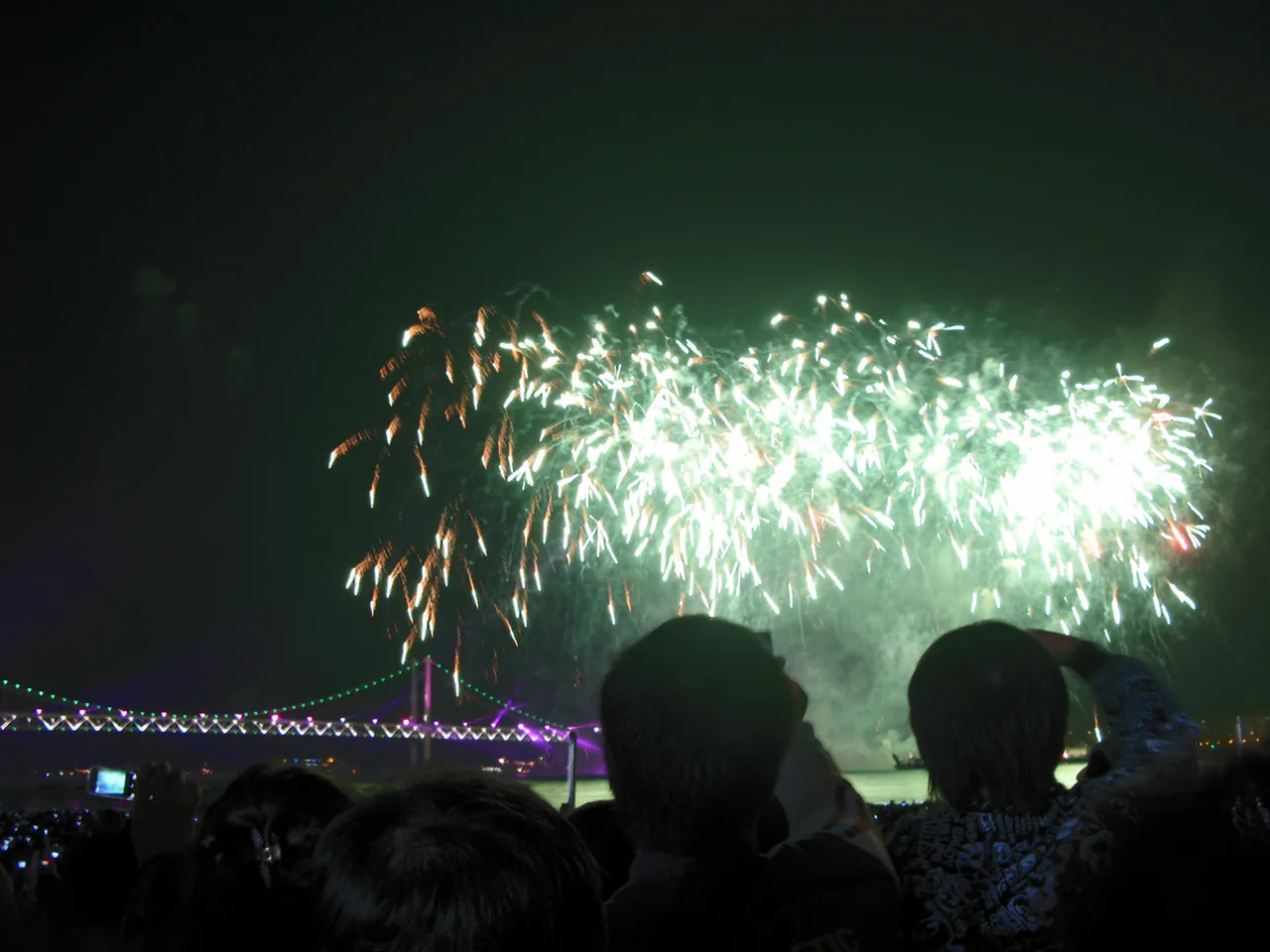
- Go to Millak: Map Millak Waterside Park gives you the bridge side-on with the fireworks above and reflections below — the classic frame.
- Bring a tripod and shoot long exposures (a few seconds) at a low ISO for clean light trails; a phone’s night or long-exposure mode works surprisingly well too.
- Arrive early to set up — once the crowd packs in you won’t be able to plant a tripod or change position.
- Frame for the bridge, leaving sky above for the bursts, and include the water for the reflection.
14. Make a trip of it
You’re coming to Busan for one night of fireworks — so build a great weekend around it. The festival lands in autumn, one of the best times to visit the city.
- By day: Gwangalli sits minutes from Haeundae and the city’s headline sights; fill the daylight hours before the show with the beaches, the markets and the sea temple. Our things to do in Busan guide has the full list.
- Plan the days: slot the festival into a wider route with our Busan itinerary guide.
- Book activities: tours, passes and day trips around your festival weekend are easy to line up in advance.
15. Busan vs Korea’s other fireworks festivals
Korea has a few big fireworks festivals. Here’s how Busan compares, so you can plan around whichever you can catch:
| Festival | Where & when | Style |
|---|---|---|
| Busan Fireworks Festival | Gwangalli Beach, Busan; late autumn (Oct–Nov) | Multimedia sea show over Gwangan Bridge; ~1M+; free plus paid seats |
| Seoul Int’l Fireworks Festival | Yeouido, Han River, Seoul; early October | Multinational teams over the river; ~1M; free; run by Hanwha |
| Pohang Int’l Fireworks | Yeongildae Beach, Pohang; summer | A more relaxed coastal summer show; smaller crowds |
All three are free and spectacular. Busan’s edge is the setting — fireworks bursting over the lit Gwangan Bridge and reflecting off the bay, which many consider Korea’s most scenic. Seoul’s, over the Han River, is the easiest to combine with a city trip; Pohang’s is the summer option.
16. First-timer mistakes to avoid
A handful of avoidable slip-ups account for most ruined festival nights:
- Arriving too late for a free spot — the central front beach is gone by late afternoon; come around 14:00–16:00.
- Rushing the metro at 20:00 — it’s gridlocked right after; wait 30–60 minutes or walk a stop.
- Underdressing — the sea air turns cold after dark in autumn, even if the afternoon was mild.
- Counting on a taxi by the beach — roads are closed; you’ll be walking to the metro either way.
- Hoping to buy a paid seat on the day — they sell out, and only via Korean platforms; sort it ahead or take a free spot.
- No power bank — hours of photos and maps in a crowd will kill your phone before the trip home.
17. Is it worth it? Who it’s for
Honestly, yes — if you accept the crowds. The show itself is world-class and free, and the atmosphere of a million people on a beach under the lit bridge is something you don’t forget.
- Great for: couples, friends, photographers and anyone who loves a big event and a buzzing crowd.
- Plan carefully with kids: it’s doable and magical, but bring a mat, warm layers and patience for the exit, and consider a roomier spot like Millak over the central crush.
- If you hate crowds: watch from Hwangnyeongsan, Igidae or a café rooftop, or honestly, this might not be your night — Gwangalli on any normal evening is lovely and calm.
18. Plan your festival night
Everything in one place: confirm the official date for your year, decide between a free spot (arrive early afternoon) and a paid seat (in by 18:00), book a room early — a bay view if you can — and plan your exit so the crowd doesn’t catch you out.
Sort the basics on arrival with getting-around guide and airport guide, pick your base in where-to-stay guide, and check best-time-to-visit guide for the autumn weather. For the wider city, see the full complete Busan Travel Guide and our Gwangalli Beach guide to the beach itself. Then claim your patch of sand and enjoy the show.
🎡Things to Do48
🍜Food7
🏨Where to Stay3
🚇Getting Around8
🧭Travel Tips14
📌More3
🧭All-Korea essentials45
Busan Fireworks Festival FAQ
📖 Read the complete Busan Travel Guide →
Images: Hero: Busan Metropolitan City, CC BY-SA 4.0. Festival fireworks: RedMosQ, CC BY-SA 2.0 KR. All via Wikimedia Commons.