
Busan Milmyeon, Explained: The City’s Own Cold Noodle Dish
What milmyeon actually is, how it differs from naengmyeon, the three competing origin stories behind it, and where to eat it in Busan in 2026 — including an important correction about Gaya Milmyeon’s original location.
| What it is | A Busan noodle dish made with wheat flour noodles, served either cold in a tangy-sweet iced broth (mul-milmyeon) or tossed in a spicy sauce with no broth (bibim-milmyeon). |
|---|---|
| Where it came from | Korean War-era Busan, when refugees who wanted buckwheat naengmyeon substituted wheat flour, much of it from U.S. relief aid, because buckwheat was scarce and expensive. |
| Who’s credited with starting it | Naeho Naengmyeon in Uam-dong is the most widely cited origin point, though the National Folk Museum of Korea documents three competing theories rather than one settled story. |
| Important correction | Gaya Milmyeon’s original Gaegeum-dong flagship closed for good in 2021 when its founder retired. Visit the independently run Haeundae Gaya Milmyeon branch instead. |
| 2026 price range | Roughly ₩6,000–9,000 for a small bowl and ₩7,000–10,500 for a large, though pricing varies shop to shop and changes over time. |
| Best season | Eaten year-round, but especially popular as a cold-weather-beating summer dish. |
1. What Is Milmyeon? The Quick Answer
2. The Origin of Milmyeon: Born Out of War, Not One Single Story
3. Milmyeon vs. Naengmyeon: What’s Actually Different
4. Mul-Milmyeon vs. Bibim-Milmyeon: The Two Styles
5. What’s Actually in a Bowl of Milmyeon
6. How Locals Actually Eat Milmyeon
7. Naeho Naengmyeon: The Restaurant Most Credited With Starting It All
8. Gaya Milmyeon: The Shop Credited With Perfecting the Recipe (Read This Before You Go)
9. Gaegeum Milmyeon: Busan’s Other Founding Name
10. More Legendary Milmyeon Shops Worth Knowing About
11. How Much Does Milmyeon Cost in Busan (2026)?
12. What to Order Alongside Milmyeon, and What to Bring Home
13. Allergy and Dietary Notes
14. Is Milmyeon a Summer-Only Dish?
15. Which Milmyeon Shop Matches What You’re Looking For
16. Tips for Your First Bowl, and Where to Go Next
Milmyeon is Busan’s own cold wheat-noodle dish, born out of wartime necessity and now one of the city’s defining foods. This guide walks through what’s actually in a bowl, how milmyeon differs from naengmyeon, the honest (and contested) story of where it came from, deep dives into the restaurants most closely tied to its history, a 2026 price guide, and an important correction about a restaurant that a lot of other guides still get wrong. For the rest of your Busan trip, pair this with our complete Busan travel guide.
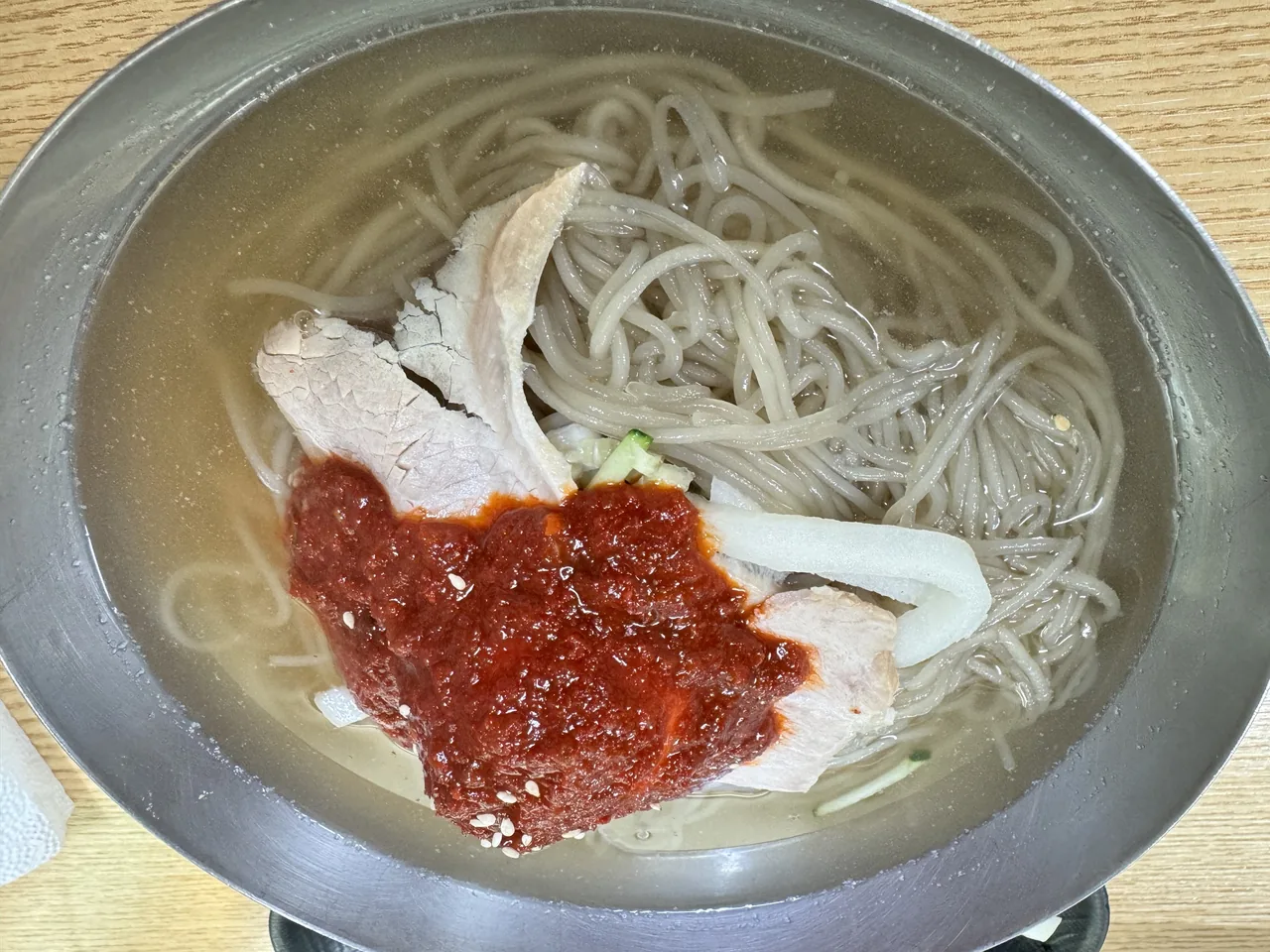
1. What Is Milmyeon? The Quick Answer
Milmyeon is Busan’s cold wheat-noodle dish, served either in a tangy-sweet iced broth or tossed in a spicy red sauce with no broth at all. It looks like naengmyeon and gets compared to it constantly, but the noodles, the broth, and the backstory are genuinely different.
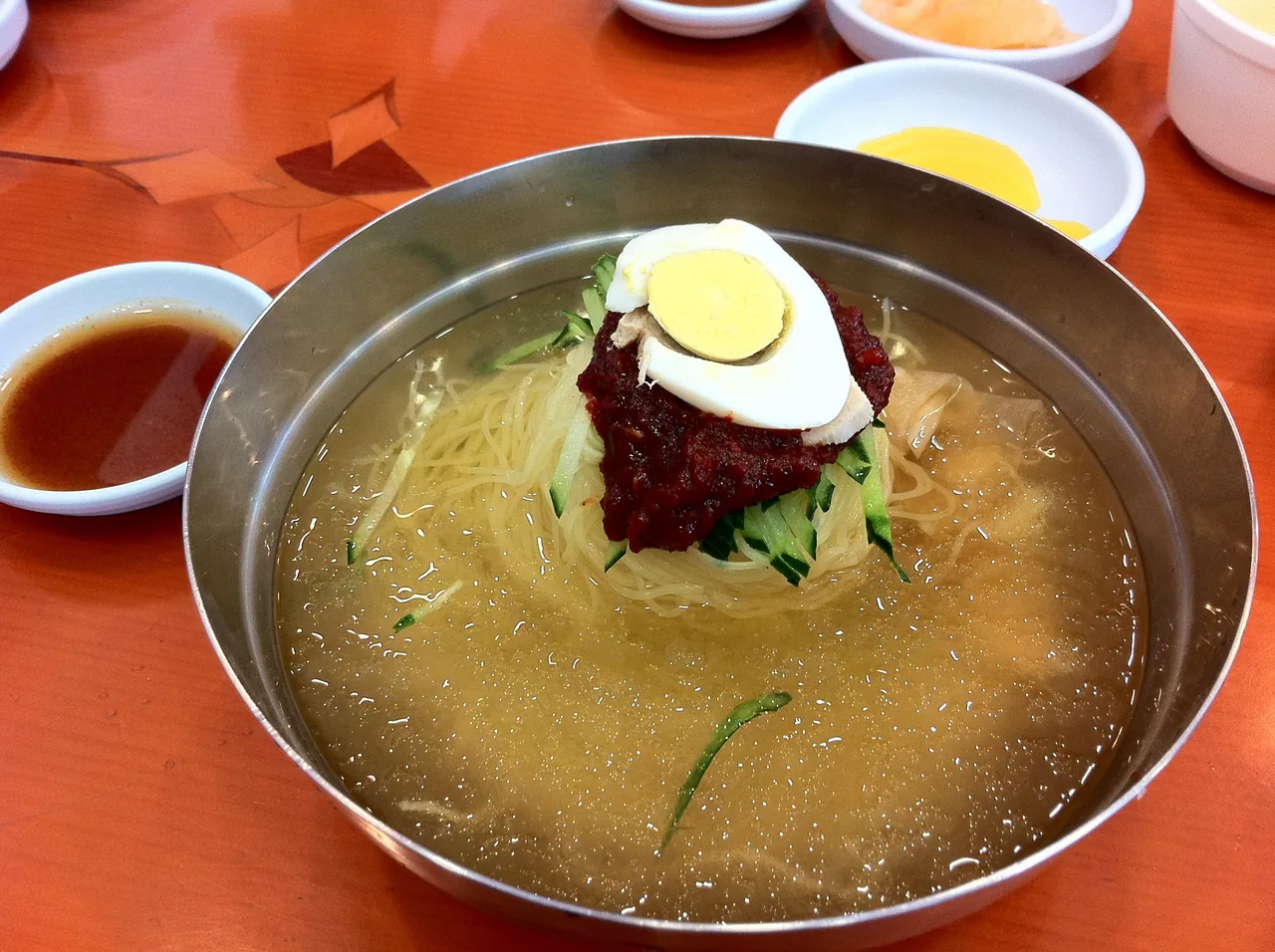
Order it and you’ll get one of two versions: mul-milmyeon, noodles in an ice-cold, faintly sweet-and-sour broth, or bibim-milmyeon, the same noodles tossed dry in a spicy-sweet sauce with no liquid in sight. Both are eaten cold, both use wheat-flour noodles instead of naengmyeon’s buckwheat, and both are considered Busan specialties rather than a dish found equally everywhere in Korea.
2. The Origin of Milmyeon: Born Out of War, Not One Single Story
Milmyeon exists because of the Korean War. Between 1950 and 1953, refugees fleeing south from the northern provinces settled in wartime Busan carrying a taste for cold buckwheat noodles, or naengmyeon, but buckwheat itself was scarce and expensive in the city at the time.
Cooks reached for wheat flour instead, a good deal of it arriving through U.S. relief aid, and milmyeon (literally “wheat noodle”) took shape as a substitute for naengmyeon rather than a dish anyone set out to invent from a blank page. That much is broadly agreed on. Who specifically gets credit for it is not.
According to research compiled by the National Folk Museum of Korea, there are three competing theories about milmyeon’s exact origin, and none of them is treated as flatly settled fact:
- The general wartime-substitution theory (the most widely cited version): milmyeon developed independently across a number of refugee-run naengmyeon stalls in Busan as buckwheat grew scarce, with no single restaurant or person credited as the sole inventor.
- The Naeho Naengmyeon Map creation theory: the dish was specifically developed by the family behind Naeho Naengmyeon, a refugee-founded restaurant that resettled in Busan’s Uam-dong, when its owners had to replace buckwheat with wheat and starch.
- The 1925 Jinju wheat-noodle theory: milmyeon’s roots are pushed back further still, to a wheat-noodle dish said to have existed in Jinju as early as 1925 — a theory the National Folk Museum of Korea itself describes as the least plausible of the three.
Most Busan food writing leans on the general wartime-substitution story, with Naeho Naengmyeon frequently singled out as the restaurant that carried the idea furthest and shaped it into the dish eaten today. Treat that as the leading, most-credited theory rather than a confirmed, sole origin.
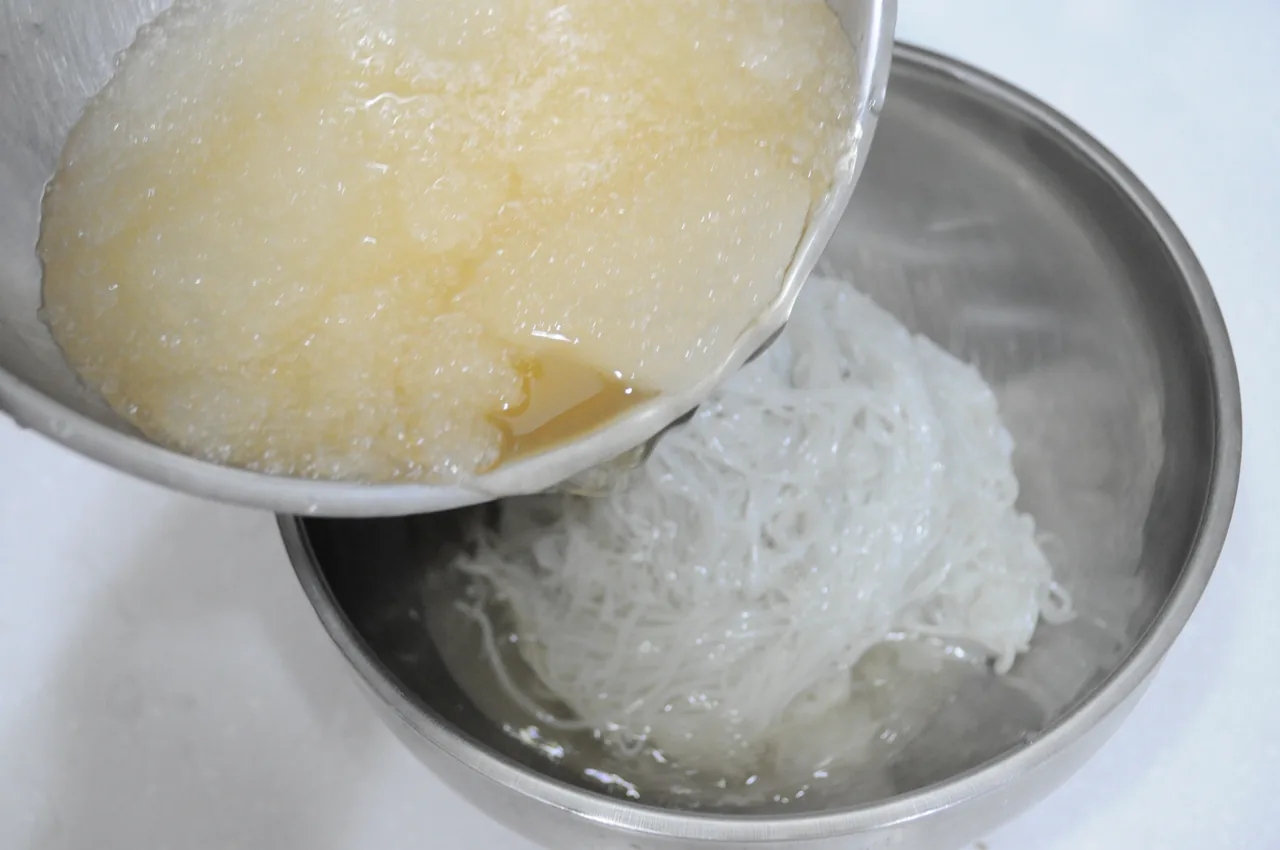
3. Milmyeon vs. Naengmyeon: What’s Actually Different
Milmyeon and naengmyeon look alike in the bowl but differ in noodle, texture, flavor, origin, and price. The comparison below covers the differences travelers actually notice at the table.
| Milmyeon | Naengmyeon | |
|---|---|---|
| Noodle | Wheat flour + starch | Buckwheat, sometimes blended with sweet potato starch |
| Texture | Chewier, springier | Softer, more delicate |
| Flavor | Sweeter and bolder | Milder and more restrained |
| Origin | Busan, Korean War era | Older, associated with Korea’s northern regions |
| Price | Generally cheaper | Usually pricier |
Neither dish is objectively “better” — they’re built for slightly different moods. Milmyeon leans sweeter and chewier, which is part of why it developed its own devoted following in Busan rather than staying a wartime stand-in.
4. Mul-Milmyeon vs. Bibim-Milmyeon: The Two Styles
Mul-milmyeon comes in a cold, tangy-sweet broth, while bibim-milmyeon skips the broth entirely for a spicy red sauce. Every milmyeon restaurant in Busan serves both, so the choice is entirely about what you’re in the mood for.
| Mul-milmyeon | Bibim-milmyeon | |
|---|---|---|
| Broth | Cold, tangy-sweet iced broth | None — noodles are tossed dry in sauce |
| Heat level | Mild | Spicy, adjustable with extra chili paste |
| Best for | Hot days, milder palates, first-timers | Spice lovers, drier and more sauce-forward eating |
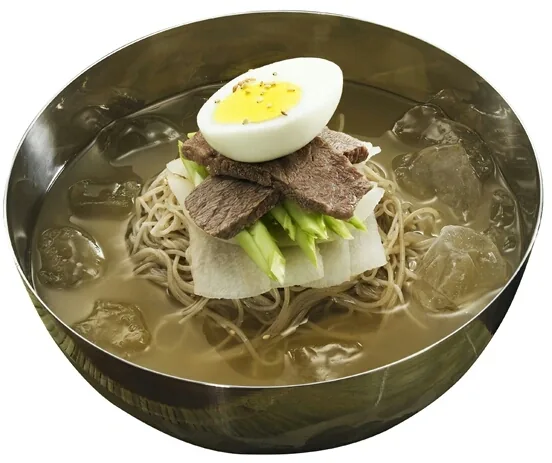
5. What’s Actually in a Bowl of Milmyeon
A bowl of milmyeon breaks down into noodles, broth or sauce, toppings, and a few condiments you add yourself. The components are consistent from shop to shop even though the exact recipe varies.
- Noodles: wheat flour blended with starch, giving milmyeon its characteristic chew.
- Broth or sauce: for mul-milmyeon, a cold beef or pork bone broth, often simmered with medicinal herbs like angelica root (danggwi) and licorice root; for bibim-milmyeon, a spicy-sweet red sauce with no broth at all.
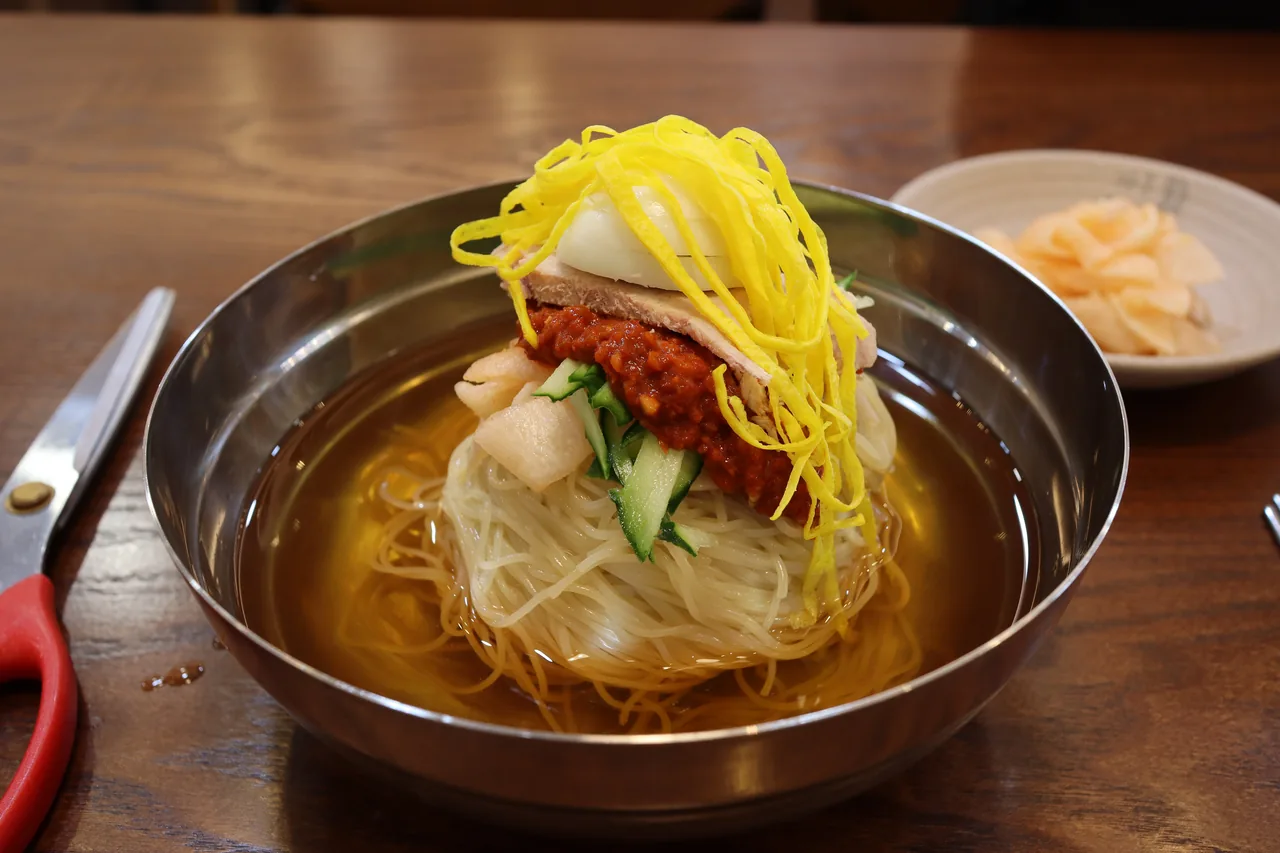
- Toppings: pickled radish, sliced cucumber, a boiled egg, and sometimes a few slices of cold cooked meat (pyeonyuk).
- Condiments on the side: vinegar, mustard, and a chili paste called dadaegi for adjusting the heat.
6. How Locals Actually Eat Milmyeon
Locals season the bowl themselves with vinegar and mustard, then either stir gently (mul-milmyeon) or mix thoroughly (bibim-milmyeon) before eating. A few small habits separate a first-timer’s bowl from a regular’s.
- Add a splash of vinegar and a dab of mustard before your first bite — both are provided on the table for exactly this.
- For bibim-milmyeon, mix the noodles and sauce thoroughly so every strand is coated; for mul-milmyeon, a gentler stir is enough since you don’t want to disturb the broth too much.
- Long noodles get cut with the kitchen scissors most restaurants leave on the table — nobody expects you to fight with a full-length noodle using just chopsticks.
- Add more dadaegi (chili paste) a little at a time if you want extra heat, rather than dumping it all in at once.
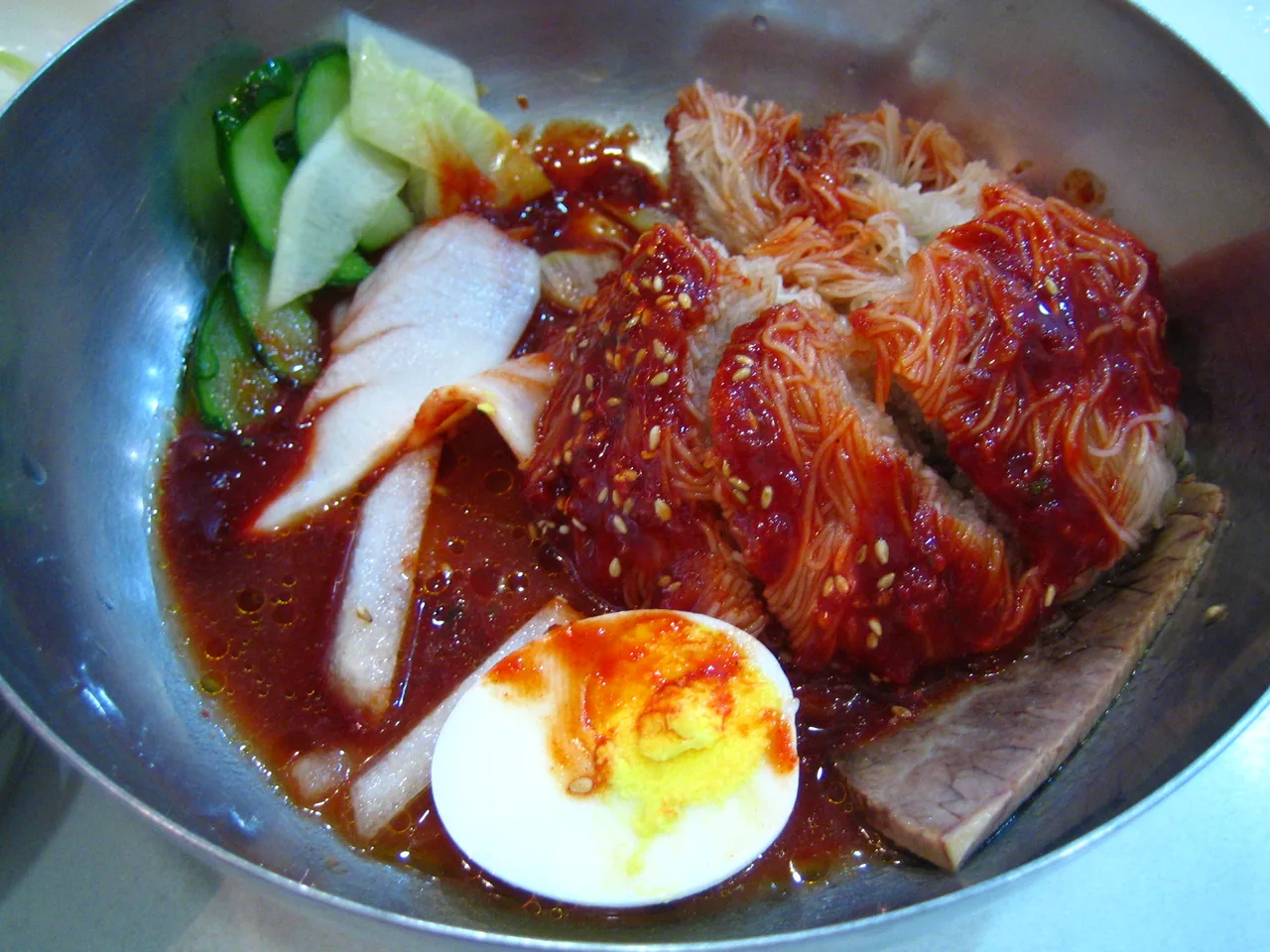
7. Naeho Naengmyeon: The Restaurant Most Credited With Starting It All
Naeho Naengmyeon is the restaurant most widely credited as milmyeon’s birthplace, tracing back to a family that fled south during the Korean War. Its history runs from colonial-era Hamgyong Province all the way to present-day Busan.
The story starts in 1919, when Lee Yeong-sun opened a restaurant called Dongchunmyeonok in Naeho-ri, in what’s now Hamnam (South Hamgyong) in North Korea. During the Hungnam evacuation in December 1950, the family fled south along with hundreds of thousands of other refugees. They eventually resettled in Busan’s Uam-dong neighborhood and reopened the restaurant under a new name, Naeho Naengmyeon, borrowed from their hometown — sources put the reopening at roughly 1952 to 1953, with the exact year differing depending on which account you read.
It was the second generation, Jeong Han-geum, who is credited with developing the wheat-and-starch noodle that became milmyeon, using U.S. relief flour in place of buckwheat that had become impossible to source reliably. The exact year that recipe turned into a commercial dish is similarly unsettled — accounts range from the early 1950s to as late as 1959 — so any specific year you see quoted elsewhere is best read as an educated guess, not a fixed date.
Naeho Naengmyeon is still family-run today, now in its fourth generation, though sources disagree on who currently runs the business, so we won’t pin a single name on it here.
| Details | |
|---|---|
| Location | Uam-dong, Busan |
| Hours | Roughly 10:30–19:00, but confirm on a map app before visiting since hours shift |
| Price | Mul- and bibim-milmyeon each roughly ₩8,000–10,000, subject to change |
8. Gaya Milmyeon: The Shop Credited With Perfecting the Recipe (Read This Before You Go)
Gaya Milmyeon Map is widely credited with perfecting milmyeon, but its original Gaegeum-dong location has been closed since 2021 — go to the Haeundae branch instead. This is one of the most commonly repeated mistakes in Busan food guides, so it’s worth being direct about it.
Gaya Milmyeon earned its reputation two ways: it helped standardize the 100% wheat-flour noodle, and it built a broth steeped in medicinal herbs like angelica root and licorice root that gave milmyeon its now-signature sweetness and aroma. Sources disagree on when the restaurant was founded, with some citing 1969 and others 1991, so neither number should be taken as a settled fact.
The restaurant worth visiting instead is Haeundae Gaya Milmyeon, which has operated independently in Haeundae for more than 22 years and is a real, functioning option for anyone chasing the Gaya Milmyeon name and style. It’s open roughly 09:00 to 20:40, with mul- and bibim-milmyeon priced in the rough ₩9,000–10,000 range.
One more thing worth knowing: “Gaya Milmyeon” is not a protected name, and more than 100 unrelated restaurants across Korea use some version of it. A Saha-gu (Saha District) shop featured on the Korean TV program SBS Saenghwal-ui Dal-in on May 25, 2026, for example, is a completely separate business with no connection to the original Gaegeum-dong restaurant or its recipe.
9. Gaegeum Milmyeon: Busan’s Other Founding Name
Gaegeum Milmyeon Map is known for a clear, clean-tasting broth style that gave rise to the term “Gaegeum-style” milmyeon. It’s frequently mentioned in the same breath as Naeho Naengmyeon and Gaya Milmyeon when Busan food guides discuss the dish’s roots.
According to official Busan Tourism Organization material, Gaegeum Milmyeon was founded in 1966 at Gaegeum Market, though some other sources cite 1999 instead — another case where the founding year isn’t fully settled across sources. What’s consistent is the style: wheat-and-sweet-potato-starch noodles in a lighter, cleaner broth than the more heavily herb-infused versions found elsewhere.
| Details | |
|---|---|
| Location | Near Gayadae-ro 482beon-gil 9-4, Busanjin-gu, Busan |
| Hours | 11:00–19:40, open year-round except major holidays |
| Price | Roughly ₩7,000–11,000, though pricing changes often — confirm before you go |
10. More Legendary Milmyeon Shops Worth Knowing About
Beyond the three founding names, a handful of other Busan restaurants have built serious reputations around their own take on milmyeon. Each one differentiates itself with a specific broth, style, or specialty.
| Restaurant | Area | What sets it apart |
|---|---|---|
| Wonjo Busan Milmyeon | Choryang, Dong-gu | Open since 1995; broth made with pheasant meat, an uncommon point of difference |
| Daeseong Milnaengmyeon | Kkangtong Market / Bupyeong-dong, Jung-gu | 42+ years running; a more subdued style closer to Pyongyang-style naengmyeon |
| Gukje Milmyeon | Yeonje-gu | A spicier bibim-milmyeon; often named as a candidate in “Busan’s three great milmyeon shops” discussions |
| Gaon Milmyeon | Gwangalli / Myeongji | Listed in the Blue Ribbon Survey; distinctive spicy variations like ttaengcho-milmyeon and jjuk-jjuk bibim-myeon |
| Choryang Milmyeon | Choryang, Dong-gu | Especially known for oversized handmade dumplings alongside its milmyeon |
| Chunhachudong Milmyeon | Seomyeon / Haeundae | A deep brown broth of beef bone and medicinal herbs, simmered roughly 7 days |
Both Wonjo Busan Milmyeon and Choryang Milmyeon sit in Choryang, Dong-gu, not far from Jagalchi Market if you want to turn a milmyeon stop into a bigger food crawl around that part of the city.
11. How Much Does Milmyeon Cost in Busan (2026)?
Expect to pay roughly ₩6,000–9,000 for a small bowl of milmyeon and ₩7,000–10,500 for a large one across Busan in 2026. Pricing varies noticeably from shop to shop, and it changes over time, so use the numbers below as a ballpark, not an exact quote.
| Size | Typical price |
|---|---|
| Small (소) | ~₩6,000–9,000 |
| Large (대) | ~₩7,000–10,500 |
Both mul- and bibim-milmyeon are usually priced the same at a given restaurant, so the size you order matters more to the final bill than which style you choose. Menu prices shift often enough that checking the restaurant’s posted menu or a map app listing before you go is worth the extra minute.
12. What to Order Alongside Milmyeon, and What to Bring Home
Dumplings are the classic milmyeon side dish, and several shops also sell take-home milmyeon kits worth considering as a souvenir. Here’s what’s actually worth ordering or packing.
A steamed or pan-fried dumpling set is the standard pairing at most milmyeon restaurants, and many shops sell a set built specifically to go with the noodles. Choryang Milmyeon, in particular, is known for its oversized handmade dumplings, worth ordering even if you came only for the noodles.
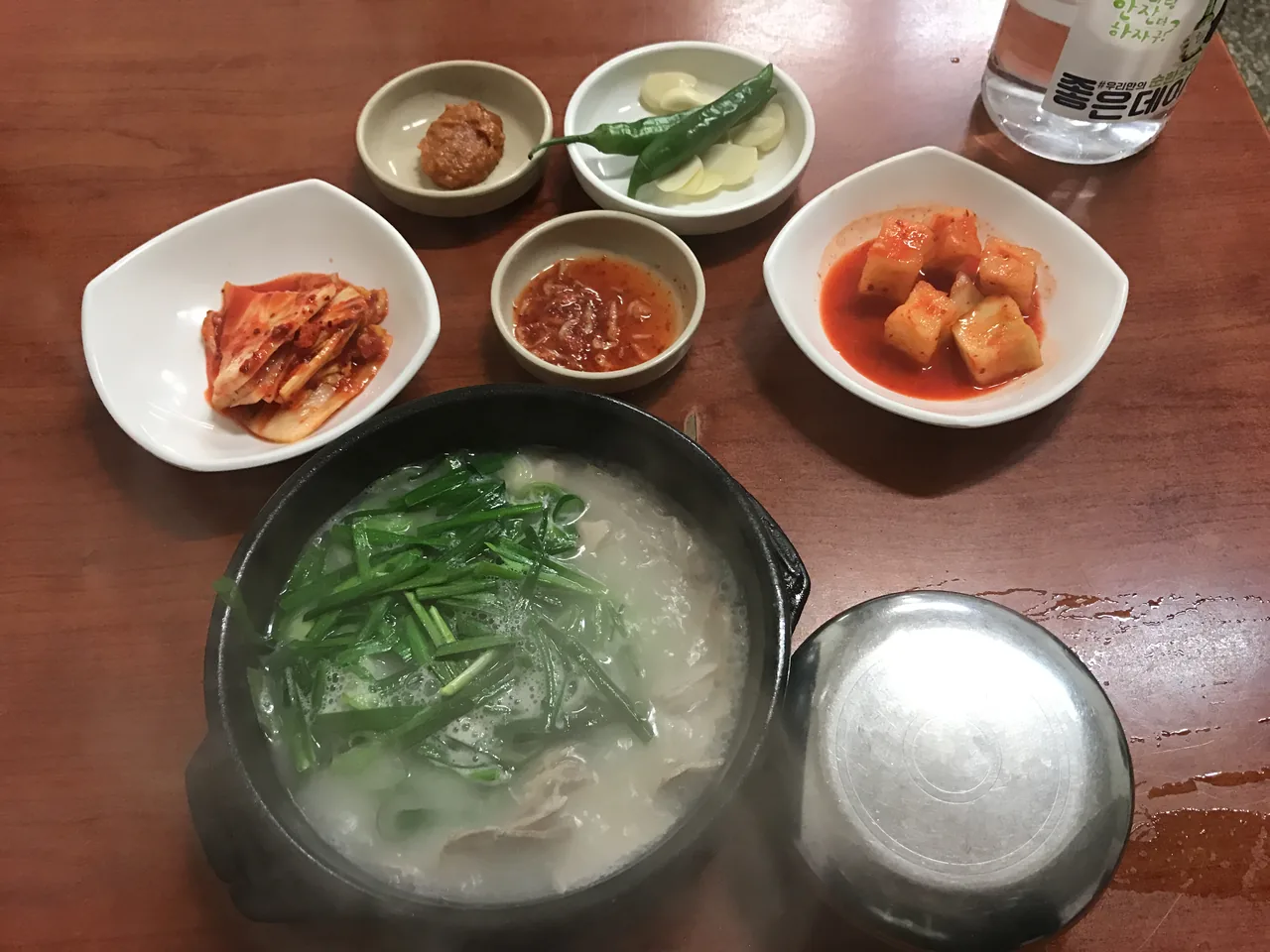
If you’d rather skip the dumplings and go straight for something heartier, Busan’s other essential comfort food, dwaeji-gukbap (pork and rice soup), makes a good hot-and-cold pairing across a single meal, or as a separate stop later in your trip.
Several milmyeon restaurants, including Gaya Milmyeon and Naeho Naengmyeon, sell packaged milmyeon kits with noodles, broth, and sauce, available both online and in-store. These make a genuinely practical souvenir or gift if you want to bring the dish home rather than just the memory of it.
If you’d rather have a guide walk you through Busan’s night markets and street-food alleys than track down these specific restaurants on your own, a guided food tour covers a lot of ground in one evening. The trade-off is a fixed itinerary that likely won’t stop at every specific shop named in this guide, milmyeon included, so weigh that against the convenience before booking a spot on one.
13. Allergy and Dietary Notes
Milmyeon is not gluten-free, and there is currently no confirmed vegetarian or vegan version. Plan around these two facts if you’re managing a dietary restriction in Busan.
- Gluten: milmyeon’s noodles are made from wheat flour, so the dish contains gluten by definition. There’s no gluten-free version of milmyeon on offer anywhere covered in this guide.
- Meat-based broth: the broth is typically made from beef bone, pork bone, or a mix of both, depending on the restaurant.
- Vegetarian or vegan options: none have been confirmed at the restaurants covered here. If you’re vegetarian or vegan, milmyeon isn’t a dish you can currently order safely in Busan without a menu built specifically to accommodate you.
14. Is Milmyeon a Summer-Only Dish?
Milmyeon is especially popular in summer, but it’s eaten year-round in Busan, including winter. The cold broth and noodles make it an obvious hot-weather order, but that doesn’t mean it disappears from menus the rest of the year.
Plenty of Busan locals eat milmyeon in the middle of winter precisely because Korean dining culture doesn’t treat cold noodle dishes as seasonal in the way some other cuisines might. If you’re visiting outside summer, don’t assume milmyeon restaurants will be closed or off-menu — nearly all of the restaurants in this guide operate year-round.
15. Which Milmyeon Shop Matches What You’re Looking For
Different milmyeon restaurants in Busan are worth visiting for different reasons, from history to broth style to sheer spice level. The table below matches a specific goal to the restaurant that fits it best.
| What you want | Where to go |
|---|---|
| History and origin experience | Naeho Naengmyeon (Uam-dong) |
| Herb-infused broth, the “perfected” version | Haeundae Gaya Milmyeon |
| A reliable, famous, no-surprises bowl | Gaegeum Milmyeon |
| An unusual broth (pheasant meat) | Wonjo Busan Milmyeon |
| Blue Ribbon Survey credentials | Gaon Milmyeon |
| Dumplings are the priority | Choryang Milmyeon |
| Maximum spice | Gukje Milmyeon (bibim-milmyeon) |
These restaurants are spread across several different neighborhoods, so hopping between more than one in a single day is realistic if you’re using Busan’s metro and a T-money transit card rather than trying to walk between them.
16. Tips for Your First Bowl, and Where to Go Next
Start with mul-milmyeon if this is your first bowl, switch to bibim-milmyeon with extra dadaegi if you like heat, and always double-check hours before visiting an older, family-run shop. A few final planning notes tie the rest of this guide together.
| Tip | Why it matters |
|---|---|
| Order mul-milmyeon first | The gentler introduction to the dish’s flavor before trying the spicier bibim version |
| Add dadaegi gradually | Lets you control the heat level rather than over-spicing the whole bowl at once |
| Confirm hours before visiting Naeho Naengmyeon or Gaegeum Milmyeon | Older, family-run restaurants adjust hours more often than chain restaurants do |
| Go to Haeundae Gaya Milmyeon, not Gaegeum-dong | The original Gaegeum-dong flagship has been closed since 2021 |
| Pair it with dumplings, not necessarily soju | Dumplings are the well-established side; the soju pairing is a matter of personal taste |
Milmyeon pairs naturally with a wider Busan street-food crawl, and a stop for Busan-style fish cake (eomuk) afterward makes an easy second course if you’re still hungry. If you’d rather finish with something calmer, Busan’s café scene is an easy way to close out the meal.
For the rest of your itinerary, from neighborhoods to beaches to day trips, our complete Busan travel guide covers everything else worth planning around your milmyeon stops.
🎡Things to Do49
🍜Food6
🏨Where to Stay3
🚇Getting Around8
🧭Travel Tips14
📌More3
🧭All-Korea essentials37
Frequently asked questions
Explore more of Busan’s food scene and neighborhoods
Images: Seefooddiet, CC BY-SA 4.0 · Hj03064, CC BY-SA 4.0 · Korea.net / KOCIS, CC BY-SA 2.0 · ayustety, CC BY-SA 2.0 · Hj03064, CC BY-SA 4.0 · Mobius6, CC BY-SA 4.0 · Michael Sean Gallagher, CC BY-SA 2.0 · chomjong, CC BY 2.0 — via Wikimedia Commons.