
National Museum of Korea: Masterpieces, Tips & Your Last Free Year
Free in 2026, enormous, and home to the Pensive Bodhisattvas and the Gyeongcheonsa Pagoda — here’s how to see the best of it in half a day.
| Cost | Free for permanent galleries in 2026 (the last free year — paid from 2027) |
|---|---|
| Where | Yongsan, Seoul. Ichon Station (Line 4 / Gyeongui-Jungang), Exit 2 |
| Hours | 10:00-18:00 daily; open late to 21:00 on Wed & Sat |
| Closed | Jan 1, Lunar New Year’s Day, Chuseok Day, plus the first Monday of Mar/Jun/Sep/Dec (maintenance) |
| Time needed | 2-3 hours minimum; the collection is far too large to see in one visit |
| Don’t miss | Pensive Bodhisattvas (Room of Quiet Contemplation), Gyeongcheonsa Pagoda, Silla gold crown |
1. The museum at a glance — and why it should top your Seoul list
2. 2026 is likely the last free year — paid admission planned for 2027
3. The Room of Quiet Contemplation — two Pensive Bodhisattvas in the dark
4. Path to History & the Ten-story Gyeongcheonsa Pagoda
5. Prehistory & Ancient History Gallery (1F) — the Silla gold crown and the land of gold
6. Sculpture & Crafts Gallery (3F) — Goryeo celadon and Buddhist sculpture
7. Calligraphy & Painting + Donation Galleries (2F) — Inwangjesaekdo and the Lee Kun-hee collection
8. Asian Arts Gallery & the digital immersive gallery (3F)
9. A half-day route — what to prioritise when you can’t see it all
10. Outdoor grounds, the Reflecting Pond & the Children’s Museum
11. Dining, cafes & the MU:DS museum shop
12. Getting there, hours & practical tips
13. Wrap-up — what to do next
1. The museum at a glance — and why it should top your Seoul list
The National Museum of Korea is free, enormous, and one of the six largest museums on earth — and 2026 is the last year you can walk into its permanent galleries without paying a won. It holds more than 410,000 objects, with over 12,000 on display at any time, across three floors and six galleries in Yongsan. You could spend a full day here and still miss most of it.
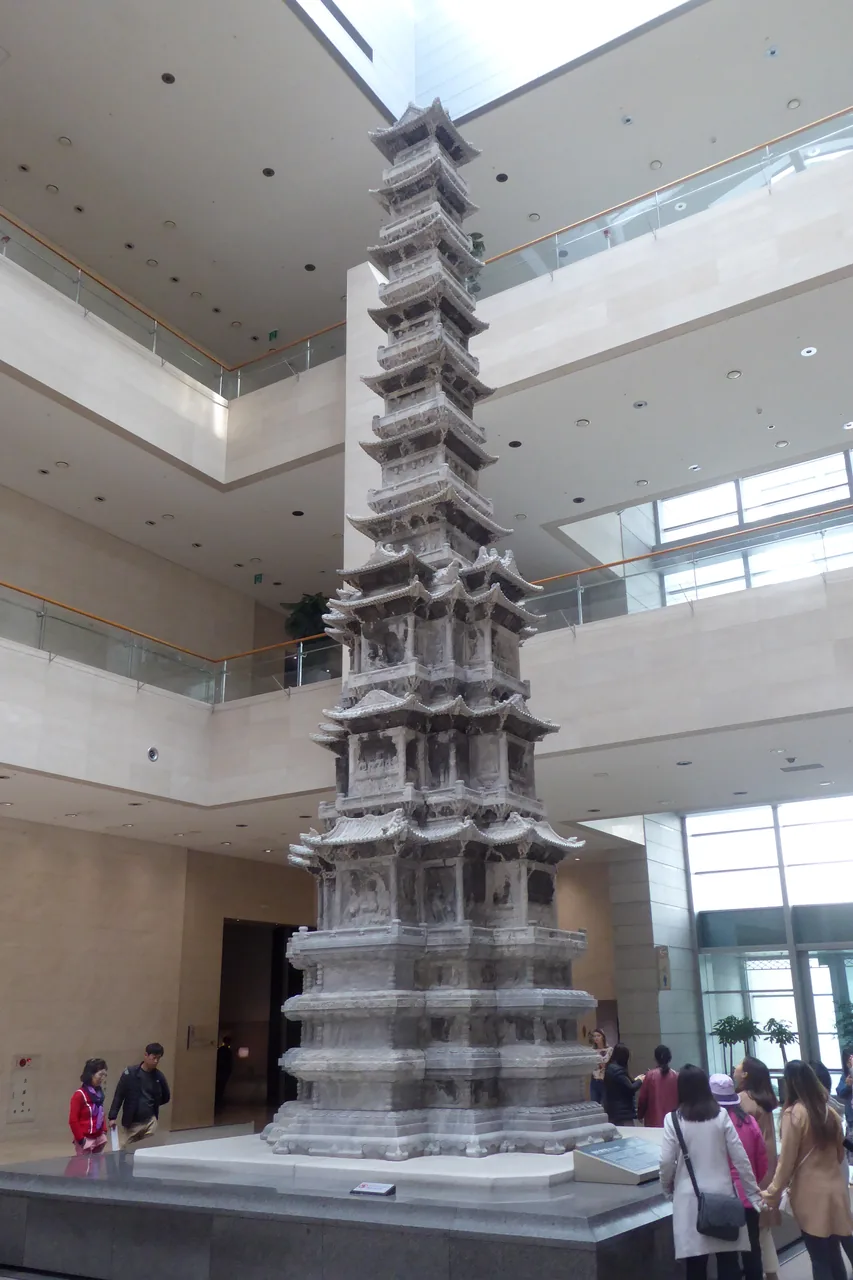
Two works alone justify the trip. The first is the Room of Quiet Contemplation, a dim, hushed gallery built around two gilt-bronze Pensive Bodhisattvas — both National Treasures, displayed side by side for the first time. The second is the Ten-story Stone Pagoda of Gyeongcheonsa, a 13.5-meter white-marble tower from 1348 that rises through the central hall and is the first thing you see when you walk in.
This isn’t a museum you “do” in an hour. It’s a place to choose a few masterpieces, see them properly, and let the rest go. This guide tells you exactly what to prioritise, how to get there, and why now is the moment to go. For where it fits in a wider trip, see our complete Korea Travel Guide and Korea itinerary guide.
📍 Map
2. 2026 is likely the last free year — paid admission planned for 2027
The permanent galleries have been free since May 2008, but under new government budget rules the museum is preparing paid admission, with a rollout targeted for 2027 — so 2026 is very likely your last chance to see the whole collection for free. Admission used to cost KRW 2,000 before it was abolished after the 2005 move to Yongsan. On 30 March 2026, the government’s budget guidelines set paid admission for national cultural facilities, and the museum has said it will follow suit, aiming for 2027 after nineteen free years. The exact go-ahead, price and date still depend on a pilot run, public hearings and inter-ministry review, so treat 2027 as the plan rather than a locked date.
The exact price hasn’t been finalised, but expectations sit in the KRW 5,000-10,000 range for adults. Special exhibitions are already ticketed separately and will stay that way.
| Year | Permanent galleries | Special exhibitions |
|---|---|---|
| 2008-2026 | Free | Ticketed |
| 2027 onward (planned) | Paid (likely KRW 5,000-10,000, TBD) | Ticketed |
The timing matters because the museum has never been more popular. A wave of global interest — fuelled by Hallyu and Netflix’s KPop Demon Hunters, which drew new eyes to Korean folklore and art — has pushed the share of foreign visitors from roughly 18% to 29%. The Silla gold crown even made headlines around the APEC 2025 summit. If a free visit to a world-class museum appeals, 2026 is the window.
3. The Room of Quiet Contemplation — two Pensive Bodhisattvas in the dark
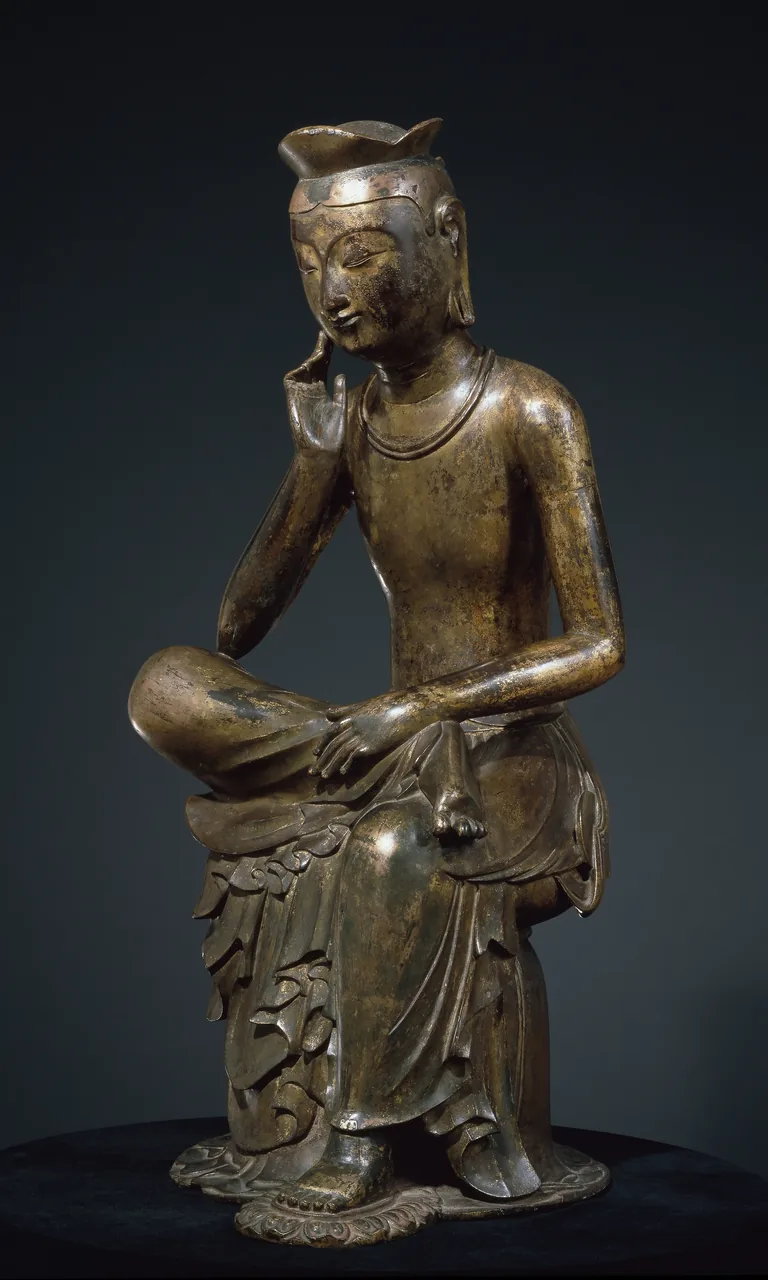
The single most moving space in the museum is the Room of Quiet Contemplation, where two of Korea’s greatest National Treasures — a pair of gilt-bronze Pensive Bodhisattvas — sit side by side in a dark, silent, near-spiritual gallery. Known in Korean as banga-sayusang, these are seated Maitreya figures, one leg crossed over the other knee, a hand resting against the cheek in the eternal posture of thought. They date from the late 6th to early 7th century, the very peak of Korean Buddhist sculpture.
What stuns visitors most is the craftsmanship. The bronze is only 2 to 4 millimetres thick — astonishingly thin for figures of this size — which speaks to a level of casting skill the ancient world rarely matched. For over a thousand years they were considered two separate masterpieces (formerly National Treasures No. 78 and No. 83). Seeing them together, in one room, is genuinely new.
The room itself is designed as a work of art. It spans roughly 440 square metres and the experience is deliberately stripped down:
- No display cases — you can walk a full 360° around each figure.
- No labels — the museum leaves interpretation to you, so you simply look.
- Slanted walls and a floor that gently rises toward the back, drawing you in.
- A ceiling that evokes stars and the universe, lit like a night sky.
- Red-clay walls that give off a faint scent of cinnamon and cypress.
Since it opened in November 2021, the room has drawn over 3.41 million cumulative visitors — the most popular single space since the museum moved to Yongsan two decades ago. The Pensive Bodhisattva is, in every sense, the museum’s icon; miniature versions are the runaway bestseller in the gift shop.
4. Path to History & the Ten-story Gyeongcheonsa Pagoda
Walk through the main entrance and the first thing you see is the Ten-story Stone Pagoda of Gyeongcheonsa, a 13.5-metre white-marble tower rising through the central hall like the spine of the whole building. That central corridor is called the Path to History, and it splits the permanent hall into north and south wings. The pagoda stands as tall as a five-story building, glass-enclosed and lit so you can see its astonishing detail.
It’s a National Treasure made in 1348, during the Goryeo dynasty (the 4th year of King Chungmok), with a dated inscription carved into its base. Almost every surface is densely worked: Buddhas, bodhisattvas, heavenly kings, arhats and narrative scenes cover the marble. The lower three tiers carry a Mongol-Tibetan influence, while tiers four through ten follow Korean tradition — a single object capturing a moment when cultures met.
Its journey is as remarkable as its carving:
- Built in Gaeseong The pagoda originally stood at Gyeongcheonsa Temple in Gaeseong (now in North Korea).
- Taken to Japan, 1907 It was dismantled and removed during the colonial era.
- Returned to Korea After international pressure, it came home, but it needed roughly a decade of conservation.
- Reassembled in 2005 It was rebuilt inside the new Yongsan museum, where it stands today.
Stand at its base and look straight up — the way the carving recedes into the upper tiers is something photographs never quite capture.
5. Prehistory & Ancient History Gallery (1F) — the Silla gold crown and the land of gold
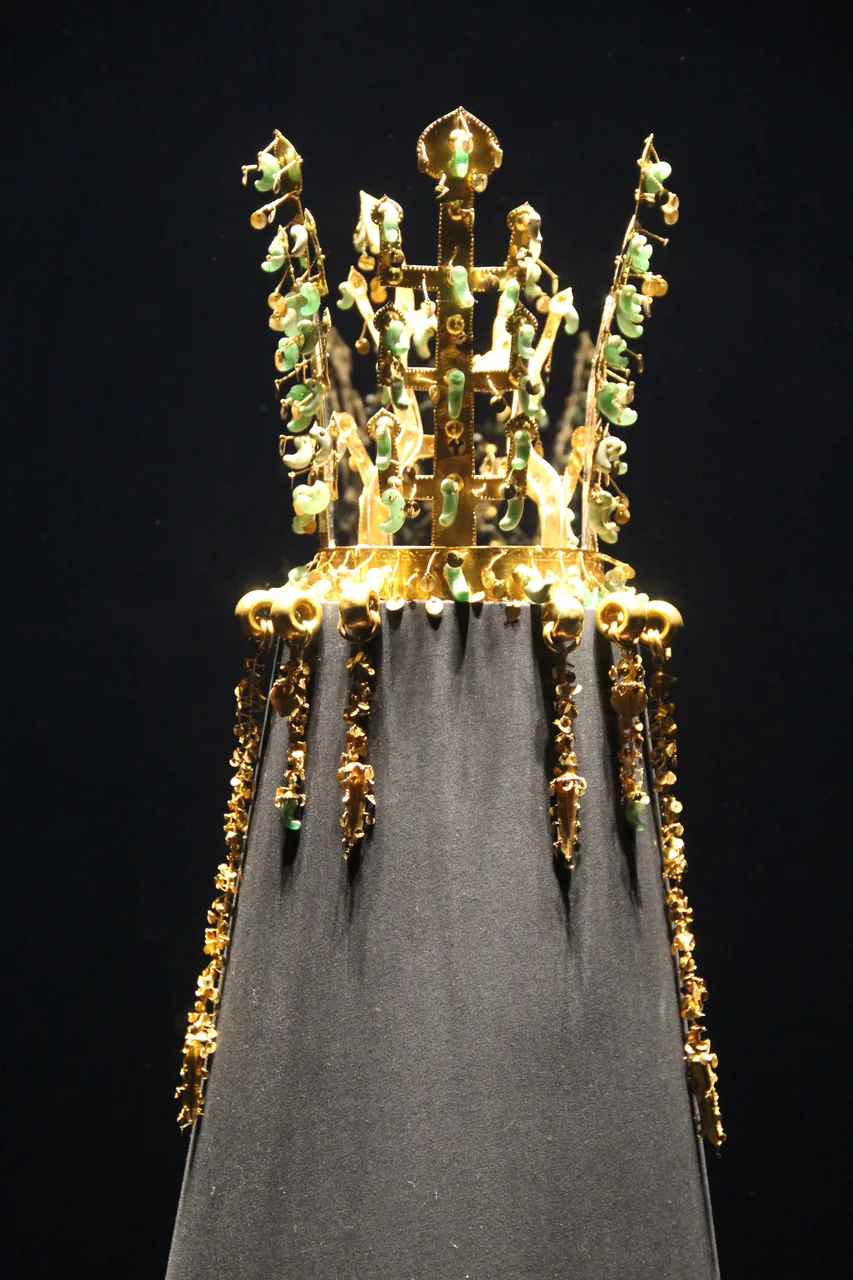
The first floor walks you from the Paleolithic to Unified Silla across roughly 4,500 objects in nine rooms, and its showstopper is the 5th-century Silla gold crown — royal regalia that earned the kingdom its name, the “land of gold.” The crown, paired with a matching gold belt, came from the North Mound of Hwangnamdaechong, a great twin tomb in Gyeongju excavated in 1975. It’s a National Treasure hung with comma-shaped jades (gogok) and tiny gold spangles that would have shimmered with every movement of the wearer.
The gallery is organised chronologically, so it doubles as a crash course in early Korean history:
| Room | Era / kingdom | Worth a look |
|---|---|---|
| Paleolithic & Neolithic | Earliest settlement | Stone tools, comb-pattern pottery |
| Bronze Age / Gojoseon | Korea’s first state | Bronze daggers, ritual objects |
| Proto-Three Kingdoms | Early statelets | Iron and early craft |
| Goguryeo, Baekje, Gaya | Three Kingdoms era | Baekje’s refinement, Gaya ironwork |
| Silla & Unified Silla | 5th c. onward | The gold crown & belt, gilt-bronze art |
Even if you skim the early rooms, give the Silla section time. The crown made global news around APEC 2025, and seeing it in person — the weight of gold, the trembling jades — explains why.
6. Sculpture & Crafts Gallery (3F) — Goryeo celadon and Buddhist sculpture
The third-floor Sculpture & Crafts Gallery holds about 630 pieces, and its crown jewel is the Celadon Incense Burner with Openwork Design (National Treasure No. 95), widely considered the pinnacle of Goryeo celadon. Look closely and you’ll see how many techniques are layered into one object: incising, inlay, relief and openwork all at once, executed flawlessly in that famous jade-green glaze.
The burner is built in three parts, each a small marvel:
- The lid — pierced openwork through which incense smoke would have drifted.
- The body — shaped like a lotus flower, the Buddhist symbol of purity.
- The base — supported by three tiny rabbits, a detail visitors love.
Nearby sits a celadon incense burner with a lion-shaped lid, another celebrated piece. Beyond celadon, the gallery traces Korea’s ceramic evolution into rougher, freer buncheong ware and the restrained beauty of Joseon white porcelain — three distinct national aesthetics in one room.
The other half of this floor is given to Buddhist sculpture: serene gilt-bronze Buddhas and bodhisattvas, stone figures and reliquaries that show how Buddhist art shaped Korea for over a millennium. It pairs beautifully with the Pensive Bodhisattvas downstairs — the same devotional world in a different medium.
7. Calligraphy & Painting + Donation Galleries (2F) — Inwangjesaekdo and the Lee Kun-hee collection
The second floor is where you’ll find Korea’s great paintings and one of the most generous art gifts in history, the 2021 Lee Kun-hee donation. The Calligraphy & Painting Gallery holds around 890 light-sensitive works — paintings, calligraphy, Buddhist paintings, and a recreated sarangbang scholar’s studio. Because ink and silk fade, these works are rotated regularly, so the displays change through the year.
Two names anchor the painting rooms. Jeong Seon’s “Inwangjesaekdo” is a National Treasure landscape of Seoul’s Inwangsan mountain after rain — a centrepiece of the Lee Kun-hee donation, though it may rotate out for conservation. And Kim Hong-do’s genre paintings capture ordinary Joseon life — wrestlers, schoolboys, farmers — with wit and warmth.
The adjoining Donation Gallery tells a story of its own. In 2021, the family of the late Samsung chairman Lee Kun-hee donated roughly 9,800 pieces to the museum, part of a vast art bequest to the nation:
| Detail | Figure |
|---|---|
| Year of donation | 2021 |
| Pieces given to this museum | ~9,800 |
| On display at any time | ~800 (masterpieces rotate) |
8. Asian Arts Gallery & the digital immersive gallery (3F)
The third floor also looks outward, with an Asian Arts Gallery of about 970 pieces and a free digital immersive gallery that has become a quiet favourite. The Asian Arts rooms put Korea in conversation with the wider continent, and one section is a genuine rarity in any museum.
| Room | Highlights |
|---|---|
| India & Southeast Asia | Buddhist and Hindu art across the region |
| Central Asia (Silk Road) | Wall paintings and finds from the great trade routes |
| China | Ceramics, bronzes and painting |
| Sinan undersea relics | Cargo from a 14th-c. shipwreck recovered off Korea’s coast |
| Japan | Lacquer, screens and decorative arts |
Don’t skip the digital immersive gallery. It’s free, and its floor-to-ceiling media art reimagines collection highlights — including a soaring digital rendering of the Gyeongcheonsa Pagoda — on a scale the physical objects can’t show. There’s also Theater Yong, the museum’s performance and screening venue. These spaces are a welcome change of pace after hours among glass cases, and they’re especially popular with families.
9. A half-day route — what to prioritise when you can’t see it all
You cannot see this museum in one visit, so don’t try — pick the masterpieces and walk a clear route, and you’ll have a rich half-day in two to three hours. The single best approach for a first visit is to hit the icons in order, then add the rest only if energy and time allow.
| Order | Stop | Floor | Why |
|---|---|---|---|
| 1 | Path to History (Gyeongcheonsa Pagoda) | Central hall | You pass it on entry; see it first |
| 2 | Room of Quiet Contemplation | 2F | The icon; go early before crowds |
| 3 | Silla gold crown & ancient history | 1F | Korea’s defining treasures |
| 4 | Celadon & Buddhist sculpture | 3F | National Treasure No. 95 |
| 5 | Painting & Donation galleries | 2F | Jeong Seon, Kim Hong-do, Lee Kun-hee gift |
| 6 | Asian Arts & immersive gallery | 3F | Only if time remains |
For getting to Yongsan and moving around Seoul on the cheapest fare, compare your options in our Climate Card vs T-money guide.
10. Outdoor grounds, the Reflecting Pond & the Children’s Museum
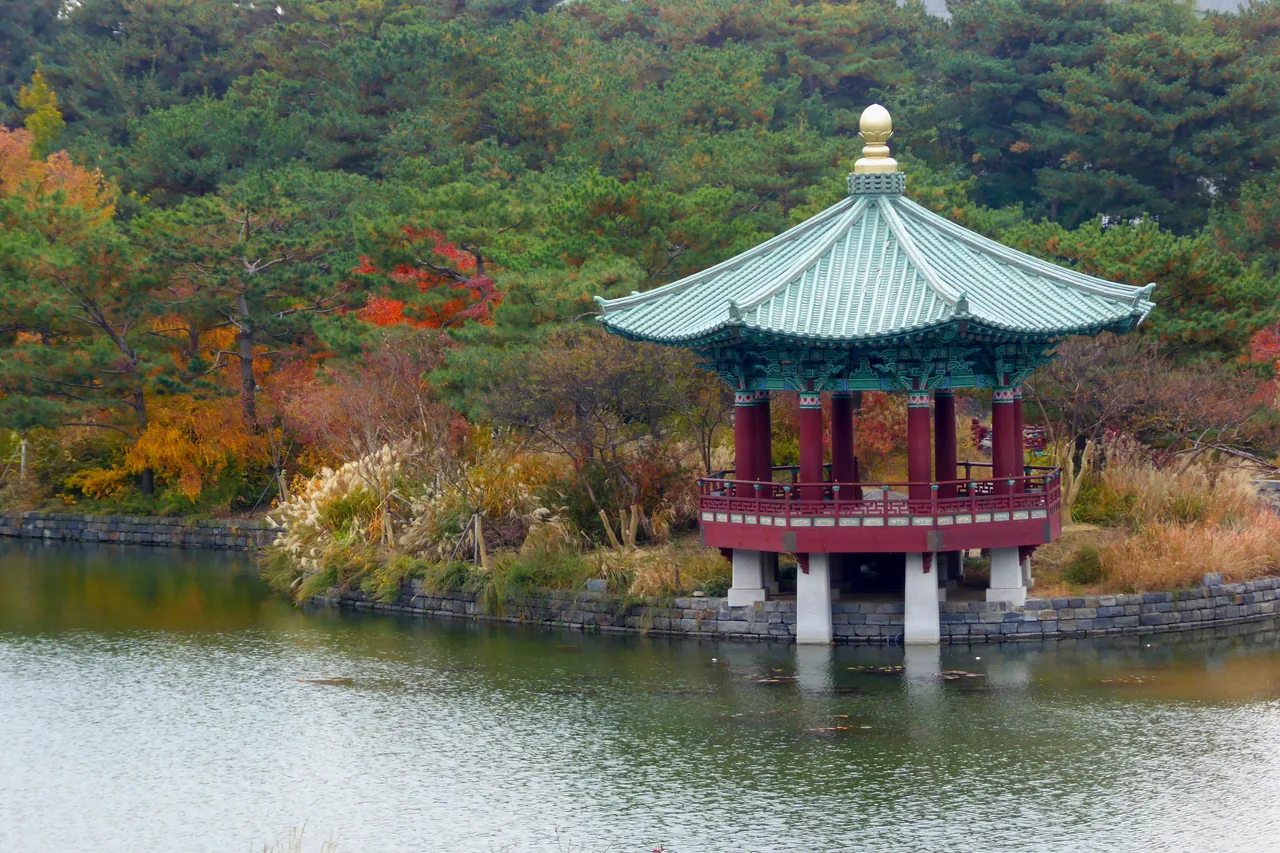
The museum’s grounds are a free, peaceful park in their own right — open from 07:00, long before the galleries — and the Reflecting Pond out front is one of Yongsan’s best photo spots. On a still day the pond mirrors the museum building and, beyond it, N Seoul Tower on the ridge above. Early morning and dusk are the prettiest times to shoot.
Wander the outdoor garden and you’ll find historic stone pagodas, stupas, lanterns and steles arranged among the trees, a celadon-roofed pavilion, a small waterfall, and the Bosingak Bell. All of it is free to enjoy from 07:00, so you can stroll the grounds before the doors even open.
Two more things for families:
- The Children’s Museum is a hands-on space designed for younger visitors, with interactive exhibits. It runs on a timed reservation system, so book your slot rather than just turning up.
- Yongsan Family Park sits right next door — a large green space perfect for a picnic or a break between the museum and the subway. 📍 Map
11. Dining, cafes & the MU:DS museum shop
You won’t go hungry — the complex has a large food court, two sit-down restaurants and several cafes, plus the excellent MU:DS shop for souvenirs. Plan to eat here if you’re spending a half-day; leaving and re-entering wastes time.
| Place | Style | Notes |
|---|---|---|
| Food court (West building 1F) | Korean / Chinese / Western / snacks | 370 seats; 10:00-18:00 (to 20:00 Wed & Sat) |
| Gyeongcheonsa-tap restaurant | Korean fine dining / fusion | Run by Insadong’s renowned “Doore” |
| Reflecting-Pond restaurant | Italian | Right beside the pond |
| Cafes (5) | Coffee & tea | All run by EDIYA Coffee since 2026: Eutteum Hall, Sayu tea house, Beogeum Hall, Theater Yong, outdoor cafe |
As of 2026 all five cafes inside the museum are run by EDIYA Coffee (a “five pauses” concept). The Eutteum Hall cafe on the 2nd floor leans into traditional Korean flavours such as injeolmi, green tea and red bean, while the Sayu tea house is themed around the Pensive Bodhisattvas and makes a lovely pause after the Room of Quiet Contemplation.
End at MU:DS, the museum shop. Its standout products are the Pensive Bodhisattva miniatures and related goods, which have become genuinely iconic souvenirs — far better than the usual fridge magnets. They make the trip’s signature keepsake.
12. Getting there, hours & practical tips
Take Line 4 or the Gyeongui-Jungang Line to Ichon Station, leave by Exit 2, and follow the “Museum Trail” underground walkway straight to the entrance — about a 150-300 metre walk and almost entirely indoors. The covered passage means you stay dry in rain and cool in summer, and there are elevators near Exits 1 and 2 for step-free access. 📍 Map
Hours and closures for 2026:
| Day | Hours |
|---|---|
| Mon, Tue, Thu, Fri, Sun | 10:00-18:00 |
| Wed & Sat | 10:00-21:00 (night opening) |
| Last admission | 30 minutes before closing |
| Outdoor grounds | From 07:00 |
A few things that make the visit smoother:
- Free official app + audio guide in Korean, English, Japanese and Chinese — well worth downloading before you arrive.
- KakaoMap indoor map (2026) now shows floor-by-floor artifact locations, so you can navigate straight to a specific masterpiece. This needs mobile data.
- Use Naver Map or KakaoMap for getting around Seoul; Google Maps is weak in Korea. See our Korea SIM & eSIM guide for staying connected.
- Photography is allowed with no flash or tripods; some special exhibitions restrict it.
- Stroller and wheelchair rental, parking, elevators, ramps and lockers are all available.
13. Wrap-up — what to do next
Pair the National Museum of Korea with Gyeongbokgung Palace and you’ve covered the two greatest cultural sights in Seoul — one tells Korea’s story through objects, the other through living architecture. The museum is a calm, indoor half-day; the palace is an open-air morning best done in hanbok. Together they make an ideal one-two for any first visit.
Where to go from here:
- Plan the palace half of your culture day with our Gyeongbokgung & hanbok guide.
- Fit the museum into a wider trip with our complete Korea Travel Guide and Korea itinerary guide.
- Sort out transport and the cheapest way around Seoul with the Climate Card vs T-money guide.
- Brush up on customs and manners before you go with our Korea etiquette guide.
Go in 2026 while it’s still free, arrive early or on a Wednesday or Saturday evening, see the Pensive Bodhisattvas with room to breathe, and you’ll understand why this is the museum Koreans are proudest of.
🎡Things to Do11
🚇Getting Around4
🧭All-Korea essentials114
Frequently asked questions
Images: Gyeongcheonsa Pagoda & lakeside view: Ethan Doyle White (CC BY-SA 4.0) · Pensive Bodhisattva: National Museum of Korea (KOGL Type 1) · Silla gold crown: Gary Todd (CC0), via Wikimedia Commons.