
Busan in September: Weather, Beaches and Chuseok Dates
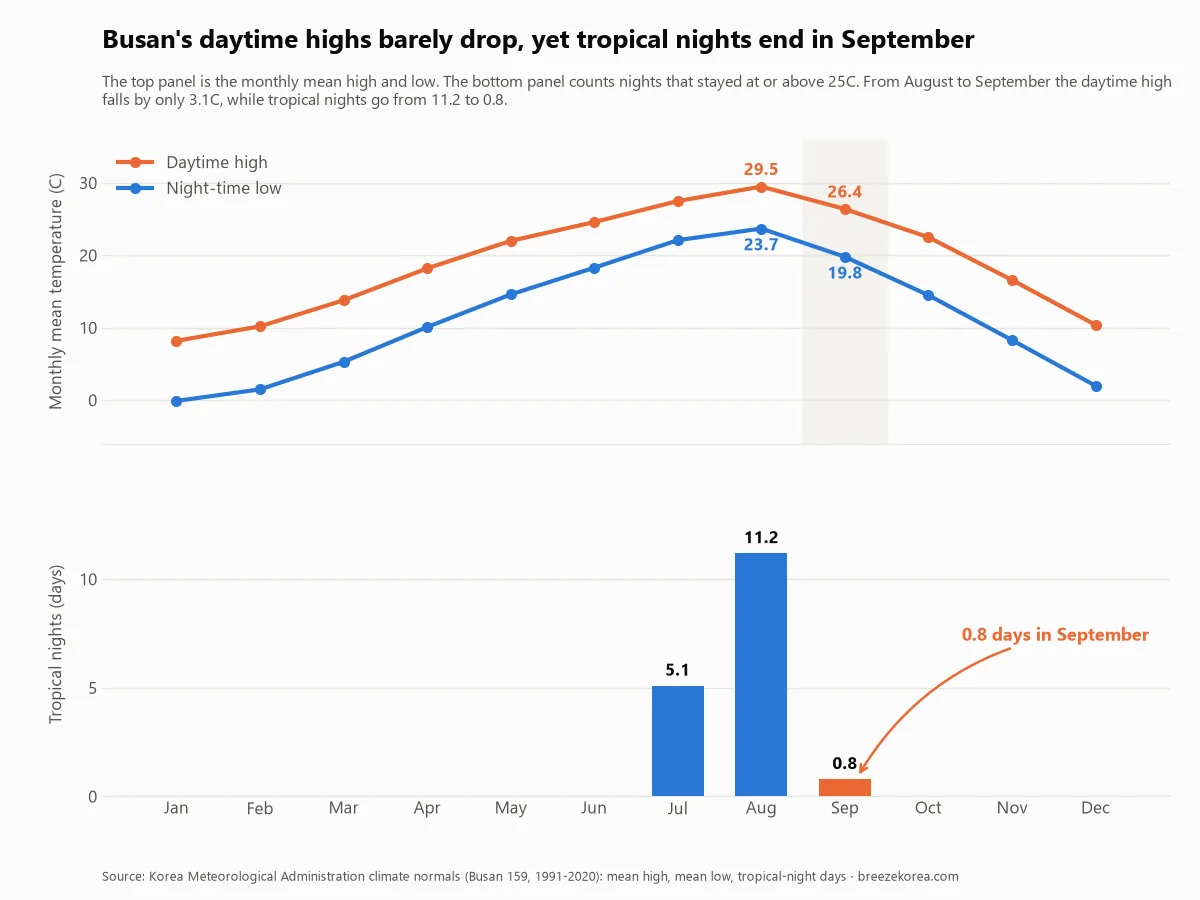
Daytime highs fall only 3.1 degrees from August, but tropical nights drop from 11.2 to 0.8. September is the month where the daylight hours and the evening hours need separate plans.
| Verdict | Strong for evenings, events and swimming before mid month, weaker than October for sunshine |
|---|---|
| Day and night | Average high 26.4°C, average low 19.8°C, and 0.8 tropical nights against 11.2 in August |
| Beaches | Haeundae runs to 15 September, every other Busan beach closed on 31 August |
| Rain | 160.6 mm across 9.2 rainy days, which is wetter than May |
| Typhoons | 0.8 storms reach Korea in an average September, fewer than August’s 1.2 |
| Busiest week | 19 to 28 September, when Japanese, Korean and Taiwanese holidays overlap |
1. Is September a good time to visit Busan?
2. Why the days and the nights need separate plans
3. September week by week
4. Daytime: planning around heat that has not left
5. After dark: the part of the month that actually changes
6. Which Busan beaches are open in September
7. Rain and typhoons: the actual risk, in numbers
8. Busan Biennale: the one large exhibition open all month
9. Byeolbada Busan and the September night programme
10. The last ten days: three countries on holiday at once
11. Chuseok in Busan: what closes and what stays open
12. Booking: trains, flights and rooms for September
13. The film festival is in October, not September
14. What to pack for Busan in September
15. August, September or October: choosing between them
16. Three ways to plan a September trip
For districts, transport and everything outside this one month, start with complete Busan travel guide.
1. Is September a good time to visit Busan?
September is a strong choice if you want warm evenings, an events calendar that runs all month and lower prices for the first eighteen days. It is a weaker choice than October if what you want is dry, bright weather. The average daytime high is 26.4°C against 29.5°C in August, so conditions in the daylight hours are still those of summer. What changes is the night, where the average low falls from 23.7°C to 19.8°C.
Two figures usually settle the decision for first time visitors. Busan records 160.6 mm of rain and 173.8 hours of sunshine in September, and October is better on both counts at 79.6 mm and 212.1 hours. September offers three things October cannot: water you can still get into, a night events programme, and three weeks before holiday demand arrives.
| What you are asking | The September answer |
|---|---|
| Is it still hot? | In daylight, yes. Average high 26.4°C with 72.6 percent humidity |
| Is it hot at night? | Almost never. 0.8 tropical nights against 11.2 in August |
| Can I swim? | At Haeundae to 15 September with lifeguards. Every other city beach closed on 31 August |
| How much rain? | 160.6 mm across 9.2 rainy days, which is more than May receives |
| Is it typhoon season? | 0.8 storms reach the Korean peninsula in an average September, below August’s 1.2 |
| What is actually on? | Busan Biennale from 29 August to 1 November, plus weekend night events at two riverside and beach parks |
| Quietest, cheapest window | 1 to 18 September |
| Week to book early | 19 to 28 September, when three countries are on holiday |
| Would October be better? | For sunshine and dry days yes. For swimming, night events and price, no |
The month divides cleanly for planning purposes. Everything connected with water shuts down in the middle of the month, and everything connected with holiday demand begins in the third week, which leaves 1 to 18 September as the part of the month most travellers should aim for.
If your dates are still movable, compare the neighbouring months before committing. Busan in August is hotter and much wetter with every beach open, Busan in October is dry and noticeably cool after dark, and the best time to visit Busan sets all twelve months against each other.
2. Why the days and the nights need separate plans
The number that separates September from August in Busan is 0.8, the average count of tropical nights, against 11.2 in August. A tropical night is an overnight minimum that stays at or above 25°C. Across the same step from August to September, the average daytime high falls by only 3.1 degrees, from 29.5°C to 26.4°C.
That combination is unusual and it has one direct consequence for a trip. Hill climbs, exposed coastal paths and long walks between midday and late afternoon are still an August problem, while the same routes after seven in the evening work in a way they do not in August.
| Measure | August | September | October |
|---|---|---|---|
| Average daily high | 29.5°C | 26.4°C | 22.5°C |
| Average daily low | 23.7°C | 19.8°C | 14.5°C |
| Tropical nights (25°C or above) | 11.2 | 0.8 | 0.0 |
| Mean humidity | 78.5% | 72.6% | 62.7% |
| Sunshine hours | 199.2 | 173.8 | 212.1 |
| Rainfall | 266.5 mm | 160.6 mm | 79.6 mm |
| Rainy days | 11.9 | 9.2 | 5.3 |
| Rain intensity | 3.23 mm/h | 2.21 mm/h | 2.00 mm/h |
| Days with a 10°C or larger daily range | 0.2 | 0.7 | 5.5 |
| Days with thunder | 3.4 | 0.9 | 0.5 |
Three rows that contradict the usual advice
Sunshine is the first. At 173.8 hours, September is the second darkest month of the year in Busan, behind July at 172.3 hours. The bright, dry, high contrast light that people associate with Korean autumn belongs to October at 212.1 hours, not to September.
Rainfall is the second. September’s 160.6 mm is above May’s 155.9 mm, so the month sits higher on the rainfall table than a month nobody packs a raincoat for. September is not the point where the summer rain stops, it is the point where it eases.
The daily temperature range is the third. Busan records just 0.7 days in September where the gap between the day’s high and the day’s low exceeds 10 degrees, against 5.5 days in October. Mornings, afternoons and evenings in September sit close together, and the packing list is lighter than the calendar month suggests.
3. September week by week
Treat September as three ten day blocks rather than one month, because the swimming season, the events calendar and the room prices all change inside it. The monthly averages hide those changes completely, and the difference between the first block and the third is larger than the difference between September and October.
| Block | Conditions | What is on | Demand |
|---|---|---|---|
| 1 to 10 September | Closest to August in daylight, without August’s overnight heat. Korean school holidays are over | Haeundae open with lifeguards and night opening. Busan Biennale running. Byeolbada night programme at Dadaepo on 4, 5 and the following weekend | The low point of the month. Rooms at their most reasonable |
| 11 to 20 September | The same daytime pattern, with the water season ending inside the block | Haeundae closes on 15 September. Byeolbada night programme on 11, 12, 18 and 19. Balcony Music Show on Gwangbok-ro on 12. Japan’s holiday week opens on 19 | Still low until the 18th, then rising sharply |
| 21 to 30 September | Coolest evenings of the month, no managed swimming anywhere | Chuseok on 25 with the holiday running 24 to 26. Byeolbada night market at Hwamyeong on 26 and 27. Balcony Music Show on 26 | The peak of the month. Trains, flights and rooms all under pressure |
1 to 10 September
This is the block to choose if the sea matters. Haeundae still runs a managed swimming area with lifeguards, the night opening is still on, and the crowd that fills the sand in early August has gone back to school and work. For the full picture of which stretch of sand suits which kind of day, see the best beaches in Busan.
11 to 20 September
Two dates sit inside this block and both matter. Haeundae’s managed season ends on 15 September, and Japan’s five day holiday opens on Saturday 19 September, which is when arrivals and room rates start to move. Booking anything that touches 19 September onward as if it were a normal weekend is the most common planning error in this month.
21 to 30 September
The last block is defined by demand rather than by weather. Three separate national holidays overlap between 19 and 28 September, the Korean one falls in the middle of it, and the practical effect is on intercity trains, flights into Gimhae and hotel pricing rather than on what you can see.
4. Daytime: planning around heat that has not left
Treat roughly 11am to 4pm as August and build the middle of the day around shade, indoor stops or water. An average high of 26.4°C with 72.6 percent humidity is a humid heat rather than a bright dry one, and with 173.8 sunshine hours in the month there is often haze rather than hard sun.
The sites that are hardest in the early afternoon are the exposed ones. Steep hillsides, rock coastline and long seafront paths have very little shade, and September has not cooled enough to make them comfortable at that hour.
| Time | What it suits | Why |
|---|---|---|
| 07:00 to 11:00 | Hillside and coastal sights, temple and viewpoint visits, market walking | Temperatures are near the daily low of 19.8°C and the light is usable for photographs |
| 11:00 to 16:00 | Aquarium, bathhouse floors, department store complexes, museums, an indoor lunch that runs long | The hottest and most humid stretch of the day, with no reliable shade outdoors |
| 16:00 to 19:00 | Beach time, harbour walking, theme park hours, cable cars and observation decks | Heat is dropping while the light is still good |
| After 19:00 | Everything outdoors that August made unpleasant | 0.8 tropical nights in the whole month |
The exposed sights to move to the morning
Gamcheon Culture VillageMap is built on a hillside with narrow lanes, stairs and very little tree cover, so it is a morning visit in September rather than an afternoon one. The same applies to Haedong YonggungsaMap, which sits on open rock above the sea with an approach that is entirely uncovered.
The two long coastal walks are the other candidates for an early start. Igidae Coastal WalkMap runs along cliff edge boardwalk and steps with intermittent shade, and TaejongdaeMap involves a long circuit on a headland. Background on both, including how the circuit works, is in the Taejongdae visitor notes and the Gamcheon Culture Village walkthrough.
Indoor blocks that absorb the hottest hours
SEA LIFE Busan AquariumMap sits directly under the Haeundae seafront, which makes it the easiest midday stop if your day is already based at that beach. Detail on tanks, timings and what the ticket covers is in the aquarium guide.
Spa LandMap inside the Centum City complex is the other reliable heat shelter, and it holds several hours without going outdoors once. The bathhouse floors, the resting rooms and the department store around them are all connected to the metro. How Spa Land works covers the entry system for anyone who has not used a Korean bathhouse before.
Lotte World Adventure Busan is an outdoor park, so in September it is an afternoon and evening visit rather than a midday one. Arriving after 16:00 puts the queues into the cooler part of the day and keeps the rides running into the illuminated hours.
Almost all of this is reachable without standing outside for long. Anything on the metro network can be done as an air conditioned transfer, which matters more in September than the temperature table suggests, and the Busan transport rundown covers cards, lines and airport connections.
5. After dark: the part of the month that actually changes
With 0.8 tropical nights against August’s 11.2, September evenings are the practical reason to pick this month. The average overnight low of 19.8°C sits 3.9 degrees below August and 5.3 degrees above October, which for most people is the range where sitting outside near the water works without a jacket and without sweating.
That one change alters the order of the day. Dinner outdoors, walking, photography and anything on a rooftop or a seafront become practical after sunset in September, while in August the same plans have to wait until very late or be dropped.
The waterfront after sunset
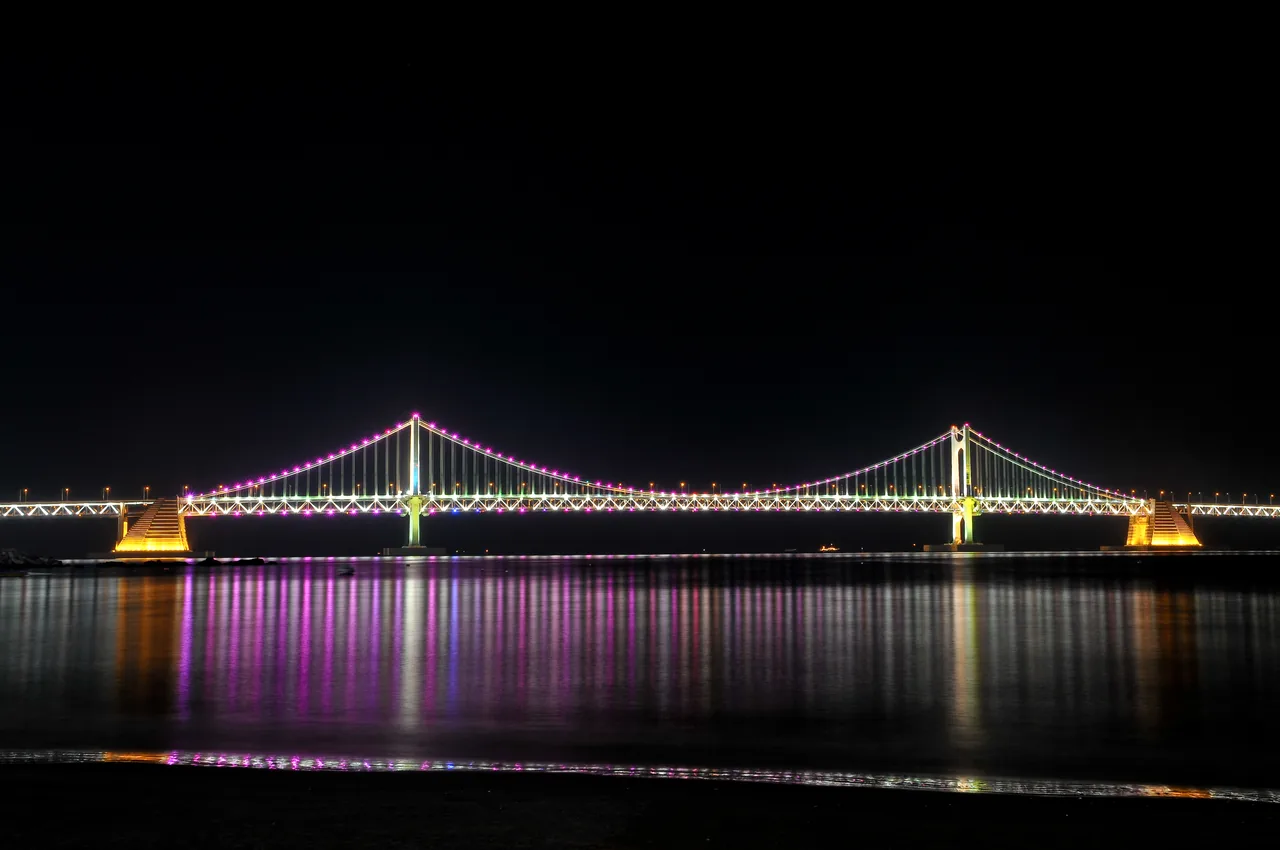
Gwangalli BeachMap is the default evening destination, because the beach faces Gwangan BridgeMap and the bars and restaurants run along the road directly behind the sand. In August that seafront is uncomfortable until very late; in September it works from sunset. The Gwangalli area rundown covers where the food and the views actually are.
Haeundae keeps its night opening until 15 September, so for the first half of the month the beach itself is lit and supervised in the evening rather than simply dark. After that date the sand is still open to walk on, but the lighting and staffing that come with the managed season are gone.
Height, and where the city looks best from
Busan X the SkyMap is the observation deck above Haeundae, and September evenings suit it better than September afternoons, because the haze that comes with 72.6 percent humidity is usually at its thickest during the day. The observation deck guide has the floor by floor detail, and the Busan photo locations list covers the other angles worth the trip.
Night tours make sense in a month like this for one specific reason. The evening is the comfortable part of the day, and the sights worth seeing after dark are spread along the coast rather than clustered, which is the kind of route that takes a long time on public transport.
The other option is to be on the water rather than beside it. Yacht cruises run out of the Suyeong Bay area past the bridge, and September evenings remove the two things that spoil them in August, which are heat on deck and the humidity that hangs over the bay.
For bars, late food and how the districts differ from each other after midnight, the Busan nightlife guide goes area by area. Seomyeon, Gwangalli and Haeundae are each different from the others on a September weekend.
6. Which Busan beaches are open in September
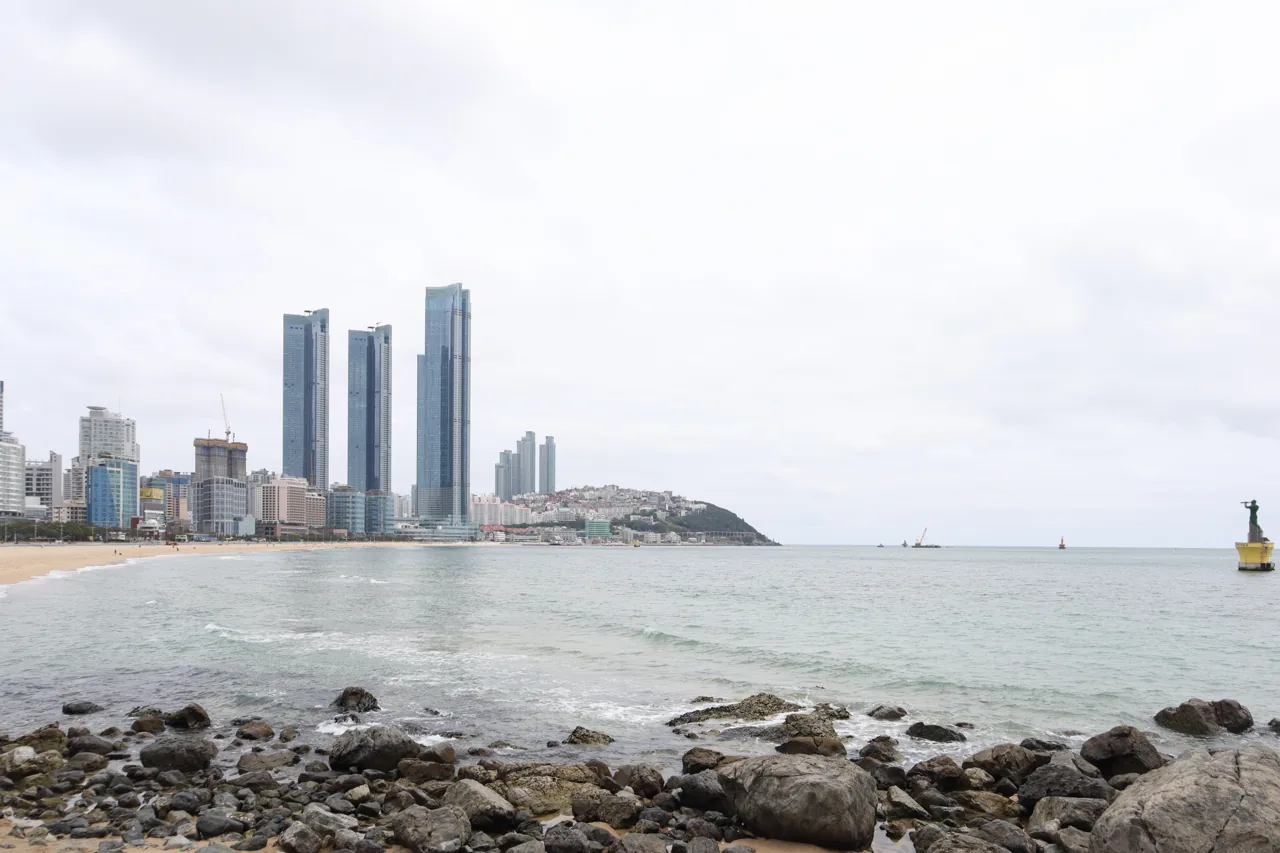
Haeundae is the only Busan beach with a managed season that reaches into September, running to 15 September. Every other city beach closed on 31 August. This is the point most September guides get wrong, in both directions, so the operating dates for 2026 are worth reading in full.
| Beach | 2026 managed season | Status in September |
|---|---|---|
| Haeundae | 26 June to 15 September, night opening included | Open with lifeguards to the 15th, unmanaged after |
| Songjeong | 26 June to 31 August | Unmanaged all month |
| Gwangalli | 1 July to 31 August | Unmanaged all month |
| Songdo | 1 July to 31 August | Unmanaged all month |
| Dadaepo | 1 July to 31 August | Unmanaged all month |
| Ilgwang | 1 July to 31 August | Unmanaged all month |
| Imnang | 1 July to 31 August | Unmanaged all month |
What “closed” means in practice
A closed beach in Busan is not a fenced one. The sand stays open and people walk, sit and photograph on all of these beaches through the autumn. What ends with the season is the safety and service layer: lifeguards on duty, marked swimming zones, changing rooms, showers, and the parasol and equipment rental that operates on the sand in summer.
That distinction is the whole of the swimming decision. Going into the water at Songjeong BeachMap, Songdo BeachMap or Dadaepo BeachMap in September means going in with nobody watching, which is a different proposition from swimming inside the marked area at Haeundae BeachMap before the 15th.
How warm is the water?
Sea water cools more slowly than air, so the water in the first half of September is not as cold as the fall in air temperature implies. This page does not publish a seasonal average sea temperature for Busan, because no official monthly figure could be verified from a public source, and an unsourced number is worse than none.
For the actual temperature on your dates, use the Korea Meteorological Administration’s live sea surface observations rather than a seasonal average from a travel page. It is a single number that updates through the day and it answers the question far better than a monthly mean would.
Two more beach guides are worth having open when you plan this part of the trip: the Haeundae area guide for the beach that stays managed longest, the Songdo guide for the cable car and the coastal walk that work with or without swimming, and the Busan surfing rundown for how Songjeong operates outside the official season. For everything else on the coast, the full Busan beach list covers the smaller stretches too.
If you are building the trip around the first half of the month, staying at Haeundae is the arrangement that gets the most out of the remaining season. It puts the only managed beach, the aquarium and the observation deck inside walking distance of each other.
7. Rain and typhoons: the actual risk, in numbers
September is not the peak of the typhoon season for Korea. An average September produces 5.1 storms in the basin and 0.8 of them affect the Korean peninsula, against 5.6 formed and 1.2 affecting in August. The reputation of the month is stronger than the figures behind it, and those figures are worth reading before you drop a plan over them.
| Typhoons, average year | July | August | September |
|---|---|---|---|
| Storms formed | 3.7 | 5.6 | 5.1 |
| Storms affecting the Korean peninsula | 1.0 | 1.2 | 0.8 |
| Share that reach Korea | about 1 in 4 | about 1 in 5 | about 1 in 6 |
Read the middle row as a whole month figure. Across an average September, less than one storm affects the country at all, and a storm that affects the peninsula does not necessarily affect Busan, and one that affects Busan occupies a day or two rather than a week. Named storms and their track numbers are out of date within weeks, so this page deals in the climatology rather than in any individual system.
What ordinary September rain looks like
The rain figure that matters more for planning is not the monthly total but the share of the month it occupies. September records 72.7 hours of rain out of 720 hours in the month, which is about 10 percent, and roughly 20.8 days in the month record no rain at all.
| Rain, average year | August | September | October |
|---|---|---|---|
| Rainfall | 266.5 mm | 160.6 mm | 79.6 mm |
| Rainy days | 11.9 | 9.2 | 5.3 |
| Hours of rain | 82.5 | 72.7 | 39.8 |
| Rain per hour of rain | 3.23 mm | 2.21 mm | 2.00 mm |
| Hours of rain per rainy day | 6.9 | 7.9 | 7.5 |
| Days with thunder | 3.4 | 0.9 | 0.5 |
Those last two rows change the advice you will read elsewhere. August rain in Busan is short and violent, at 3.23 mm per hour across 6.9 hours on a rainy day. September rain is gentler and longer, at 2.21 mm per hour across 7.9 hours, so a wet day in September is more likely to stay wet rather than to clear after an hour.
Thunder follows the same direction. Busan records 3.4 days with thunder in August and 0.9 in September, so the sudden violent afternoon storm is far less of a September event than an August one.
What to actually do about it
- Check the radar, not the daily icon. A daily forecast showing rain covers a month where rain occupies about a tenth of the hours, so the icon rarely means the whole day is lost.
- Keep one indoor block in reserve. A bathhouse floor, the aquarium or a large complex absorbs four to six hours without going outside, and none of them need to be booked around the weather.
- Move outdoor days rather than cancel them. With 20.8 dry days in an average month, swapping a coastal walk from one day to the next usually works.
- In a storm, stay on the metro network. Wind sensitive attractions such as cable cars, observation decks and boat services suspend first, while the underground lines and the connected complexes keep running.
A full wet weather plan for the city, with opening hours and closures, is in what to do in Busan when it rains. The single most useful reservation on a wet September day is a bathhouse, because it is the one activity that is no worse in bad weather than in good.
8. Busan Biennale: the one large exhibition open all month
Busan Biennale 2026 runs from 29 August to 1 November, 65 days in total, and it is the only major exhibition that covers the whole of September. The edition is titled Dissident Chorus, and it is led by co-artistic directors Evelyn Simons and Amal Khalaf.
The Biennale is a contemporary art event held across several sites in the city rather than in one building, which is how it fills a September itinerary. Two of the three venues are not conventional galleries, and that is part of the design of the edition.
| Venue | What it is |
|---|---|
| Museum of Contemporary Art Busan | The main venue, a purpose built contemporary art museum on Eulsukdo at the mouth of the Nakdong River |
| The former Busan Nam High School | A disused school building used as an exhibition site for this edition |
| Space Wonji | A third site added for this edition |
Museum of Contemporary Art BusanMap is the venue to plan around if you only have time for one. It closed for renovation from 20 July to 28 August and reopened on 29 August, which is the Biennale’s opening day, so September is the first full month of normal operation there.
For a first time visitor the Biennale also solves a specific September problem. The middle of the day is the part that needs indoor time, and a large exhibition absorbs exactly that block without forcing you to spend it in a shopping complex.
9. Byeolbada Busan and the September night programme
Busan runs two separate night events under the Byeolbada Busan name in September, on different weekends and in different parks. The music and camping evenings run on Friday and Saturday from 4 to 19 September at Dadaepo Beach Park, and the night market runs on 26 and 27 September at Hwamyeong Ecological Park.
| Event | September dates | Where |
|---|---|---|
| Byeolbada Busan Night Music Camcnic | 4 and 5, 11 and 12, 18 and 19 September | Dadaepo Beach Park |
| Byeolbada Busan Night Market | 26 and 27 September | Hwamyeong Ecological Park, lotus garden area |
| Balcony Music Show | 12 and 26 September, the second and fourth Saturday | Gwangbok-ro in the old downtown |
| Haeundae night opening | Until 15 September | Haeundae Beach |
Both Byeolbada programmes run in the late afternoon and evening, generally from around 16:00 to 21:00, with the exact hours varying by programme. That timing follows the same pattern as the rest of the month, because the comfortable outdoor hours in September start late.
Dadaepo, on the weekends up to the 19th
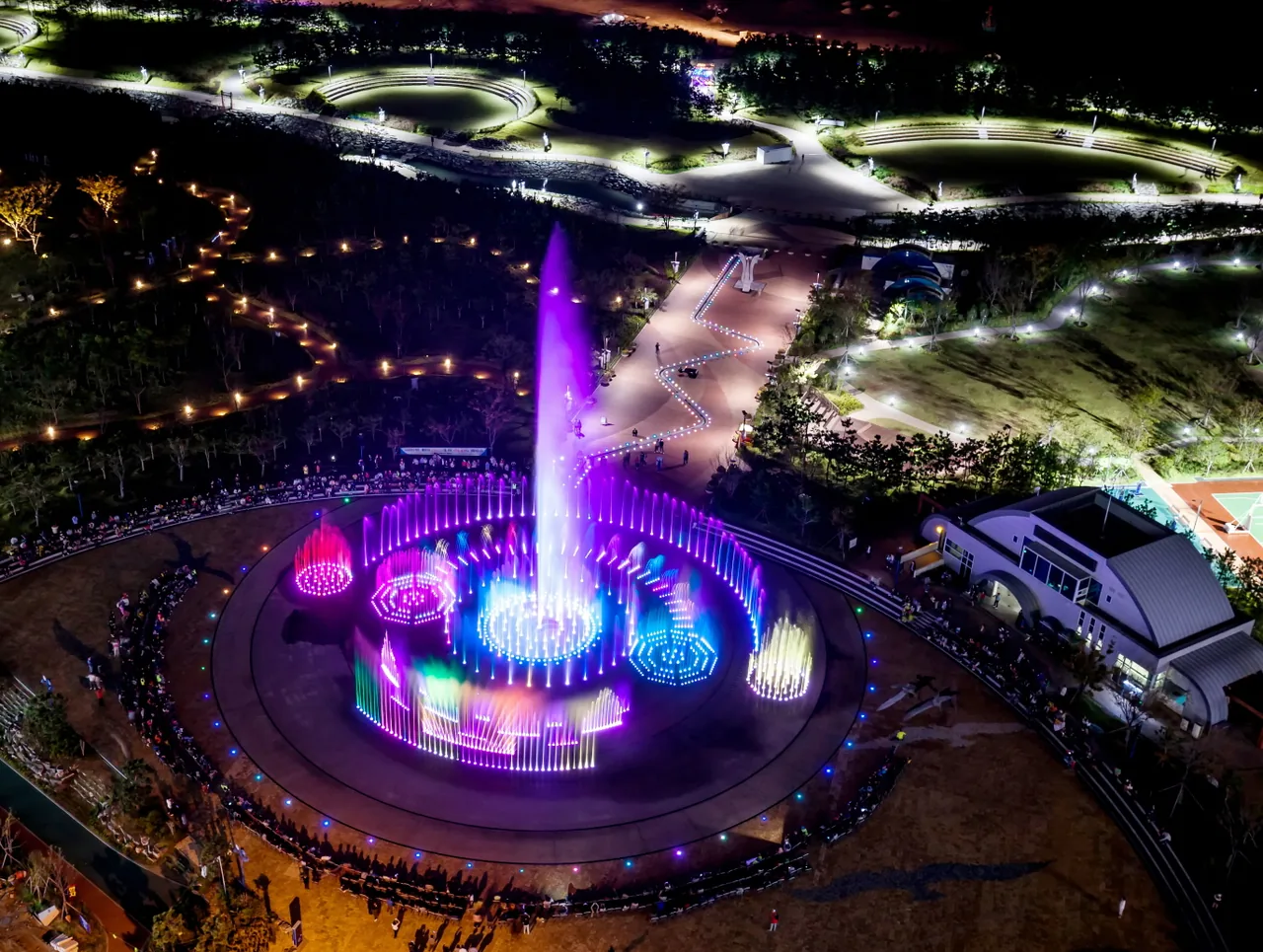
Dadaepo Beach sits at the mouth of the Nakdong River at the far western end of the city, and its beach park is wide, flat and open, which is why the camping style evenings are held there. The Dadaepo Sunset Fountain of DreamMap is on the same site, so the trip out works as one evening rather than two separate outings.
Getting there takes longer than most Busan destinations, since Dadaepo is the last stop on Line 1. Budget the travel time into the evening rather than treating it as a quick detour, and read the Dadaepo area guide for how the beach, the park and the fountain fit together.
Hwamyeong, on the last weekend
Hwamyeong Ecological ParkMap runs along the Nakdong River in the north of the city, and the night market is held in the lotus garden section. The September dates are 26 and 27, and the same market continues on further weekends through October, which is useful if your trip slips past the end of the month.
The old downtown, twice a month
The Balcony Music Show is held on Gwangbok-roMap, the pedestrian shopping street in the Nampo area, on the second and fourth Saturday of every month. In September that means 12 and 26 September, and both fall on evenings when you are likely to be in that part of the city anyway for the markets and the food streets.
10. The last ten days: three countries on holiday at once
Between Saturday 19 September and Monday 28 September, public holidays in Japan, Korea and Taiwan overlap, and travellers from all three arrive in Busan across the same dates. None of this stops you travelling. It changes what a room costs and whether a train seat exists.
| Where | Dates | What it is | Why it reaches Busan |
|---|---|---|---|
| Japan | 19 to 23 September, Saturday to Wednesday | Five consecutive days off, with Respect for the Aged Day on the 21st, a citizens’ holiday on the 22nd and the autumn equinox on the 23rd. This alignment has not occurred for eleven years | Busan is a short flight from Fukuoka and Osaka and a ferry route from Kyushu, so Japanese demand arrives first and lands hardest on hotels |
| Korea | 24 to 26 September, Chuseok on Friday the 25th | Three statutory holidays. There is no substitute holiday in 2026 | Domestic travel peaks. Intercity trains and buses fill, and Busan is a destination as well as a hometown for a large number of people |
| Taiwan | 25 to 28 September, Friday to Monday | Mid-Autumn Festival on the 25th and Teachers’ Day on the 28th, giving four consecutive days with no make up working day | A second wave of inbound demand landing on exactly the same dates as the Korean holiday |
The sequence matters as much as the individual dates. The first of the three holidays starts on the 19th and the last one ends on the 28th, so demand stays high for ten continuous days rather than for a single long weekend.
Korea’s Chuseok has no substitute holiday in 2026, because Chuseok generates one only when it falls on a Sunday, and in 2026 the three holiday days are Thursday, Friday and Saturday. Sunday 27 September then follows the holiday, so the break reads as four days off in practice while only three are statutory. Hotels commonly price that Sunday as part of the holiday.
11. Chuseok in Busan: what closes and what stays open
Chuseok falls on Friday 25 September, and the statutory holiday runs from 24 to 26 September. For a visitor the effect is narrower than the reputation suggests: transport and small independent businesses are affected, while the things most travellers came for keep running.
Chuseok is the Korean harvest holiday, one of the two largest in the calendar. Families travel to their hometowns, hold a memorial rite for their ancestors on the morning of the day itself, and visit family graves, which is why the movement in the country is domestic and concentrated on the roads and the railways.
What closes
| Category | What happens over 24 to 26 September |
|---|---|
| Banks, government offices, district offices, post offices | Closed for all three days. Change money and handle any paperwork before the 24th |
| Small independent restaurants, neighbourhood shops, market stalls | Many close at least on Chuseok day itself and some for the whole holiday. This is the category most likely to affect a traveller’s dinner plans |
| Large supermarkets | Chains such as Emart, Homeplus and Lotte Mart commonly close on Chuseok day only, and individual branches differ. Costco normally closes on the day itself as standard practice |
| Department stores | In recent years most branches have closed for around two days across the holiday. Each store announces its own dates shortly before |
What stays open
| Category | What happens over 24 to 26 September |
|---|---|
| Convenience stores | Open 24 hours throughout. They are the reliable fallback for food on the day itself |
| Metro, city buses, taxis | Running. Urban transport inside Busan is not the problem, intercity transport is |
| Airports and duty free | Airports do not close for the holiday. Duty free operates close to normally |
| Major paid attractions | Theme parks, aquariums, observation decks and large complexes generally operate, and some run holiday programmes with traditional games |
| Traditional markets | Busier than usual in the days before the holiday as people shop for it, then quieter or partly shut during it |
If something goes wrong during the holiday
Pharmacies and clinics thin out over the three days, and the official tool for finding what is open is the government’s emergency medical portal at e-gen.or.kr, which lists open hospitals, emergency rooms and pharmacies by location. The numbers to know are 119 for an emergency and 129 for the health and welfare call centre.
The practical version for a traveller in Busan
The risk on 25 September is dinner rather than sightseeing. Plan that evening around a hotel restaurant, a large complex or a chain, keep a convenience store as the fallback, and avoid arriving in a residential neighbourhood at 8pm expecting to find a small restaurant open. The full picture of the holiday, including how it works elsewhere in Korea, is in the Chuseok holiday guide.
12. Booking: trains, flights and rooms for September
If any part of your trip touches 19 to 28 September, book the intercity leg and the accommodation first and build the rest of the itinerary around them. Outside that block, September is one of the easier months of the year to book at short notice.
KTX and intercity trains
Seats between Seoul and Busan sell out over Chuseok, and the holiday period is handled through a special reservation window that opens weeks ahead rather than through the normal rolling schedule. In past years that window has opened around four to five weeks before the holiday, after a priority period for elderly and disabled passengers.
There is an additional complication in 2026. Korail and SR, the two operators running high speed services on the Seoul to Busan corridor, began merging their membership systems on 14 July 2026, with the integrated booking arrangement covering trains that run from September onward. Confirm the current position on the operators’ own channels, then set up and verify your account well before tickets are released rather than on the morning itself.
Flights and the airport
Gimhae International Airport handles the short haul routes from Japan, Taiwan and mainland China that carry most of the September holiday traffic, so the same 19 to 28 September block that raises hotel prices also tightens flight availability. Airports do not close for Chuseok, and urban public transport in Busan, including the light rail link from Gimhae, runs during the holiday.
Long haul travellers arriving through Seoul have the extra decision of the domestic leg. Taking the train rather than a connecting flight is usually the simpler option outside the holiday, and inside it the train is the leg that sells out first. Getting from the airport into Busan covers the transfer options and roughly what each costs.
Where to stay, and when it matters
Room rates in Busan differ sharply between the two halves of the month. Through 18 September the city is in a low demand period between the domestic summer peak and the autumn festival season, and mid-range rooms are widely available. From 19 September the same rooms move into the high bracket.
The area decision depends on which half of the month you are in. Before the 15th, the beach areas make sense because the water is still managed. After that date there is less reason to pay for a beachfront address, and a base with better transport and food access is the more useful choice. The Busan area by area accommodation guide compares the districts, and the Haeundae accommodation breakdown goes street by street for the beach itself.
Gwangalli is the compromise that suits September specifically. The beach is unmanaged from 1 September so you are not paying for swimming access you cannot use, while the seafront is the best evening location in the city during exactly the month when evenings are the point.
13. The film festival is in October, not September
The Busan International Film Festival does not take place in September. The 31st edition runs from 6 to 15 October. This is the single most common date error made about Busan, and it comes from a real cause rather than from carelessness.
The 30th edition ran from 17 to 26 September in 2025, because the Korean holiday calendar sat differently that year, and a large amount of published advice was written during or about that edition. Anyone planning a September trip around the festival on the basis of last year’s dates will miss it by around ten days.
| Event | When | Where |
|---|---|---|
| Busan International Film Festival, 31st edition | 6 to 15 October | Busan Cinema Center and screens across the Haeundae area |
| Busan International Rock Festival | 2 to 4 October | Samnak Ecological Park |
| Busan Fireworks Festival | November | Gwangalli Beach |
| Busan Biennale | 29 August to 1 November | Three sites, see the Biennale section above |
Busan Cinema CenterMap is the festival’s main venue and it is open all year as a working cinema and cultural building, so a September visitor can see the architecture and use the screens without the festival being on. The Busan Cinema Center guide explains the building, the outdoor screen and the surrounding Centum City area.
Samnak Ecological ParkMap hosts the rock festival on the first weekend of October, along the Nakdong River. The fireworks festival at Gwangalli falls in November and is the largest single event of the Busan year, which is covered in the Busan Fireworks Festival guide.
14. What to pack for Busan in September
Pack for a warm humid day and a mild evening, not for autumn. The gap between the average high and the average low is 6.6 degrees in September, and Busan records only 0.7 days in the month where that gap exceeds 10 degrees, against 5.5 days in October. Layering is much less of a September problem than the calendar month implies.
| Item | Why | Needed when |
|---|---|---|
| Light breathable daytime clothing | 26.4°C average high with 72.6 percent humidity | Every day |
| One light long sleeve layer | Average low 19.8°C, comfortable rather than cold | Evenings, all month |
| Compact umbrella and a light rain shell | 9.2 rainy days, and September rain lasts about 7.9 hours on the days it appears | Any day |
| Sun protection | Midday sun is still summer strength even with haze | Middle of the day |
| Swimwear | Only Haeundae runs a managed swimming area, and only to 15 September | Trips ending before the 15th |
| Shoes with grip | Coastal boardwalks, stone steps and hillside lanes hold water after rain | Any walking day |
| Quick dry socks or a spare pair | The one genuinely useful small item in a month with 72.6 percent humidity | Any day |
The two mistakes people make
The first is over-packing for cold. September in Busan has no tropical nights to speak of, but it also has no autumn chill, and 19.8°C overnight does not need anything heavier than a long sleeve layer. A coat or a heavy jacket adds weight to the bag for no benefit.
The second is bringing the wrong rain gear. Because August rain in Korea is short and violent, most advice recommends a rain jacket over an umbrella. September rain is the opposite pattern, gentler at 2.21 mm per hour but longer at about 7.9 hours per rainy day, and an umbrella is the more useful of the two in this particular month.
15. August, September or October: choosing between them
The choice comes down to three trade-offs: swimming access, evening comfort and dry weather. No month gives you all three. Only August has every beach open. Only October has reliably dry weather. September is the only one of the three where the evenings are comfortable outdoors.
| What you want | August | September | October |
|---|---|---|---|
| Managed swimming | Every beach, to 31 August | Haeundae only, to 15 September | None |
| Comfortable evenings outdoors | No. 11.2 tropical nights | Yes. 0.8 tropical nights, lows of 19.8°C | Cool. Lows of 14.5°C |
| Sunshine | 199.2 hours | 173.8 hours | 212.1 hours |
| Rain to plan around | 266.5 mm over 11.9 days | 160.6 mm over 9.2 days | 79.6 mm over 5.3 days |
| Humidity | 78.5% | 72.6% | 62.7% |
| Large events | Biennale opens 29 August | Biennale all month, Byeolbada night programme on weekends | Film festival 6 to 15 October, rock festival 2 to 4 October |
| Room prices | High in the first half | Mid-range to 18 September, high from the 19th | High on festival weekends |
| Walking and hiking | Difficult at any hour | Good before 11:00 and after 16:00 | Good all day |
- Pick September if the trip is built around evenings outdoors, the Biennale, and getting a mid-range room, and if you can start before the 19th.
- Pick October if you want dry bright weather, the film festival or the rock festival, and you have no interest in swimming.
- Pick August only if swimming at every beach and the full summer programme outweigh 11.2 nights above 25°C.
There is one hybrid worth knowing about. A trip that starts in the last few days of September and runs into the first week of October catches the Biennale, the rock festival and the opening of the film festival in one visit, with October’s weather for most of it. The cost is that it also sits inside the Chuseok and Taiwanese holiday block at the start.
16. Three ways to plan a September trip
The right shape of trip depends on which part of the month you land in, because the water season, the events and the crowd level are all different across the three blocks. These are three day cores that can be extended in either direction.
Plan A: 1 to 15 September, with swimming still available
- Day one. Morning at Gamcheon and the old downtown while it is cool, an indoor lunch, then the afternoon and evening at Haeundae while the managed beach and the night opening are still running.
- Day two. Early start for the coastal walk at Igidae or the Taejongdae circuit, the aquarium or a bathhouse floor through the middle of the day, then Gwangalli from sunset for the bridge and the seafront restaurants.
- Day three. The Biennale at the Museum of Contemporary Art Busan out on Eulsukdo, then Dadaepo Beach Park in the evening if the day is a Friday or a Saturday up to the 19th.
Plan B: 16 to 23 September, with no swimming
- Day one. Haedong Yonggungsa first thing, the eastern coast and the Haeundae area through the day, and Busan X the Sky in the evening once the daytime haze has dropped.
- Day two. The Biennale across two of its three sites, which fills the hot middle of the day indoors, followed by the old downtown markets and Gwangbok-ro in the evening.
- Day three. A day trip out of the city, or the Songdo cable car and coastal walk, then a yacht or a night tour in the evening while the water is calm and the air is at 19.8°C rather than 23.7°C.
Plan C: 24 to 28 September, inside the holiday block
- Book everything first. The room and any intercity train are the two things that run out. Nothing else about this plan works if those are left late.
- Base yourself in one district. Moving across the city is slower and busier during the holiday, so pick a base with food and transport in walking distance and stay with it.
- Use the large operators for the 25th. Attractions, complexes and hotel restaurants run through Chuseok, while the small independent places are the ones that shut. Keep the evening of the 25th uncomplicated.
- Take the night market on the 26th and 27th. Hwamyeong Ecological Park is running exactly on the holiday weekend, and it is one of the few things scheduled specifically for those dates.
A pass covering several paid attractions is worth checking against your list for the middle of a September day, since most of the indoor stops that solve the heat are the ones a pass usually includes.
For longer trips and for how these days join up with Gyeongju, Tongyeong and the other places within reach, the Busan itinerary planner lays out three, four and five day routes that can be dropped straight into any of the three blocks above.
🎡Things to Do49
🍜Food7
🏨Where to Stay3
🚇Getting Around8
🧭Travel Tips13
📌More3
🧭All-Korea essentials37
Busan in September: common questions
Read the complete Busan travel guide
Images: Gwangan Bridge at night: Doo-ho Kim, public domain. Sunset Fountain of Dreams at Dadaepo: 오재순, CC BY-SA 3.0. Haeundae Beach: Mobius6, CC BY-SA 4.0. Via Wikimedia Commons. Temperature and tropical-night chart: Breeze Korea, from Korea Meteorological Administration climate normals for Busan, 1991-2020.