
Haeundae vs Gwangalli: Which Busan Beach Should You Choose?
A no-nonsense comparison of Busan’s two star beaches — swimming, nightlife, the Saturday drone show, hotels and how to do both in one evening
| Quick verdict | Pick Haeundae for swimming, families and a first Busan trip; pick Gwangalli for the bridge lights, the Saturday drone show and cheaper ocean views |
|---|---|
| Beach & swimming | Haeundae wins — wider sand and a longer 2026 season (Jun 26–Sep 15 vs Gwangalli’s Jul 1–Aug 31) |
| Nightlife & the drone show | Gwangalli wins — Gwangan Bridge lit nightly 19:00–22:00 and a free drone light show every Saturday |
| Who it suits | Haeundae for families, luxury hotels and sunrise; Gwangalli for couples, cafés, photography and a younger buzz |
| Where to stay & price | Haeundae is the 5-star cluster (Signiel, Paradise, Westin); Gwangalli is cheaper bridge-view stays, closer to Busan Station |
| Getting between them | Metro Line 2, 4 stops, about 16 minutes; a taxi is roughly 10–15 minutes |
| Do you have to choose? | No — with only 16 minutes between them, most visitors do Haeundae by day and Gwangalli after dark, ideally on a Saturday |
1. The one-line verdict — quick answer
2. Haeundae vs Gwangalli at a glance — the comparison table
3. The beach and swimming — where Haeundae wins
4. The vibe — and who each beach is for
5. Night views and the drone show — where Gwangalli wins
6. Things to do nearby — attractions compared
7. Food — market feasts vs seafront raw fish
8. Cafés and nightlife — refined vs young
9. 2026 events calendar — who owns which festival
10. Where to stay — hotels and neighbourhoods compared
11. Cost and budget — which beach is cheaper
12. Getting there and getting between them
13. When to go — season and time of day
14. The perfect “do both” plan — one day, two beaches
15. Final verdict — so, which one?
Choose Haeundae if you want to swim, travel with family or are seeing Busan for the first time; choose Gwangalli if you’re here for the Gwangan Bridge at night, the free Saturday drone show and cheaper ocean-view rooms — but with only 16 minutes between them on Metro Line 2, the honest answer for most visitors is both. Haeundae is Korea’s big, polished resort beach: wider sand, a longer swimming season and a wall of five-star towers behind it. Gwangalli is younger and more atmospheric, a curve of cafés and pochas facing the illuminated Gwangan Bridge, and it owns Busan’s best free night spectacle. This guide sets the two side by side, tells you honestly which one wins each dimension, and shows you how to string them together in a single evening. For the wider city, start with our complete Busan travel guide.
1. The one-line verdict — quick answer
If you can only pick one, the rule is simple: Haeundae for the daytime beach and swimming, Gwangalli for the night. Everything else is a variation on that. Both are on Metro Line 2, both have clear English signage, and both are genuinely worth your time — so this is a question of what you want from the day, not of one beach being “better” than the other.
Here’s the fast decision, sorted by the kind of traveller you are:
Choose Haeundae if…
You want to swim, you’re travelling with kids, you want a wide beach and a luxury ocean-view hotel, or it’s your first time in Busan and you want the easy, iconic option.
Choose Gwangalli if…
You’re a couple, you love a city-at-night view, you want cafés and rooftops, you’re chasing the drone show and fireworks, or you want an ocean-view room without the five-star price.
Have a full day? Do both.
Beach and lunch at Haeundae, then ride four stops to Gwangalli for sunset, dinner with a bridge view and — if it’s Saturday — the 20:00 drone show.
One-line takeaway: Haeundae is the daytime champion, Gwangalli is the night champion, and the 16-minute Metro ride between them means you rarely have to pick just one.
2. Haeundae vs Gwangalli at a glance — the comparison table
This single table is the heart of the decision — scan the rows that matter to you and you’ll know which beach fits. Below it, the rest of the guide drills into each dimension in turn, so treat this as your map.
| Dimension | Haeundae | Gwangalli |
|---|---|---|
| Character | Big, classic resort beach — international, upscale | Young, arty, café-and-nightview vibe |
| Beach size | 1.5 km long, 70–90 m wide (wider) | 1.4 km long, 25–110 m (varies) |
| 2026 swim season | Jun 26 – Sep 15 (longest in Busan) | Jul 1 – Aug 31 (shorter) |
| Best for swimming | Yes — wider, longer season, family-friendly | Fine, but it’s more about the view |
| Night scene | Marine City skyline, observation deck, refined | Bridge lights + free Saturday drone show |
| Signature sight | Marine City / BUSAN X the SKY / Blue Line Park | Gwangan Bridge, drone show, fireworks festival |
| Food | Traditional market, fine dining, ocean-view cafés | Raw-fish centres, live-fish market, café street, pochas |
| Hotels & price | Five-star ocean-view cluster; mid to premium | Cheaper bridge-view stays; budget to mid |
| Metro (Line 2) | Haeundae Stn, exits 3 & 5, 5–10 min walk | Gwangan Stn, exits 3 & 5, 5–10 min walk |
| Best suited to | Families, swimmers, luxury, first-timers, sunrise | Couples, photographers, night owls, budget ocean views |
Read it this way: the two beaches barely differ in length, but they diverge sharply in personality. Haeundae is the wide, sun-and-swim resort with the marquee hotels; Gwangalli is the night-out beach where the bridge, the drone show and the café strip do the heavy lifting. Almost everything below flows from that split.
3. The beach and swimming — where Haeundae wins
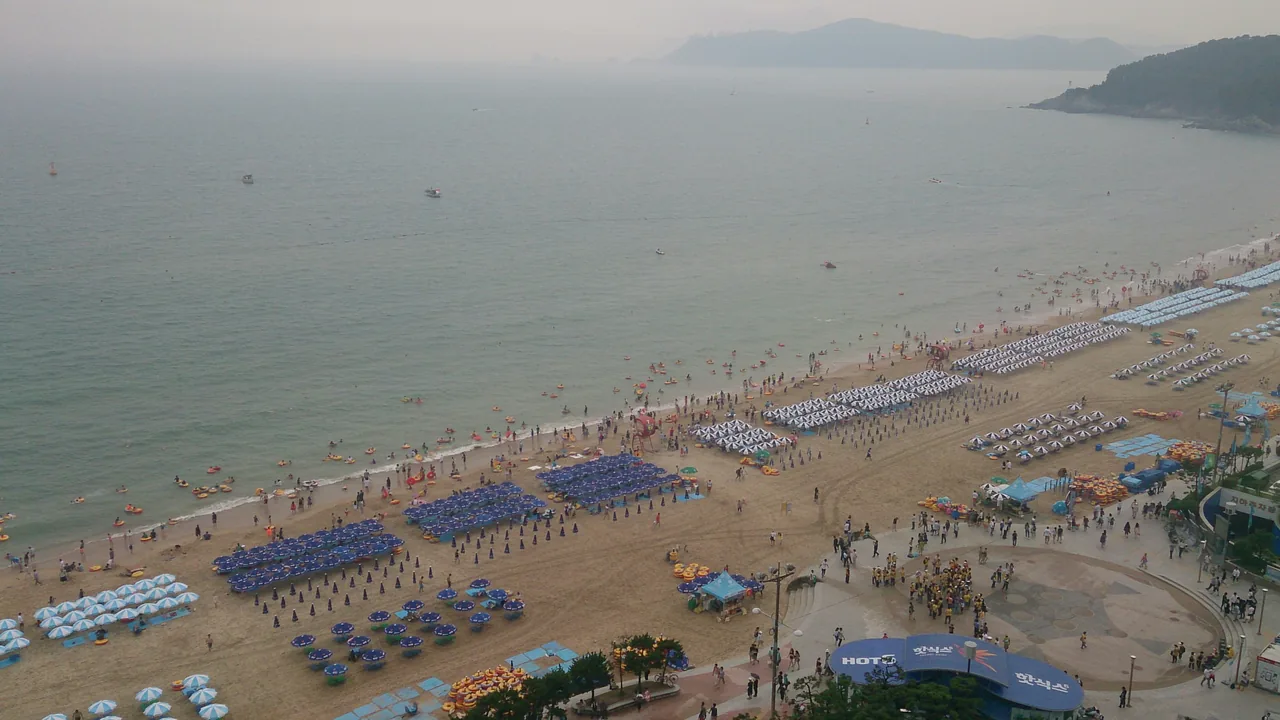
For actually getting in the water, Haeundae is the clear winner: it’s wider, it has the longest swimming season in Busan, and its scale swallows crowds better. Gwangalli is perfectly swimmable in season, but its sand is narrower in stretches and its official season is shorter, and locals treat it more as a place to sit and look at the bridge than to spend the day in the surf.
The season dates are the single most practical difference, so plan around them:
| Detail | Haeundae | Gwangalli |
|---|---|---|
| 2026 swim season | Jun 26 – Sep 15 | Jul 1 – Aug 31 |
| Sand length | 1.5 km | 1.4 km |
| Sand width | 70–90 m (consistently wide) | 25–110 m (varies by section) |
| Area | ~120,000 m² (among Korea’s largest) | ~82,000 m² |
| Water temp (Jul–Sep) | Roughly 24–28°C | Roughly 24–28°C |
Both beaches are patrolled and equipped during the official season, with lifeguards, changing facilities and marked swimming zones. Busan’s environmental authority rates the water and sand quality across the city’s beaches as suitable for swimming, though entry can be suspended in rough weather — check the flags before you go in.
The width difference is more meaningful than the near-identical length suggests. Haeundae holds a steady 70–90 m of sand across its whole arc, which means room to lay a mat, set up with kids and still reach the water without threading through crowds. Gwangalli’s sand pinches to as little as 25 m in places, so at peak times the usable beach feels tighter even though the headline numbers look close.
Crowd behaviour differs too. Haeundae draws serious beachgoers who come to swim and sunbathe for hours, so the water fills up but the beach is built for it; Gwangalli attracts people who sit, snack and photograph the bridge, so the sand can be packed in the evening while the water stays relatively empty. If your day is about the sea itself, that tilts things further toward Haeundae.
Timing note: outside the official season the beaches stay open to walk and photograph, but there are no lifeguards and swimming is discouraged. If swimming is the point of your trip, aim for July or August, when both seasons overlap and the water is warmest. For the full breakdown of Haeundae itself, see our full Haeundae Beach guide guide.
4. The vibe — and who each beach is for
Haeundae feels like an international resort district; Gwangalli feels like a young, local neighbourhood that happens to face a spectacular bridge. That single contrast decides most trips. One is polished and orienting; the other is casual, creative and better after dark.
Haeundae is Busan’s classic beach in every sense — a broad arc of sand backed by luxury hotels and the Marine City skyline, with a traditional market a block inland and an easy, well-signed layout that suits first-time visitors and families. It’s busy, international and slightly upmarket, and it works from breakfast to a smart dinner.
Gwangalli trades scale for atmosphere. The seafront is a strip of cafés, rooftops, bars and raw-fish restaurants, filling up in the late afternoon and coming alive at night when the bridge lights up. It skews younger, more Korean and more Instagram-driven, and it’s where you go for a relaxed evening rather than a beach-club afternoon.
Match yourself to the right beach here:
| You are… | Go to |
|---|---|
| A family with kids who want to swim | Haeundae |
| A couple after a romantic night view | Gwangalli |
| Young travellers chasing cafés and nightlife | Gwangalli |
| A photographer wanting the bridge + drones | Gwangalli |
| After a luxury ocean-view hotel | Haeundae |
| On a budget but wanting a sea view | Gwangalli |
| In Busan for the first time and want it easy | Haeundae |
| Chasing sunrise over the sea | Haeundae |
A useful reframe: if your ideal photo is you in the water under a blue sky, that’s Haeundae; if it’s a city skyline and a bridge glowing over the sea at night, that’s Gwangalli.
5. Night views and the drone show — where Gwangalli wins
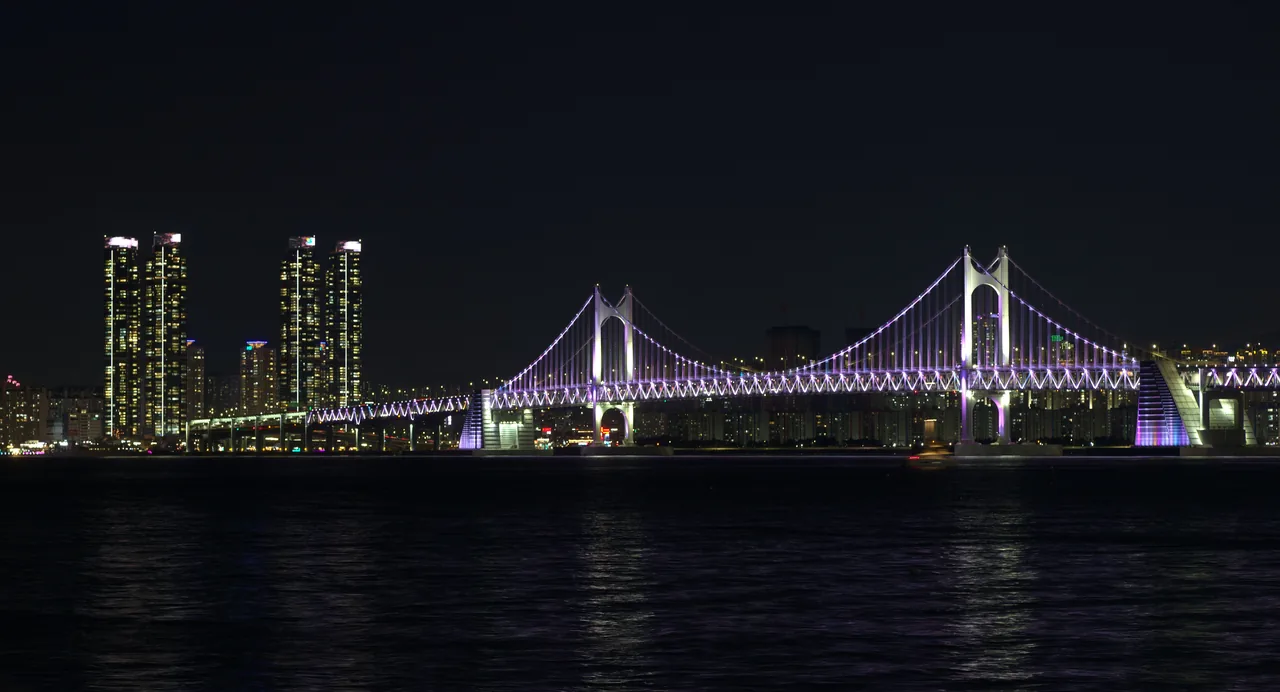
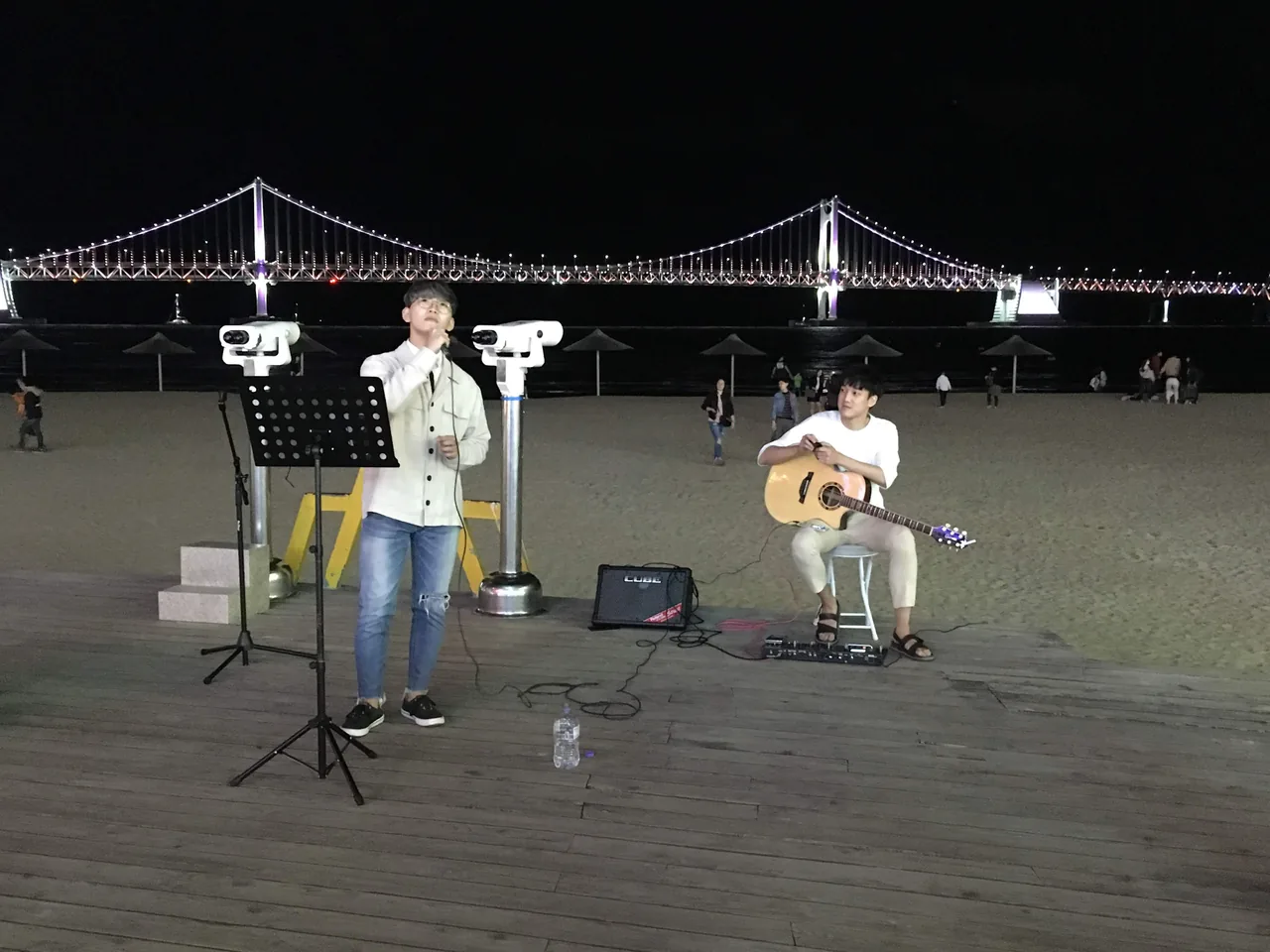
After dark, Gwangalli is in a different league: the Gwangan Bridge is lit every night and the beach hosts a free drone light show every Saturday, making it Busan’s premier night beach. Haeundae’s evening is quieter and more refined — a glittering skyline rather than an event — so if you want a spectacle, this round goes decisively to Gwangalli.
The two big draws at Gwangalli run on a predictable schedule:
| Attraction | When | Details |
|---|---|---|
| Gwangan Bridge lighting | Nightly 19:00–22:00 | Best viewing roughly 20:00–23:00; visible along the whole beach |
| M Drone Light Show | Every Saturday | Free, viewable from anywhere on the beach; ~10–12 min, two shows per night |
The drone show times shift with the season, so check before you go:
| Season | Show times |
|---|---|
| Summer (Mar–Sep) | 20:00 & 22:00 |
| Winter (Oct–Feb) | 19:00 & 21:00 |
The regular show flies about 1,000 drones, rising to 1,100 drones from July 2026, with special editions (Lunar New Year, New Year’s countdown) scaling up to around 2,500. Each show lasts roughly 10–12 minutes and is completely free — just stand on the sand. Monthly programmes are tweaked and shows can be delayed or cancelled in rain, high wind or communication issues, so confirm the current schedule on the official site (gwangallimdrone.co.kr) the week you visit.
Haeundae’s night is a different mood entirely: the Marine City skyscrapers throw a wall of light over the water, the BUSAN X the SKY observation deck gives you the city from above, and The Bay 101 delivers the famous mirror-reflection skyline shot. It’s elegant and understated rather than an event.
For the best drone-show experience, arrive at the beach 30–45 minutes early on a Saturday — the sand fills fast, and the prime central stretch facing the bridge goes first. You don’t need a ticket or a reserved spot; the whole beach is a free viewing gallery, and the second show two hours later is usually less crowded if you’d rather eat first and watch later.
It’s worth being realistic about cancellations. Because the drones are weather- and signal-sensitive, a show can be delayed or scrapped at short notice in rain or high wind, and the official channel posts updates on the day. If the drone show is the single reason you’re timing your trip around a Saturday, build in a fallback evening and check gwangallimdrone.co.kr before you commit.
The verdict on night: for a free spectacle, social-media moments and a genuine event, Gwangalli wins outright; for a sophisticated, high-rise skyline reflected on calm water, Haeundae has the edge. For the full evening scene, see our full Gwangalli Beach guide guide.
6. Things to do nearby — attractions compared
Both beaches sit inside a cluster of attractions, but they pull in opposite directions: Haeundae’s are polished, ticketed headline sights, while Gwangalli’s are free, walkable and atmospheric. Each is covered in depth in its own guide, so this is a one-line orientation rather than a full tour.
Around Haeundae:
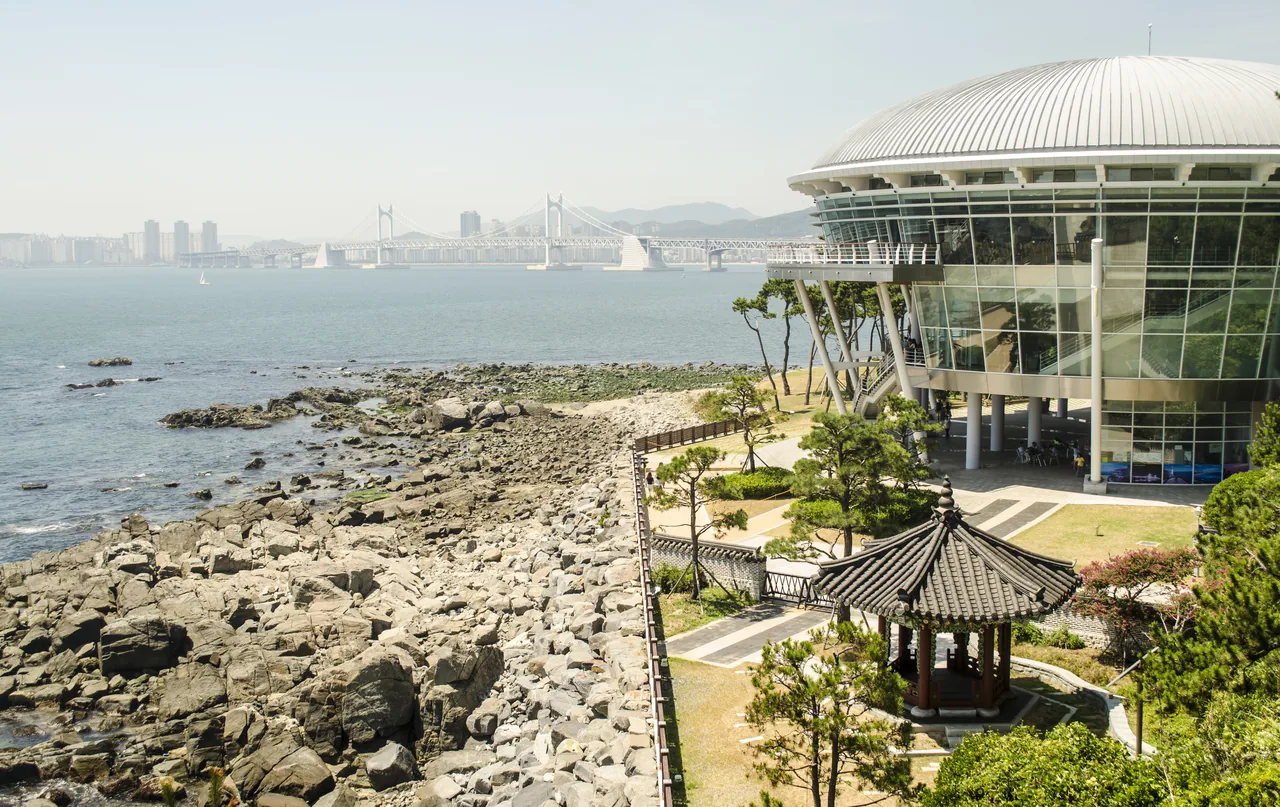
- Dongbaek Island & Nurimaru APEC House — a free coastal walk around a wooded headland to the landmark APEC summit hall.
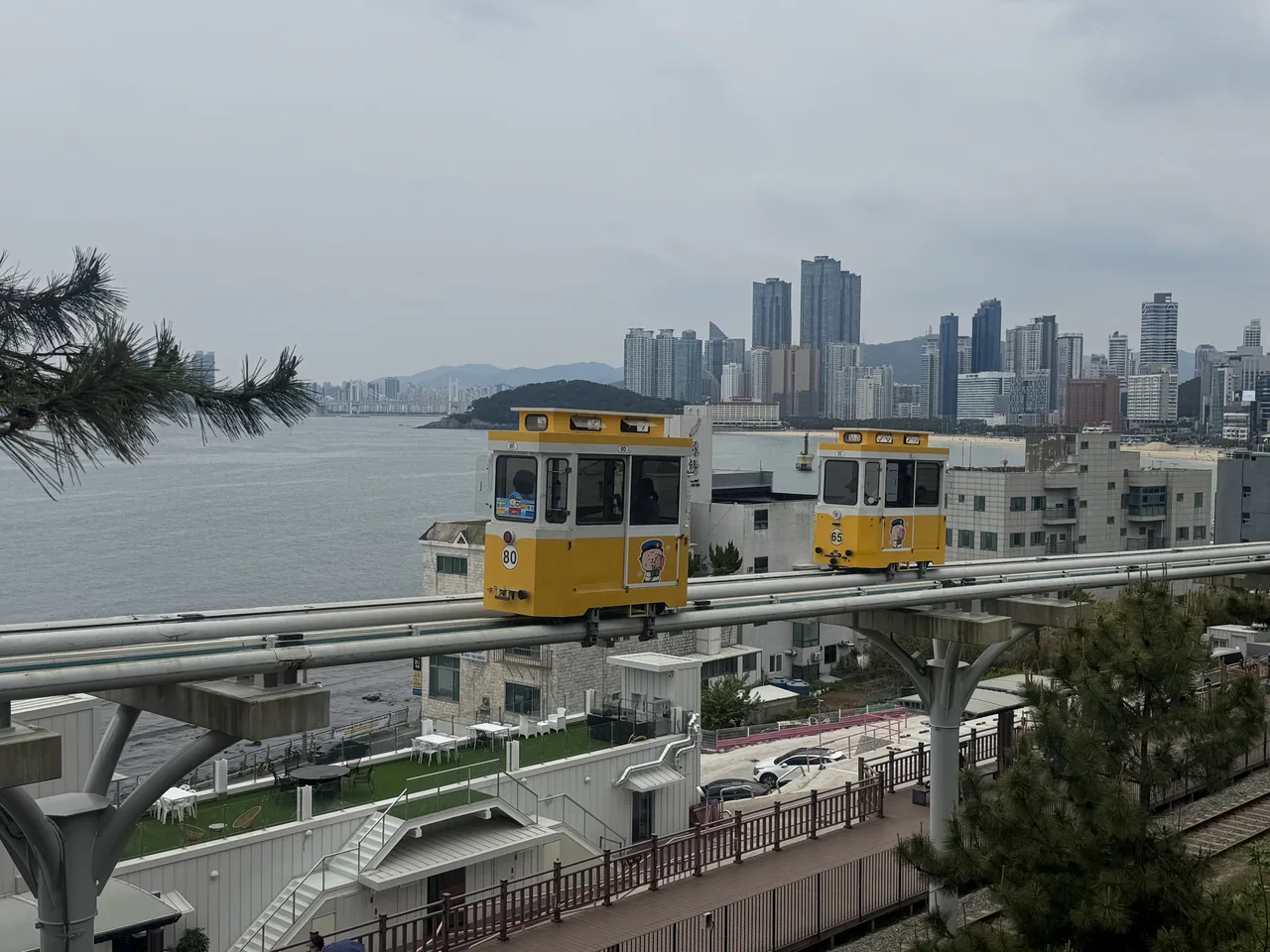
- Blue Line Park — the coastal beach train plus the Sky Capsule, the retro pastel pods running Mipo to Cheongsapo (about 30 minutes one way, from 09:30). Explore the full ride in our Blue Line Park & Sky Capsule guide guide.
- BUSAN X the SKY — the LCT observation deck at 411.6 m, Korea’s second-tallest, with the city at your feet; details in our BUSAN X the SKY guide guide.
- SEA LIFE Busan Aquarium — a large aquarium right on the beach, good for families and a rainy day; see our SEA LIFE Busan Aquarium guide guide.
- Marine City & The Bay 101 — the skyline waterfront for the reflection night shot.
The Sky Capsule sells out fast, so book ahead:
Around Gwangalli:
- Gwangan Bridge — the lit centrepiece of every night view.
- Seafront café street & rooftops — the beach’s defining strip.
- Millak Waterside Park — a sea-facing park famous for chimaek (fried chicken and beer) by the water, about an 8-minute walk from the beach.
- Millak The Market — a bay-view food-and-lifestyle complex, 10:00–24:00.
- Namcheon-dong cherry blossoms — the Samik Beach apartment strip, a spring highlight.
The night-time yacht cruise past the bridge is a standout Gwangalli experience — you can book a bridge-view sailing here:
Sky Capsule note: the pods are on the Haeundae side and are the single most booked-out activity in the area — reserve a slot online rather than turning up. If you want more than one big attraction, the next section’s Busan pass can bundle several.
7. Food — market feasts vs seafront raw fish
Both beaches eat brilliantly, but differently: Haeundae leans on its traditional market and fine dining, while Gwangalli is all about raw fish eaten with a bridge view. Neither will leave you hungry — it’s a question of setting.
| Style | Haeundae | Gwangalli |
|---|---|---|
| Signature experience | Haeundae Traditional Market crawl | Raw fish with a bridge view |
| Local specialities | Hoe (raw fish), grilled hagfish, seed hotteok, fish cake, milmyeon | Live-fish sashimi, seafood, pochas |
| Upscale side | Fine dining & ocean-view cafés | Café street, izakayas, rooftop bars |
| Trendy pocket | Haeridan-gil (newtro lanes) | Seafront café strip & Millak |
Haeundae is anchored by its covered traditional market a short walk from the sand — a browsing feast of raw fish, grilled hagfish, seed-filled hotteok, fish cakes and Busan’s cold milmyeon noodles — flanked by higher-end restaurants and ocean-view cafés, plus the retro-cool Haeridan-gil dining lanes.
Gwangalli is defined by seafront raw-fish centres and the live-fish market in Millak-dong, where hundreds of stalls serve sashimi you pick yourself, ideally eaten looking straight at the illuminated bridge. Around it sits the café street, pochas and izakayas that give the beach its late-night energy.
One practical difference: at Gwangalli’s live-fish market you typically choose your fish at a stall and pay a small fee to have it sliced and served at a nearby table, often with the sea in view — a hands-on experience that’s part of the appeal. Haeundae’s market is more about wandering and grazing, buying a skewer here and a hotteok there as you go.
Quick call: for variety and street-food grazing, Haeundae’s market wins; for the specific magic of sashimi and soju with the bridge glowing across the water, Gwangalli is unbeatable.
8. Cafés and nightlife — refined vs young
Haeundae’s nightlife is polished — hotel bars, smart restaurants and the design-led Haeridan-gil — while Gwangalli’s is younger, cheaper and centred on the seafront café-and-pocha strip. Both are lively in summer; they just attract different crowds.
Haeundae suits an evening that starts with a rooftop cocktail and moves to a good dinner: think hotel sky bars with Marine City views, the curated cafés and boutiques of Haeridan-gil, and a generally more grown-up, international feel. It’s the choice for a refined night out rather than a raucous one.
Gwangalli is where Busan’s twenties and thirties go to drink by the sea. The waterfront is a wall of cafés, rooftop bars, craft-beer spots and pochas, all facing the bridge, and the mood is casual and buzzy well past midnight. It’s cheaper, louder and more spontaneous. For a deeper look at Busan after dark across both areas, see our Busan nightlife guide guide.
| Aspect | Haeundae | Gwangalli |
|---|---|---|
| Crowd | International, mixed ages, upscale | Younger, mostly local, casual |
| Signature | Hotel sky bars, Haeridan-gil | Seafront café strip, rooftops, pochas |
| Price | Higher | Cheaper |
| Best for | A refined evening | A lively, low-key night by the sea |
9. 2026 events calendar — who owns which festival
The two beaches split Busan’s big events between them: Haeundae owns the Sand Festival and the Polar Bear Swim, while Gwangalli owns the Eobang Festival and — the headline of the year — the Busan Fireworks Festival. If a specific event is your reason to visit, this table tells you which beach to base yourself at.
| Event | 2026 dates | Beach |
|---|---|---|
| Haeundae Sand Festival | May 15 (Fri) – May 18 (Mon) | Haeundae |
| Haeundae Polar Bear Swim (39th) | Main event Jan 18 (Sun) | Haeundae |
| Gwangalli Eobang Festival (24th) | Jun 12 (Fri) – Jun 14 (Sun) | Gwangalli |
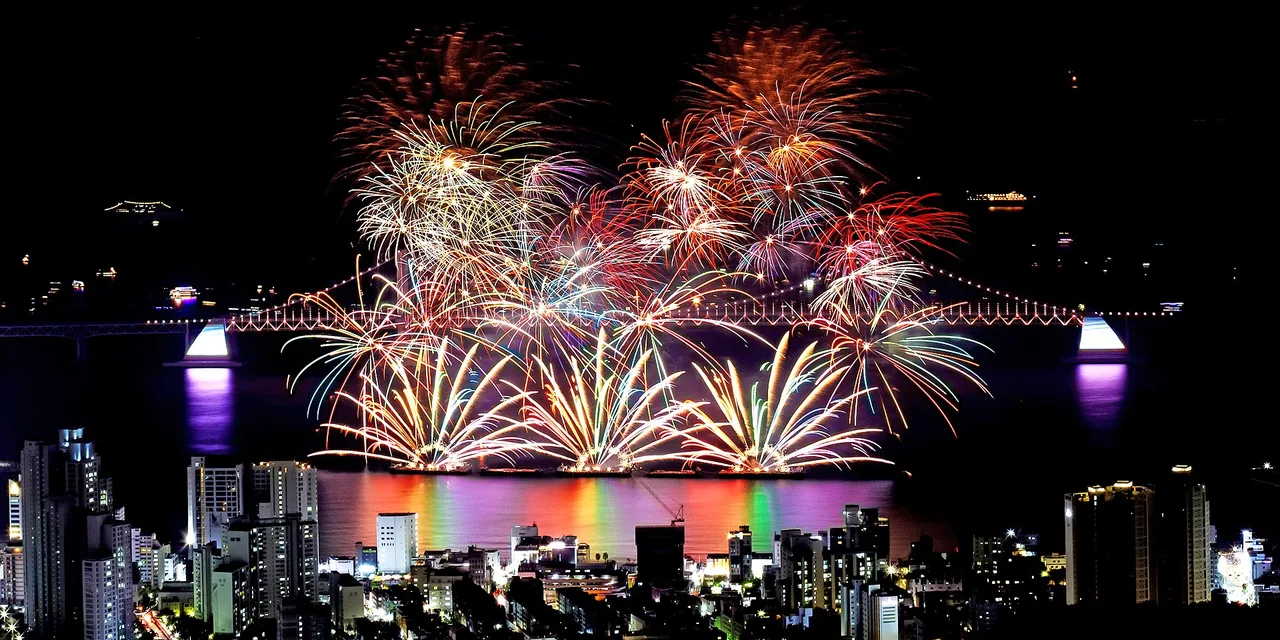
| Busan Fireworks Festival | Nov 7 (Sat), main show 20:00 | Gwangalli & Igidae |
| Busan Sea Festival | Early August (exact dates TBA) | Dadaepo-centred, also here |
The Busan Fireworks Festival on November 7, 2026 is the single biggest night of the year at Gwangalli, with the fireworks launched over the bridge and a main show at 20:00; paid grandstand seats go on sale from around October 1, and free viewing spots along the beach fill hours in advance. The Eobang Festival (June 12–14) celebrates the area’s traditional fishing culture around the beach and Suyeong Historic Park. For the full fireworks playbook — timing, seats and where to stand — see our Busan Fireworks Festival guide guide.
If you’re planning to hit several ticketed attractions around both beaches, a city pass can pay for itself:
Haeundae’s calendar leans on its beach itself. The Sand Festival in May turns the sand into an open-air gallery of large-scale sculptures with concerts and hands-on zones, while the January Polar Bear Swim sees thousands plunge into the winter sea — a uniquely Haeundae spectacle that Gwangalli has no equivalent to. Between them, they make Haeundae the beach for festival-goers outside the fireworks season.
Booking tip: hotels near Gwangalli sell out and spike in price around the November fireworks — book a month ahead if that’s your date.
10. Where to stay — hotels and neighbourhoods compared
Haeundae is Busan’s five-star ocean-view district; Gwangalli is where you find cheaper bridge-view rooms and a shorter hop from Busan Station. Your budget and your priorities — luxury and swimming versus value and night views — point clearly to one or the other.
Haeundae is the premier hotel address in Busan, home to a cluster of five-star ocean-view properties — Signiel Busan, Paradise Hotel, Westin Josun and Grand Josun among them — plus a full range of mid-range options a block or two back. It’s the pick for a family holiday, a special-occasion stay or anyone who wants to step from the lobby to the sand.
Gwangalli is the value play: bridge-view rooms are the local speciality, prices generally sit below Haeundae’s, and the area’s younger, walkable streets appeal to couples and solo travellers. It’s also closer to Busan Station, which matters if you’re arriving by KTX. For the citywide picture, including Seomyeon and Nampo, see our where to stay in Busan guide guide.
| Tier | Rough nightly rate (KRW) | Where |
|---|---|---|
| Guesthouse / hostel | From ~₩40,000 | Both; more budget beds near Gwangalli |
| Mid-range hotel | ~₩80,000–150,000 | Both; bridge-view value at Gwangalli |
| Five-star ocean view | ~₩180,000–400,000+ | Haeundae (Signiel, Paradise, Westin, Grand Josun) |
Compare live rates and bridge-view or ocean-view rooms for both beaches here:
Location within each district matters as much as the beach itself. In Haeundae, an oceanfront room in the five-star cluster puts the sand at your door but costs the most; a mid-range hotel a couple of blocks back near the Metro and market cuts the price sharply while keeping you walkable to everything. In Gwangalli, the premium is on a genuine bridge view — confirm the room faces the water before booking, since “Gwangalli” in a listing doesn’t guarantee the view you’re paying for.
If Busan is one stop on a wider Korea trip, Gwangalli’s proximity to Busan Station is a quiet advantage for KTX arrivals and departures, shaving time off transfer days. Haeundae sits at the far eastern end of Line 2, so factor in a longer ride to the station when you weigh the two.
Peak-season warning: late July to mid-August, weekends and the November fireworks night sell out a month ahead and rates jump sharply — lock in early for those dates.
11. Cost and budget — which beach is cheaper
Gwangalli is the cheaper base overall — rooms, food and drinks all tend to run lower than Haeundae’s — while Haeundae carries a premium for its luxury hotels and upscale dining. The gap is real but not huge; you can do either beach on a budget or blow out at either one.
| Item | Haeundae | Gwangalli |
|---|---|---|
| Mid-range room (night) | ~₩100,000–150,000 | ~₩80,000–130,000 |
| Ocean/bridge-view room | Premium; five-star cluster | Generally cheaper for a sea view |
| Raw-fish dinner (2 people) | ~₩60,000–100,000+ | ~₩50,000–90,000 |
| Coffee / café | Slightly higher | Slightly lower |
| Signature paid activity | Sky Capsule from ₩40,000 (per capsule, 1–2 people) | Drone show free; yacht cruise paid |
| Getting between the two | Metro ~₩1,600–1,700 by card / taxi ~₩7,000–10,000 | |
The Sky Capsule at Blue Line Park is priced per capsule one way: ₩40,000 for 1–2 people, ₩45,000 for three and ₩50,000 for four. Gwangalli’s headline attraction — the Saturday drone show — costs nothing, which is a genuine point in its favour for budget travellers.
Budget verdict: stay and eat around Gwangalli to save money and still get an ocean view; splurge at Haeundae when the hotel itself is part of the holiday.
12. Getting there and getting between them
Both beaches are on Metro Line 2 with clear English signage, and they’re only four stops apart — about 16 minutes — which is exactly why doing both in one day is so easy. There is no single continuous seaside promenade linking them, so you hop between them by Metro or taxi rather than walking the coast.
The essentials for reaching each beach:
| Beach | Metro station (Line 2) | To the sand |
|---|---|---|
| Haeundae | Haeundae Station, exits 3 & 5 | 5–10 min walk |
| Gwangalli | Gwangan Station, exits 3 & 5 (Namcheon side: Geumnyeonsan) | 5–10 min walk |
Moving between them is quick and cheap:
| Mode | Time | Cost / notes |
|---|---|---|
| Metro Line 2 (Haeundae ↔ Gwangan) | ~16 min | 4 stops (Dongbaek, Busan Museum of Art, Centum City, Millak); ~₩1,600–1,700 by card |
| Bus | ~22 min | Roughly every 15 min |
| Taxi | 10–15 min | ~5–6 km road distance; longer in rush hour |
The Metro is almost always the smart choice for the hop. It’s immune to Busan’s notorious coastal traffic, it costs a fraction of a taxi, and the four intermediate stops — Dongbaek, Busan Museum of Art, Centum City and Millak — are useful detours in their own right, with Centum City home to the record-breaking Shinsegae department store. A taxi only really wins late at night or with heavy luggage.
Two things to know: some map apps quote a “4-minute” drive between the beaches — that’s an error; realistically it’s 10–15 minutes by taxi. And there’s no unbroken coastal walkway between the two, though from Gwangalli you can stroll to Millak Waterside Park and Millak The Market in about 8 minutes. For fares, cards and the wider network, see our Busan metro & transit card guide guide.
Set up mobile data before you arrive so maps and a taxi app work the moment you land:
13. When to go — season and time of day
The right beach shifts with the season and even the hour: mornings and summer swimming favour Haeundae, while evenings, the bridge lights and the Saturday drone show favour Gwangalli. Line up your visit with what each does best and you’ll see both at their peak.
By season:
| Season | What’s on | Which beach shines |
|---|---|---|
| Spring (Mar–May) | Namcheon-dong cherry blossoms, mild days, Sand Festival (May) | Gwangalli for blossoms, Haeundae for the festival |
| Summer (Jun–Aug) | Swimming season, warm sea, buzzing nights | Haeundae by day, Gwangalli by night |
| Autumn (Sep–Nov) | Comfortable weather, Fireworks Festival (Nov 7) | Gwangalli for the fireworks |
| Winter (Dec–Feb) | Polar Bear Swim (Jan), quieter beaches, winter drone times | Haeundae for the swim, Gwangalli for the drones |
By time of day: Haeundae is at its best in the morning and early afternoon — sunrise over the sea, then a swim and a market lunch. Gwangalli comes into its own from late afternoon onward, with the bridge lighting at 19:00, dinner over the water, and the Saturday drone show at 20:00 (summer) or 19:00 (winter).
Planning note: both beaches genuinely face east to south-east, so both get a good sunrise. Gwangalli’s “night beach” reputation comes from the bridge lights and drone show, not from being a better sunset spot — don’t assume it’s the place for sunset over the sea.
14. The perfect “do both” plan — one day, two beaches
With only 16 minutes between them, the smartest itinerary isn’t choosing — it’s Haeundae by day and Gwangalli by night, timed so you catch the bridge lights and, ideally, the Saturday drone show. Here’s the full-day version, followed by an evening-only variation.
The full day (best on a Saturday for the drone show):
- Morning at HaeundaeStart on the wide sand — swim in season, or walk the beach and around Dongbaek Island to Nurimaru APEC House. Ride the Sky Capsule or Blue Line Park train along the coast if you’ve booked.
- Midday sights & lunchHead up BUSAN X the SKY for the city view, or into the traditional market for raw fish, hotteok and milmyeon.
- Late afternoon: hop to GwangalliTake Metro Line 2 from Haeundae to Gwangan — four stops, about 16 minutes — and walk down to the seafront as the light softens.
- Evening: café, dinner, bridge lightsGrab a rooftop coffee, then dinner at a seafront raw-fish spot or over at Millak The Market. The Gwangan Bridge lights up at 19:00.
- Night: the drone showIf it’s Saturday, stay on the sand for the free M Drone Light Show at 20:00 (summer) or 19:00 (winter) — about 10–12 minutes, with a second show two hours later.
Short on time? The evening-only version: skip straight to Gwangalli in the late afternoon, eat with a bridge view, and catch the lights and (on a Saturday) the drone show — a complete Busan beach night in three hours.
A few timing tips make the day flow. Book the Sky Capsule or any timed attraction for the morning so you’re not racing a slot; keep the Metro hop for the golden hour before sunset so you arrive at Gwangalli with the light still soft; and if it’s a Saturday, work backward from the 20:00 (summer) or 19:00 (winter) drone show so dinner lands just before it. On a non-Saturday, the nightly bridge lighting from 19:00 still gives you the signature Gwangalli evening.
Make it a Saturday. The drone show only runs on Saturdays, so if your schedule has any flexibility, put your Gwangalli evening on one — it’s the free highlight that competitors bury.
15. Final verdict — so, which one?
There’s no universal winner — there’s a winner for you. Match your trip to the row below and you have your answer; and remember that with a 16-minute Metro ride between them, “both” is almost always on the table.
| If you’re… | Choose | Because |
|---|---|---|
| A family | Haeundae | Wider, safer, longer swim season, easy layout |
| A couple | Gwangalli | Bridge lights, drone show, romantic dinners |
| Young / nightlife-focused | Gwangalli | Cafés, rooftops, pochas, buzz |
| A photographer | Gwangalli | Bridge + drones + fireworks |
| After luxury | Haeundae | Five-star ocean-view cluster |
| A first-timer | Haeundae | Iconic, easy, well-oriented |
| Chasing sunrise | Haeundae | Classic east-facing sunrise |
| Here for the fireworks | Gwangalli | Nov 7 festival is launched over the bridge |
| On a budget | Gwangalli | Cheaper stays, free drone show |
Distilled to a single line: Haeundae is the daytime, swimming, family and luxury beach; Gwangalli is the night, view, budget and event beach. Both are on Line 2, both are foreigner-friendly, and both are 16 minutes apart — so if you can, don’t choose, and do the day at one and the night at the other. For the rest of your Busan trip, start from our complete Busan travel guide.
🎡Things to Do48
🍜Food7
🏨Where to Stay3
🚇Getting Around10
🧭Travel Tips14
📌More3
🧭All-Korea essentials53
Frequently asked questions
Picked your beach — or decided to do both? Now plan the rest of your trip, from neighbourhoods and food to where to stay, with our complete complete Busan travel guide.
Images: ProjectManhattan, CC BY-SA 3.0 · Jeena Paradies, public domain · VN.NguyenDucDuy, CC BY-SA 4.0 · Busan Metropolitan City, CC BY-SA 4.0 · Christophe95, CC BY-SA 4.0 · StephNurnberg, CC BY 2.0 — via Wikimedia Commons.