
Hongdae, Seoul: Busking Rules, Live Houses, Yeonnam-dong and Which Subway Exit to Take
Hongdae is the name of a university that became the name of a district, and the district is bigger than most visitors expect. What you find here is not museums but stages, and the buskers on the street are not playing freely. They won a slot in a monthly lottery, and by ten at night the street goes quiet.
| How far does Hongdae reach? | Seogyo-dong at the centre, with Yeonnam-dong, Sangsu-dong and Hapjeong within walking distance. |
|---|---|
| Which exit? | Exit 9 for the main street, Exit 3 for Yeonnam-dong, Hapjeong Station for the river. |
| When is the busking? | Afternoon until ten at night. After ten the rules shut it down. |
| What is there most of? | Stages. The district has far more performance venues than sights. |
| Are there museums? | None. The district tourism list has no museum in the Hongdae area at all. |
| Where do people sleep? | Guesthouses and registered homestays, far more than hotels. |
1. Hongdae is a university, and then it became a neighbourhood
2. The exit you choose decides which Hongdae you get
3. Count what is here and you find stages, not sights
4. The buskers on the street won a lottery to be there
5. There are two performance streets and they work differently
6. Sangsangmadang stacks a whole night into one building
7. The live houses and small theatres are down side streets
8. The free market is paused, and Saturday has moved
9. Yeonnam-dong is a walk along a railway that is not there any more
10. Sangsu-dong and Hapjeong got the cafés first
11. Over the hill toward the river there is a shrine and a graveyard
12. Seoul’s café district, by the city’s own count
13. Two public bodies recommend restaurants here, and they never agree
14. The old shops here stay open late, and that is the tell
15. Most beds here are in somebody’s house, not a hotel
16. Shopping is one department store and three small markets
17. The festivals land in autumn
18. Practical things worth knowing before you go
1. Hongdae is a university, and then it became a neighbourhood
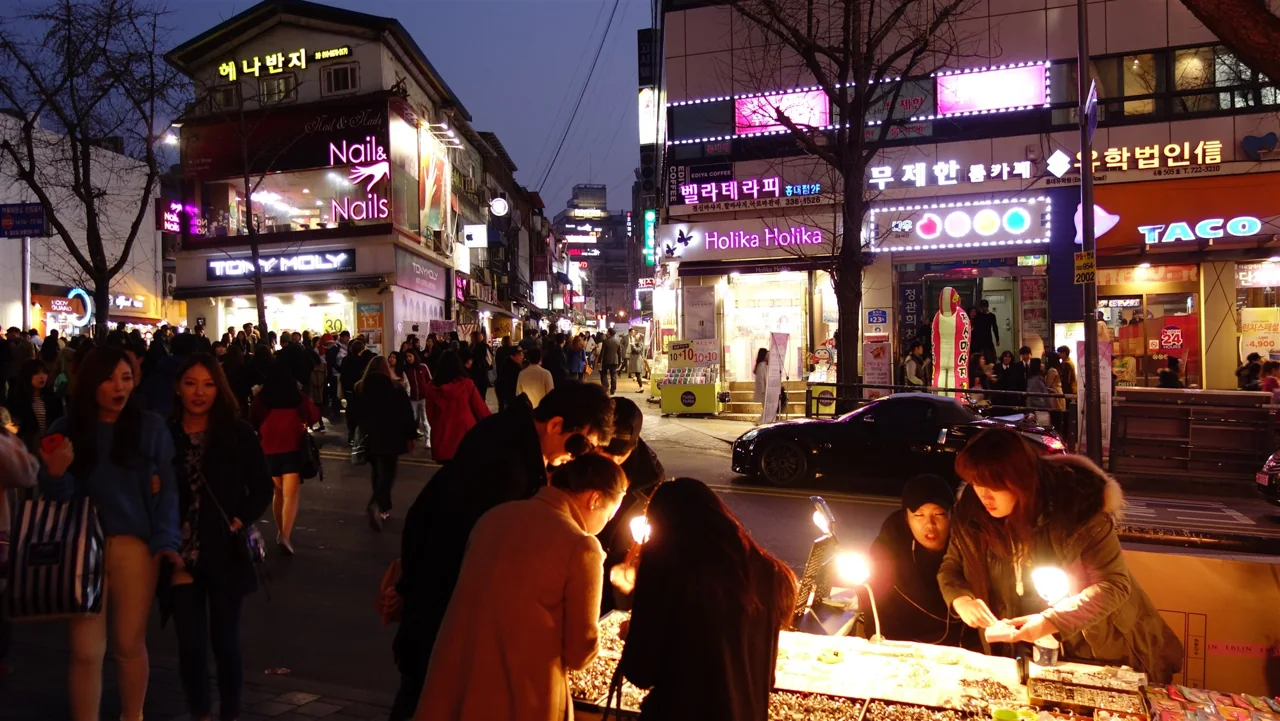
Hongdae is short for Hongik University. Over the years the name slid off the campus and onto the streets around it, and then onto the neighbouring districts you can reach on foot. That is why two people can agree to meet in Hongdae and end up a twenty minute walk apart.
There is an official version of the boundary too. Seoul and the Mapo district office designated this area a culture and arts tourism zone, and the designation covers Seogyo-dong and Donggyo-dong at the centre, reaching out to Sangsu-dong and Hapjeong-dong. Yeonnam-dong, one exit away on the other side of the station, belongs to the same night out even if the paperwork treats it separately.
Four neighbourhoods, four moods
Seogyo-dong is the loud one. This is where the crowds are and where the night runs latest. Yeonnam-dong is built along a former railway that is now a long thin park, and the side streets off it are quiet. Sangsu-dong filled up with cafés before the bars arrived, so its days are long and its nights end early. Hapjeong is closest to the river and has the big buildings.
With a full day you can start in Seogyo-dong and drift into Yeonnam-dong, or come the other way from the river. With half a day, pick one. If you are still assembling the wider trip, the Seoul travel guide sets out how the districts fit together.
2. The exit you choose decides which Hongdae you get
Hongik University Station is served by three lines: Seoul Subway Line 2, the Gyeongui-Jungang Line and the Airport Railroad. Three lines make for a long station, and the exits are far enough apart that the wrong one adds ten minutes of walking.
| Exit | What is up there |
|---|---|
| 8 and 9 | The main pedestrian strip and the walk toward the university |
| 6 and 7 | Dabok-gil, Seogyo Market, the start of the forest park |
| 3 | Yeonnam-dong, its craft street and the park itself |
| 1 | The main road hotels |
| 4 | The department store |
Exit 9 for the street, Exit 3 for Yeonnam-dong. That single decision saves more time than any other piece of advice on this page. Transfers and fare cards are covered in the Seoul subway guide.
Sometimes the next station is the better one
Hapjeong Station sits on Lines 2 and 6 and drops you at the big malls and the river side of the area. Sangsu Station on Line 6 is closest to the café streets and several small venues. Mangwon Station, also Line 6, is the one for the market end.
On a Saturday evening Hongik University Station is genuinely crowded, and walking in from Sangsu or Hapjeong can be quicker than working your way up the stairs. The three stations are a comfortable walk apart.
You can arrive straight from the airport
All Airport Railroad commuter trains stop at Hongik University Station. With a transit card it is 4,650 won from Incheon Airport Terminal 1 and 5,250 won from Terminal 2. No transfer, no dragging a suitcase across the city centre, which is why so many people book their first or last night around here.
There is a bus as well. Route 6002 runs between Incheon Airport and Cheongnyangni and stops at the station. At the airport you board at stops 5B and 11B. Every other way into the city is laid out in getting from Incheon Airport into Seoul.
Map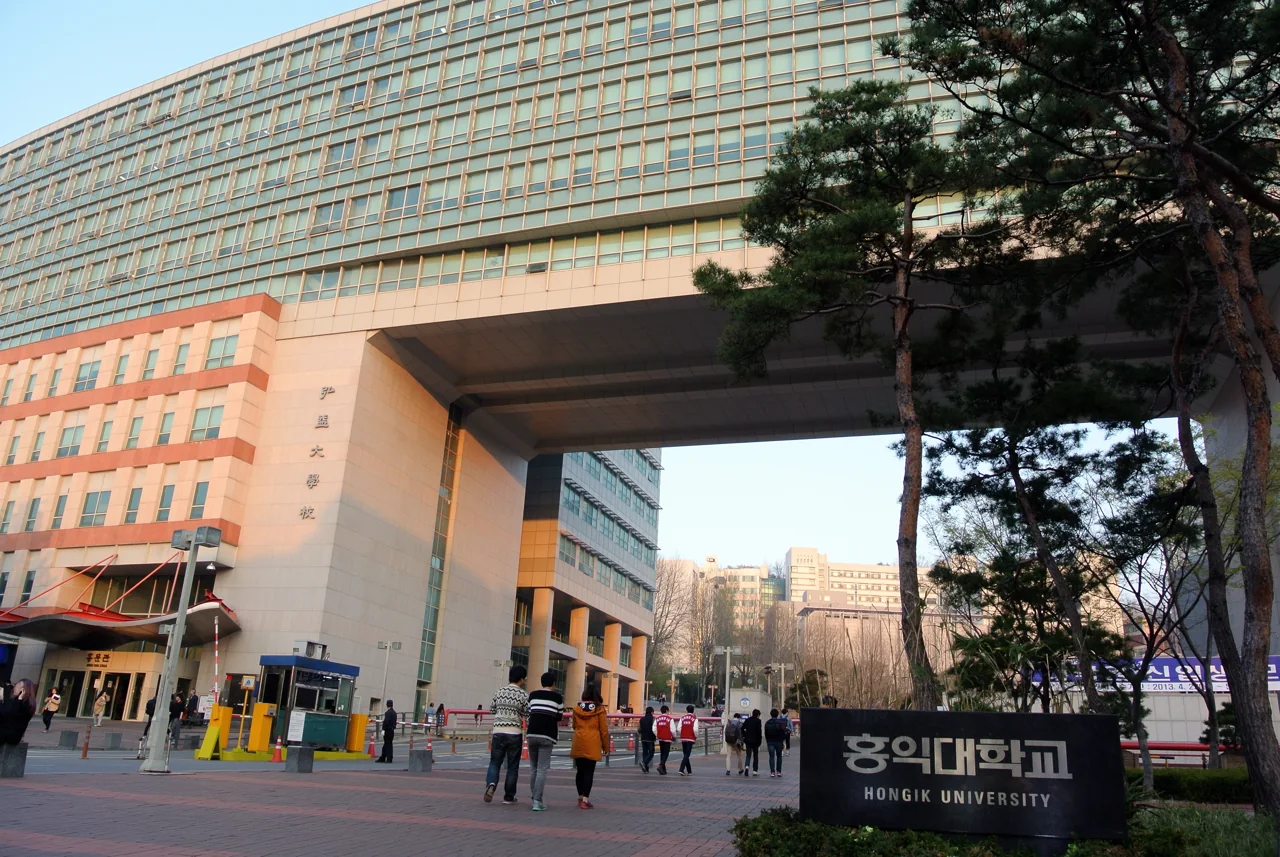
3. Count what is here and you find stages, not sights
Take the Mapo district tourism listings and keep only the entries inside Hongdae, and the largest category by a wide margin is performance venues. There are more than twice as many stages as there are named attractions.
What is missing says even more. There is not a single museum in the Hongdae part of the district listing. The museum category is simply empty, and the hands-on exhibition halls are all clustered in Sangam, a different part of Mapo entirely. No palace, no temple complex, no fortress.
So you plan it differently
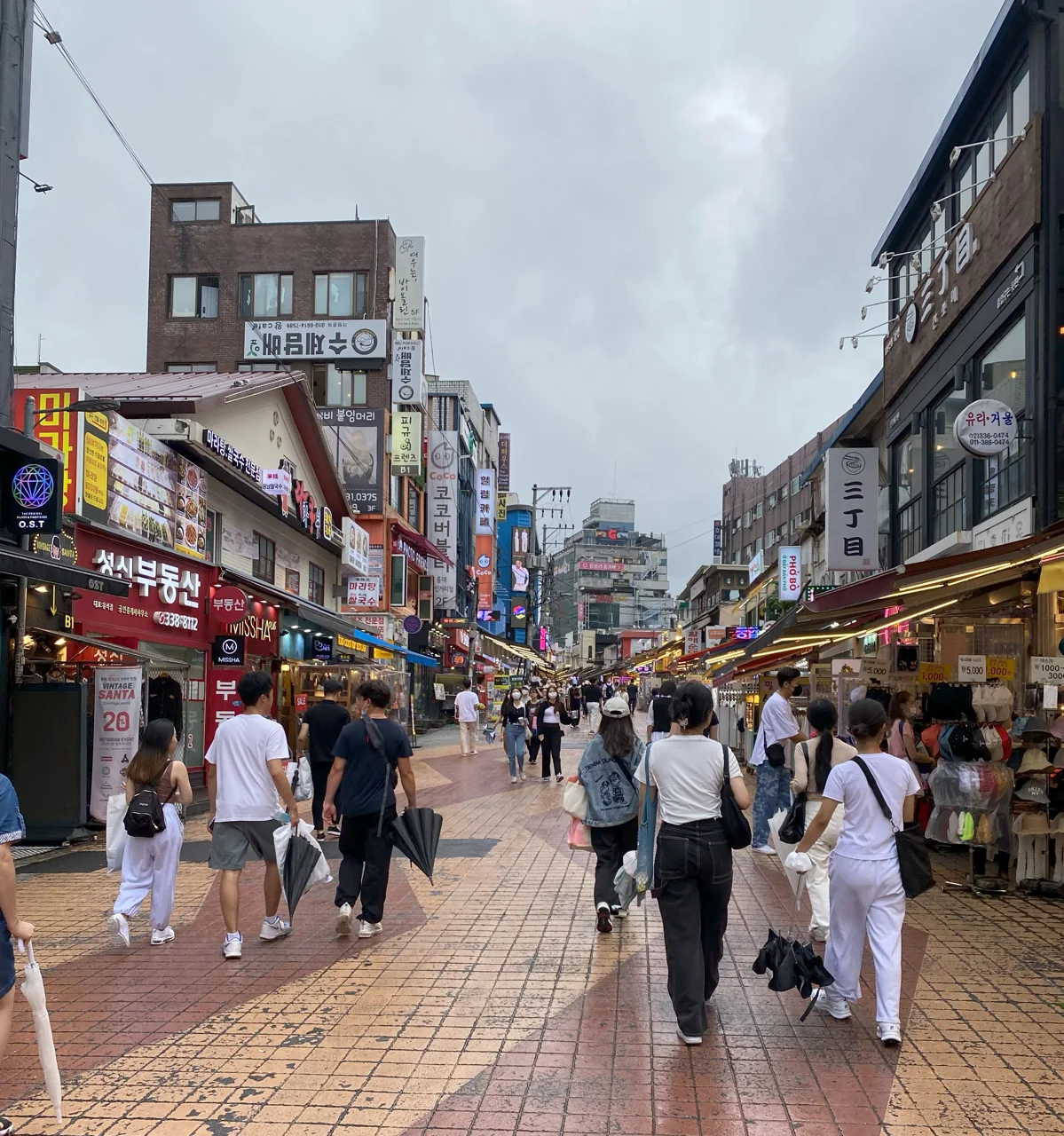
The Gyeongbokgung model of arrive, look, leave does not work here. In the afternoon the area is cafés and shops. From early evening it is food and performances. Late it becomes bars and clubs. The same alley is three different places in one day.
The practical answer is to spend your daylight hours somewhere else and come into Hongdae from late afternoon. The Seoul itinerary shows how to slot that in.
Rain is its weak point
Myeongdong has underground arcades and Jamsil has enormous indoor complexes. Hongdae has streets, and half the pleasure of it is walking them. In heavy rain that half disappears. The compensation is that the cinemas, galleries and live houses are all indoors and all close together, so you can hop between them. More wet weather options are in Seoul when it rains.
4. The buskers on the street won a lottery to be there
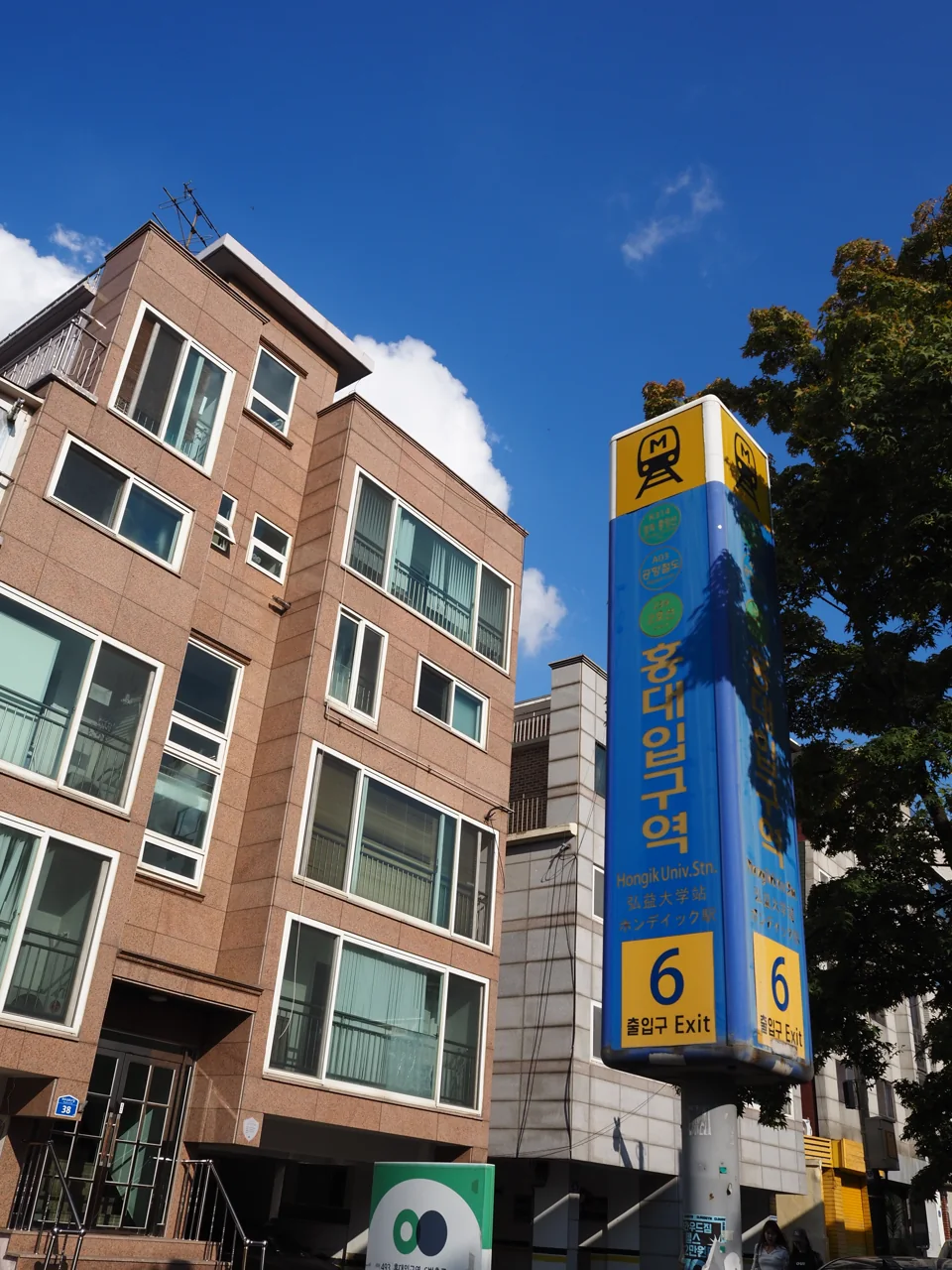
Street music is the thing Hongdae is known for, and visitors reasonably assume it is spontaneous. It is not. The district office marks out busking zones on the pedestrian street, and those zones are the only legal places to play.
The system was rewritten recently. There used to be a registration step: a performer signed up, got a number, and applied with it. That registration has been abolished and the existing numbers cancelled. First-come booking is gone too. Everything is decided by draw now.
Two rounds every month
Applications for next month open from the tenth to the sixteenth, and the draw happens around the twentieth. Whatever is left over goes to a second round from the twenty-fifth to the twenty-seventh, drawn around the twenty-ninth. Slots are booked in two hour blocks, and one person can hold up to six in a month, of which two may fall on a weekend.
The application has to state the genre and include a performance plan. If what happens on the day does not match what was written, the performer forfeits the slot. Results are not sent out; performers check the district website themselves.
The zones are not interchangeable
| Zone | What is allowed |
|---|---|
| Zones 1, 2 and 4 | Amplified acts. Singing and dance |
| Zone 3 | Unamplified only. Quiet vocals, magic, mime, acoustic instruments |
Two amplifiers is the ceiling, and the volume limit is the same whether you bring one or two. Go over it and the performance can be stopped. Lighting rigs brought in by performers are banned outright.
The notice explains why in plain terms. The pedestrian street backs onto homes and onto places where people are sleeping. That is the constraint the whole system is built around.
What this means if you are only watching
The schedule is published. The district website posts who is playing where and when, so if you want to catch a particular act you can look it up before you go rather than wandering and hoping.
And it stops at ten. The line you will read elsewhere about busking going on into the small hours does not match the current rules. After ten what continues is the bars and the clubs, not the street.
5. There are two performance streets and they work differently
Two streets in Hongdae host outdoor performance, and because their names are similar people assume they are the same place. They are managed separately and they allow different things.
The pedestrian street, the one signposted as the walking street, runs off Exits 8 and 9. The busking zones described above are here. The festival street is the stretch in front of Sangsangmadang, and it is divided into a band zone and a performance zone.
The festival street opens at noon and closes at ten
Those hours are fixed, and performance after ten at night is prohibited. There is one more restriction that surprises people: on the festival street only singing is allowed. Dance is not. For dance crews, head to the busking zones on the pedestrian street instead.
What cannot happen there
Product and corporate promotion, selling anything, brand ambassador activity, and political or religious events are all excluded from the approval process. Groups that have generated repeated complaints are excluded as well. Events expecting very large crowds need separate safety clearance.
For a spectator this division is useful rather than bureaucratic. If you want a band with a full PA, stand in front of Sangsangmadang. If you want someone with an acoustic guitar and no amplifier, walk into the pedestrian street and find Zone 3.
6. Sangsangmadang stacks a whole night into one building
The grey concrete building on Eoulmadang-ro is KT&G Sangsangmadang Hongdae. It is the landmark people give directions from, and what is inside changes floor by floor.
| Floor | What is there |
|---|---|
| Basement 4 | Cinema |
| Basement 2 | Live hall |
| Ground and 2nd | Design shop |
| 3rd | Lounge and project space |
| 4th and 5th | Gallery |
| 6th and 7th | Classrooms |
An exhibition, a shop, a film and a gig in one lift shaft. It is the obvious move on a wet afternoon, and it works when a group cannot agree on what to do.
The floors keep their own hours
Opening times are not published as a single set. The cinema, the gallery and the shop each run on their own schedule, so check the floor you actually want before you set out.
The building faces the festival street, which means on performance days you hear the show before you reach the door.
Map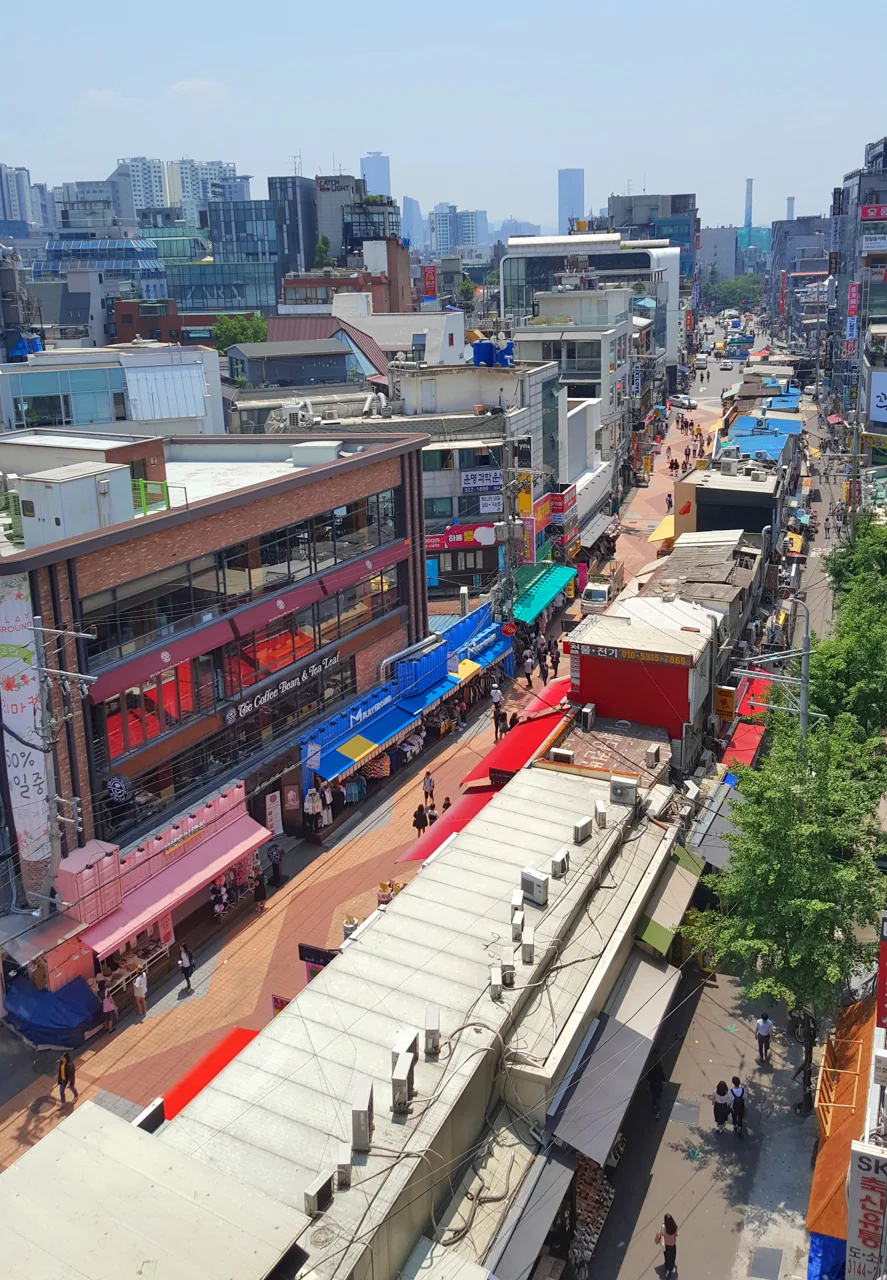
7. The live houses and small theatres are down side streets
Hongdae venues do not announce themselves from the main road. Most of them are in a basement or on an upper floor off a side street, and you can walk past the entrance without noticing it.
Where the bands play
Rolling Hall is on Eoulmadang-ro, and the Sangsangmadang live hall is in the basement of the building described above, on the same street. Toward the pedestrian street there is West Bridge Live Hall. Out toward Hapjeong you have Musinsa Garage and Velourse. Near Sangsu Station there is Alive Hall.
Shows generally start in the evening and tickets are sold in advance. Some nights you can pay at the door, but for a band with a following the advance sale ends it.
Where the plays are
Sanullim Theatre on Wausan-ro is one of the older houses in the city and is known for its seasons of classic drama. Within walking distance you will also find Gureumarae Theatre, Post Theatre and Byeolbit Theatre.
Further out there is Im Hyeokpil Theatre near Hapjeong and CJ Azit over by Gwangheungchang Station. They are all described as Hongdae venues, but some of them are a subway stop or two away, so check the address before you buy.
One show needs no Korean at all
There is a dedicated Nanta theatre off Yanghwa-ro. The show is non-verbal percussion, so language is not a barrier. It runs at eight in the evening on weekdays, and at two and five in the afternoon on Saturdays, Sundays and public holidays.
8. The free market is paused, and Saturday has moved
Every older guide to Hongdae mentions the artists’ free market that filled the playground park on Saturdays, with handmade goods spread around the edge of a small playground. It is one of the images the neighbourhood is built on.
The district’s own listing now carries a single line: temporarily suspended. No return date is given. People still turn up on Saturday afternoons expecting stalls and find an empty park.
What is actually on instead
In Yeonnam-dong, Dongjin Market holds a market every Saturday from one in the afternoon until six. Handmade accessories, soap, cookies, vegetables grown by the sellers, and a few stalls cooking on the spot. Smaller than the old free market, similar in spirit.
Along the forest park there is a market at Ttaeng-ttaeng Street, reached from Exit 6 and a short walk up the path. Its dates are not fixed, so check before you plan around it.
The playground itself has not gone anywhere. It is a small park ringed by painted walls, people sit there on any decent evening, and buskers still turn up.
Map9. Yeonnam-dong is a walk along a railway that is not there any more
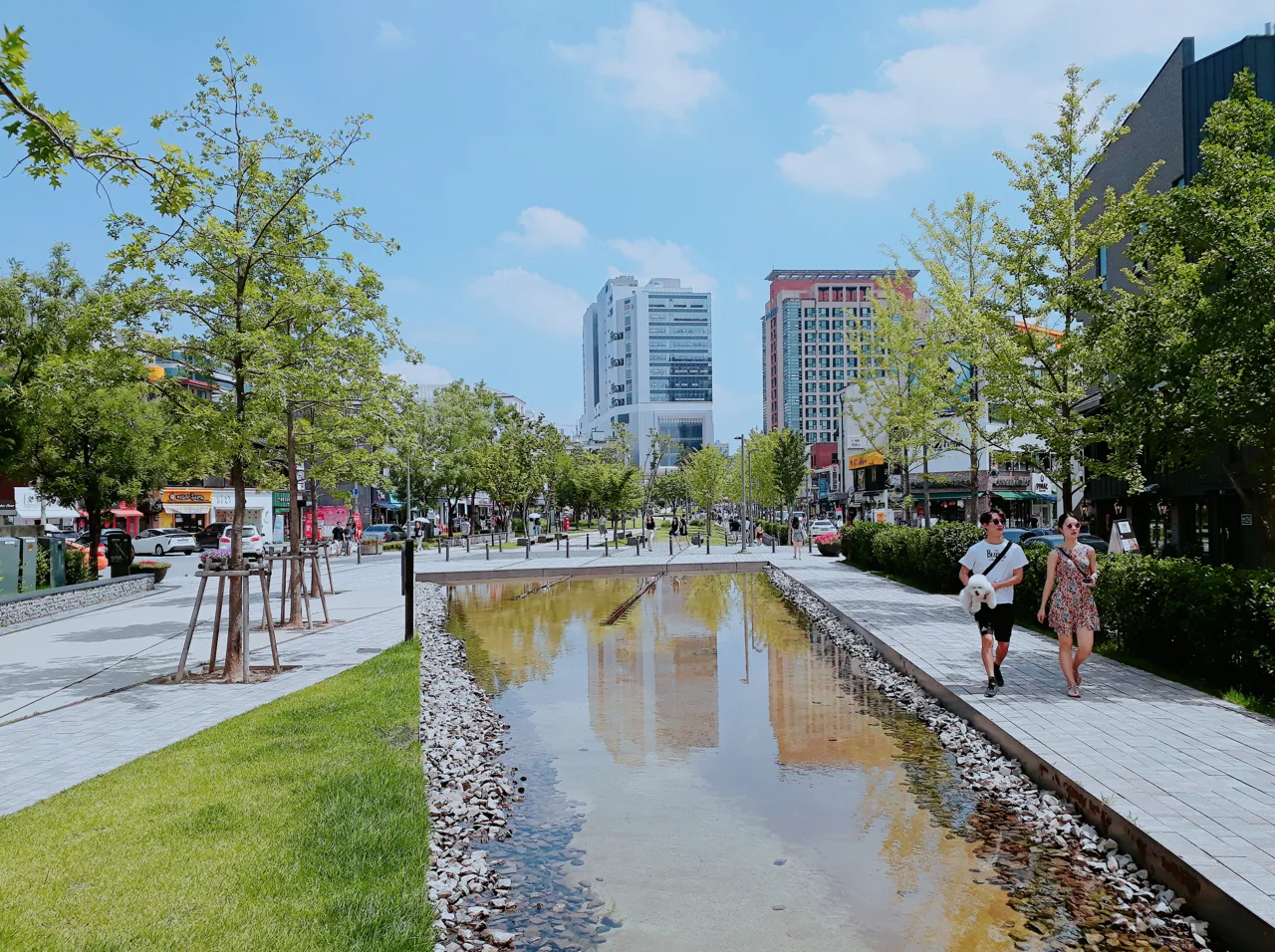
Come out of Exit 3 and the volume drops. A long narrow park runs through the neighbourhood along the bed of a disused railway line. Officially it is the Gyeongui Line Forest Park; the Yeonnam-dong stretch has picked up its own nickname among locals.
It is long enough that walking end to end takes a while. Lawns, a shallow water channel, and cafés and restaurants pressing in from both sides. On a good afternoon finding somewhere to sit on the grass is the hard part.
A street of bookshops beside it
Gyeongui Line Book Street sits near the park. Mapo has long been the publishing district of Seoul, and this strip leans on that, with a different themed programme each day of the week. Humanities on Tuesday, arts on Wednesday, travel on Thursday, literature on Friday, children on Saturday, and talks or small concerts on Sunday.
It opens at eleven in the morning and closes at eight in the evening, Tuesday to Sunday, and it is shut on Mondays. Arrive on a Monday and you are looking at closed shutters.
Small streets branching off
One block from the park you find Semo-gil and the craft street. Semo-gil is named for the triangle the roads make; the craft street is lined with makers selling what they produce on site. Both are calmer than anything in front of the university.
Yeonnam-dong rewards wandering rather than a list. Follow the park and turn off it when a side street looks good.
Map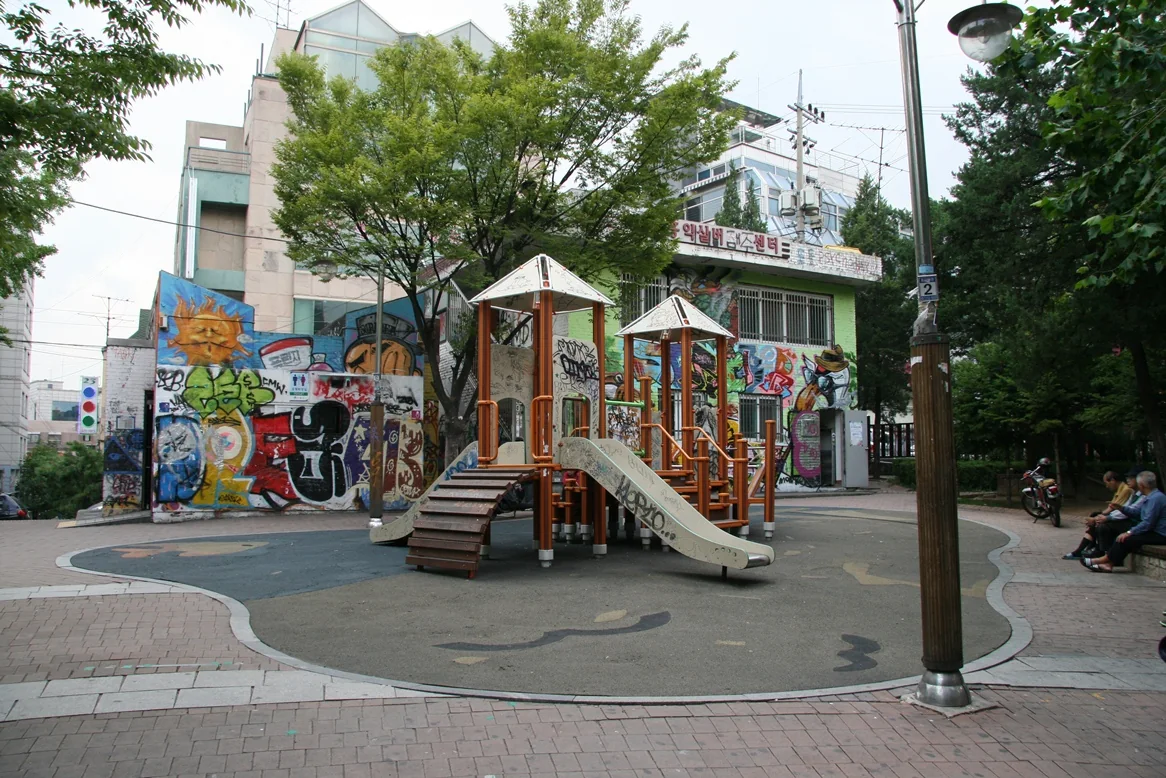
10. Sangsu-dong and Hapjeong got the cafés first
One of the streets the district lists for visitors is the Sangsu-dong café street: a run of small cafés along the lanes off Wausan-ro, quieter than the centre and with more room to sit.
Exit 1 at Sangsu Station is closest. Two small venues, Alive Hall and Art Hall Bejjangi, sit in the same few blocks, so coffee in the afternoon and a show in the evening is an easy sequence.
Cherry blossom without the crowd
There is a blossom lane along Tojeong-ro in the Dangin-dong direction. It runs toward the river, so you can continue down to the water. It is not on the standard blossom lists, which is exactly its advantage.
Hapjeong is buildings and river
Hapjeong has a different shape. Large mixed-use complexes connect straight to the station, with shops, a cinema and a performance space inside them. It is a neighbourhood you use from the inside rather than one you walk around.
Head downhill from the station and you reach the Han River. There is a cruise pier here for boats to Yeouido and Sangam, but note that those sailings run on weekdays only and do not operate at weekends or on public holidays. Turning up on a Sunday will not work.
11. Over the hill toward the river there is a shrine and a graveyard
It is easy to forget from the middle of the bar district that this neighbourhood ends at the Han River. Walk down from Hapjeong Station and you arrive somewhere entirely unlike what you just left.
Jeoldusan Martyrs’ Shrine stands on a bluff above the water. Catholic converts were executed here in the late Joseon period, and the site now holds a church and a memorial museum. Mass is celebrated daily at ten in the morning and three in the afternoon, though there is no afternoon mass on Mondays.
Next to it is the Yanghwajin Foreign Missionary Cemetery, where missionaries who came to Korea in the nineteenth century are buried. It is open Monday to Saturday, ten in the morning to five in the afternoon.
Old houses and shrines inside the neighbourhood
In a Seogyo-dong side street stands the former residence of President Choi Kyu-hah. It is open to visitors, but entry is by timed session rather than whenever you arrive, with slots through the morning and afternoon, and it closes on Mondays.
Changjeon-dong and Dangin-dong still have village shrines where rites are held on dates set by the lunar calendar. Toward Mangwon there is Mangwonjeong, a pavilion looking out over the river.
Toward Sinchon you will find the Kim Dae-jung Library, open on weekdays and on the first Saturday of the month, with last entry an hour before closing.
12. Seoul’s café district, by the city’s own count
Look at how the Seoul Tourism Organization sorts its restaurant listings by area, and Hongdae’s café and dessert entries outnumber every other district’s by a distance. Myeongdong and Dongdaemun are overwhelmingly Korean restaurants. Hongdae tilts toward coffee.
The ones that have lasted
Doksuri Dabang, the eagle coffee house, sits in front of the university. In Hapjeong there is Anthracite, built inside an old factory. For bread, Paul & Paulina, Peter Pan 1978 and Richemont over in Seongsan are the long-standing names.
Specialists make the list too: Gyeonggi Tteokjip for rice cakes and Dangojip for Japanese-style dango. Ubuaerado appears on the vegetarian list as well as the café one.
The district office picked different bakeries
Mapo runs a guided walk that visits bakeries, and its choices do not overlap with the city’s. They are Aoi Tori, run by a Japanese baker and known for curry bread and mentaiko baguette; Ray and Cream for macarons and meringue; and Blanc, which bakes and sells on the same day without chemical additives.
13. Two public bodies recommend restaurants here, and they never agree
Search for somewhere to eat in Hongdae using official sources and you run into something odd. The district office keeps a list of designated restaurants. The city tourism organization keeps its own. Not one name appears on both.
They are measuring different things. Mapo designates tourist restaurants on the basis of foreign language menus and service, plus separate hygiene-based categories. The city picks places a visitor might want to eat at, sorted by cuisine. Different criteria, different lists.
What the district office chose
A lot of Chinese restaurants. Yeongbinru and Choma for jjamppong, Dimchai for dim sum, and in Yeonnam-dong Haha, Hyangmi and Yeongyo. For Indian food there is Santi, Sitara and Usab, and for Thai, Simply Thai.
On the Korean side the list has Goguryeo and Ganggangsullae for grilled meat, Gyeongbokgung for a set-course dinner, and Hapjeongok for beef soup.
What the city chose
More Korean restaurants, and bars included. Samgeori Pocha, Evans and Inoshishi appear under drinking places, Slunch Factory under vegetarian, and Delhi India under halal.
Neither list is more correct than the other. Read them together and what you see is how wide the range is in a small area. For the broader picture of what to eat in the country, there is what to eat in Korea.
14. The old shops here stay open late, and that is the tell
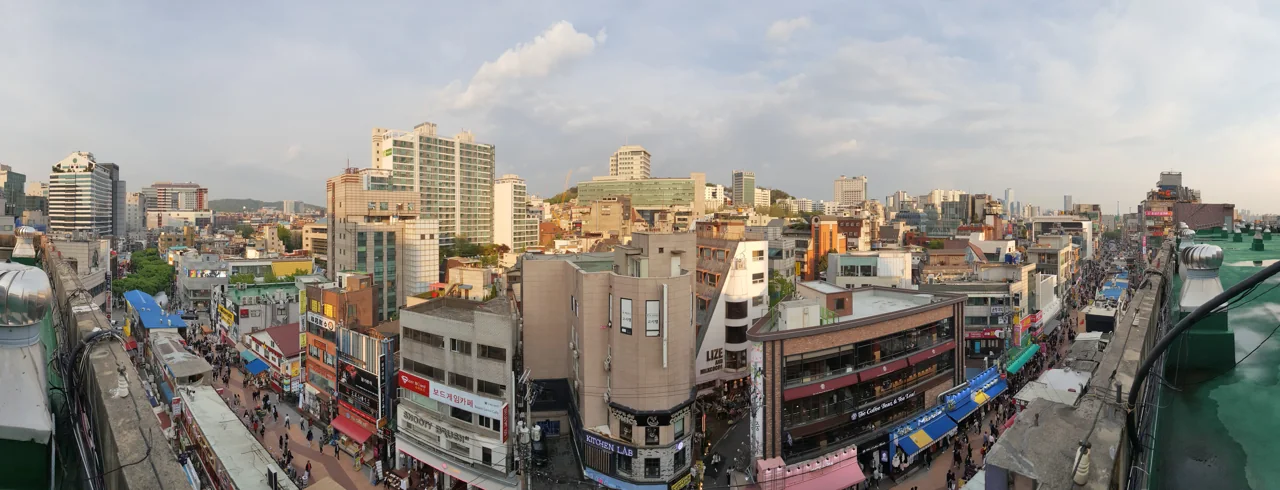
Mapo keeps a separate list of long-running shops. Only a handful fall inside Hongdae, and those few say a lot about how the neighbourhood works.
Homi Art Shop sells art materials. Hongik University is an art school, so generations of students have passed through it, and it is open every day from nine in the morning until nine at night, closing only for the Lunar New Year and Chuseok holidays. An art supplies shop open until nine is not a normal thing.
Geulbeot Bookshop, a secondhand bookshop, runs from half past ten in the morning until ten at night. Also late.
The third entry is Sanullim Theatre, the same theatre mentioned earlier. A performance venue appearing on a list of historic shops is about as Hongdae as it gets.
There is a walk for this
The district runs a guided walk around the older shops of Sangsu-dong, Hapjeong-dong and the old power station. That particular route is conducted in Korean only.
15. Most beds here are in somebody’s house, not a hotel
Search for a room in Hongdae and guesthouses come up before hotels. That is not an impression. Among the registered homestays that the city promotes, Hongdae has more than any other area of Seoul, by a margin that is not close. Myeongdong and Gangnam are nowhere near it.
Hotels in the same area can be counted on two hands. A few chain properties on the main road, and after that small places down side streets.
The main road hotels are on top of the station
L7 Hongdae is right at Exit 1 and RYSE is near Exit 9. Along Yanghwa-ro you have the Mercure Ambassador and a Holiday Inn Express. Toward Hapjeong, Hotel the Designers is a minute from Exit 3.
Being on the airport line is the reason people pick these for the first or last night of a trip.
What to check before booking a homestay
The places on the city list are registered and inspected. Note that a listing with Hongdae in its name is often physically in Yeonnam-dong, Hapjeong-dong or Mangwon-dong. Judge the walk from the map, not from the name.
Noise varies enormously over short distances. Inside the pedestrian street you hear performances until ten and drinkers after that. One block off it, nothing. The trade-offs between Seoul neighbourhoods are compared in where to stay in Seoul.
16. Shopping is one department store and three small markets
For a district this busy, Hongdae has little large-format retail. Clothes and cosmetics are everywhere at street level, but if you want to do it all under one roof the choice is short.
AK Plaza is attached to Exit 4 of Hongik University Station. It is open every day from eleven in the morning to ten at night, with no closing day, and you reach it without going outside.
At Hapjeong there is Mecenatpolis, connected underground to Exits 9 and 10. The same complex holds a Homeplus hypermarket, open from ten in the morning until midnight and closed on the second and fourth Sunday of the month.
The markets are for residents
| Market | Getting there |
|---|---|
| Seogyo Market | A short walk from Exit 6, then down into the basement level |
| Yeongjin Market | Off a lane near Exit 1 at Mangwon Station |
| Hapjeong Market | Close to Exit 7 at Hapjeong Station |
None of these is a tourist market. They are where people who live here buy vegetables. Arrive expecting a spectacle and they will feel small. Arrive expecting cheap and quiet and they deliver.
Map17. The festivals land in autumn
The best known Hongdae festival is about books. The Seoul Wow Book Festival takes over the area in autumn, though the exact dates move from year to year, so check before you build a trip around it. Programmes spread from the car park street into galleries, independent spaces and book cafés.
On the music side there is Zandari Festa, which links the venues around Donggyo-dong into one event. The district office also runs its own street event on the pedestrian street.
The village rites are still going
Changjeon-dong and Dangin-dong hold shrine rites, and there is a rite at the King Gongmin shrine as well. The dates follow the lunar calendar, so they shift against the Western one each year. These are not tourist events; they are neighbourhood ceremonies that have simply continued in a district otherwise full of clubs.
18. Practical things worth knowing before you go
A few last items that matter on the ground.
There is a tourist information centre in the middle of it
The Mapo Tourist Information Centre is on Hongik-ro. It is open from ten in the morning to seven in the evening and closes on the eve of and the day of the major holidays. Staff assist in English, Chinese and Japanese, and there is phone charging and a computer for looking things up.
The free guided walks have conditions
Mapo runs walking tours led by residents. They are free and take about two hours, with participants covering only their own drinks or activity costs. The conditions matter.
| Condition | Detail |
|---|---|
| Booking | At least a week before the date. Same-day booking is not accepted |
| Minimum | Two people, or the tour does not run |
| Insurance | Travel insurance is not included |
Languages differ by route. The Yeonnam-dong walk runs in Korean, English, Japanese and Chinese; the bakery walk in Korean and Japanese; the old shops walk in Korean only.
The circular tourist bus is ending
Mapo’s circular sightseeing bus finishes service this autumn. If you had planned to use it to link the neighbourhoods, plan something else. Within Hongdae, walking is faster anyway.
Remember the night timetable
Street performance ends at ten. Last trains vary by line, and Hongik University Station stays busy long after that. If you plan a late night, work out in advance where taxis queue and which night buses run.
Plenty of people pair Hongdae with Myeongdong in a single day. They are connected by subway and they are opposites, which makes a natural day-and-night split. Myeongdong is covered in the Myeongdong guide.
🎡Things to Do11
🚇Getting Around4
🧭All-Korea essentials114
Frequently asked questions
Images: Photographs via Wikimedia Commons: Ken Eckert (CC BY-SA 4.0), Adbar (CC BY-SA 3.0), RyuMinjoo (CC BY-SA 4.0), Minseong Kim (CC BY-SA 4.0), Michaela den (CC BY-SA 3.0), Brit in Seoul (CC BY-SA 4.0), U0894629 (CC BY-SA 4.0).