
Gimpo Airport: Which Cities It Flies To, the Five Subway Lines at Gimpo Airport Station, Parking Rates, Lotte Mall, and Why Nothing Takes Off After 11pm
Gimpo is Seoul’s city airport, and it closes at 11pm. The last departure of the day leaves at 8:50pm. Here is where it flies, how to reach central Seoul on five different subway lines, how to cross to Incheon, and what to do if you have hours to kill.
| Opening hours | 06:00 to 23:00. Outside those hours nothing lands or takes off unless it is an emergency. |
|---|---|
| First and last flight | The first departure is 06:00 to Jeju. The last is 20:50 to Shanghai Hongqiao. |
| Where it flies | Tokyo, Osaka, Nagoya, Shanghai, Beijing, Taipei and Kaohsiung. Everywhere else leaves from Incheon. |
| Mostly domestic | Four out of five passengers last year were on a domestic flight, and most of those were going to Jeju. |
| Getting into Seoul | Five lines meet at Gimpo Airport Station: Line 5, Line 9, the Airport Railroad, the Gimpo Goldline and the Seohae Line. |
| Reaching Incheon Airport | One train, no change. 4,350 won to Terminal 1 and 4,950 won to Terminal 2. |
1. Nothing flies between 11pm and 6am
2. The eight international routes
3. The domestic side, which is mostly Jeju
4. How the day is shaped
5. Two separate terminals
6. Five subway lines meet under the airport
7. Which line to take for where you are going
8. Crossing to Incheon Airport
9. Buses and taxis
10. Parking costs 20,000 to 30,000 won a day
11. If you have hours to fill
12. Practical things in the international terminal
13. Gimpo or Incheon
14. What first-time users get wrong
1. Nothing flies between 11pm and 6am
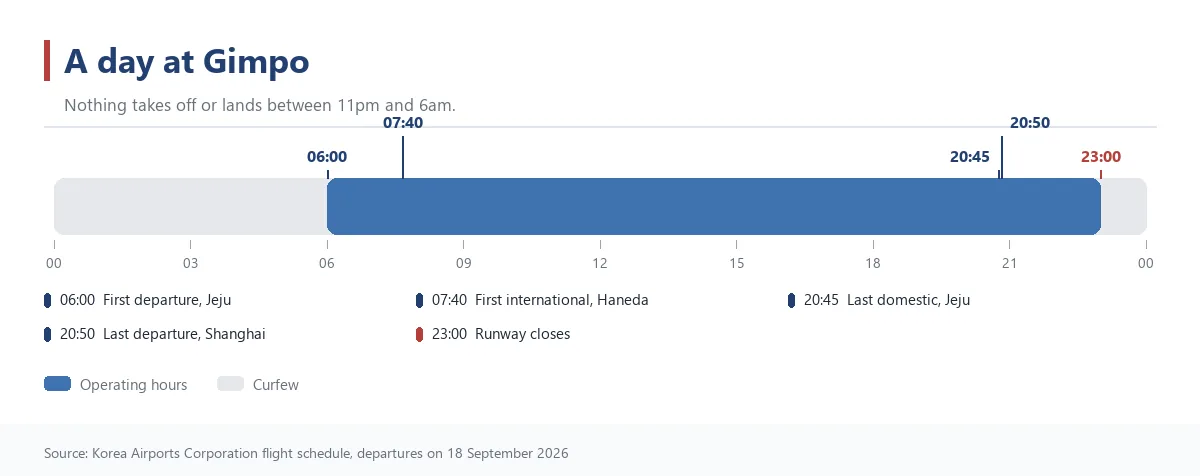
Start with the clock, because it shapes everything else. Gimpo operates 06:00 to 23:00. Since 1993 a night-time restriction has made it illegal for aircraft to take off or land in the seven hours in between, except in an emergency. People live right up against the airport fence.
So there are no red-eye flights at Gimpo. The final departure of the day leaves at 8:50pm, and only a handful of arrivals follow it. If your flight is a late one, you are going to Incheon, which runs around the clock.
The cut-off is measured at touchdown
What counts is the moment the wheels meet the runway, not the moment the crew is cleared to approach. A flight that is cleared but runs late in the final minutes has to climb away and divert. Airlines know this, so inbound evening schedules are built with slack rather than pushed to the limit.
What kind of airport this is
Nearly 23 million people passed through Gimpo last year. Around 18.5 million of them were flying domestically and only 4.4 million internationally, and the international network reaches just eight cities in Japan, China and Taiwan.
| Gimpo | Incheon | |
|---|---|---|
| Hours | 06:00 to 23:00 | 24 hours |
| Passengers last year | 23.0 million | 74.0 million |
| International destinations | 8 cities | 178 cities |
| Domestic flights | 158 departures a day to 7 cities | Almost none |
| Into central Seoul | Five subway lines | Airport Railroad and buses |
Those figures come from the Korea Airports Corporation statistics portal, January to December 2025. The airport code you will see on your ticket is GMP, and the general information line is 1661-2626.
2. The eight international routes
Gimpo’s international network is short enough to list in full: Tokyo Haneda, Osaka Kansai, Nagoya Chubu, Shanghai Hongqiao, Beijing Capital, Beijing Daxing, Taipei Songshan and Kaohsiung.
| City | Departures a day | First | Last | Passengers last year |
|---|---|---|---|---|
| Tokyo Haneda | 12 | 07:40 | 19:55 | 1.93 million |
| Osaka Kansai | 10 | 08:10 | 18:50 | 930,000 |
| Taipei Songshan | 6 | 11:15 | 20:20 | 245,000 |
| Shanghai Hongqiao | 4 | 08:30 | 20:50 | 619,000 |
| Kaohsiung | 4 | 09:45 | 20:35 | 172,000 |
| Beijing Capital | 3 | 09:05 | 15:00 | 278,000 |
| Nagoya Chubu | 2 | 11:20 | 17:50 | 128,000 |
| Beijing Daxing | 1 | 13:30 | only flight | 128,000 |
Two thirds of the traffic is Japanese
Of the 4.4 million international passengers last year, roughly 3.0 million were on Japan routes. Haneda alone accounts for 44% of Gimpo’s international traffic. China follows with about 1.0 million and Taiwan with 417,000. If you are arriving from Tokyo, you are on the busiest thing this airport does.
Taipei and Kaohsiung flights do not run every day
The Taiwan routes are shared out between carriers by day of the week, so a timetable that looks like six daily Songshan departures is really several part-week services stacked on top of each other.
Check the day before you book. The 09:45 Kaohsiung service runs Tuesday, Thursday and Saturday, while the 10:50 runs Monday, Wednesday, Friday and Sunday. Songshan at 11:15 and 11:20 splits the same way. Some evening Songshan departures operate only once or twice a week.
A few charter routes appeared last year
The statistics also list Nha Trang, Da Nang, Hanoi and Huangshan, but those four combined carried 961 passengers across six flights in a whole year. They were charters, not something you can book. There is no scheduled Gimpo service to Southeast Asia. For anywhere beyond Japan, China and Taiwan, you want Incheon and its 178 destinations.
3. The domestic side, which is mostly Jeju
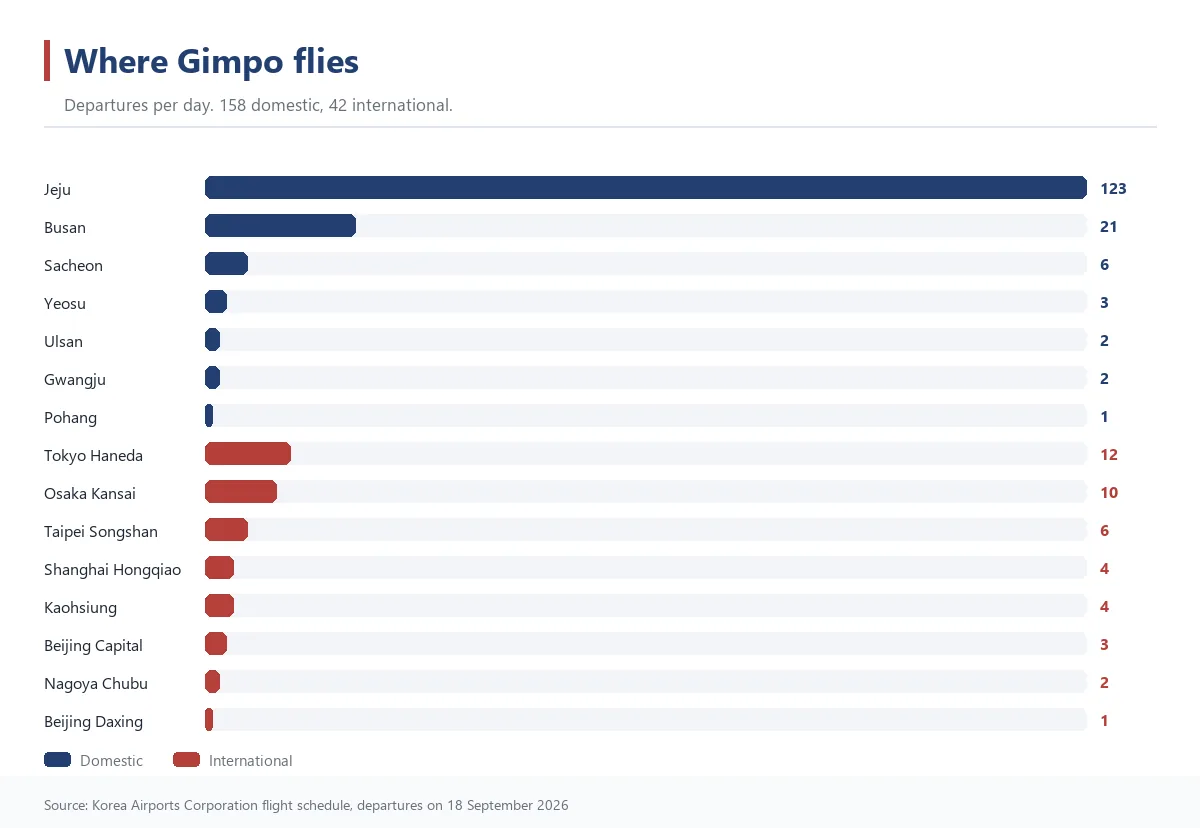
Most flights at Gimpo are domestic, and most domestic flights go to one island. Jeju took 15.3 million of the 18.5 million domestic passengers last year. Busan came second with 2.4 million, and the remaining five airports together managed 870,000.
| City | Departures a day | First | Last | Airlines |
|---|---|---|---|---|
| Jeju | 123 | 06:00 | 20:45 | Korean Air, Asiana, Air Busan, Air Seoul, Eastar, Jeju Air, Jin Air, Trinity, Parata |
| Busan (Gimhae) | 21 | 07:00 | 20:00 | Korean Air, Air Busan, Jeju Air, Trinity |
| Jinju (Sacheon) | 6 | 07:20 | 17:50 | Sum Air, Jin Air |
| Yeosu | 3 | 07:05 | 16:40 | Asiana, Jin Air |
| Ulsan | 2 | 07:20 | 18:55 | Korean Air |
| Gwangju | 2 | 10:15 | 15:40 | Asiana |
| Pohang Gyeongju | 1 | 08:55 | only flight | Jin Air |
Jeju runs like a shuttle
With 123 departures a day there is a Jeju flight roughly every seven minutes through the working day, from six in the morning until a quarter to nine at night. Missing one is not a crisis. Busan is thinner at 21 a day but still comfortable.
Everywhere else needs planning
Pohang Gyeongju has exactly one flight a day, the 08:55 Jin Air service. Miss it and there is no second chance until tomorrow. Gwangju has two departures, Ulsan has two, and Yeosu has three.
The Jinju route is flown partly by Sum Air, a small carrier you will not recognise from the big booking sites. Timetables for any of this are on the official Gimpo schedule page, where you pick a date and a route.
4. How the day is shaped
The curfew gives Gimpo a fixed daily rhythm. It wakes up at six with a Jeju flight and stops departing just before nine in the evening.
Mornings are domestic only
Nothing international leaves before 07:40, which is the first Haneda service. If you arrive at the airport at dawn, the international terminal will be quiet and most of its shops will still be shut.
Afternoon thins out fast
Beijing Capital has gone by 15:00 and Nagoya by 17:50. After about five in the afternoon your international options narrow to Haneda, Kansai, Songshan, Kaohsiung and Hongqiao.
- 06:00 First departure of the day, to Jeju.
- 07:40 First international departure, to Haneda.
- 15:00 Last Beijing flight of the day.
- 20:45 Last domestic departure, to Jeju.
- 20:50 Last departure of the day, to Shanghai Hongqiao.
- 23:00 The runway closes until six the next morning.
If you land in the evening, the trains outlast the planes. The last Airport Railroad service towards Seoul Station leaves Gimpo at 00:34, and Line 9 runs until just after midnight in the Gaehwa direction. You will not be stranded by a 9pm arrival.
5. Two separate terminals
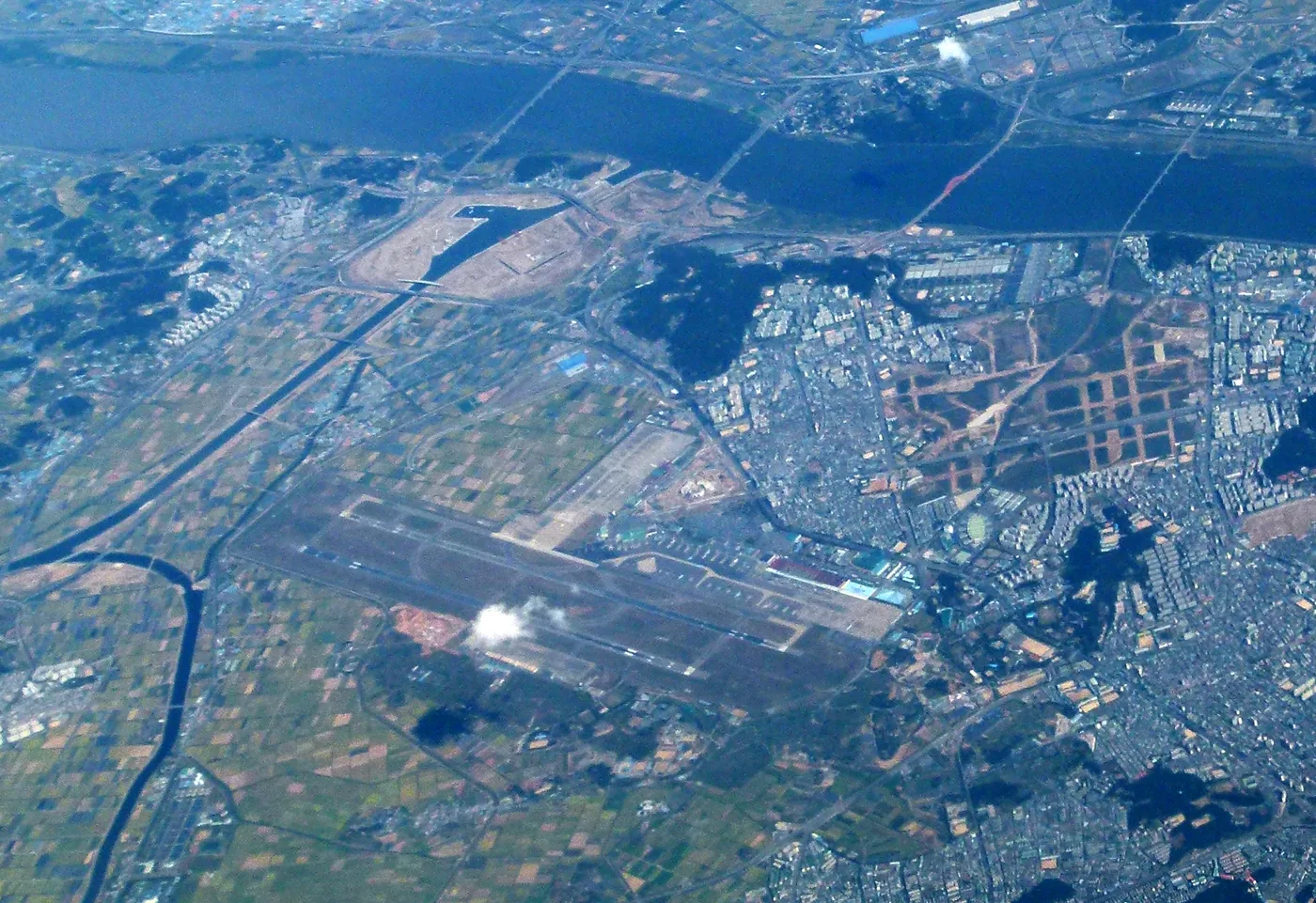
Gimpo has a domestic terminal and an international terminal, and they are two different buildings standing apart from each other. The domestic terminal is at 111 Haneul-gil, Gangseo-gu, SeoulMap and the international one is right next doorMap.
A free bus links them
The airport circulation bus runs between the terminals and costs nothing to ride. Through the middle of the day it comes every 15 to 20 minutes. Early in the morning and late at night the gap stretches to around 25 minutes, and the passenger-terminals-only loop runs every 12 to 15 minutes.
| Route | Hours | Where to board |
|---|---|---|
| Passenger and cargo terminals | 06:00 to 23:00 | International terminal, exit Gate 1 on the first floor, turn right, stop 5 |
| Passenger terminals only | 08:00 to 23:00 | Domestic terminal, exit Gate 4 on the first floor, turn left, stop 8 |
The two buildings are very different sizes
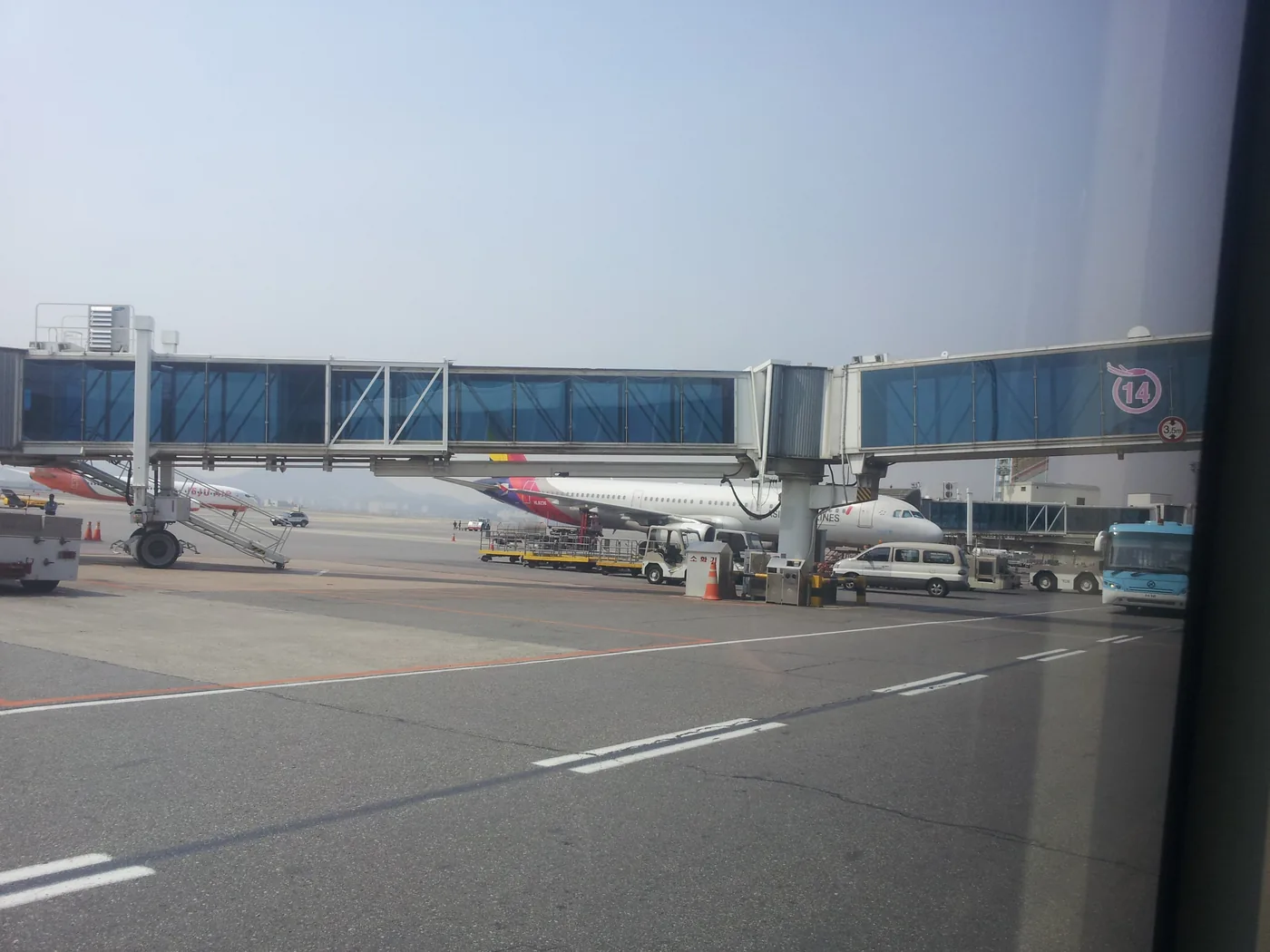
The domestic terminal has nine jet bridges and the international terminal has six. Between them they were built to handle 34.7 million passengers a year, of which 30.4 million was the domestic allowance. The international building feels small because it is small. There are two runways, one 3,600m long and one 3,200m.
One trap on the circulation bus
The cargo-terminal loop turns around inside a bonded area that the public cannot enter. If you stay on to the end of the line, you have to get off and cross to the stop on the opposite side to continue.
Changing from a domestic to an international flight means collecting your bag, crossing between buildings and checking in again from scratch. Leave more time than you would at a single-terminal airport. The official page is the Gimpo public transport guide.
6. Five subway lines meet under the airport
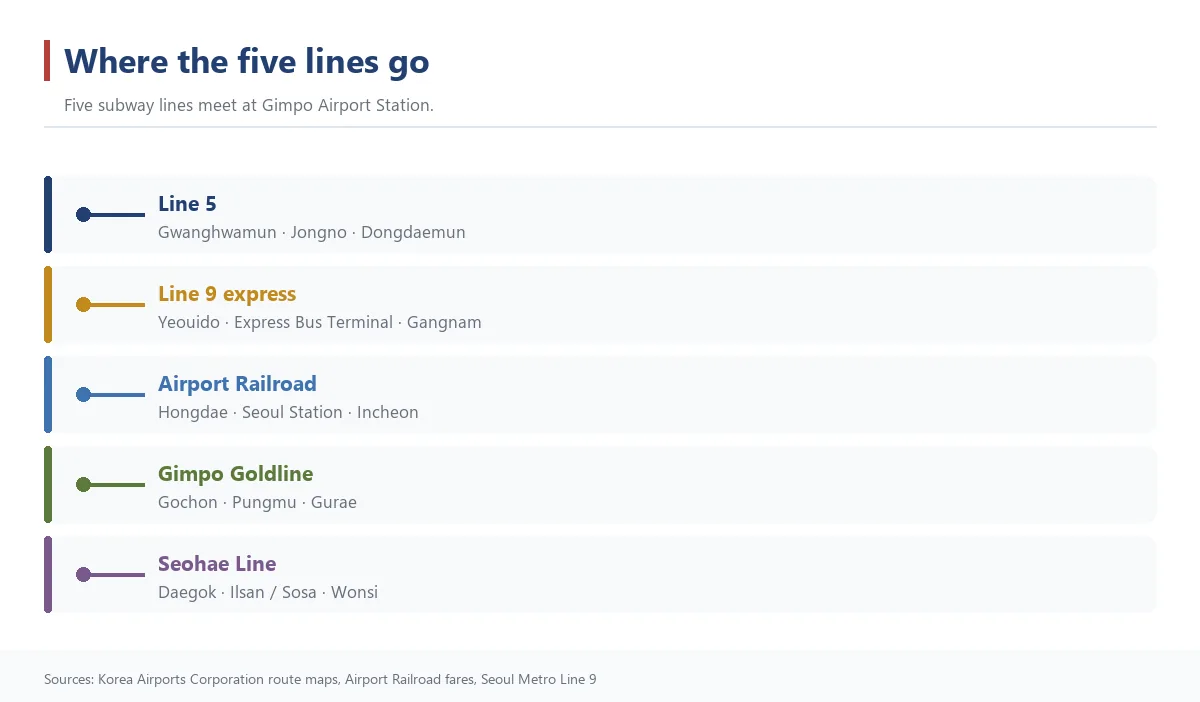
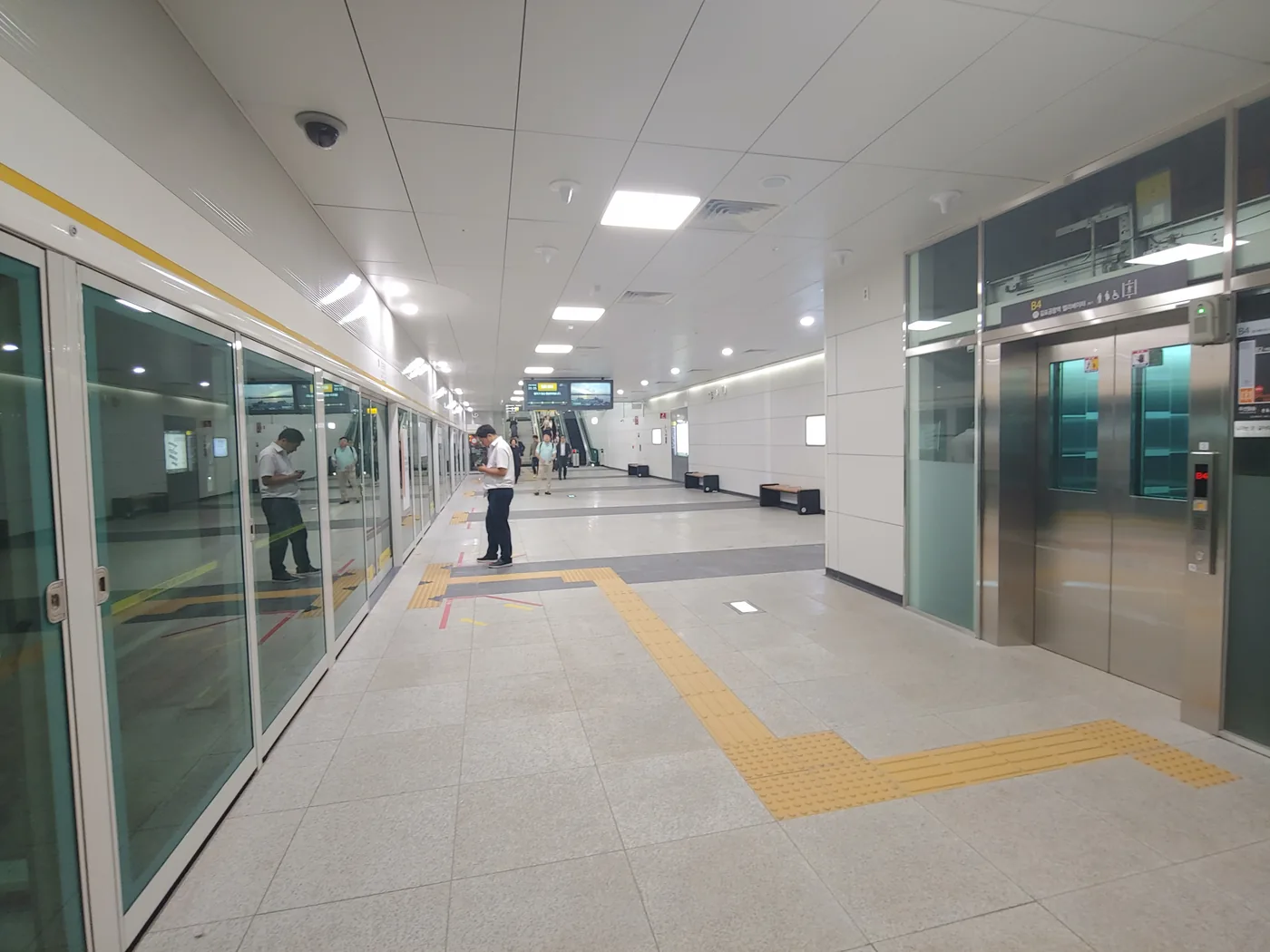
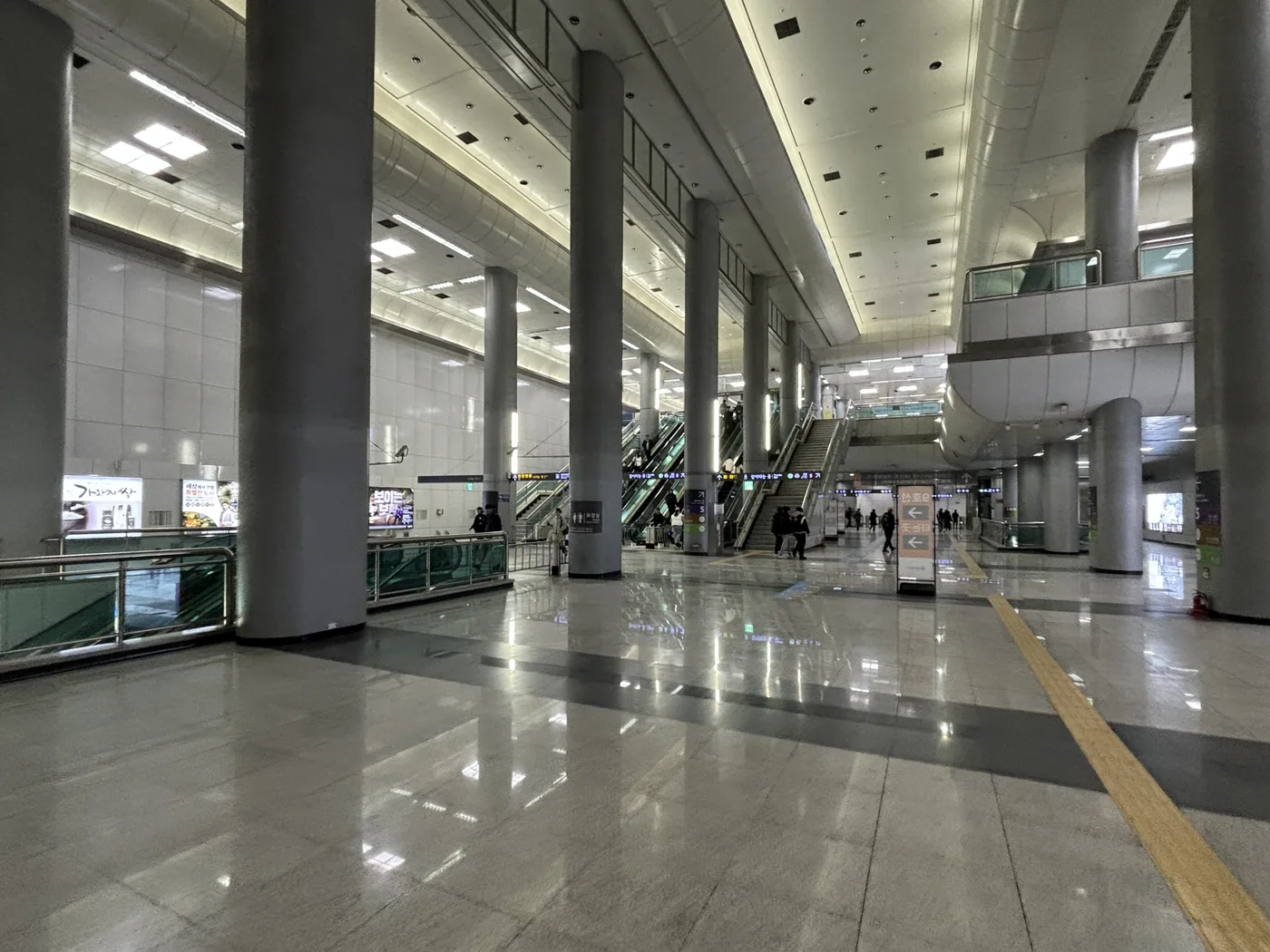
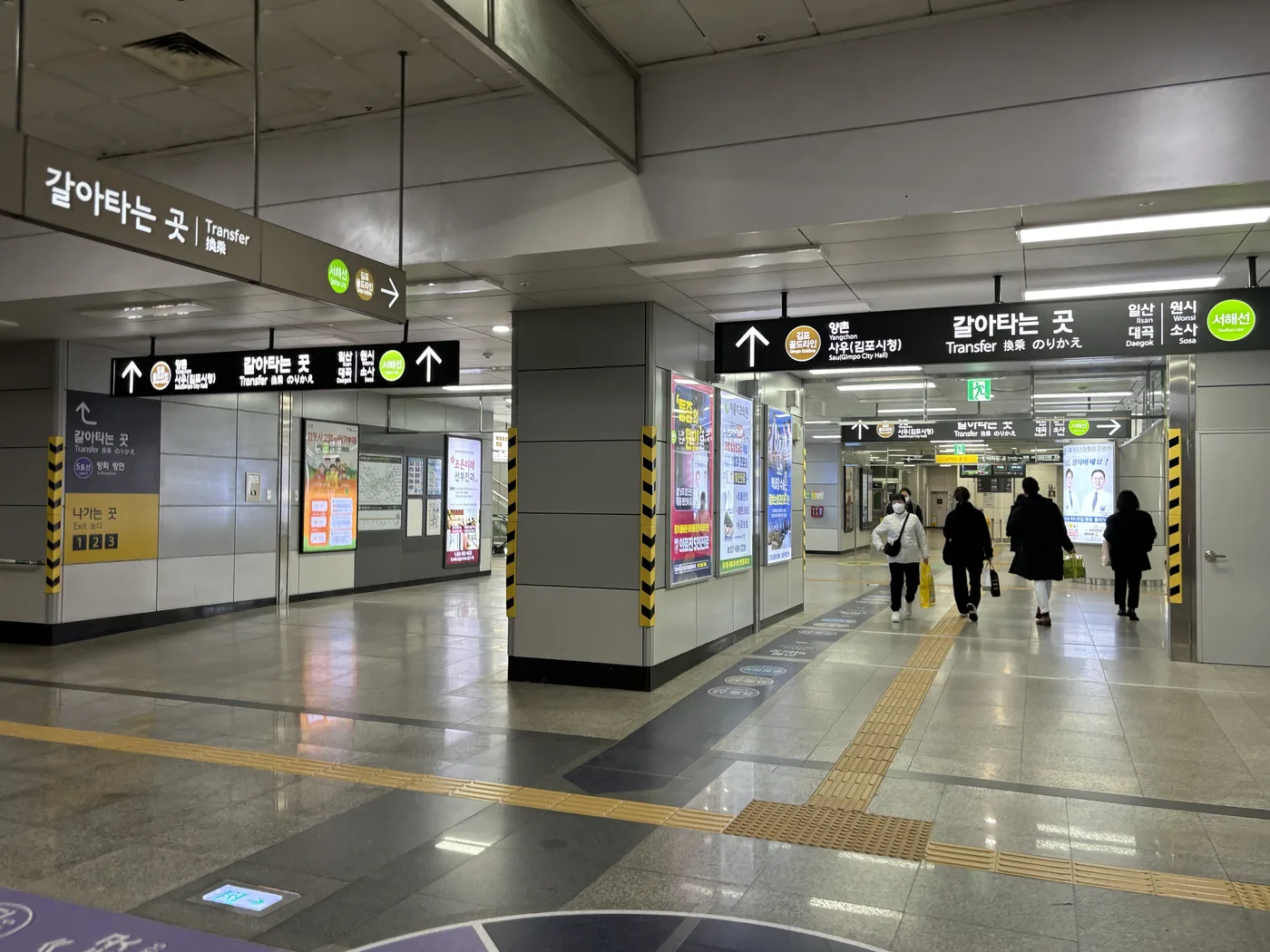
Gimpo Airport StationMap is served by Line 5, Line 9, the Airport Railroad, the Gimpo Goldline and the Seohae Line. No other station in Seoul stacks up that many.
| Line | Useful stops | Runs between |
|---|---|---|
| Line 5 | Yeouido, Gongdeok, Gwanghwamun, Jongno 3-ga, Dongdaemun History and Culture Park | Banghwa and Hanam |
| Line 9 | Magongnaru, Dangsan, Yeouido, Noryangjin, Express Bus Terminal, Sinnonhyeon, Bongeunsa | Gaehwa and Jungang Bohun Hospital |
| Airport Railroad | Digital Media City, Hongik University, Gongdeok, Seoul Station, and the other way to Incheon Airport | Seoul Station and Incheon Airport Terminal 2 |
| Gimpo Goldline | Gochon, Pungmu, Sau, Janggi, Gurae | Gimpo Airport and Yangchon |
| Seohae Line | Daegok, Baengma, Ilsan, and the other way Wonjong, Sosa, Siheung | Ilsan and Wonsi |
Two of the five are not for visitors
The Gimpo Goldline and the Seohae Line both head away from central Seoul. The Goldline serves the new towns in Gimpo city, and the Seohae Line runs out to Ilsan in one direction and Bucheon, Siheung and Ansan in the other. They matter enormously if you live there and not at all if you are heading downtown.
Interchanges here are long walks
Five lines share a name but not a level. Changing between the Airport Railroad and Line 5 in particular means a serious walk with your luggage. Build in the time.
Getting across the station if you need help
There is a support service for the walk from the platforms to the check-in desks. It covers passengers aged 70 or over, passengers with disabilities, pregnant travellers and anyone with a child under seven. Electric carts run from the subway station to the terminal entrance, and a wheelchair service goes all the way to the airline counters.
You do not need to book it in advance. Ask at the subway connecting passage or the information counter on the first floor of the domestic terminal. If nobody is at the desk, the direct line is 02-2660-2478.
7. Which line to take for where you are going
The five lines are not interchangeable. Pick by destination.
Palaces and the old centre: Line 5
Line 5 runs from Gimpo through Yeouido and Gongdeok to Gwanghwamun, Jongno 3-ga and Dongdaemun without a change. For Gyeongbokgung, Insadong or the northern end of Myeongdong this is the simplest ride in the building.
Gangnam: Line 9 express
Line 9 goes to Express Bus Terminal, Sinnonhyeon, Bongeunsa and Sports Complex. Express and local trains alternate, and the express calls at sixteen stations only. The Seoul city government puts Gimpo to Sports Complex at 38 minutes on the express.
Platform indicators mark express and local separately. With luggage the local train is sometimes the better choice simply because you can sit down. Line 9 expresses towards Gangnam are notoriously crowded at rush hour.
Seoul Station and Hongdae: the Airport Railroad
The Airport Railroad calls at Digital Media City, Hongik University, Gongdeok and Seoul Station. Take it if you are catching a KTX or staying around Hongdae.
| From Gimpo Airport to | Fare with a transit card |
|---|---|
| Magongnaru | 1,550 won |
| Digital Media City | 1,650 won |
| Hongik University | 1,650 won |
| Gongdeok | 1,750 won |
| Seoul Station | 1,750 won |
| Gyeyang | 1,550 won |
| Cheongna International City | 1,750 won |
Fares and the first and last trains
All five lines use the integrated metropolitan fare. The base fare rose to 1,550 won on a transit card on 28 June 2026, with 100 won added for every 5km beyond the first 10km. A single-journey paper ticket is 1,650 won, and there is a 20% discount if your first tap of the day is before 06:30.
The Airport Railroad runs from Gimpo towards Seoul Station between 05:42 and 00:34, and towards Incheon Airport Terminal 2 between 05:43 and 00:22. On Line 9 the first train towards Gangnam is 05:30 and the last one that runs deep into the city is the 23:05 to Sinnonhyeon. After that, services turn back early at Dongjak, Dangsan and Gayang.
Fares and times come from the Airport Railroad fare table and the Seoul Metro Line 9 timetable. Our wider guide to the network is the Seoul subway guide.
8. Crossing to Incheon Airport
Arriving at Gimpo and flying onward from Incheon is common, and the two airports are on the same railway, with IncheonMap at the far end. No change of train is needed.
| From Gimpo Airport to | Fare with a transit card |
|---|---|
| Incheon Airport Terminal 1 | 4,350 won |
| Incheon Airport Terminal 2 | 4,950 won |
| Geomam | 1,650 won |
| Unseo | 3,450 won |
The express train does not stop at Gimpo. The Airport Railroad’s non-stop express runs between Seoul Station and Incheon Airport only. From Gimpo you can take the all-stations train and nothing else.
Allow more time than the map suggests
The all-stations service calls everywhere, and it is a commuter train with commuter seating, so standing with suitcases is a real possibility at busy times. If you are connecting to an international departure, give yourself a wide margin.
It works in both directions
The same train takes you from Incheon to Gimpo if you have arrived internationally and are continuing on a domestic flight. Our separate guide covers getting from Incheon Airport into Seoul, and for the south of the country there is Gimhae Airport into Busan.
9. Buses and taxis
With five subway lines underneath it, Gimpo does not lean on buses the way Incheon does. They matter mainly for the southern half of Gyeonggi province.
Airport buses leave from the domestic terminal, bay 3
Services to Suwon, Seongnam, Yongin and Osan all use bay 3 at the domestic terminal. Last departures vary a lot between routes, so check before you plan an evening arrival around one.
| Route | Towards | First and last from the airport |
|---|---|---|
| 4300 | Dongsuwon | 08:30 to 23:00 |
| 4300-1 | Yeongtong Station | 11:40 to 21:20 |
| 4300-2 | Bugok depot | 11:50 to 20:40 |
| 5100 | Seongnam | 06:00 to 22:25 |
| 5200-1 | Agricultural Products Centre | 06:20 to 22:50 |
| 8165 | Yongin terminal | 07:05 to 22:00 |
| 8840 | Hosu Xi | 06:20 to 21:20 |
| 8848 | Osan Station transfer centre | 07:40 to 19:50 |
Intercity coaches need a ticket first
Intercity coaches leaving Gimpo must be booked before boarding, at a machine in the terminal or through an app. You cannot simply get on and pay the driver.
Routes and fares are listed on the Gyeonggi bus information site.
Taxis are short rides from here
Because Gimpo is inside the city, taxi journeys are not the long haul they are from Incheon. Ranks are outside the arrivals level of both terminals. Roads out of the airport split towards the Gaehwa underpass, towards Songjeong Station and towards the Korean Air intersection, so drivers pick a different exit depending on where you are going.
10. Parking costs 20,000 to 30,000 won a day
There is room for about 6,000 cars across the airport’s paid car parks. The thing to know about the pricing is that weekends cost 10,000 won a day more than weekdays.
| Standard vehicle | Large vehicle | |
|---|---|---|
| First 30 minutes | 1,000 won | 1,200 won |
| After that | 500 won per 15 minutes | 400 won per 10 minutes |
| 24 hours, Monday to Thursday | 20,000 won | 40,000 won |
| 24 hours, Friday to Sunday and holidays | 30,000 won | 40,000 won |
Ten minutes is free
If you are only dropping someone off, leaving within ten minutes of entry costs nothing. Once you have paid at a machine you then have twenty minutes to get out before the meter starts again.
Only one valet company is legitimate
Turu Valet is the only authorised valet operator at Gimpo. The desk is on the second floor of the domestic terminal and the staff wear orange. Any other valet service at this airport is operating illegally, and neither the airport corporation nor the official operator will cover your losses if something goes wrong.
Small coins are rejected
The payment machines do not accept 10 won or 50 won coins, so a card is easier. The car parks are split into domestic lot 1, domestic lot 2, the international basement and the international parking building, and live space counts for each are published on the airport website.
11. If you have hours to fill
Gimpo is unusual in that people come here without flying anywhere. A department store, a supermarket, a cinema and a national museum are all attached to the airport.
The National Aviation Museum is free
The National Aviation Museum of KoreaMap opened in July 2020 at 177 Haneul-gil, right beside the airport, and admission to the exhibitions is free. Check the day of the week before you set off.
The museum opens Tuesday to Sunday, 10:00 to 18:00, with last admission at 17:30. It is closed every Monday, plus 1 January and the main days of Seollal and Chuseok. When a Monday is a public holiday it opens and closes the following weekday instead.
Lotte Mall runs until 10pm
Lotte Mall Gimpo AirportMap holds a department store, a hypermarket, a cinema and a hotel in one 194,874 square metre complex. Closing times differ by tenant.
| Part of the complex | Hours |
|---|---|
| Lotte Mall | 10:30 to 22:00 |
| Lotte Department Store, floors 1 to 5 | 10:30 to 20:00 |
| Lotte Department Store, lower floors | 10:30 to 22:00 |
| Lotte Mart | 10:00 to 23:00 |
There is an outdoor observation deck
The fourth floor of the domestic terminal has an open-air deck looking over the runways, and there is no charge to use it. A linked park called Sky Park is open to anyone, and the same site holds a hospital and a 200-bay golf range. Some of this is less an airport than a neighbourhood that happens to have runways.
With a long wait, walking from the domestic terminal to the museum is perfectly doable, and the circulation bus covers it for free. On a Monday the museum is shut, so aim for Lotte Mall instead.
12. Practical things in the international terminal
The international terminal is the smaller of the two, with six jet bridges. You will not get lost in it.
Duty free is airside and it is split
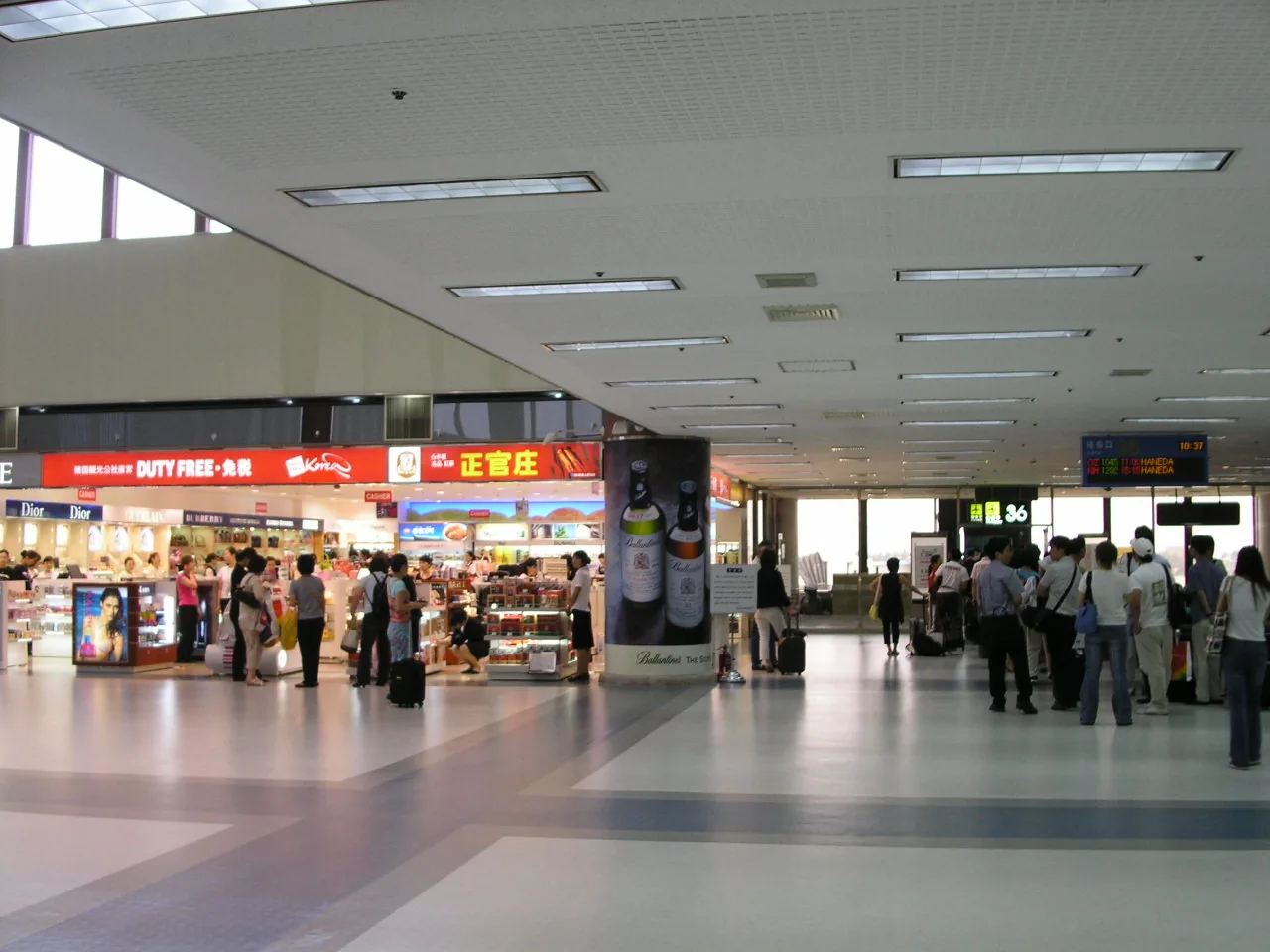
Two operators sit past security on the third floor, and they carry different things. Lotte Duty Free handles cosmetics and fragrance, Shilla Duty Free handles spirits and tobacco. The selection is nothing like Incheon’s, so order online in advance if there is something you actually need.
Connectivity
All three Korean mobile operators keep roaming desks side by side next to Gate 1 on the first floor of the international terminal. Free wifi runs throughout the public areas of both terminals under Gimpo_Airport Free Wi-Fi and Public WiFi Free.
Charging and post
Phone charging stations are spread across five spots in the domestic terminal and six in the international one, including several past security. A post office on the first floor of the domestic terminal opens 09:00 to 18:00 on weekdays, and anything handed in after 17:30 goes out the next day.
You can hire a private room
The airport rents small lounges. They sit on the third-floor concourse and the first-floor arrivals hall, and for up to five people the rate is 55,000 won for two hours in the domestic terminal and 77,000 won in the international terminal, then 11,000 and 22,000 won per extra hour.
These rooms need a phone booking the day before and are only released when they are not needed for official guests. You cannot walk up and take one.
13. Gimpo or Incheon
Five cities are served by both airports, which means the choice is real for Tokyo, Osaka, Shanghai, Taipei and Beijing. Here is what actually decides it.
| If this is you | Use | Why |
|---|---|---|
| Starting from central Seoul | Gimpo | Five subway lines reach it |
| Flying late at night | Incheon | Gimpo closes at 23:00 |
| Japan, China or Taiwan | Gimpo | The routes exist |
| Anywhere else | Incheon | Gimpo has no service |
| Connecting to Jeju or Busan | Gimpo | Incheon has almost no domestic flights |
| Serious duty-free shopping | Incheon | Gimpo’s shops are small |
| Transferring between flights | Incheon | Gimpo has few onward connections |
Proximity is the entire argument for Gimpo
Gimpo is inside Seoul. One line from Gwanghwamun, one line from Gangnam, and you are at the terminal. Incheon takes over 40 minutes from Seoul Station on the express and longer on anything else. On a short trip to Tokyo or Osaka, that difference is a meaningful part of the holiday.
The trade is a much smaller map
Eight international cities against 178. Nothing in Southeast Asia, Europe or the Americas leaves from Gimpo. If your trip involves a long-haul leg, the decision has already been made for you. How to move around the rest of the country is covered in our Korea transport guide.
14. What first-time users get wrong
A short list of the mistakes that actually happen here.
Going to the wrong terminal
Turning up at the domestic terminal for an international flight is the classic one, and it happens because the subway exits and most of the bus stops are on the domestic side. The circulation bus will get you across, but that is another twenty minutes you may not have.
Waiting for an airport bus outside the international terminal
Airport buses and intercity coaches only serve the domestic terminal. If you land internationally, take the circulation bus across first. Standing outside the international building will not produce a bus.
Expecting a night flight
People confuse Gimpo with Incheon and look for a late departure. Nothing leaves Gimpo after about nine in the evening.
Waiting for the express train
The Airport Railroad express runs straight through Gimpo Airport Station. However long you wait on that platform, it is not going to stop.
Visiting the museum on a Monday
The National Aviation Museum closes on Mondays. The observation deck and Lotte Mall are open.
Budgeting parking at the weekday rate
Leaving the car from Friday to Sunday means 30,000 won a day, not 20,000. That is a 30,000 won gap over a long weekend.
Check which terminal you need before you leave for the airport. The terminal name is printed on your booking, and the two buildings have separate entrances, separate check-in and separate transport. What to do once you are in the city is in our Seoul itinerary.
🎡Things to Do10
🚇Getting Around3
🧭All-Korea essentials112
Frequently asked questions
See all our Korea travel guides
Images: Photographs via Wikimedia Commons: Brücke-Osteuropa (CC0), revi (CC BY 2.0 KR), MNXANL (CC BY-SA 4.0), IRTC1015 (public domain), Magicsgram (CC BY-SA 3.0). Charts by Breeze Korea from Korea Airports Corporation data.