
January in Busan: 21 Freezing Days, Barely Any Snow, and the Polar Bear Swim
The ground freezes on two days out of three this month, and snow falls on barely one. Very little on your itinerary actually gets called off
| Cold | The ground freezes on 21.2 days, more than any other month. Snow falls on 1.4 days and there are no cold-wave days at all. |
|---|---|
| Temperature | Highs of 8.2°C and lows of -0.1°C. That is 6.1°C warmer by day than Seoul. |
| Daylight | Sunrise is at 07:32 on New Year’s Day. The latest sunrise of the year lands on 5 to 10 January, not on the 1st. |
| Sunrise events | Dadaepo starts at 05:30 and Songdo at 06:00. Haeundae and Gwangalli draw the biggest crowds with no official programme at all. |
| Festivals | The Polar Bear Festival takes a mid-month weekend. The Haeundae lights close around the same time, and Seomyeon and Gwangbok-ro run into February. |
| Holidays | One public holiday, on 1 January. The next long weekend is five weeks later. |
1. The ground freezes on 21 days and snow falls on barely one
2. Five temperature measures all bottom out this month
3. The driest month of the Busan year
4. Two lines flip when you set Busan against Seoul
5. Sunset moves 29 minutes later, sunrise only 8 minutes earlier
6. The latest sunrise of the year is not on New Year’s Day
7. Where to stand on the morning of 1 January
8. The month Busan swims in the sea on purpose
9. The Haeundae lights switch off in the middle of the month
10. Gwangbok-ro stays lit into late February
11. The drone show moves to 19:00 and 21:00 for the winter
12. One bathhouse opens at half past five in the morning
13. The cable car closes at the same hour while the sun sets later
14. What is open when the wind picks up
15. One public holiday, then five empty weeks
16. If you are bringing or hiring a car
17. Choosing which week of January to come
January in Busan freezes without ever settling. Part of our complete Busan travel guide.
1. The ground freezes on 21 days and snow falls on barely one
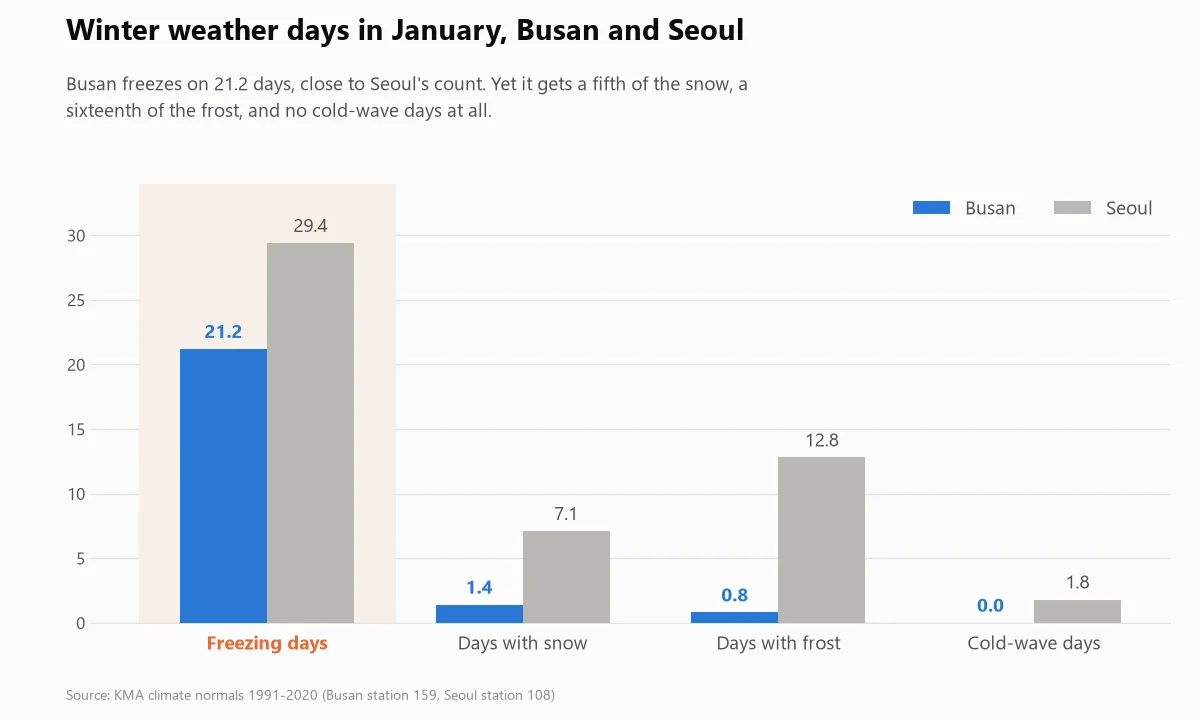
Busan records 21.2 freezing days in January, more than in any other month of the year. Across a 31-day month that works out at two days in every three. Over the same month the city records 1.4 days of snowfall, 0.8 days of frost, and zero cold-wave days.
Those four lines come from the Korea Meteorological Administration climate normals for 1991 to 2020, measured at the Busan station. All four lines come from the same source, so they can be read together: the ground freezes repeatedly while almost nothing settles on top of it.
What the four numbers look like together
| Measure | January | December | February |
|---|---|---|---|
| Freezing days | 21.2 | 15.0 | 14.7 |
| Days with snowfall | 1.4 | 0.9 | 1.2 |
| Days with frost | 0.8 | 0.9 | 0.8 |
| Cold-wave days | 0.0 | 0.0 | 0.0 |
Only the freezing count jumps. It climbs from 15.0 days in December to 21.2 in January, then falls back to 14.7 in February. January is the one month where the overnight low sits below zero on the monthly average, at -0.1°C, and that single fact drives the whole row.
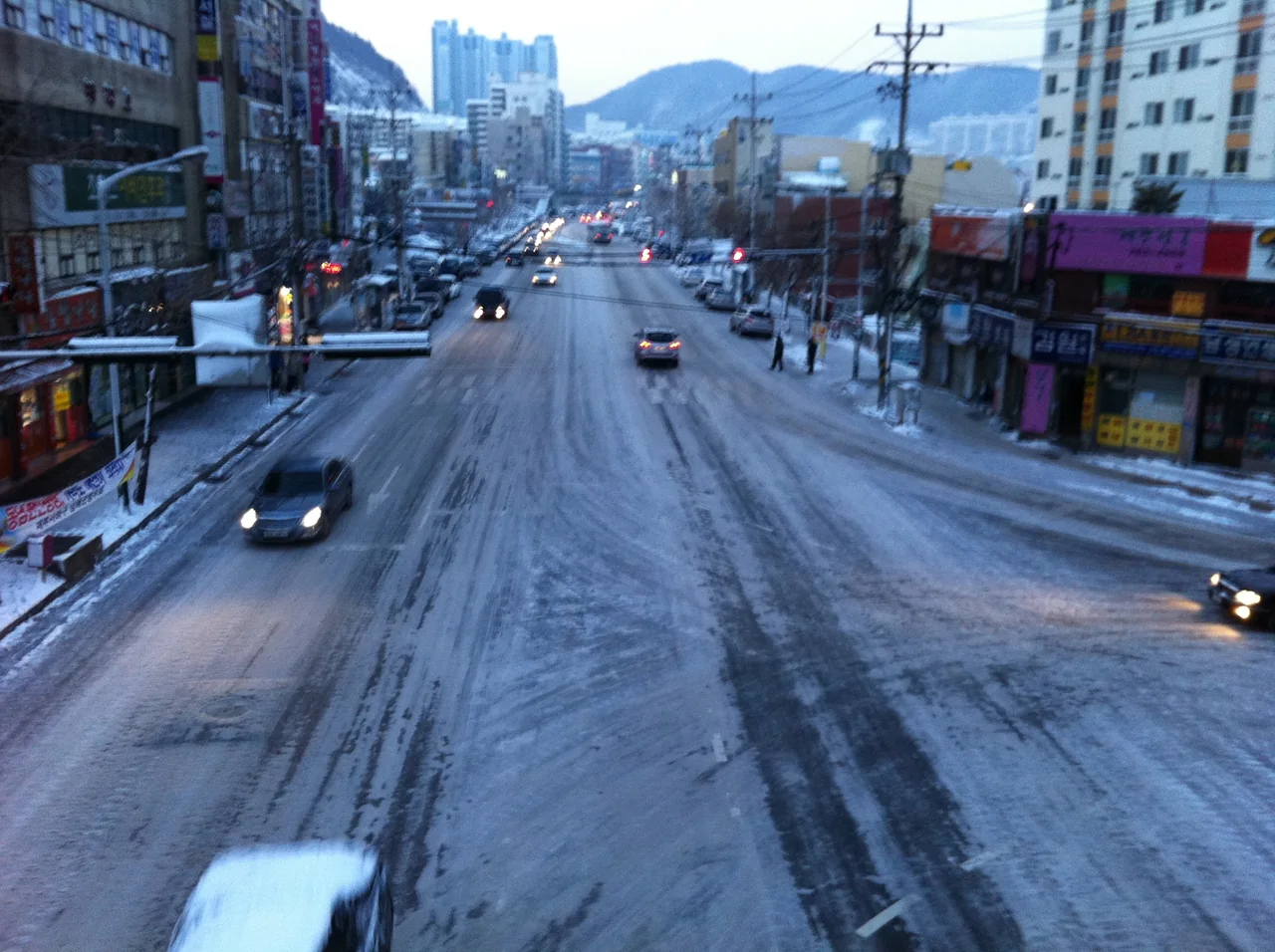
The practical consequence sits in the second line. At 1.4 snow days a month, snow clearance almost never disrupts anything. Outdoor sites stay open, roads stay clear, and buses and trains run to timetable. What does change is the surface underfoot on shaded steps and promenades first thing in the morning.
This is not the same winter as Seoul
In the same month Seoul records 7.1 days of snow and 12.8 days of frost. That is 5.1 times and 16 times the Busan figures. Seoul also logs 1.8 cold-wave days against zero in Busan.
So the two cities call for different preparation. Seoul asks for kit that copes with snow and severe cold snaps. Busan asks for kit that copes with frozen surfaces and coastal wind. Grip on the sole matters more here than thickness of insulation, which is not the trade-off most visitors expect to make in a Korean winter.
2. Five temperature measures all bottom out this month
Busan’s mean January temperature is 3.6°C, the lowest of the twelve months. The gap to August, at 26.1°C, is 22.5 degrees. Daytime highs of 8.2°C and overnight lows of -0.1°C are likewise the annual minimum.
That much is expected. The interesting part is the two rows underneath. Grass minimum temperature, measured just above the ground surface, reads -3.6°C, and ground surface temperature reads 3.4°C. Both bottom out in January as well.
All five annual lows land here
| Measure | January | Rank among twelve months |
|---|---|---|
| Mean temperature | 3.6°C | Lowest |
| Mean daily high | 8.2°C | Lowest |
| Mean daily low | -0.1°C | Lowest |
| Grass minimum | -3.6°C | Lowest |
| Ground surface | 3.4°C | Lowest |
The grass minimum reads -3.6°C while the air minimum reads -0.1°C. The 3.5-degree gap comes from measurement height. Air temperature is taken at 1.5m above ground and the grass minimum at roughly 5cm. The ground cools faster and further than the air above it. The 21.2 freezing days are recorded at that lower height, which is why the pavement can be iced while the thermometer reads a degree above zero.
The temperature moves 8.3 degrees inside a single day
A high of 8.2°C against a low of -0.1°C is a spread of 8.3 degrees. Busan logs 7.5 days in January where the daily range exceeds 10 degrees. Seoul logs 4.3 days in the same month.
The warmer city has the wider daily swing. Seoul stays close to freezing all day, with a high of only 2.1°C, so there is less room to move. Busan climbs into single figures by early afternoon and drops below zero again overnight. Layers you can add and shed beat one heavy coat here, because morning and mid-afternoon are effectively two different days.
3. The driest month of the Busan year
Relative humidity averages 46.8% in January, the lowest reading of any month in Busan. The distance to July, at 83.4%, is 36.6 percentage points. The heaviest single-day rainfall normal also bottoms out here, at 17.8mm.
Total rainfall is low too. The monthly figure of 34.5mm is second only to December’s 33.8mm, and it is roughly a tenth of July’s 326.8mm. Rain falls on 5.4 days and for 43.2 hours in total.
Rain, cloud and sun
| Measure | January | Rank among twelve months |
|---|---|---|
| Relative humidity | 46.8% | Lowest |
| Heaviest one-day rainfall | 17.8mm | Lowest |
| Monthly rainfall | 34.5mm | Second lowest |
| Mean cloud cover | 3.2 | Second lowest |
| Solar radiation | 291.8 MJ/m² | Second lowest |
| Days with rain | 5.4 | Sixth lowest |
| Hours of rain | 43.2 | Fourth lowest |
The heaviest one-day figure of 17.8mm is the most useful number on this table for planning. July’s equivalent is 115.9mm. A day of rain heavy enough to write off an entire itinerary does not appear in the January normals. Carry an umbrella, but there is little need to build a full wet-weather alternative for each day.
The sun shows up in a higher share of the daylight than almost any month
Possible daylight, the total time the sun could be above the horizon, comes to 312.8 hours in January. Actual recorded sunshine comes to 203.1 hours. That ratio is 64.9%, second only to December’s 67.4% and 1.66 times July’s 39.0%.
Put the raw sunshine hours next to summer and the comparison is blunter still. January’s 203.1 hours beat June’s 180.3 and July’s 172.3. The days are short, but the sun works a higher proportion of them, because the rainy season and the typhoon months put cloud over the summer sky and January has very little to put over it.
4. Two lines flip when you set Busan against Seoul
Busan runs 6.1°C warmer by day and 5.4°C warmer at night than Seoul in January. It records 33.5 more hours of sunshine and 5.7 fewer days of snow. None of that is surprising.
Read to the bottom of the table, though, and two rows come out the opposite way round from what the rest of it suggests.
Busan and Seoul in January
| Busan | Seoul | |
|---|---|---|
| Mean temperature | 3.6°C | -1.9°C |
| Mean daily high | 8.2°C | 2.1°C |
| Mean daily low | -0.1°C | -5.5°C |
| Grass minimum | -3.6°C | -9.7°C |
| Sunshine hours | 203.1 | 169.6 |
| Days with snowfall | 1.4 | 7.1 |
| Days with frost | 0.8 | 12.8 |
| Freezing days | 21.2 | 29.4 |
| Cold-wave days | 0.0 | 1.8 |
| Relative humidity | 46.8% | 56.2% |
| Rainfall | 34.5mm | 16.8mm |
| Hours of rain | 43.2 | 43.7 |
| Days with a range above 10°C | 7.5 | 4.3 |
| Mean wind speed | 3.5m/s | 2.3m/s |
First flip: twice the rainfall, the same hours of it
Busan records 34.5mm against Seoul’s 16.8mm, so 2.05 times as much. Yet rain falls for 43.2 hours in Busan and 43.7 hours in Seoul, half an hour longer in the capital.
A good share of Seoul’s January precipitation arrives as snow, and snow takes far longer to deliver the same measured depth of water. Busan gets it over with. The same 43 hours carry double the volume. For a visitor that usually means an hour or two indoors rather than a lost afternoon.
Second flip: the warmer city has the wider daily swing
Days with a temperature range above 10 degrees number 7.5 in Busan and 4.3 in Seoul, a difference of 3.2 days.
Seoul spends January compressed against freezing at both ends of the day. Busan climbs to 8.2°C in the afternoon and falls below zero overnight, so the spread is wider. Dressing for the afternoon will leave you underdressed at night here more often than it would in Seoul.
5. Sunset moves 29 minutes later, sunrise only 8 minutes earlier
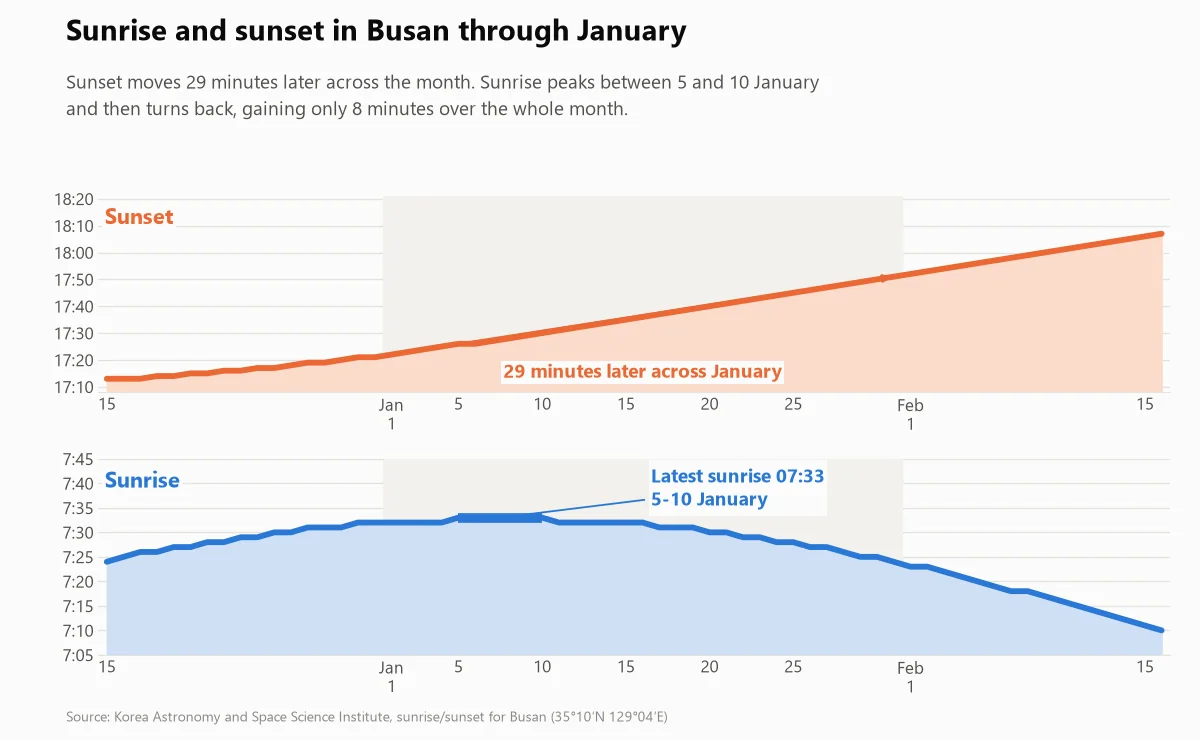
Busan gains 37 minutes of daylight across January. Sunset moves 29 minutes later, from 17:22 to 17:51, and sunrise moves 8 minutes earlier, from 07:32 to 07:24.
Those figures come from Korea Astronomy and Space Science Institute rise and set times for the Busan coordinates, read day by day across the month. Of the 37 minutes, 29 are on the sunset side.
Day by day through the month
| Date | Sunrise | Sunset | Daylight | Fully dark |
|---|---|---|---|---|
| 1 January | 07:32 | 17:22 | 9h 50m | 17:51 |
| 5 January | 07:33 | 17:26 | 9h 53m | 17:54 |
| 10 January | 07:33 | 17:30 | 9h 57m | 17:58 |
| 15 January | 07:32 | 17:35 | 10h 3m | 18:02 |
| 20 January | 07:30 | 17:40 | 10h 10m | 18:07 |
| 25 January | 07:28 | 17:45 | 10h 17m | 18:12 |
| 31 January | 07:24 | 17:51 | 10h 27m | 18:17 |
Read the sunrise column downwards and it barely moves. It stays between 07:24 and 07:33 for the whole month. The sunset column moves about a minute a day, every day, without pausing.
What that changes about planning
In practice, the morning window stays the same size all month and only the evening window grows. In the first week it is night by half past five. By the last week there is usable light until nearly six.
If you are going out for night views or illuminations, work from the last column rather than from sunset. For 26 to 29 minutes after the sun goes down the sky is still blue, and lighting does not read at its own colour until that window closes. The difference between the two columns is what separates the 17:30 switch-on at one festival from the 18:00 switch-on at another.
6. The latest sunrise of the year is not on New Year’s Day
The latest sunrise Busan sees all year is 07:33, and it falls on 5 to 10 January. Sunrise on 1 January is 07:32, one minute earlier. New Year’s Day is not the darkest morning of its own month.
The winter solstice was back on 22 December, so a latest sunrise in early January looks wrong at first. The shortest day and the latest sunrise are simply not the same date. Earth’s orbit is an ellipse rather than a circle, which makes the length of a solar day vary slightly through the year and pushes the two events apart.
Sunrise through the first fortnight
| Date | Sunrise | First light |
|---|---|---|
| 1 January | 07:32 | 07:04 |
| 3 January | 07:32 | 07:04 |
| 5 January | 07:33 | 07:05 |
| 8 January | 07:33 | 07:05 |
| 10 January | 07:33 | 07:05 |
| 12 January | 07:32 | 07:05 |
| 31 January | 07:24 | 06:57 |
One minute is not something anyone notices standing on a beach. It is still worth knowing. If you want a sunrise without the New Year crowd, any morning in that first fortnight gives you the same show, and the 5th to the 10th actually run a minute later than the 1st.
Busan gets light 15 minutes before Seoul
| Busan | Seoul | Difference | |
|---|---|---|---|
| First light | 07:04 | 07:18 | 14 min |
| Sunrise | 07:32 | 07:47 | 15 min |
| Sunset | 17:22 | 17:24 | 2 min |
| Fully dark | 17:51 | 17:53 | 2 min |
On 1 January the sunrise gap is 15 minutes and the sunset gap is 2. Busan sits both east and south of Seoul. Being further east brings the sun up earlier and takes it down earlier; being further south lengthens the winter day and pushes sunset later. The two effects add up in the morning and cancel out in the evening.
The result is that a Busan winter day is front-loaded. An early train down from Seoul will not get you there for sunrise, and a night in the city beforehand leaves plenty of margin.
7. Where to stand on the morning of 1 January
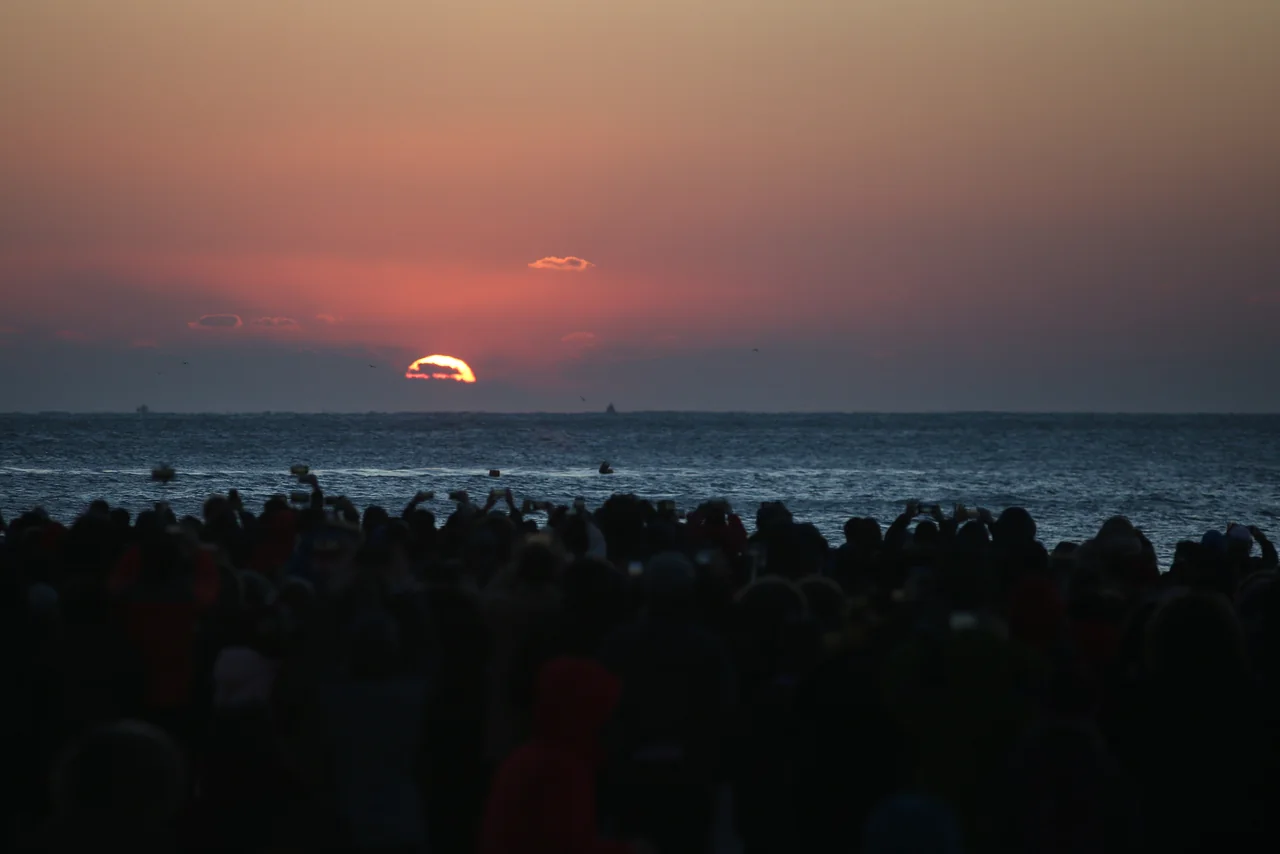
The beaches that run official New Year sunrise programmes in Busan are not the ones where the crowds go. At the most recent turn of the year, Haeundae drew an estimated 29,000 people and Gwangalli 23,000, and neither had an official event.
The places that do lay on soup, coffee and a stage are Dadaepo, Songdo, and a park in the Jung-gu district.
Where there is an official programme
| Place | Starts | What is laid on |
|---|---|---|
| Dadaepo Beach, east sideMap | 05:30 | Free fish cake, rice-cake soup and coffee. Percussion troupe on the sand from about 06:50 |
| Songdo BeachMap | 06:00 | Rice-cake soup and tea, tarot readings, discounted souvenirs |
| Neonadeuri Park, Yeongju-dong | 07:00 | Jung-gu district reunification-themed sunrise event |
Sunrise is at 07:32 and Dadaepo opens two hours earlier. First light is not until 07:04, so arriving at 05:30 means an hour and a half in the dark before the sky does anything. The soup and the drumming exist to fill exactly that gap. If you only want the sun, arriving at 06:40 is enough.
Where the crowds go instead
No official event means no stage, no announcements and no extra toilets. Fifty thousand people turn up between the two anyway. Police deploy around 700 officers across the beaches and other sunrise spots including Haedong Yonggungsa temple.
Smaller gatherings run from about 07:00 at Oryukdo SkywalkMap, the Sanggyebong peak on GeumjeongsanMap, the summit of Baesan in Yeonje-gu, and the maritime university car park on Yeongdo. The Igidae coastal walk and Oryukdo Skywalk side of the city is markedly quieter than the beaches.
Getting back afterwards
Metro services run past 01:00 on the night of 31 December. At the most recent turn of the year the last train from Nampo stationMap on Line 1 left at 02:06 towards Dadaepo Beach and 01:36 towards Nopo, with buses through Nampo-dong running until around 01:00.
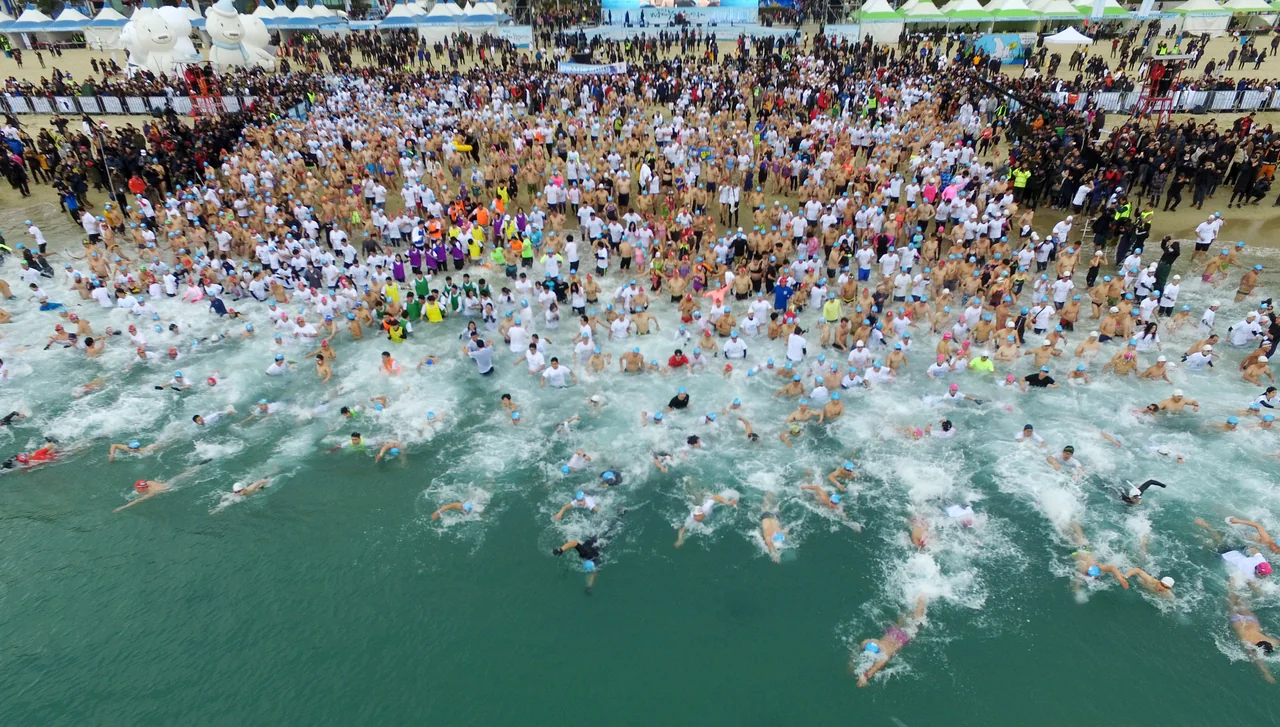
8. The month Busan swims in the sea on purpose
The Haeundae Polar Bear Festival takes a mid-January weekend on Haeundae Beach. At the most recent edition, the 39th, the exhibition ran on Saturday 17 and Sunday 18 January, the main event fell on Sunday the 18th, and the 1km group swim ran from 08:00 to 10:00 that morning.
The organiser is the Busan Ilbo newspaper, jointly run with the Busan-Ulsan-Gyeongnam Open Water Swimming Association, and backed by the Busan Metropolitan Government and Haeundae district. It is open to residents and visitors alike, including foreign participants.
The most recent edition
| Element | Date | Published time |
|---|---|---|
| Exhibition | Sat 17 to Sun 18 January | Not published |
| Eve event | Sat 17 January | Not published |
| Main event | Sun 18 January | Not published |
| 1km group swim | Sun 18 January | 08:00 to 10:00 |
Set the swim against the sunrise times and the schedule reads like this. Sunrise on 18 January is 07:31 and the swim starts at 08:00. Participants enter the water 29 minutes after the sun clears the horizon, just past the coldest stretch of the day.
You do not have to get in
The swim takes registered participants, with separate individual and group entry. Watching from the sand needs no registration at all, and the exhibition runs across both days on Haeundae BeachMap.
If you are only spectating, bear in mind that this particular weekend puts far more people on Haeundae than a normal January day. Our Haeundae Beach guide covers access and what sits within walking distance.
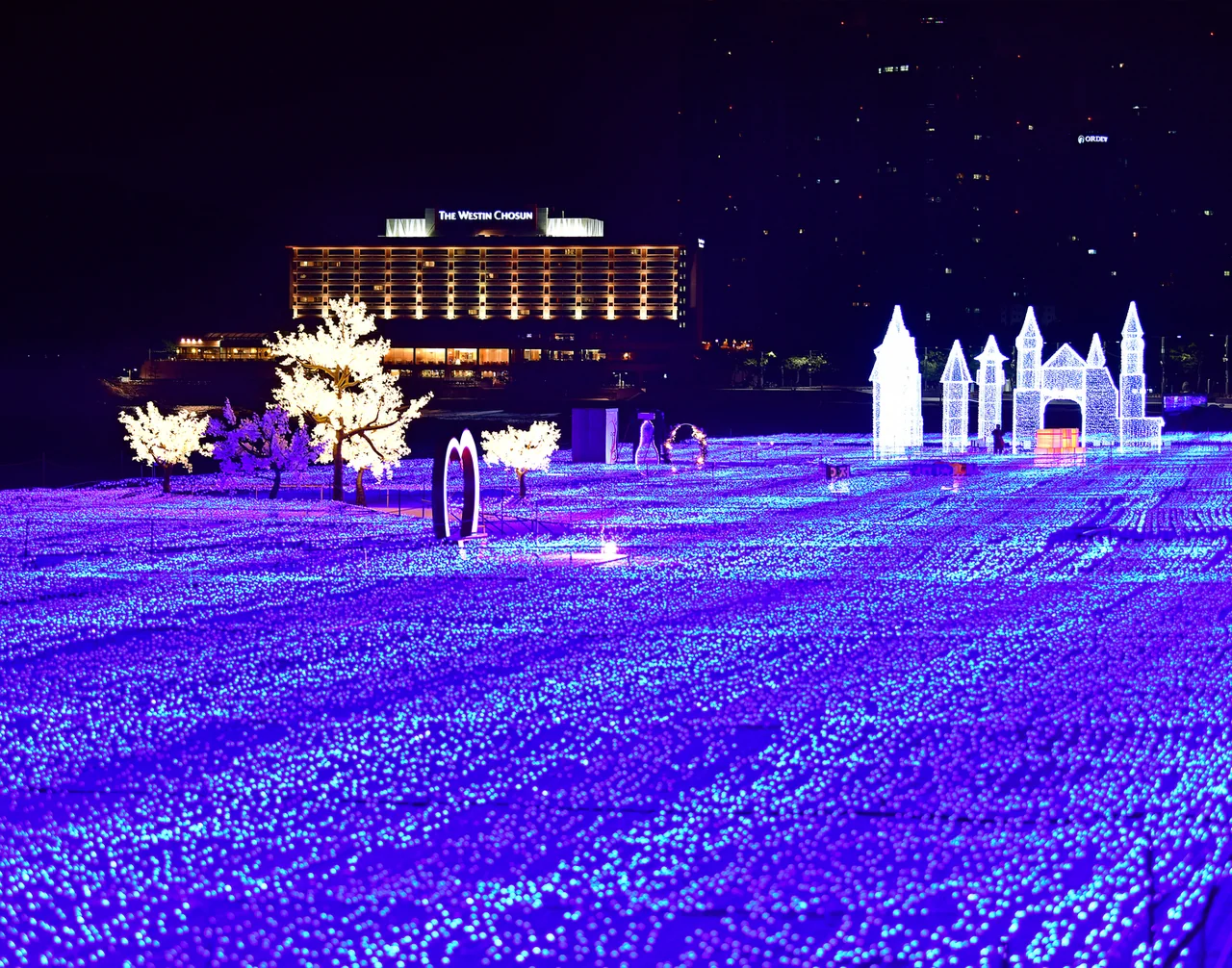
9. The Haeundae lights switch off in the middle of the month
The Haeundae light festival does not run through January. The most recent edition, the 12th, opened on 29 November and closed on 18 January. Arrive at Haeundae in the last week of the month and the installations have already come down.
Lighting hours are 18:00 to 23:00 and entry is free. The site covers Haeundae Beach and the Gunam-ro approach, with a 180m stretch along the sand.
The most recent edition
| Element | Detail |
|---|---|
| Dates | 29 November to 18 January |
| Lit | 18:00 to 23:00 |
| Site | Haeundae Beach and Gunam-ro, 180m along the sand |
| Entry | Free |
| Organiser | Haeundae district office |
Set the 18:00 switch-on against this month’s darkness times and early January differs from mid January. On the 1st the sky is fully dark at 17:51, so the lights read at their own colour the moment they come on. By the middle of the month they switch on while there is still light in the sky. For photography that difference is the whole thing.
Three things stack up on one weekend
At the most recent edition the Polar Bear Festival on 17 and 18 January and the closing weekend of the Haeundae lights landed on the same days, with the Gwangbok-ro festival running throughout.
| Event | Sat 17 January | Sun 18 January |
|---|---|---|
| Polar Bear Festival | Exhibition and eve event | Main event, swim at 08:00 |
| Haeundae lights | 18:00 to 23:00 | Final day, 18:00 to 23:00 |
| Gwangbok-ro lights | 17:30 to 22:00 | 17:30 to 22:00 |
Two of the three sit in Haeundae and one of them ends that Sunday. If you only have one day in Busan this month, that weekend carries the most per day. The same fact makes it the hardest weekend of the month for rooms and transport.
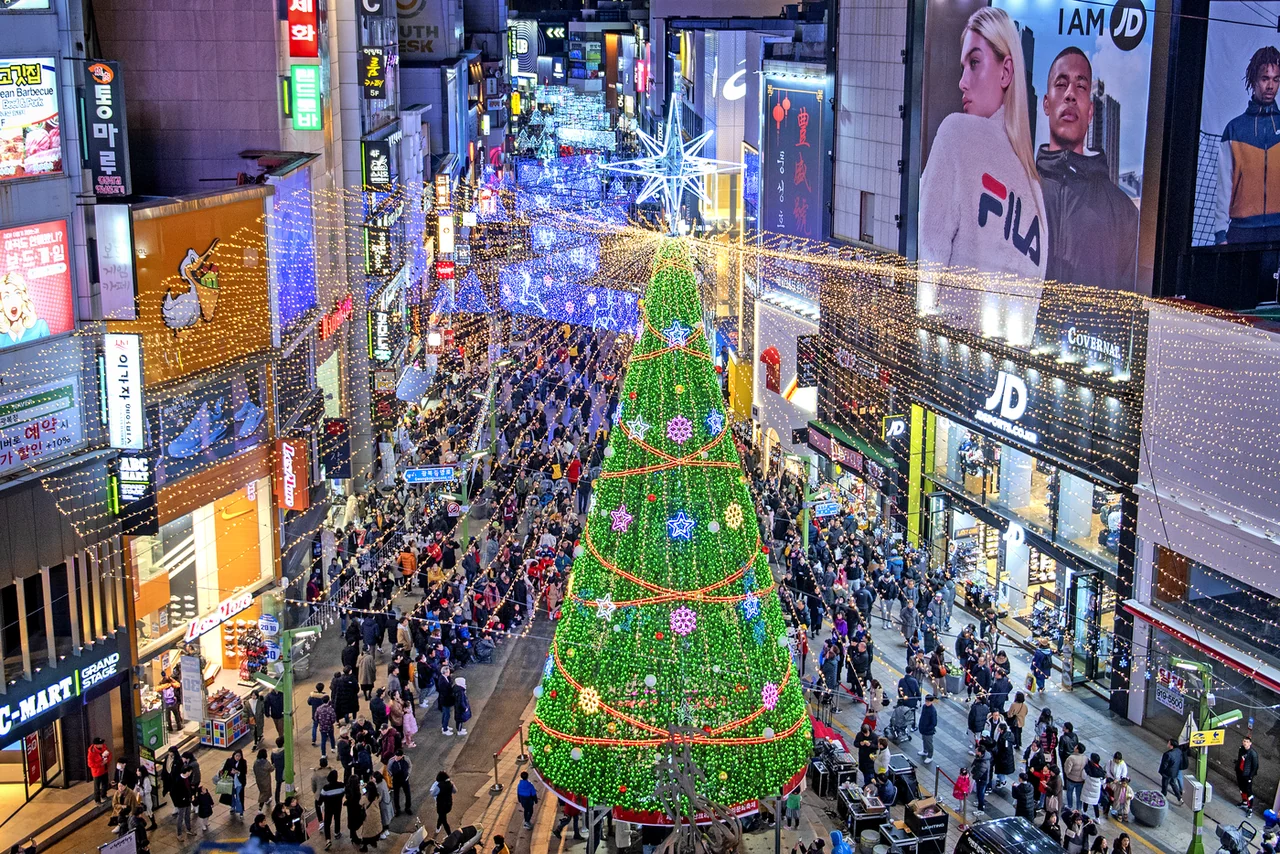
10. Gwangbok-ro stays lit into late February
The Gwangbok-ro winter light festival is the longest running of the three. The most recent edition opened on 5 December and closed on 22 February, five weeks after the Haeundae installations came down on 18 January.
It lights at 17:30 and goes dark at 22:00, free of charge, across Gwangbok-ro and Gwangbok-jungang-ro in the old city centre.
The two festivals compared
| Gwangbok-ro | Haeundae | |
|---|---|---|
| Closes | 22 February | 18 January |
| Lights up | 17:30 | 18:00 |
| Goes dark | 22:00 | 23:00 |
| Location | Jung-gu, old city centre | Haeundae Beach and Gunam-ro |
| Entry | Free | Free |
Gwangbok-ro turns on half an hour earlier and off an hour earlier, so its whole evening sits further forward. In early January the 17:30 switch-on precedes full darkness at 17:51 by 21 minutes, which means the first twenty minutes happen against a blue sky rather than a black one.
If you come in the last third of the month
From 19 January onwards two light festivals are left in the city, Seomyeon and Gwangbok-ro. Both sit on Line 1, so they work as one evening. Gwangbok-roMap is a five-minute walk from exit 7 of Nampo station on Line 1.
Jagalchi MarketMap and Gukje Market sit in the same few blocks, so dinner and the lights fold into a short loop without any transport in between. Our things to do in Busan guide sets out the old-centre cluster.
11. The drone show moves to 19:00 and 21:00 for the winter
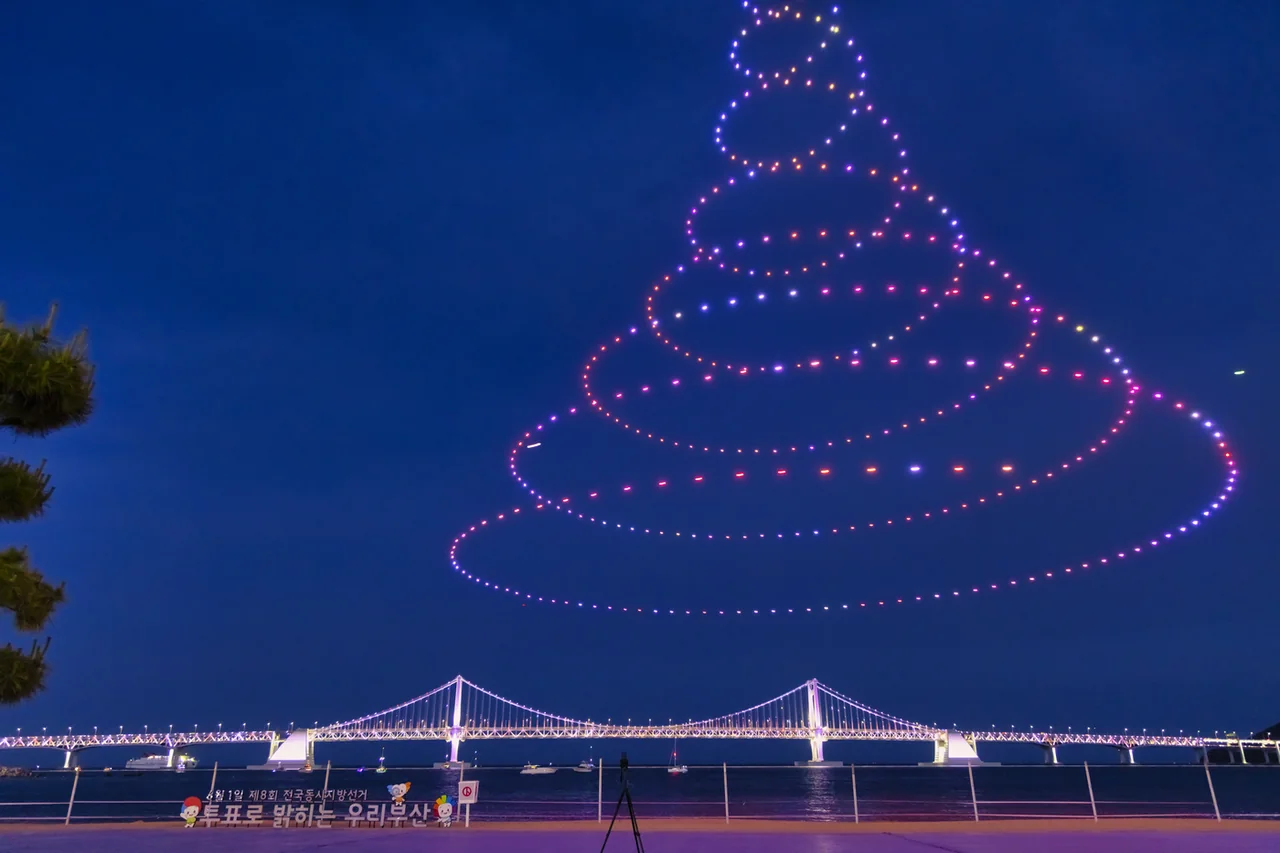
The Gwangalli M Drone Light Show runs at 19:00 and 21:00 from October through February. From March to September the two showings move to 20:00 and 22:00. It happens every Saturday, runs about 12 minutes, and is free.
January carries five Saturdays, so this month gets more showings than a month with four.
Winter and summer times
| Period | First showing | Second showing |
|---|---|---|
| October to February | 19:00 | 21:00 |
| March to September | 20:00 | 22:00 |
The 19:00 showing is safe all month. Full darkness arrives at 17:51 on 1 January and 18:17 on the 31st, so the earlier slot always begins well after the sky has gone black. The summer 20:00 showing does not always get that, and drones read poorly against a sky that still holds light.
Choosing between the two
The 19:00 showing suits an evening that starts with dinner. The 21:00 showing is generally less crowded. The programme is the same at both. On temperature the earlier one has a slight edge, given an overnight low of -0.1°C and an exposed seafront.
You can watch from anywhere along Gwangalli BeachMap. Our Gwangalli drone show guide covers viewing spots in detail.
12. One bathhouse opens at half past five in the morning
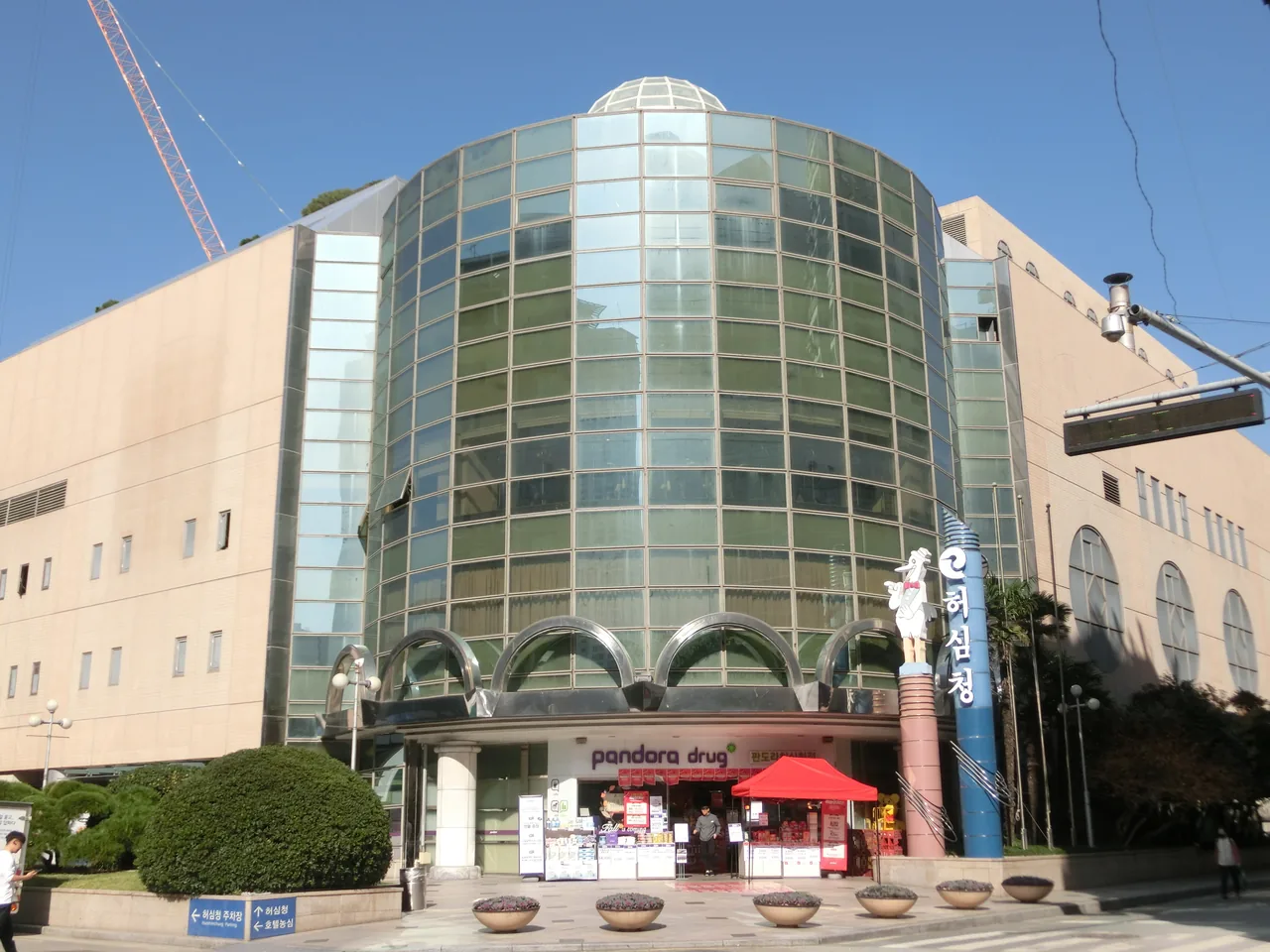
Hurshimchung in Dongnae opens its baths at 05:30. That is two hours before the New Year sunrise at 07:32 and two and a half hours before the Polar Bear swim starts at 08:00. It runs every day of the year.
Spa Land in Centum City opens at 08:00. The two and a half hour gap between them matters more in January than in any other month.
Hours and prices
| Hurshimchung | Spa Land | |
|---|---|---|
| Opens | 05:30 | 08:00 |
| Closes | 22:00, last entry 21:30 | 23:00, last entry 22:00 |
| Weekday entry | 15,000 won | 26,000 won |
| Weekend and holiday entry | 18,000 won | 26,000 won |
| Included time | 4 hours baths, 6 hours with the sauna floor | 4 hours |
| Overtime | 2,000 won an hour | 5,000 won an hour |
| Closing days | None, open year-round | Not published |
Weekday entry differs by 11,000 won and the overtime rate by a factor of 2.5, so the gap widens the longer you stay. Hurshimchung includes six hours if you use the baths and the sauna floor together, extendable to seven.
Why the opening hour matters in January
Sunrise finishes at 07:32. Anyone standing on a beach at that moment and looking for somewhere warm will find most places still shut. Hurshimchung has been open for two hours by then.
The same applies after the group swim. Deciding where to go before you get in the water is easier than deciding afterwards. HurshimchungMap is in Dongnae and Spa LandMap is in Centum City, so from Haeundae the latter is much the closer of the two.
Facility rules and the mineral content of the water are set out in our Busan spa and jjimjilbang guide.
13. The cable car closes at the same hour while the sun sets later
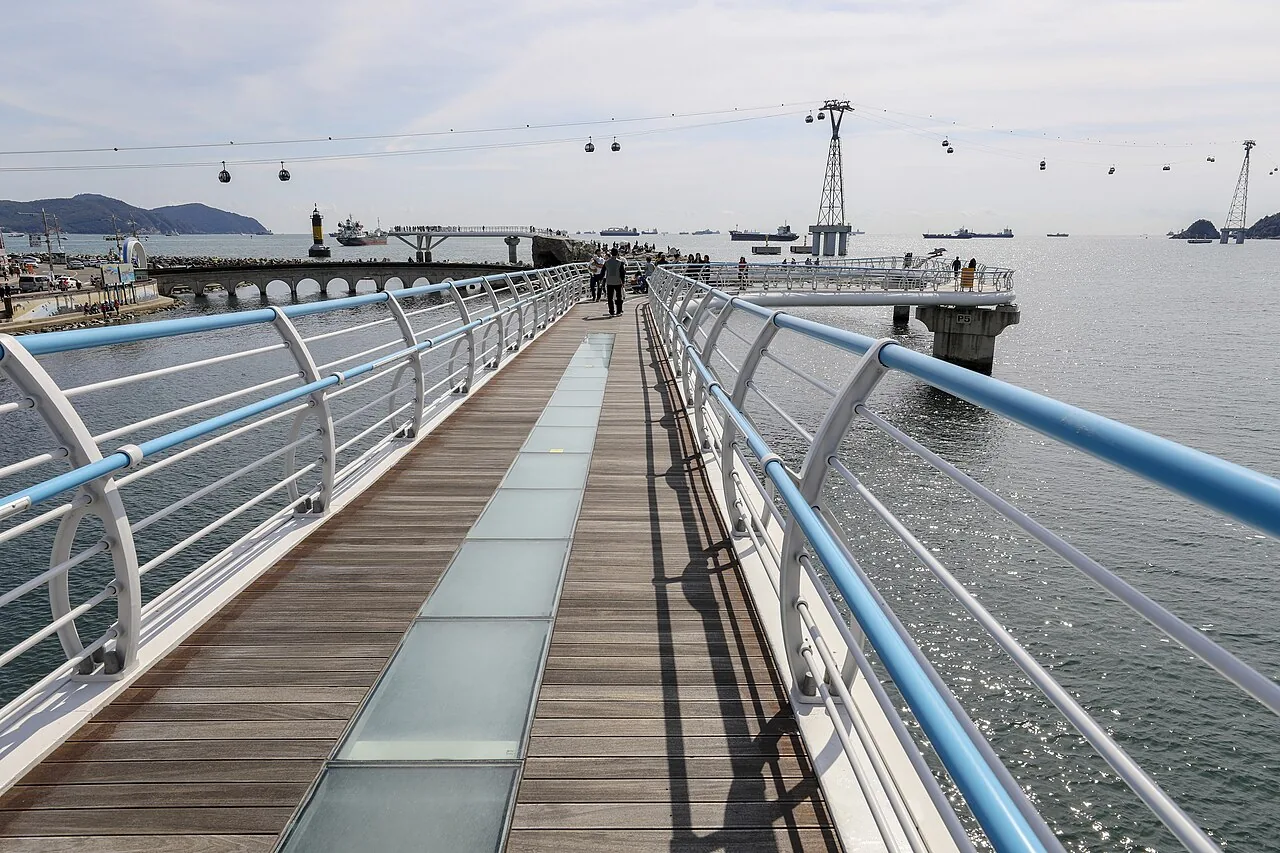
The Songdo Marine Cable Car closes at 20:00 in January, February and December. From March to June and September to November it runs to 21:00, and in July and August to 22:00. Ticket sales stop 30 minutes before closing.
That 20:00 closing is fixed for the whole month. Sunset, meanwhile, moves 29 minutes later. The window for riding after dark therefore shrinks as the month goes on.
How much dark riding time is left
| Date | Sunset | Closing | Window |
|---|---|---|---|
| 1 January | 17:22 | 20:00 | 2h 38m |
| 15 January | 17:35 | 20:00 | 2h 25m |
| 31 January | 17:51 | 20:00 | 2h 9m |
Twenty-nine minutes disappear across the month. If night views are the point of the trip, early January gives more room than late January. From 1 March the closing time returns to 21:00 and the window opens up again.
Fares
| Ticket | Adult | Child |
|---|---|---|
| Crystal Cruise return | 24,000 won | 18,000 won |
| Crystal Cruise one way | 19,000 won | 15,000 won |
| Air Cruise return | 19,000 won | 14,000 won |
| Air Cruise one way | 15,000 won | 12,000 won |
| Day pass, weekdays only | 35,000 won | 30,000 won |
Crystal Cruise cabins have glass floors and Air Cruise cabins do not, a difference of 5,000 won on a return ticket. Child fares apply from 36 months to the end of primary school and adult fares from middle school upwards. One-way tickets can only be boarded at the station where they were issued.
The cable carMap links the base station by Songdo Beach with the Skypark above Amnam Park. Our Songdo Beach guide covers the cloud walkway and how the two ends connect.
14. What is open when the wind picks up
Mean wind speed in Busan runs at 3.5m/s in January against Seoul’s 2.3m/s. The city is 5.5 degrees warmer on paper, but that margin narrows on an exposed seafront. More outdoor plans get abandoned here for wind than for rain.
Three indoor options stay open into the evening this month and are worth knowing before you need them.
Open after dark
| Venue | Hours | Admission |
|---|---|---|
| BUSAN X the SKYMap | 10:00 to 21:00, last entry 20:30, open daily | 27,000 won adult, 24,000 won child |
| SEA LIFE Busan AquariumMap | Weekdays 10:00 to 19:00, last entry 18:00 Weekends 10:00 to 20:00, last entry 19:00 | 31,000 won adult, 26,500 won child |
| Busan City Tour night route | 19:00 departure from November to March, 19:30 April to October. Closed Mondays and Tuesdays. About 2h 10m | 20,000 won adult, 10,000 won child |
The night bus departure time works in your favour this month. It leaves at 19:00 from November through March and 19:30 the rest of the year. With full darkness falling between 17:51 and 18:17 across January, a 19:00 departure means the entire route runs in the dark.
City tour fares
| Route | Adult | Child |
|---|---|---|
| Circular routes: Red, Green, Orange | 20,000 won | 10,000 won |
| Circular routes bought online | 19,000 won | 9,500 won |
| Night route | 20,000 won | 10,000 won |
| West Busan themed route | 25,000 won | 20,000 won |
| East Busan themed route | 30,000 won | 25,000 won |
One day ticket covers all three circular routes and buying online takes 5% off. The night and themed routes carry no discount. Every route is closed on Mondays and Tuesdays. On a two-night trip that is worth checking against your dates before anything else.
More wet-weather options are in our Busan when it rains guide. The night route departs from Busan StationMap.
15. One public holiday, then five empty weeks
January carries a single public holiday in Korea, on the 1st. It falls on a Friday, which runs the break through to Sunday the 3rd. After that the calendar is clear for the rest of the month.
The next break is Seollal, the lunar new year, which falls on 7 February with a four-day holiday from Saturday 6 to Tuesday 9 February. The Tuesday is a substitute holiday.
Nothing between 4 January and 5 February
Those five weeks are the point of the month. A single day of leave attached to a weekend produces three days, and Busan is at low-season prices for all of them. Avoiding the first week is by itself enough to get a quiet trip.
Other calendars do not line up with Korea’s
| Country | January holidays | Long weekend |
|---|---|---|
| Korea | 1 January | 1 to 3 January |
| Japan | 1 January and 11 January, Coming of Age Day | Year-end break plus 9 to 11 January |
| Taiwan | 1 January, Founding Day | 1 to 3 January. Lunar new year falls in February |
| United States | 1 January and 18 January, MLK Day | 16 to 18 January |
| Spain | 1 January and 6 January, Epiphany | Single days |
Japan gets two three-day weekends in January where Korea gets one. That puts noticeably more Japanese visitors in Busan on the second weekend of the month. Taiwan is quiet in January because its main holiday is in February.
The middle weekend is where several of these overlap. The Polar Bear Festival and the closing nights of the Haeundae lights land at roughly the same time as the Japanese and American three-day weekends. That is the weekend to book early.
16. If you are bringing or hiring a car
January sits in the middle of the seasonal fine dust management period. The scheme runs from 1 December to 31 March each year, and January is its second month.
Across Busan, vehicles rated grade 5 for emissions that have not had abatement work done are restricted from driving. The restriction covers the whole city rather than a designated zone.
How the restriction works
| Element | Detail |
|---|---|
| Period | 1 December to 31 March |
| Applies to | Grade 5 emission vehicles without abatement work |
| Area | All of Busan |
| Hours | Weekdays 06:00 to 21:00, excluding weekends and public holidays |
| Enforcement | 43 cameras across 30 locations |
| Penalty | 100,000 won per day |
| Exempt | Emergency vehicles, vehicles displaying a disability badge, vehicles with completed abatement work |
Hire cars are rarely affected, since rental fleets are young enough to sit well above grade 5. The people this catches are those driving their own older vehicle into the city. Vehicle grade can be checked by registration number on the Ministry of Environment emissions grading site before setting off.
Weekends are not enforced
Enforcement runs on weekdays between 06:00 and 21:00 only, and weekends and public holidays are excluded. The 1 to 3 January break is therefore outside it.
Getting around generally is covered in our Busan transport guide, arrivals from the airport in Gimhae Airport to the city, and the route down from the capital in Seoul to Busan by KTX.
17. Choosing which week of January to come
January in Busan is really two months in one. The first week combines the sunrise crowds with the national holiday, the middle weekend stacks the festivals, and the last third is quiet but is down from three light festivals to two.
What each stretch actually offers
| When | Running | Not running | Crowds |
|---|---|---|---|
| 1 to 3 January | Sunrise events, national holiday, all three light festivals | Nothing | Heaviest |
| First week, weekdays | All three light festivals, drone show | Sunrise events | Light |
| Middle weekend | Polar Bear Festival, all three light festivals, drone show | Nothing | Heavy |
| Last third | Gwangbok-ro lights, drone show, later sunsets | Haeundae lights, Polar Bear Festival | Lightest |
The last third has two things going for it at once. It is the emptiest stretch, and the evening is 29 minutes longer than it was at the start of the month. Against that, the Haeundae lights are gone. Come before the middle weekend for the illuminations, or after it for a city with nobody in it.
What holds true whichever week you pick
Highs of 8.2°C, lows of -0.1°C. Snow on 1.4 days and rain on 5.4. Outdoor plans rarely get cancelled, but the wind is constant. Layers you can shed and footwear with grip are what this month actually asks for.
Choosing a neighbourhood is covered in where to stay in Busan, and how the months compare in the best time to visit Busan. The months either side are in Busan in December and Busan in February.
What is in season to eat
The Ministry of Oceans and Fisheries picks seaweed fulvescens and freshwater eel as the seafood of the month for January. In Busan the winter catch runs to yellowtail, cod, snailfish and oysters, with gwamegi, the half-dried Pacific saury of the southeast coast, appearing around the same time.
All of it trades at market rate at Jagalchi MarketMap and the Busan Cooperative Fish Market, so there is no fixed price to quote. What to order and where is in what to eat in Busan.