A working Seon temple on Geumjeongsan, with one of Korea’s best foreigner-friendly templestays
Last updated: June 2026
The short answer
Beomeosa is a 1,300-year-old Buddhist monastery founded in 678 on the slopes of Geumjeongsan, in northern Busan, and entry is free.
Unlike the seaside, tourist-heavy Haedong Yonggungsa, Beomeosa is a quiet working mountain temple where monks still practise, so it is the place in Busan where you can actually do an overnight templestay.
It is the easiest major temple to reach in Busan: take Subway Line 1 to Beomeosa Station, then bus 90 (or walk the forest path) up to the gate.
Come in May for the wisteria, in lavender bloom, in autumn for the foliage, or early any morning for the calm; allow about 1 to 1.5 hours just to see the grounds.
Beomeosa is a thousand-year mountain temple (founded 678) tucked into the eastern flank of Geumjeongsan, above the city in northern Busan, and it is free to enter. If you have only seen the dramatic seaside Haedong Yonggungsa, Beomeosa is its opposite: a hushed forest monastery where monks chant at dawn and the main draw is calm, history and the chance to sleep over on a real templestay. It sits on Subway Line 1, so it is the simplest serious temple in the city to reach. This guide is part of our complete Busan Travel Guide, and it goes deep on the templestay, because Beomeosa is one of the best places in Korea for a foreign visitor to try one.
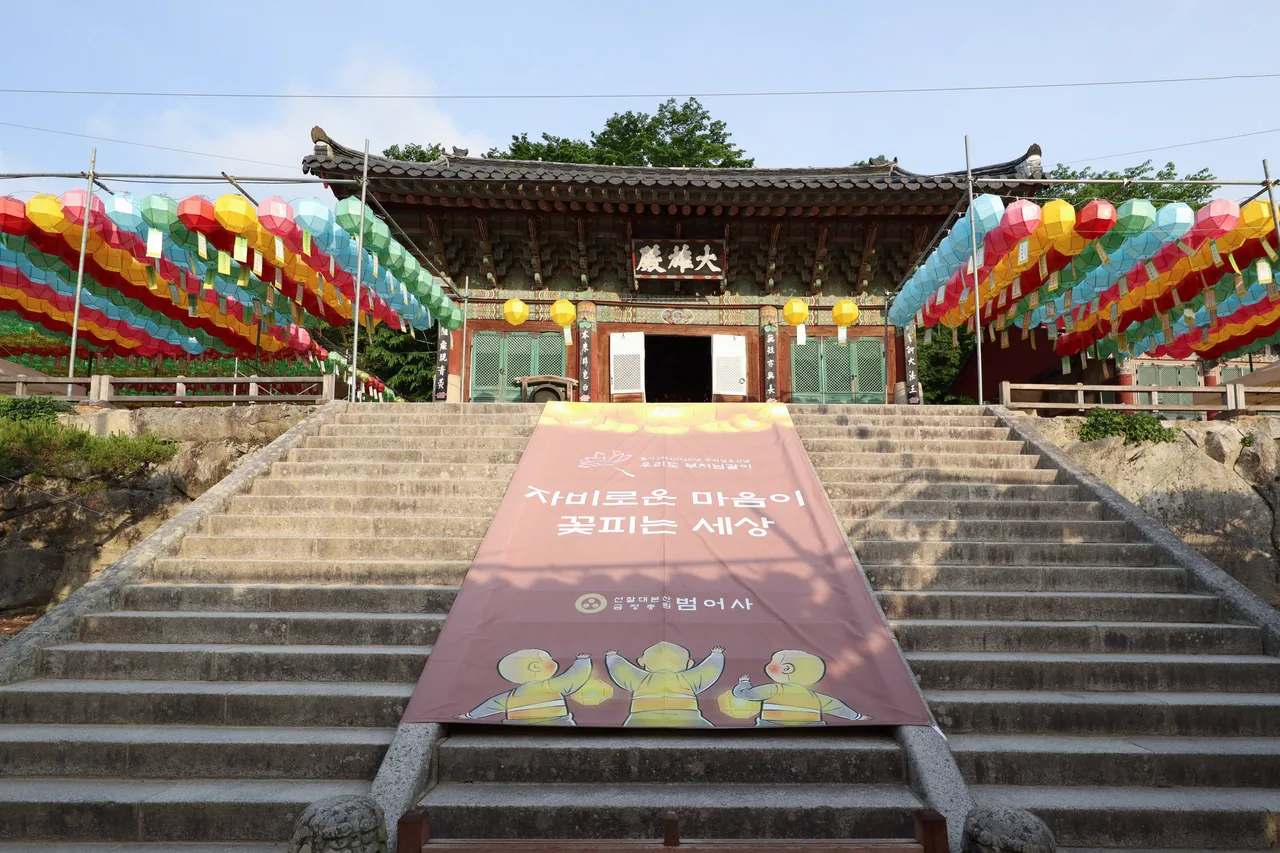
Daeungjeon, the main hall (Treasure No. 434), rebuilt in 1614. (Photo: Mobius6, CC BY-SA 4.0)
1. Why Beomeosa, not just Yonggungsa
Beomeosa is the real thing: a working mountain monastery, founded in 678, where Buddhist monks still live and train. Busan’s other famous temple, the seaside Haedong Yonggungsa, is photogenic but its current buildings are a modern reconstruction, it is packed with day-trippers, and it offers no overnight stay. Beomeosa is the counterweight: ancient, set in the forest of Geumjeongsan, far quieter, and the one Busan temple where you can do a proper templestay.
If you want a polished sea view and a quick photo stop, Yonggungsa wins. If you want a genuine Korean mountain temple, dawn chanting, meditation and history measured in centuries, that is Beomeosa. The two have completely different characters, and with time you can do both in one Busan trip.
Quick orientation: Free entry, roughly 1 to 1.5 hours to walk the grounds, and a single subway line gets you most of the way there. The early morning is the most beautiful and the least crowded time to arrive.
2. Beomeosa at a glance
Detail
What to know
Location
Geumjeonggu, northern Busan, on the eastern slope of Geumjeongsan
Entry fee
Free (a donation box sits inside; giving is optional)
Hours
Roughly morning until sunset; check the official site or a map app before you go
Time needed
Grounds: 1 to 1.5 hours. Add hiking or a templestay for a half-day to an overnight.
Getting there
Subway Line 1 to Beomeosa Station, then village bus 90 (about 15 min), or walk the forest path uphill
Best seasons
May (wisteria in lavender bloom), October to November (autumn foliage), winter (snow)
Best for
Travellers who want a true mountain temple, quiet, culture, hiking, or a templestay
Beomeosa is large but easy to read once you are there. The buildings climb the hillside in a line, from the entrance gate up to the main hall, with stone steps and trees between each level. You do not need a plan: follow the path uphill and you will pass everything worth seeing.
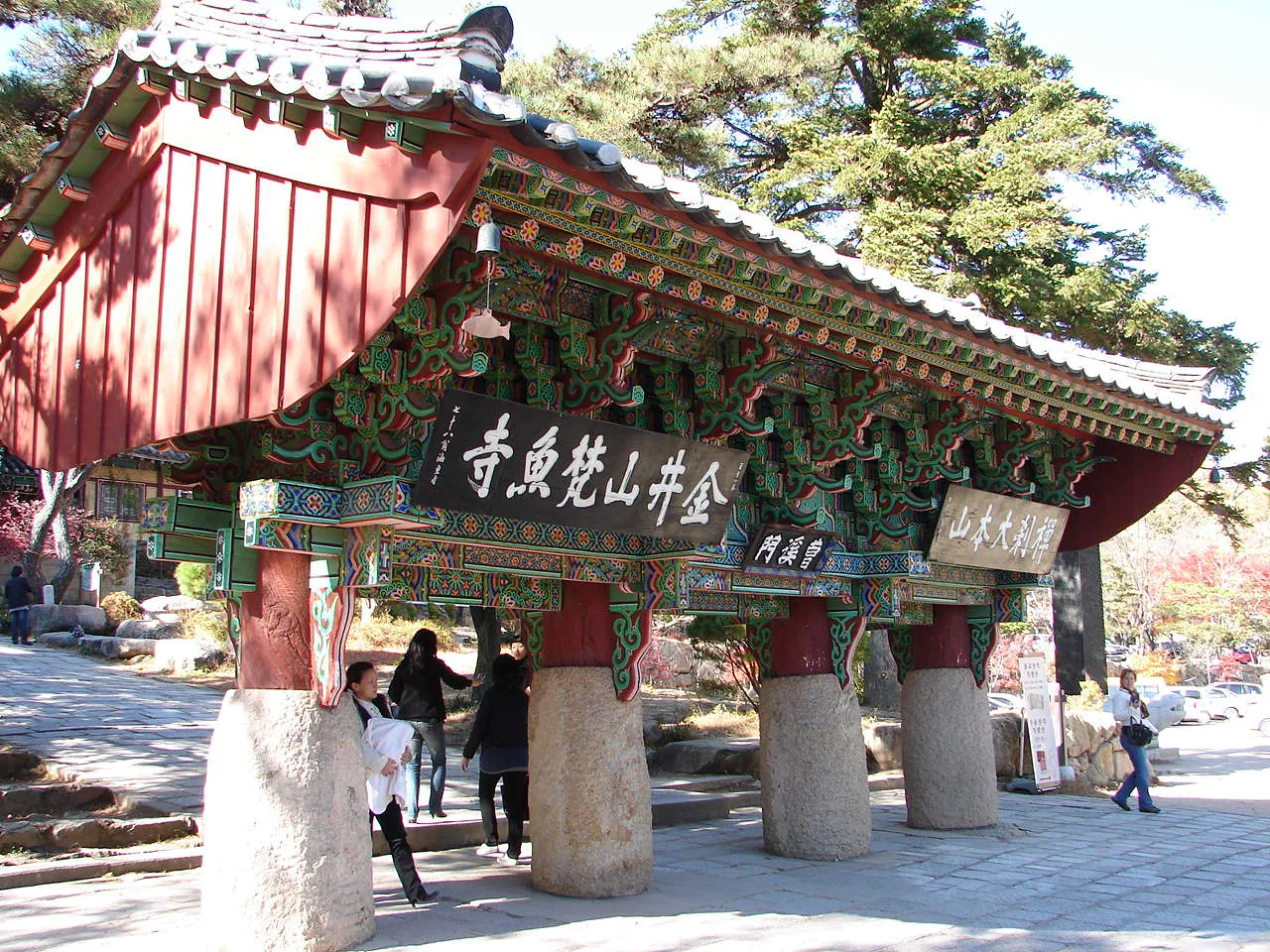
The Iljumun gate, with its unusual row of four pillars. (Photo: Steve46814, CC BY-SA 3.0)
3. History and meaning
Beomeosa was founded in 678, during the Unified Silla period, by the great monk Master Uisang. Legend says a golden fish rode down from heaven on a five-coloured cloud and played in a golden well on the mountain. That gave both the mountain its name, Geumjeongsan (“Golden Well Mountain”), and the temple its name, Beomeosa (“Heavenly Fish Temple”). The original complex is said to have been enormous, with hundreds of rooms.
The temple is one of the ten great monasteries of the Hwaeom school, and today it is the head temple of the 14th district of the Jogye Order, overseeing Buddhism across Busan and the surrounding region. It is counted among the three great temples of the Yeongnam area, alongside Tongdosa and Haeinsa.
Beomeosa was burned to the ground during the Japanese invasions of 1592. It was rebuilt from 1613, and the layout you walk through today dates largely from that reconstruction. During the colonial era in the early twentieth century, the temple was also a centre of resistance and Buddhist reform.
Daeungjeon (main hall) Treasure No. 434, rebuilt 1614. A masterpiece of mid-Joseon timber work, with elaborate bracketing and dancheong colour painting.
Three-story stone pagoda A Treasure dating to the 9th-century Unified Silla period, standing in front of the main hall.
Iljumun (One-Pillar Gate) A Treasure with an unusual structure: four pillars set in a single straight line. The temple’s signature photo spot.
Flagpole supports & stone lanterns Older stone elements scattered through the grounds, survivors of the temple’s long history.
4. What to see on the grounds
The temple unfolds in sequence as you climb. Walking it in order is the simplest way to experience a Korean mountain monastery, where each gate marks a step further from the everyday world.
Stop (in order)
What it is
Iljumun (One-Pillar Gate)
The temple’s first gate and a designated Treasure, famous for its single line of four pillars. The best place for a photo.
Cheonwangmun & Burimun
The Gate of the Four Heavenly Kings and the Gate of Non-Duality, marking the boundary between the worldly and the sacred.
Bojeru
A large pavilion used for Dharma gatherings.
Daeungjeon (main hall)
The heart of the temple, a Treasure, with vivid bracketing and dancheong and the Shakyamuni triad inside. Keep quiet and bow with palms together when you enter.
Three-story stone pagoda
The Unified Silla Treasure standing right in front of the main hall.
Hermitages
Smaller cloisters such as Cheongnyeonam, Naewonam and Gyemyeongam are scattered up the mountain, good to combine with hiking or a templestay.
Wisteria grove (Natural Monument No. 176) Below the Iljumun gate, in the valley, grows one of Korea’s largest wild wisteria habitats (Natural Monument No. 176; a 2016 census counted about 1,100 plants). In May it bursts into a lavender canopy, the temple’s most loved seasonal sight.
Inside the halls: Photography is restricted in some areas and worshippers may be praying, so step softly, keep your voice down and follow any posted rules.
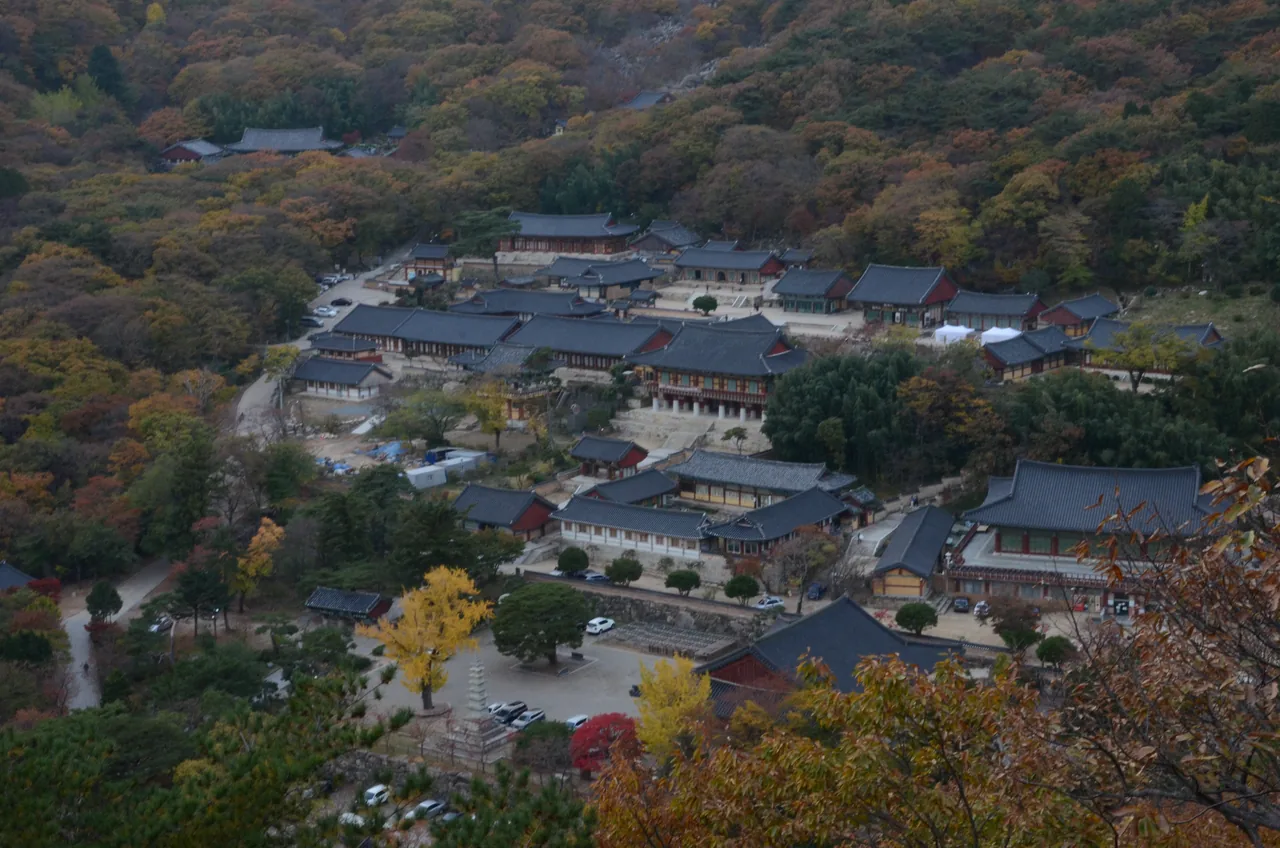
Beomeosa spread across the forested slopes of Geumjeongsan. (Photo: Jeong Sun-deuk / Busan Tourism Org., KOGL Type 1)
5. Templestay 1: overview and program types
Because Beomeosa is a head temple of the Jogye Order, it runs an official templestay, an overnight stay where you live and practise alongside the monks for a day or two. This is the big reason to choose Beomeosa over Yonggungsa, which has no templestay and is day-visit only. Beomeosa’s signature is Seon (Zen) meditation, so its programs lean toward stillness, sitting practice and quiet reflection.
There are three main formats. The table below compares them so you can pick the right fit.
Program
Length
What you do
Rough fee
Experience (structured)
2 days / 1 night
Full schedule: temple tour, barugongyang formal meal, tea with a monk, temple etiquette, Seon meditation, evening and dawn services, 108 prostrations, prayer-bead making, hermitage walk, sometimes a hike toward the summit.
about ₩30,000 to 50,000
Rest (relaxation)
2 days / 1 night
A free, unstructured stay focused on walking the grounds, meditation and simply resting, with far fewer set activities. A trekking and recharge theme.
around ₩40,000
Templelife (day program)
about 3 hours
Meditation, a singing-bowl session, prayer-bead making and a look around the temple. Mostly arranged for groups of 7 or more.
varies
On cost: An overnight is roughly ₩30,000 to 50,000 depending on the program and any discount. Government-supported schemes (such as the youth and “double happiness” templestay subsidies, aimed mainly at residents) can make it cheaper. Prices and refund rules can change, so confirm the current figures when you book.
English-language programs Around 30 temples across Korea run foreigner-friendly (English) templestays, and Beomeosa has an English information page at templestay.com/en. Important: not every session is run in English, so you must check on templestay.com which specific dates have English guidance before you commit.
Booking is done only through the official site, templestay.com (not by phone or at the door). Available dates are released only about two months in advance, and overnight programs run mainly on Saturdays and not every week, so plan ahead and reserve early. For reference, the temple’s Seon Culture Education Center can be reached at 051-508-5726 or 010-2581-5726, and at beomeosa@templestay.com.
6. Templestay 2: a day in the program
Here is the rough flow of the 2-day, 1-night experience program. Every session differs and the official schedule always takes priority, but this gives you a realistic picture of how the time is spent.
Day 1
13:00 Check-in & orientation. You register, change into the loose temple uniform provided, and get a short welcome and house rules.
14:00 Temple tour & etiquette. A guided walk of the halls and a lesson in how to bow, when to be silent and how to move around a temple respectfully.
17:00 Evening meal. A simple temple-food dinner, served either as a regular meal or as the formal barugongyang.
18:30 Evening service & 108 prostrations. The chanting service in the Dharma hall, followed by the 108 prostrations, a slow, repeated full bow that is both physical and meditative.
20:00 Seon meditation, tea & beads. Sitting meditation, a tea conversation with a monk, and making a 108-bead bracelet to take home.
21:30 to 22:00 Lights out. You sleep in shared rooms, separated by gender.
Day 2
04:00 to 04:30 Dawn service. The pre-dawn chanting and the doryangseok ritual that wakes the temple. The quietest, most memorable part of the stay.
05:00 Meditation. Early-morning Seon practice while it is still dark.
06:30 Barugongyang. The formal monastic breakfast (see the box below).
08:00 Communal work & walk. Light cleaning work (ullyeok), then a hermitage pilgrimage or a walk on Geumjeongsan.
11:00 Closing circle. Sharing reflections over tea and snacks.
12:30 Closing & departure. The program ends and you head out.
What is barugongyang? This formal monastic meal is the highlight of a Beomeosa templestay. You eat from a set of nesting bowls, take only what you can finish and leave not a single grain behind. At the end you rinse the bowls with water (and a slice of radish or kimchi) and drink that water, so nothing is wasted. It is a meditation on restraint and non-attachment as much as a meal.
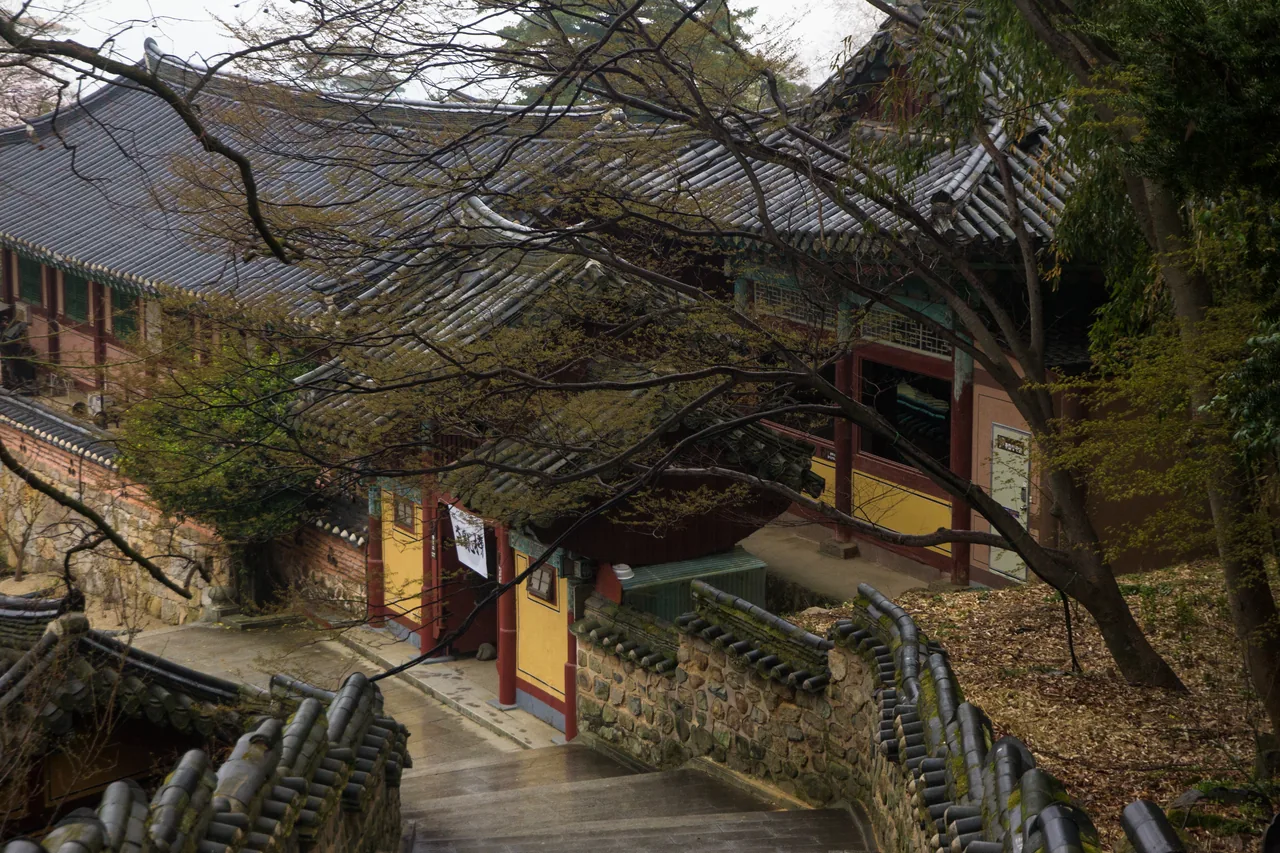
Spring on the temple grounds, before the May wisteria opens. (Photo: Alexey Komarov, CC BY-SA 4.0)
7. Templestay 3: what to bring, dress code, etiquette and booking
A templestay is comfortable but it is not a hotel. A little preparation makes it far easier, especially the dress code and the early start.
Dress code (important): Dress modestly and plainly. Avoid bright primary colours, revealing or flashy clothing, heavy makeup, strong perfume and large accessories. The temple lends or gives you a loose practice uniform (a modified hanbok), so you really only need to bring your own activewear and underwear.
Bring
Why
Easy slip-on shoes
You take shoes off constantly to enter the halls.
Grippy walking or hiking shoes
For the hermitage walk or a stroll on the mountain.
Your own towel & toiletries
These are usually not provided.
Warm layers
Nights are cold up in the mountains, even outside winter.
Water bottle, optional notebook
For walks and reflection. Phone use is discouraged, and some sessions ask for silence.
Basic etiquette Bow with palms together (hapjang) and do a half-bow as you enter a hall. Stay quiet inside, respect photo restrictions, and greet monks with hapjang. During barugongyang keep silence and leave no food. Stick to the routes and areas you are shown.
How to book, step by step:
Go to templestay.com (use the /en path for English).
Search for “Beomeosa.”
Pick a date and program (experience, rest or day). Remember that dates open only about two months ahead and overnight stays run mainly on Saturdays.
Choose the number of guests and pay. Booking is online only, not by phone or at the gate.
Get your confirmation email. Check the program detail page to confirm whether that session is run in English.
Who it suits: If you want meditation, a digital detox and real Korean Buddhist culture, the experience program is wonderful. If the 4 a.m. wake-up, plain vegetarian food, shared rooms and basic discipline sound like too much, choose the rest program or the 3-hour day option instead.
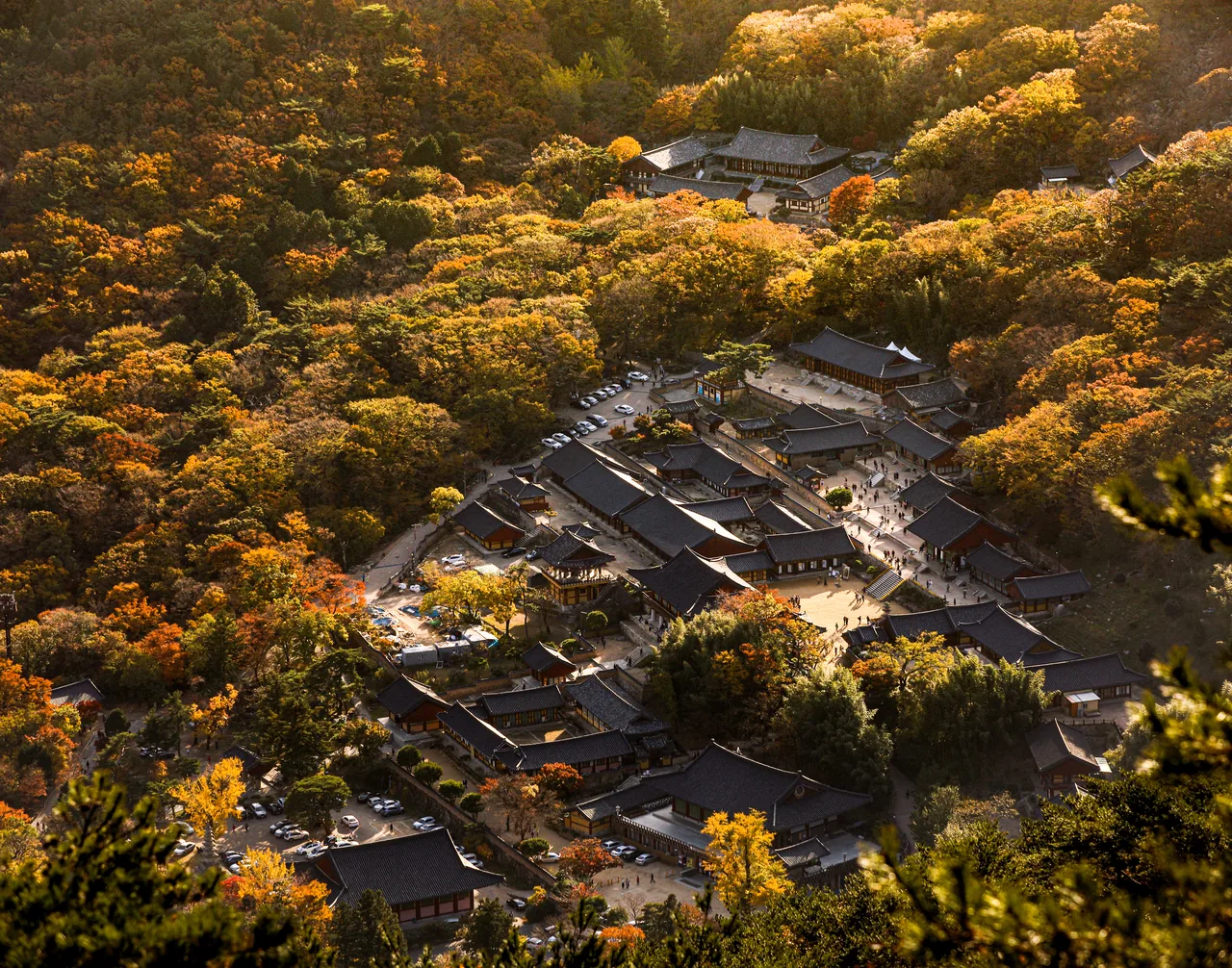
Autumn colour around the halls, peaking in late October and November. (Photo: Choi Su-jin / Busan Tourism Org., KOGL Type 1)
8. Hiking Geumjeongsan and the fortress
Beomeosa is the classic trailhead for Geumjeongsan (801 m) and Geumjeongsanseong Fortress. Many visitors pair the temple with a walk up the mountain behind it, which is part of the appeal of coming all the way out here.
Route
Distance / time
Difficulty
Beomeosa to the North Gate
About 1 hour one way, 1.5 to 2 hours round trip
Fairly gentle, good for most people
Godangbong (summit) loop
Around 8 km, 4 to 4.5 hours
Demanding, for fit hikers
Geumjeongsanseong is a historic fortress with a wall stretching roughly 18 km, the largest of its kind in Korea, with north, south, east and west gates. The village inside, Sanseong Maeul, is well known for its makgeolli (rice wine), black-goat dishes and grilled duck, a popular reward after coming down off the mountain.
Practical notes: Bring hiking shoes, water and a snack. Combine the climb with the May wisteria or autumn foliage for the best of both. A cable car (from Geumgang Park) can replace part of the route if you prefer.
9. How to get there
Beomeosa is the easiest big temple in Busan to reach, because it sits directly on Subway Line 1. That single line saves you the bus transfers that other temples require.
Step
Details
1. Subway
Take Line 1 to Beomeosa Station, exit 5 or 7.
2a. Village bus
Catch village bus 90 to the temple entrance / car park, about 15 minutes, frequent service.
2b. Or walk
Take the forest path uphill from the station, about 20 to 30 minutes, an uphill but scenic walk.
From downtown
About 35 to 45 minutes from the Seomyeon area.
By car
There is a car park; entry is free.
Maps: Use Naver Map or KakaoMap for directions and bus times. Google Maps directions are limited in South Korea, so it is not reliable for the final leg.
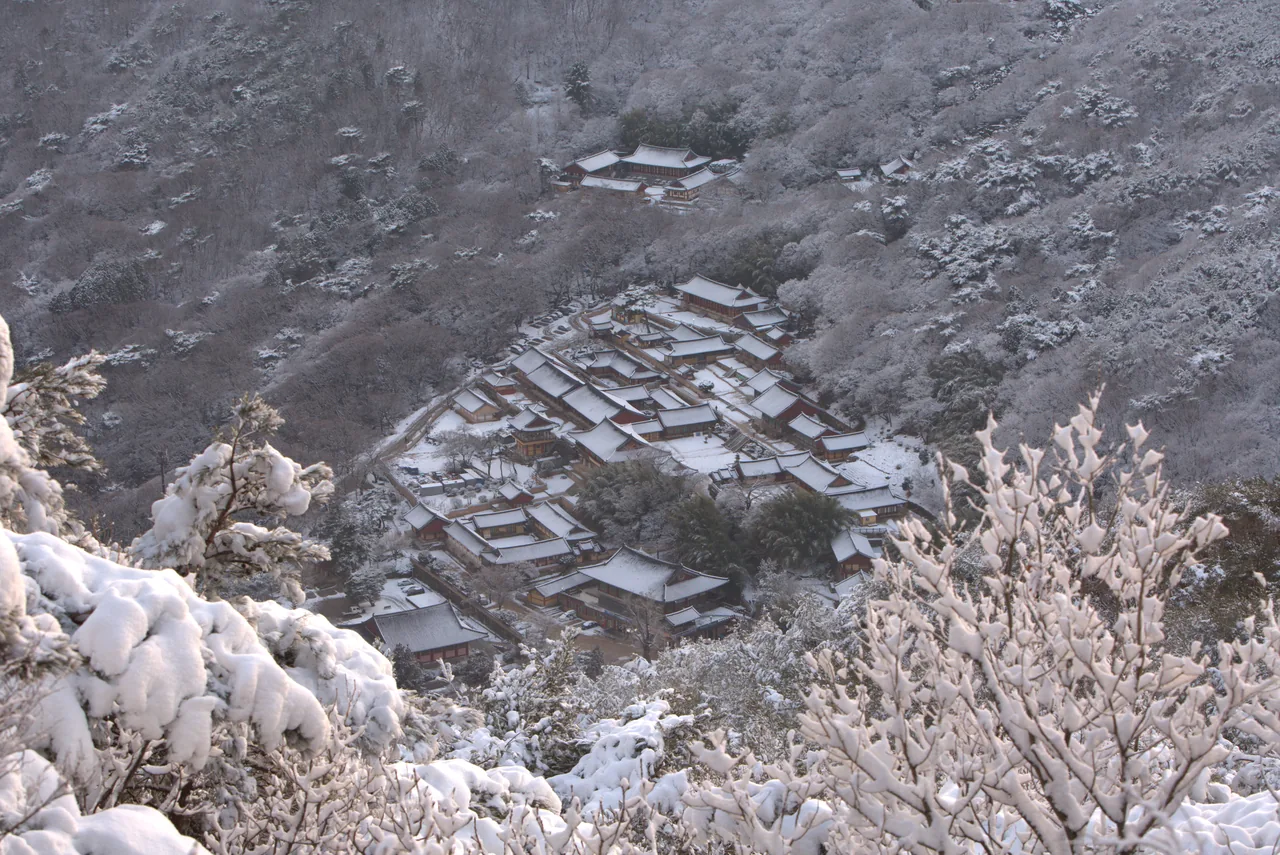
A quiet winter morning under snow. (Photo: Choi Nam-sun / Busan Tourism Org., KOGL Type 1)
10. Best seasons and practical tips
Beomeosa changes dramatically through the year, and timing your visit well makes a big difference.
May: wisteria The wild wisteria grove below the gate opens into a lavender canopy, the temple’s most famous bloom.
October to November: foliage The slopes turn red and gold, framing the dark timber halls.
Winter: snow Snow on the curved roofs and quiet courtyards is the most peaceful scene of all.
Early morning, any season Dawn and early morning are the calmest, the opposite of the crowds at Yonggungsa.
On the ground: This is a mountain temple, so expect steps and slopes and wear comfortable shoes. Keep quiet in the halls and respect photo restrictions. Entry is free but there is a donation box. There are temple cafes and traditional tea houses where you can rest.
11. Yonggungsa vs Beomeosa: which to choose
They are not rivals so much as opposites, and which one is “better” depends entirely on what you want from a temple. If your time allows, visiting both gives you two very different sides of Busan Buddhism.
Haedong Yonggungsa
Beomeosa
Setting / mood
Seaside, touristy, crowded
Mountain, quiet, contemplative
Founded
Current buildings rebuilt in the 1970s
678, a thousand-year temple
Templestay
None (day visit only)
Yes (overnight and day)
Getting there
Bus transfer, on the city’s edge
Subway Line 1, direct
Best for
Photos, sea views, a short stop
A true mountain temple, meditation, hiking
In short: go to Haedong Yonggungsa for the dramatic seaside photo, and to Beomeosa for the quiet, the history and the chance to stay overnight. They sit at opposite ends of the city and offer opposite experiences, which is exactly why many travellers fit both into one trip.
No, entry to Beomeosa is free. There is a donation box inside the grounds, but giving is entirely optional. There is also a car park if you drive.
Q. How do I get to Beomeosa from central Busan?
Take Subway Line 1 to Beomeosa Station (exit 5 or 7), then village bus 90 up to the temple, about 15 minutes. You can also walk the forest path uphill in 20 to 30 minutes. It is about 35 to 45 minutes from the Seomyeon area.
Q. Beomeosa or Haedong Yonggungsa: which should I visit?
They are opposites. Yonggungsa is a seaside, touristy temple that is great for photos but offers no overnight stay. Beomeosa is a quiet thousand-year mountain temple with a real templestay and is easier to reach by subway. If you can, see both.
Q. How much does a Beomeosa templestay cost and how do I book?
An overnight (2 days, 1 night) runs roughly 30,000 to 50,000 won depending on the program and any discount. Booking is online only, through the official site templestay.com (not by phone or at the door), and dates open about two months ahead.
Q. What is a Beomeosa templestay day actually like?
The experience program is structured: a temple tour, evening service with 108 prostrations, Seon meditation, tea with a monk and bead-making on day one, then a 4 a.m. dawn service, the formal barugongyang breakfast and a mountain walk on day two before a midday closing.
Q. Can foreigners do the templestay, and is English available?
Yes. Beomeosa is one of Korea’s foreigner-friendly temples and has an English page at templestay.com/en. However, not every session is run in English, so you must check on templestay.com which specific dates offer English guidance before booking.
Q. What should I bring and wear for the templestay?
Dress modestly and avoid bright colours, revealing clothes, strong perfume and heavy makeup. The temple provides a practice uniform, so bring your own activewear, underwear, easy slip-on shoes, walking shoes, towel, toiletries and warm layers for the cold mountain nights.
Q. How long is the hike from Beomeosa, to the North Gate or the summit?
Beomeosa is the main trailhead for Geumjeongsan. The North Gate is a gentle walk of about 1 hour one way (1.5 to 2 hours round trip). The full Godangbong summit loop is around 8 km and 4 to 4.5 hours, and is demanding.
Q. When is the best time to visit Beomeosa?
May for the lavender wisteria, October and November for autumn foliage, and winter for snow on the roofs. Whatever the season, early morning is the calmest and least crowded time, in sharp contrast to the busy Yonggungsa.
Q. How long do I need to see the temple grounds?
Allow about 1 to 1.5 hours to walk the grounds at an easy pace. Add a few hours for a hike up Geumjeongsan, or a half-day to a full overnight if you join a templestay.