
Renting a Car on Jeju: Licences, the 112 Companies, Insurance and Loss-of-Use
Jeju has 112 rental companies holding 29,782 cars, and nine in ten of them sit in one cluster west of the airport. Here is which licence actually works, how the companies differ, what the insurance you are offered really covers, and what you owe if you damage the car.
| Can you drive here | Only with an International Driving Permit from a Geneva or Vienna Convention country, or from Taiwan or Vietnam. Mainland Chinese licences do not work. |
|---|---|
| How long it is valid | One year from the day you enter Korea. |
| What to carry | The permit, your home licence, your passport and a physical credit card in your own name. All four. |
| Where the cars are | Not at the terminal. Nine in ten companies are 2 to 3km west of it, reached by company shuttles from gates 3 and 5. |
| What the basic insurance covers | Other people and other cars. Damage to the car you rented is a separate product you have to add. |
| If you damage it | You pay an excess plus a loss-of-use charge, and the standard contract caps that charge at half the rental rate. |
1. First question: is your licence valid here?
2. Four documents, all physical
3. 112 companies hold the island’s 29,782 cars
4. Almost all of them are in the same few streets
5. From the plane to the car
6. The island is not allowed to add more cars
7. When the cars actually run short
8. Deposits, cancellation and the one-hour rule
9. Seven reasons they can refuse you at the counter
10. The insurance has two layers, and the car you are driving is in the second
11. Loss-of-use is capped at half, and most people never find out
12. If you have an accident, the order matters
13. Why Jeju regulates rental cars so heavily
14. What gets settled when you hand the car back
15. Your rental car cannot go to Udo
16. The two mountain roads close in winter
1. First question: is your licence valid here?
This is the part that sends people home from the counter, so it goes first. Korea joined the 1949 Geneva Convention on road traffic, and that membership decides whose paperwork it honours.
Three kinds of International Driving Permit work in Korea:
- An IDP issued by a Geneva Convention country. This covers the United States, the United Kingdom, Australia, Canada, Japan and most of Europe.
- An IDP issued by a Vienna Convention country. Korea has recognised these since 2002.
- An IDP issued by a country that signed a mutual recognition agreement with Korea. Taiwan and Vietnam are the two that matter here.
Permits issued in Hong Kong and Macau are honoured as well, under an arrangement that survived both handovers.
Taiwan is a special case worth knowing
Taiwan is not a party to either convention. Taiwanese permits are valid in Korea because of a memorandum of understanding signed on 17 February 2022, which made recognition reciprocal in both directions. If a rental agent hesitates, that agreement is what to point at.
How long you can drive
You may drive for one year from the date you entered Korea. That is separate from how long the permit itself is valid, which is one year for Geneva permits and three for Vienna ones. The Korean clock starts at the immigration desk.
2. Four documents, all physical
An International Driving Permit is not a licence. It is a translation booklet attached to the licence you already hold, which is why the counter needs both.
| What | Why they need it |
|---|---|
| International Driving Permit | Proves Korea recognises your entitlement |
| Your home driving licence | The permit is meaningless without it |
| Passport | Identity, and the entry date that starts your one-year window |
| A credit card in your own name | The deposit is held on it |
One thing the paperwork will not warn you about
Korea drives on the right, with the wheel on the left. If you are coming from the UK, Ireland, Australia, New Zealand, Hong Kong, Singapore, Malaysia, Japan or anywhere else that drives on the left, everything swaps: the wide turn becomes the left turn, and the indicator stalk moves to the other side of the column. Reaching for the indicator and setting off the wipers is what almost everyone does in the first hour. It is harmless in itself, but it is worth getting out of the way somewhere quiet. The depots sit on the coast west of the airport, so turning onto a coast road rather than straight into city traffic gives you wide lanes and few junctions while you recalibrate.
The name on all four documents has to match, and it has to be the name on the booking. That last point is not a formality: the standard rental contract lets a company refuse you outright if the person collecting the car is not the person named on the reservation. If two of you plan to share the driving, register both names when you book.
3. 112 companies hold the island’s 29,782 cars
Jeju Province publishes a register of every licensed rental operator twice a year. The current one lists 112 companies and 29,782 cars. Of those companies, 103 are headquartered on Jeju and 9 are branch offices of mainland Korean firms.
The two largest operators are both branch offices. Lotte Rental and SK Rent-a-Car between them hold more than 6,600 cars, and the top five companies together hold about a third of everything on the island.
| Company | Cars | Type |
|---|---|---|
| Lotte Rental | 3,718 | Branch office |
| SK Rent-a-Car | 2,947 | Branch office |
| Jeju Rent Car | 1,162 | Head office |
| Socar | 1,064 | Head office |
| Jeju OK Rent Car | 820 | Head office |
| Mujigae Rent Car | 762 | Head office |
| Blue Rent Car | 500 | Head office |
| Pacific Rent Car | 485 | Branch office |
Below the top few, the companies are strikingly similar in size
Sixty-nine of them hold between 100 and 200 cars, and another 34 hold between 200 and 500. The median operator runs about 157 cars. Not one company on the register holds fewer than 60.
That matters because avoiding a small local company in favour of a big brand changes less here than you would expect. Every licensed operator on Jeju has a real fleet. What separates them is the contract, and that is what the rest of this article is about.
4. Almost all of them are in the same few streets
Sort the register by address and the island collapses into one neighbourhood. Twenty-seven companies list Yongdam 2-dong, twenty-one list Dodu 2-dong, twenty-one more list Yongdam 3-dong, nineteen list Dodu 1-dong. Add the adjacent districts and you reach 98 companies holding 27,849 cars, which is 88 percent of the operators and 94 percent of the fleet.
All of it lies two to three kilometres west of Jeju International Airport, along the western end of the runway. Koreans call the whole strip the Rental Car House.
One company sits somewhere else entirely
Exactly one of the 112 is outside that cluster. Udo Electric Rent Car keeps its 60 vehicles on Udo, the small island off Jeju’s eastern tip, and it is the only operator on the register with “electric” in its name. Both facts have the same cause, and §15 explains it.
Map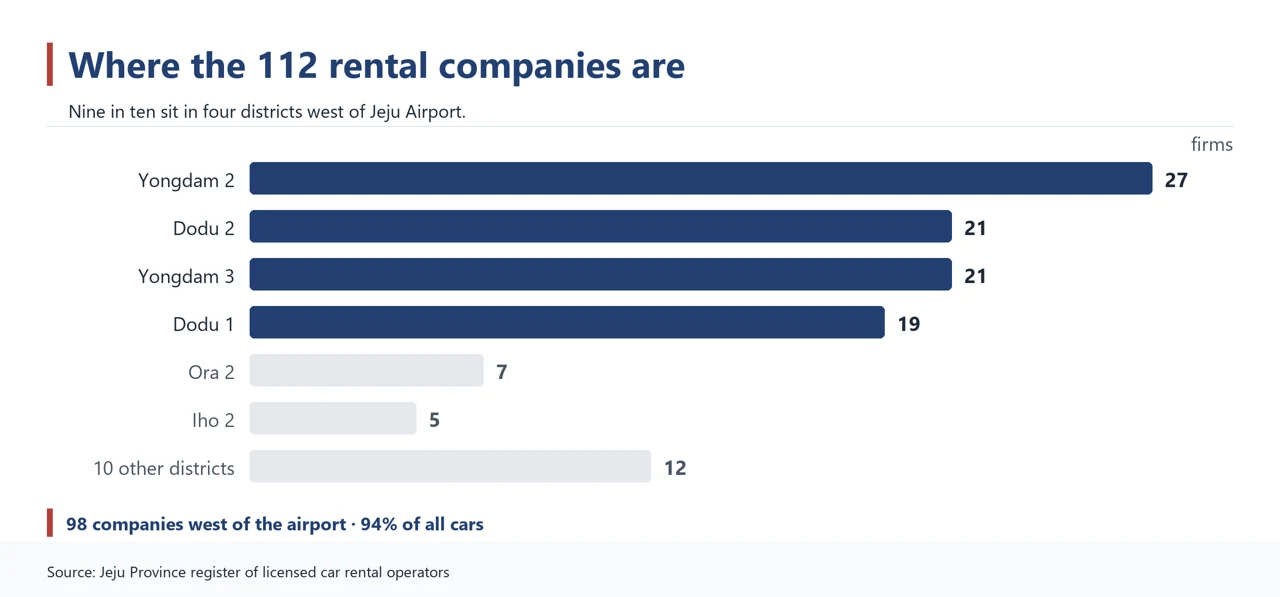
5. From the plane to the car
Arrivals at Jeju is on the first floor. Once you have your bags, the exits are numbered, and the one you want is not the one most people take.
If you flew in on a domestic flight, the odds are it came from Gimpo Airport in Seoul, where eight in ten domestic passengers are heading to Jeju. Everywhere else in Korea, trains and buses beat driving.
- Leave through gate 3 or gate 5. The other exits put you at the taxi and private car ranks.
- Cross the pedestrian crossing outside. The shuttle stops are on the far side.
- Follow the signs to the Rental Car House, mounted under the canopy.
- Find your company’s numbered bay. Each operator has its own.
- Ride that company’s shuttle to the depot, where there is a waiting room.
Some companies have a desk inside the terminal
Lotte Rent-a-Car keeps a counter on the first floor beside gate 2. Tamra Rent-a-Car and Jeju Rent Car are both listed in the airport’s own directory with phone numbers. Starting the paperwork at a desk saves a step, but the cars themselves are still at the depot, so you will travel there either way.
6. The island is not allowed to add more cars
Jeju runs a supply cap that no other Korean province has. The province sets a number it considers appropriate and refuses new registrations and fleet increases above it.
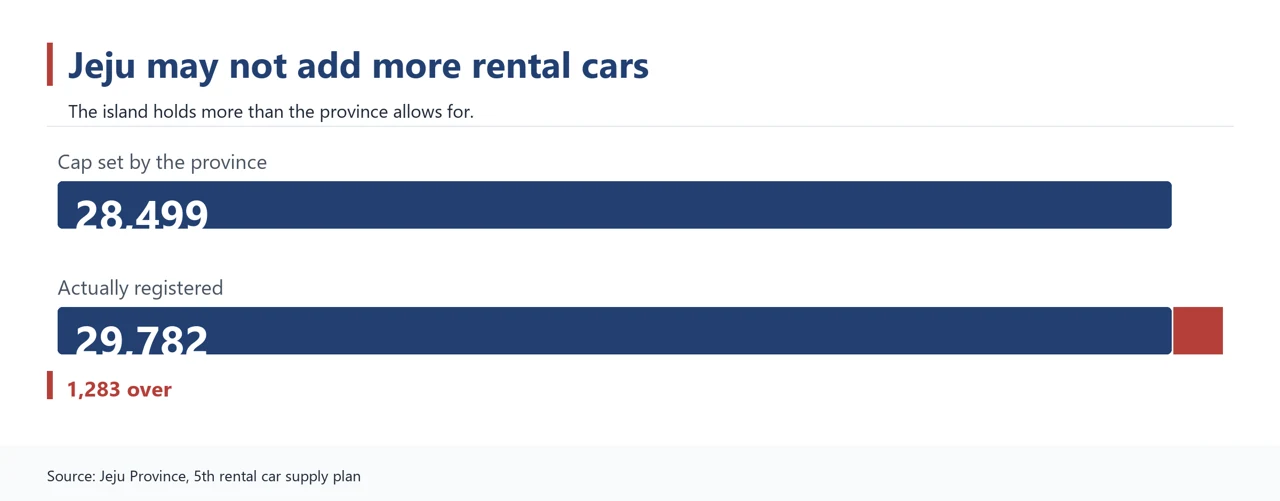
The figure it has settled on is 28,499 cars. The island actually has 29,782. There are 1,283 more rental cars on Jeju than the province thinks there should be, so the registration freeze has been extended for another two years.
| Cap set by the province | 28,499 |
| Actually registered | 29,782 |
| Over the cap by | 1,283 |
| How the cap was calculated | Peak-season utilisation, tourist demand, service quality |
| What is frozen | New registrations and fleet expansion |
There is no mechanism to force existing cars off the road. The province simply blocks new ones and lets the number drift down.
What that does to the price you pay
When more visitors arrive in summer, the supply of cars cannot rise to meet them. Only the price can move. This is the reason Jeju rental rates climb so sharply in the high season while the fleet stays flat, and it is why booking early is worth more here than in places where an operator can simply bring in more cars.
7. When the cars actually run short
The Jeju Tourism Organization publishes monthly utilisation figures supplied by the island’s rental car cooperative. Utilisation is the share of the registered fleet that is out on hire.
| Month | Utilisation | |
|---|---|---|
| August | 79.6% | Tightest |
| July | 75.2% | Summer peak |
| October | 74.4% | Autumn peak |
| June and September | around 74% | Shoulder |
| May | 71.0% | Middling |
| April | 68.3% | Middling |
| January | 63.5% | Slack |
| February | 60.8% | Slack |
| March | 60.1% | Loosest |
In high summer four cars in five are out. In early spring it is three in five.
Cars left over are not the cars you wanted
Eighty percent utilisation does not mean a comfortable one-in-five chance. It means the cheap classes are gone. Small cars and compacts clear first, and what remains late in the booking cycle is the large and imported end of the fleet. Booking late in August rarely means no car at all. It means a bigger car than you planned at a higher rate than you planned.
The standard contract does cover the case where your class has sold out. If the company substitutes a similar vehicle, you pay the lower of the two rates: your original rate if the substitute is dearer, the substitute’s rate if it is cheaper. You may also refuse the substitute outright and take your deposit back in full.
8. Deposits, cancellation and the one-hour rule
Korean rental contracts are built on a standard form issued by the Fair Trade Commission. Individual companies write their own terms, but most follow this template closely, so the clause numbers below are worth checking against whatever you are asked to sign.
| Situation | Rule | Clause |
|---|---|---|
| Deposit ceiling | No more than 10 percent of the expected rental charge | Art. 2 |
| You cancel more than 24h ahead | Deposit returned in full | Art. 3 |
| You cancel within 24h | Deposit forfeited | Art. 3 |
| The company cancels | You receive twice the deposit | Art. 3 |
| Force majeure | Deposit returned | Art. 3 |
| You are more than an hour late | Booking treated as cancelled, deposit forfeited | Art. 3 |
The clause running the other way is worth knowing too. If the company cancels on you, it does not merely refund what you paid. It owes you double.
9. Seven reasons they can refuse you at the counter
A confirmed booking is not a guarantee of a car. Article 4 of the standard contract lists the grounds for refusal. Your deposit comes back if any of them applies.
- You do not have the driving licence you need, or you will not cooperate with the check on your entitlement
- Your identity cannot be confirmed, or you refuse to answer questions or provide documents
- You appear to be drunk, or under the influence of drugs
- The person collecting the car is not the driver named on the booking
- You have a record of deliberate accidents, or of unpaid rental charges, excesses or repair bills
- You have previously done something the contract’s prohibited-conduct clause forbids
- Any comparable objective reason
Age and experience
The same article lets companies set their own rules on age and years held, taking accident rates and insurance pricing into account. In practice that means drivers under 26, or those licensed for less than a year, find certain classes closed to them or priced higher. It varies by operator, so check before you book rather than at the depot.
10. The insurance has two layers, and the car you are driving is in the second
This is where most of the money goes wrong, and it is simpler than the counter makes it sound.
The first layer is already there
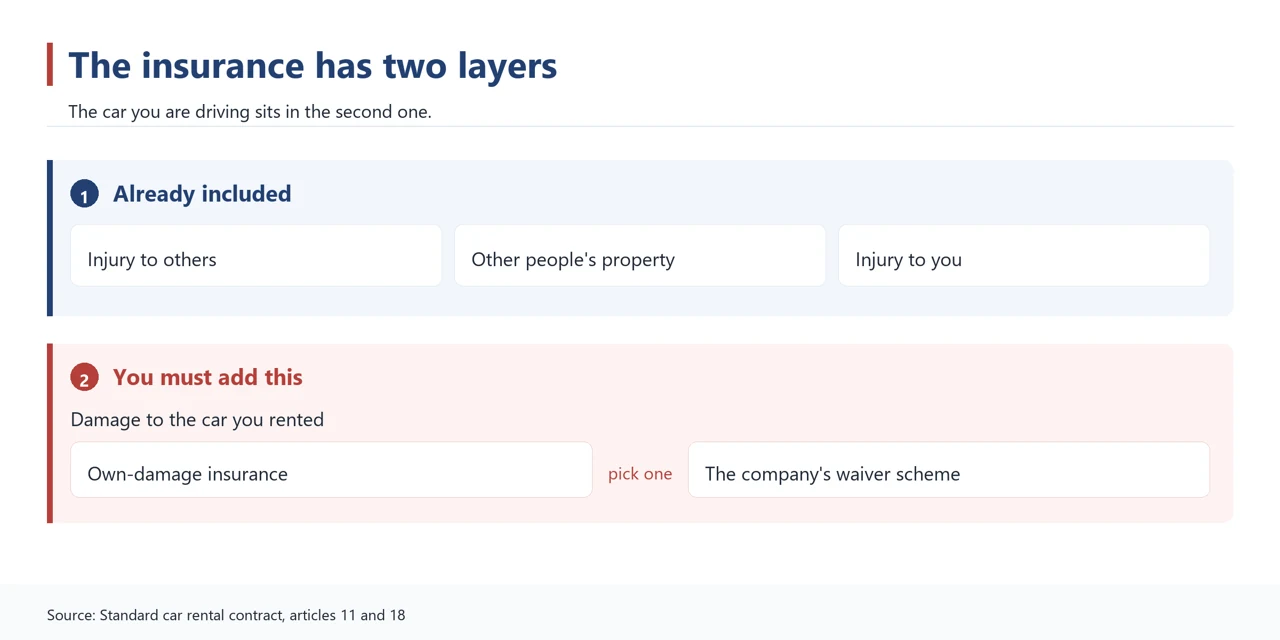
Every rental car is required to carry compulsory liability insurance plus a comprehensive motor policy covering injury to others, damage to other people’s property, and injury to you. When you rent the car you become an insured party under that policy. Other people, other cars and your own body are covered before you sign anything.
The second layer is not
What is missing is damage to the car you are driving. The contract requires you to choose one of two ways to cover it.
| Option | What it is |
|---|---|
| Own-damage insurance | A policy sold by an insurance company |
| The company’s own waiver scheme | A liability-limitation product run by the rental operator itself |
Either way, if the accident was your fault you still pay an excess. But there is one protection worth knowing: if you took the operator’s waiver scheme, the excess you pay cannot exceed what the repair actually cost. A company cannot charge a flat excess larger than the bill it paid.
If you decline both
Damage the car with no own-damage cover in place and you owe its assessed value at the time of the accident. And if whatever cover you did buy falls short of what you owe, the shortfall is yours.
The product names are marketing, not law
- The excess. Zero, or from what amount?
- The payout ceiling. Is there one?
- Loss-of-use. Included or not? That is §11.
- Single-vehicle accidents, tyres, wheels and glass. Included or not?
The last is where products diverge most. Kerbing a wheel alone, with no other vehicle involved, is excluded from plenty of policies that call themselves complete.
11. Loss-of-use is capped at half, and most people never find out
Alongside the repair bill sits a second charge called loss-of-use: compensation for the income the company did not earn while the car sat in a workshop. Article 19 governs it.
It contains a limit that is easy to miss and worth real money.
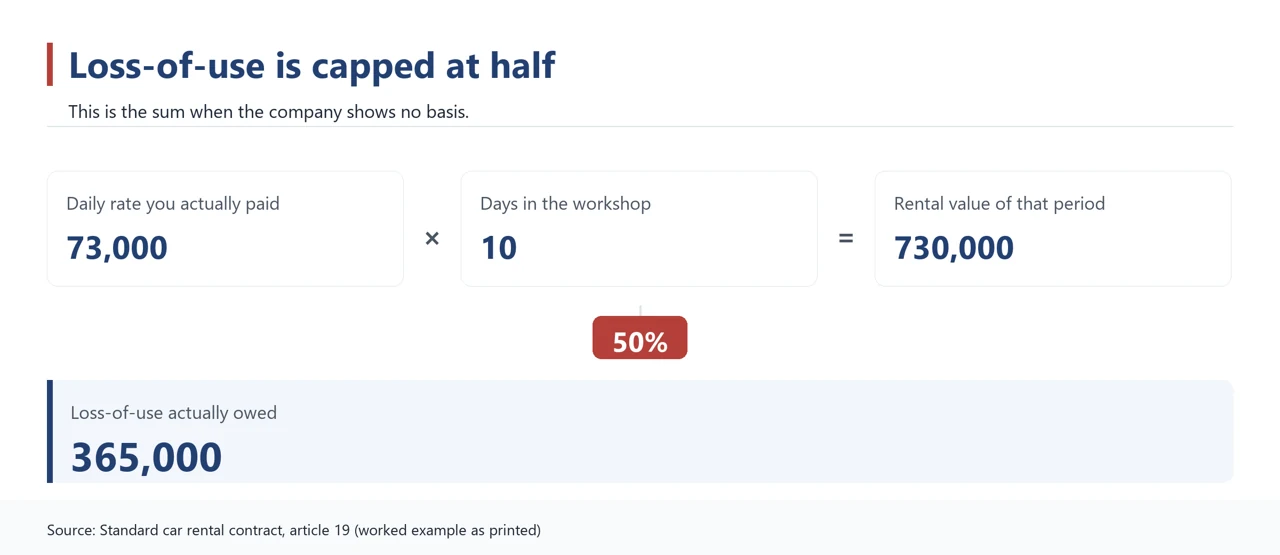
The rate used is the daily rate you actually paid. The contract even carries a worked example:
| Daily rate on a rental of 7 days or more | 73,000 won |
| Days in the workshop | 10 |
| Rental value of that period | 730,000 won |
| Loss-of-use actually owed | 365,000 won |
The same car rented for a day or two carries a higher daily rate of 91,000 won, but the calculation uses the rate you were actually charged. A long rental is costed as a long rental.
What to do if you are billed
Ask for the basis of the calculation before paying. Receive a proper rate schedule for the same class of car and that figure stands. Receive nothing and half is the ceiling. People who do not know this clause exist tend to pay whatever number they are given.
One more thing: the protection in §10, where the excess cannot exceed the repair cost, does not extend to loss-of-use. It is calculated separately.
12. If you have an accident, the order matters
Article 17 sets out a sequence, and departing from it shifts costs onto you.
- People first. Get anyone injured to hospital and report to the police, as road traffic law requires.
- Tell the rental company immediately.
- Provide whatever the insurer asks for.
- Do not settle with the other party before consulting the company. Roadside agreements unravel later.
- Repairs go to a workshop agreed with the company. Move, tow or repair the car on your own initiative and any re-work is billed to you.
You are entitled to the paperwork
The company has to tell you the estimated cost before repairs begin, and on request must give you the pre-repair estimate and the post-repair itemisation. This is written into the contract, so asking is not an imposition.
Some things follow you home
Parking fines, traffic penalties and parking charges remain yours after you return the car. Camera-issued tickets surface weeks later and are passed on through the rental company.
The handover inspection is the cheapest insurance there is
You and the company fill in a condition sheet together: bodywork, fuel level, tyres, wipers, lights, mirrors, glass, seatbelts. For an electric or hydrogen car the charge level takes the fuel line. Anything not written down at pickup becomes an argument at return, so walk the car and photograph all four corners and every wheel on your phone.
13. Why Jeju regulates rental cars so heavily
If the last few sections felt unusually dense with rules, this is the section that explains them.
Jeju’s autonomous police service counted 2,414 rental car accidents over the most recent five years. Those crashes killed 26 people and injured 4,032.
The reasons are not mysterious. Almost everyone behind the wheel is driving these roads for the first time, in a car whose dimensions they do not know, on a schedule that leaves no slack. Jeju’s sights are also scattered, so the daily distances are long.
The fleet cap, the ban on taking cars to Udo and the repeated failure of proposals to recognise Chinese licences all trace back to this number. The rules look scattered but they grow from one root.
Children under six need a car seat, and it is the law
Korean road traffic law requires a child restraint for passengers under the age of six, with the seatbelt fastened over it. The fine for driving without one is 60,000 won, and rental cars are not exempt.
Above six a car seat is no longer compulsory and the standard belt is enough, though a booster is still sensible for a small child, because the shoulder belt otherwise crosses the neck.
14. What gets settled when you hand the car back
The return has its own rules, and money changes hands during it.
You return it as you received it
Article 22 requires the car to come back in the condition recorded at pickup, minus ordinary wear. It also requires the company to inspect the car in your presence. Do not drop the keys and walk off; stand there while they look.
The same article obliges them to check for belongings you or your passengers left behind. That clause exists because luggage gets forgotten in boots.
Fuel settles in both directions
| Situation | Who pays whom |
|---|---|
| You return it with less fuel than you got | The company charges you for the difference |
| You return it with more fuel than you got | You may charge the company for the difference |
| You received it full | You return it full |
Almost nobody knows the second line exists. If you handed the car back with more fuel in it than you were given, you are entitled to ask for that back. The clause is written symmetrically. For an electric or hydrogen car, state of charge takes the place of fuel.
Changing the drop-off point costs money
You return the car where the contract says. If you leave it somewhere else, you pay the cost of recovering it. One-way rentals, say collecting at the airport and dropping in Seogwipo, have to be agreed at the booking stage rather than improvised.
If you are late
Once 24 hours have passed beyond the end of the rental period without the car coming back, the company may take legal steps to recover it. It may also use vehicle tracking, but only if it told you the car was tracked and got your acknowledgement at handover. After seven days with neither car nor customer located, it can report the vehicle stolen.
If something is wrong from the start
Article 20 entitles you to a replacement vehicle or an equivalent remedy when a pre-existing fault makes the car unusable. If the company cannot arrange that, it refunds the rental and bears the cost of collecting the car. If something sounds wrong in the first half hour, stop and call rather than pressing on.
15. Your rental car cannot go to Udo
Udo is the small island off Jeju’s eastern tip and a standard day trip. You cannot take a rental car onto it. A provincial traffic order bars them, and the current order runs to the summer of 2029. It is the fifth consecutive extension.
| Which vehicles | |
|---|---|
| Barred | Rental cars not garaged on Udo itself, chartered coaches, rented motorcycles and mopeds, personal mobility devices, and any vehicle without compulsory insurance |
| Allowed | Rental cars carrying a disabled, elderly or infant passenger; electric and hydrogen vehicles; 16-seat chartered coaches |
This is why Udo Electric Rent Car from §4 is built the way it is. Its garage is registered on Udo and its cars are electric, which clears the restriction twice over. No other operator among the 112 is arranged like that.
So how do you get there
You leave the car at the harbour and cross as a foot passenger. Ferries run from Seongsan Port or Jongdal Port to Cheonjin or Haumokdong on Udo, and the crossing from Seongsan takes a little over ten minutes. On the island you move by circular bus, electric bicycle or scooter. The local bus costs 950 won.
Ferries and getting around the island are set out in the Jeju travel guide.
16. The two mountain roads close in winter
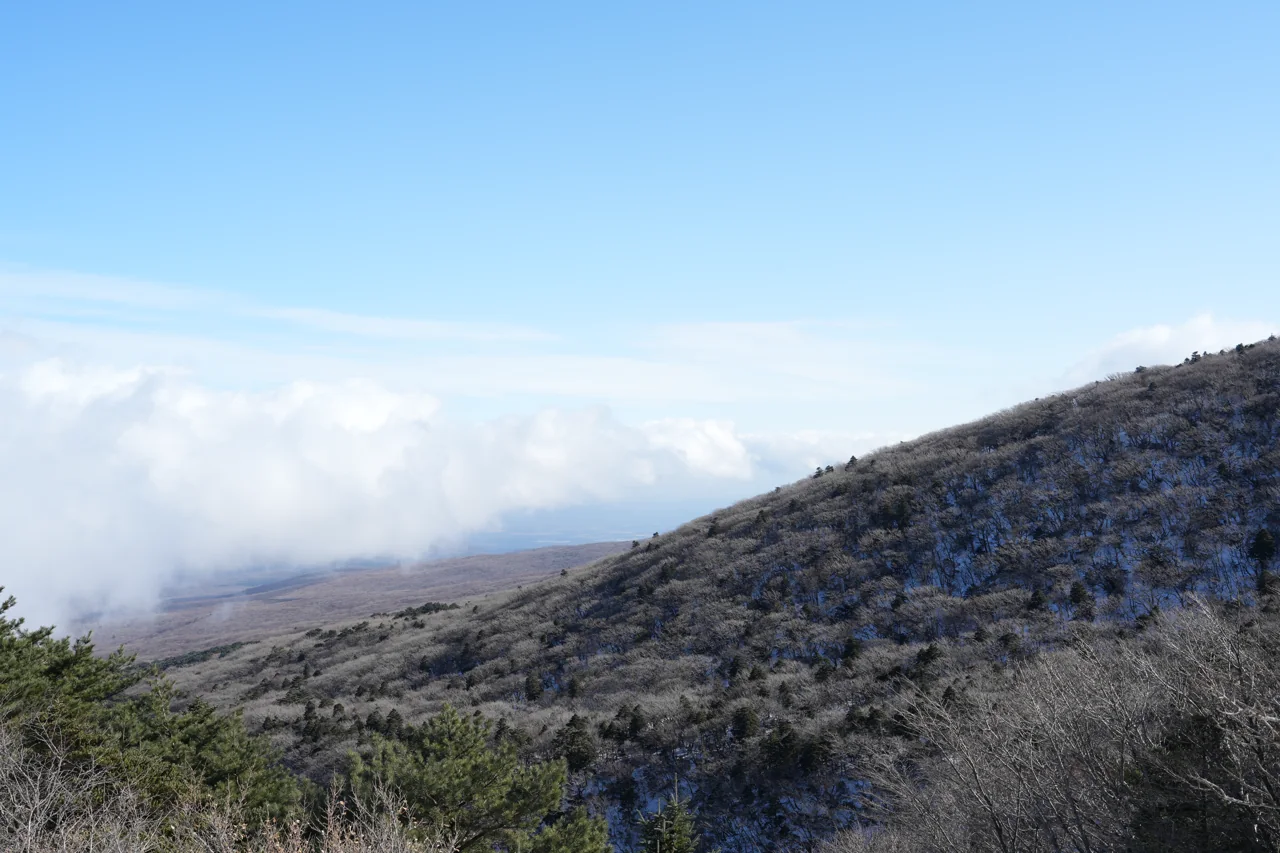
Two roads cross Hallasan between Jeju City on the north coast and Seogwipo on the south: Route 5·16 and Route 1100. Both are short and scenic, both get suggested by navigation apps, and both come with winter conditions attached.
| Road | When it snows |
|---|---|
| Route 1100 | Can close along its entire length |
| Route 5·16 | Can require chains or equivalent winter equipment |
Above the mid-slopes the surface ices over, and clear streets at sea level tell you nothing about conditions higher up. Fog is frequent on both roads and reduces visibility badly.
There is a way around
If you are not in a hurry, take the lowland routes instead: Pyeonghwa-ro to the west, Beonyeong-ro to the east. Both link Jeju City and Seogwipo, both are longer, and both stay low with far fewer tight bends.
Restrictions are imposed when a snow or cold-weather warning is issued for the highlands, not every time a flake falls. Check conditions on the day before setting off.
🧭All-Korea essentials126
Frequently asked questions
Images: Photographs via Wikimedia Commons: 콩가루 (CC BY-SA 4.0), Sharon Hahn Darlin (CC BY 2.0), 제주영상문화산업진흥원 (KOGL Type 1), Sadopaul (CC BY 4.0), Grapesurgeon (CC BY-SA 4.0), Loooys (CC BY-SA 3.0). Charts by Breeze Korea from Jeju Province and Fair Trade Commission data.