
Busan in December 2026: Three Light Festivals, New Year’s Eve and the Weather
The shortest days of the year, and the sunniest share of them. December in Busan is planned around the evening
| Weather | The driest month of the year at 33.8mm, with the least cloud. Highs 10.4°C, lows 2.0°C. |
|---|---|
| Daylight | Shortest of the year at 9h 50m a day, but 67.4% of it is sunshine, the highest ratio of any month. |
| Light festivals | Gwangbok-ro switches on at 17:30 and Haeundae at 18:00, with Seomyeon lit as well. All three are free and run all December. |
| 31 December | Three separate events: Gwangalli countdown 22:00, Yongdusan bell 23:00, drone show at midnight. |
| New Year sunrise | 07:32 on 1 January, fifteen minutes earlier than Seoul. |
| Snow | 0.9 days in the whole month. Seoul gets 6.4. |
1. The shortest days of the year, and the sunniest
2. The driest month of the year
3. Evenings start getting longer again on 8 December
4. Viewing hours get shorter from 1 December, not longer
5. Three light festivals overlap for the whole month
6. Drones fly at 19:00 and 21:00 on Saturdays
7. Three separate things happen on the night of 31 December
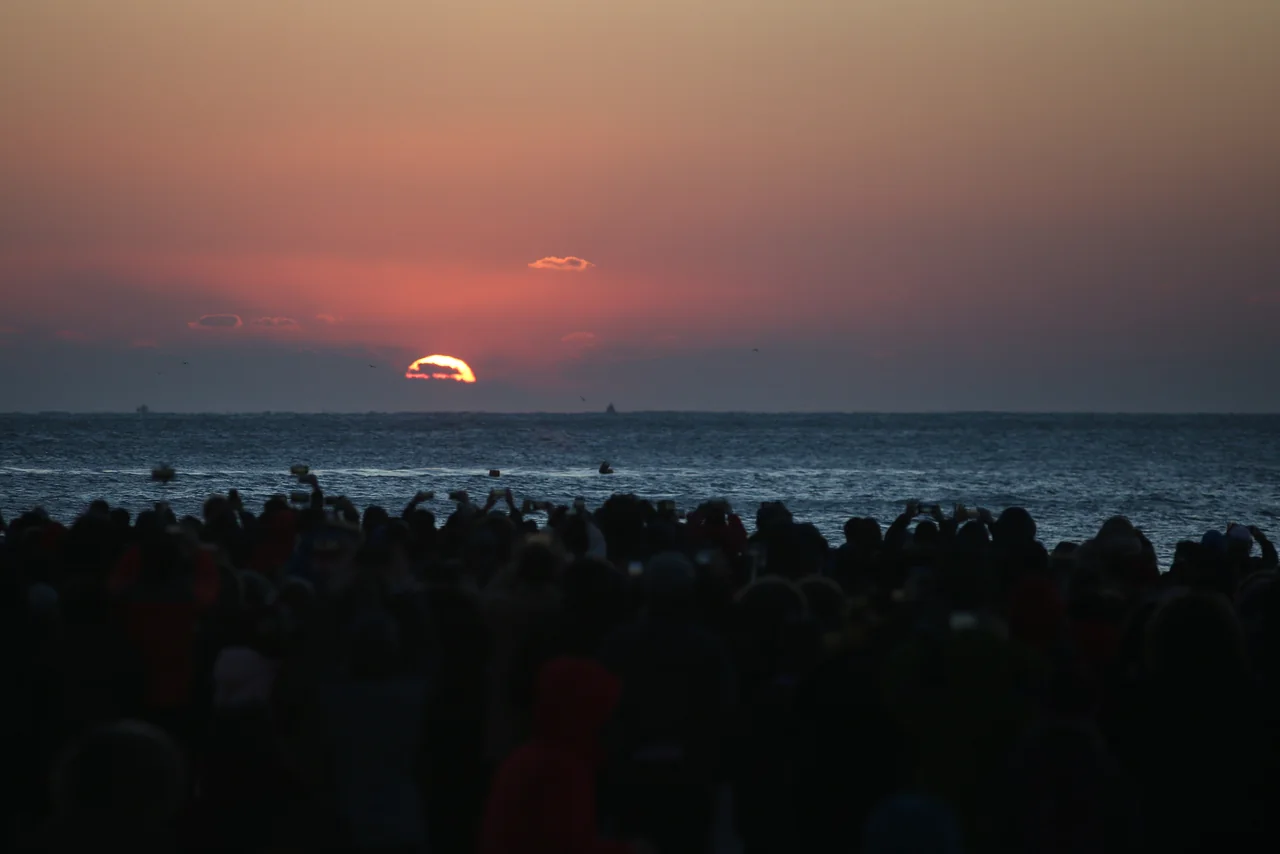
8. The New Year sunrise is at 07:32
9. Christmas Day and New Year’s Day both fall on a Friday
10. Snow falls on less than one day in the month
11. Older diesel vehicles are restricted city-wide from 1 December
12. The two hot spring complexes have different rules, not just different prices
13. All seven beaches are closed for the season
14. What does not happen in Busan in December
15. Which week to pick
December is Busan’s darkest month and its clearest one. Part of our complete Busan travel guide.
1. The shortest days of the year, and the sunniest
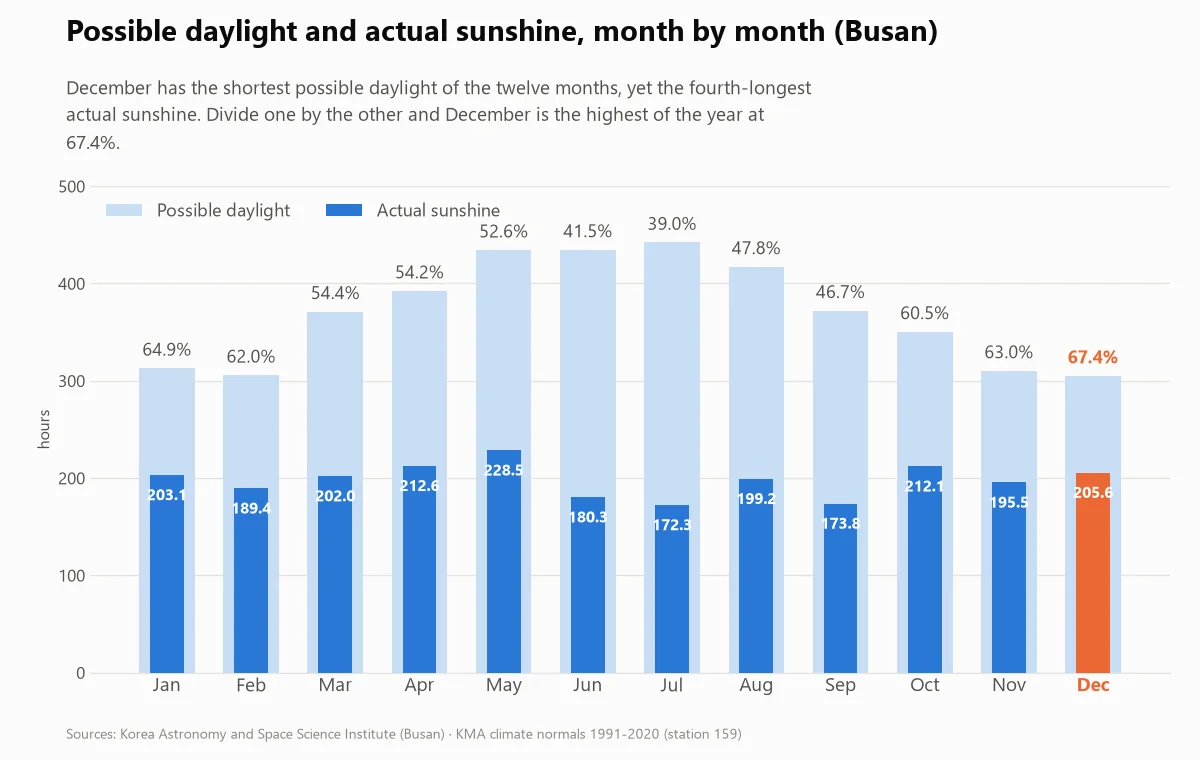
December has the least possible daylight of any month in Busan. Add up sunrise to sunset across all 31 days using Korea Astronomy and Space Science Institute figures and the total is 304.9 hours, an average of 9 hours 50 minutes a day. July gets 442.1 hours.
And yet the Korea Meteorological Administration climate normals put Busan’s December sunshine at 205.6 hours. That is more than June (180.3), July (172.3), August (199.2) and September (173.8). Ranked across the twelve months, December comes fourth, behind May, April and October.
Divide one figure by the other
| Month | Possible daylight | Actual sunshine | Ratio |
|---|---|---|---|
| July | 442.1 h | 172.3 h | 39.0% |
| June | 434.6 h | 180.3 h | 41.5% |
| September | 372.0 h | 173.8 h | 46.7% |
| October | 350.3 h | 212.1 h | 60.5% |
| November | 310.2 h | 195.5 h | 63.0% |
| December | 304.9 h | 205.6 h | 67.4% |
December’s 67.4% is the highest of the twelve months and 1.7 times July’s 39.0%. In summer the sun is above the horizon for more than twelve hours a day and actually shines for about five of them. In December it is up for under ten hours and shines for two thirds of that. The monsoon rains and the typhoon season sit over the summer sky; December has almost nothing over it.
What this changes about planning
Two things hold at once. The window for outdoor plans is narrow, and the chance of being rained on inside that window is the lowest of the year. Treat anything before 07:30 and anything after 17:30 as dark. The nine and a half hours in between run as scheduled far more reliably than they do in June or July.
For photography December is the better month. The sun stays low, so the light comes in at an angle all day, and mean cloud cover of 2.9 is the lowest reading of the year. December and January are the only months in Busan where shadows stay long at noon.
2. The driest month of the year
Busan’s December rainfall normal is 33.8mm, the lowest of the twelve months. January is a whisker behind at 34.5mm, and July gets 326.8mm. Rain falls on 4.7 days and for 30.2 hours in total. December runs to 744 hours, so rain is falling for 4.1% of the month.
All three measurements bottom out in December: total rainfall, number of rain days, and hours of rain. Mean cloud cover of 2.9 is also the annual low.
Busan against Seoul in December
| Busan | Seoul | |
|---|---|---|
| Mean temperature | 5.8°C | 0.2°C |
| Daytime high | 10.4°C | 4.2°C |
| Overnight low | 2.0°C | -3.4°C |
| Sunshine | 205.6 h | 162.9 h |
| Mean cloud cover | 2.9 | 3.7 |
| Rainfall | 33.8mm | 22.6mm |
| Hours of rain | 30.2 h | 46.2 h |
| Days with rain | 4.7 | 7.8 |
| Days with snow | 0.9 | 6.4 |
| Days with frost | 0.9 | 13.0 |
| Days with ice | 15.0 | 26.7 |
| Relative humidity | 48.1% | 57.8% |
| Mean wind speed | 3.3 m/s | 2.3 m/s |
One line runs the other way. Busan gets 11.2mm more precipitation than Seoul. Yet Seoul spends sixteen hours longer receiving it. A large share of Seoul’s December precipitation arrives as snow, and snow takes far longer to deliver the same measured depth of water. Busan’s version arrives in short bursts and stops.
The lines a visitor actually feels are the three near the bottom. Seoul has frost on thirteen mornings while Busan has it on less than one, and Busan gets a seventh of the snow. Wind is the single measurement where Busan is harsher, by 1.0 m/s.
Wind, not temperature, sets the day
Busan’s December mean wind speed of 3.3 m/s is higher than several summer months. On paper the city is 5.6°C warmer than Seoul, and on the sand at Gwangalli or Haeundae that margin shrinks. The gap between a sheltered street and an exposed seafront is wider in December than at any other time. The same afternoon can be comfortable in the alleys of Nampo-dong and hard going on the promenade twenty minutes later.
3. Evenings start getting longer again on 8 December
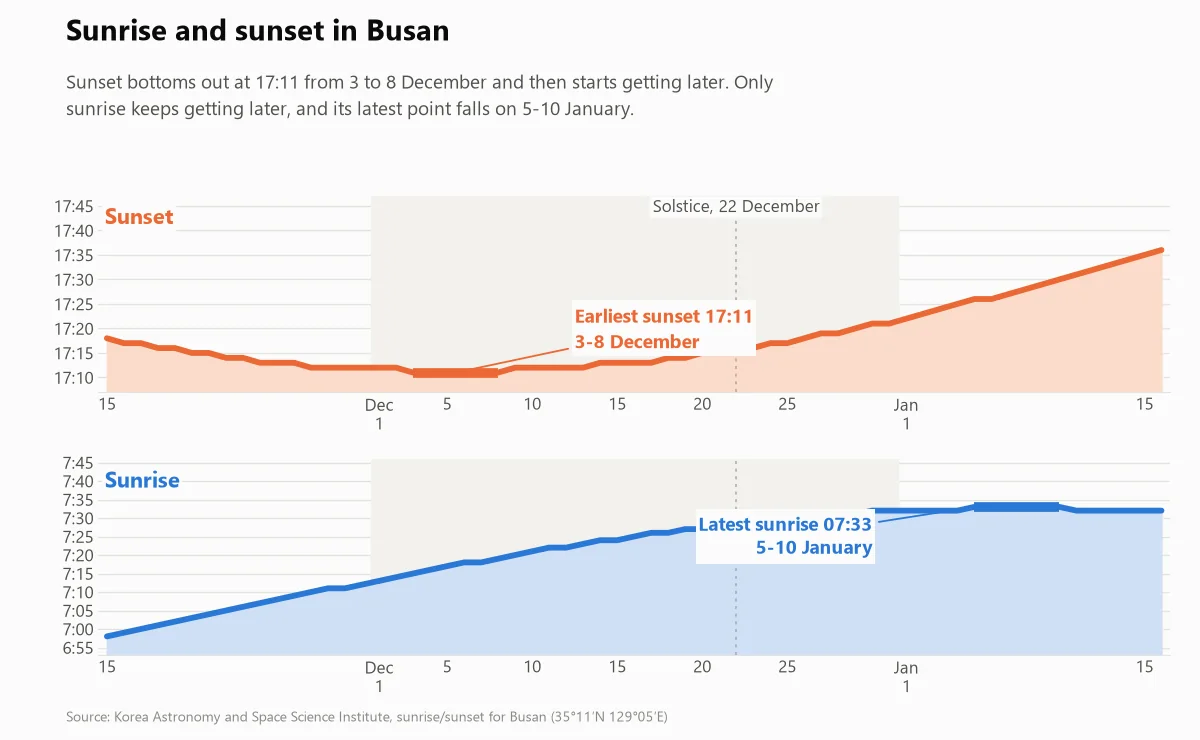
The earliest sunset of the year in Busan is 17:11, and it holds for six days, from 3 to 8 December. From 9 December sunset moves later again. By 31 December the sun sets at 17:21, nine minutes later than on 1 December.
Sunrise does the opposite and gets later right through the month, from 07:13 on 1 December to 07:32 on 31 December. The latest sunrise of the year is 07:33, and those dates fall on 5 to 10 January, outside December altogether.
Day by day through December
| Date | Sunrise | Sunset | Day length | Full dark |
|---|---|---|---|---|
| 1 December | 07:13 | 17:12 | 9h 59m | 17:39 |
| 5 December | 07:17 | 17:11 | 9h 54m | 17:39 |
| 8 December | 07:19 | 17:11 | 9h 52m | 17:39 |
| 15 December | 07:24 | 17:13 | 9h 49m | 17:41 |
| 22 December | 07:28 | 17:16 | 9h 48m | 17:44 |
| 25 December | 07:30 | 17:17 | 9h 47m | 17:46 |
| 31 December | 07:32 | 17:21 | 9h 49m | 17:49 |
The column to watch is day length. From 17 to 26 December, ten days in a row, the day stays between 9 hours 47 minutes and 9 hours 48 minutes. The solstice on 22 December is not measurably shorter than the days on either side of it. Change slows almost to a stop around both solstices, which is why timing a trip to land on 22 December buys nothing in practice.
Plan against full dark, not sunset
Between sunset and genuine darkness there are 27 to 28 minutes. That period is civil twilight, and it is still bright enough to read outdoors. It ends at 17:39 on 1 December and at 17:49 on 31 December.
For night views and light festivals, use that second time rather than sunset. The sun goes down at 17:11 and the sky stays blue for another half hour, so illuminations do not read at their proper colour until about 17:40. This is the reason Gwangbok-ro switches its lights on at 17:30 and Haeundae waits until 18:00, which comes up again below.
4. Viewing hours get shorter from 1 December, not longer
An earlier sunset sounds like more night-view time. Busan’s main viewing attractions move the other way and close earlier in December. The Songdo Marine Cable Car runs until 21:00 from March to November and drops back to 20:00 on 1 December.
Time left between sunset and closing
| Month | Sunset (15th) | Cable car closes | Time in between |
|---|---|---|---|
| October | 17:49 | 21:00 | 3h 11m |
| November | 17:18 | 21:00 | 3h 42m |
| December | 17:13 | 20:00 | 2h 47m |
| January | 17:34 | 20:00 | 2h 26m |
Sunset is five minutes earlier than in November and the night-viewing window is 55 minutes shorter. Add that ticket sales stop 30 minutes before closing, so the last chance to buy is 19:30. Going up as the sun sets at about 17:13 leaves a comfortable two hours. Going up after dinner usually does not work.
Closing times for the evening attractions
| Attraction | Hours | Admission |
|---|---|---|
| BUSAN X the SKY (100th floor, Haeundae LCT) | 10:00-21:00, last entry 20:30, open daily | Adult 27,000 KRW / child and senior 24,000 KRW |
| SEA LIFE Busan Aquarium | Mon-Fri 10:00-19:00 (last entry 18:00), Sat-Sun 10:00-20:00 (last entry 19:00) | Adult 31,000 KRW / child 26,500 KRW |
| Songdo Marine Cable Car | Dec-Feb 09:00-20:00, Mar-Jun and Sep-Nov 09:00-21:00 | Varies by cabin type |
| Busan City Tour night bus | Departs 19:00 from November to March (19:30 April to October). Closed Mon and Tue | Adult 20,000 KRW / child 10,000 KRW |
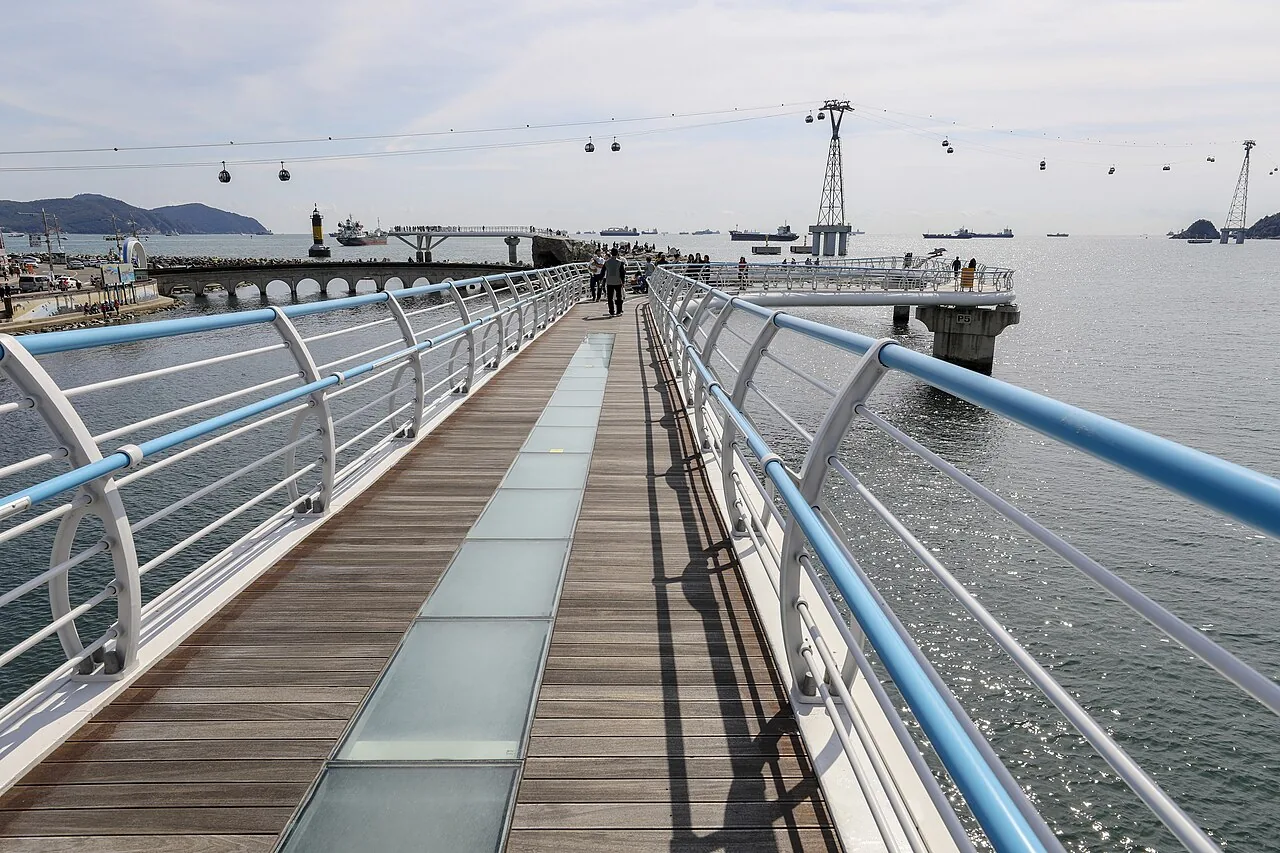
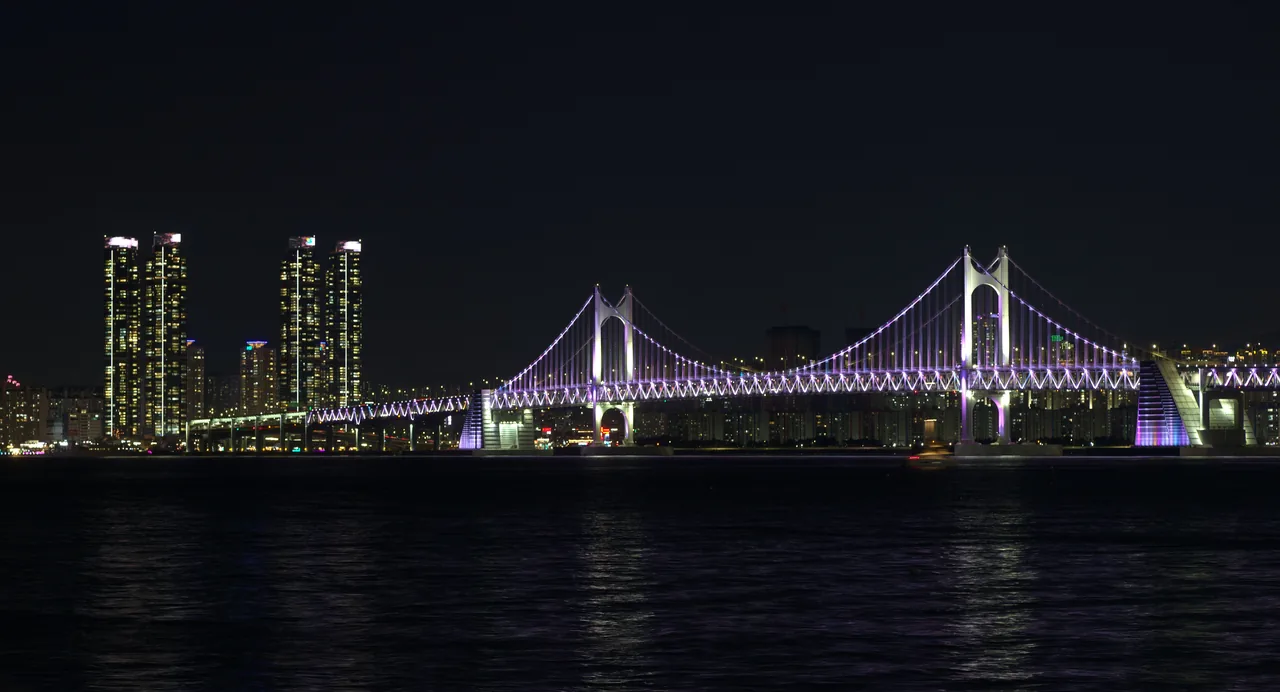
The night bus leaves half an hour earlier through the winter. It starts at Busan Station and runs via Busan Bridge, Busan Harbour Bridge, Gwangalli beach (10-minute photo stop), Marine City, Haeundae, Gwangan Bridge, Namhang Bridge, the Songdo Cloud Trails skywalk (10-minute photo stop) and Jagalchi before returning. The loop takes about 2 hours 10 minutes and seating is first come, first served. It does not run on Mondays or Tuesdays, so an early-week trip loses this option entirely.
BUSAN X the SKY keeps its 21:00 close all winter and opens every day of the year. It is the one viewpoint that still works after dinner. The observation floor sits at 411.6m on the 100th floor of the LCT tower at HaeundaeMap.
5. Three light festivals overlap for the whole month
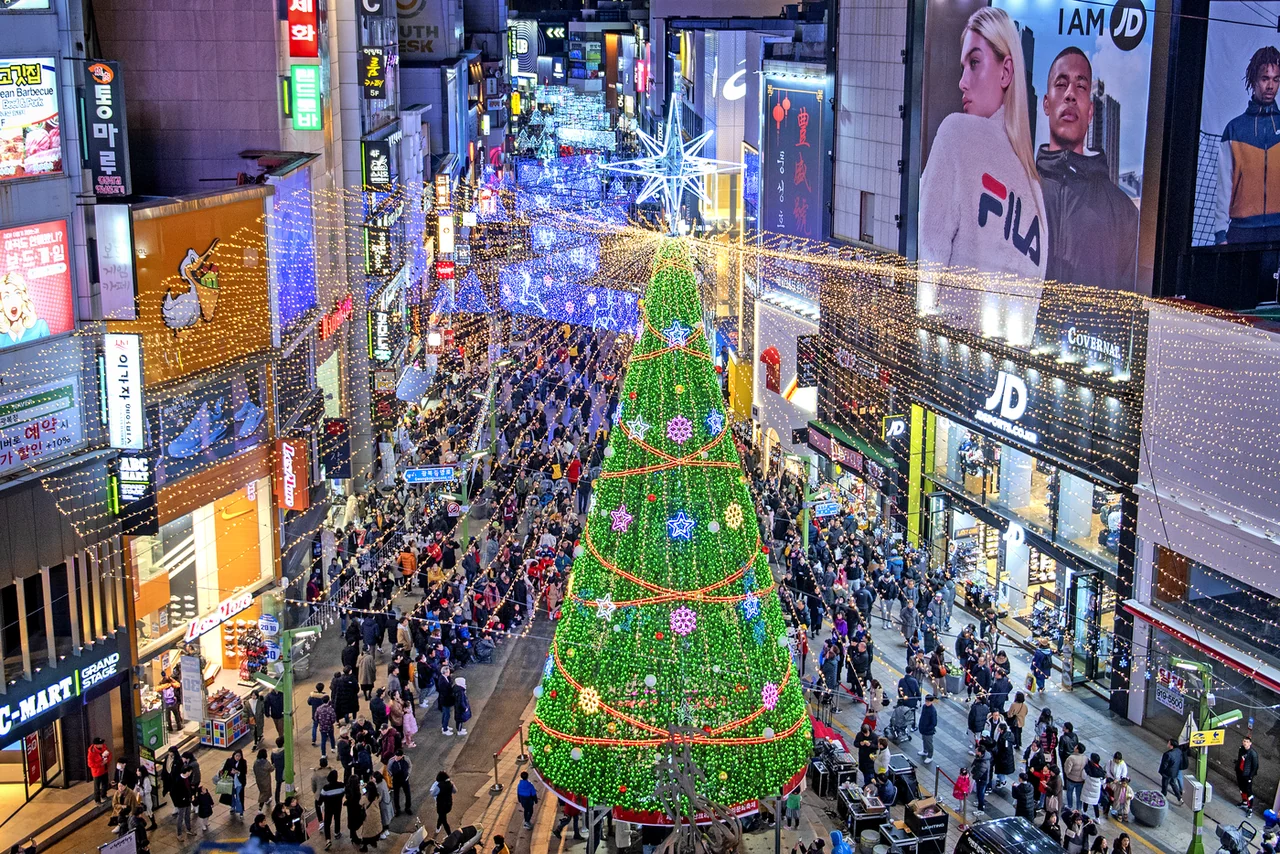
Busan’s headline December events are its light festivals, one downtown, one at the beach and one in Seomyeon, and their dates overlap across the entire month. All three are free to visit.
The Gwangbok-ro Winter Light Tree Festival
Illuminations and large trees fill Gwangbok-roMap and Gwangbok Jungang-ro in the Nampo-dong district. It used to be called the Busan Christmas Tree Festival and is run by Jung-gu district office. The most recent edition switched on with a ceremony on 5 December and ran to 22 February, with lights on from 17:30 to 22:00. Opening night included busking by Busan musicians and a public switch-on where visitors light the trees themselves.
17:30 falls just after the December sunset of 17:11 to 17:21 and 8 to 19 minutes before full dark. Arrive around 17:20 to catch the moment the lights come on; the colours read strongest from about 17:50. The site is a five-minute walk from exit 7 of Nampo stationMap on subway line 1.
The Haeundae Light Festival
Light sculptures and media art are installed along Haeundae beachMap. It is run by Haeundae district office and the most recent edition, the twelfth, opened on 29 November and closed on 18 January. Lights ran 18:00 to 23:00 and hands-on programmes ran 18:00 to 22:00. The opening night had a switch-on ceremony and fireworks.
The 18:00 start is half an hour later than downtown because the beach needs to be genuinely dark for the installations to work. Full dark in December comes at 17:39 to 17:49, so 18:00 is already night.
The Seomyeon light festival
Busanjin District puts lights up along Jungang-daero 691beon-gil, Seomyeon-ro and Sincheon-daero 62beon-gil. The most recent edition switched on 13 October and ran to 14 February, 125 days, which makes it the earliest to start and the longest to run of the three. It is free.
The theme that edition was Light Station, and the installation was split into five zones covering the main street, the local shopping area, an international zone, a street food zone and a young people’s zone. Seomyeon StationMap, where Lines 1 and 2 meet, comes out right at it. Switch-on times change from edition to edition, so check the Busanjin District notices.
All three sit on one metro line
Gwangbok-ro is Nampo Station on Line 1, Seomyeon is the Line 1 and Line 2 interchange, and Haeundae is on Line 2. Because Seomyeon is where the two lines meet, the three run in a single sequence.
All three in one evening
⚠️ The dates and hours above are the confirmed details of the most recent edition. The 2026 dates for all three festivals had not been announced when this was written, so check the Jung-gu, Haeundae and Busanjin district office notices before you travel. Each publishes its own dates for each edition.
6. Drones fly at 19:00 and 21:00 on Saturdays
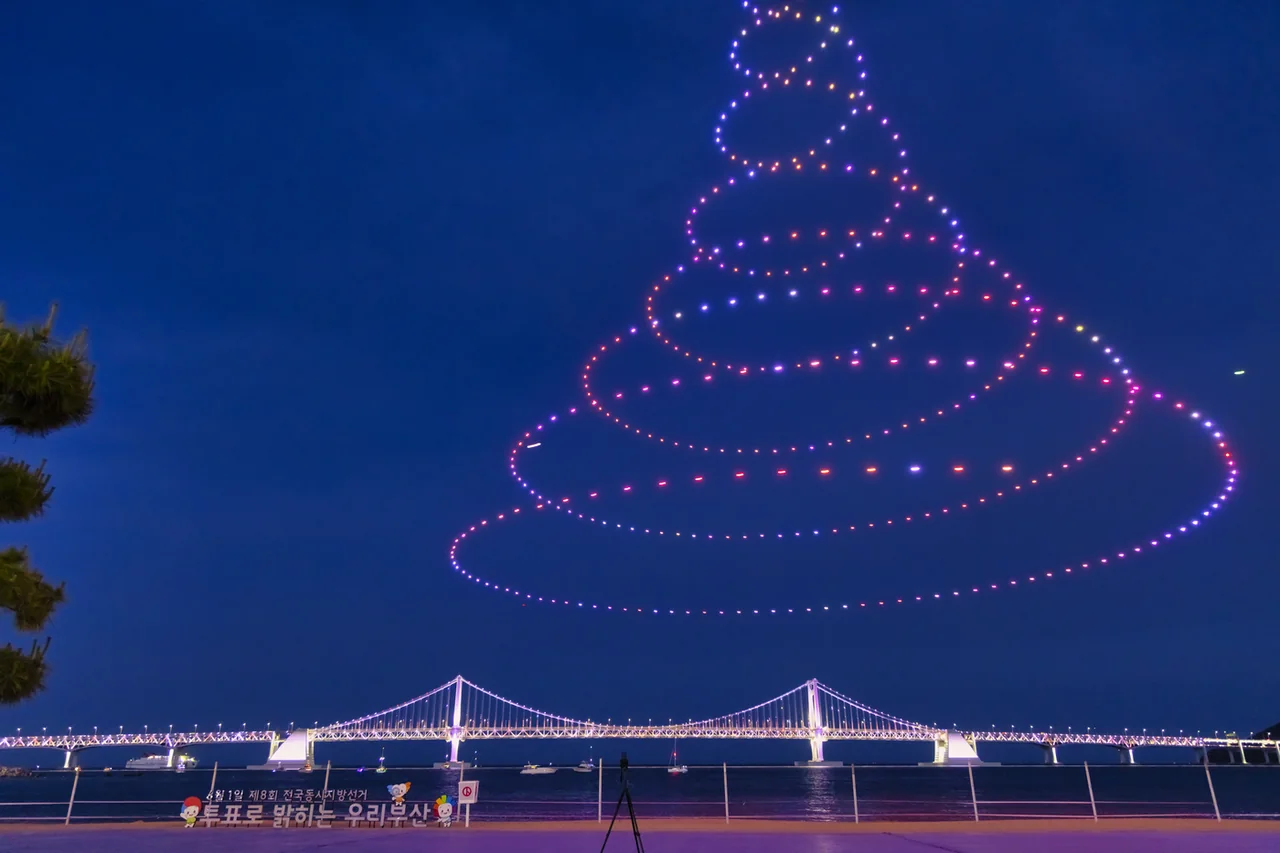
The M Drone Light Show over Gwangalli beachMap runs every Saturday, and from October to February the two performances are at 19:00 and 21:00. From March to September they move to 20:00 and 22:00, so a summer listing sends you to the beach after the first winter show has already finished.
In December 2026 the Saturdays are the 5th, 12th, 19th and 26th. Each show lasts about twelve minutes and is visible from anywhere along the beach. There is no charge. Viewing spots and cancellation rules are set out in our Gwangalli drone show guide.
31 December runs to a different clock
A separate countdown event fills the same stretch of beach on the same night. If the drones are the only reason you are there, being on the sand by about 23:30 is enough. Getting inside the fenced event area is a different matter, and the timings for that are in the next section.
Why December favours the drones
Drone shows are cancelled or delayed for weather and for radio conditions. Busan’s December normals are 4.7 rain days, the fewest of any month, and 0.2 days with thunder. On probability alone this is one of the better months to catch one.
Wind is the counterweight. Mean wind speed of 3.3 m/s is above October and November, both 3.1 m/s, and wind cancels more shows than rain does. Check the day’s notice before setting out. There is also a live stream on the Suyeong-gu district YouTube channel.
7. Three separate things happen on the night of 31 December
Busan’s New Year’s Eve is not gathered in one place. Gwangalli, Yongdusan Park and the sky above Gwangalli each run to their own timetable. All three are free and seeing all three is not physically possible.
One night, three timetables
Everything worth seeing lands within twenty minutes of midnight. Gwangalli and Yongdusan ParkMap are about 40 minutes apart by subway, so pick one.
Choosing between them
| Gwangalli | Yongdusan Park | |
|---|---|---|
| Main event | 2,500 drones and a countdown show | Twelve minutes of the Citizens’ Bell |
| Starts | 22:00, venue opens 19:00 | 18:00, bell at 00:00 |
| Capacity limit | First 1,200 into the venue | None |
| Visible from outside | Yes. The drones are visible along the whole beach | Not applicable |
| Straight afterwards | You can wait on the same beach for sunrise | Sunrise needs a journey |
The 1,200 cap applies to the fenced area in front of the stage. The drone performance itself is visible from anywhere on the beach, so missing the cut still leaves you the show. What does matter on 31 December is that both the roads and the subway around Gwangalli are heavily loaded, which is a strong argument for sleeping within walking distance.
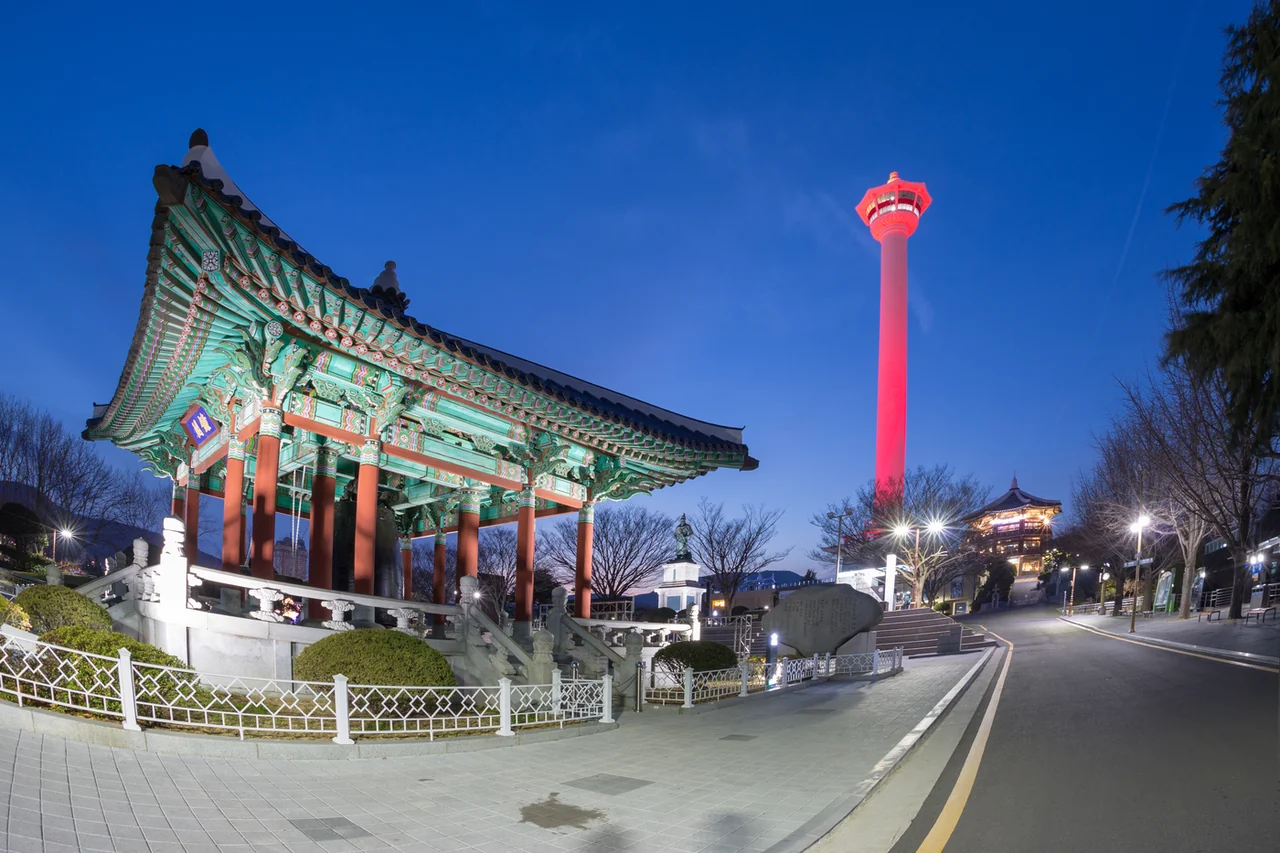
Yongdusan has no capacity limit and its programme runs for more than six hours from 18:00. The bell itself is twelve minutes from midnight. The Gwangbok-ro illuminations are a five-minute walk away, which fills the evening before it.
⚠️ These timings are from the most recent edition. Both events publish final details in mid-December.
8. The New Year sunrise is at 07:32
The sun rises over Busan at 07:32 on 1 January. In Seoul it is 07:47, a difference of fifteen minutes. The sky starts to lighten at 07:04 in Busan and 07:18 in Seoul.
That time connects directly to the night before. The Gwangalli countdown finishes at 00:10 and sunrise is a little over seven hours later, which is why a number of people simply stay on the beach.
Why Busan is fifteen minutes ahead
| Busan | Seoul | |
|---|---|---|
| First light | 07:04 | 07:18 |
| Sunrise | 07:32 | 07:47 |
| Sunset | 17:22 | 17:24 |
Busan sits east and south of Seoul. The longitude pulls sunrise forward and the latitude lengthens the winter day. Sunset, though, differs by only two minutes between the two cities. A Busan winter day is stretched at the front and cut at the back.
Where to stand
Haeundae and Gwangalli face south and south-east, so the sun does not come up straight ahead of you. The genuinely east-facing points are the IgidaeMap coastal path and the headland looking towards Oryukdo. On the morning of 1 January every beach in the city is busy regardless.
Aim to be in position 40 minutes before sunrise, which means 06:50. That puts you there before the sky starts to lighten. The first subway trains generally run from around 05:20, and in some years the service is extended over the New Year, so check the Busan Transportation Corporation notice.
Everything from 1 January onward is in our guide to Busan in January. The latest sunrise of the year, 07:33, falls on 5 to 10 January, so the whole first week of the year works for a sunrise at much the same hour.
9. Christmas Day and New Year’s Day both fall on a Friday
There is one public holiday in December 2026 in Korea: Christmas Day on the 25th. It lands on a Friday, so 25 to 27 December runs as three consecutive days off. New Year’s Day is also a Friday, giving another three days from 1 to 3 January.
How the last fortnight is shaped
| Date | Day | |
|---|---|---|
| 25 Dec | Fri | Christmas Day, public holiday |
| 26-27 Dec | Sat-Sun | Weekend |
| 28-30 Dec | Mon-Wed | Working days |
| 31 Dec | Thu | Working day, events at night |
| 1 Jan | Fri | New Year’s Day, public holiday |
| 2-3 Jan | Sat-Sun | Weekend |
Three days of leave, on 28, 29 and 30 December, join everything into a ten-day run from 25 December to 3 January. Two days of leave still covers New Year’s Eve and the 1 January sunrise across four days.
To avoid crowds instead, 28 to 30 December are the three quietest days of the month. They sit between the two holiday blocks, they are ordinary working days, and all three light festivals are still switched on with all the decorations already in place.
The rest of the region matters too
| Country | Year-end holidays | Consecutive days |
|---|---|---|
| Korea | 25 Dec (Fri), 1 Jan (Fri) | Three each |
| Japan | Government offices closed 29 Dec to 3 Jan | One day of leave on 28 Dec makes nine, 26 Dec to 3 Jan |
| Taiwan | New Year’s Day, 1 Jan (Fri) | Three, 1 to 3 Jan |
| Spain | Constitution Day moved to 7 Dec in most regions, Immaculate Conception 8 Dec, Christmas 25 Dec | Four, 5 to 8 Dec |
Busan draws heavily on Japanese and Taiwanese visitors. Japan’s year-end break starts on 29 December and Taiwan’s New Year holiday starts on 1 January, so rooms in Haeundae and Seomyeon tighten a second time from 29 December. That squeeze is a different animal from the Christmas weekend of 25 to 27 December, and it catches people who booked around the first one.
Christmas Day is a public holiday in Korea, but department stores, supermarkets and restaurants all trade normally. What closes is government offices and banks. The practical effect on a trip is the crowd rather than the shutters.
10. Snow falls on less than one day in the month
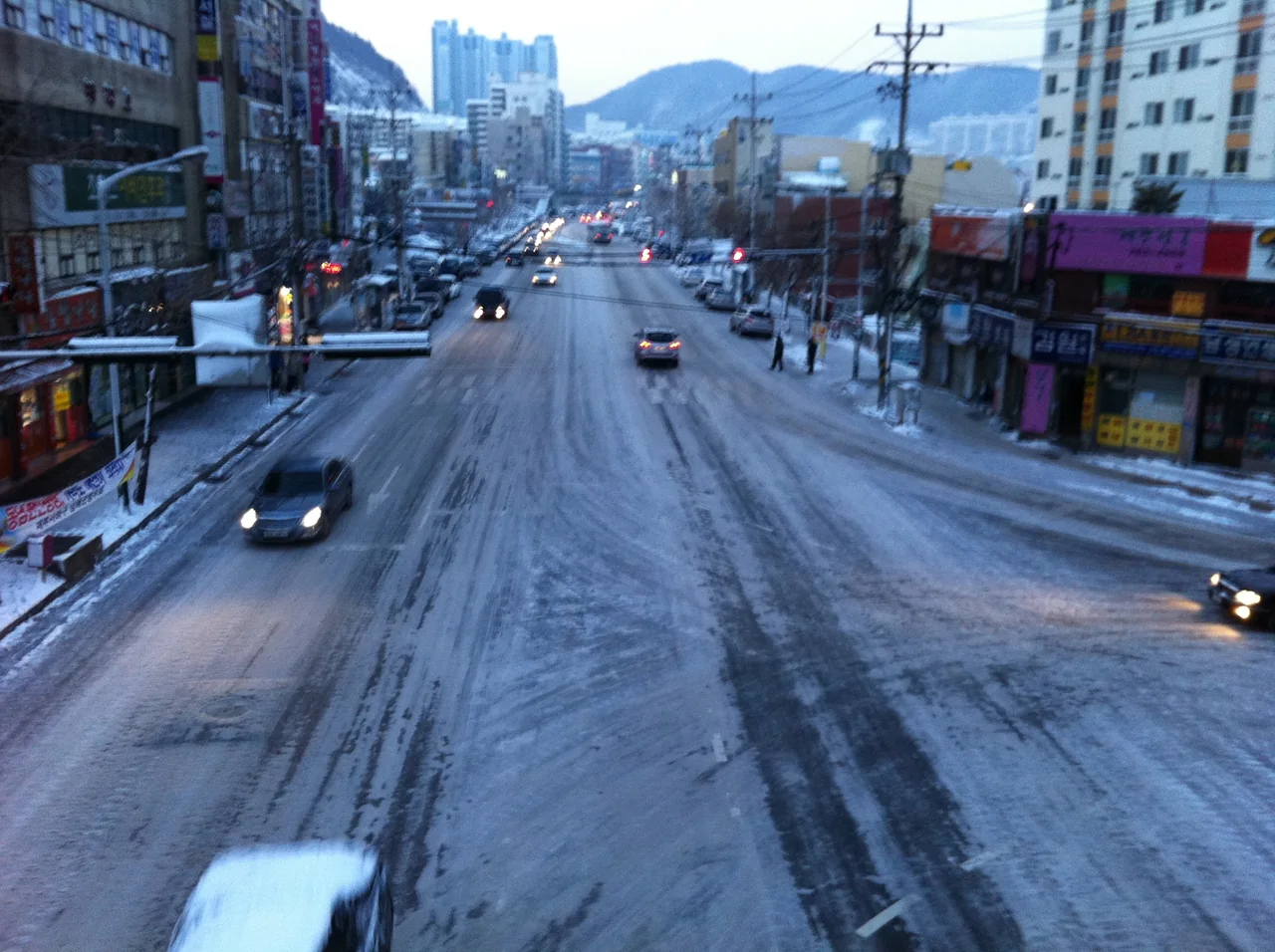
Busan’s December snowfall normal is 0.9 days. Less than one day in the whole month. Seoul records 6.4. January adds only 1.4 days in Busan, so all three winter months together come to less than one Seoul December.
Frost days come out at 0.9 as well, against 13.0 in Seoul. Walking out to a white lawn or a frozen windscreen happens roughly once a month here.
Ice, though, does form
| November | December | January | |
|---|---|---|---|
| Days with ice | 1.7 | 15.0 | 21.2 |
| Days with snow | 0.1 | 0.9 | 1.4 |
| Days with frost | 0.2 | 0.9 | 0.8 |
| Overnight low | 8.3°C | 2.0°C | -0.1°C |
Only the ice line jumps, from 1.7 days in November to 15.0 in December, a factor of nine. December is the month freezing starts in Busan. No snow and regular freezing is an unusual combination, and it comes from the grass minimum temperature: the normal is -1.9°C, so the ground goes below zero while the air above it stays above.
What to pack
Daytime high 10.4°C, overnight low 2.0°C, mean wind 3.3 m/s. That is 8.4°C of movement inside a single day, with sea wind running constantly. Several thin layers under a windproof outer shell beat one heavy coat. Indoor venues and the subway are heated hard, so you will be taking the outer layer off repeatedly.
Bring a scarf and gloves if you have any evening plans. The light festivals and the drone show all involve standing outdoors after dark, and temperatures in those hours run 5°C to 8°C below the daytime high. Gwangalli and Haeundae have nothing to break the wind.
Snow boots and ice cleats are not needed. But with freezing on close to half the days, early-morning steps and shaded pavements can be slick. If you are heading up the hillside roads or to Gamcheon Culture VillageMap first thing, wear something with grip.
11. Older diesel vehicles are restricted city-wide from 1 December
One more thing starts on 1 December: Korea’s seasonal fine dust management programme. It runs from 1 December to 31 March every year, and during it Busan restricts Grade 5 emissions vehicles across the entire city.
How the most recent round worked
| Item | Detail |
|---|---|
| Period | 1 December to 31 March |
| Vehicles affected | Grade 5 emissions vehicles without retrofit |
| Area | All of Busan |
| Enforcement hours | Weekdays 06:00-21:00, excluding weekends and public holidays |
| Method | 43 cameras at 30 locations |
| Penalty | 100,000 KRW per day |
| Exempt | Emergency vehicles, vehicles displaying a disability permit, retrofitted vehicles |
For a rental car this is not a practical concern. Rental fleets are new enough that Grade 5 does not apply. It matters if you are driving something older into the city.
What the air is actually like
The programme starts in December because stagnant air and inflow from outside the country begin to overlap around then. Busan is coastal, though, and its December mean wind of 3.3 m/s is well above Seoul’s 2.3 m/s. On the same day the coastal reading is often lower than the inland one.
On days with a lot of outdoor plans, check the live readings before you set out. The fallback on a bad-air day is the same as the fallback on a wet one: the hot springs and indoor attractions below, plus the itineraries in Busan when it rains.
⚠️ Details of the round starting in December 2026 are published around November. The number of camera sites and the enforcement hours shift slightly from year to year.
12. The two hot spring complexes have different rules, not just different prices
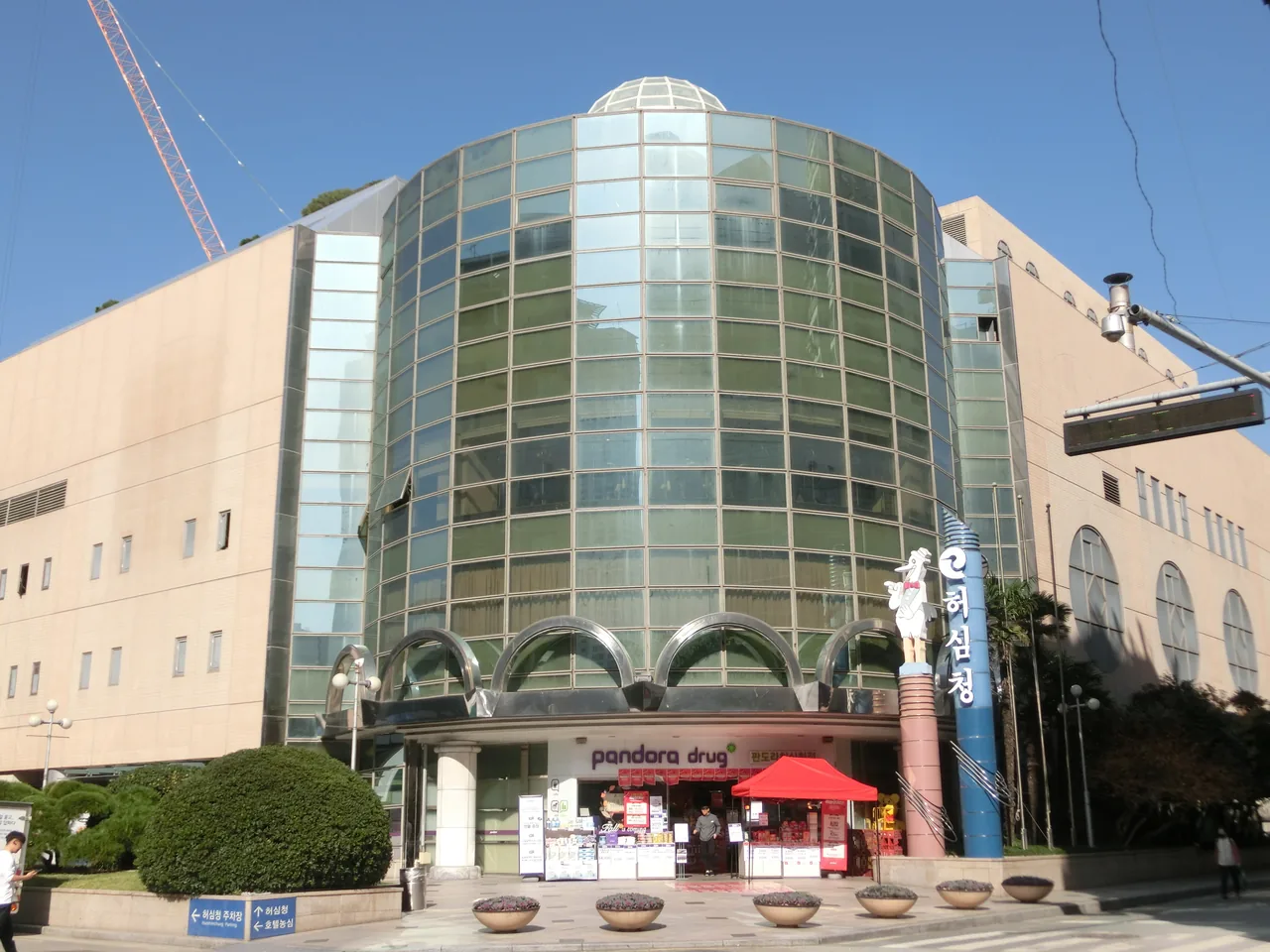
Busan has natural hot springs inside the city, which makes them the default indoor plan in December. The two big names are Hurshimchung in Dongnae and Spa Land in Centum City, and they differ on more than price.
Hurshimchung, Dongnae: the official rates
| Category | Weekday | Weekend and holidays | Notes |
|---|---|---|---|
| Adult | 15,000 KRW | 18,000 KRW | Middle school age and above |
| Primary school | 11,000 KRW | 12,000 KRW | |
| Infant | 7,000 KRW | 7,000 KRW | 12 months to pre-school |
| Group | 12,000 KRW | 15,000 KRW | 20 or more |
| Jjimjilbang | 4,000 KRW | 4,000 KRW | Gown hire |
The baths run 05:30 to 22:00 with last entry at 21:30, and the jjimjilbang sauna floor runs 06:30 to 21:00. It is open every day of the year. Included time is four hours for the baths alone and six hours with the sauna floor, capped at seven. After that it is 2,000 KRW per additional hour.
Spa Land, Centum City
Inside the Shinsegae Centum City department store, open 08:00 to 23:00 with last entry at 22:00. Admission is 26,000 KRW for adults and 21,000 KRW for students. One entry covers four hours, extended to six if you spend 10,000 KRW or more inside, and each additional hour is 5,000 KRW. The water comes from two sources, one calcium chloride and one sodium chloride.
Picking one
| Hurshimchung | Spa Land | |
|---|---|---|
| Location | DongnaeMap | Centum CityMap |
| Weekday adult | 15,000 KRW | 26,000 KRW |
| Closes | 22:00, last entry 21:30 | 23:00, last entry 22:00 |
| Included time | 4 hours, 6 with the sauna floor | 4 hours, 6 if you spend 10,000 KRW inside |
| Extra time | 2,000 KRW per hour | 5,000 KRW per hour |
| Minimum age | 12 months | Primary school |
| Tattoos | Explicitly not admitted | No published rule either way |
Spa Land closes later, so it is the one that works after an evening out. Hurshimchung is cheaper and gives more time for the money. Our Busan hot springs and jjimjilbang guide covers the smaller places as well.
13. All seven beaches are closed for the season
Busan’s seven designated beaches operate only during the summer season. In December all of them are closed. Closed here means no lifeguards on duty and no beach facilities running. Access itself is not blocked, and the sand and the promenades stay open.
What the winter coast is actually for
Swimming is not on the table at this time of year. Walking the coast takes its place. The IgidaeMap coastal path, the Songdo Cloud TrailsMap skywalk and the shoreline route from Mipo to Cheongsapo all work in December. There are far fewer people than in August, and with mean cloud cover at 2.9 the view carries a long way.
The winter coast does have conditions summer does not. A mean 3.3 m/s reads much stronger out on a breakwater or a headland. Climbing on tetrapods is dangerous in any month. And at an air temperature of 5.8°C, getting wet is not something you shrug off.
Seeing the sea from indoors
Several options keep the view without the wind. The Cheongsapo Daritdol ObservatoryMap at Haeundae is free. The Haeundae Blue Line Park beach train and Sky Capsule both run the coastline under cover. The Songdo cable car operates until 20:00 through December.
Seaside cafés are easier in December than at any other time. Window tables that are impossible in August are generally free on a weekday afternoon. The water also reads a deeper colour in winter than it does in summer.
Individual beaches and how to reach them are covered in things to do in Busan and getting around Busan.
14. What does not happen in Busan in December
Several of Busan’s best-known events are not December events. People arrive expecting them and find the dates do not line up, so they are worth listing.
| Event | When it actually runs |
|---|---|
| Busan Fireworks Festival | November. The most recent 21st edition was a single day, 7 November |
| Haeundae Polar Bear Festival | January. The most recent 39th edition ran 16 to 18 January |
| Busan International Film Festival | October |
| Autumn colour | Peaks 5 to 15 November |
| Cherry blossom | Late March into early April |
The fireworks and the polar bears
The fireworks festival is an autumn event held over Gwangalli, Haeundae and Igidae, and the most recent edition was on 7 November. Details are in our Busan Fireworks Festival guide. What goes up over Gwangalli in December is drones.
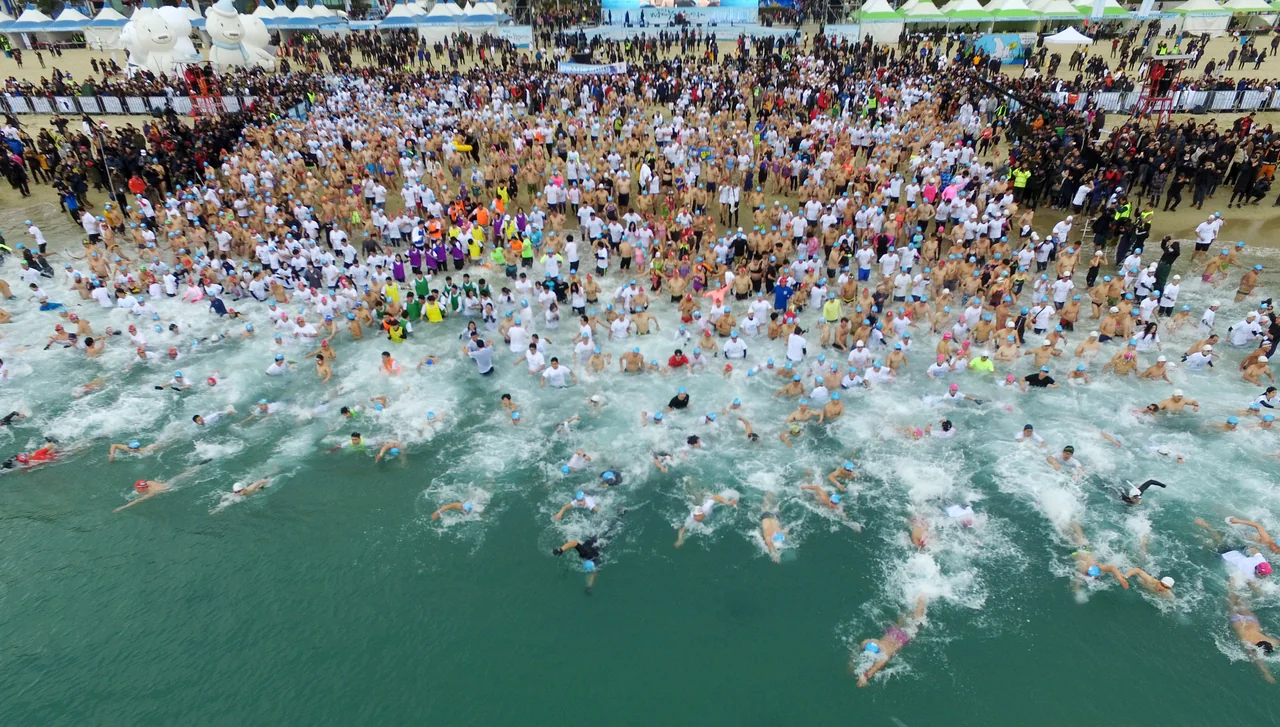
The Haeundae Polar Bear Festival, where participants swim in the winter sea, runs in January. The most recent 39th edition was 16 to 18 January, with the 1km group swim on the final morning from 08:00 to 10:00. Residents, visitors and foreign nationals can all enter. Being in Busan at the end of December leaves you about a fortnight short.
What only December has
Some things run the other way. December is the only month with all three light festivals lit at once, the only night when the drone show flies a single performance at midnight, and the month with the highest sunshine ratio of the year. The two festivals continue into January and February, but the three events of 31 December happen once.
To weigh the months against each other, read this alongside Busan in November and Busan in January.
15. Which week to pick
December in Busan is not one month but six distinct stretches. Grouping the dates above by week gives this.
| Dates | What is on | Suits |
|---|---|---|
| 1-6 Dec | Earliest sunset of the year, 17:11 from the 3rd to the 8th. Gwangbok-ro switch-on. Drone show Sat 5th | Seeing the illuminations in their first days, with the smallest crowds |
| 7-13 Dec | All three light festivals running normally. Drone show Sat 12th | Fitting the whole December list in without queueing for any of it |
| 14-20 Dec | Shortest days begin, 9h 47m from the 17th. Drone show Sat 19th | Trips weighted towards indoor plans |
| 21-27 Dec | Solstice on the 22nd. Christmas Day Fri 25th, three days off. Drone show Sat 26th | Anyone tied to the holiday. Accommodation is at its tightest |
| 28-30 Dec | Working days. All the lights still on | The three quietest days of the month |
| 31 Dec-3 Jan | Three New Year’s Eve events, sunrise 07:32 on 1 Jan, three-day New Year holiday | Spending the turn of the year in Busan |
By what you came for
One thing holds whichever week you choose. It is night by 17:30 and that night runs for more than six hours. A December itinerary in Busan is settled by what goes in the evening, not by what goes in the afternoon. All three light festivals, the observation deck, the night bus and the hot springs are all open in that window.
Food shifts in December too. Korea’s fisheries ministry names gwamegi, half-dried herring, and oysters as the seafood of the month, and in Busan yellowtail is at its best from December into January. Both are sold at market rates at Jagalchi MarketMap and the Busan Cooperative Fish Market. There is more in what to eat in Busan.