Jagalchi Market: How to Eat at Korea’s Biggest Fish Market
Jagalchi is Korea’s largest seafood market and one of Busan’s must-do experiences: pick your catch downstairs, have it cooked upstairs, and eat the freshest seafood of your life. Here’s how it works, what to eat, what it costs and how to get there.
Last updated: June 2026
The short version
Jagalchi Market is the largest seafood market in South Korea, right on Busan’s waterfront in Nampo-dong — a noisy, colourful, only-in-Busan experience.
The classic way to eat: buy your live seafood from a stall on the ground floor, then take it to a restaurant on the second floor, where they prepare it as raw hoe (sashimi), grilled, steamed or in a spicy stew for a preparation fee.
It’s easy to reach — Jagalchi Station (Line 1), Exit 10, about a 6-minute walk — and best in the morning for the freshest catch; most stalls close on the 1st and 3rd Tuesdays.
⚠️ Prices are by market rate, so always agree the weight and total price before you buy to avoid overpaying.
If you want to understand Busan in one place, go to Jagalchi. This is Korea’s largest seafood market, sprawling along the harbour in the old downtown of Nampo-dong, and it has been the beating heart of the city’s fishing culture for generations. The air smells of the sea, tanks bubble with live fish, octopus and abalone, and the famous Jagalchi ajumma — the no-nonsense women who run the stalls — call out the Busan-dialect slogan, “Oiso, boiso, saiso!” (come, see, buy). But Jagalchi isn’t just for looking: the whole point is to eat. You choose your seafood from the stalls downstairs, carry it up to a restaurant on the floor above, and minutes later it’s in front of you as sashimi, grilled, steamed or in a fiery stew. This guide explains exactly how that works, what to order, how much to pay (and how not to get overcharged), opening hours, how to get there, the October festival and what to see nearby. Plan it alongside the rest of your trip with our complete Busan Travel Guide.
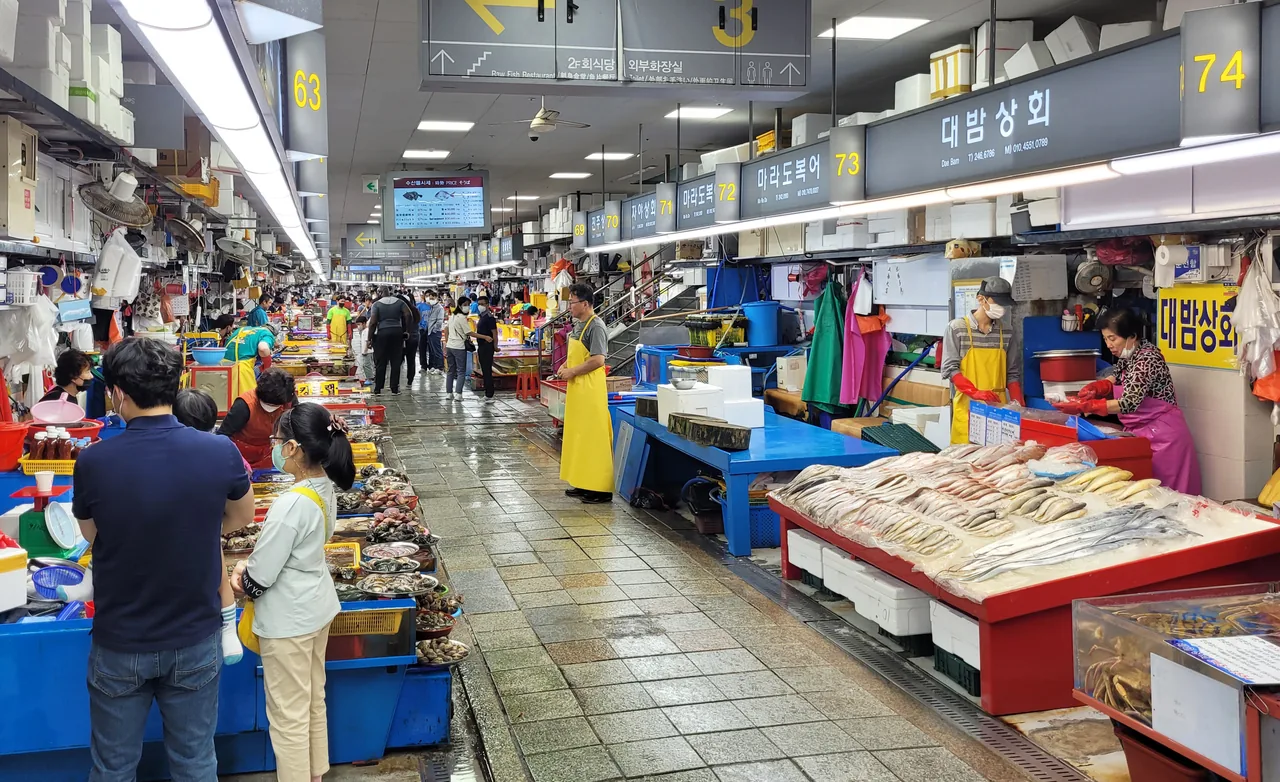
The bustling indoor aisles of Jagalchi Market, Korea’s largest seafood market. Photo: Bernard Gagnon, CC0, via Wikimedia Commons.
⚡ Quick Facts
🚇 Getting there
Jagalchi Stn (Line 1), Exit 10
🕐 Hours
05:00-22:00 (closed 1st/3rd Tue)
💵 Admission
Free
⏱️ Time needed
1-1.5 hours
1. Is Jagalchi Market worth visiting?
Yes — Jagalchi is one of Busan’s defining experiences and a must for any first-time visitor, whether or not you eat seafood. As Korea’s largest fish market it’s a feast for the senses: rows of stalls piled with the day’s catch, live tanks, the shouts of the sellers and the salt smell of the harbour.
There are two reasons to come. First, the atmosphere — it’s a window into real, working Busan, free to wander and endlessly photogenic. Second, the food — there is nowhere fresher in the city to eat seafood, and the buy-downstairs, eat-upstairs ritual is an experience in itself. It’s also right in the Nampo-dong downtown, so you can easily fold it into a day with BIFF Square and Gukje Market.
Bottom line: go for the atmosphere and stay for the seafood. Come hungry, ideally late morning or midday, and don’t be shy about wandering the aisles before you choose a stall.
2. What is Jagalchi Market?
Jagalchi is South Korea’s largest seafood market, on the Nampo-dong waterfront in Busan’s Jung-gu (central) district. Its roots go back to the years after the Korean War, when women — refugees and fishermen’s wives — sold fish along the shore to survive. Those sellers became an icon: the Jagalchi ajumma, and the market grew into the symbol of Busan’s seafood culture.
The scale: a huge modern market building on the harbour, plus a warren of outdoor stalls and dried-seafood shops in the surrounding streets.
The slogan: you’ll hear (and see) “Oiso, boiso, saiso” — Busan dialect for “come, see, buy.”
On the water: it sits right on Busan’s South Harbour, so the upstairs restaurants and rooftop have harbour views.
Tip: the main indoor building is the easiest place to start — clean, organised, with the live-tank stalls downstairs and the restaurants directly above. The outdoor lanes are great for browsing dried fish and a more old-school atmosphere.
3. How it works: pick downstairs, eat upstairs
The signature Jagalchi experience is simple: choose your live seafood from a stall on the ground floor, then take it to a second-floor restaurant, which prepares it however you like for a cooking/table fee.
Style
What you get
Hoe (raw / sashimi)
Sliced raw fish, the most popular choice — eaten with chilli paste, soy and wraps
Grilled (gui)
Shellfish, fish or eel grilled at your table
Steamed (jjim)
Crab, abalone and shellfish, steamed
Spicy stew (maeuntang)
Often made from the bones/leftovers after sashimi — a hot, spicy fish soup
The fee: the restaurant charges a per-person preparation/side-dish fee (often called sangcharim) on top of what you paid for the seafood. Ask the price first.
A common combo: order your fish as sashimi, then ask for the frame to be made into a spicy maeuntang to finish.
Don’t fancy choosing? Plenty of the upstairs restaurants also serve set menus, so you can just sit down and order.
Tip: agree both the seafood price and the per-person table fee before anything is cooked. A quick “how much in total?” saves any surprises.
4. What to eat at Jagalchi
From everyday fish to special-occasion shellfish, Jagalchi has it all — here’s what to look for.
Hoe (raw fish): flounder, sea bream and more, sliced fresh — the classic order.
King crab & snow crab: a splurge, usually sold by weight and steamed upstairs.
Abalone (jeonbok): grilled or raw; a Korean delicacy.
Scallops & shellfish (jogae): grilled at the table — smoky, buttery and great with soju.
Live octopus (san-nakji): for the adventurous, served still moving.
Eel (kkomjangeo): spicy grilled hagfish, a Busan specialty.
Dried seafood: in the outer lanes — squid, anchovies and seaweed, great for gifts.
Tip: if you’re new to all this, a mixed sashimi platter (modeumhoe) plus a grilled shellfish plate is a crowd-pleasing way to sample a lot at once.
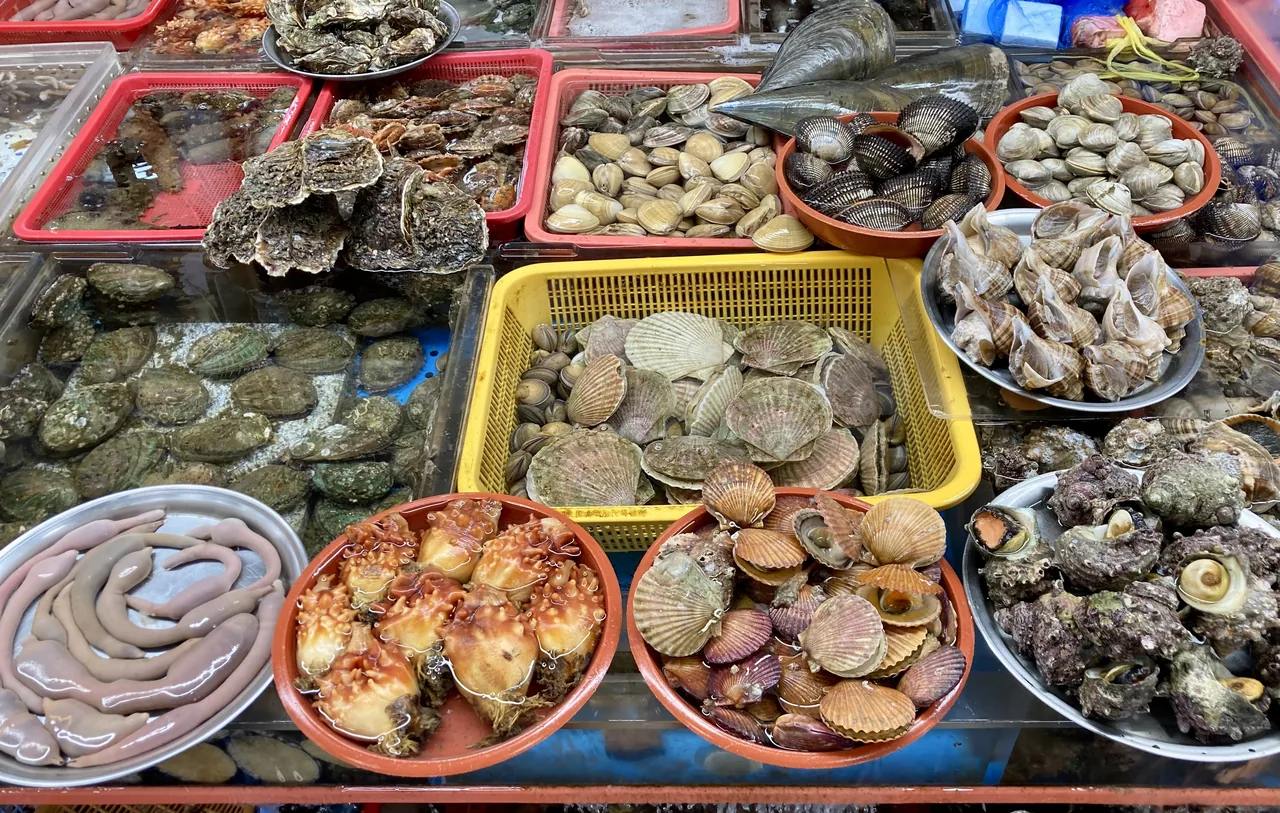
Shellfish, abalone, scallops and sea squirt on display at a Jagalchi Market stall. Photo: Dudva, CC BY-SA 4.0, via Wikimedia Commons.
5. Prices and how to avoid overpaying
Seafood at Jagalchi is sold at the daily market rate, not a fixed menu price, so the single most useful habit is to confirm the price before you commit. It’s a working market, and a little clarity goes a long way.
Ask the total, not just the rate: agree the price per weight and the total for what you’re buying before it’s bagged.
Check the table fee: upstairs, confirm the per-person preparation/side-dish charge in advance.
Watch the weighing: it’s normal to see your seafood weighed — just keep an eye on it.
Browse first: walk a few stalls to get a feel for prices before choosing.
Avoid surprises: never let seafood be prepared before you’ve agreed the price. A friendly “how much altogether?” up front prevents the most common complaint at any fish market — a bill bigger than expected.
6. Visiting: hours, closing days and getting there
Jagalchi is in central Busan and easy to reach by subway; aim for daytime, and note the Tuesday closures.
Detail
Info
Location
Nampo-dong, Jung-gu, Busan (on the South Harbour)
Getting there
Jagalchi Station (Metro Line 1), Exit 10, ~6 min walk (Nampo Station is also close)
Hours
Roughly early morning to around 10pm; 2nd-floor restaurants from mid-morning — check current times
Closed
Most stalls close the 1st and 3rd Tuesdays of the month
Best time
Late morning to midday for the freshest selection
Subway is easiest: from Jagalchi Station take Exit 10 and walk toward the harbour.
Go on a non-Tuesday if you can, to be sure the market is in full swing.
Combine it with nearby Nampo-dong sights for a half-day downtown.
Tip: mornings are liveliest and freshest; if you want a meal, the second-floor restaurants generally get going later in the morning, so midday is a safe bet for both the buzz and lunch.
7. The Jagalchi Festival (October)
Every October, Jagalchi hosts the Busan Jagalchi Festival, the country’s biggest seafood festival, right around the market and harbour. For a few days the area fills with food stalls, performances, seafood tastings and events celebrating the city’s fishing heritage.
When: mid-to-late October each year (the 2025 edition ran 23–26 October; 2026 is expected in October — confirm the exact dates closer to the time).
What happens: seafood markets and tastings, cultural performances, and a festive harbour-side atmosphere.
Why go: it’s the liveliest time to experience Jagalchi, and it pairs well with autumn, one of the best seasons to visit Busan.
Tip: if your trip falls in October, check the festival dates — it’s a great add-on, and it overlaps with one of Busan’s most pleasant times of year.
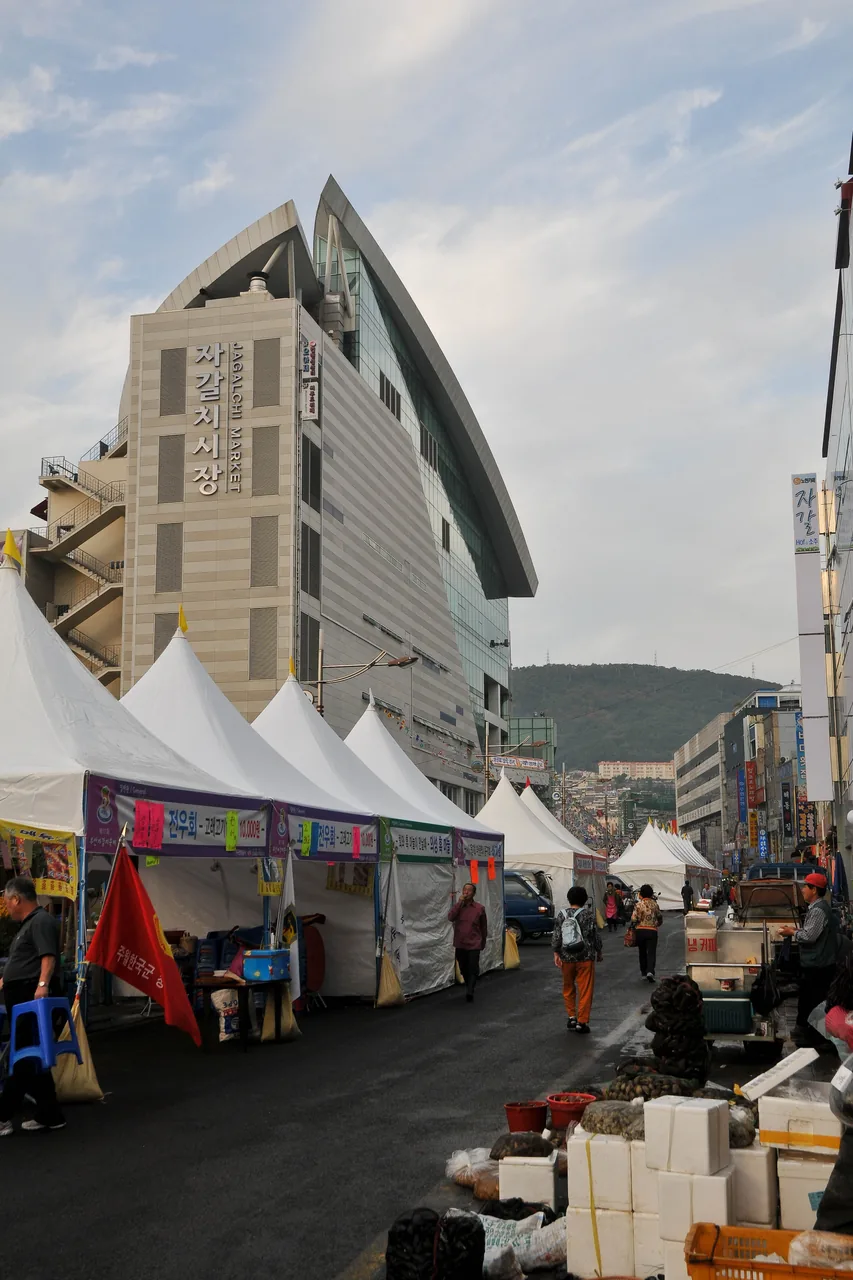
The Jagalchi Market building on Busan’s South Harbour, with festival stalls outside. Photo: Doo Ho Kim, CC BY-SA 2.0, via Wikimedia Commons.
8. What’s nearby
Jagalchi sits in the heart of old Busan, surrounded by some of the city’s most famous downtown sights — all walkable.
Nearby
What it is
BIFF Square
Busan’s cinema street, packed with street-food stalls (try the ssiat hotteok)
Gukje Market
A huge, historic traditional market for clothes, goods and snacks
Because everything clusters around Nampo, you can easily build a half- or full-day: seafood at Jagalchi, street food at BIFF Square, browsing at Gukje Market, and a walk across to Yeongdo for the coast.
Tip: a great plan is lunch at Jagalchi, then street food and shopping around BIFF Square and Gukje Market — all within a few minutes’ walk.
9. Tips and verdict
A few last things to make the most of Jagalchi.
Come hungry and curious — browse before you buy, and ask sellers what’s good that day.
Agree prices first — both the seafood and the upstairs table fee.
Bring cash as well as a card; some stalls prefer it.
Go late morning for the best of both the market and the restaurants.
Wear comfortable shoes — the market floors can be wet.
Verdict: Jagalchi is Busan in a single place — loud, salty, generous and utterly fresh. As Korea’s largest seafood market, it’s both a free, atmospheric sight and the best seafood meal in the city, with the unforgettable ritual of choosing your catch downstairs and eating it upstairs minutes later. Easy to reach in Nampo and simple to combine with BIFF Square and Gukje Market, it belongs on every Busan itinerary. Plan it with our complete Busan Travel Guide.
Yes — it’s one of Busan’s defining experiences and Korea’s largest seafood market. Even if you don’t eat seafood, the atmosphere is a real window into working Busan: rows of stalls, live tanks, the famous Jagalchi ajumma and the harbour air. And if you do eat, there’s nowhere fresher in the city. It’s free to wander and easy to combine with the Nampo-dong downtown.
Q. How do you eat at Jagalchi Market?
The classic way is to buy your live seafood from a stall on the ground floor, then take it to a restaurant on the second floor, which prepares it as raw hoe (sashimi), grilled, steamed or in a spicy stew for a per-person preparation/side-dish fee. Many upstairs restaurants also offer set menus if you’d rather just sit down and order. Always agree the prices before anything is cooked.
Q. How much does it cost to eat at Jagalchi?
Seafood is sold at the daily market rate, not a fixed price, so the cost depends on what and how much you choose. On top of the seafood, second-floor restaurants charge a per-person preparation/side-dish fee (sangcharim). The key is to confirm both the seafood total and the table fee before you commit — a quick ‘how much altogether?’ avoids any surprises.
Q. How do I get to Jagalchi Market?
Take Busan Metro Line 1 to Jagalchi Station, leave by Exit 10 and walk about 6 minutes toward the harbour; Nampo Station is also nearby. The market is in Nampo-dong in Jung-gu, right on Busan’s South Harbour, and it’s well signed.
Q. What are Jagalchi Market’s opening hours?
The market runs roughly from early morning to around 10pm, with the auction and stalls busiest early; the second-floor restaurants generally open mid-morning. Most stalls close on the 1st and 3rd Tuesdays of the month. Times vary by shop, so check current hours before a special trip.
Q. What should I eat at Jagalchi Market?
Popular choices include raw fish (hoe) such as flounder and sea bream, king or snow crab, abalone, grilled scallops and shellfish, live octopus (san-nakji), sea squirt, and Busan’s spicy grilled eel (kkomjangeo). A mixed sashimi platter plus a grilled shellfish plate is a great way to try a lot at once, and you can finish with a spicy maeuntang stew.
Q. When is the Jagalchi Festival?
The Busan Jagalchi Festival, Korea’s largest seafood festival, is held around the market every October (the 2025 edition ran 23–26 October; 2026 is expected in October). It brings food stalls, tastings and performances to the harbour, and it’s the liveliest time to visit — though check the exact dates closer to your trip.
Q. Is Jagalchi Market expensive?
It can be as cheap or as splurgy as you like. Everyday fish for sashimi is reasonable, while king crab and abalone are pricier and sold by weight. Because prices follow the market rate, the smart move is to browse a few stalls, then agree the weight, total and table fee upfront. Bring some cash as well as a card.
Q. What’s near Jagalchi Market?
It’s in the heart of old Busan, walking distance from BIFF Square (cinema street and street food), Gukje Market (a huge traditional market), and the Nampo-dong and Gwangbok-ro shopping streets. Yeongdo island — with Huinnyeoul Culture Village and Taejongdae — is just across the bridge, so it’s easy to build a full downtown day.
Q. Is Jagalchi Market good for non-seafood eaters?
Yes, even if you don’t eat seafood it’s worth visiting for the atmosphere alone, and it’s completely free to walk around. Nearby BIFF Square and Gukje Market have plenty of non-seafood street food and snacks, so you can soak up Jagalchi and eat elsewhere a few minutes away.