
Busan When It Rains: Indoor Things to Do, Prices & Hours
Rain in Busan is heavy but short, and the 2026 rainy season is already over. Here is how to plan a wet day, including the museum closures worth checking first.
| Wettest month | July, 326.8 mm spread over 13.6 rainy days |
|---|---|
| Rain hours | Rain falls during only 13.5% of the hours in July |
| Intensity | 3.26 mm per hour in July against 0.80 in January |
| Closed now | Busan Museum of Art since 2023; MOCA Busan is open again |
| Mondays | All six free museums and the Cinema Center close |
| Best indoor | Shinsegae Centum City: spa, ice rink, food, metro linked |
1. When Busan’s rainy season runs
2. How much rain Busan really gets
3. Busan rain is heavy, but it is short
4. What to do if it is raining today
5. Museum closures worth checking before you go
6. SEA LIFE Busan Aquarium
7. Hot springs and jjimjilbang: Spa Land and Hurshimchung
8. Shinsegae Centum City, where a whole day fits in one building
9. Busan Cinema Center
10. Free indoor space: six museums that cost nothing
11. Rainy days with children
12. Busan X the Sky, and why rain is the wrong day for it
13. Markets with a roof over them
14. Walking underground instead of above ground
15. Indoor cafes with a sea view
16. F1963 and Yeongdo
17. Lotte World Adventure Busan and the outdoor attractions
18. Two rainy day routes that actually work
For everything else about the city, start with complete Busan travel guide.
1. When Busan’s rainy season runs
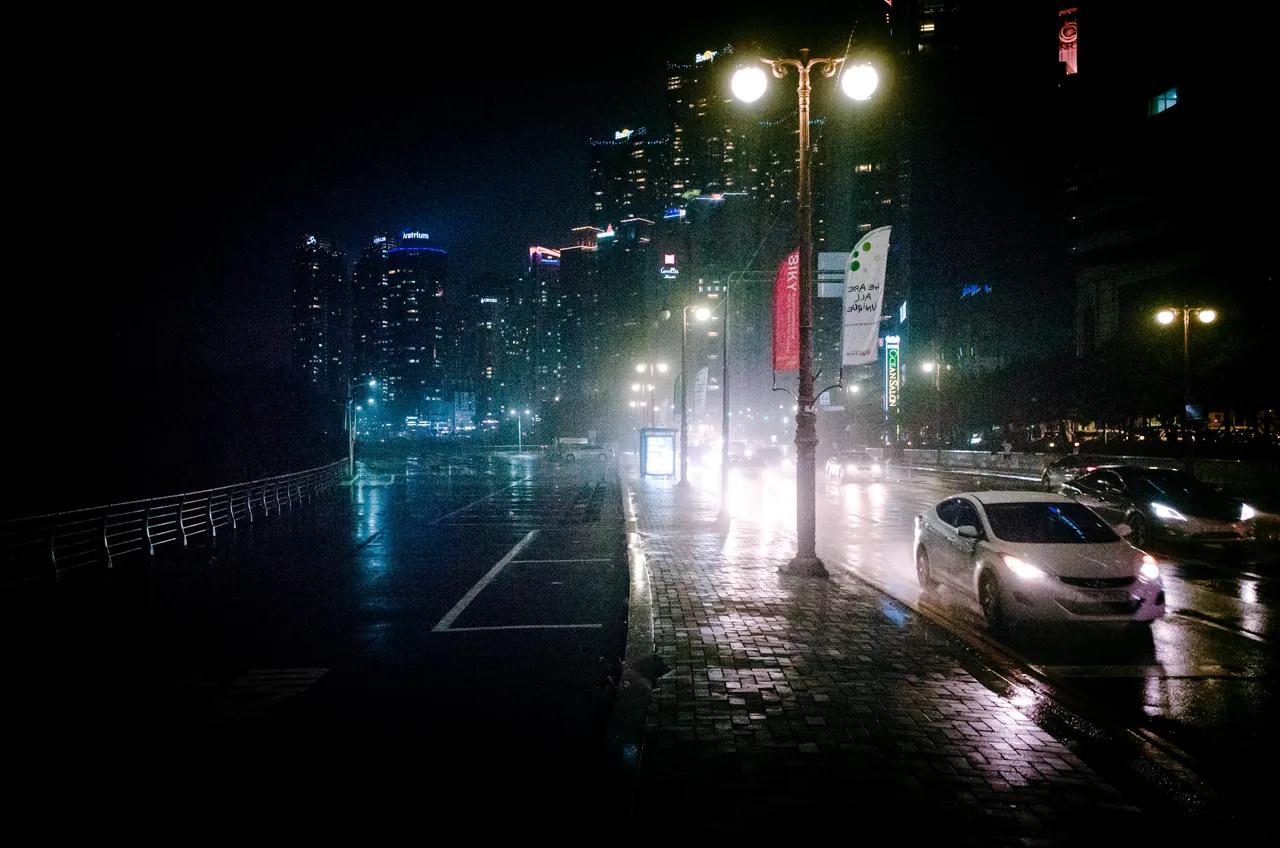
Busan’s monsoon normally runs from late June to late July, and once it clears, August into early September brings short heavy showers and typhoons rather than days of continuous drizzle. The start date moves a lot from year to year. In 2026 the rainy season opened in the southern region, Busan included, on 1 July. That was the fifth latest start since records began in 1973, against a normal southern start of around 23 June.
It also ended quickly. Jeju finished on 19 July, and the central and southern regions closed out after the rain stopped on 26 and 27 July. National accumulated rainfall from 1 to 21 July was 206.0 mm, and adding June’s 95.4 mm brings the season to 301.4 mm, which is 67.8 percent of the 444.6 mm normal.
The rain that did fall concentrated on single regions instead of spreading evenly across the country, so one area could take a warning level downpour on a day another stayed dry. After the monsoon the North Pacific high and the Tibetan high overlapped and the heat set in. For month by month planning, see Busan in July, Busan in August and Busan in September, or compare the whole year in the best time to visit Busan.
2. How much rain Busan really gets
Busan receives 1,576.7 mm of rain in an average year, and 593.3 mm of that falls in July and August alone. The figures below are the Korea Meteorological Administration climate normals for 1991 to 2020 at Busan station 159. They describe the average year, not any particular trip.
| Month | Rainfall (mm) | Rainy days | Hours of rain | Heaviest day (mm) | Mean temp (°C) |
|---|---|---|---|---|---|
| January | 34.5 | 5.4 | 43.2 | 17.8 | 3.6 |
| February | 49.6 | 5.9 | 44.3 | 28.3 | 5.4 |
| March | 89.7 | 8.3 | 64.9 | 34.0 | 9.1 |
| April | 140.9 | 9.2 | 73.0 | 55.1 | 13.8 |
| May | 155.9 | 9.1 | 76.5 | 61.4 | 17.9 |
| June | 188.4 | 10.4 | 87.6 | 74.3 | 21.0 |
| July | 326.8 | 13.6 | 100.2 | 115.9 | 24.4 |
| August | 266.5 | 11.9 | 82.5 | 89.0 | 26.1 |
| September | 160.6 | 9.2 | 72.7 | 70.7 | 22.6 |
| October | 79.6 | 5.3 | 39.8 | 46.3 | 17.9 |
| November | 50.4 | 6.0 | 37.8 | 27.8 | 11.9 |
| December | 33.8 | 4.7 | 30.2 | 19.8 | 5.8 |
Humidity peaks in the same month at 83.4 percent, with August close behind at 78.5 percent. That is a second reason to put an air conditioned stop into a summer afternoon even when nothing is falling, and it is why the driest travel months in Busan run from October to February.
3. Busan rain is heavy, but it is short
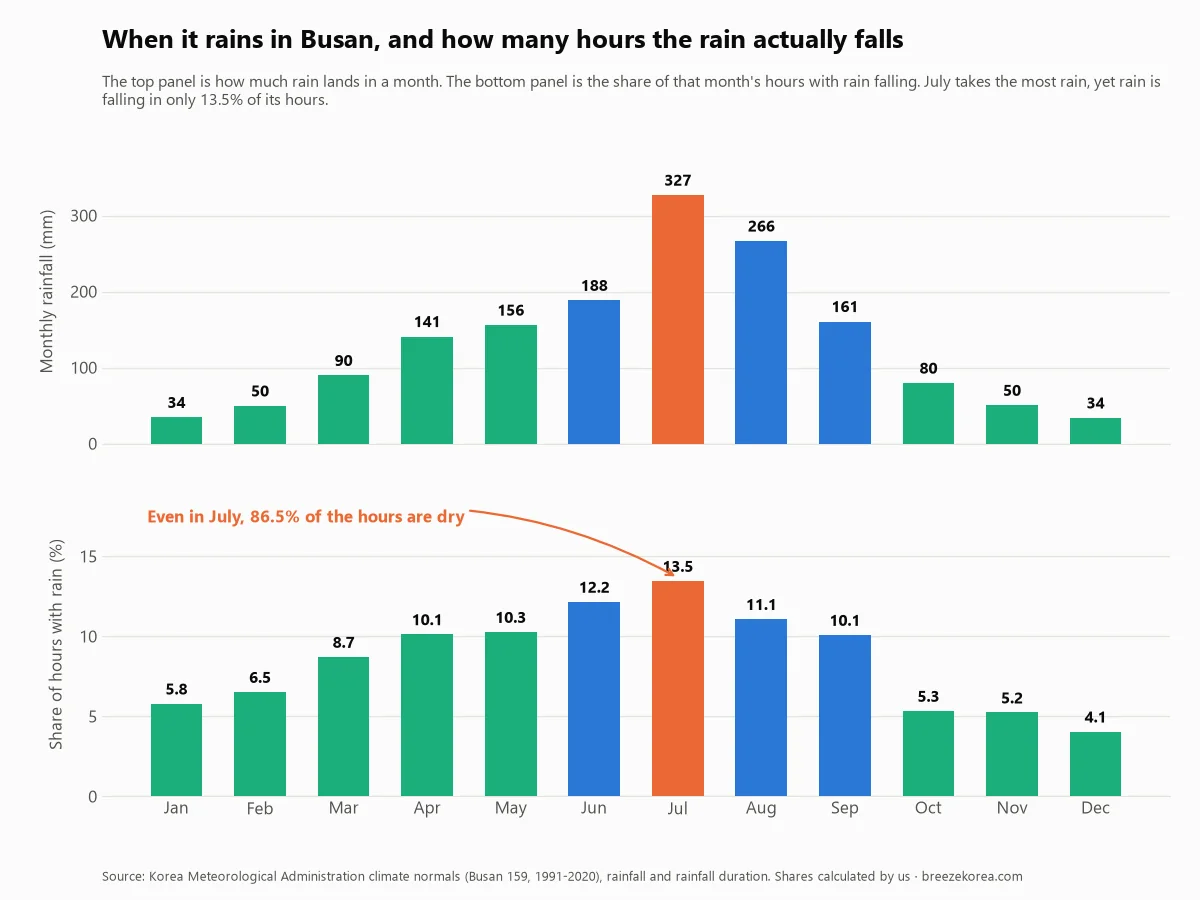
In July, the wettest month of the year, rain is actually falling during only 13.5 percent of the hours in the month. The climate normals record hours of precipitation alongside millimetres, and dividing one by the other changes how a rainy trip should be planned.
| Month | Hours in the month | Hours of rain | Share of hours with no rain |
|---|---|---|---|
| July | 744 | 100.2 | 86.5% |
| August | 744 | 82.5 | 88.9% |
| June | 720 | 87.6 | 87.8% |
| September | 720 | 72.7 | 89.9% |
| January | 744 | 43.2 | 94.2% |
What the summer months have instead is intensity. Rainfall divided by hours of rain gives 3.26 mm per hour in July and 3.23 in August, against 0.80 in January, so an hour of summer rain in Busan drops roughly four times the water of an hour of winter rain.
The same division per rainy day shows how long it keeps going. A July day that records rain averages 7.4 hours of it and August 6.9 hours, while January averages 8.0 hours per rainy day even though the total is small. Winter rain in Busan lasts longer on the days it appears.
The practical version is to fix two or three indoor stops and leave the gaps loose, rather than writing off the whole day. The metro removes most of the risk from the hours you cannot forecast.
4. What to do if it is raining today
Decide by how hard it is raining, not by whether the forecast shows a cloud icon. A summer shower in Busan often passes inside an hour, so a radar app is more useful than a daily forecast when you are choosing between an outdoor and an indoor plan.
The single decision that protects a rainy day is transport. Anything reachable on the Busan metro can be reached without standing outside for long, while Gijang, Osiria and the far side of the harbour involve exposed transfers.
5. Museum closures worth checking before you go
Busan’s art museums have been through a run of renovations and temporary closures, so confirm the dates before you build a rainy day around art. The schedule below was checked in August 2026 and some of these venues will have reopened since, so treat it as a prompt to check rather than a current status.
| Venue | Status | Dates |
|---|---|---|
| Busan Museum of Art, main building | Long term closure for renovation | Closed since 18 December 2023. Reopening is planned for autumn 2026 and the exact date has not been announced |
| Museum of Contemporary Art Busan, Eulsukdo | Open as usual | The temporary closure is over. Tuesday to Sunday, 10:00 to 18:00, last entry 17:30 |
| Busan Museum, second floor art hall | One hall at a time, rest of the museum open | Maintenance closes a single room now and then; check the notice if you are going for one gallery |
Space Lee Ufan, which stands on the Busan Museum of Art site, is open through the renovation and admission is free for the duration because the main building is closed. It runs 10:00 to 18:00 with last entry at 17:30, and closes on Mondays and 1 January.
6. SEA LIFE Busan Aquarium
SEA LIFE Busan Aquarium is built three floors below ground at Haeundae beach, which makes it the one attraction in the area that the weather cannot affect. It holds eight zones, around 250 species and an 80 m underwater tunnel.
SEA LIFE Busan AquariumMapOpening hours are 10:00 to 19:00 Monday to Friday with last entry at 18:00, and 10:00 to 20:00 at weekends with last entry at 19:00. Hours shift with the season and conditions, and the aquarium has opened at 09:00 on peak days.
Pricing is dynamic and changes by date. The official listing shows child tickets at 22,000 to 27,500 won on the day and 19,000 to 23,500 won booked in advance, with adult tickets higher than that, and advance booking is discounted by up to 30 percent. A child is 36 months to 13 years old, an adult ticket starts at 14, and under 36 months is free. The combined ticket with Brickman Cities is 38,000 won for adults and 33,500 won for children.
The entrance is about a six minute walk from exit 5 of Haeundae Station on metro line 2, so you can arrive without crossing the beach. It is also included in the Visit Busan Pass. There is more detail in the full SEA LIFE Busan Aquarium guide and in the wider Haeundae area guide.
7. Hot springs and jjimjilbang: Spa Land and Hurshimchung
Spa Land inside Shinsegae Centum City and Hurshimchung in Dongnae are the two bathhouses worth a rainy afternoon, and they solve different problems. Spa Land is part of a department store you can reach underground from the metro, while Hurshimchung uses Dongnae hot spring water and opens before dawn.
| Spa Land Centum City | Hurshimchung, Dongnae | |
|---|---|---|
| Hours | 08:00 to 23:00, last entry 22:00 | Baths 05:30 to 22:00, last entry 21:30. Jjimjilbang 06:30 to 21:00. Open every day |
| Adult admission | 26,000 won | 15,000 won on weekdays, 18,000 won at weekends and on public holidays |
| Younger visitors | 21,000 won for students born 2008 to 2019 | 11,000 or 12,000 won for primary school age, 7,000 won from 12 months to preschool |
| Time included | 4 hours, or 6 hours if you spend 10,000 won or more inside on top of admission | 4 hours for the baths, 6 hours with the jjimjilbang, up to 7 hours including the food outlets |
| Going over | 5,000 won per extra hour | 2,000 won per extra hour |
| Extras | Parking free for 4 hours, or 6 with 10,000 won of spending | Jjimjilbang facilities 4,000 won including gown hire. Groups of 20 or more pay 12,000 or 15,000 won |
Spa Land admits children from primary school age, and a primary school child must be accompanied by a guardian of the same sex. There are also restrictions relating to visible tattoos, which are worth checking in advance if that applies to you. General enquiries are on 1668-2850 for Spa Land and 051-550-2200 for Hurshimchung.
The time limits matter more than the price, because both venues charge by the hour once the included window ends. More options are set out in the Busan jjimjilbang and hot spring guide.
8. Shinsegae Centum City, where a whole day fits in one building
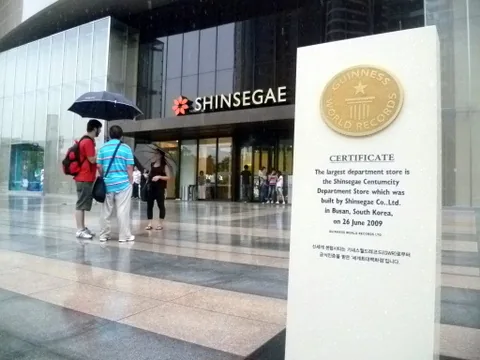
Shinsegae Centum City is the largest department store in the world by Guinness World Records, registered on 26 June 2009 and still holding the record, and it connects to the metro underground. That combination is what makes it the default answer for a wet day in Busan: you arrive on line 2 at Centum City Station and never step outside.
Shinsegae Centum CityMapRetail floors run 10:30 to 20:00, extending to 20:30 on some days, and the restaurant floors run 11:00 to 21:00 with last orders 30 minutes before closing. Inside the building are Spa Land on the first floor, an ice rink on the fourth, the Trinity Club on the tenth and a golf range on the eleventh.
The ice rink runs 10:30 to 18:00 on weekdays and 10:30 to 20:30 at weekends. Weekday admission is 16,000 won for adults and teenagers and 13,000 won for children, rising to 17,000 and 14,000 won at weekends. The 18:00 to 20:00 slot on weekdays is reserved for lessons, and the rink number is 051-745-1400.
Two metro stops separate Centum City from Haeundae, which is why this side of the city works as a rain plan even if your hotel is at the beach. More on the retail options is in the Busan shopping guide.
9. Busan Cinema Center
The Busan Cinema Center is the one cinema in the city worth travelling to in the rain, because the building itself is part of the visit. It stands at 120 Suyeonggangbyeon-daero in Haeundae district, and the Big Roof over the complex is an attraction in its own right.
Busan Cinema CenterMapScreens include the Cinematheque, a mid sized hall, a small hall, Indie Plus, the Haneulyeon Theater and the Roof Theater. Programming leans towards retrospectives, independent releases and festival seasons rather than blockbusters, so it is worth reading the schedule before you go rather than turning up.
Season pricing gives a usable reference point. World Cinema 2026, which ran 2 June to 1 July across 23 screenings, was priced at 7,000 won general and 5,000 won for paying members, young people and seniors. The centre is closed on Mondays, with exceptions for some programmes, and the enquiry lines are 051-780-6000 and 051-780-6080.
The Busan Cinema Center guide covers the programme structure and the individual halls in more detail.
10. Free indoor space: six museums that cost nothing
Six museums in Busan charge no admission at all, which makes a rainy day cost nothing beyond transport. They are spread across the city rather than clustered, so pick by which district you are already in. There are more free doors than these six. All 41 museums in Busan sets out the whole city listing by subject.
| Museum | Hours | Closed |
|---|---|---|
| Busan Museum, Daeyeon | 09:00 to 18:00, last entry 17:00 | Mondays, 1 January |
| National Maritime Museum of Korea, Yeongdo | 09:00 to 18:00 Tuesday to Friday, last entry 17:30. Saturdays, Sundays and public holidays 09:00 to 19:00, last entry 18:30 | Mondays |
| Busan Modern History Museum, Jung-gu | 09:00 to 18:00, last entry 17:00 | Mondays, 1 January |
| National Memorial Museum of Forced Mobilization, Daeyeon | 09:30 to 17:30, last entry 30 minutes before closing | Mondays, 1 January, Seollal and Chuseok |
| Provisional Capital Memorial Hall, Seo-gu | 09:00 to 18:00 | Mondays, 1 January |
| Space Lee Ufan, next to BEXCO | 10:00 to 18:00, last entry 17:30 | Mondays, 1 January |
National Maritime Museum of KoreaMap
Busan Modern History MuseumMap
The Maritime Museum is the strongest choice for a long stay because it contains an aquarium, a children’s museum and a maritime library under one roof, and only the 4D theatre and paid special exhibitions cost extra. Parking is free at the Forced Mobilization museum.
11. Rainy days with children
The three indoor options that hold children for a full session are the Busan National Science Museum, the Samjin Eomuk cooking class on Yeongdo and the Centum City ice rink. Each one runs to fixed hours or fixed session times, which makes a wet day easier to build around them than around an open ended attraction.
Busan National Science MuseumMapThe science museum in Gijang runs 09:30 to 17:30 with ticket sales ending at 16:30. The permanent exhibition is 3,000 won for adults and 2,000 won for young people, and the separate children’s science hall is 2,000 won. It closes on Mondays, 1 January and the days of Seollal and Chuseok, plus three extra dates in 2026: 18 August, 25 September and 6 October.
Samjin Eomuk Experience CenterMapThe Samjin Eomuk experience and history hall on Yeongdo runs a fish cake making class at 20,000 won per person, priced the same on weekdays and weekends for individuals, with 15,000 won for nursery and kindergarten groups. Weekday sessions start at 10:30, 13:30 and 15:30, and weekend sessions at 10:00, 13:00, 14:30 and 16:00. What you make is cooked and eaten on site. Reservations are on 051-412-5468.
The aquarium at Haeundae is the fourth option and works for a wider age range, while the ice rink at Centum City suits older children and comes with the rest of the department store attached if the session ends early.
12. Busan X the Sky, and why rain is the wrong day for it
An indoor observation deck sounds like the perfect rainy day plan, but Busan X the Sky is the one attraction here that heavy rain makes pointless. The deck sits near the top of the LCT tower at Haeundae, and thick rain or fog leaves the windows grey while you still pay the full ticket price.
Busan X the SkyMapIt is better treated as a light rain option, or as somewhere to go once a shower has passed. The deck is open 10:00 to 21:00 every day of the year with last entry at 20:30, so a late change of plan still fits, and observation deck visitors get two hours of free parking.
Check what the sky is doing before you buy rather than after. If cloud is sitting below the top of the tower, spend the afternoon somewhere else and come back at sunset. The Busan X the Sky guide covers ticket types and the best hours to arrive.
Several of the indoor stops in this guide, including the aquarium and this observation deck, are bundled into the Visit Busan Pass, which is worth the arithmetic if your wet day turns into three or four paid attractions. Full details are in the Visit Busan Pass guide.
13. Markets with a roof over them
Three of Busan’s big markets stay usable in rain, and all three are within walking distance of each other in the old downtown. Gukje Market and Bupyeong Kkangtong Market run into one another, and Jagalchi has its own indoor building on the waterfront.
| Market | Hours | Regular closures |
|---|---|---|
| Gukje Market | 09:30 to 19:30 | First and third Sunday of the month |
| Jagalchi Market | 05:00 to 22:00 | Usually the first and third Tuesday of the month |
| Bupyeong Kkangtong Market | Arcade section all day, night market 19:30 to 23:30 | Open all year, with temporary closures before the main holidays |
Gukje MarketMap
Bupyeong Kkangtong MarketMap
Jagalchi MarketMap
Gukje Market is the general goods side and Bupyeong Kkangtong is the food side, which is the practical way to split a few hours between them. Bupyeong Kkangtong is covered by arcade roofing strung between buildings, though modernisation has been completed in some sections and not others, so a few lanes are still open to the sky.
Jagalchi is the one to prioritise if the rain is heavy, because the seafood market occupies a dedicated indoor building rather than street stalls. Check the date against the closure column before you travel, since two of the three take regular days off. Details are in the Jagalchi Market guide, and the surrounding district is covered in the Nampo-dong guide.
14. Walking underground instead of above ground
Busan has six underground shopping arcades attached to metro stations, so a good part of the city centre can be crossed without an umbrella. They run under Seomyeon, Jungang, Nampo, Gwangbok, Gukje and Busan Station, and each connects directly to the platforms above.
The Seomyeon arcade is the largest draw of the six for shopping. Clothing, accessories and shoes make up most of the units and the price level is low, which suits an hour of browsing more than a targeted purchase. The surrounding district is covered in the Seomyeon guide.
The Nampo arcade is at 17 Jungang-daero Underground in Jung-gu, with an information line on 051-713-8200. It links the Nampo and Gwangbok sections towards Gukje Market, so the old downtown can be covered on foot in bad weather with only short spells above ground.
15. Indoor cafes with a sea view
Busan has a large number of glass fronted cafes facing the water, and they are the low effort answer to an afternoon of rain. The coastline runs close to the built up areas, so several of these are reachable without leaving the city.
Wave On at 286 Haemaji-ro in Jangan-eup, Gijang County, is the best known of them. It opens 11:00 to 24:00 every day, has floor to ceiling glass and high ceilings, and the enquiry line is 051-727-1660. It is a long way out of the city, so pair it with Gijang rather than treating it as a city centre stop.
Cheongsapo, Gwangalli and Yeongdo all have clusters of glass walled cafes closer in, which is the better option if you do not want a long transfer in bad weather. Individual menu prices have not been verified and are not listed here. More options are in the Busan sea view cafe guide.
16. F1963 and Yeongdo
F1963 in Suyeong is a former Kiswire wire rope factory converted into a cultural complex, and it is open 09:00 to 21:00 every day. The conversion kept the industrial structure, so the building is a reason to go on its own.
F1963MapInside are a Yes24 second hand bookshop, a Terarosa coffee roastery, Hyundai Motorstudio Busan, a library and a glass greenhouse. The bookshop and the coffee house together will hold a couple of hours, and the late closing time makes it one of the few cultural venues in Busan that still works after the museums shut at 18:00.
Yeongdo is the other half of this pairing and holds two of the entries above: the National Maritime Museum and the Samjin Eomuk experience hall. The island is served by bridge rather than metro, so allow for bus or taxi time in wet weather. Background on both is in the Yeongdo guide and the Busan fish cake guide.
17. Lotte World Adventure Busan and the outdoor attractions
Lotte World Adventure Busan is an outdoor park, so rain stops most of the rides and some days end with an early closure. It still has an indoor core, and a rainy visit is a question of whether that core is worth the ticket rather than whether the park is open.
Lotte World Adventure BusanMapThe indoor attractions are Forbidden Castle, which opened on 16 May 2026 and pairs a 5 m high, 38 m long curved screen with motion simulators, plus the Gwimun haunted attraction, a mirror maze and the Kidstoria children’s zone. The Romantic Rainy Parade is a replacement show that runs in the same time slot when weather cancels the standard parade, so the schedule is not simply dropped.
A one day adult ticket is 49,000 won, and the After 3 ticket for entry from 15:00 is 38,000 won. On a doubtful forecast the afternoon ticket carries less risk, since you will know by lunchtime what the sky is doing.
Two other outdoor attractions handle rain better than the park does. Skyline Luge Busan in Gijang runs normally in light rain and stops only for heavy rain, thunder and lightning, while Haeundae Blue Line Park runs through cloud and passing showers and suspends only for strong wind, heavy rain or fog. When the Blue Line Park stops, the usual remedy is a full refund or a date change. Practical detail on the park itself is in the Lotte World Adventure Busan guide.
18. Two rainy day routes that actually work
Two routes cover most rainy days in Busan: the Centum City route on the east side and the Nampo route in the old downtown. Each one keeps you on a single metro line, and each has an indoor fallback within a few minutes of every stop.
Centum City route
Nampo and Jagalchi route
Where you sleep decides which of the two is easier. A room on the Centum City side keeps the department store, Spa Land and the metro within walking distance, which matters more in wet weather than a sea view does. If your trip also takes in the capital, the same approach for a wet day there is in the rainy day Seoul guide.
🎡Things to Do48
🍜Food7
🏨Where to Stay3
🚇Getting Around8
🧭Travel Tips14
📌More3
🧭All-Korea essentials37
Rainy day Busan: common questions
Read the complete Busan travel guide
Images: Rainy night in Haeundae: Anton Strogonoff, CC BY 2.0. Shinsegae Centum City in the rain: Kimberly Hiller, CC BY 2.0. Centum City on an overcast day: Prime number, CC BY 4.0. Via Wikimedia Commons. Rainfall chart: Breeze Korea, from Korea Meteorological Administration climate normals for Busan, 1991-2020.