
Nampo-dong: Gukje Market, BIFF Square & Busan Tower in One Day
Nampo-dong is Busan’s original downtown — a walkable maze of post-war markets, a film-festival street paved with celebrity handprints, a tree-lined fashion boulevard, a hilltop tower over the harbour, and Korea’s first night market, all stitched together by the water. Here’s exactly what to see, eat and do.
- Nampo-dong is the historic heart of Busan — the old downtown in Jung-gu, where the city’s great markets, its film-festival street and its harbour-front tower all sit within one walkable loop.
- The headline draws are Gukje Market and the BIFF Square street-food strip, the Gwangbok-ro fashion boulevard, Yongdusan Park with Busan Tower, the Bupyeong Kkangtong night market, and the secondhand Bosu-dong Book Street.
- Getting here is easy: ride Metro Line 1 to Nampo or Jagalchi station — the whole district is flat, dense and best explored on foot in a single loop.
- Give it half a day to a full day: shop and snack through the markets, ride the escalators up to the tower, then come back at night for the lit-up streets and the night market.
1. Is Nampo-dong worth visiting?
2. How to get to Nampo-dong and get around
3. Gwangbok-ro Fashion Street
4. Gukje Market (국제시장)
5. BIFF Square (BIFF광장)
6. Yongdusan Park & Busan Tower
7. Bupyeong Kkangtong Night Market
8. Bosu-dong Book Street
9. Jagalchi Market & the Nampo waterfront
10. What to eat in Nampo
11. Where to stay in Nampo
12. A ready half-day plan for Nampo
Nampo-dong is where Busan began. Long before the beaches and skyscrapers of Haeundae, this tight grid of lanes in Jung-gu was the city’s downtown — and it still feels like its soul. This is the Busan of the post-war years: the sprawling Gukje Market that grew out of refugee trade, the canned-goods alleys of Bupyeong, a secondhand book street born from the books left behind after liberation, and a cinema strip that became the home of Korea’s biggest film festival. We always give Nampo a day on every trip, because everything is packed into one walkable loop by the harbour: market snacks for breakfast, a ride up the escalators to Busan Tower, an afternoon of bargain shopping on Gwangbok-ro, a seed-stuffed hotteok at BIFF Square, and then the neon and the night-market stalls after dark. This guide is the complete, fact-checked walk-through — how to get there and around, Gwangbok-ro, Gukje Market, BIFF Square, Yongdusan Park and Busan Tower, the Bupyeong night market, Bosu-dong Book Street, the Jagalchi waterfront, what to eat, where to stay, and a ready half-day plan. Plan it alongside the rest of your trip with our complete Busan Travel Guide.
| 🚇 Getting there | Nampo Stn (Line 1) |
| 🕐 Hours | Markets daytime · Bupyeong night market 19:30-24:00 |
| 💵 Admission | Free (Busan Tower ≈ ₩12,000) |
| ⏱️ Time needed | Half day |
1. Is Nampo-dong worth visiting?
Yes — if you want the real, lived-in old Busan rather than the polished beach city, Nampo-dong is essential. It isn’t a single attraction; it’s the city’s historic downtown, and the appeal is the density — markets, street food, shopping, a harbour-front tower and decades of history packed into a few walkable blocks.
- Markets & street food: Gukje Market, the BIFF Square food strip, the Bupyeong Kkangtong night market and Korea’s largest fish market at Jagalchi — this is the best concentration of market eating in the city.
- History & culture: a downtown shaped by the Korean War and the Busan International Film Festival, with the nostalgic Bosu-dong Book Street and the 40-Step Stairs telling the refugee story.
- Views & shopping: Yongdusan Park and Busan Tower for the panorama, and the Gwangbok-ro boulevard — “Busan’s Myeongdong” — for fashion and cosmetics.
2. How to get to Nampo-dong and get around
Nampo-dong sits on Metro Line 1, served by two adjacent stations — Nampo and Jagalchi — so it’s a quick, direct ride from across the city, and the whole district is walkable.
- By metro: ride Line 1 to Nampo Station (for Gwangbok-ro, Gukje Market, BIFF Square and Yongdusan Park) or one stop further to Jagalchi Station (for the fish market and waterfront). From Busan Station (KTX) it’s just a few stops; a rechargeable Cashbee/T-money card makes it seamless.
- The layout: the sights form a compact loop — Nampo Station Exit 7 feeds straight onto Gwangbok-ro, which runs up to Gukje Market and BIFF Square, with Yongdusan Park rising behind and the Jagalchi waterfront below. You can walk the whole thing in an afternoon.
- On foot: the area is flat and pedestrian-friendly, and a covered arcade and back lanes link the markets — easy to wander even in rain or heat.
- The escalators: to reach Yongdusan Park and Busan Tower without the climb, take the outdoor escalators that lead up from the Gwangbok-ro / Gukje Market side.
3. Gwangbok-ro Fashion Street
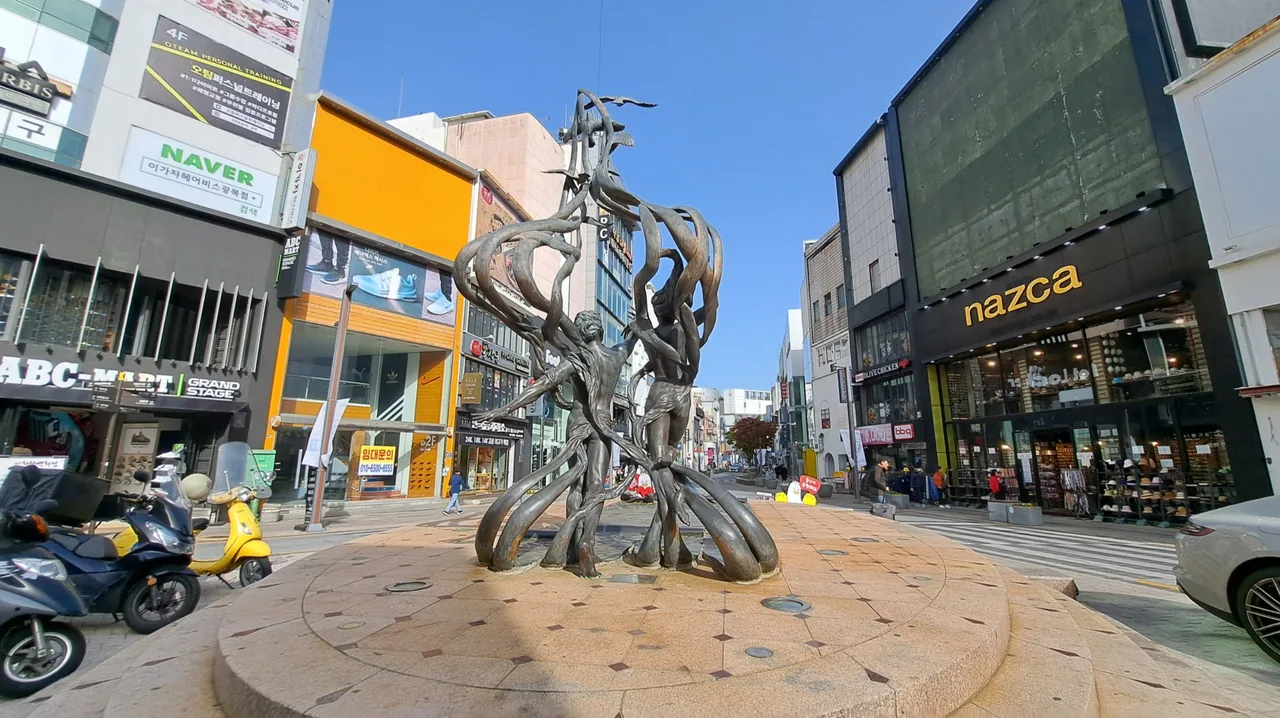
Gwangbok-ro is Nampo’s main shopping boulevard — often called “Busan’s Myeongdong” — a tree-lined pedestrian street packed with fashion brands, cosmetics shops and cafés. It runs from Nampo Station up toward Gukje Market and forms the spine of the whole downtown.
- What’s there: a mix of well-known Korean and international fashion brands, beauty and cosmetics stores, shoe shops, cafés and street stalls — from name brands to bargain finds, all on one walkable stretch.
- The vibe: a leafy, lantern-lit shopping promenade that’s busiest in the late afternoon and evening, when the lights come on and the crowds spill out of the side markets.
- In winter: Gwangbok-ro hosts Busan’s famous Christmas-tree light festival, when the whole boulevard is wrapped in illuminations — one of the city’s signature seasonal sights.
4. Gukje Market (국제시장)
Gukje Market is Busan’s great post-war market — a vast, labyrinthine bazaar of over 60 years that grew out of refugee and aid-goods trade after the Korean War. Its name means “international market,” and it became so woven into the city’s story that it lent its title to the hit 2014 film Ode to My Father.
- What’s there: a dense grid of thousands of stalls selling clothing, fabric, hardware, kitchenware, souvenirs and everything in between — the kind of sprawling, bargain-everything market that has all but vanished elsewhere.
- The food street: Gukje’s Arirang Street food alley is a Busan institution — open-air stalls serving chungmu gimbap (tiny rice rolls with spicy squid), bibim dangmyeon (spicy glass noodles), knife-cut noodles, pajeon and sweet seed hotteok at standing counters.
- How to do it: don’t try to “see it all” — pick a couple of lanes, graze the food street, and treat getting a little lost as part of the experience.
5. BIFF Square (BIFF광장)
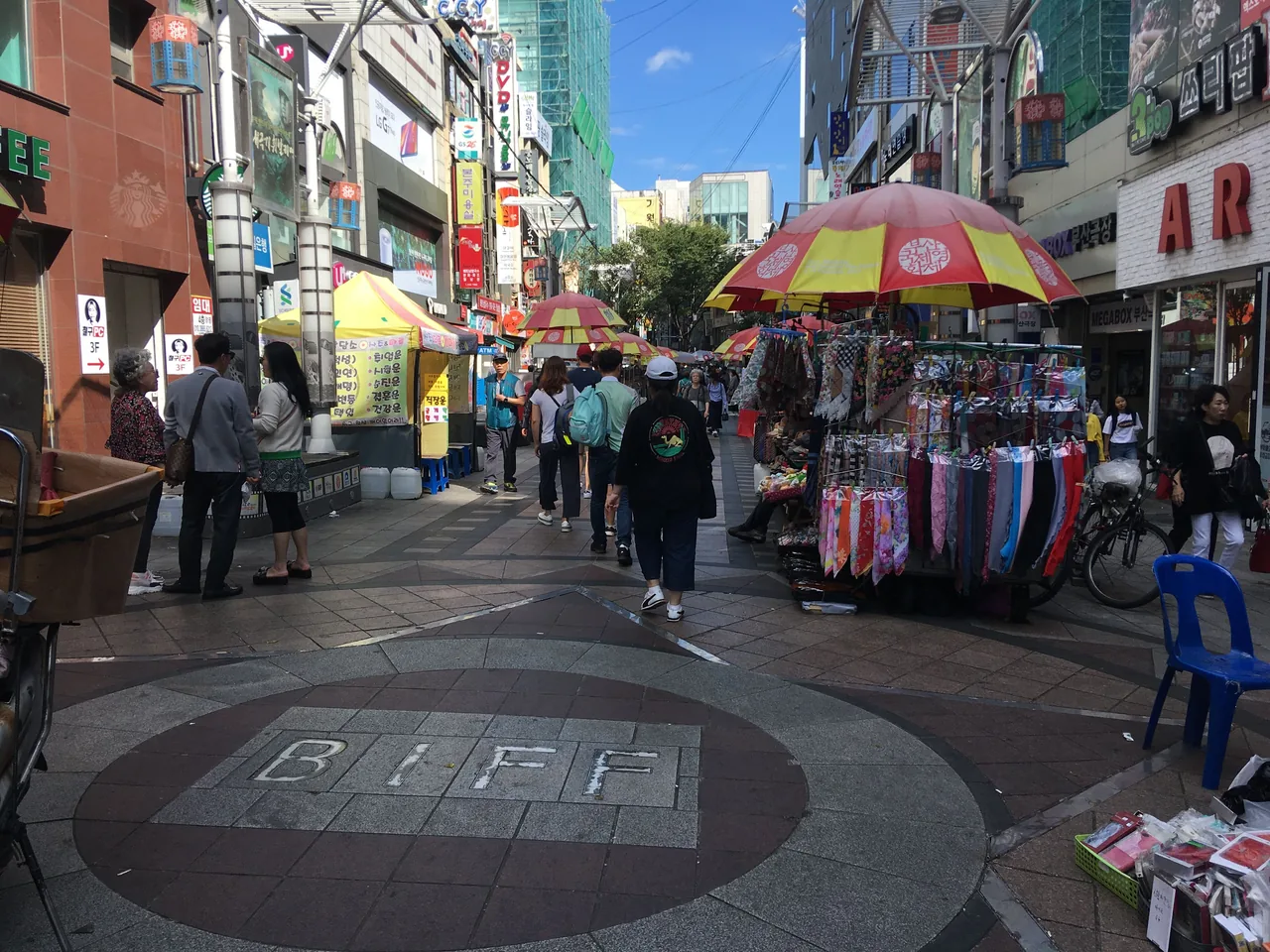
BIFF Square is Nampo’s cinema-and-street-food heart — a roughly 430-metre strip of theatres and food stalls named in 1996 for the Busan International Film Festival. By day it’s a snacking paradise; it’s also the birthplace of Busan’s most famous street snack, the seed-stuffed hotteok.
- The street food: the legendary ssiat hotteok — a fried sweet pancake stuffed with sunflower, pumpkin and sesame seeds, nuts and honey — was popularised here (around ₩2,000 for the seed version, ₩3,000 for the honey one). Stalls also sell tteokbokki, fish-cake skewers, gimbap, taiyaki and roasted chestnuts.
- The handprints: set into the pavement are the gold handprints and signatures of Korean and international film stars and directors who’ve visited the festival over the years — a fun, free thing to hunt for.
- The cinema connection: the strip grew up around Nampo’s old movie theatres and still anchors the area’s film identity, even though the festival’s main venues have since moved to Centum City.
6. Yongdusan Park & Busan Tower
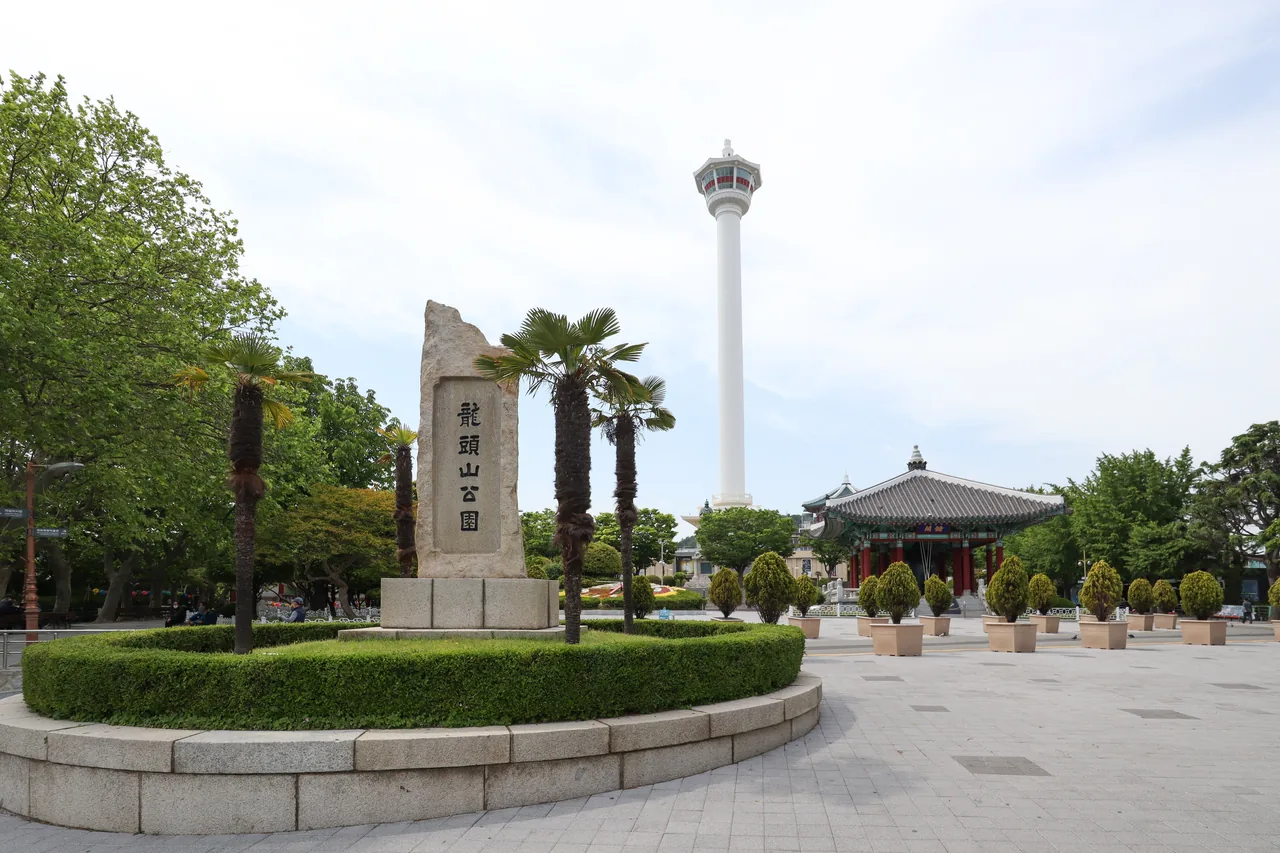
Yongdusan Park is the green hill at the centre of Nampo, crowned by the 120-metre Busan Tower and reached by a set of outdoor escalators from the market streets below. It’s the area’s breathing space and its best viewpoint.
- The park: a leafy hilltop with a flower clock, a bell pavilion, the Chunghon Tower memorial and a dragon sculpture (Yongdusan means “dragon-head mountain”), plus benches and pigeons — a calm pause between the markets.
- Busan Tower: the city’s classic observation tower (also branded the “Diamond Tower”) gives a 360° panorama over Nampo, Busan Port and Yeongdo Island. Tickets are usually around ₩12,000 for adults (cheaper booked online), and after dark a media-façade light show plays over the harbour.
- Free alternative: for a no-cost view, head to the rooftop garden observatory of the Lotte Department Store (Gwangbok branch) by the waterfront, which also has a musical fountain.
7. Bupyeong Kkangtong Night Market
Bupyeong Kkangtong Market is Nampo’s atmospheric food market — and the home of Korea’s first permanent night market. “Kkangtong” means “can”: the market got its name from the imported canned goods that were traded here in the post-war years.
- By day: a covered traditional market of food stalls, snacks, side dishes, and the dried goods and sundries it’s always been known for.
- By night: from around 7:30 pm until midnight, a long run of pojangmacha-style stalls fires up into a night market — grilled skewers, dumplings, street snacks and global bites to eat as you wander.
- Why go: it’s the most fun place in Nampo after dark, cheap and lively, and a short walk from Gukje Market and BIFF Square — an easy add-on to a downtown evening.
8. Bosu-dong Book Street
Bosu-dong Book Street is a nostalgic alley of secondhand bookshops tucked just behind Gukje Market — one of Busan’s most atmospheric corners. It began after liberation, when traders started reselling books left behind by departing Japanese residents, and grew into a whole lane of used-book stores.
- What’s there: narrow lanes lined floor-to-ceiling with secondhand and rare books, old textbooks, magazines and prints — a browser’s paradise even if you can’t read Korean, for the atmosphere alone.
- The history: for generations of students this was where you bought and sold your textbooks each new semester; it remains a living piece of Busan’s post-war culture.
- Good to know: it’s a quiet, photogenic contrast to the market bustle nearby — pair it with a coffee in one of the small cafés that have opened among the bookshops.
9. Jagalchi Market & the Nampo waterfront
Below the markets, Nampo meets the sea at Jagalchi — Korea’s largest seafood market — and a working harbour-front strung with history. It’s the salty, photogenic edge of the old downtown.
- Jagalchi Market: a sprawling fish market where you pick your catch downstairs and have it prepared upstairs — the definitive Busan seafood experience, run for generations by the famous “Jagalchi ajumma” (market women).
- Yeongdo Bridge: at the waterfront’s edge stands Korea’s only raising bascule bridge, which still lifts its deck once a day (around 2 pm) to let boats through — a small daily spectacle linking Nampo to Yeongdo island.
- 40-Step Stairs: a short walk away, this memorial stairway and its culture street commemorate the Korean War refugees who once gathered here — a poignant, often-missed corner of the old city.
10. What to eat in Nampo
Nampo is one of the best places in Busan to eat your way through the markets — cheap, fast and rooted in the city’s food history.
- Ssiat hotteok: the seed-stuffed sweet pancake of BIFF Square — Busan’s signature street sweet, crisp outside and molten inside.
- Chungmu gimbap & bibim dangmyeon: the classics of Gukje’s Arirang food street — bite-sized rice rolls with spicy squid, and chewy sweet-potato glass noodles tossed in a spicy-sweet sauce.
- Seafood: straight from Jagalchi — sliced raw fish (hoe), grilled fish, and spicy seafood stews on the upstairs floors.
- Dwaeji-gukbap: Busan’s signature pork-and-rice soup is everywhere downtown — a hearty, cheap one-bowl meal that’s open late.
- Night-market bites: grilled skewers, dumplings and global snacks at the Bupyeong Kkangtong night market after dark.
11. Where to stay in Nampo
Nampo is a characterful, well-connected base — central, walkable and steeped in old-Busan atmosphere, with the markets and the waterfront on your doorstep.
- Why stay here: you’re in the heart of the historic downtown, steps from the markets, street food and the harbour, with Line 1 linking you straight to Busan Station, Seomyeon and beyond.
- Who it suits: travellers who want markets, food and local character over beach resort life, and anyone arriving by KTX or cruise who wants to be central.
- The trade-off: it’s downtown energy and harbour views rather than a sandy beach — if you want to wake up to the sea, base in Haeundae and treat Nampo as a day-and-night out.
12. A ready half-day plan for Nampo
This easy loop strings together the best of Nampo on foot, finishing with the night market.
- Late morning: start at Jagalchi Market for the seafood spectacle, then walk up into Gukje Market and graze the Arirang food street.
- Afternoon: wander Bosu-dong Book Street, snack through BIFF Square, then ride the escalators up to Yongdusan Park and Busan Tower for the late-afternoon view.
- Evening: shop along Gwangbok-ro as the lights come on, then finish with skewers and snacks at the Bupyeong Kkangtong night market.