
What to Eat in Busan: 25+ Dishes & Where Locals Go
Busan is Korea’s greatest food city after Seoul — and for market eating, seafood and one-bowl soul food, many Koreans would say it’s better. This is the complete, fact-checked guide to eating your way through it: the iconic dishes and the stories behind them, the markets and food streets, the legendary old restaurants, a seasonal calendar, prices, and exactly how to order like you know what you’re doing.
- Busan’s food identity was forged by the sea and the Korean War — a port city flooded with wartime refugees turned humble ingredients into icons: dwaeji-gukbap (pork rice soup), milmyeon (wheat noodles), eomuk (fish cake) and seed-stuffed hotteok.
- The must-eat five: dwaeji-gukbap, milmyeon, fresh hoe (raw fish) at Jagalchi Market, ssiat hotteok at BIFF Square, and Busan eomuk — most cost under ₩12,000.
- Go deeper with the local legends: nakgopsae (octopus-tripe-shrimp hotpot born at the old Joseon Textile mill), Dongnae pajeon, hagfish grilled over straw fire, pufferfish soup and wandang dumpling soup — each with a decades-old original restaurant still serving.
- Eat at the markets: Jagalchi for seafood, Gukje Market’s Arirang street, the Bupyeong Kkangtong night market (Korea’s first permanent night market, ~7:30 pm–midnight) and Haeundae Market.
- Spring is anchovy season in Gijang, autumn brings jeoneo (gizzard shad), winter is for cod soup and pufferfish — the seasonal calendar below tells you what to order when.
1. What food is Busan famous for?
2. The Big Five: Busan’s must-eat dishes
3. Dwaeji-gukbap: the soul of Busan in a bowl
4. Milmyeon: the noodle Busan invented
5. Eomuk: how fish cake became a Busan brand
6. Street food: ssiat hotteok, bibim dangmyeon & the BIFF Square scene
7. Hoe & seafood: Jagalchi and the raw-fish ritual
8. Nakgopsae: the hotpot born in a textile mill
9. Dongnae pajeon: the 90-year-old pancake
10. The deep cuts: hagfish, pufferfish soup, wandang & jaecheop
11. Korean BBQ in Busan: galbi, samgyeopsal & one legendary grill house
12. The markets & food streets, mapped
13. What to eat when: Busan’s seasonal calendar
14. Cafés & dessert: where to land after the markets
15. How to order, eat & pay like you’ve done this before
16. What eating in Busan costs — and a one-day food crawl
Ask a Korean where to eat in Korea and Busan will come up within the first breath. This city eats differently from Seoul: saltier, more honest, closer to the boat. Its signature dishes weren’t invented in palace kitchens — they were born on the docks and in the refugee markets of the Korean War, when Busan was the wartime capital and a million displaced people had to turn pork bones, aid-flour and fish scraps into dinner. That history is still steaming away in every bowl of dwaeji-gukbap on Seomyeon’s soup alley, every plate of milmyeon, every skewer of eomuk pulled from a market vat. We’ve eaten our way through this city on every trip for years — markets at dawn, galbi houses at night, hotteok queues in between — and this guide is everything we know: the five dishes you can’t leave without trying, the deep cuts most visitors never find (nakgopsae, Dongnae pajeon, straw-fire hagfish, wandang), the markets and food streets, the seasonal calendar, real prices, and the ordering know-how that makes it all easy. Hungry? Good. Plan the rest of the trip with our complete Busan Travel Guide.
1. What food is Busan famous for?
Busan is famous for dwaeji-gukbap (pork rice soup), milmyeon (chilled wheat noodles), fresh raw fish from Jagalchi Market, eomuk fish cake and ssiat hotteok — a food culture built on the sea and shaped by the Korean War. If Seoul’s food is refined and trend-driven, Busan’s is honest, salty and generous, and locals are fiercely proud of the difference.
Two forces made Busan eat the way it does:
- The port. Korea’s biggest fish market, its mackerel fleet (the mackerel is literally the official city fish), its seaweed and anchovy farms in Gijang — the sea sets the menu, and “fresh” here means it was swimming this morning.
- The war. As Korea’s wartime capital from 1950–53, Busan absorbed a flood of refugees who had to cook with what existed: pork bones from US army surplus and markets, aid-shipment wheat flour, cheap fish. Out of that came dwaeji-gukbap, milmyeon and the city’s eomuk industry — survival food that became identity food.
2. The Big Five: Busan’s must-eat dishes
If you only have a couple of days, these five dishes are the non-negotiables — all of them cheap, all of them everywhere, all of them genuinely Busan.
| Dish | What it is | Where to try it | Typical price |
|---|---|---|---|
| Dwaeji-gukbap 돼지국밥 | Milky pork-bone soup with rice — Busan’s soul food | Seomyeon’s soup alley; everywhere, open late | ₩9,000–12,000 |
| Milmyeon 밀면 | Chilled chewy wheat noodles in icy broth or spicy sauce | Milmyeon specialists citywide; summer peak | ₩7,000–10,000 |
| Hoe 회 (raw fish) | Korean-style sashimi, picked live from the tank | Jagalchi Market — choose downstairs, eat upstairs | Market price (~₩30,000+ to share) |
| Ssiat hotteok 씨앗호떡 | Fried brown-sugar pancake stuffed with seeds and nuts | BIFF Square, Nampo-dong — its birthplace | ₩2,000–3,000 |
| Eomuk 어묵 | Busan fish cake — skewers in broth or bakery-style | Markets everywhere; Samjin Eomuk for the original | ₩1,000–5,000 |
3. Dwaeji-gukbap: the soul of Busan in a bowl
Dwaeji-gukbap — rice in a milky, slow-simmered pork-bone broth — is Busan’s defining dish, and the one locals miss most when they leave. It was born of wartime scarcity, when refugees in the 1940s–50s simmered cheap pork bones into something rich enough to live on, and it never left.
- Where it lives: the famous soup alley at Seomyeon Market, where the oldest house traces back to 1946 — founded by Song Gap-sun, who started in a small market before moving to bustling Seomyeon, now in its third generation — and a 1954 rival founded by an Gyeongju-born matriarch whose six sons went on to open branches across the district.
- How to eat it: it arrives nearly unseasoned — that’s your job. Add saeu-jeot (fermented baby shrimp) for salt and depth, a spoon of dadaegi chilli paste if you want heat, and a handful of buchu (garlic chives). Stir, taste, adjust.
- When: any time — it’s a breakfast, a hangover cure, a 2 am dinner. Most gukbap houses run very late or around the clock.
4. Milmyeon: the noodle Busan invented
Milmyeon is Busan’s home-grown answer to naengmyeon — chewy wheat-flour noodles served two ways: mul (in an icy, tangy broth) or bibim (tossed in a fiery red sauce). You will not find it done properly anywhere else in Korea, because nowhere else has the history.
- The origin: refugees from the North craved their buckwheat naengmyeon, but buckwheat was scarce in the wartime south — American aid wheat flour wasn’t. They swapped the flour in, and a new dish was born: cheaper, chewier, and over seventy years, beloved.
- Mul or bibim? First-timers should go mul — the icy anchovy-and-beef broth with a dab of mustard is the classic. Spice lovers go bibim, with a bowl of warm broth on the side.
- When: summer is the peak — queues form at the famous houses in July and August — but specialists serve it year-round.
5. Eomuk: how fish cake became a Busan brand
Eomuk — fish cake — is so tied to this city that across Korea it’s sold as “Busan eomuk,” and the oldest maker of all is still here. What’s a humble street snack elsewhere is a point of civic pride in Busan, and the quality gap is real: more fish, less filler.
- The original: Samjin Eomuk began in 1953 in a plank-board shack in Yeongdo’s Bongnae Market — founder Park Jae-deok had learned the trade and built the business as wartime refugees drove demand. It’s Korea’s oldest fish-cake brand, and its Yeongdo headquarters now houses a history museum (opened 2013) that draws around a million visitors a year.
- How to eat it: two ways — the classic skewer bobbing in hot broth at a market stall (drink the paper cup of broth, it’s free and it’s the point), or the modern “eomuk bakery” style: trays and tongs, dozens of varieties, croquettes and cheese-stuffed rolls.
- Souvenir tip: vacuum-packed eomuk gift boxes from the big makers travel well and make the most Busan souvenir there is.
6. Street food: ssiat hotteok, bibim dangmyeon & the BIFF Square scene
Busan’s street-food capital is BIFF Square in Nampo-dong — birthplace of the ssiat hotteok — backed by the market alleys of Gukje and the Bupyeong night market. Come hungry and graze; nothing here costs more than a few thousand won.
- Ssiat hotteok (씨앗호떡): the city’s signature sweet — a brown-sugar pancake deep-fried crisp, then split and stuffed with sunflower and pumpkin seeds and nuts. Around ₩2,000 (₩3,000 for the honey version) at the BIFF Square stalls where it was popularised. Eat it standing, carefully — the sugar inside is lava.
- Bibim dangmyeon (비빔당면): chewy sweet-potato glass noodles tossed in a spicy-sweet sauce — the classic of Gukje Market’s Arirang food street, eaten at standing counters.
- Chungmu gimbap, mul-tteok & the rest: bite-size rice rolls with spicy squid, skewered rice cakes in eomuk broth, tteokbokki, twigim, roasted chestnuts — the full Korean street-food canon, Busan edition.
7. Hoe & seafood: Jagalchi and the raw-fish ritual
Eating hoe — Korean raw fish — at Jagalchi Market is Busan’s single greatest food experience: pick your fish live downstairs, then eat it minutes later upstairs. This is the largest seafood market in Korea, run for generations by the famous Jagalchi ajumma, and it’s as much theatre as dinner.
- How it works: wander the tanks, agree a price (it’s by weight — confirm the total before they net the fish), then take it to the upstairs restaurants, who charge a small setting fee and turn it into a spread: sliced hoe, lettuce and perilla leaves, ssamjang, wasabi-soy, and finally a bubbling maeun-tang stew made from the bones.
- What to order: flatfish (gwang-eo) and rockfish (urok) are the reliable everyday choices; mackerel — Busan’s official city fish — is a revelation raw when spanking fresh; sea squirt and abalone for the adventurous.
- Beyond Jagalchi: the Millak waterfront raw-fish town by Gwangalli lets you eat hoe with the bridge lights; Gijang’s harbours do crab and anchovy straight off the boats.
8. Nakgopsae: the hotpot born in a textile mill
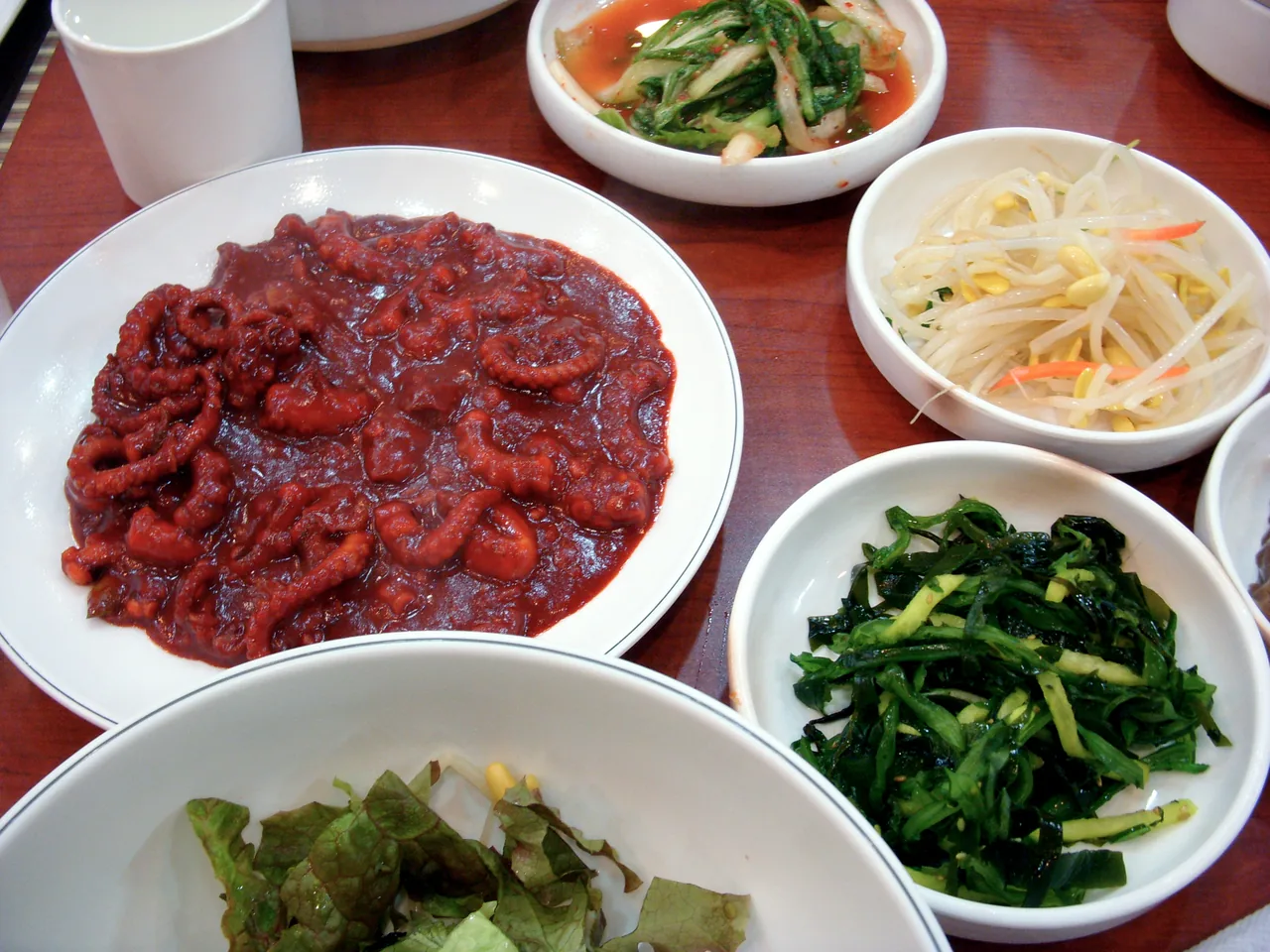
Nakgopsae — a bubbling red hotpot of nakji (octopus), gopchang (beef tripe) and saeu (shrimp) — is Busan’s great local obsession, and its origin story is pure Busan. The name is just the three ingredients squashed together, and the dish is a flavour bomb: sweet, fiery, and made for sharing.
- The origin: it grew out of “Jobang nakji” — spicy octopus served near the old Joseon Textile mill (est. 1917) in Beomil-dong, where workers from the factory made boiled octopus their after-shift staple. Customers asked for it spicier and saucier, the gochugaru went in, and by the 1990s Beomil-dong’s octopus alley was nationally famous.
- How to eat it: let it boil down at your table, ladle it over rice — most locals order bokkeumbap (fried rice) in the pan at the end, which many will tell you is the real point of the meal.
- Heat warning: the default is genuinely spicy. Ask for 덜 맵게 (deol maepge — less spicy) if you’re unsure, and keep the cold broth close.
9. Dongnae pajeon: the 90-year-old pancake
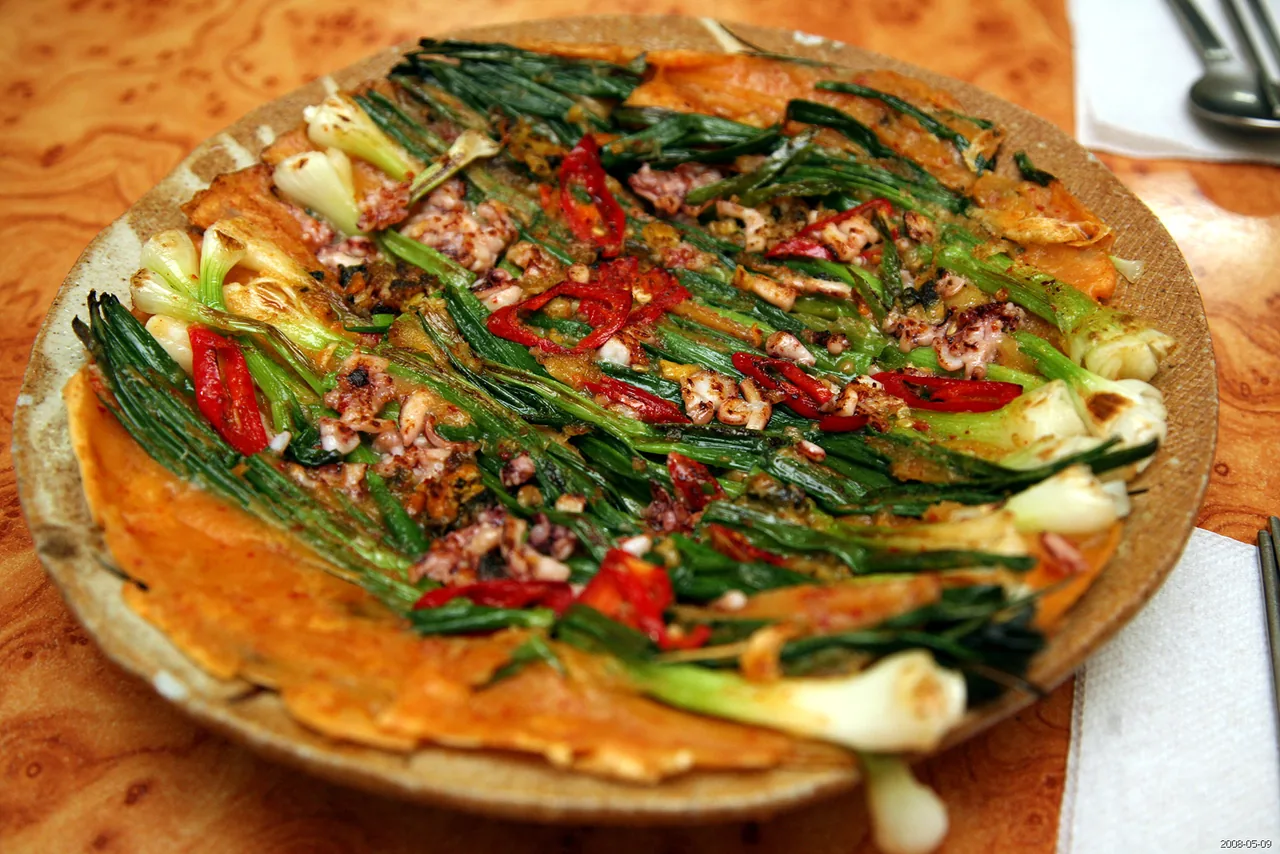
Dongnae pajeon is Busan’s aristocrat — a thick, custardy pancake of whole spring onions and seafood, born in the old hot-spring district of Dongnae and made properly by almost no one else. This is not the thin, crispy pajeon of a pub night; it’s a different dish entirely.
- What makes it different: a batter blended with glutinous rice flour, loaded with spring onions (the area near Geumjeongsan was famous for them) and seafood from the harbour, then — crucially — steamed under a lid at the end. The result is soft, almost pudding-like inside, crisp-edged outside.
- The legend: Dongnae Halmae Pajeon traces to a small 1930s pancake stall in Dongnae Market opened by the current owner’s great-great-grandmother; after a few moves it settled under its present name in the 1970s and is now run by the fourth generation. A whole pancake runs about ₩20,000–40,000 depending on size — it feeds two to three.
- Make a day of it: Dongnae is also Busan’s historic hot-spring quarter — pair the pancake with a soak. Rain, makgeolli and pajeon is the holy Korean trinity; if it’s pouring, you know where to go.
10. The deep cuts: hagfish, pufferfish soup, wandang & jaecheop
These are the dishes that separate visitors from regulars — old, strange-sounding, utterly Busan, and each anchored by a decades-old original restaurant that’s still serving.
- Kkomjangeo (hagfish), 꼼장어: chewy, rich and usually grilled in a spicy sauce — the speciality of Jagalchi’s hagfish alley. The primal version lives in Gijang: jipbul gomjangeo, hagfish straw-fire-roasted whole, a method born in the lean post-war years that survives only around Busan. Best with soju, no exceptions.
- Bok-guk (pufferfish soup), 복국: a crystal-clear, restorative fugu soup with bean sprouts and minari — Busan’s most elegant hangover cure. The tradition of serving it bubbling in an earthenware ttukbaegi began at Geumsu Bokguk in Haeundae, founded 1970, whose owner Lee Bong-deok adopted the pot so the broth would stay scalding to the last spoon.
- Wandang, 완당: Busan’s feather-light wonton soup — paper-thin dumplings the size of a thumbnail in a clear broth. The dish travelled from China via Japan and settled here; Wonjo 18-beon Wandang started as a street cart in Bosu-dong in 1947, opened its shop in 1956, and is on its third generation.
- Jaecheop-guk, 재첩국: a gentle, milky freshwater-clam soup that was once hawked door-to-door each morning along the Nakdong River — the old Busan breakfast, now a nostalgic find in Hadan and Gupo.
11. Korean BBQ in Busan: galbi, samgyeopsal & one legendary grill house
Busan does Korean barbecue as well as anywhere in the country — and it owns one true pilgrimage grill: a charcoal galbi house that’s been packing tables since 1964.
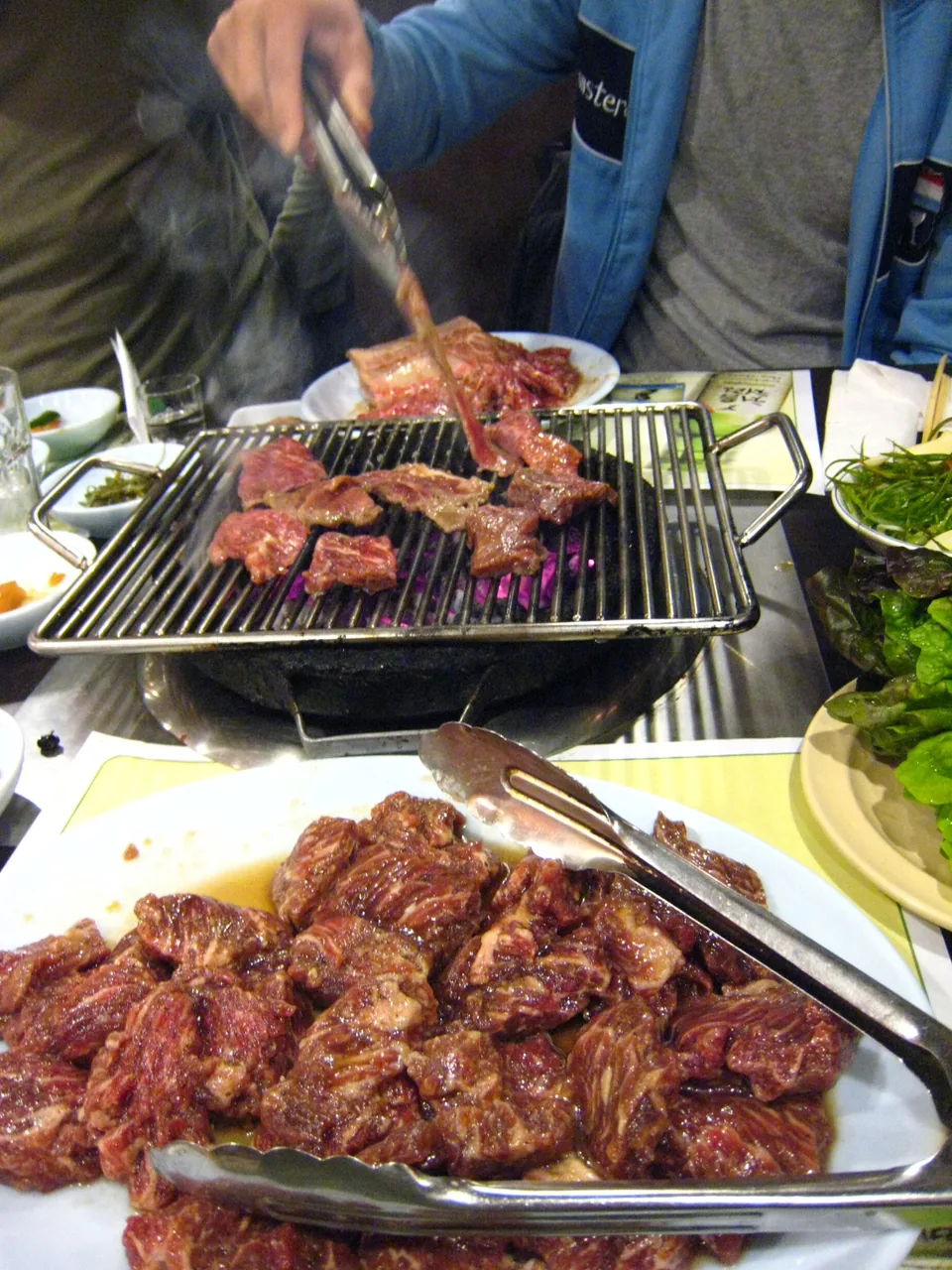
- The legend: Haeundae Amso Galbijip (“the Haeundae female-cattle rib house”) was opened in 1964 by Yoon Seok-ho, a chef trained at the old Dongnae hot springs. Three generations later it grills only premium female hanwoo beef, moved into a purpose-built three-storey building in late 2023, and holds a place in the Michelin Guide Busan 2026. It’s expensive and worth it — book or queue.
- The everyday version: neighbourhood samgyeopsal (pork belly) joints are everywhere and excellent — Seomyeon’s back lanes and the university districts are full of them. Grill, dip in ssamjang, wrap in lettuce with garlic, repeat.
- Budget move: lunchtime galbi-tang (beef-rib soup) or a pork-belly set gets you the grill-house flavour for a fraction of the dinner bill.
12. The markets & food streets, mapped
Market eating is the heart of Busan food culture — these are the six that matter, and what to eat at each.
| Market / street | Eat this | Notes |
|---|---|---|
| Jagalchi Market | Hoe (raw fish), grilled fish, hagfish | Korea’s biggest fish market; pick downstairs, eat upstairs |
| Gukje Market (Arirang St.) | Bibim dangmyeon, chungmu gimbap, kalguksu | Standing-counter classics in the post-war bazaar |
| BIFF Square | Ssiat hotteok, tteokbokki, twigim | Street-food strip; the hotteok birthplace |
| Bupyeong Kkangtong Night Market | Skewers, dumplings, global bites | Korea’s first permanent night market, ~19:30–24:00 |
| Seomyeon Market & food alleys | Dwaeji-gukbap, BBQ, pojangmacha snacks | The soup alley + the city’s busiest dining district |
| Haeundae Market | Eomuk, gukbap, grilled shellfish | One lane back from the beach; great after a swim |
13. What to eat when: Busan’s seasonal calendar
Busan eats by the calendar — the fish change with the water, and timing your plate to the season is the easiest way to eat like a local.
| Season | Order this | Why now |
|---|---|---|
| Spring (Mar–May) | Gijang anchovies (myeolchi) — raw, grilled, in stew; dodari-ssukguk (flatfish & mugwort soup) | The anchovy fleet lands at Daebyeon Port; the festival there marked its 30th year in 2026. Spring anchovies (10–15 cm) are fat and tender. |
| Summer (Jun–Aug) | Milmyeon, mulhoe (chilled raw-fish soup), grilled eel for stamina | Icy noodles and cold raw fish are the city’s natural air-conditioning. |
| Autumn (Sep–Nov) | Jeoneo (gizzard shad) — grilled or raw; prawns | “Autumn jeoneo” is a Korean proverb for irresistible; Myeongji’s festival runs Aug–Sep at the Nakdong estuary. |
| Winter (Dec–Feb) | Daegu-tang (cod soup) from Gadeok Island cod, bok-guk, oysters | Cold-water cod hits peak sweetness; clear hot soups own the season. |
| All year | Mackerel — grilled, braised, raw when very fresh | It’s Busan’s official city fish, with its own festival — the everyday king of the table. |
14. Cafés & dessert: where to land after the markets
Busan’s café scene is now a destination in its own right — an industrial-cool district the New York Times flagged, plus ocean-view roasters the equal of anywhere in Asia. After a market morning, this is the afternoon.
- Jeonpo Café Street: old tool-shop blocks near Seomyeon reborn as one of Korea’s densest specialty-coffee quarters — the area made the New York Times’ places-to-go list, and new roasters still open monthly.
- Sea-view coffee: Yeongdo’s converted-warehouse mega-cafés stare across the harbour; the cliffside terraces between Haeundae and Songjeong pour single-origins over Pacific views.
- Dessert to hunt: patbingsu (shaved-ice with red bean) in summer, fat Busan-style baked goods year-round, and hotteok ice-cream mashups for the brave.
15. How to order, eat & pay like you’ve done this before
Korean restaurant mechanics are simple once you know the rules — and in Busan, nobody stands on ceremony.
- Getting attention: there’s no hovering waiter — call out 저기요! (jeogiyo, “excuse me!”) or press the table bell. It’s not rude; silence is.
- Banchan are free: the small side dishes that arrive unasked are included, and refills are free — just ask. Water and broth are usually self-serve from a cooler.
- Useful phrases: 이거 주세요 (igeo juseyo — this one, please), 덜 맵게 해주세요 (deol maepge — less spicy please), 포장돼요? (pojang dwaeyo? — can I get this to go?).
- Paying: take the bill slip to the counter by the door — table-side payment isn’t a thing. Cards work almost everywhere; keep ₩10,000–20,000 in cash for market stalls. There is no tipping, ever.
- Solo diners: gukbap houses, milmyeon shops and market counters are built for eating alone — BBQ is the only format that’s awkward solo (two-portion minimums).
16. What eating in Busan costs — and a one-day food crawl
Busan is one of the best-value food cities in the developed world: you can eat brilliantly on ₩30,000 a day, or splurge on ₩100,000 and feel like royalty.
- Budget day (~₩25,000–35,000): dwaeji-gukbap breakfast (₩10,000), market grazing for lunch — hotteok, eomuk, bibim dangmyeon (~₩8,000) — and milmyeon or nakgopsae-over-rice for dinner (~₩10,000–15,000).
- Blowout day (~₩80,000–120,000): bok-guk breakfast, Jagalchi hoe spread for lunch (₩30,000–50,000 a head shared), charcoal hanwoo galbi for dinner.
- A perfect one-day crawl: Seomyeon soup alley at 9 am → metro to Nampo: Gukje Market noodles + BIFF hotteok → Jagalchi for a late hoe lunch → coffee in Jeonpo → Bupyeong night market skewers → finish with eomuk and a beer.