
A Night at Sajik Stadium: Watching the Lotte Giants in Busan
A Lotte Giants home game is the single best night out in Busan — three hours of synchronized chants, orange plastic-bag hats, fried chicken and 23,000 people singing ‘Busan Seagull’ in unison. You don’t need to know a thing about baseball. This is the complete A-to-Z: how to get tickets as a foreigner, where to sit, what every chant means, what to eat, and how to do it all without a word of Korean.
- It’s not really about the baseball. Koreans call Sajik Stadium ‘the world’s biggest karaoke room’ — the crowd is the show: nonstop singing, drums, batter theme songs and a sea of orange. Total newcomers have the best night of their trip here.
- Tickets are easy for foreigners. Buy on the official Lotte Giants app, or — with no Korean phone number — on Ticketlink Global or Interpark Global (English, foreign cards). Sales open 2–3 weeks before each game. Seats start around ₩12,000.
- Sit on the 1st-base side — that’s the home (Lotte) end, right by the cheering platform, where you’ll learn every chant in an inning. The outfield is cheapest and rowdiest; premium table seats are the splurge.
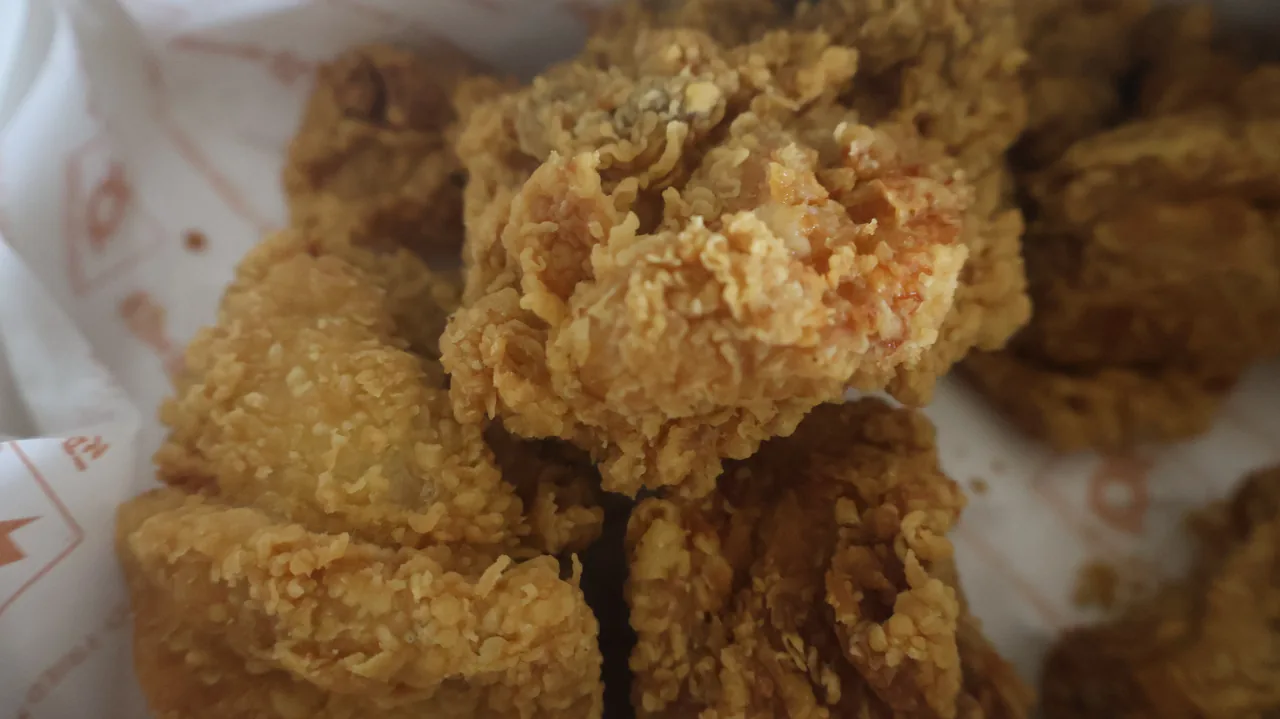
- The food is half the fun. ‘Chimaek’ — fried chicken and beer — is the ballpark religion, and you’re allowed to bring your own. Grab chicken near Sajik Station on the way in.
- Go in 2026 or 2027. The historic 1985 ballpark is slated for demolition and rebuild — current Sajik’s last seasons are now. The atmosphere here will never be replaced, only relocated.
Weekend and rivalry games sell out — grab a guaranteed seat with English support before you go:⚾ Book a Lotte Giants experience · KKday⚾ Book a Lotte Giants experience · Klook* affiliate link
1. Why a Lotte Giants game is Busan’s best night out
2. Sajik Stadium at a glance
3. Korean baseball for total beginners (the 5-minute rulebook)
4. What makes Sajik special — and why you should go now
5. How to get tickets (even with no Korean phone number)
6. Where to sit — reading the seat map
7. The cheering culture, decoded
8. What to eat and drink — the chimaek religion
9. Game day, hour by hour
10. Getting there and back
11. Practical tips & etiquette
12. When to go — picking the right game
13. Make a night (or day) of it
14. What it costs — and a ready-made Giants night
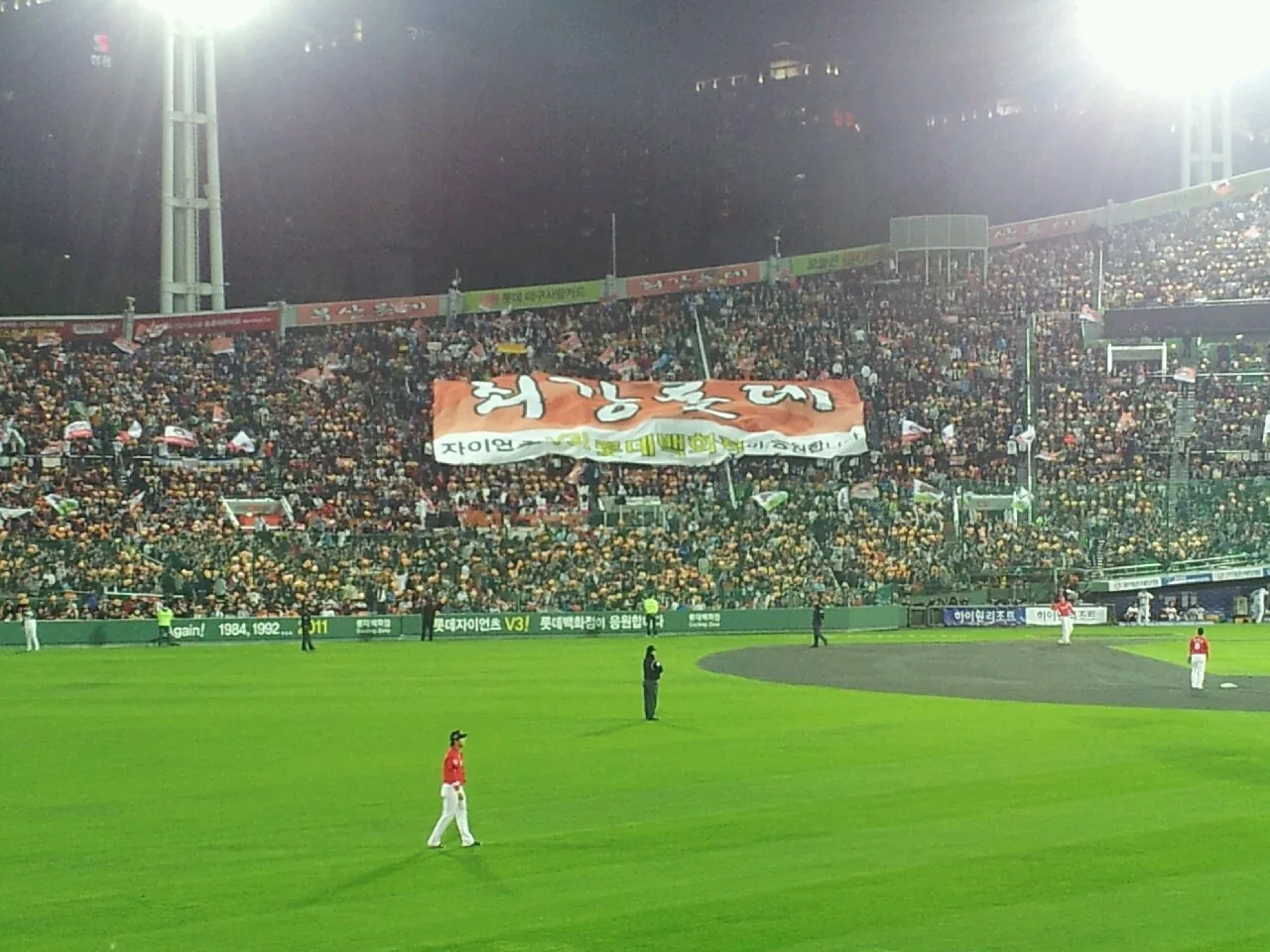
Walk into Sajik Stadium for the first time and you will be baffled — not by the baseball, but by everyone around you. Twenty-three thousand people are wearing inflated orange bin-bags on their heads. A man on a platform in front of the home dugout is conducting the entire stand like an orchestra. Every single batter walks up to his own personalized pop song that the whole stadium already knows by heart. And at some point, without warning, the lights catch the crowd and the entire bowl sings a 1980s ballad called ‘Busan Seagull’ loudly enough to rattle your chest. This is Korean baseball, and the Lotte Giants’ home in Busan is its loudest, most beloved cathedral. You do not need to understand the rules, follow the score, or speak a word of Korean to have one of the best nights of your entire trip — you just need to stand up when everyone else stands up. This guide is the complete playbook for first-timers: how to get a ticket (it’s genuinely easy), where to sit, what every ritual means and when to join in, what to eat and drink, how to get there and back, and why you should see this particular ballpark before it’s gone. Slot it into the rest of your trip with our complete Busan Travel Guide.
1. Why a Lotte Giants game is Busan’s best night out
A Lotte Giants home game at Sajik Stadium is the most fun, most local, most unforgettable thing you can do in Busan after dark — and it works perfectly even if you have never watched a baseball game in your life. Koreans have a nickname for Sajik: “the world’s biggest karaoke room.” They are not exaggerating.
Here is the thing that surprises every first-timer: the game on the field is almost beside the point. The real event is in the stands. Busan is called Korea’s “city of baseball,” and the Giants are the country’s most beloved, most passionately supported team. Their fans turned cheering into an art form — and a three-hour Giants game is less a sporting event and more a giant, joyful, chicken-fuelled singalong that 23,000 strangers somehow all know the words to.
- You don’t need to know baseball. You’ll spend more time singing and waving than watching pitches. The crowd tells you exactly when to stand, cheer and sit.
- It’s astonishingly cheap. A ticket starts around ₩12,000 — less than a cinema seat — and you can bring your own food and drink.
- It’s the realest Busan there is. No tour buses, no curated “experience” — just the city being completely, gloriously itself.
2. Sajik Stadium at a glance
Everything you need on one screen — the where, when and how much.
| Details | |
|---|---|
| Team | Lotte Giants (롯데 자이언츠) — KBO League |
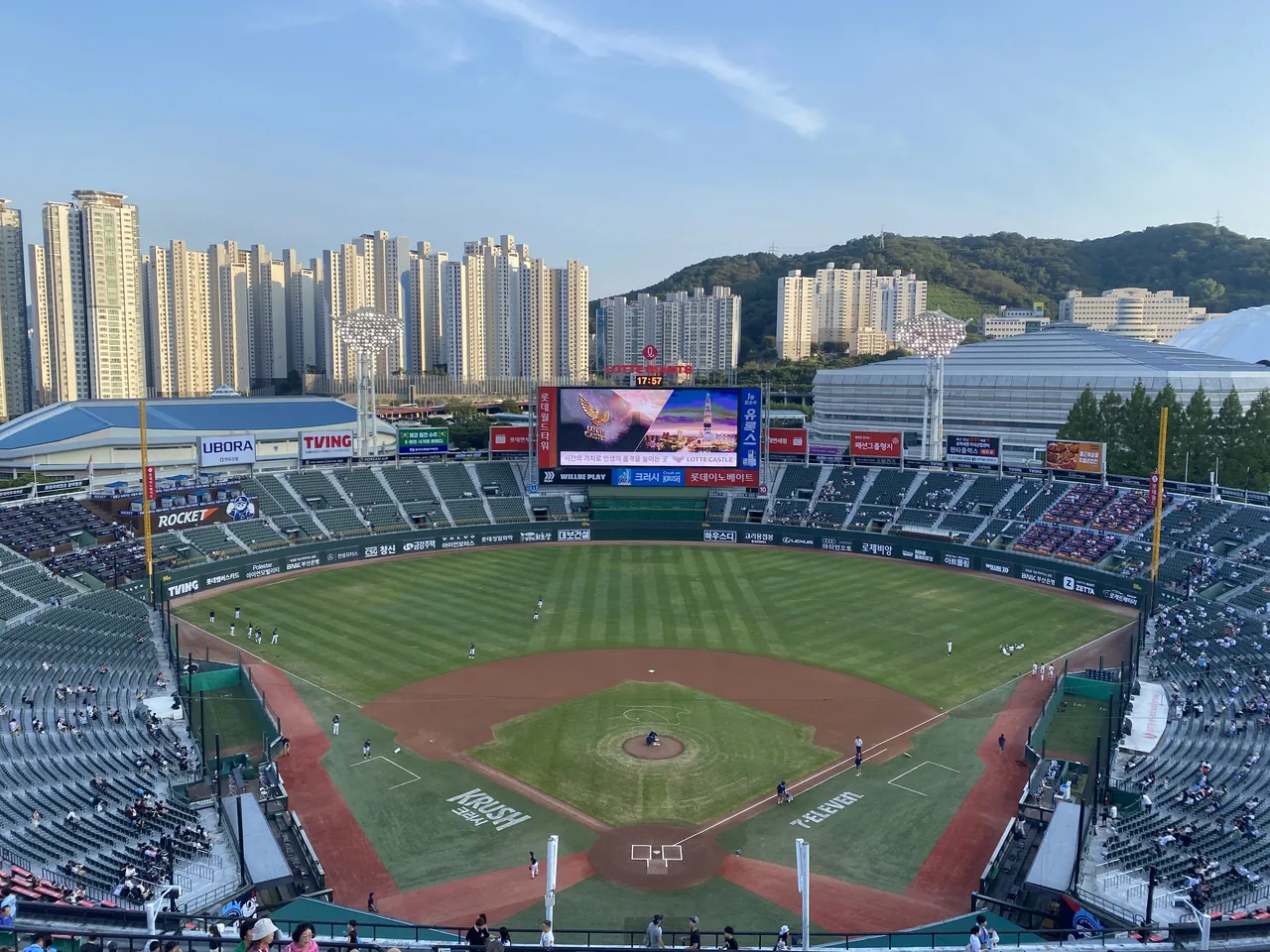
| Stadium | Sajik Baseball Stadium, Dongnae-gu, Busan (opened 1985) |
| Capacity | ~23,000 (open-air, no roof) |
| Season | Late March – October (regular season); playoffs into November |
| First pitch | Weekdays ~18:30 · Saturday ~17:00 (some 18:00) · Sunday ~14:00 |
| Ticket price | From ~₩12,000 (general) up to ₩50,000–100,000 (premium/table) |
| Where to buy | Lotte Giants app · Ticketlink Global · Interpark Global · KKday/Klook packages |
| Getting there | Busan Metro Line 3 → Sajik Station, Exit 1, 5–10 min walk |
| Bring | Cash, an empty stomach, a light layer (open-air); fried chicken optional but recommended |
3. Korean baseball for total beginners (the 5-minute rulebook)
You genuinely do not need this section to enjoy the night — but here’s everything you need to follow along, in plain English.
Baseball is two teams taking turns to bat and to field, over nine innings. In each inning, one team tries to score and the other tries to stop them; then they swap.
- How you score: a batter hits the ball and runs around four bases. Make it all the way round and touch home = one run. Hit the ball clean out of the park = a home run (the crowd goes berserk).
- How you get out: three strikes (missed swings) and you’re out; a caught ball is out; beaten to a base is out. Three outs and the teams swap sides.
- The board: the big scoreboard shows the score, the inning, balls/strikes and the current batter — all in numbers you can read even without Korean.
- How long: roughly three hours. The atmosphere peaks late, so a close game in the 8th–9th inning is electric.
4. What makes Sajik special — and why you should go now
Sajik isn’t Korea’s biggest or newest stadium — it’s its loudest and most emotional, and the current ballpark is living on borrowed time.
Built in 1985 and home to the Giants since 1986, Sajik is a proper old-school open-air bowl: concrete, close to the action, and packed with decades of Busan sporting memory. The fan culture here was invented, not imported — the newspaper cheer, the orange-bag hats and the mass singalongs all started in these stands and then spread across the whole league.
- “The world’s biggest karaoke room”: the nickname comes from the wall-to-wall singing — when 23,000 people belt ‘Busan Seagull’ together, you feel it in the seats.
- The most loyal fans in Korea: the Giants pack the house even in losing seasons. Busan supports this team the way other cities support nothing.
- It’s on the clock. The historic stadium is set to be demolished and rebuilt: the team is expected to move to a temporary stadium from 2028, with a brand-new open-air ballpark targeted for 2031. That makes the 2026 and 2027 seasons the last chance to experience the original Sajik.
5. How to get tickets (even with no Korean phone number)
This is the part everyone worries about, and it’s far easier than you think. There are three good routes — pick by how much Korean you want to deal with.
Tickets for each game go on sale roughly two to three weeks in advance (sales now open earlier than the old one-week window), usually at 2 PM. Weekday games are an easy walk-up; popular weekend games and rivalry matches sell out, so book ahead for those.
- Route 1 — Ticketlink Global / Interpark Global (best for most foreigners)These English-language ticketing sites let you sign up with just an email — no Korean phone number needed — and pay with an international credit card. Search “Lotte Giants,” pick your game and seat from the map, and you’re done. This is the cleanest DIY route.
- Route 2 — The official Lotte Giants appThe cheapest face-value tickets are on the Giants’ own app and website (giantsclub.com), but the sign-up can ask for a Korean phone number and the interface is in Korean. Use your phone’s translation if you go this way.
- Route 3 — A booked package (zero hassle)Platforms like KKday and Klook sell ready-made Giants experiences — a guaranteed seat, sometimes bundled with a cheering headband, a café drink or a beer/meal voucher and English support. You pay a little more than face value for the convenience and certainty of a seat.
No ticket and game day already? Self-service ticket machines in front of the stadium open about an hour before first pitch — if it isn’t a sellout, you can often just turn up and buy one there.
Big weekend and rivalry games sell out, and the official site is Korean-only — a ready-made package locks in a guaranteed seat with English support. Compare options:⚾ Book a Lotte Giants experience · KKday⚾ Book a Lotte Giants experience · Klook* affiliate link
6. Where to sit — reading the seat map
The single most important seating decision: sit on the 1st-base side. That’s the home end — the Lotte side — where all the singing, the cheer leader and the energy live.
| Area | What it’s like | Best for |
|---|---|---|
| 1st-base side (home) | The Lotte cheering section — the cheer platform is here, the crowd is loudest, every chant happens around you | First-timers who want the full experience |
| 3rd-base side | The visiting team’s end — quieter, fine if you’re rooting for the away team | Away fans, calmer viewing |
| Outfield | Cheapest seats, young and rowdy, pure party energy, no seatbacks in places | Budget + maximum atmosphere |
| Infield table / premium | Wider seats, tables, sometimes food service — the comfortable splurge | Couples, families, a relaxed night |
| Behind home plate | Best view of the actual baseball, central, pricier | If you actually want to watch the game |
7. The cheering culture, decoded
This is why you came. Korean baseball cheering is organized, relentless and joyful — and Sajik’s is the most famous in the country. Here’s what’s happening, and when to join in.
- The cheer leader (응원단장): a showman on a platform in front of the home dugout, with a microphone, drummers and dancers. He runs the whole stand. Follow him and you can’t go wrong.
- Batter theme songs: every Lotte player has his own short pop-song chant. When he comes to bat, the crowd sings it. You’ll have three or four memorized by the end of the night.
- ‘Busan Seagull’ (부산갈매기): the team anthem — a 1980s ballad the whole stadium sings together, arms swaying. When it starts, just go with it. Often paired with another local classic, ‘Come Back to Busan Port.’
- The newspaper cheer: a Sajik original from 1993 — fans wave shredded newspaper like pom-poms during big moments.
- The orange bags (봉다리): the famous one. Fans inflate orange plastic bags and wear them on their heads, handles looped under the ears. Orange is the team colour; the bags are handed out in the stands. Yes, you should absolutely do it.
- Thunder sticks & “Ma!”: inflatable bat balloons for banging together, and a sharp Busan-dialect shout — “Ma!” — that erupts at key moments.
8. What to eat and drink — the chimaek religion
Half the joy of Sajik is the food, and the headline act is ‘chimaek’ — chi(cken) + maek(ju, beer) — the sacred ballpark combination. Best of all: you’re allowed to bring your own.
- Bring fried chicken. The local move is to grab a box of fried chicken before the game and carry it in. Outside food is welcome — half the stand is sharing chicken boxes by the second inning.
- Where to grab it: there are chicken shops and convenience stores around Sajik Station and near the stadium — pick up a box and some drinks on the walk over.
- Inside the stadium: concession stands sell fried chicken, tteokbokki (spicy rice cakes), hot dogs, kimbap, dried squid, fries and draft beer — classic ballpark fare with a Korean accent.
- Drinks: beer is part of the ritual. You can buy it inside; outside non-alcoholic drinks are generally fine to bring, and many fans pick up convenience-store beer nearby.
9. Game day, hour by hour
Here’s how to time a weekday evening game (first pitch ~18:30) so you catch every ritual and beat the worst of the crowds.
- ~17:00 — Arrive at Sajik StationGet off Line 3, take Exit 1, and buy your chicken and drinks at a shop near the station before you walk to the stadium (5–10 min).
- ~17:30 — Get in earlyGates open well before first pitch. Going in early means an easy entry, time to find your seat, soak up the warm-up and grab your free orange bag.
- 18:30 — First pitchThe cheer leader fires up the stand. Settle in, start your chicken, and watch the 1st-base side to learn the chants.
- Mid-game — full singalong modeBy the 3rd or 4th inning you’ll know the batter songs. When ‘Busan Seagull’ kicks off, stand up and sing — this is the moment.
- Late innings — the crescendoA close game in the 8th–9th is the loudest the place gets. Newspaper cheers, thunder sticks, the whole bowl on its feet.
- ~21:30 — Head outThe post-game crowd surges toward the metro. Either move fast or grab one more drink nearby and let the station clear for 20 minutes.
10. Getting there and back
Sajik is easy: it’s a straight metro ride to a dedicated station, then a short walk.
- By metro (best): take Busan Metro Line 3 to Sajik Station, leave by Exit 1, and follow the crowd — it’s a 5–10 minute walk to the stadium. Sports Complex Station (also Line 3) is another option.
- Transfers: Line 3 connects to Lines 1 and 2, so you can reach Sajik easily from Seomyeon, Haeundae or Nampo with one change. Check our transit guide for the card and route details.
- Getting back: the metro is the move, but everyone leaves at once. If the train platform looks like a mosh pit, duck into a nearby chicken-and-beer joint for 20 minutes and let it thin out.
- Taxis: available but slow right after the game as roads clog — walking a few blocks away from the stadium first makes hailing one much easier.
11. Practical tips & etiquette
A few things that make a first game smoother.
- It’s open-air: no roof. Bring a light layer for spring and autumn evenings, and check the forecast — games can be delayed or called for heavy rain.
- Cash and card: bring some cash for concession stands and street chicken, though cards are widely accepted.
- With kids: Sajik is family-friendly — kids love the bags, the songs and the snacks. Premium table seats are the comfortable choice for families.
- Photos: shoot all you like — the crowd is the photo. The wave of orange and the cheer platform are the shots everyone wants.
- Etiquette: join in, be loud, but follow the crowd’s lead. Don’t heckle players, and remember the cheering is organized — you fit into it, not over it.
- No game on? Sajik also offers behind-the-scenes stadium tours on some non-game days — a fallback if your dates don’t line up with a home stand.
12. When to go — picking the right game
The season runs late March to October. Any home game delivers, but the right pick depends on what you want.
- For an easy ticket: midweek games (Tuesday–Thursday) rarely sell out — perfect for a spontaneous evening and a walk-up purchase.
- For maximum atmosphere: Friday and weekend games, and big rivalry matches (the “Nakdonggang derby” against the NC Dinos, or visits from Seoul’s powerhouse teams) bring the fullest, loudest houses — book these ahead.
- By season: opening weeks in late March/April have a fresh-start buzz; warm summer evenings are peak chimaek weather; September’s run-in matters most if the Giants are chasing the playoffs.
- Weekday vs weekend: weekday = easier and cheaper; weekend = bigger and louder. For a first game, a Friday night hits the sweet spot of energy without total sellout chaos.
13. Make a night (or day) of it
A Giants game slots perfectly into a bigger Busan plan — here’s what pairs well around it.
- Before the game: the stadium sits in Dongnae, home to Busan’s historic hot springs — a soak at a Dongnae bathhouse or Spa Land, then chicken and baseball, is a gloriously Korean double bill.
- After the game: ride Line 3 and transfer to Seomyeon for late-night food, bars and noraebang — the natural next stop when the final out doesn’t end your night.
- The culture combo: pair the game with a jjimjilbang scrub for the two most quintessentially Korean experiences in one trip.
- Active day, loud night: surf or hike by day (see our activities guide), recover in a hot spring, then finish at Sajik — a perfect Busan 24 hours.
14. What it costs — and a ready-made Giants night
A Lotte Giants night is one of the best-value experiences in Busan: world-class atmosphere for the price of a cheap meal out.
- Ticket: from ~₩12,000 (general/outfield) to ₩50,000–100,000 (premium table). Most first-timers are very happy in a ~₩15,000–25,000 1st-base seat.
- Chicken + beer: a box of fried chicken (~₩18,000–25,000) plus a couple of beers — the full chimaek experience for two costs about the same as one mid-range dinner.
- Transit: a few thousand won each way on the metro.
- A package (optional): a KKday/Klook Giants experience bundles the seat with extras and English support for added convenience.
The ready-made plan: soak at a Dongnae hot spring in the late afternoon → pick up fried chicken near Sajik Station → arrive early, claim your orange bag → sing through nine innings on the 1st-base side → ride to Seomyeon for a nightcap. Total spend for two, all in: roughly the cost of one nice dinner — for a night you’ll never forget.
🎡Things to Do38
🍜Food7
🏨Where to Stay3
🚇Getting Around7
🧭Travel Tips14
📌More3
🧭All-Korea essentials29
Lotte Giants & Sajik Stadium — FAQ
⚾ Next: plan the rest of your trip with all our Busan guides →