When to Visit Korea: The Best Time to Go, Season by Season
When should you go to Korea? A clear, fact-checked guide to the four seasons, cherry blossoms and autumn leaves, the rainy season and typhoons, the cheapest months, and exactly when to travel for what you want to see.
Last updated: June 2026
The short version
Best overall
Spring (mid-April to May) and autumn (late September to November) — mild, dry and sunny. Autumn is the single most reliable season, with clear skies and famous foliage.
Cherry blossoms (2026)
Late March in Jeju and Busan, around 3–10 April in Seoul. They move south to north, so you can chase the bloom up the country.
Autumn foliage (2026)
From mid-to-late October in the northern mountains (Seoraksan ~22 Oct) down to early–mid November in Seoul, Busan and the south.
Cheapest
Winter (Dec–Feb), outside the holidays, for the lowest flight and hotel prices; the shoulder weeks of late May–June and September are great value too.
Avoid if you can
The monsoon (late June to late July) and typhoon season (Aug–Sep) for rain, and the Seollal & Chuseok holidays for closures and crowds.
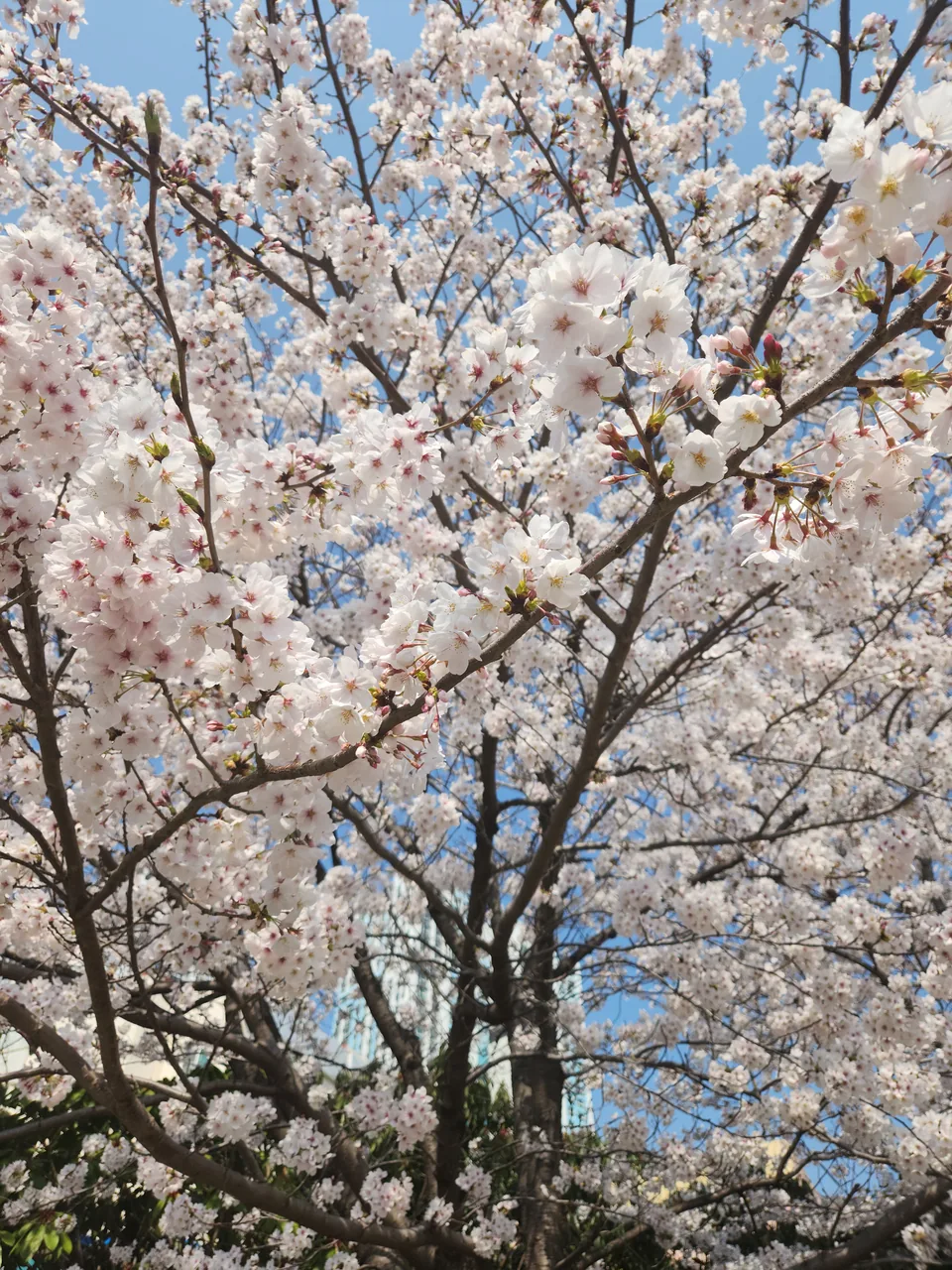
Cherry blossoms peak from late March in the south to mid-April in Seoul (here in Busan). Photo: Vichycombo, CC BY-SA 4.0, via Wikimedia Commons.
1. When is the best time to visit Korea?
The best times to visit Korea are spring — roughly mid-April to May — and autumn, late September to November. Both seasons are mild, dry and sunny, with the country at its prettiest: cherry blossoms in spring, fiery foliage in autumn. If you want one safe answer, choose autumn: it has the most stable weather of the year, low humidity, clear skies and Korea’s signature fall colours.
For cherry blossoms: late March (south) to mid-April (Seoul).
For autumn leaves and the clearest skies: mid-October to early November.
For beaches and festivals: July–August (hot, humid and busy).
For skiing, snow and low prices: December–February.
Bottom line: if your dates are flexible, aim for April–May or September–October. You’ll get the best weather, the best scenery and comfortable days for sightseeing. The rest of this guide is about fine-tuning that choice to what you want to do.
2. Korea’s four seasons at a glance
Korea sits in a temperate, four-season climate, but because it’s long from north to south, the same month can feel different in Seoul and in Busan. Here’s the big picture:
Season
Months
Weather
Best for
Spring
Mar–May
Mild, cool mornings; dry and bright by late spring
Cherry blossoms, easy sightseeing
Summer
Jun–Aug
Hot & humid; monsoon rain then typhoons
Beaches, water parks, festivals
Autumn
Sep–Nov
Clear, dry, comfortable — the most stable season
Foliage, hiking, photography
Winter
Dec–Feb
Cold & dry (north); milder on the south coast; snow inland
Skiing, snow, illuminations, low prices
North vs south: Seoul and the inland north get real winters with snow and sub-zero days; the southern coast and Busan stay noticeably milder, often warm enough for a beach walk even in January. Jeju, off the south coast, is the warmest of all.
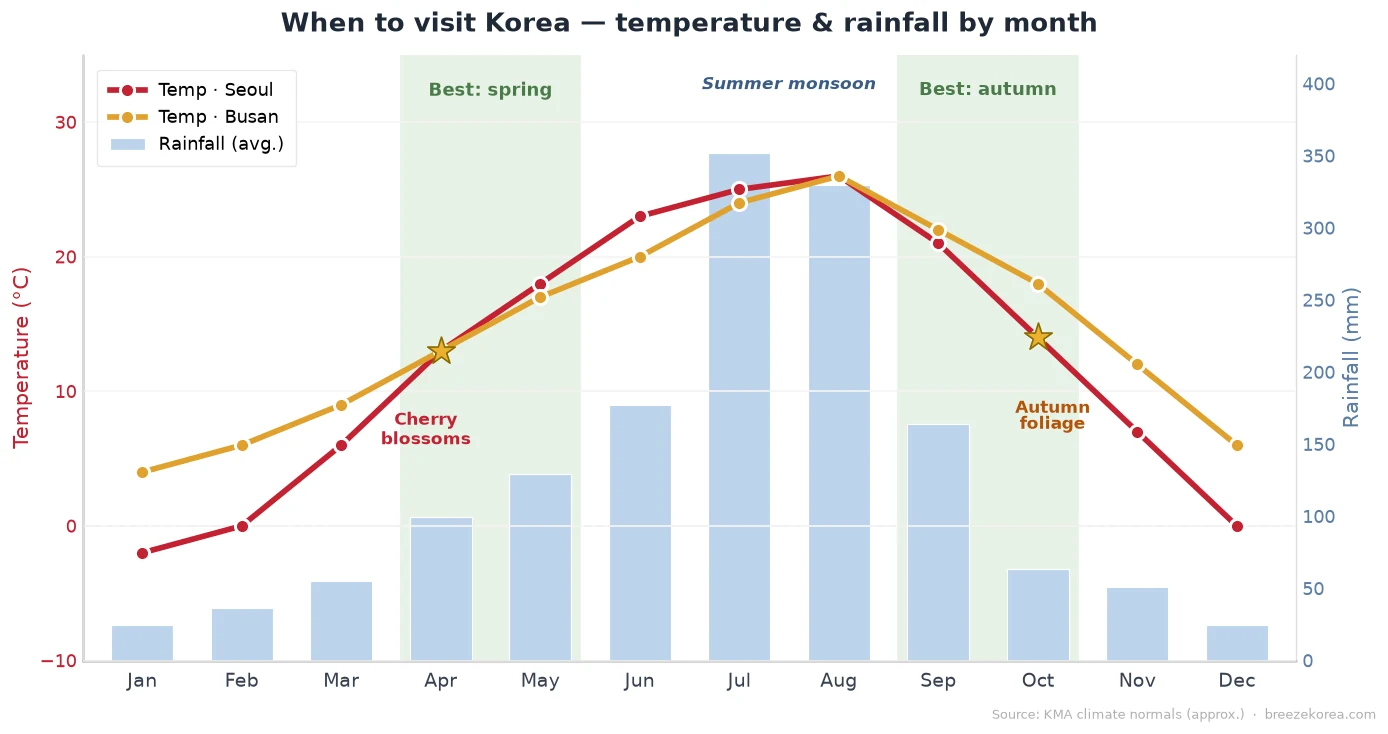
Korea’s climate by month: mild spring and autumn, a hot, wet summer monsoon (Jul–Aug) and a cold winter — with Busan milder than Seoul all year.
3. Spring (March–May): cherry blossoms & mild days
Spring is one of the two best times to visit, and it builds to a peak with the cherry blossoms. Early March is still chilly, but by April the days are bright and mild and the whole country flowers — first plum and then the famous cherry blossoms, followed by golden canola fields and azaleas.
Cherry-blossom timing moves south to north, so with good planning you can follow the bloom up the peninsula. The 2026 forecast (about 2–7 days earlier than average):
Late spring (May) is warm, dry and green — arguably the most comfortable weather of the year, just after the crowds thin.
Watch for: spring can bring hazy days and occasional fine dust; check the air-quality forecast and pack a mask for bad days.
Blossom tip: peak bloom lasts only about a week and shifts with the weather, so build in a day or two of flexibility. Heading to the south coast? See exactly when in our best time to visit Busan.
4. Summer (June–August): monsoon, heat & beach season
Summer is hot, humid and lively — the season of beaches and festivals, but also of rain. It splits into two parts: the monsoon, then the peak-summer heat.
The monsoon (jangma): roughly late June to late July, bringing spells of heavy rain. It doesn’t rain all day every day, but skies are grey and humidity is high. Pack a compact umbrella and quick-dry clothes.
Peak summer (late July–August): hot and sticky, often 30°C+ with high humidity. This is beach season — Busan’s Haeundae and the east-coast beaches are at their busiest — and the time for water parks and big summer festivals.
Typhoons: mainly August–September. Most pass quickly, but they can disrupt flights and ferries, so keep your plans flexible and watch the forecast.
Heads-up: if you visit in July–September, build slack into your itinerary and book refundable where you can — a rainy monsoon spell or a passing typhoon is much easier to absorb with a flexible plan.
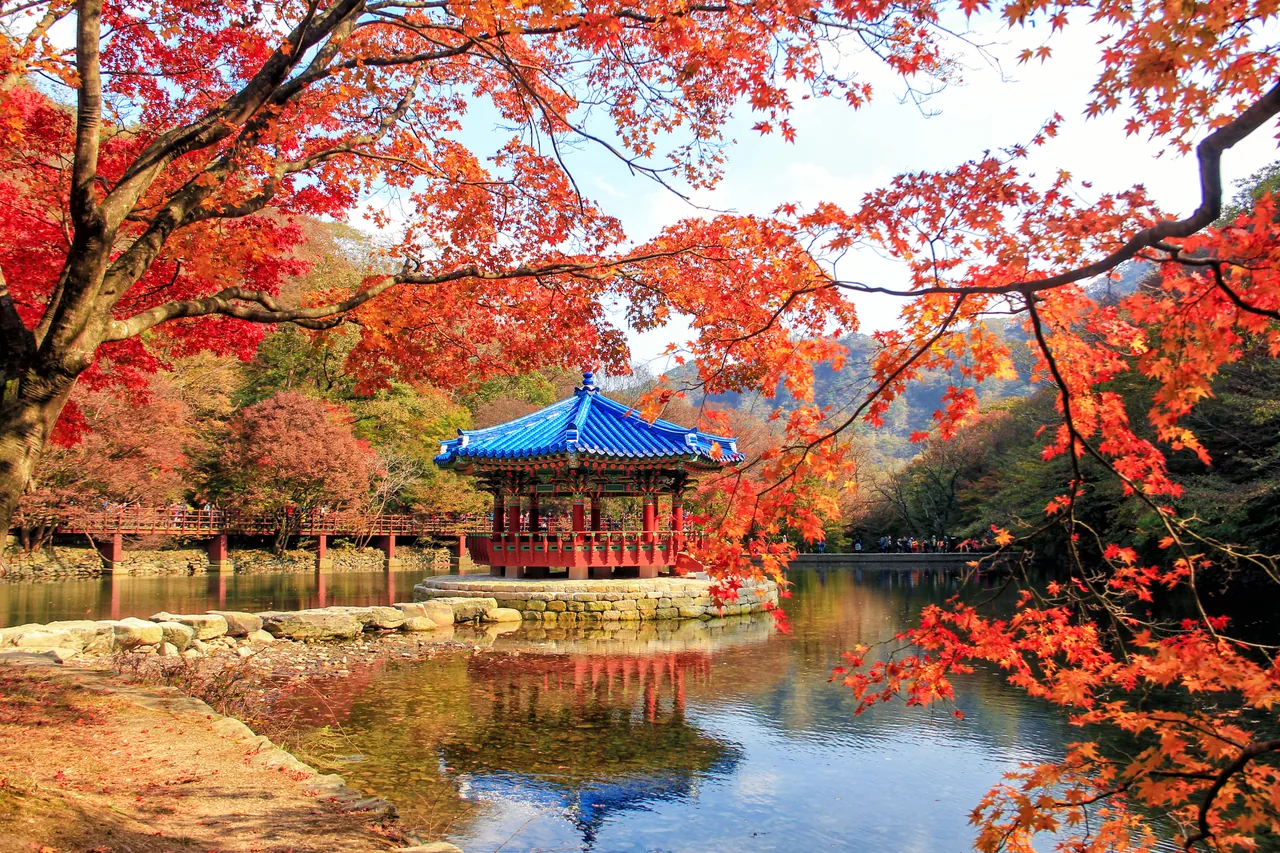
Autumn colour sweeps from the northern mountains in October down to the south by November. Photo: Tungdangthanh, CC BY-SA 3.0, via Wikimedia Commons.
🌊 Travelling in summer? Don’t skip a warm evening on the river — our Han River summer guide covers riverside picnics, chimaek delivery, the Banpo rainbow fountain and the outdoor pools.
Autumn is, for many travellers, the single best time to visit Korea. Once the late-summer heat fades, the country settles into weeks of clear blue skies, low humidity and comfortable temperatures — perfect for sightseeing, hiking and photography. Then the foliage arrives.
Autumn colour moves north to south — the opposite of the blossoms — starting in the high northern mountains and finishing on the south coast. The 2026 pattern:
Where
Peak foliage (2026)
Seoraksan & northern mountains
mid-to-late October (~22 Oct)
Naejangsan, Seoul & the centre
late October to early November
Busan, the south & Jeju (Hallasan)
early–mid November
September is still warm and pleasant, with the heat easing — a great, less-crowded window before the leaves turn.
Mid-October to early November is the sweet spot: Seoul, Nami Island and Gyeongju are all at or near peak, with the most stable weather of the year.
Note: the Chuseok harvest holiday (around late September in 2026) briefly closes shops and packs the transport network — see the holidays section below.
Photographer’s tip: autumn’s dry, clear air gives the sharpest views of the year — ideal for mountain temples, palaces and city skylines. Pair it with the south-coast timing in our best time to visit Busan.
🍁 Chasing autumn colour but want to skip the crowds? Our guide to hidden autumn-foliage spots in & near Seoul covers seven quiet valleys, temples and ginkgo trees most visitors never find.
Korean winters are cold and dry, but they’re also clear, quiet and cheaper — and they unlock things you can’t do any other time. The north and the inland mountains get real cold and snow; the south coast stays much milder.
Seoul & the north: cold and dry, often near or below freezing, dropping to around -10°C in cold snaps, with occasional snow that makes palaces and mountains magical.
Busan & the south coast: much milder — daytime highs often above freezing and rarely heavy snow, so you can still walk the beaches and headlands.
Skiing & snow: the resorts in Gangwon Province (the 2018 Winter Olympics region) run from roughly December to February — Korea’s winter-sports heartland.
Bonus: winter illuminations and light festivals, the fewest crowds of the year, and the lowest prices outside the holidays.
Mild-winter tip: if you want some warmth in winter, head south — Busan and especially Jeju are the gentlest. Check month-by-month detail in our best time to visit Busan.
7. Month-by-month quick guide
If you already know your dates, here’s what each month is like across most of the country:
Month
Weather
Highlights & notes
January
Coldest month; dry, snow inland
Skiing, illuminations, low prices; mild in the south
February
Cold, easing late; dry
Late-season skiing; Seollal holiday (~17 Feb 2026)
March
Cool, warming
Early blossoms in the south late in the month
April
Mild & bright
★ Cherry-blossom peak; prime season
May
Warm, dry, green
★ Often the most comfortable weather of the year
June
Warm; monsoon begins late
Good early-month; rain arrives late June
July
Hot, humid, monsoon
Beaches, festivals; pack an umbrella
August
Hot & humid; typhoons
Peak beach season; busiest & priciest
September
Warm, easing; some typhoons
Pleasant; Chuseok holiday (~25 Sep 2026)
October
Clear, dry, comfortable
★ Best all-round month; foliage begins
November
Crisp, cool
★ Foliage in the centre & south; clear skies
December
Cold, dry; snow inland
Skiing, Christmas lights; mild in the south
8. Best time by region: north, south, mountains & islands
Because Korea stretches a fair way north to south, the ideal timing shifts depending on where you’re headed:
Seoul & the centre: best in spring (cherry blossoms ~early/mid April) and autumn (foliage late Oct–early Nov). Winters are cold and snowy; summers hot and humid.
Busan & the south coast: the mildest mainland — earlier blossoms (late March), later foliage (November) and gentle winters. Great shoulder-season choice. Details in our best time to visit Busan.
Jeju Island: the warmest region — earliest spring, mild winters, and canola and camellia blooms when the mainland is still cool.
Gangwon & the mountains (Seoraksan, ski country): autumn colour arrives first (mid-to-late October) and winter brings the snow and skiing.
Combine it cleverly: in early April you can catch late blossoms in Seoul and fresh ones still opening further north; in early November you can chase the last foliage down to Busan and the south.
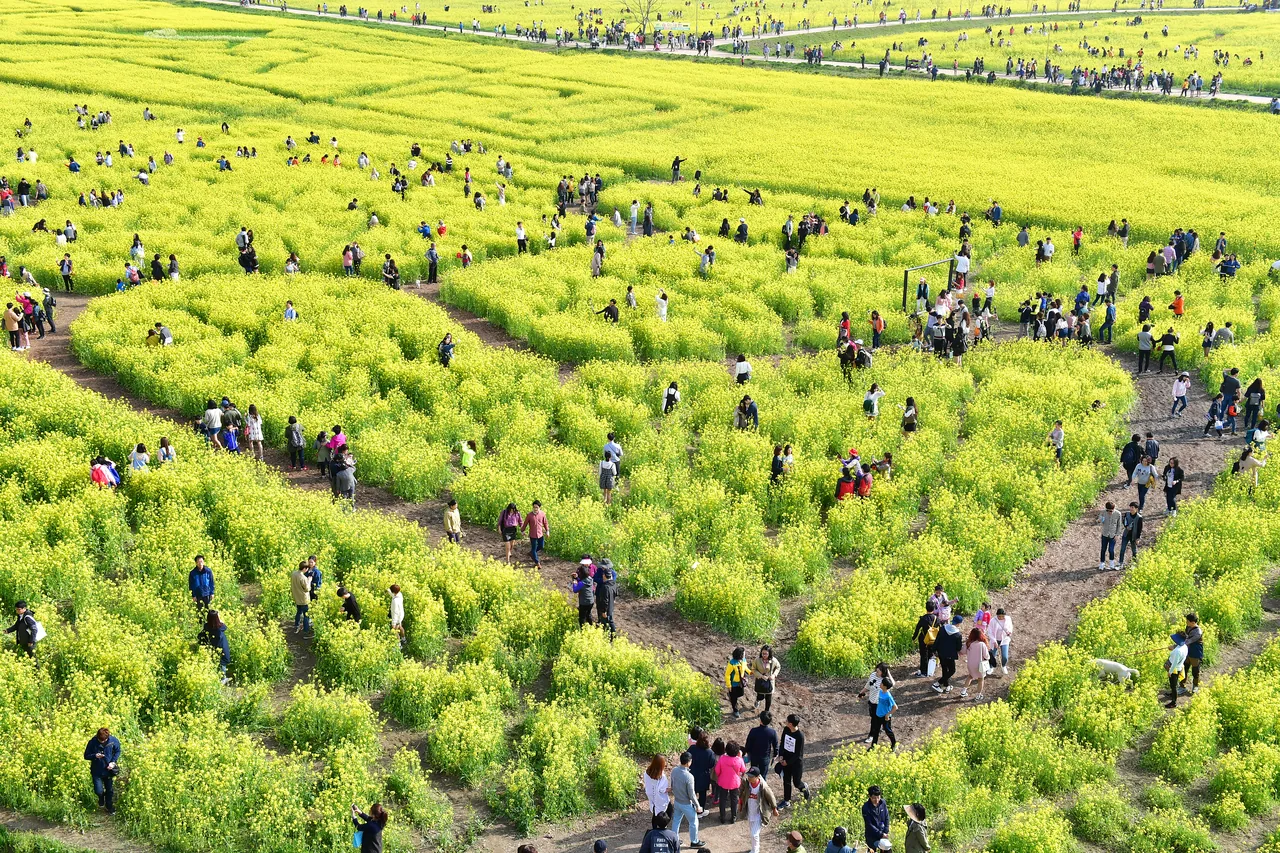
Late spring layers canola fields and blossoms — often the most comfortable weather of the year (here at Daejeo, Busan). Photo: Appleysj, CC BY-SA 4.0, via Wikimedia Commons.
9. The cheapest time to visit Korea
The lowest prices fall in winter (excluding the holidays) and in the quieter shoulder weeks of late spring and early summer. Flights and hotels swing a lot with the seasons, so timing can save you a good deal.
Cheapest:December to February (skip Seollal and Christmas/New Year) — low demand means the best flight and hotel deals, especially mid-week.
Good value shoulders:late May–June (after the blossom rush, before the monsoon) and September (after summer peak, before foliage crowds).
Most expensive: cherry-blossom April, peak-summer August, and foliage October — plus the Seollal and Chuseok holiday weeks, when domestic travel surges.
Value sweet spot: for great weather and reasonable prices, target late May or early-to-mid September — comfortable, dry and a step cheaper than the blossom and foliage peaks.
10. When to avoid: rain, typhoons & national holidays
No month is truly off-limits, but a few windows need planning around:
The monsoon (late June–late July): the wettest stretch of the year. Travel is fine, but expect grey skies and downpours — keep outdoor plans flexible.
Typhoon season (August–September): occasional storms can disrupt flights and ferries (especially to Jeju). Watch the forecast and allow buffer time.
Seollal (Lunar New Year, ~17 Feb 2026) and Chuseok (~25 Sep 2026): Korea’s two biggest holidays. Many shops and restaurants close for a few days and trains, buses and roads are jammed as the country travels home. Palaces and big attractions often stay open (some are even free), but book transport far ahead and expect a quieter, shuttered feel in the cities. Dates shift each year with the lunar calendar.
Peak August: hottest, most humid and most crowded at the beaches and busiest for domestic travel.
Holiday planning: if your trip overlaps Seollal or Chuseok, reserve KTX and intercity buses the moment booking opens, and check opening hours for anything you can’t miss.
11. Best time for what you want to do
Travelling for something specific? Match the activity to the month:
You want…
Go in…
Cherry blossoms
late March (south) → mid-April (Seoul)
Autumn foliage
mid-Oct (mountains) → early Nov (south)
Beaches & summer festivals
July–August
Skiing & snow
December–February (Gangwon)
Hiking & the clearest views
October (cool, dry, stable)
Mild weather + low prices
late May or September
Fewest crowds
winter weekdays (outside holidays)
Verdict: for most first-time visitors, April–May or September–October is the answer — mild, dry and beautiful, whether you want blossoms or foliage. Pick your window, then build the trip itself with our complete Korea Travel Guide.
Best time to visit Korea — Frequently asked questions
Q. What is the best month to visit Korea?
April and October are the two best months. April brings the cherry blossoms and mild spring weather, while October has the clearest skies, the most comfortable temperatures and the start of the autumn foliage. May and September are excellent too — slightly less crowded and often better value.
Q. When is cherry blossom season in Korea in 2026?
In 2026 the blossoms are forecast about 2–7 days earlier than average. They start in the south — Jeju and Busan around 25 March — then move north, reaching Gangneung about 1 April and Seoul around 3 April, peaking in Seoul near 10 April. Peak bloom lasts only about a week, so keep a day or two of flexibility.
Q. When is the best time to see autumn leaves in Korea?
From mid-to-late October to early-mid November. The colour starts in the northern mountains (Seoraksan peaks around 22 October), reaches Seoul and the centre in late October to early November, and finishes in Busan, the south and Jeju in early-to-mid November. Mid-October to early November is the all-round sweet spot.
Q. What is the rainy season in Korea?
Korea’s monsoon, called jangma, runs roughly from late June to late July, bringing spells of heavy rain and humidity (the centre and north tend to run a little later than the south). It doesn’t rain every hour of every day, but skies are grey — bring a compact umbrella. A separate typhoon season runs mainly through August and September.
Q. What is the cheapest time to visit Korea?
Winter — December to February, excluding the Seollal holiday and the Christmas/New-Year period — has the lowest flight and hotel prices. Late May to June and September are good-value shoulder windows with much better weather. The most expensive times are blossom season (April), peak summer (August) and foliage season (October).
Q. What are the hottest and coldest months?
August is the hottest and most humid, often above 30°C. January is the coldest, dry and sometimes below -10°C in Seoul and the inland north — though the south coast and Busan stay much milder, and Jeju milder still.
Q. Is Korea worth visiting in summer or winter?
Yes — each has its own appeal. Summer (June–August) is for beaches, water parks and festivals, though it’s hot, humid and includes the monsoon and typhoons. Winter (December–February) is cold but clear, with skiing in Gangwon, fewer crowds, lower prices and a mild south coast. Just match the season to what you want to do.
Q. When should I avoid visiting Korea?
No time is truly bad, but plan around the monsoon (late June–late July) and typhoon season (August–September) if you want dry weather, and around the Seollal (~17 Feb 2026) and Chuseok (~25 Sep 2026) holidays, when many businesses close and transport is heavily booked.
Q. When is the best time to visit Seoul, Busan and Jeju?
All three are best in spring and autumn, but the timing shifts: blossoms reach Busan and Jeju (late March) before Seoul (early April), while autumn foliage reaches Seoul (late Oct–early Nov) before Busan and Jeju (November). Busan and Jeju also have the mildest winters, making them good cool-season choices.
Q. How many seasons does Korea have?
Four distinct seasons: spring (March–May), summer (June–August), autumn (September–November) and winter (December–February). Spring and autumn have the most pleasant weather; summer is hot and wet; winter is cold and dry, milder in the south.