Korea Visa & K-ETA in 2026: Do You Actually Need One?
Visa, K-ETA and the free e-Arrival Card, explained in plain English and by nationality. Find out exactly what your passport needs, what changes on 1 January 2027, and how to skip the sites that overcharge travellers.
Last updated: July 2026
The short version
Visa
Tourists from the US, UK, Canada, Australia, New Zealand and dozens of other countries need none for a holiday.
K-ETA
Waived through 31 Dec 2026 for 22 countries and regions (US, UK, Canada, Australia, NZ, Japan, Taiwan, Hong Kong and more). From 1 Jan 2027 every visa-free traveller needs one again.
e-Arrival Card
Free, and now the one step almost everyone does — required if you arrive without a valid K-ETA. Fill it at e-arrivalcard.go.kr within 72 hours of landing.
How long you can stay
90 days for most; 180 days for Canadians. Tourism and short business only — no working.
Watch out
Use only the official .go.kr sites. Look-alike pages charge fat fees for what’s free or cheap.
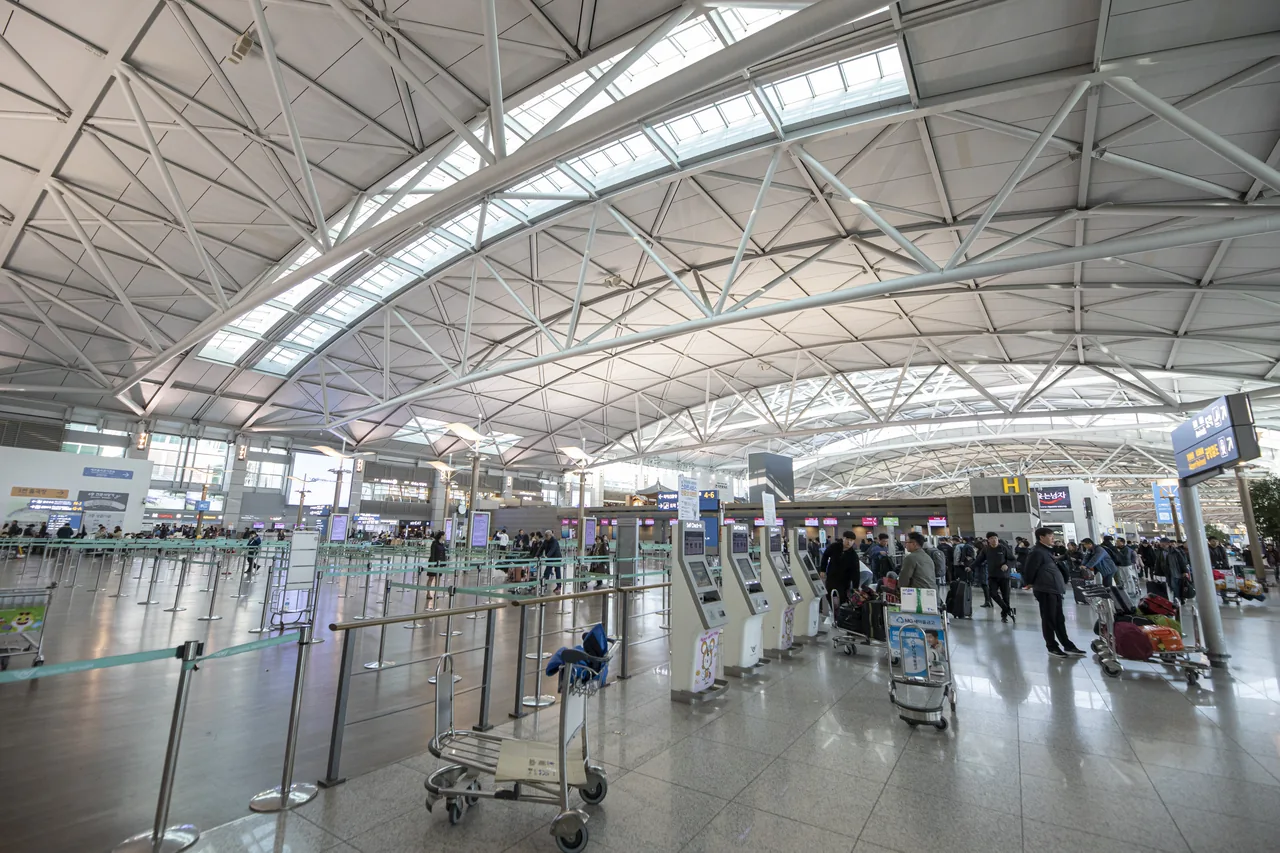
Korea’s international airports are the entry point for most visitors — and the entry rules are the same nationwide. Photo: Arne Müseler / arne-mueseler.com, CC BY-SA 3.0, via Wikimedia Commons.
1. Do you need a visa or K-ETA for Korea?
If you hold a US, UK, Canadian, Australian or New Zealand passport, you need no visa for a holiday in Korea — and no K-ETA either, at least through 31 December 2026. All it takes is a valid passport and the free e-Arrival Card. These countries sit on Korea’s temporary K-ETA exemption list, so for most Western tourists getting in has never been simpler.
The exact answer still comes down to your nationality, so check yours before you book:
US, UK, Australia, New Zealand: visa-free for 90 days; no K-ETA needed through the end of 2026.
Canada: an unusually generous 180 days (6 months) visa-free; no K-ETA through the end of 2026.
Ireland: visa-free for 90 days, but Ireland is not on the exemption list, so Irish travellers do still need a K-ETA. The same catch hits Portugal, Greece, Switzerland and several other visa-free countries.
Visa-required nationalities: a number of passports (for example India, the Philippines, Vietnam, China and Indonesia) need a proper visa — a K-ETA is not an option for them.
Bottom line: for most English-speaking tourists in 2026 the checklist is short — passport plus the free e-Arrival Card, no visa, no K-ETA. From 1 January 2027, add a K-ETA. The rest of this guide breaks down each piece.
2. Visa, K-ETA or e-Arrival Card — which one is you?
Korea’s entry system has three separate parts, and most tourists only ever touch the last one. They don’t stack the way travellers fear — you generally need just one of the first two, plus the arrival card.
What it is
Who needs it
Cost
Where
Visa
Only nationalities not on the visa-free list (e.g. India, Vietnam, the Philippines, China)
Varies
Korean embassy / consulate / visa centre
K-ETA
Visa-free travellers — except the 22 countries and regions exempt until end of 2026
~10,000 won (~US$7)
k-eta.go.kr
e-Arrival Card
Everyone arriving without a valid K-ETA (including exempt countries, children and seniors)
Free
e-arrivalcard.go.kr
Work out your single track and ignore the rest. A valid K-ETA replaces the e-Arrival Card; if you’re K-ETA-exempt, you do the e-Arrival Card instead; and a visa stands in for the K-ETA. Nearly every Western tourist right now is on the first track below.
Which entry track are you on?
Passport from one of the 22 exempt countries?✅ Just the e-Arrival CardFree, at e-arrivalcard.go.kr. Most US, UK, Canada, Australia and NZ readers are here.
Visa-free, but not on the exempt list?📄 Get a K-ETA~10,000 won at k-eta.go.kr. Then you skip the arrival card.
A nationality that needs a visa?🛂 Apply for a C-3 visaAt a Korean embassy or authorised visa centre, before you travel.
3. How long can you stay in Korea without a visa?
Visa-free stays run from 30 to 180 days depending on your passport — comfortably more than any normal holiday needs. Here are the main markets:
Passport
Visa-free stay
K-ETA (2026)
K-ETA (2027+)
Canada
180 days
Not required
Required
United States
90 days
Not required
Required
United Kingdom
90 days
Not required
Required
Australia
90 days
Not required
Required
New Zealand
90 days
Not required
Required
Germany, France, Spain, Italy
90 days
Not required
Required
Japan
90 days
Not required
Required
Taiwan, Hong Kong, Macao
90 days
Not required
Required
Singapore
90 days
Not required
Required
Ireland
90 days
Required
Required
Portugal, Greece
90 days
Required
Required
Thailand
90 days
Required
Required
Russia
60 days
Required
Required
UAE, South Africa
30 days
Required
Required
Visa-required nationalities (India, the Philippines, Vietnam, China, Indonesia and others) aren’t shown here — they need a C-3 visa, not a K-ETA. Always confirm your own passport.
It’s for tourism and short business only. You cannot work on a visa-free entry, paid or unpaid.
Keep your passport valid for the whole trip; six months’ validity is the safe rule of thumb.
Never overstay. Korea enforces it with fines and re-entry bans. A handful of nationalities get only 30 days visa-free, so confirm your own number.
Good to know: a typical Korea trip is one to two weeks, so 90 days (or Canada’s 180) is far more than you’ll use. There’s nothing longer to apply for on an ordinary holiday.
4. What is the K-ETA, and who’s exempt until 31 Dec 2026?
The K-ETA (Korea Electronic Travel Authorization) is an online pre-approval that visa-free travellers normally get before flying — but a temporary exemption lets 22 nationalities skip it right now.
Exempt through 31 Dec 2026 (22 countries & regions): the United States (incl. Guam), Canada, the United Kingdom, Germany, France, Italy, the Netherlands, Spain, Poland, Sweden, Finland, Norway, Belgium, Denmark, Austria, Japan, Taiwan, Hong Kong, Macao, Singapore, Australia and New Zealand. These travellers bypass the K-ETA and just do the e-Arrival Card.
Still needed right now: every other visa-free nationality — including Ireland, Portugal, Greece, Switzerland, Thailand, Chile, Colombia, Mexico, Argentina and Russia. Being visa-free does not mean being K-ETA-exempt.
The big 2027 change: the exemption ends on 31 December 2026. From 1 January 2027 every visa-free traveller will need a K-ETA again, the 22 exempt countries included. If your trip lands in 2027 or later, budget for it.
How to apply for a K-ETA
Where: only the official site k-eta.go.kr or the official K-ETA app.
Cost: about 10,000 won (roughly US$7), paid by card.
Validity:3 years, multiple entries — apply once and reuse it across trips (or until your passport expires).
Timing: apply at least 72 hours before you fly; most approvals land well inside that window, but leave a buffer.
Age: travellers 17 and under or 65 and over are exempt from the K-ETA — but they still complete the free e-Arrival Card.
5. What if your K-ETA is denied or still pending?
Approvals are usually automatic and quick, but a few come back as pending or refused — so apply early and know your options.
Still pending? Most clear within 72 hours, but some take longer. Check the status at k-eta.go.kr with your application number, and don’t book non-refundable travel until it says approved.
Refused? The usual triggers are a typo in your passport data, a photo that doesn’t meet the spec, or an unclear travel purpose. You can reapply with the details corrected.
Won’t approve in time? A traveller flagged for K-ETA can’t just switch to the e-Arrival Card. Contact the K-ETA help centre, and in the worst case apply for a C-3 visa at a Korean mission instead.
Details changed? A new passport means a new K-ETA, because it’s tied to the passport. Changing your flights or dates does not.
Tip: screenshot your approval and keep the application number. Airlines and immigration can look it up, but having it on hand saves time at the gate.
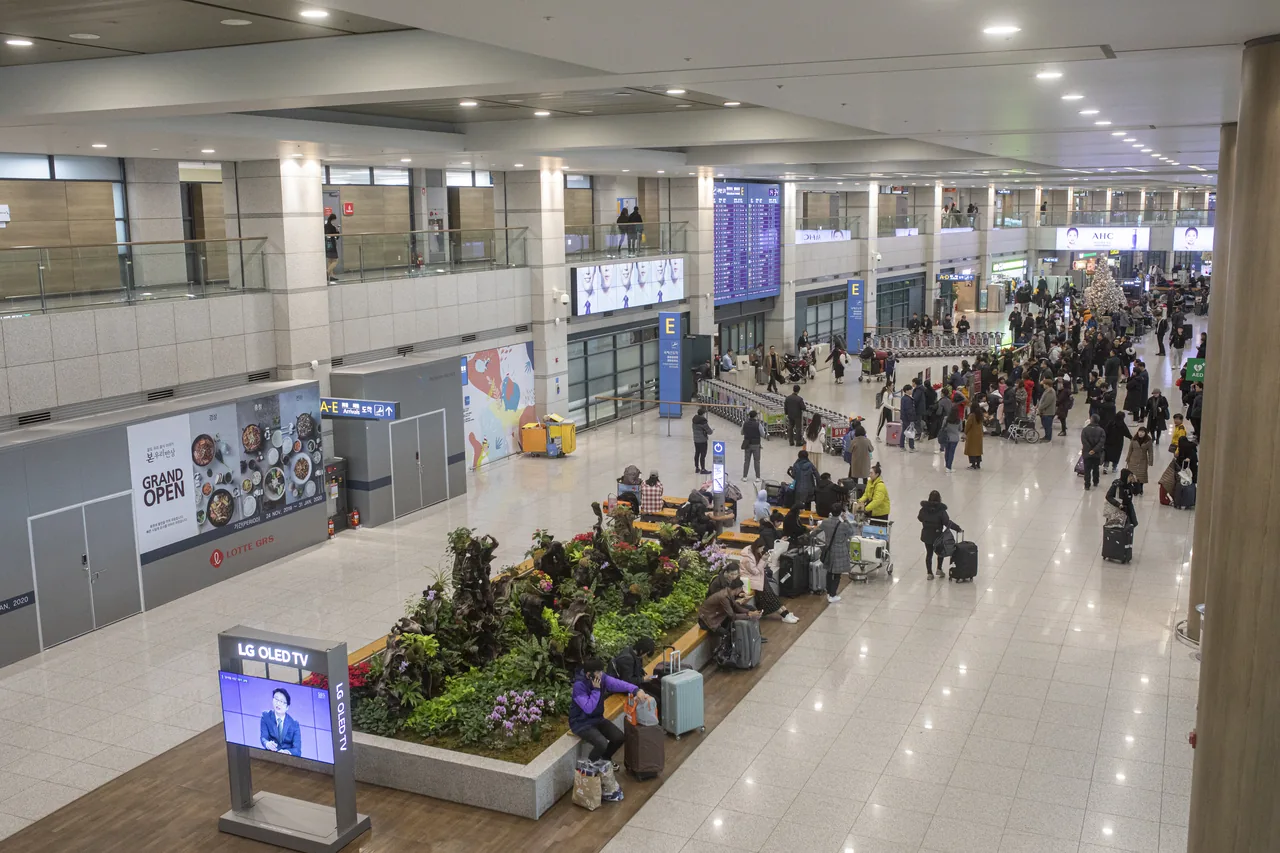
Inside a Korean international airport. Entry rules are identical whichever city you fly into. Photo: Arne Müseler / arne-mueseler.com, CC BY-SA 3.0, via Wikimedia Commons.
6. The e-Arrival Card: the one step almost everyone now takes
Korea retired the paper arrival card — it launched the digital e-Arrival Card in February 2025, and from January 2026 airlines stopped handing out paper slips. Anyone entering without a valid K-ETA now files this free online form before immigration.
Who needs it: every foreign visitor arriving without a valid K-ETA — including citizens of the 22 exempt countries, children and seniors. If you hold a valid K-ETA, or you’re a registered foreign resident, you don’t.
Cost: it’s 100% free.
Where: the only official site is e-arrivalcard.go.kr (check the address ends in .go.kr).
When: you can submit it from 72 hours (3 days) before you land.
How: it takes about 5–10 minutes — passport details, flight number, and your address or hotel in Korea — and produces a QR code. Screenshot it and show it at the immigration desk.
Tip: fill it in the night before your flight, once you know your hotel address and flight number, and screenshot the QR so you’re not hunting for a signal after you land.
7. Your entry timeline: what to do and when
For a typical visa-free tourist, the whole process spreads across just a few moments before and during the trip. Here’s the sequence at a glance.
Weeks ahead
Check your passport. Make sure it’s valid for your whole stay (six months is safe). If your nationality needs a visa, start the C-3 application now.
72h+ before
Apply for a K-ETA at k-eta.go.kr — only if your nationality needs one. The 22 exempt countries skip this step.
Night before
File the e-Arrival Card at e-arrivalcard.go.kr and screenshot the QR code (skip if you hold a valid K-ETA).
At check-in
The airline checks your K-ETA or exemption. Without the right document you can be turned away at the gate.
On landing
Clear immigration with your passport and QR code (or K-ETA). Fingerprints and a photo are taken, and you’re in.
8. What immigration is actually like on arrival
Korean immigration is fast, orderly and signed in English, so first-timers rarely have trouble. Knowing the flow just means you breeze through it.
Biometrics: visitors aged 17 and over give fingerprints and a face photo at the desk. It takes seconds and applies to nearly all foreign arrivals.
What they ask: usually just the basics — how long you’re staying and where. Have your hotel address (on the e-Arrival Card QR) ready.
Families: travelling together is fine, and children are processed with a parent. Everyone without a valid K-ETA still needs their own e-Arrival Card.
After the desk: collect your bags, walk through customs, and the airport rail links, limousine buses and taxis run straight into the city.
Tip: the automated Smart Entry Service e-gates are mainly for residents and registered visitors, so as a tourist just follow the Foreigner lanes — they move quickly.
9. Transit and layovers: when you need none of this
If you’re only changing planes in Korea and never clear immigration, you generally need neither a K-ETA nor an e-Arrival Card.
International-to-international transit: stay airside at Incheon and you skip Korean entry formalities entirely.
Leaving the airport on a layover: the moment you pass immigration you’re “entering” Korea, so the normal rules — K-ETA or e-Arrival Card, by nationality — apply.
Transit tours: Incheon runs free short city tours for eligible transit passengers, a great way to use a long layover; check the terms, as some involve formally entering.
Check your route: if your bags aren’t checked through to the final destination, or you switch airports (for example Incheon to Gimpo), you must clear immigration — so treat it as a normal entry.
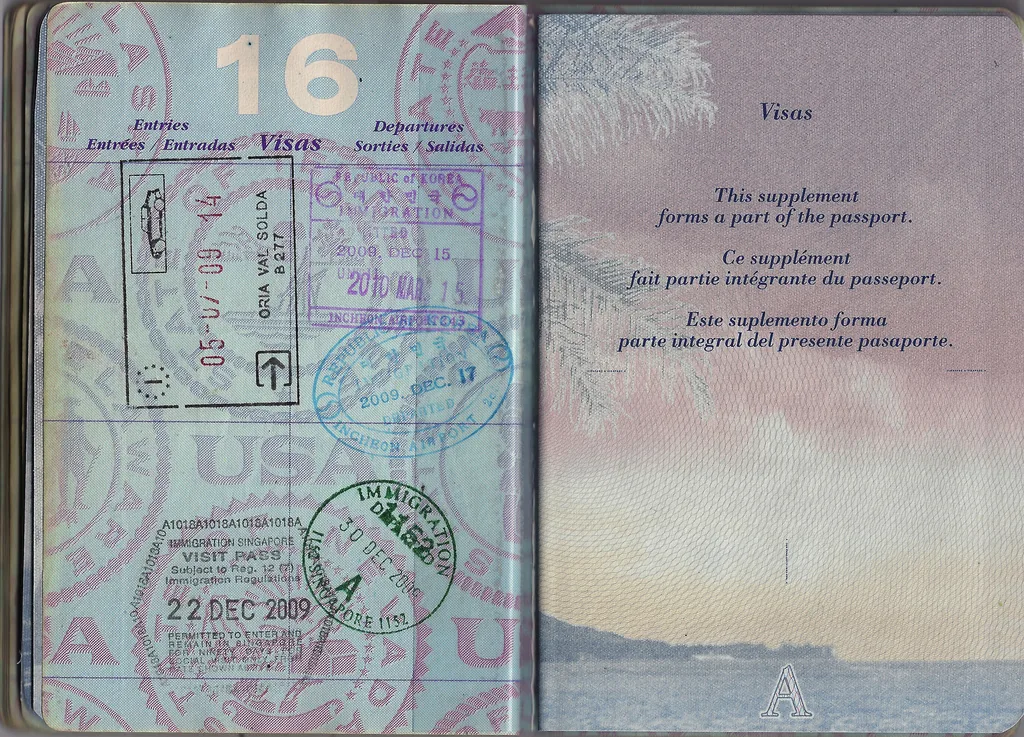
A passport with Korean entry stamps. Most tourists now just need a passport and the free e-Arrival Card. Photo: Daniel Clayton Greer, public domain, via Wikimedia Commons.
10. Overstaying, extending your stay, and re-entry
Visa-free entry is generous but firm: you get your allotted days, you can’t work, and overstaying carries real penalties.
Extending: a normal tourist entry usually can’t be pushed past your visa-free limit. If you need longer, you’d leave and, where appropriate, return; formal extensions are for specific circumstances handled by immigration.
Overstaying: fines climb with the length of the overstay and can come with a re-entry ban, so plan your exit before your days run out.
Re-entry: a K-ETA is multiple-entry for 3 years, so short hops out and back are fine. Frequent back-to-back visa-free entries can draw questions, though — it’s meant for tourism, not for living here.
Working: no visa-free or K-ETA status lets you work, paid or unpaid. A job needs the right visa, arranged before you arrive.
11. If you need a tourist visa (C-3)
If your nationality isn’t on the visa-free list, you’ll need a short-term visit visa (usually the C-3) before you travel — a K-ETA isn’t an option in that case. This applies to a number of passports, such as India, the Philippines, Vietnam, China and Indonesia.
How it works: complete the form on Korea’s official visa portal (visa.go.kr), then submit it at a Korean embassy, consulate or an authorised visa centre (VFS Global, BLS or KVAC). There is no general tourist e-visa that skips this step.
Documents: passport, application form, photo, proof of funds, your itinerary with flight and hotel bookings, and sometimes proof of employment or an invitation. The exact list varies by country.
Stay: a C-3 tourist visa usually allows 30 to 90 days. Apply well ahead, since processing takes time.
Group-tour bonus: the fee for the C-3-2 group tourist visa is waived through 30 June 2026 for organised groups from India, China, Vietnam, the Philippines, Indonesia and Cambodia — worth asking your tour operator about.
Important: visa rules and required documents differ by nationality and change often. Always confirm the current list with your nearest Korean mission before booking anything non-refundable.
12. Only use the official .go.kr sites (and dodge the fee traps)
The most common way travellers waste money on Korean entry is by using unofficial websites. Plenty look slick and rank high in search, but they charge inflated processing fees for things that are free or cheap on the government sites.
K-ETA — official only:k-eta.go.kr (or the official K-ETA app). The real price is about 10,000 won.
e-Arrival Card — official only:e-arrivalcard.go.kr. It is completely free.
The tell: if the address doesn’t end in .go.kr, it isn’t the Korean government. Third-party sites may add tens of dollars and can mishandle your passport data.
Visas: only ever through a Korean embassy/consulate or the official visa-centre partner for your country.
What you should pay vs. what the copycats charge:
K-ETA · official
₩10,000 (~$7)
K-ETA · copycat
often $40–60
e-Arrival · official
FREE
e-Arrival · copycat
$20–40 for nothing
Tip: bookmark the two .go.kr sites now. If a page wants a big fee for the free e-Arrival Card, or far more than ~10,000 won for the K-ETA, close the tab.
13. Get online the moment you land
Korea runs on apps — Naver Map and KakaoMap for directions, Kakao T for taxis — so having data the second you land makes the whole trip smoother. You can buy a SIM or eSIM at the telecom booths in the arrivals hall, but the queues after a long flight are real, and the airport counters aren’t the cheapest.
Sorting a Korea eSIM before you fly means your phone connects on the jet bridge, with your e-Arrival Card QR and maps already loaded. It’s the one bit of trip admin worth doing in advance.
📶 Korean SIM counters want your passport. An eSIM skips the desk entirelySee on Yesim →See on Saily →See on Airalo →Affiliate link — we may earn a commission at no extra cost to you.
14. Before you fly: the 60-second checklist
Here’s the whole thing, start to finish, for a typical visa-free tourist heading to Korea.
Check your passportValid for your whole stay (six months is the safe rule).
Work out your trackExempt country → e-Arrival Card only. K-ETA-required → apply at k-eta.go.kr a few days early. Visa-required → apply for a C-3 well ahead.
Do the e-Arrival CardWithin 72 hours of arrival, fill it at e-arrivalcard.go.kr and screenshot the QR (skip if you hold a valid K-ETA).
Sort your dataSet up an eSIM so maps and taxis work the moment you land.
At immigrationPassport and QR (or K-ETA) ready; fingerprints and a photo, and you’re through.
The verdict: for most visitors, getting into Korea in 2026 really is simple — no visa, no K-ETA, just a free online card and your passport. Remember two things: do the e-Arrival Card before you land, and only ever use the official .go.kr sites. And if your trip is in 2027 or later, the K-ETA is back for everyone. Now for the fun part — plan the rest with our complete Korea Travel Guide.
Most likely not, if you’re a tourist from a visa-free country. US, UK, Canadian, Australian, New Zealand, Japanese, Taiwanese, Hong Kong, Singaporean, Spanish and many other passport holders can visit Korea visa-free for short stays — 90 days for most, 180 days for Canadians. Some nationalities, such as India, the Philippines, Vietnam and China, do need a short-term (C-3) visa applied for at a Korean embassy or visa centre. Always confirm for your specific passport.
Q. Do I need a K-ETA for Korea in 2026?
It depends on your nationality. Through 31 December 2026, 22 countries and regions are temporarily exempt — including the US, UK, Canada, Australia, New Zealand, Japan, Taiwan, Hong Kong, Macao, Singapore and 11 EU states plus Norway — and don’t need a K-ETA. Other visa-free nationalities (for example Ireland, Portugal, Thailand, Chile, Mexico and Russia) still need one. From 1 January 2027 the exemption ends and all visa-free travellers will need a K-ETA again.
Q. What is the e-Arrival Card and is it mandatory?
The e-Arrival Card is Korea’s digital entry declaration. It launched in February 2025, and since paper cards were phased out at the start of 2026 it’s effectively required for everyone arriving without a valid K-ETA. You complete it free at e-arrivalcard.go.kr within 72 hours of arrival; it takes about 5–10 minutes and generates a QR code to show at immigration. Valid K-ETA holders and registered residents don’t need it.
Q. Is the e-Arrival Card free?
Yes, it’s completely free on the official government site, e-arrivalcard.go.kr. If a website charges you for it, that’s an unofficial third party — close the page. Always check the address ends in .go.kr.
Q. How much does the K-ETA cost and how long is it valid?
The K-ETA costs about 10,000 Korean won (roughly US$7), paid by card on the official site k-eta.go.kr. Once approved it’s valid for 3 years with multiple entries, so you apply once and reuse it across trips. Watch out for unofficial sites charging much more.
Q. What’s the difference between a K-ETA and the e-Arrival Card?
The K-ETA is an online travel authorization some visa-free travellers must get before flying (valid 3 years, about 10,000 won). The e-Arrival Card is a free entry declaration done within 72 hours of arrival. You generally do one or the other: with a valid K-ETA you skip the e-Arrival Card; if you’re K-ETA-exempt, you do the e-Arrival Card instead.
Q. How long can I stay in Korea without a visa?
It depends on your passport. Canadians get an unusually long 180 days (6 months). Citizens of the US, UK, Australia, New Zealand, Japan, Taiwan, Hong Kong, Macao, Singapore, Spain and many others get 90 days. Russians get 60 days, and a few nationalities get 30. It’s for tourism and short business only — you can’t work, and overstaying brings fines and re-entry bans.
Q. Do children and seniors need a K-ETA?
No — travellers aged 17 and under or 65 and over are exempt from the K-ETA. But they still complete the free e-Arrival Card before immigration, like everyone arriving without a valid K-ETA.
Q. Will I be fingerprinted at Korean immigration?
Yes. Foreign visitors aged 17 and over give fingerprints and a face photo at the immigration desk. It takes only a few seconds and is standard for almost all arrivals; children under 17 are exempt from the biometrics.
Q. Which are the official websites for the K-ETA and e-Arrival Card?
The only official sites are k-eta.go.kr for the K-ETA and e-arrivalcard.go.kr for the e-Arrival Card — both end in .go.kr. There’s also an official K-ETA app. Avoid look-alike sites that add so-called service fees; they aren’t run by the Korean government.
Q. Do I need a K-ETA if I’m just transiting through Korea?
If you stay airside and don’t clear immigration, you generally need neither a K-ETA nor an e-Arrival Card. The moment you pass immigration — to leave the airport, recheck bags, or switch to another airport — you’re entering Korea and the normal rules for your nationality apply. Incheon also offers free transit tours for eligible passengers.
Q. What happens if my K-ETA is denied?
Refusals usually come from a data typo, a non-compliant photo, or an unclear travel purpose. You can reapply at k-eta.go.kr with the details corrected. If it still won’t approve before your trip, contact the K-ETA help centre — a traveller flagged for K-ETA can’t simply substitute the e-Arrival Card, and in the worst case you’d apply for a C-3 visa at a Korean mission.
Q. Can I extend my stay or stay longer than 90 days?
Not on a normal visa-free entry — your allotted days (90 for most, 180 for Canadians) are the limit, and routine tourist extensions aren’t granted. For a longer stay you’d need the appropriate visa. Overstaying brings fines and possible re-entry bans, so plan your departure before your days run out.
Q. Is my K-ETA good for more than one trip?
Yes. Once approved, a K-ETA is valid for 3 years with multiple entries, so you can reuse it across trips until it or your passport expires. It’s tied to your passport, so a new passport means a new K-ETA, but changing your flights or dates does not.
Q. Do I need a return ticket or proof of funds to enter Korea?
For visa-free tourism you aren’t always asked, but immigration can request evidence of onward travel and enough funds for your stay, so have a return or onward ticket and your hotel details ready. The e-Arrival Card already captures your address in Korea, which covers most of what’s asked.
Q. Does it matter which airport I arrive at in Korea?
No — the entry rules (visa, K-ETA, e-Arrival Card) are national, so they’re the same whether you land at Seoul’s Incheon or Gimpo, Busan’s Gimhae, or Jeju. Immigration works the same too — passport, QR code or K-ETA, fingerprints and photo — and the signage is in English.