Incheon Airport to Seoul: The Fastest, Cheapest and Easiest Ways In
A no-stress guide to getting from Incheon Airport (ICN) into Seoul — the AREX train, limousine buses, taxis and private transfers, with real fares, first and last departures, and exactly which one to pick for your bags, budget and arrival time.
Last updated: June 2026
The 30-second answer
Want it fast
AREX Express train — non-stop to Seoul Station in 43 min (51 from Terminal 2), reserved seat. About ₩11,000 booked online (₩13,000 on the spot).
Want it cheap
AREX All-Stop train — tap a T-money card, pay ~₩4,500, ~60 min, and change to the subway at Hongik Univ., Gongdeok or Seoul Station.
Have big bags
Airport limousine bus (₩17,000–18,000) — one seat, suitcases under the bus, no transfers, dropped near major hotels. E.g. bus 6015 to Myeongdong.
Want door-to-door
Taxi (~₩60,000–80,000) or a pre-booked private transfer — best late at night, with a group, or when you’re too tired to think.
Land after midnight
Trains and most buses have stopped. Take a 24-hour taxi (night surcharge), a private transfer, or a limited N-bus, or wait for the first train (~05:15).
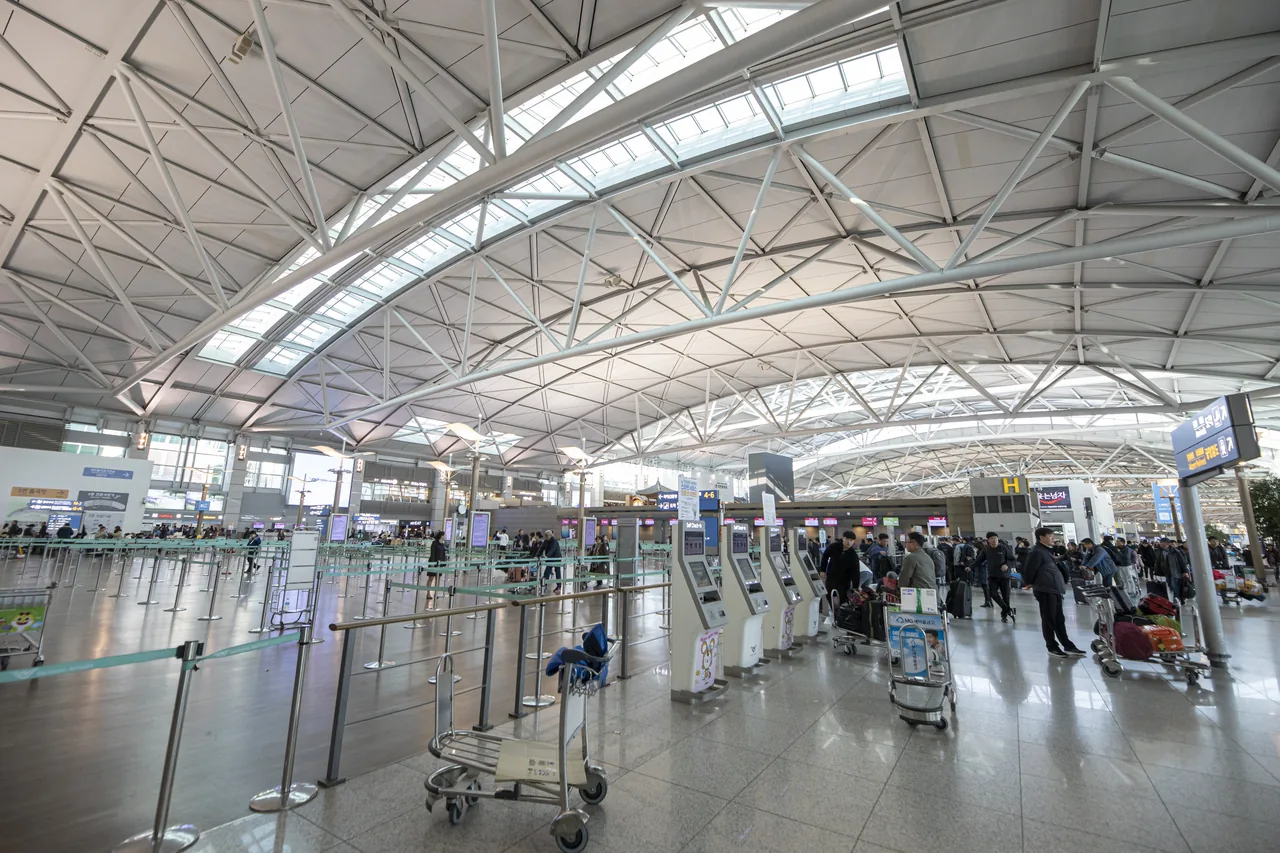
Incheon International Airport — the start of an easy run into Seoul. Photo: Arne Müseler / arne-mueseler.com, CC BY-SA 3.0 DE, via Wikimedia Commons.
1. The quick answer: which one is right for you?
Incheon (ICN) sits about 50–70 minutes west of central Seoul, and the good news is that getting in is genuinely easy — the hard part is just choosing. Here’s the honest shortcut: If you want the city rather than the airport, the Incheon travel guide covers the open port quarter, Wolmido and Yeongjong separately.
Light bags, want speed and a guaranteed seat? AREX Express train.
Counting every won? AREX All-Stop train with a T-money card.
Two big suitcases and no patience for stairs? An airport limousine bus that stops near your hotel.
Late flight, a group, or just exhausted? A taxi or a pre-booked transfer, straight to the door.
🚐 AREX Express runs Seoul Station in 43 minutes with a reserved seat and space for bagsSee on Klook →See on KKday →See on Trip.com →Affiliate link — we may earn a commission at no extra cost to you.
First-timer’s reassurance: every option is signed in English, staff are used to confused arrivals, and you can pay by card almost everywhere. You will not get stuck. New to the country generally? Our guide to getting around Korea guide covers getting around once you’re in town.
2. The four ways in, side by side
Times below are to central Seoul and shift with traffic and your final stop.
Option
Cost
Time
Why pick it
AREX Express
~₩11,000 (online)
43–51 min
Fastest, reserved seat, no transfers — to Seoul Station
AREX All-Stop
~₩4,500 (T-money)
~60 min
Cheapest, frequent, links straight to the subway
Limousine bus
₩17,000–18,000
60–90 min
No transfers, luggage hold, stops near hotels
Taxi
~₩60,000–80,000
60–70 min
Door to door, anytime, good for 2–4 people
Private transfer
Fixed, pre-booked
60–90 min
Meet & greet, set price, ideal for families/groups
The honest verdict: a solo traveller or couple staying central usually wins with the AREX (Express for speed, All-Stop for value). The moment you add heavy luggage, a group, or a midnight landing, a bus, taxi or transfer earns its price.
3. AREX Express: the fast, no-thinking option
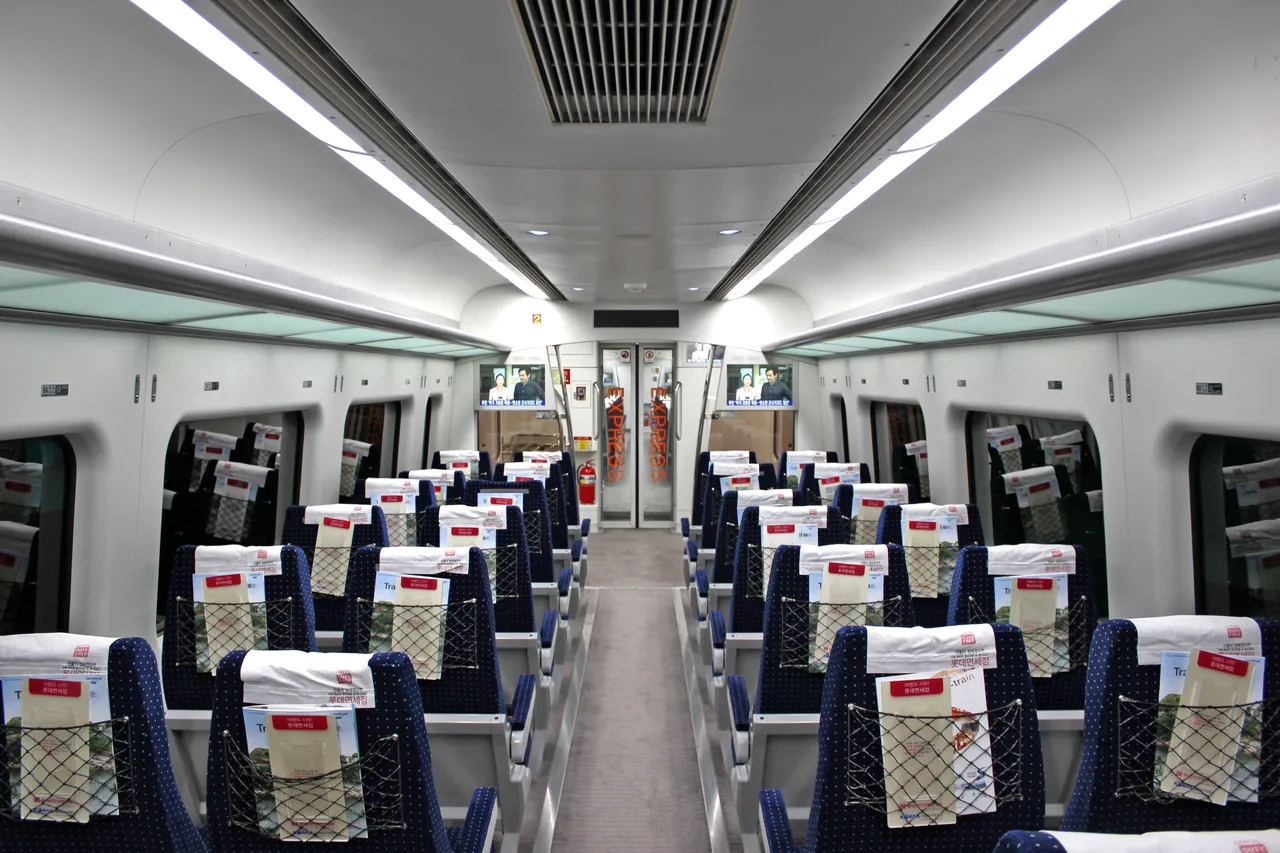
The AREX Express runs non-stop from the airport to Seoul Station with a reserved seat, free Wi-Fi, charging points and proper luggage racks. It’s the calmest way in if you’re not loaded down with bags.
Journey: about 43 minutes from Terminal 1, 51 from Terminal 2, with no stops.
Fare: roughly ₩11,000 when you book online in advance, versus about ₩13,000 bought on the spot.
Frequency: every 30–45 minutes, first train around 05:15, last around 22:40–22:50.
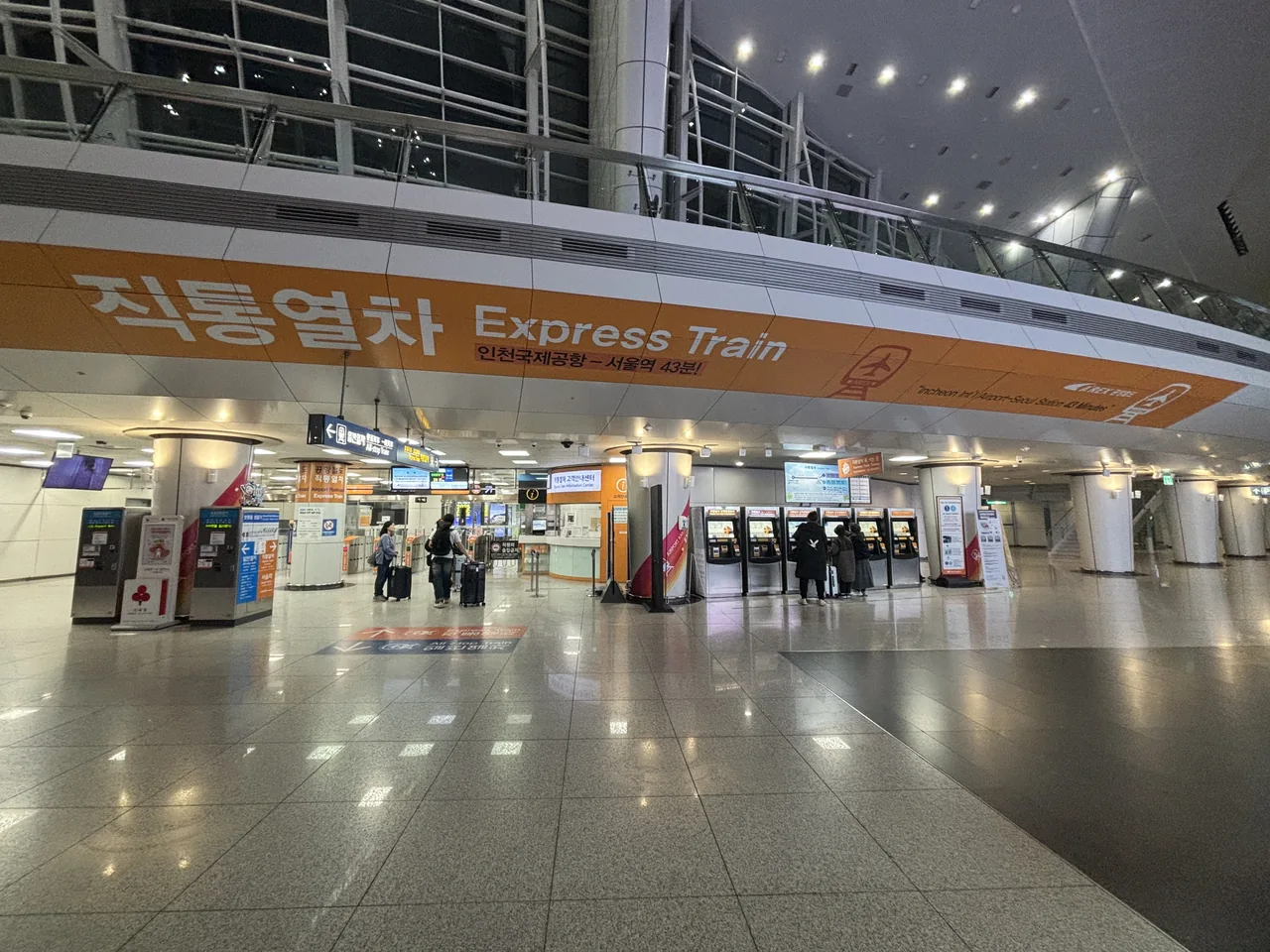
Where to catch it: follow the AREX / Airport Railroad signs down to B1, the Transportation Center, under both terminals. Book online for the cheaper fare and a guaranteed seat, then scan your QR at the gate.
The one catch: it only goes to Seoul Station. If your hotel is elsewhere, you’ll finish with a short subway ride (Lines 1 and 4 connect there) or a quick taxi — so factor that last leg in.
🚐 Buying the Express ticket ahead costs less than the counter price at the airportSee on Klook →See on KKday →See on Trip.com →Affiliate link — we may earn a commission at no extra cost to you.
Pro move: book the Express online before you fly. It’s a few thousand won cheaper than the counter, locks in your time slot, and you walk straight to the platform instead of queuing at the machine after a long flight.
4. AREX All-Stop: the cheapest way, by far
The All-Stop train is the regular commuter service, and it’s the budget king. There’s no ticket to buy and no seat to reserve — you just tap in with a T-money card like a local, pay around ₩4,500 depending on your stop, and ride in about 60 minutes. Trains come every 5–15 minutes from roughly 05:18 to 23:32.
Its secret weapon is that it stops at stations that feed straight into the subway, so for many neighbourhoods you skip Seoul Station entirely:
Get off at
Good for
Gimpo Int’l Airport
Domestic connections; Line 5 & 9
Digital Media City
Line 6, the northwest
Hongik Univ. (Hongdae)
Hongdae, Mapo, Line 2 & the airport line itself
Gongdeok
Lines 5 & 6, Gyeongui–Jungang line
Seoul Station
Lines 1 & 4, KTX, the city centre
Best value in Korea: if you’re staying near Hongdae or any subway-connected stop and you’re travelling light, the All-Stop is unbeatable — a few thousand won versus ₩13,000 for the Express. The trade-off is no guaranteed seat, so it can mean standing with your bag at busy times.
5. Airport limousine bus: easiest with luggage
If you’ve got real suitcases, the limousine bus is the sweet spot. You get one seat, your bags stowed in the hold, and zero transfers — the bus carries you from the airport to a stop near the big hotels and neighbourhoods.
Fare:₩17,000 for a standard bus, ₩18,000 for the plush KAL Limousine (fewer, wider seats); children about ₩12,000.
Time: roughly 60–90 minutes, depending on your stop and traffic.
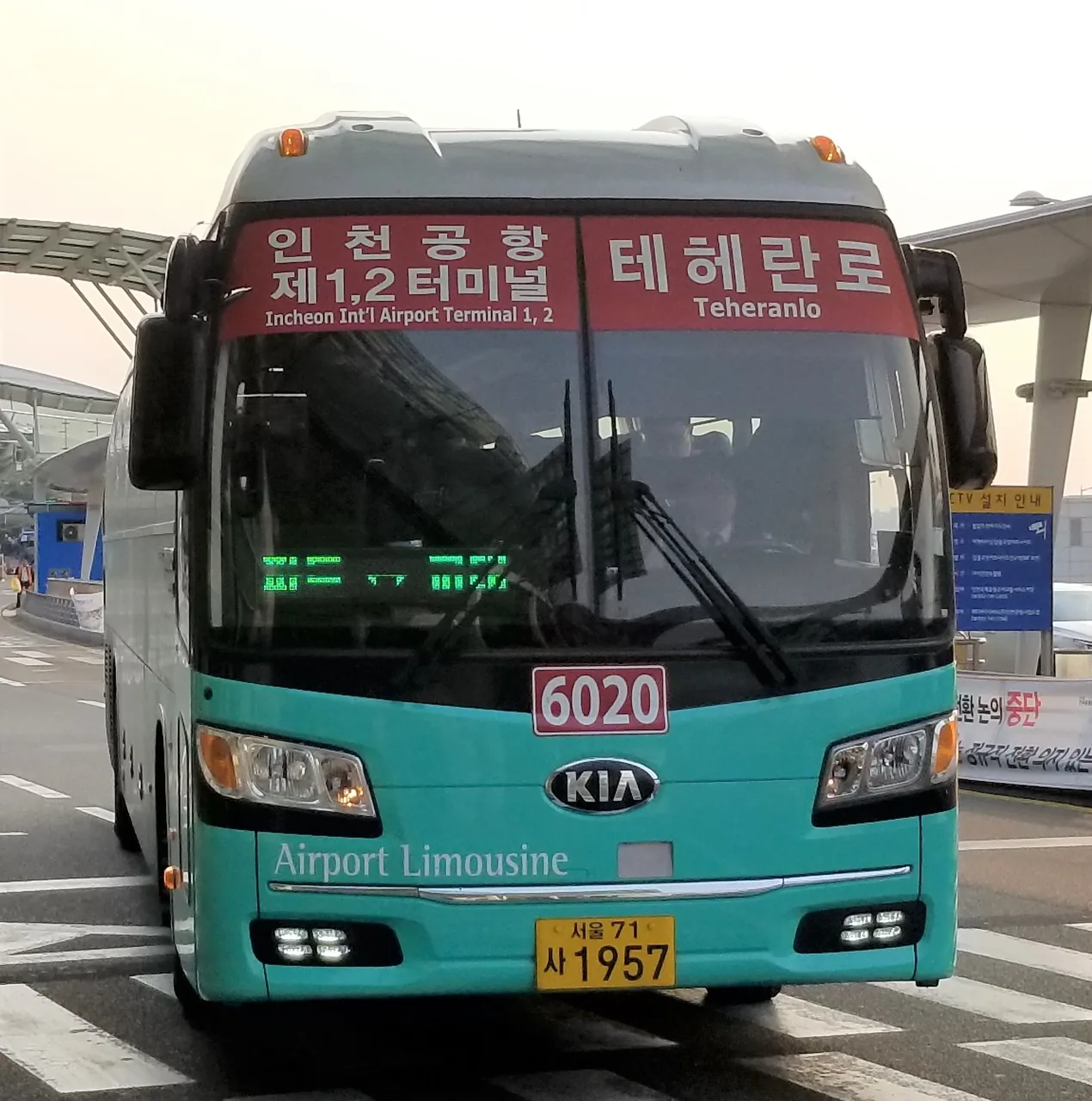
Useful routes:6015 runs to Myeongdong; 6001/6002 serve the Namdaemun–Myeongdong–Dongdaemun corridor; the KAL deluxe 6701 hits City Hall, Gwanghwamun and Seoul Station hotels; 6009/6020/6030 head for Gangnam, COEX and Jamsil.
Tickets: buy at the counter or kiosk on B1 (the kiosks switch to English, Chinese or Japanese — tap the flag, search your hotel/stop, pay by card), or just outside the 1F arrival exits. First buses around 05:30, last around 23:00–23:30.
Check the stop before you commit. A limousine bus is brilliant if it stops near your hotel — and a pain if it drops you 1 km away with your luggage. Search your hotel’s nearest limousine stop first; if there isn’t a close one, take the AREX or a taxi instead.
The AREX Express runs non-stop to Seoul Station with a reserved seat, free Wi-Fi and luggage racks. Photo: Minseong Kim, CC BY-SA 4.0, via Wikimedia Commons.
6. Taxi: door to door, on your schedule
A taxi is the simplest thing in the world after a long flight: walk to the rank, get in, hand over the address, arrive at your door. It’s the priciest everyday option but unbeatable when you’re tired, loaded or arriving at an awkward hour. Expect 60–70 minutes and roughly:
Type
Rough fare to downtown
Notes
Regular (orange/grey)
₩60,000–75,000
Metered; tolls (~₩8,000) added
Deluxe / “Mobeom” (black)
up to ₩100,000
Roomier, pricier rate
International Taxi (orange logo)
~₩75,000–95,000
English-speaking, fixed-zone fares you can prepay
Night surcharge: fares rise about 20% from midnight to 4am.
Use Kakao T: Korea’s standard ride app has an English interface, shows the metered fare, and saves you haggling — also your best friend for the trip back.
Use the official rank, ignore the touts. Anyone approaching you inside the terminal offering a “taxi” or “limo” is to be avoided. Go to the marked taxi stand outside the 1F arrivals exits, or call one on Kakao T, and insist on the meter (or a clear app fare) rather than a quoted flat price.
You’ll want data on arrival for Kakao T, maps and translation. Sort an eSIM before you fly so it switches on the moment you land — see our Korea SIM & eSIM guide.
7. Private transfer: the zero-stress option
A pre-booked private transfer is a taxi without any of the friction. You reserve before you fly; a driver waits in the arrivals hall holding a sign with your name, helps with the bags, and drives you straight to your accommodation for a price fixed in advance. No queue, no fare surprise, no language gap at 1am.
It makes the most sense when you’re:
A family or group — split between 3–6 people, a van often beats separate train or bus tickets.
Landing late, after the trains and buses have stopped.
Travelling with small kids, lots of luggage, or simply done with decisions after a long-haul flight.
🚐 A private car makes sense with three people, big bags or a landing after midnightSee on Klook →See on KKday →See on Trip.com →Affiliate link — we may earn a commission at no extra cost to you.
Book ahead to lock the price: transfers are charged per vehicle, so the more of you there are, the better the value — and your driver is waiting the second you clear customs.
8. Getting to your neighbourhood
Where you’re staying decides the smart pick more than anything else:
Staying in…
Easiest route from ICN
Myeongdong / City Hall
AREX to Seoul Station + one subway stop, or limousine bus 6015 / KAL 6701
Hongdae / Mapo
AREX All-Stop straight to Hongik Univ. — no transfer needed
Gangnam / COEX
Limousine 6009/6020/6030, or AREX to Seoul Station then Line 1→Line 2
Dongdaemun
Limousine 6001/6002, or AREX + Line 1/4
Gwanghwamun / Insadong
KAL 6701, or AREX + a short subway/taxi hop
Two-minute method: drop your hotel into a Korean map app (Naver Map or KakaoMap — Google Maps is limited here), check the nearest subway station and whether a limousine stops close by, then pick the route with the fewest transfers for the bags you’re carrying. Planning the days too? Our Korea itinerary guide helps you slot it all together.
Incheon has two passenger terminals, and which one you land at changes your trip a little:
Terminal 2 is the newer one, used by Korean Air, Delta, Air France, KLM and their partners. It sits a bit further out, so the AREX takes ~51 minutes versus ~43 from Terminal 1.
Terminal 1 serves Asiana, most foreign airlines and the low-cost carriers.
Each terminal has its own AREX station, bus stops and taxi rank down at the Transportation Center, so you don’t move between terminals to catch your ride.
If you ever land at the wrong one (to meet someone, say), a free shuttle connects them in 15–20 minutes, or the All-Stop train links them in one stop.
Confirm your terminal before you fly out, too. Departing from the wrong terminal is a genuine, time-eating mistake — it’s printed on your ticket, so check it.
An airport limousine bus: one seat, bags in the hold, and a stop near many hotels. Photo: hyolee2, CC BY-SA 4.0, via Wikimedia Commons.
10. Your first 30 minutes at Incheon
Knowing the flow turns a daunting mega-airport into a simple checklist. After you land:
Immigration Have your passport and (if required) your K-ETA ready — see our Korea visa & K-ETA guide. Lines move steadily; e-gates speed things up for many nationalities.
Baggage & customs Grab your bags, walk through customs, and you’re in the 1F arrivals hall.
Pick up SIM / Wi-Fi & cash Collect a pre-ordered SIM/eSIM or pocket Wi-Fi at the arrivals desks, and grab a T-money card and some cash if you need them.
Head to your transport For the train and buses, follow signs down to B1 (Transportation Center). For taxis and some bus stops, step outside the 1F exits to the marked stands.
Everything is downstairs together: the AREX platforms and the bus/taxi hub all sit in or beside the Transportation Center, clearly signed in English — you won’t wander far.
11. Landing late at night?
A very late flight narrows your options, so it’s worth deciding before you’re standing in an emptying arrivals hall at 1am:
Trains: the last AREX leaves around 22:40 (Express) / 23:32 (All-Stop), so a post-midnight landing usually rules them out.
Limousine buses: last departures are around 23:00–23:30, then night N-buses (N6000/N6002) run roughly midnight–4am, every 40–50 minutes, to limited destinations.
Taxis run 24/7 with the night surcharge — the reliable fallback; just budget a little extra.
A pre-booked transfer is the calmest late choice: your driver is there whatever the hour, at the price you already agreed.
Or wait it out: Incheon is a 24-hour airport with lounges, a spa/sauna, a capsule hotel and convenience stores — some travellers simply rest until the ~05:15 first train.
Book the late-night ride before you fly. Lining up a transfer, or knowing your Kakao T plan, beats hunting for options while jet-lagged in a quiet terminal.
12. Cards, apps & cash: a 5-minute setup
Five minutes of prep in the arrivals hall makes the whole trip smoother — and it pays off the second you board the train or hail a cab.
Transit card: grab a T-money (or Cashbee) card at any convenience store — CU, GS25, 7-Eleven, Emart24 — on B1, and load some cash. It pays for the All-Stop train, the subway, city buses and even taxis. Tourist-friendly WOW Pass machines (card + currency exchange) are at the airport too.
Get online: an eSIM or SIM means Kakao T, maps and translation work the instant you land — see our Korea SIM & eSIM guide.
Save your address in Korean: keep the hotel’s Korean name and address on your phone to show a driver or type into a map app.
One note on the Climate Card: Seoul’s unlimited-transit “Climate Card” is great in the city but doesn’t cover the AREX airport run, so it’s not your ticket in from Incheon. For the full breakdown — which pass pays off and when T-money still wins — see our Climate Card vs T-money comparison.
That’s the airport sorted. For getting around once you’re in town — subway, buses, taxis and the apps that actually work in Korea — read our full guide to getting around Korea guide, and plan the whole trip with our complete Korea Travel Guide.
🏨 Sorted your ride from the airport? The next question is where to sleep. Our guide to where to stay in Seoul, by neighborhood breaks down Myeongdong, Hongdae, Gangnam and more, with who each area suits.
Q. What’s the cheapest way from Incheon Airport to Seoul?
The AREX All-Stop train. You tap in with a T-money card and pay around ₩4,500 depending on your stop — the same as a normal subway ride — and it takes about 60 minutes to Seoul Station, connecting straight into the subway at stops like Hongik Univ. and Gongdeok.
Q. What’s the fastest way into Seoul?
The AREX Express train, non-stop to Seoul Station in about 43 minutes from Terminal 1 (51 from Terminal 2), with a reserved seat. From Seoul Station you transfer to the subway or KTX for your final stop. A taxi or transfer can be quicker door-to-door if your hotel is far from Seoul Station.
Q. How much is the AREX Express, and where do I buy it?
About ₩13,000 on the spot, or around ₩11,000 booked online in advance. Buy it online (and scan a QR), or at the counter or machines on B1, the Transportation Center under both terminals. The All-Stop train, by contrast, needs no ticket — just tap a T-money card.
Q. How much is a taxi from Incheon Airport to Seoul?
Roughly ₩60,000–75,000 to central Seoul in a regular taxi including tolls, up to about ₩100,000 in a black deluxe taxi, and around ₩75,000–95,000 for an English-speaking International Taxi with fixed fares. A ~20% night surcharge applies from midnight to 4am. Use the official rank or the Kakao T app.
Q. Which limousine bus goes to Myeongdong / Gangnam?
Bus 6015 runs to Myeongdong, and 6001/6002 cover the Namdaemun–Myeongdong–Dongdaemun area; for Gangnam, COEX and Jamsil look at 6009, 6020 or 6030. Buy a ticket at the B1 counter or a multilingual kiosk, or just outside the 1F exits. Standard fare is ₩17,000 (₩18,000 for the KAL deluxe).
Q. How do I get to Hongdae from Incheon Airport?
Take the AREX All-Stop train straight to Hongik Univ. station — it’s right in Hongdae, so there’s no transfer at Seoul Station. It’s cheap (a T-money tap, ~₩4,500) and frequent. A limousine bus toward the Hongdae/Mapo side also works if you have heavy bags.
Q. What if I arrive after midnight?
The trains (last around 22:40–23:32) and most buses have stopped. Your options are a 24-hour taxi with the night surcharge, a pre-booked private transfer, or a limited night N-bus (N6000/N6002, roughly midnight–4am). Otherwise, Incheon is a 24-hour airport where you can wait comfortably for the first train around 05:15.
Q. Does the AREX use a T-money card?
On the All-Stop train, yes — tap in and out exactly like the subway. The Express train is a separate reserved-seat service, so it needs its own ticket (bought online, at the counter or from a machine), not a simple T-money tap.
Q. Does it matter whether I land at Terminal 1 or Terminal 2?
A little. Terminal 2 (Korean Air, Delta, Air France, KLM and partners) is further out, so the AREX takes about 51 minutes versus 43 from Terminal 1. Both terminals have their own train station, bus stops and taxi rank, and a free shuttle links them in 15–20 minutes. Check your terminal on your ticket.
Q. Is the airport far from Seoul, and how long does it take?
Incheon is about 50 km west of the city. In practice you’re looking at roughly 43–51 minutes on the AREX Express, around 60 minutes on the All-Stop train, and 60–90 minutes by bus or taxi depending on traffic and where you’re staying.