
Gwangalli Drone Show in Busan: Times, Spots and Cancellations
Eleven hundred drones over the water, twelve minutes, no ticket and no seat
| When | Every Saturday, twice a night. 8pm and 10pm from March to September, 7pm and 9pm from October to February |
|---|---|
| Cost | Free. There is no ticket, no seat and nothing to book |
| Scale | Twelve minutes, 1,100 drones. Holiday specials run up to 3,000 |
| Where to stand | On the sand. The official zone runs 200m either side of Manname Square |
| Where you cannot go | Millak Beach Park is the launch pad and closes 40 minutes before each show |
| The catch | Weather. Twelve shows were cancelled or postponed during 2025 alone |
1. First, check whether it is running tonight
2. Why a twelve-minute show is twelve minutes
3. Where to stand
4. Getting there, and parking
5. When to arrive and how the night runs
6. Nights when a special is on
7. Before and after, along the beach
8. If it is cancelled
The show itself takes twelve minutes. Everything else is preparation. Part of our complete Busan Travel Guide.
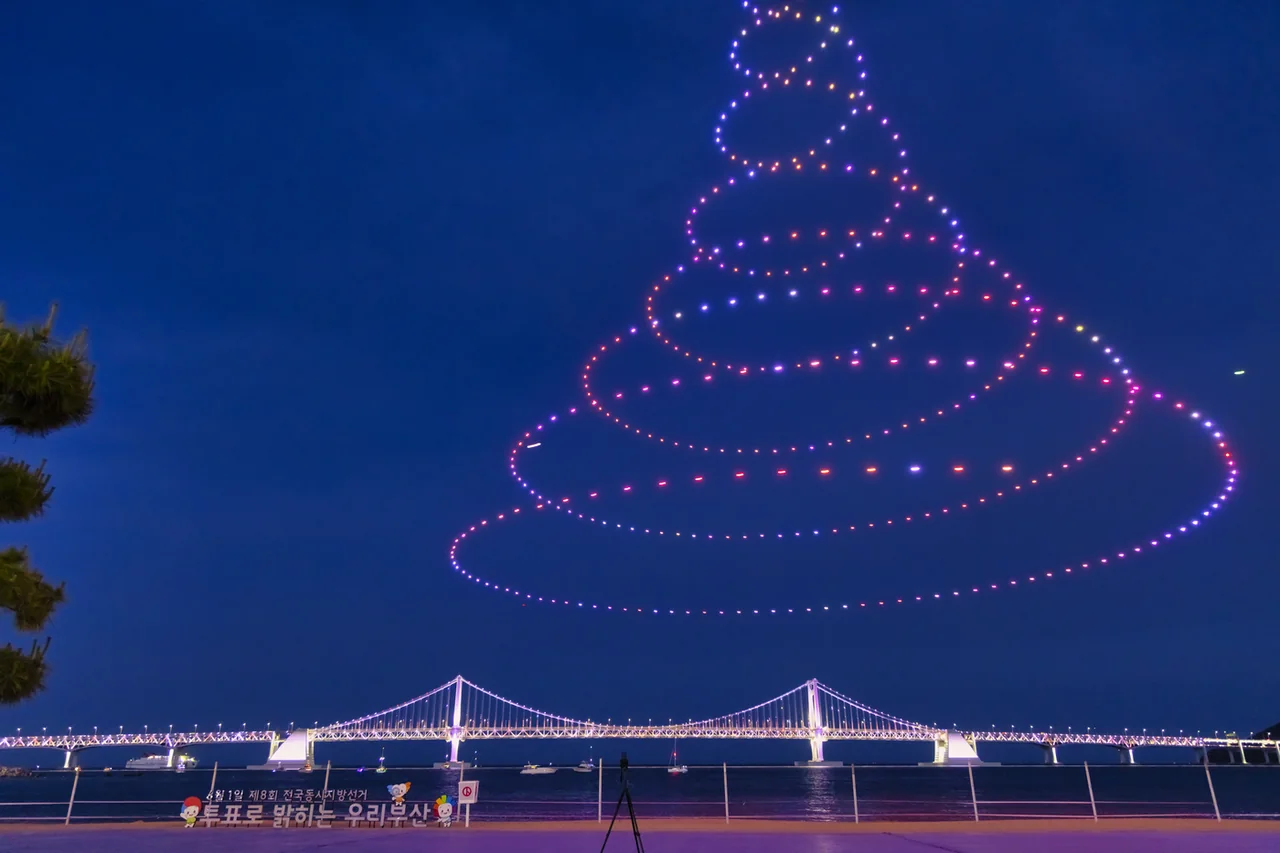
1. First, check whether it is running tonight
It says every Saturday, and quite often it does not happen. Counting every notice posted by Suyeong-gu, the district that runs the show, 2025 brought twelve cancellations or postponements. Add one 30-minute delay and three Saturdays announced in advance as having no show at all. The pattern held into 2026, with six cancellations between January and July.
| Across 2025 | Count |
|---|---|
| Cancelled or postponed | 12 |
| Delayed by 30 minutes | 1 |
| Announced in advance as no show | 3 |
Roughly one Saturday in four or five, then. Almost no travel listing mentions it. The line that circulates is “every Saturday, free” and nothing more, which is how visitors end up planning a Saturday night in Busan around a show that was called off the previous evening.
Why it gets called off so often
The official notice gives two reasons. Weather is the obvious one: rain, strong wind, typhoons. The second is communications, and that one tells you what kind of show this is.
Nobody is piloting these aircraft. The path of all 1,100 is programmed in advance, and each machine follows it by continuously fixing its own position from satellite navigation. Coordinates fly the fleet, not people. If the positioning signal or the radio link wavers, the formation cannot hold, which is why a clear sky guarantees nothing.
That single fact explains most of the rules around the show. Public wi-fi on the beach is switched off during holiday specials to keep the airwaves clean. Flying your own drone over Gwangalli at night without prior approval is prohibited for the same reason: one uncleared machine inside that airspace puts 1,100 others at risk, and without a remote pilot certificate and a night flight permit it is an offence under the Aviation Safety Act. Wind is part of the same story, since show drones are built extremely light in order to stay up, which leaves them little to fight a gust with.
🔴 So the warning comes late. The official notice states that a show may be cancelled or delayed “the day before or on the day itself”, and the posting dates bear that out: some went up the previous evening, others on the Saturday morning. Weather and radio conditions are not knowable in advance, so there is nothing to confirm earlier.
There is one place to look: the notice board on the official show website. The organisers state in their own visitor rules that cancellations are posted there. Instagram, YouTube and the district blog all carry the show too, but the notice board is where a cancellation appears first. Check once on Saturday afternoon and again before you leave your accommodation, and you will almost never make a wasted trip.
2. Why a twelve-minute show is twelve minutes
A show drone carries enough battery for about twenty minutes in the air. Take out take-off, getting the fleet into formation and landing again, and the window left for actually drawing anything is usually five to eight minutes. Gwangalli’s twelve is at the long end of that. If it feels short, it is because the format is running close to its technical ceiling.
The fleet has not always been this size either. The permanent run began with 300 drones, went through 500 and 700, and reached 1,000 in July 2025. The official figure now is 1,100. If your memory of this show is a few years old, what flies today is a different production. Holiday and year-end specials push it as high as 3,000.
It is not a silent show, either. The beach carries a sound system and the drones move to music, which is worth knowing when you pick a spot: how well you hear matters as much as what you see.
The clock moves an hour when the season changes
Two showings a night, and the whole timetable shifts by an hour in March and October. Twelve minutes each, same programme both times.
| Season | First showing | Second showing |
|---|---|---|
| March to September | 20:00 | 22:00 |
| October to February | 19:00 | 21:00 |
That switch is where people get caught. Information written in September is an hour wrong by October, so if you are travelling across the changeover, look the times up again rather than trusting a saved page.
Suyeong-gu commissioned Pusan National University’s industry-academic foundation to measure what the show is worth, and a year of data came back at up to 28.6 billion won of economic impact annually, with as much as 700 million won in a single week around a showing. Visitor satisfaction scored 6.18 out of 7. The figures carry weight because the study isolated people who came specifically for the drones. In practical terms, a beach that used to make its money in one summer season now pulls a crowd every Saturday night of the year.
3. Where to stand
The drones fly out over the sea, so anyone on the sand facing the water is looking straight at them. Nothing to crane your neck at, nothing in the way. The organisers say the show is visible from anywhere along Gwangalli BeachMap, and broadly that holds.
There is still a better spot, and it is worth the walk. Suyeong-gu marks a recommended viewing zone on its site plan: the sand in front of Manname SquareMap, the meeting point about halfway along the beach. A related notice puts a figure on it, 200 metres to each side of the square, 400 metres in total.
| Spot | What you get |
|---|---|
| Sand at Manname Square | The official zone, 400m with the formation dead ahead |
| West end of the beach | More room, but the formation sits at an angle |
| The seafront pavement | Organisers actively ask people not to stand here |
| Millak Beach Park | 🔴 Closed. See just below |
| On the water | A paid option that skips the crowd |
Millak Beach Park is shut on show nights
Millak Beach ParkMap is where the drones take off. It appears on the official site plan as the launch zone, cordoned from 1pm to midnight on show days, with public access stopping 40 minutes before each showing and staying shut until the show ends. The photo zone marked on the same plan closes with it.
This matters because Millak has a reputation as a vantage point, and on any ordinary evening it earns it: the bridge sits close and the angle is generous. On a Saturday with drones, that same ground is behind the stage. Walk along to Manname Square instead.
Coming with a wheelchair or a pram, there is a reserved area, set up fresh 40 minutes before each showing opposite the Starbucks Gwangalli branch at 247 Gwanganhaebyeon-ro. It is not permanent, so arriving much earlier means arriving before it exists. It exists because of the sand, which wheels do not cross well in the dark. The nearest public toilets are in the basement of the Gwangalli tourist information centre and towards Millak Beach Park.
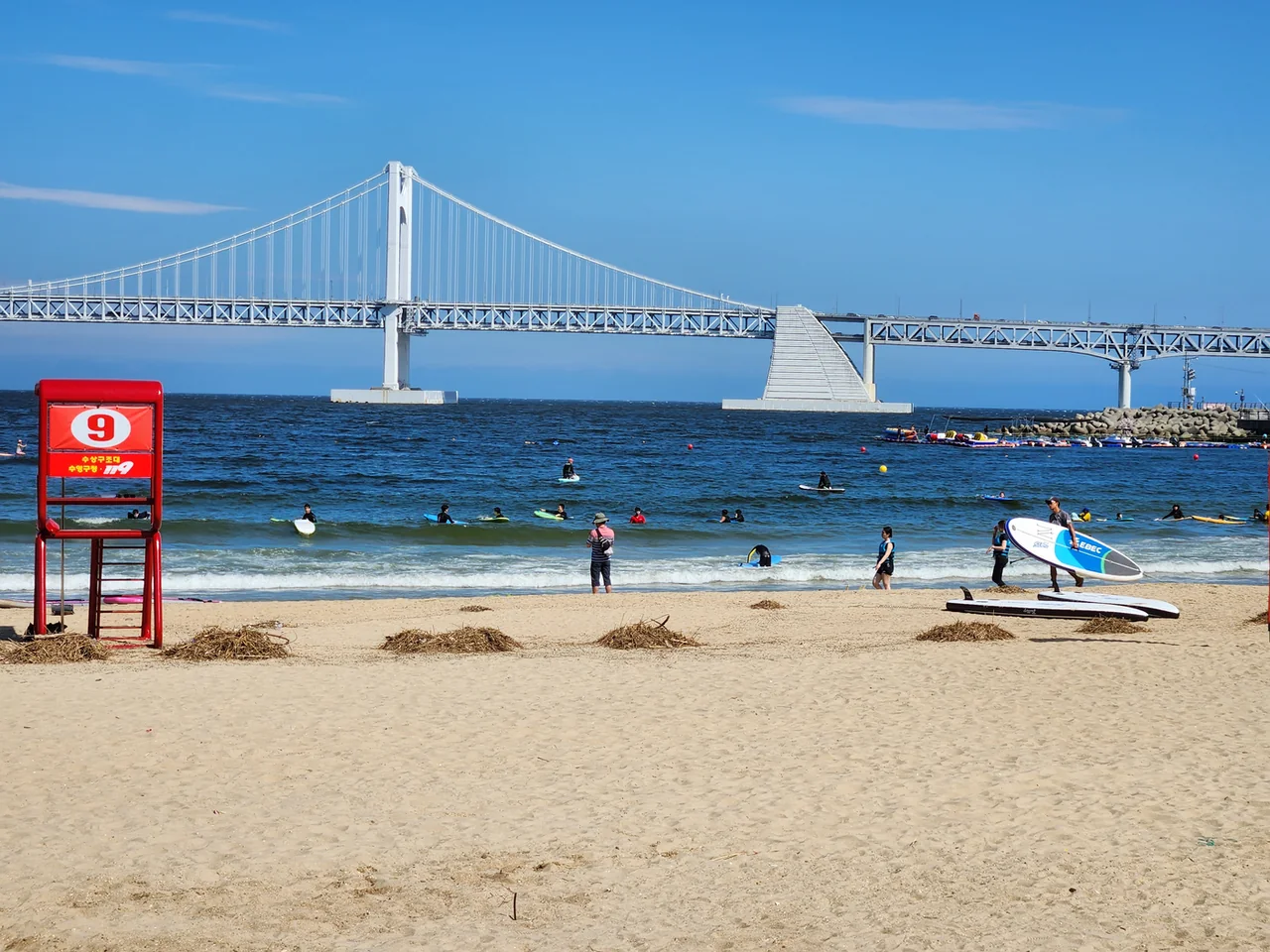
4. Getting there, and parking
Line 2 of the metro drops you ten minutes’ walk away at either of two stations, both from exit 3.
Between the two stations, Geumnyeonsan lands nearer the western end and Gwangan nearer the cafe street and Manname Square, so Gwangan wins if you are aiming for the official zone. Buses stop on the seafront itself, which makes the walk three minutes, but that seafront road is the first thing to seize up before and after a showing. From Haeundae or Seomyeon the metro is more predictable in both directions.
If you are thinking of driving, start with what the organisers put in their own visitor rules: parking is limited, use public transport. It is not a formality. There are six public car parks near the beach.
| Car park | Address |
|---|---|
| Gwangalli Beach public car park | 75 Namcheonbada-ro 33beon-gil |
| Millak Beach Park public car park | near 13-1 Millaksubyeon-ro |
| Millak reclaimed land public car park | 60 Millaksubyeon-ro 17beon-gil |
| Millak Waterfront Park No.1 | 95 Millaksubyeon-ro |
| Millak Waterfront Park public car park | near 105 Millaksubyeon-ro |
| Subyeon Children’s Park public car park | 9-23 Gwanganhaebyeon-ro 370beon-gil |
Four of the six sit on the Millak side, beside the cordon and in the direction everyone leaves. Twelve minutes of show ends with several thousand people moving at once, so budget more time to get out of the car park than the show itself took. With a rental car, leaving it near a Line 2 station and riding two stops in beats circling the seafront. Passes and payment are covered in our guide to getting around Busan.
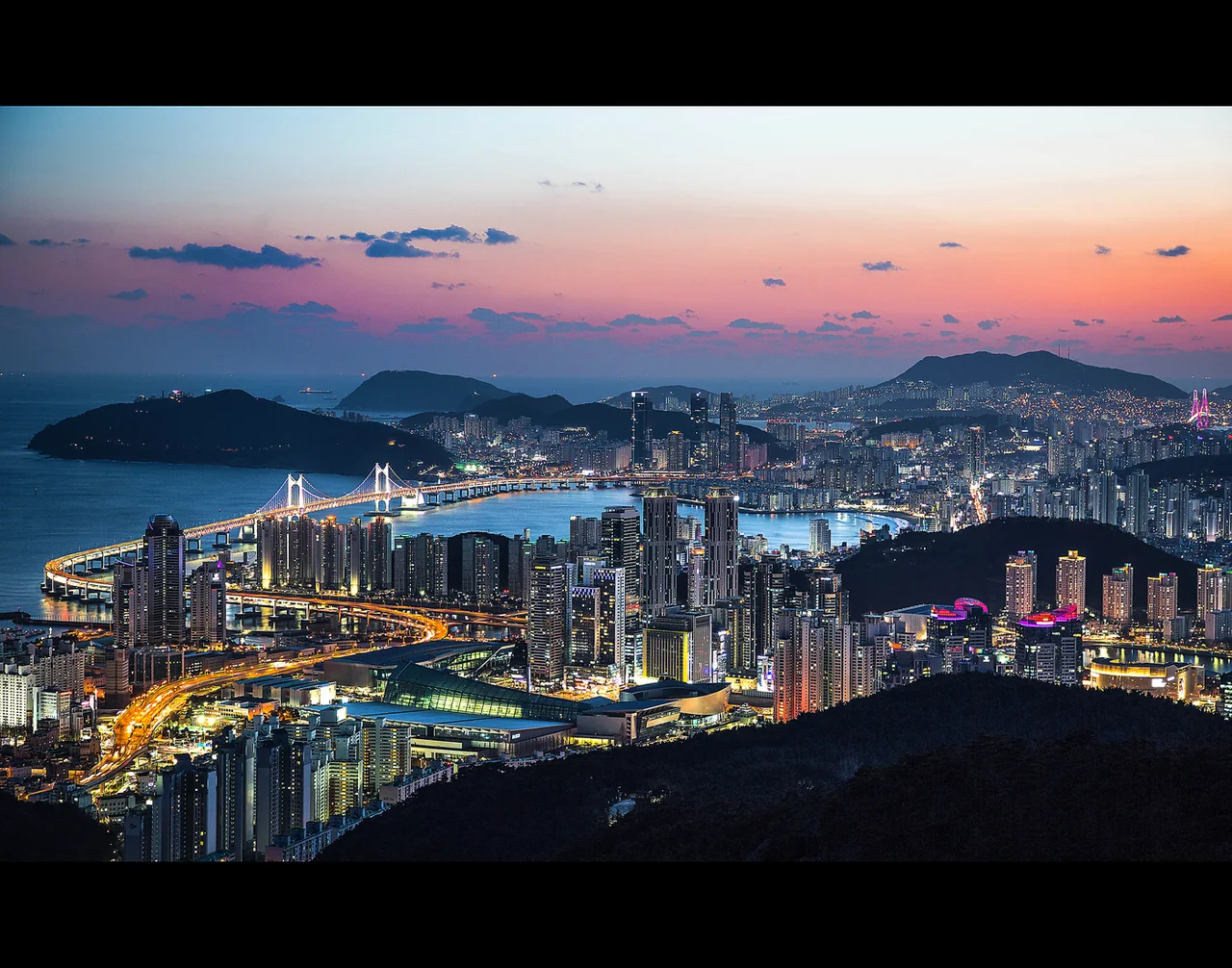
5. When to arrive and how the night runs
The show is twelve minutes. The competition for space happens in the hour before it. With no seating, position goes to whoever came first, and in summer the beach already has people on it long before anyone thinks about drones. The recommended zone fills earlier than the rest.
The accessible area goes up and Millak Beach Park closes. A useful clock to work backwards from.
Claim a spot in the recommended zone. On a summer weekend, earlier.
The formation stays out over the water. Twelve minutes is too short to move, so pick a spot and hold it.
Stewards move the crowd onto the pavement gradually. Heading straight for the metro puts you in the thick of it.
Bring something to sit on if you plan to sit. It is sand, it holds the cold, and the winter showings feel considerably colder on the shore than a few streets inland. Shoot handheld: the drones are out over the water, so facing the sea from the beach is the shot, and twelve minutes leaves no time to relocate mid-show.
Do not pack up the moment the last figure fades. Eleven hundred machines coming down together make a considerable noise, a wall of overlapping rotors that is worth staying for, and standing up at that exact moment only puts you in the crowd anyway.
First showing or second
Same programme both times, so there is no content reason to prefer one. What differs is the crowd and the journey home.
| First showing | Second showing | |
|---|---|---|
| Crowd | Heavier | Thinner |
| Finding space | Arrive early | More forgiving |
| Getting back | Transport is relaxed | Watch the last train |
| With children | The realistic one | Ends at 10:12pm in summer |
Around dinner it splits cleanly. In summer you either watch at 8pm and eat late, or eat early and watch at 10pm. In winter the two slots land either side of dinner, so decide the order before you arrive. The half hour after each showing is the worst of it, when every restaurant and cafe near the beach fills at once.
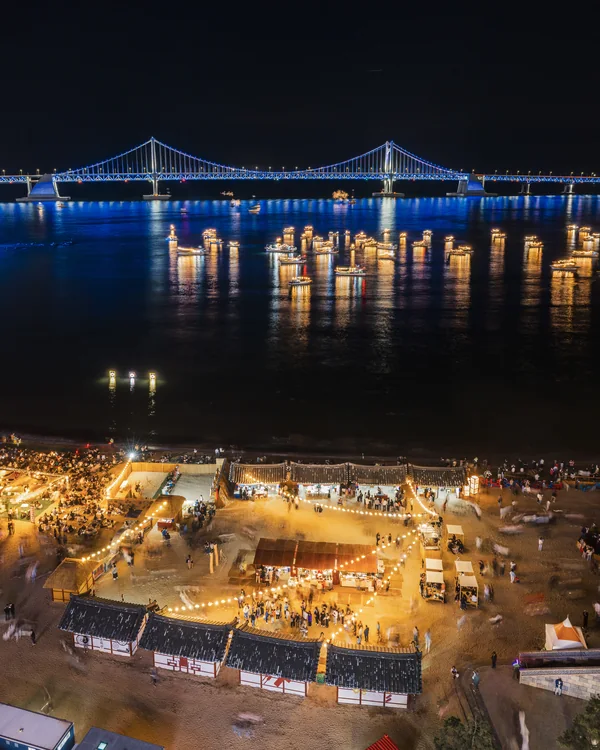
6. Nights when a special is on
For Lunar New Year, Chuseok and the New Year countdown the fleet grows to as many as 3,000. Close to triple, so the figures are bigger and the show is built differently. The crowd roughly triples too.
Special nights come with three notices attached, and seeing all three go up is itself the signal. Sections of the seafront road close, which removes driving as an option altogether. Public wi-fi on the beach is switched off for the reason set out earlier, so do not count on a connection. On late finishes such as the countdown, metro hours are extended, though the notice always adds that services may be adjusted depending on how crowded Gwangan and neighbouring stations get. Plan around the normal last train.
Specials get cancelled too. One New Year countdown show was called off outright. Three thousand drones do not loosen the weather or the radio conditions.
November 2025 added a separate production, the Gwangalli Drone × Laser Show. It is not the weekly show under another name and it is still at the trial stage, with a third pilot performance on record. Because the beams are projected out to sea, those nights also restrict yacht and boat movement. Whether it becomes fixed in the calendar is not yet clear, so plan around the regular Saturday show and treat a laser night as a bonus if one lands during your stay. Note that the drone show does not run on fireworks festival night. In 2026 that is Saturday 7 November, and our guide to Busan in November has the rest of the month.
It is a different animal from the Busan International Fireworks Festival, which fills the same bay once a year, sells paid seating and draws crowds on another scale. The drone show’s real advantage is repetition. Miss one and there is another next Saturday.
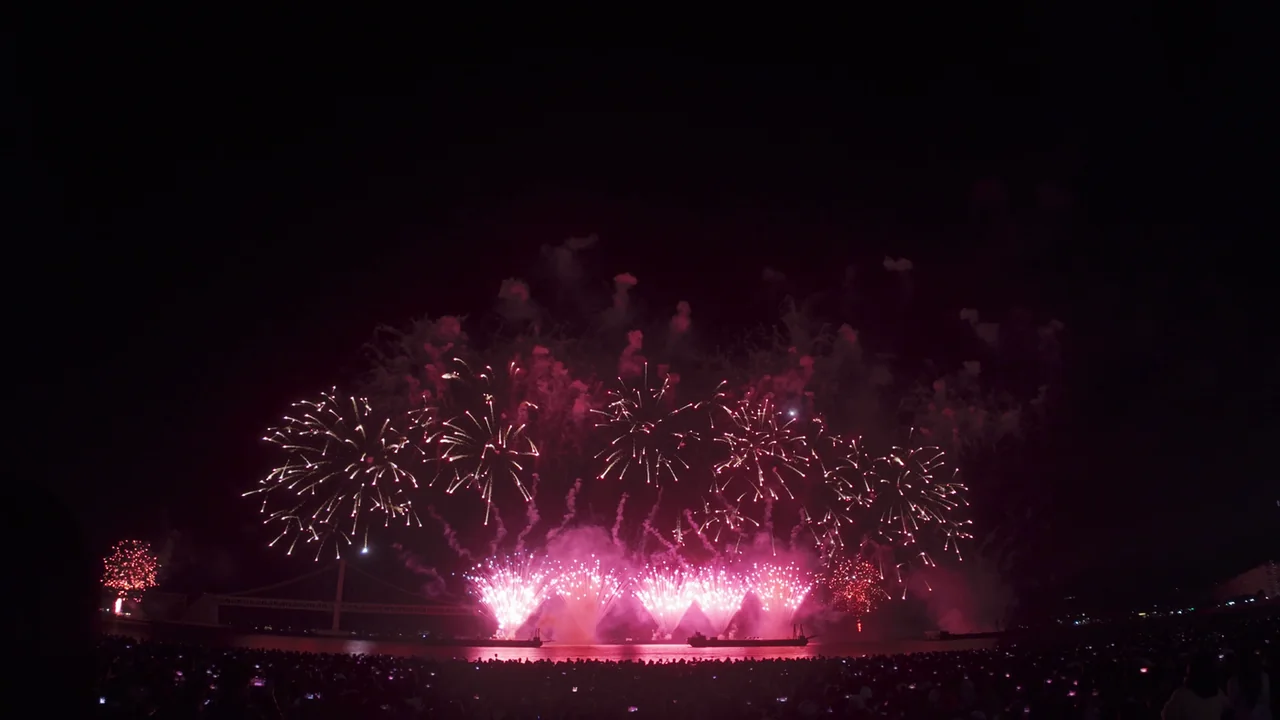
The New Year show runs to a different clock. On 31 December in the most recent edition there were no 19:00 or 21:00 performances at all. There was a single show at midnight, with 2,500 drones lifting off at 23:56. Turning up at 19:00 that night means seeing nothing. The full timetable for that night, including the Yongdusan bell and the Gwangalli countdown, is in Busan in December.
7. Before and after, along the beach
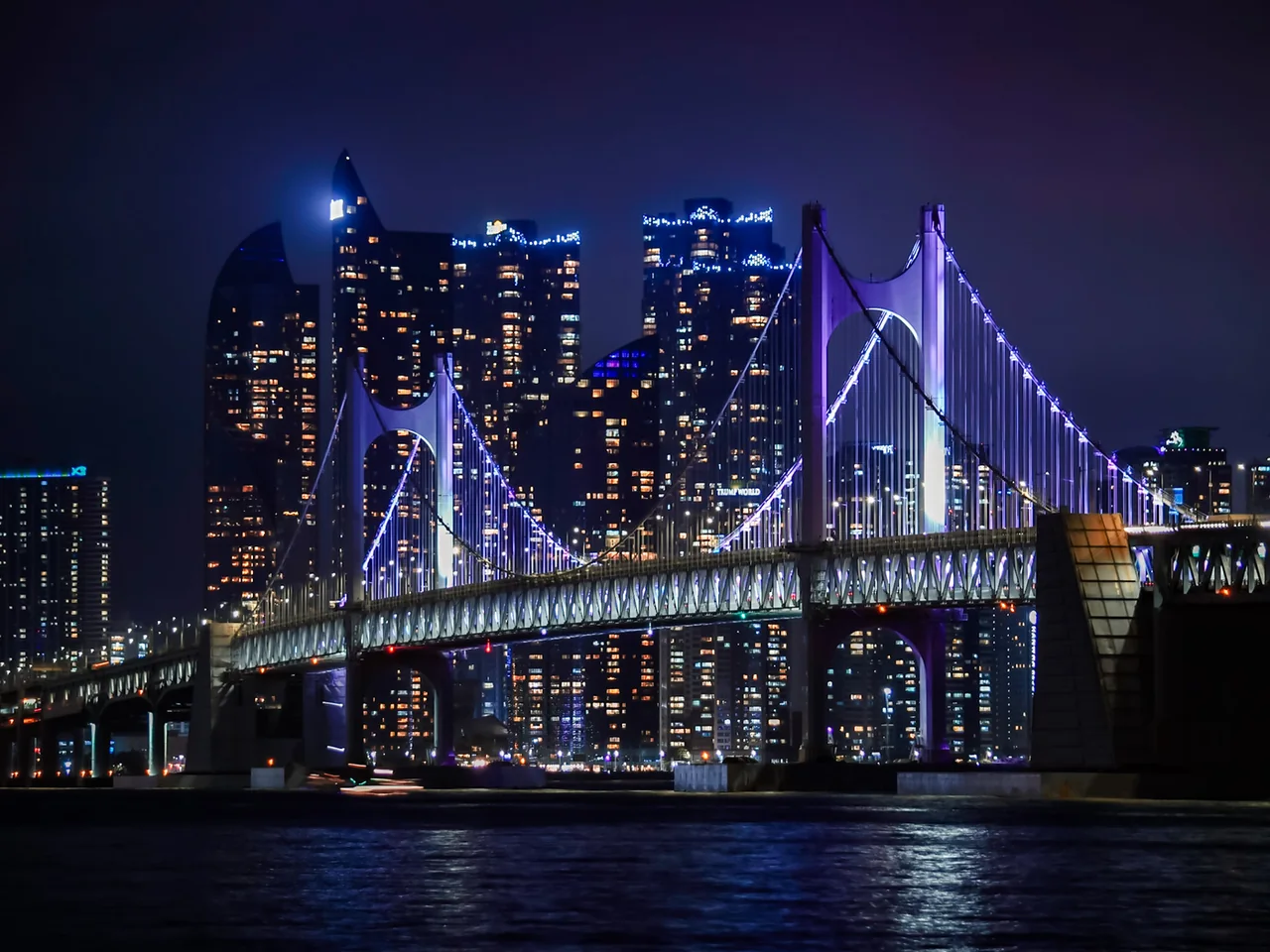
Twelve minutes does not need a whole day cleared for it. Gwangalli packs its seafront promenade, cafe street and the Millak raw fish market into walking distance, so the hours either side fill themselves. The lights on Gwangan BridgeMap come on every night whether drones fly or not, which means the view survives a cancellation.
The one thing to plan around is the Saturday crowd. Eat before the show or in the gap between showings, because for half an hour afterwards there is a queue for everything. What is worth eating there is in our guide to Gwangalli Beach, and where the night goes next is in the Busan nightlife guide.
Staying in Gwangalli removes the problem entirely. You walk back rather than timing the last train, which also makes the late showing painless.
8. If it is cancelled
A cancellation notice does not write off the evening. The drones are the only part that stops.
Lit every night and visible the length of the promenade.
If rain called it off, a jjimjilbang or a department store observation floor works.
Igidae and Hwangnyeongsan both look back at the whole bridge.
It runs weekly, so a longer stay gets another attempt.
If you have several days in Busan, the sturdier plan is not to hang everything on one Saturday. Cancellations land roughly one Saturday in four or five, and the odds of that being your Saturday are higher than they sound.
🎡Things to Do48
🍜Food7
🏨Where to Stay3
🚇Getting Around8
🧭Travel Tips14
📌More3
🧭All-Korea essentials47
Frequently asked questions
Read the complete Busan travel guide →
Images: All photographs from the Busan Tourism Archive (visitbusan.net/archive) under KOGL Type 1. Gwangalli M Drone Light Show (featured image), Gwangalli Beach and Gwangan Bridge at night: Busan Metropolitan City / Busan Tourism Organization. Gwangan Bridge at sunset, Gwangalli Beach on an event night, Busan International Fireworks Festival: Busan Metropolitan City.