
Suwon Hwaseong Fortress guide: getting there from Seoul, free walls, the trolley, archery and Monday closures
The fortress itself is free and never closes. Most of what you walk on was rebuilt between 1975 and 1979, and the official list says exactly which parts. Here is what to see and which day to avoid.
| Tickets | The fortress wall is free and open at all hours. The only paid site is the palace, at 2,000 won. |
|---|---|
| When it was built | Started 1794, finished 1796. But most of what stands today was rebuilt in the 1970s. |
| How much was rebuilt | 42 of the 48 structures on the official list carry a post-1950 repair date. Seventeen of them in 1975 alone. |
| What is original | Seobuk Gongsimdon and Bangwhasuryujeong have no recorded work since 1934. Both are national Treasures. |
| You cannot circle it | The wall on both sides of Paldalmun was demolished for road widening in the 1920s. 184m east, 120m west. |
| Avoid Monday | The wall and palace open, but the trolley, both museums and the martial arts demonstration all close. On weekdays that demonstration runs once at 11:00; only Saturday and Sunday get two. |
1. Walking the fortress is free
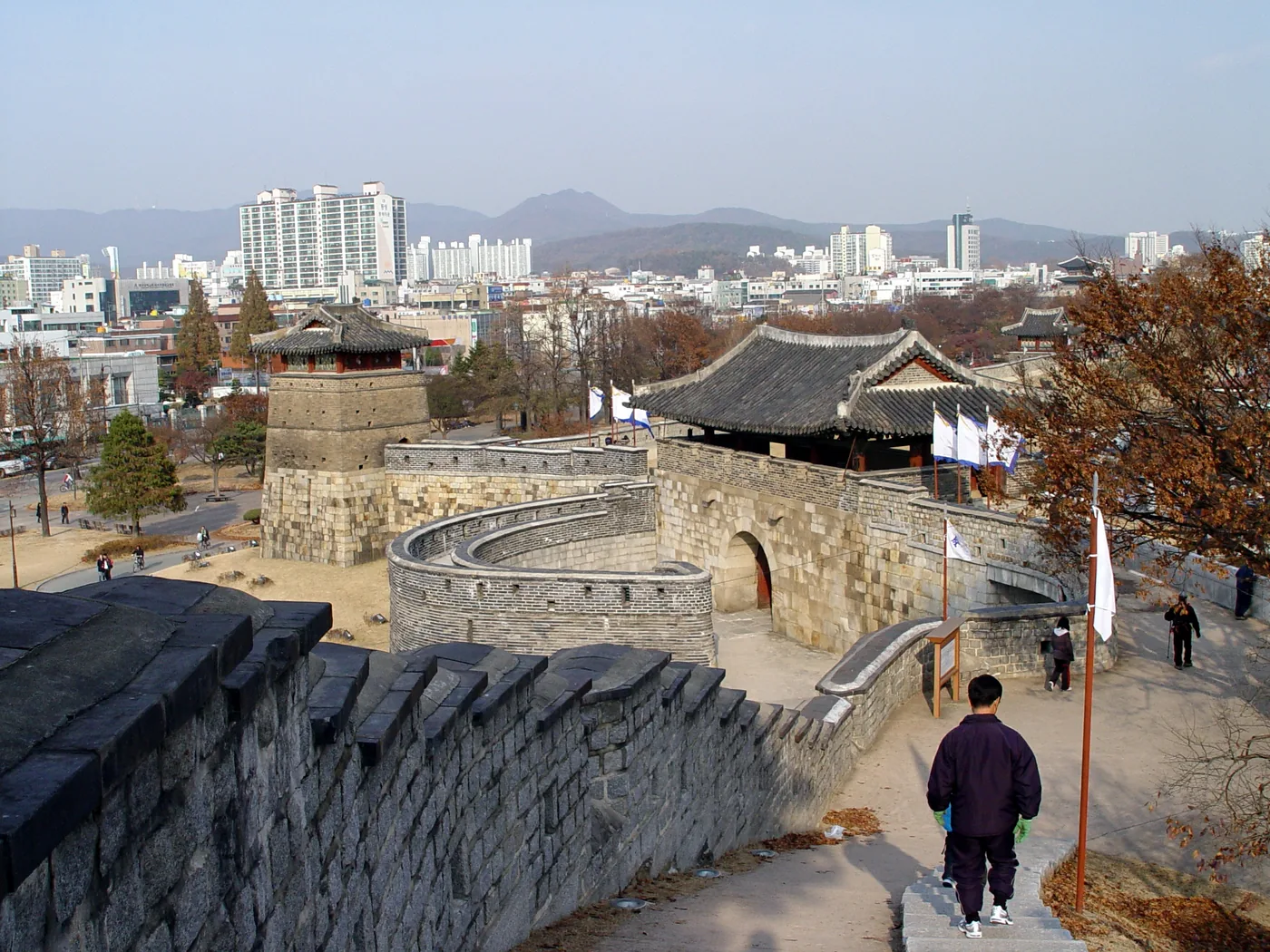
2. Most of the wall was rebuilt in the 1970s
3. Where the original survives
4. You cannot walk a full circuit
5. Only two buildings in the palace are original
6. Do not come on a Monday
7. What you can ride and try
8. Take the direct bus, not the subway
9. Which part of the wall to walk
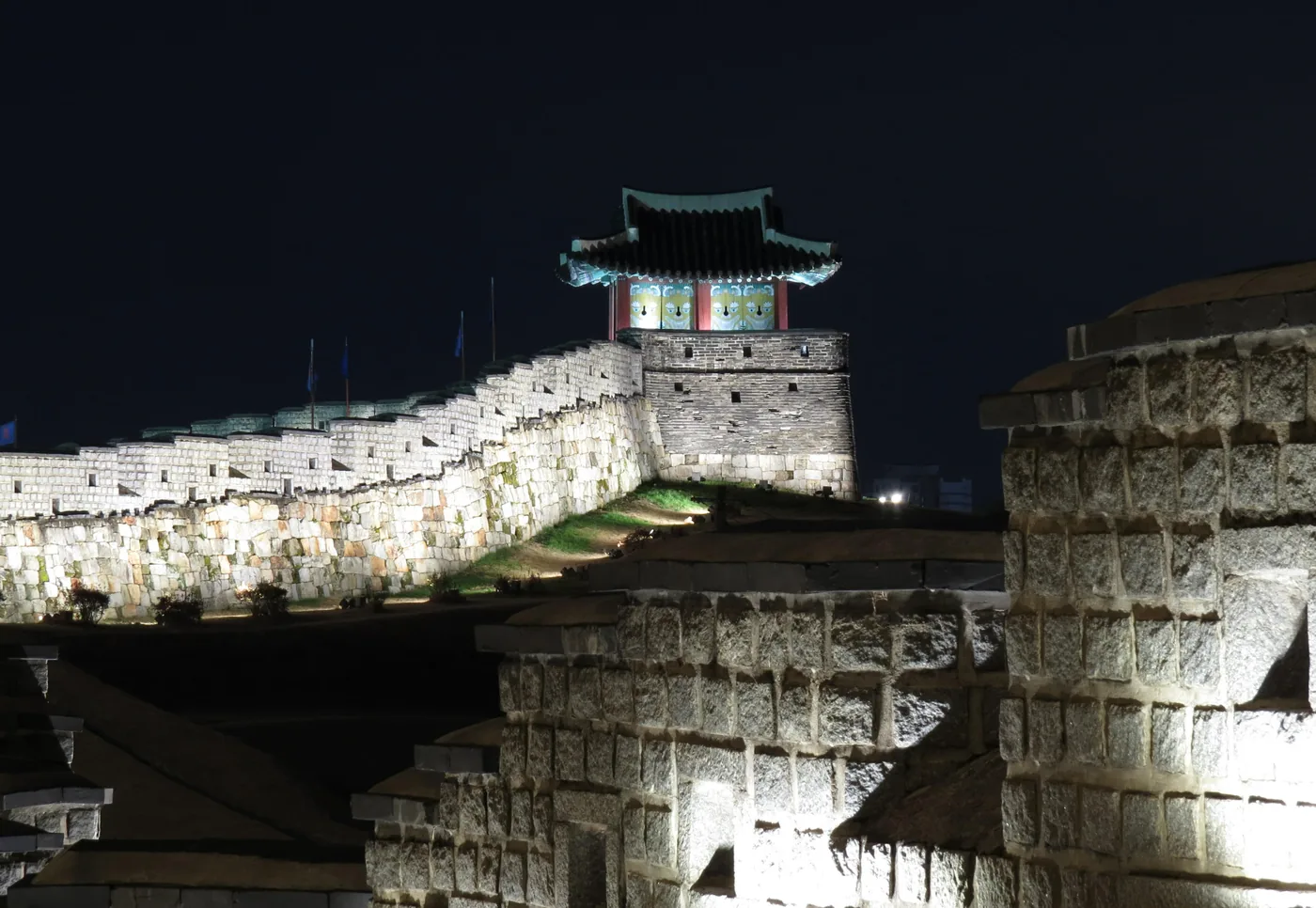
10. What is different at night
11. When you do not pay
12. When to come
13. What else is inside the ticket
14. How to plan the day
1. Walking the fortress is free
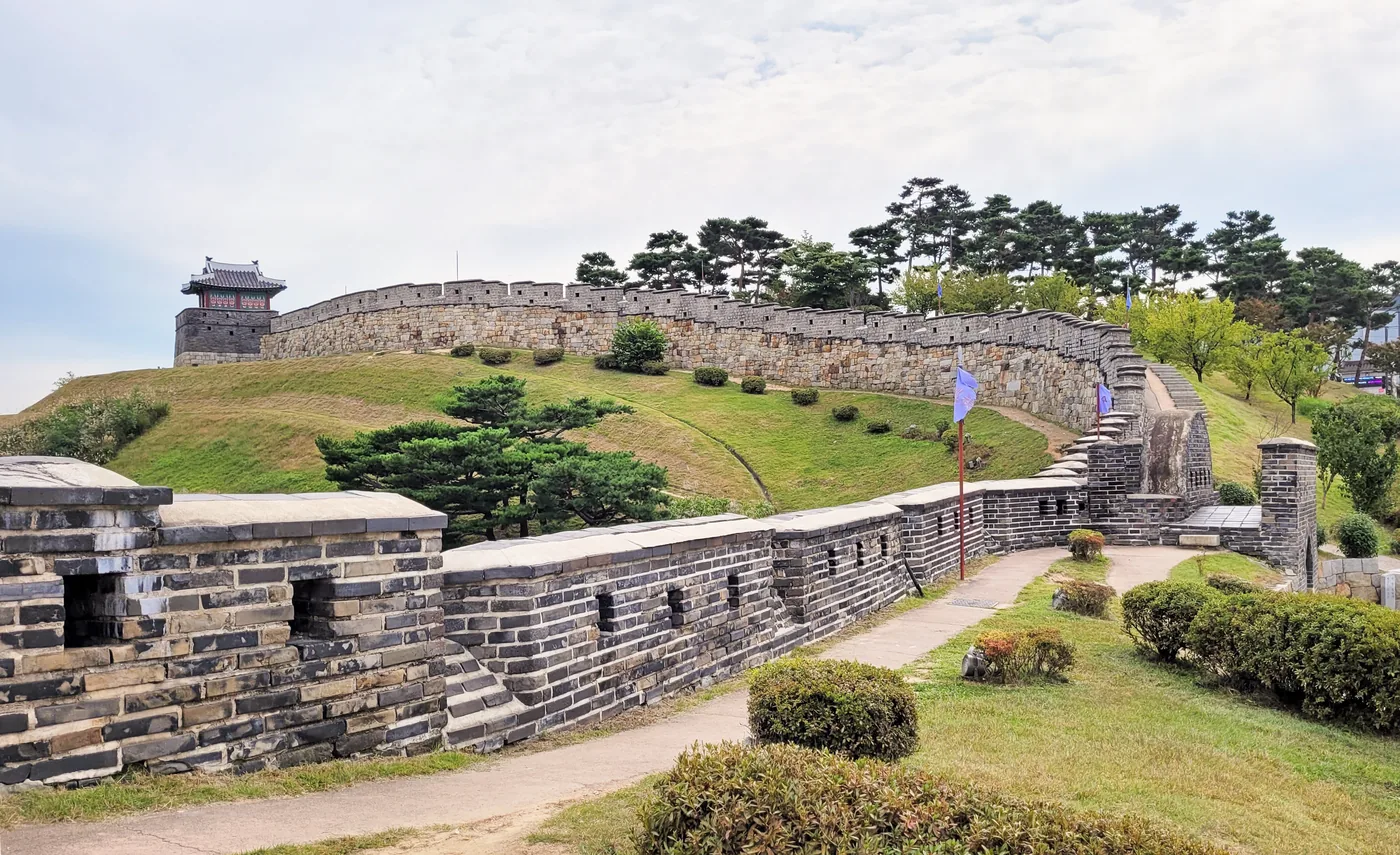
Every Seoul day trip list names Suwon Hwaseong, and almost none of them say what you actually do there. Start with the money, because this is the part visitors get wrong. A UNESCO World Heritage fortress with no ticket booth.
| Site | Hours | Closed | Price |
|---|---|---|---|
| Hwaseong fortress wall | Any time | Never | Free |
| Hwaseong Haenggung palace | 09:00–18:00 | Never | Adults 2,000 won |
| Palace, youth and military | 1,500 won | ||
| Palace, children | 1,000 won | ||
| Combined ticket, 3 sites | Adults 4,000 won |
There is no fence and no gate. The wall runs through the middle of a working city, and people use it as a footpath. You can be on it at six in the morning or ten at night.
The palace ticket includes Hwaryeongjeon
The 2,000 won palaceMap ticket also covers Hwaryeongjeon, the shrine next door built in 1801 to hold King Jeongjo’s portrait after his death. Many visitors walk past it because they assume it is separate. It is not.
Last entry is an hour before closing
The palace closes at 18:00 but stops selling tickets at 17:00. If your plan is to walk the wall first and see the palace afterwards, that hour is the trap. Do the palace first.
2. Most of the wall was rebuilt in the 1970s
The Suwon Cultural Foundation publishes a structure-by-structure list, and each entry carries both the year it was built and the year it was worked on. We counted all 48 entries.
| First recorded work after 1950 | Structures |
|---|---|
| 1960s | 3 |
| 1970s | 36 |
| 2000s | 1 |
| 2010s | 2 |
| Total | 42 of 48 |
Seventeen structures carry the year 1975 alone. Another seven are dated 1976 and seven more 1979.
Why that decade
The foundation explains it directly: “From 1975 to 1979 most of the fortress was repaired and restored to its original form, based on the Hwaseong Seongyeok Uigwe published immediately after construction.”
The Uigwe is a construction record published in 1801, listing materials, measurements, wages and drawings for every structure. That document is the reason a rebuilt fortress could still be listed by UNESCO. What was restored was not guesswork.
Two gate pavilions were lost in the Korean War
The list mentions the war twice. The upper pavilions of Janganmun and Changnyongmun were destroyed and rebuilt in 1975 and 1976. The tiled roofs everyone photographs at the north and east gates are fifty years old, not two hundred.
Two water gates were lost to floods
Hwahongmun, the north water gate, washed away in 1848, was rebuilt, washed away again in 1922 and restored in 1932. The south water gate collapsed in 1848 and was only rebuilt in 2012.
3. Where the original survives
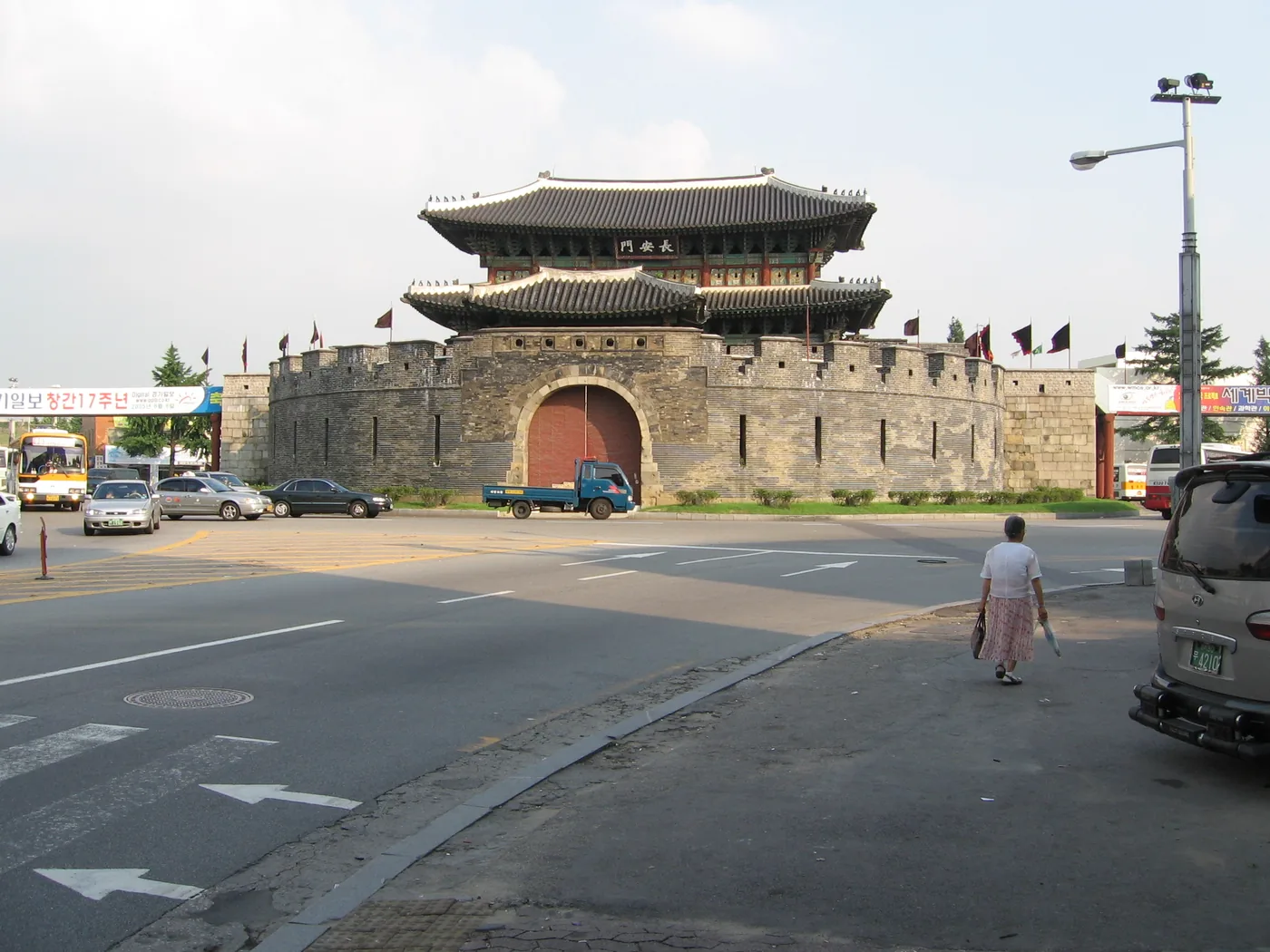
If 42 structures were rebuilt, where does that leave the rest? Six entries carry no work after 1950, and three of those are things that no longer exist. Three are standing.
| Structure | Last recorded work | Status |
|---|---|---|
| Seobuk Gongsimdon | Repaired 1934 | National Treasure |
| Bangwhasuryujeong (northeast pavilion) | Dismantled and repaired 1934 | National Treasure |
| Hwahongmun (north water gate) | Restored 1932 | After the 1922 flood |
Stand at Seobuk Gongsimdon or Bangwhasuryujeong and you are looking at the oldest fabric in the fortress. If you only have time for two stops on the wall, make them these.
The hollow watchtower exists nowhere else
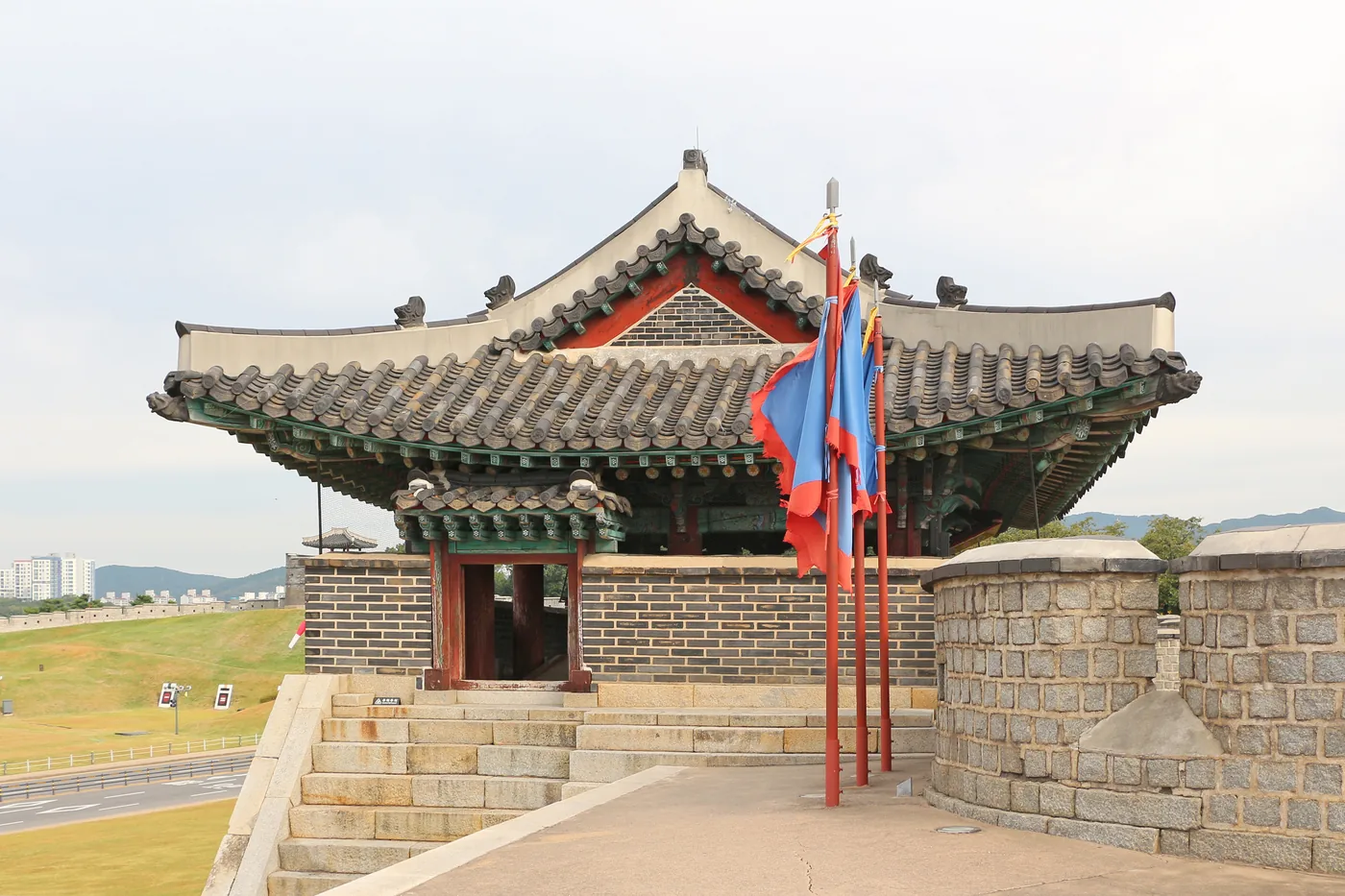
A gongsimdon is a watchtower built hollow, with an internal staircase and firing slits on each level. Hwaseong had three. One is gone, so two remain: Seobuk in the west and Dongbuk in the east. The eastern one was rebuilt in 1976.
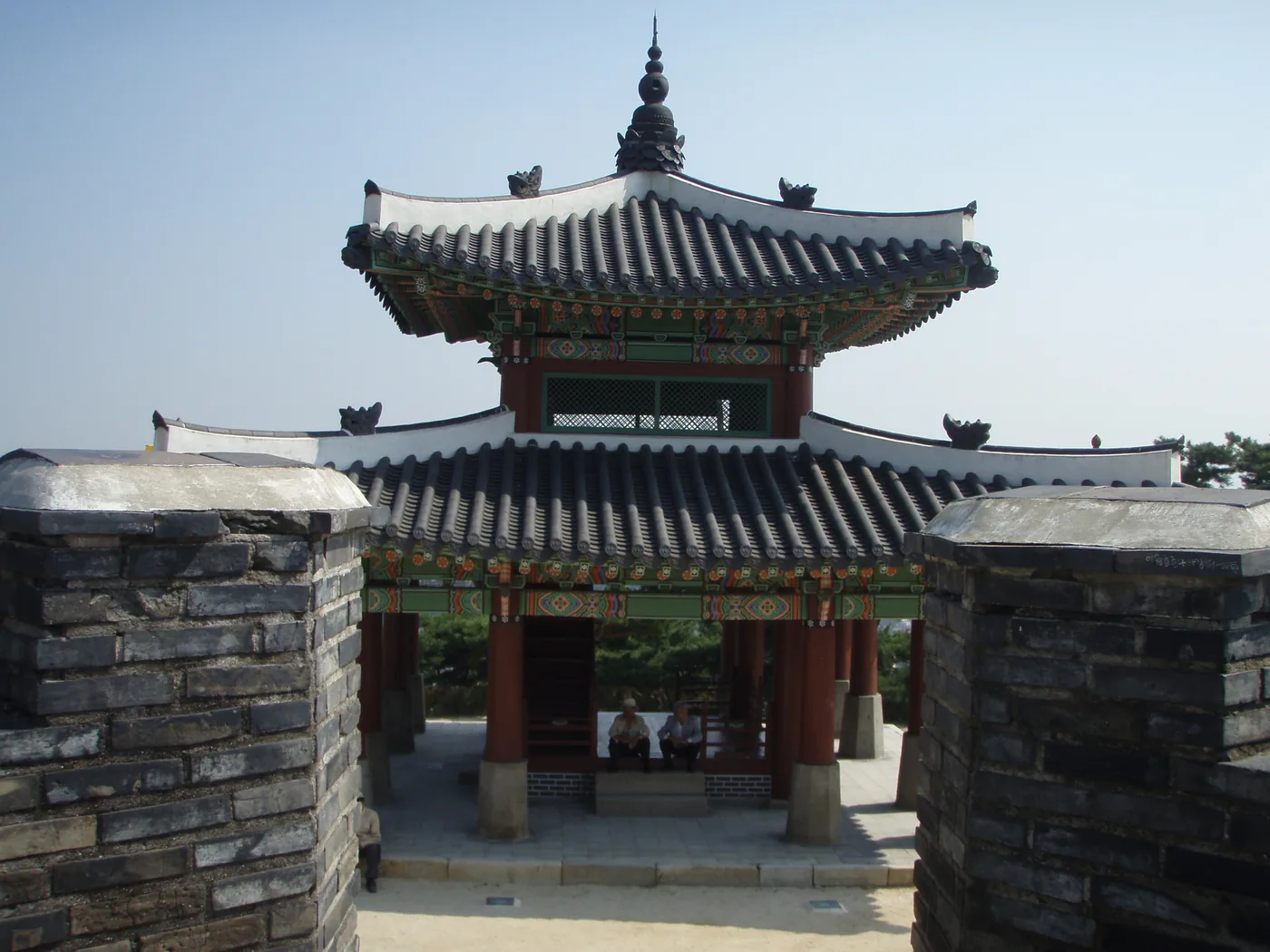
Bangwhasuryujeong was a guard post
It is the most photographed spot in Suwon and it looks like a garden pavilion, but its purpose was observation. Corner pavilions sat at the angles of the wall to watch the approaches. Below BangwhasuryujeongMap is Yongyeon, a pond dug in 1796, which is why the reflection shot exists.
Four structures are designated Treasures
Checking the national heritage register, the Treasures on the fortress are Paldalmun, Hwaseomun, Seobuk Gongsimdon and Bangwhasuryujeong. Hwaryeongjeon’s main hall is also a Treasure. The wall as a whole is a Historic Site.
4. You cannot walk a full circuit
Almost every guide suggests “walking the full loop.” The official structure list includes two entries that make this impossible, and they are listed as structures in their own right: “Unrestored eastern wall” and “Unrestored western wall.”
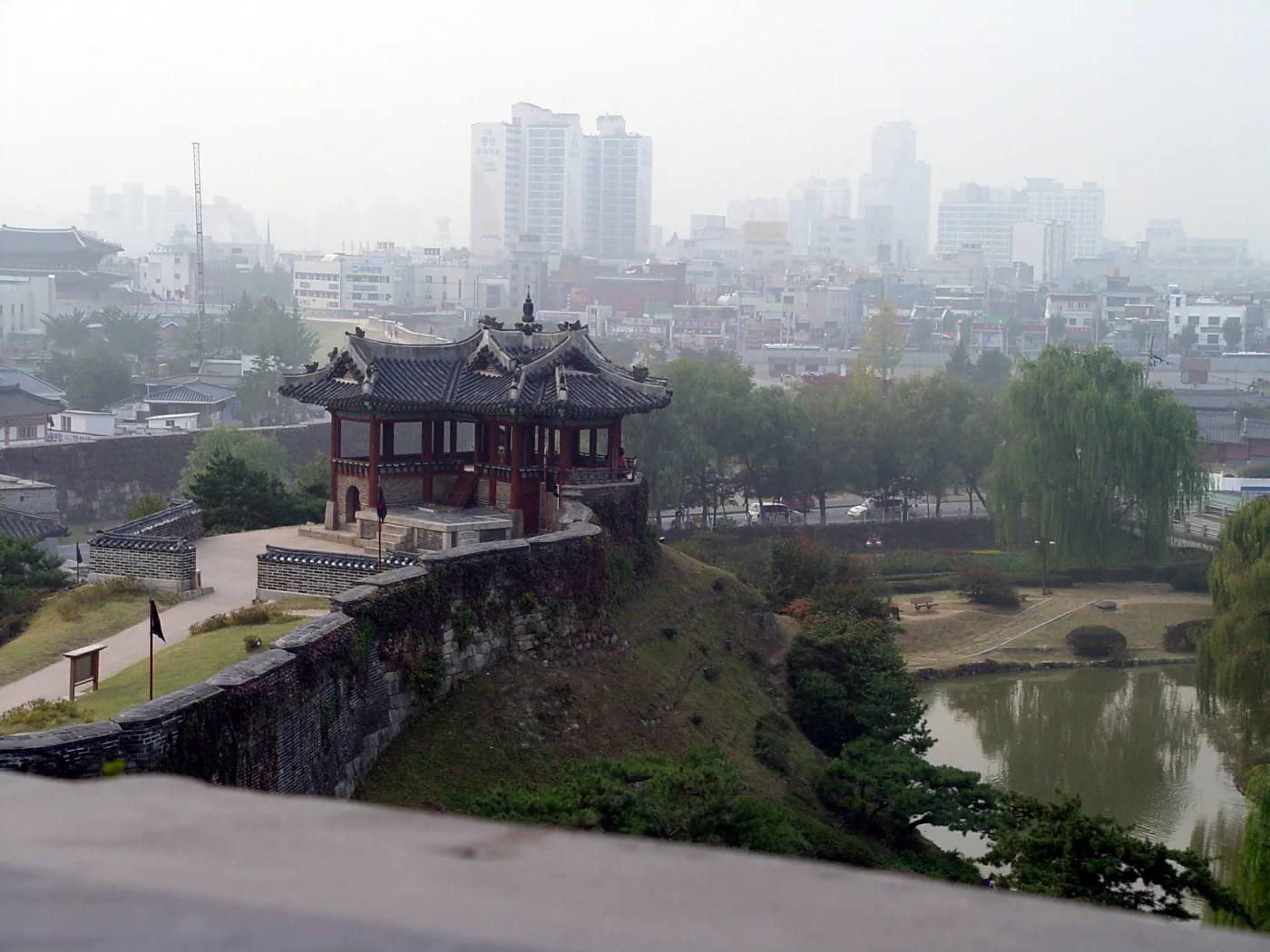
“Suwon Hwaseong is severed on both sides of Paldalmun.”
| Missing section | Length | What stood there |
|---|---|---|
| East of Paldalmun | 184m | Southeast bastion, south secret gate, south hollow watchtower |
| West of Paldalmun | 120m | Southwest bastion, south hidden watergate |
Both were demolished in the 1920s to widen the road, and neither was rebuilt. Paldalmun now stands on a traffic island, disconnected from the wall on either side.
What was lost there
The 184m east section held the south secret gate. Secret gates are normally emergency exits, but this one had a market outside it and so was used as the main entrance from the day the fortress opened. The southeast bastion stood about 49m east of Paldalmun, and the south hollow watchtower about 36m beyond the gate.
The western 120m held the southwest bastion and a hidden watergate that drained the fortress ponds.
The ponds are gone too
The same source states: “There were five ponds and two hidden watergates inside the fortress, and none were restored.”
The northern watergate was located and documented during 1970s excavation, but was deliberately left out of the restoration so it could be done together with the pond it fed. It is still waiting.
So how do you actually walk it
Treat Paldalmun as a break rather than a continuation. You come down off the wall, cross the roads around the gate, and pick the wall up again on the other side. The hill section and the flat section are effectively two separate walks joined by a street crossing.
A photograph taken in 1907 survives and shows the section before it was cleared.
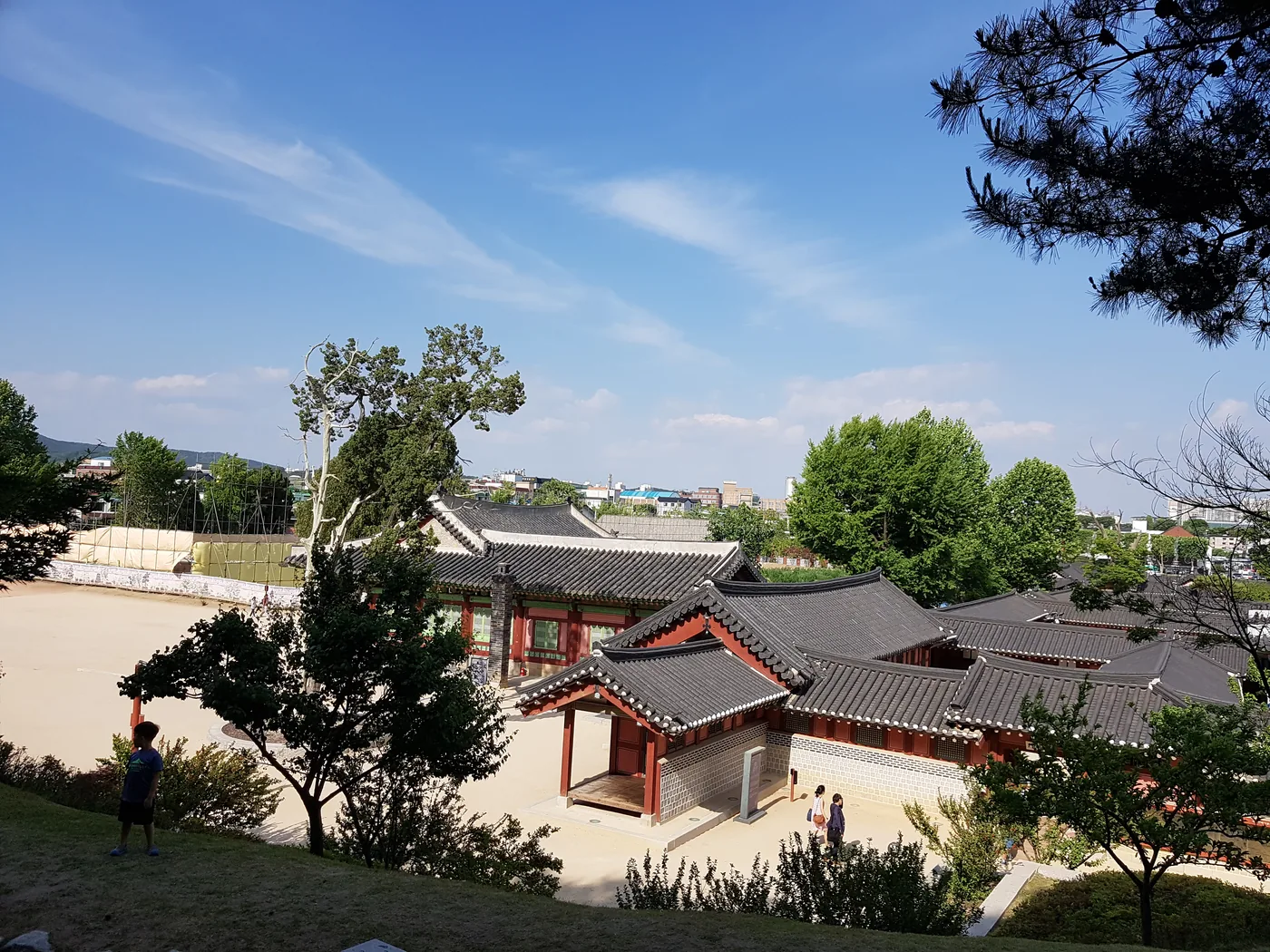
5. Only two buildings in the palace are original
Hwaseong Haenggung was completed in 1796 at a size of about 600 kan, the traditional bay measurement. King Jeongjo travelled here twelve times over eleven years, between February 1790 and January 1800, and stayed in it each time.
The city was moved here on purpose
The palace began as a government office. In 1789 Jeongjo moved his father Prince Sado’s tomb to the site of the existing Suwon town centre, which meant moving the town itself to the foot of Paldalsan. The palace was the administrative building of that relocated town.
He then promoted Suwon to Hwaseong Yusu-bu, a higher administrative rank, and in 1795 renamed and added buildings to host his mother Lady Hyegyeong’s sixtieth birthday banquet here. The palace came first and the wall was built around the city that held it.
It became a hospital
The foundation’s own account: “From 1911 it was used as a hospital and a police station, and most of it was destroyed in the 1920s when the hospital building was newly constructed.”
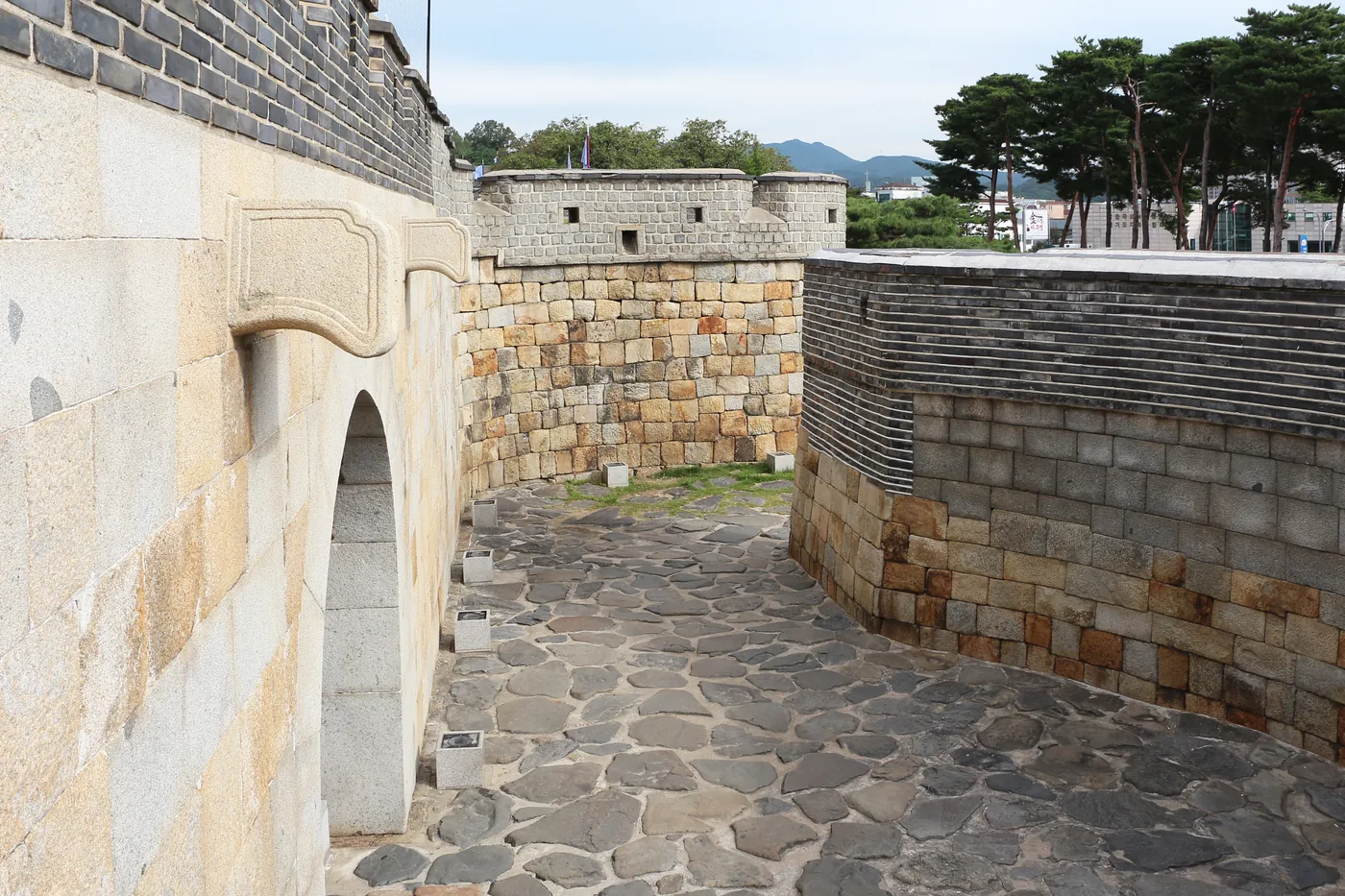
The next line matters. “Today only Nangnamheon and Noraedang retain their original form.” Two buildings out of roughly 600 kan.
A protest happened here in 1919
On 29 March 1919, around thirty gisaeng led by Kim Hyang-hwa, on their way to a compulsory medical examination at the hospital, stopped in front of the police station on the palace grounds and raised the Korean flag. The hospital and the police station were both inside the old palace.
Restoration only finished in 2024
- Spring 1989. Local historian Lee Seung-eon finds a coloured drawing of the palace in the Kyujanggak archive.
- October 1989. Eighty-nine residents form a restoration committee under Kim Dong-hwi.
- 1996. Construction begins.
- 2002. The central complex is finished.
- 2016. Excavation continues on the outer buildings.
- 24 April 2024. The palace is declared complete, thirty-five years after the campaign started.
Nearly everything you see inside was built after 2002. Nangnamheon and Noraedang are the exception, and they are worth finding for that reason.
The person behind it
The foundation credits Shim Jae-duck (1939–2009), head of the Suwon Cultural Centre and later the city’s first and second elected mayor. Besides the palace he drove the 1997 UNESCO listing, the 2002 World Cup bid, and the city’s public toilet programme.
6. Do not come on a Monday
Because the wall is free and always open, it is easy to assume any day works. On Mondays almost everything except the wall and the palace is shut.
| Site | Monday |
|---|---|
| Fortress wall | Open (free, any hour) |
| Hwaseong Haenggung palace | Open (never closes) |
| Hwaseong trolley | Closed |
| Suwon Hwaseong Museum | Closed |
| Suwon Museum | Closed |
| Martial arts demonstration | Tue–Sun only, so none |
| Suwon Procession | Closed |
| XR Bus 1795 | Closed Mon and Tue |
Never buy the combined ticket on a Monday
The 4,000 won combined ticket covers the palace plus the two museums. On a Monday both museums are shut, so you would be paying 4,000 won for the 2,000 won site. Buy the plain palace ticket instead.
On weekdays the martial arts demonstration runs once
The Muye 24 Ki demonstration takes place at Sinpungnu, the palace’s main gate, Tuesday through Sunday. On weekdays and public holidays there is a single 11:00 performance. Only Saturday and Sunday get a second one.
| Day | Performances |
|---|---|
| Monday | None |
| Tuesday to Friday, public holidays | 11:00 only |
| Saturday and Sunday | 11:00 and 14:00 |
It performs the twenty-four fighting techniques recorded in the Muyedobotongji, a manual compiled in 1790 by order of King Jeongjo. Arrive on a weekday afternoon and you have missed it.
Sunday afternoons add a guard ceremony
The Jangyongyeong guard ceremony runs Sundays from 16:00 for an hour at the same gate. It runs spring through autumn and pauses in July and August. Jangyongyeong was the royal guard unit King Jeongjo created in 1793.
7. What you can ride and try
The wall costs nothing, but the things you do along it are priced separately.
| Activity | Where | Hours | Price |
|---|---|---|---|
| Hwaseong trolley | Departs Yeonmudae | 09:40–17:00, roughly every 20 min Closed Mondays | Adults 6,000 / youth and military 3,500 / children 2,000 |
| Traditional archery | Yeonmudae | Mar–Oct 09:30–17:30 Nov–Feb 09:30–17:00 | 3,000 won for 10 arrows |
| Suwon Procession | Yeonmudae | 10:00–17:00, Tue–Sun | Free (trial period, wheelchair vehicle available) |
| XR Bus 1795 | Yeonmudae car park | 11:00 / 13:00 / 15:00 / 17:00 | Free |
| Stamp tour | 10 points | All year | Free |
| Flying Suwon | Changnyongmun car park | All year | Adults 24,000 / youth 22,000 / primary 20,000 |
The trolley does not circle the fortress
The name suggests a loop of the walls. The actual route is fixed:
YeonmudaeMap → Hwahongmun → Janganmun → HwaseomunMap → Maehyanggyo → Yeonmudae, about 30 minutes. You can get off at Hwahongmun, Hwaseomun and Maehyanggyo. There are 36 seats.
Look at that route and you will notice what is missing: it never goes near the hill or Paldalmun. Seojangdae and the south gate still have to be walked.
Book the trolley ahead if you can
With 36 seats and a twenty minute gap, weekends mean waiting. Online booking runs to the end of the following month, and only the leftover seats are sold on site. Miss a departure and the next one is twenty minutes away. The child fare starts at 36 months.
The trolley does not run in snow or rain. Fine dust alerts and emergency reduction measures can also shorten or suspend the route. On a bad weather day, do not build the visit around it.
Archery is 3,000 won for ten arrows
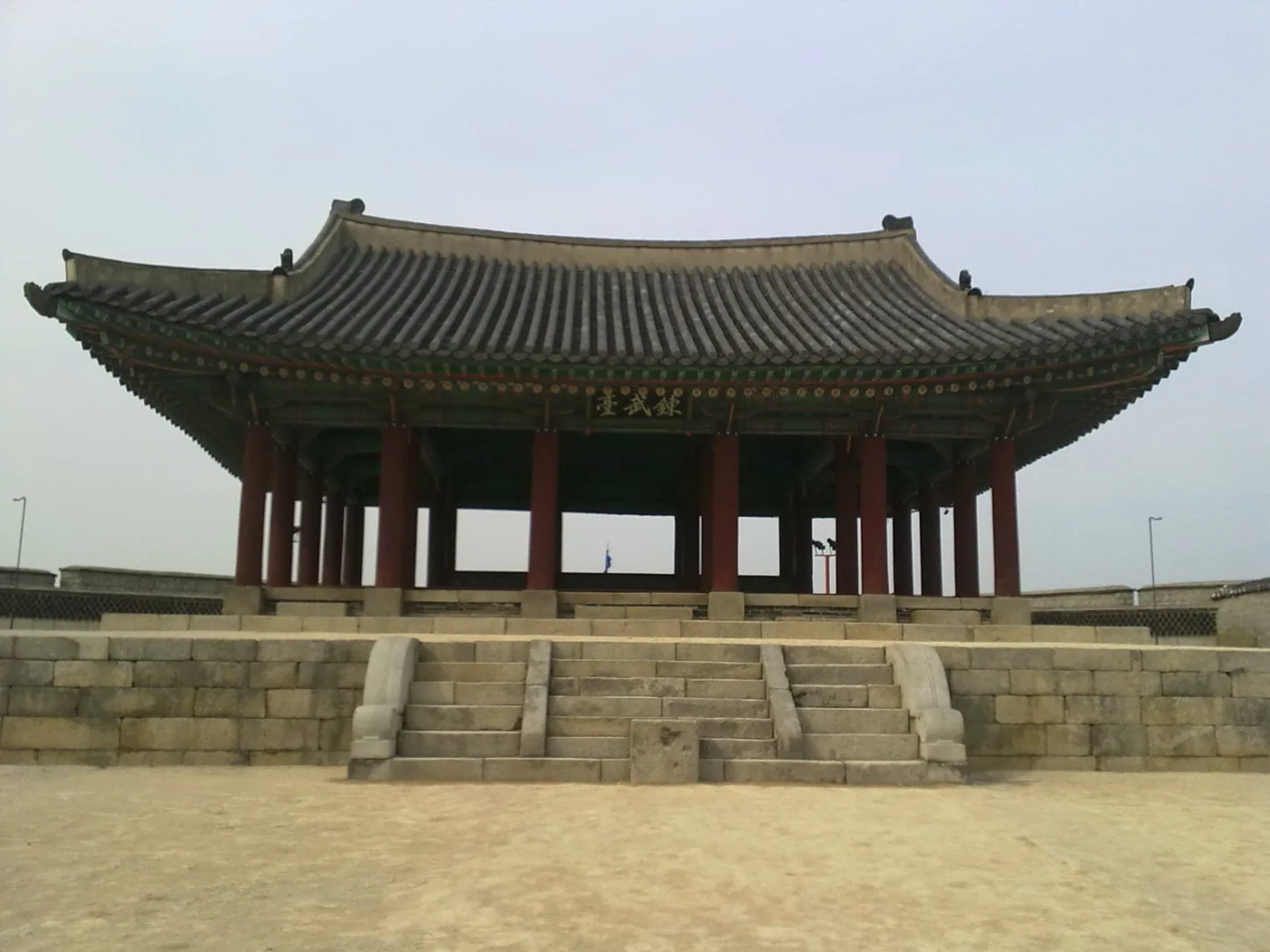
Yeonmudae has a working archery range. Ten arrows, 3,000 won, open to 17:30 from March to October and to 17:00 from November to February, with a lunch break from 12:00 to 13:00. The name means “martial training platform” because this was the eastern command post where soldiers drilled.
The stamp tour doubles as a route
The ten stamp points are the palace, Janganmun, Paldalmun, Changnyongmun, Hwaseomun, Hwahongmun, the south water gate, Seojangdae, the Traditional Culture Centre and the Hwaseong Museum. It is free, and joining those ten points takes you past most of what matters.
8. Take the direct bus, not the subway
Every day-trip guide says “subway, about an hour.” What they leave out is that Suwon Station is not the fortress. You arrive and then take a city bus. There are direct buses from Seoul that skip that step entirely.
Direct buses, no transfer
From Jamsil or Gangnam, one bus puts you at the fortress. The Sadang routes need a transfer unless you take the 7770 to the north gate.
If you do take the subway
Line 1 from Seoul Station to Suwon StationMap takes about 40 minutes on an express and about an hour on an all-stops train. Then you transfer to a city bus.
| At Suwon Station | Bus | Get off at |
|---|---|---|
| Exit 4 (in front of the Novotel) | 11 or 13 | Hwaseong Haenggung |
| Exit 7 (across from AK Plaza) | 60 or 7-2 | Hwaseong Haenggung |
| Bus transfer centre | 700-2 | Hwaseong Haenggung |
| Exit 7 | 60, 301, 777, 7-1, 7-2, 310, 900, 5, 787 | Jangan Park, for Janganmun |
All of these end with a five minute walk. On the Suin-Bundang line, get off at Maegyo Station exit 7 and take the 112, 25, 25-2 or 25-5.
Driving means paying for parking
| Stay | Cost |
|---|---|
| Out within 10 minutes | Free |
| First 30 minutes | 900 won |
| Each 10 minutes after that | 400 won |
| All day | 14,000 won |
Walking the whole wall takes three to four hours. At that length the day pass works out cheaper. If you are only riding the trolley and shooting a few arrows, pay by the hour.
Decide your entry point before you leave
Hwaseong has no single entrance. Whether you start at the palace, at Yeonmudae for the trolley, or at Janganmun for the wall changes which stop you want. Working it out on arrival means one more bus ride.
9. Which part of the wall to walk
The circuit is 5,744 metres around an area of 130 hectares. If you are not walking all of it, split it into three. The terrain and the contents differ.
| Section | What is on it | Character |
|---|---|---|
| North | Janganmun, Hwahongmun, Bangwhasuryujeong, Yongyeon pond | Flat, and the best photographs are here |
| West | Seojangdae, the western crossbow platform, Hwayangnu | Uphill over Paldalsan. Views across the whole city |
| East | Changnyongmun, Yeonmudae, Dongbuk Gongsimdon, the beacon tower | Flat. Trolley, archery and parking are all here |
Only the west section climbs
Hwaseong is usually described as a flatland fortress, but the western stretch goes over Paldalsan. SeojangdaeMap is the command post at the top. Built in 1794, restored in 1971, and repaired again after a fire in 2006.
If time or energy is short, the north section alone covers most of what Hwaseong is known for. Bangwhasuryujeong, Hwahongmun and Janganmun are all within a few hundred metres of each other.
The east section is the practical one
Yeonmudae has the trolley departure point, the archery range and the car park together. If you are driving or planning to ride, start in the east.
On the wall and beside it
Some stretches let you walk on top of the wall and others put you on a path beside it. The access stairs are at fixed points, near the gates, corner pavilions and command posts, so you cannot climb up wherever you like.
With a pushchair or a wheelchair the raised sections are not workable. The trolley covers the northern stretch sitting down, and the palace and Hwaryeongjeon are both level ground.
The beacon tower is unusual
Beacon towers were normally built on hilltops away from the walls. At Hwaseong the bongdon was built into the wall itself, in brick. It dates from 1796 and was repaired in 1971. You will find it on the eastern section.
10. What is different at night
Because the wall never closes, the night version costs nothing extra. Paid and free programmes sit on top of it.
The evening opening runs from early May to early November
The evening opening season is 1 May to 1 November, and within it the palace opens every Friday, Saturday, Sunday and public holiday, 18:00 to 21:30, with last entry at 21:00. The price is the same 2,000 won as during the day.
One exception to note: the free admission on the last Wednesday of each month, Korea’s Culture Day, does not apply to the evening opening.
During the Suwon Hwaseong Cultural Festival, 4 to 11 October, the palace opens every night regardless of the day. Those eight days are the only chance in the year to see the palace lit on a weekday evening.
There is a night version of the martial arts too
Within the evening season, 4 to 19 September and 16 October to 1 November, a night performance of Muye 24 Ki runs at Yuyeotaek from 19:00 for twenty minutes. The daytime show is at the front gate. This one is at Yuyeotaek, deeper inside the palace, so you have to go in and find it.
Live music at Yongyeon pond, called Hwahong Pungnyu
Yongyeon pondMap sits directly below Bangwhasuryujeong. Traditional Korean music is performed there from 1 May to 31 October, every Friday and Saturday at 20:00 for an hour. The programme is called Hwahong Pungnyu and uses gayageum, daegeum and piri. It is free and outdoors, so bad weather cancels it.
The days overlap with the evening opening. Come on a Friday or Saturday night and you get both the lit palace and the music by the pond.
The media art at Hwaseomun lasts under three weeks
Suwon Hwaseong Media Art runs 19 September to 6 October around Hwaseomun and Janganmun. That is a short window, so if this is what you are coming for, fix the date first.
| Where | Times | Length |
|---|---|---|
| Hwaseomun | 19:30, 20:30, 21:30, three a night | under 35 min |
| Janganmun | 19:00–22:00 | about 15 min |
| Festival hours | 18:00–22:00 |
There are 625 seats in front of Hwaseomun: 451 general, 50 in a family zone for visitors with young children, and eight wheelchair spaces. Seats are free on weekdays and 5,000 won per person at weekends, on public holidays and the day before a long weekend, booked through Naver. Standing to watch is free on any day.
Evening tours need booking
The evening tour is called Moonlight Fortress Walk and runs only on evening-opening nights, which means Fridays, Saturdays, Sundays and public holidays. It goes twice a night, leaving at 18:00 and 20:00, and lasts about 90 minutes.
Each departure takes about 15 people. That is not the same as the daytime group tours, which take up to 100. The guiding is free, but you still pay the evening admission. Booking opens seven days before your visit and cancellations close three days out.
It starts at Sinpungnu and goes through Bongsudang, Nangnamheon, Mirohanjeong and Seongsinsa up to Seojangdae. That last stretch climbs Paldalsan, so wear trainers. Preschool children and anyone aged 75 or over cannot join.
Worth knowing. The English, Japanese and Chinese guided tours are reserved for foreign visitors. Korean residents cannot book them. If you are visiting from abroad, this is the one thing here that is easier for you than for locals.
11. When you do not pay
The palace is only 2,000 won, but the exemption list is long enough that many visitors pay nothing.
Applies to anyone
- Wearing hanbok gets you in free. Modernised hanbok counts.
- Age 65 and over with ID, free.
- Children aged six and under, free.
- The last Wednesday of every month is free, except for the evening opening.
- Registered disability, free, and where the disability is severe one carer is included.
- Children on Children’s Day, 5 May, free.
Korean residents only
- Families with two or more children, Suwon residents only.
- Suwon volunteers, 50% off.
- Suwon residents aged 19 to 39, Fridays only.
- Families recognised for military service.
- Voters showing a voting certificate on election day.
Renting hanbok is a real strategy
Hanbok gets you into the palace free, and rental shops operate near the palace gates. The same rule applies at Gyeongbokgung in Seoul, though it is worth knowing that Changdeokgung’s Secret Garden charges even in hanbok. Suwon does not.
If you are combining this with the Seoul palaces, the booking rules differ, and Changdeokgung’s Secret Garden in particular needs planning ahead.
12. When to come
The day of the week matters more than the time of day here.
| Day | What you get |
|---|---|
| Monday | Trolley, museums and demonstration all closed. Fine if you only want to walk |
| Tuesday to Thursday | Everything open and the fewest people. Martial arts at 11:00 only |
| Friday to Sunday | Evening opening and Hwahong Pungnyu. Two martial arts shows on Sat and Sun. Also the busiest |
For the full set, come Tuesday to Thursday. For the night version, Friday to Sunday.
The day by the clock
- 09:00 Palace opens. The trolley starts at 09:40.
- 11:00 Martial arts demonstration. On weekdays this is the only one.
- 14:00 A second demonstration, Saturdays and Sundays only.
- 17:00 Last palace entry and last trolley.
- 18:00 Palace closes, then reopens on evening opening days.
17:00 is the hinge. Miss it and the palace is gone for the day. The wall stays available regardless.
Early October stacks several events on top of each other
If you are coming in autumn, moving the date by a few days changes a great deal. There is a stretch when the whole fortress becomes a venue.
| Event | When | Where |
|---|---|---|
| Suwon Hwaseong Media Art | 19 Sep–6 Oct | Hwaseomun and Janganmun |
| Suwon Hwaseong Cultural Festival | 4–11 Oct, eight days | Palace squareMap, the palace, the wall |
| King Jeongjo Royal Procession | 4 Oct, one day | Noseong area through Janganmun to the palace square |
| Hwahong Pungnyu | Fri and Sat until 31 Oct | Yongyeon pond |
The cultural festival runs eight days each autumn and this is its sixty-third year. The procession opens it, re-enacting the journey King Jeongjo made in 1795 with his mother, Lady Hyegyeong. Anyang and Suwon stage it as consecutive legs.
To avoid crowds, skip the first week of October. To see the most at once, 4 to 6 October is when the media art and the festival overlap.
Summer has almost no shade
There is nothing overhead on the wall. The hill section has trees, but the northern and eastern flat sections are fully exposed. In midsummer aim for early morning or late afternoon. Events here do get cancelled during heat warnings.
13. What else is inside the ticket
It is easy to see the wall and the palace and leave. A few more places are either included in your ticket or a short walk away.
| Place | Ticket | Note |
|---|---|---|
| Hwaryeongjeon | Included with the palace | Jeongjo’s portrait shrine. Main hall is a Treasure |
| Suwon Hwaseong Museum | Combined ticket | Closed Mondays |
| Suwon Museum | Combined ticket | Closed Mondays |
| Traditional Culture Centre | Stamp tour point | Near the palace |
Hwaryeongjeon is already paid for
Built in 1801, the year after Jeongjo died, to hold his portrait. Later kings stayed here too. It is a designated Historic Site and its main hall, corridor and side chamber are Treasures. Walk in with your palace ticket.
Judge the museums by the day
The combined ticket is the palace plus two museums for double the price. Buy it only if you will actually go inside them, and never on a Monday.
Most of Suwon’s heritage is indoors
The national heritage register lists 91 items under Suwon, among them 18 Treasures and 3 Historic Sites. Many of them are calligraphy, portraits and books rather than buildings, so they are in museum cases, not on the wall.
The three Historic Sites are Hwaseong itself, the palace and Hwaryeongjeon, and all three are within walking distance of each other.
14. How to plan the day
The order depends on what brought you.
First visit
- Morning. Bus 1007 from Jamsil to the palace stop. Do the palace first, because of the 17:00 cutoff.
- 11:00. Martial arts at Sinpungnu. Any day but Monday.
- Midday. Hwaryeongjeon, already on your ticket.
- Afternoon. Up onto the wall at Janganmun and walk the north section to Bangwhasuryujeong.
- Late afternoon. Continue to Yeonmudae for archery or the trolley.
If you came to walk
- Start at Janganmun and go clockwise: Hwahongmun → Bangwhasuryujeong → Yeonmudae → Changnyongmun.
- Past the beacon tower and down towards Paldalmun. The wall ends here. Cross the roads on foot.
- Climb Paldalsan to Seojangdae for the view over the whole fortress.
- Down past Hwaseomun and back to Janganmun.
If you came for photographs
The north section is enough. Bangwhasuryujeong, Yongyeon pond and Hwahongmun sit together, and this is where every image of Suwon comes from. On Friday and Saturday evenings there is live music at the pond.
With children
- Start at Yeonmudae. The trolley and archery are both here.
- Ten arrows for 3,000 won is a low-commitment first try.
- The trolley covers the north section in 30 minutes, seated.
- The ten stamp points give the walking a purpose.
Half a day covers the fortress, and a full day if you walk the whole wall and add the museums. Where this fits in a Seoul trip is in our Seoul itinerary, and the Korea travel guide covers combining cities.
🧭All-Korea essentials125
Frequently asked questions
See the full Korea travel guide
Images: Photographs via Wikimedia Commons: Bernard Gagnon (CC0), Johannes Barre / iGEL (CC BY-SA 3.0), Jpbarrass (public domain), Adil (CC BY-SA 4.0), 잉여빵 (CC BY-SA 3.0), oreum (CC BY-SA 3.0), Rtflakfizer (CC BY-SA 4.0).