
Gangneung Travel Guide: Choosing Between Gyeongpo, Anmok, Jumunjin and Jeongdongjin
Gangneung’s coastline runs about 40km from north to south, and the stretch of beach you sleep on decides how much of the city you actually see.
| Getting there | KTX-Eum from Seoul Station takes about 1 hour 50 minutes and costs 27,600 won in standard class. |
|---|---|
| Where to base yourself | Gyeongpo and Anmok for sea views, near Gangneung Station for easy transport, Jumunjin and Okgye for lower prices. |
| City buses | A flat 1,530 won by card wherever you ride, with two free transfers inside 60 minutes. |
| Best value ticket | A 3,000 won Ojukheon ticket cuts 7,000 won off Haslla Art World and 6,000 won off Gyeongpo Aquarium the same day. |
| Cliff trail | The Badabuchaegil runs 3.01km one way and costs 5,000 won. High wind warnings close it. |
| When to come | August is the hottest and wettest month. December is the driest month of the year. |
1. A small city with a very long shore
2. Getting there: the KTX and the intercity bus
3. Getting around once you arrive
4. Pick your stretch of coast first
5. Gyeongpo: a beach with a lake behind it
6. Anmok coffee street began with vending machines
7. Three ways to drink coffee in Gangneung
8. Jumunjin is a harbour that still works
9. Jeongdongjin is a sunrise town
10. The Badabuchaegil, a 3km cliff walk
11. What to do in the water
12. The old houses inland
13. One 3,000 won ticket that discounts nine places
14. The high ground behind the city
15. What to eat here
16. Two weeks when the city fills up
17. The year in numbers
18. Where to stay and what it costs
19. Budget for two days
20. Two-day and three-day plans
Gangneung is two hours from Seoul, and the hard part starts after you arrive. This is the Gangwon chapter of our Korea travel guide.
1. A small city with a very long shore
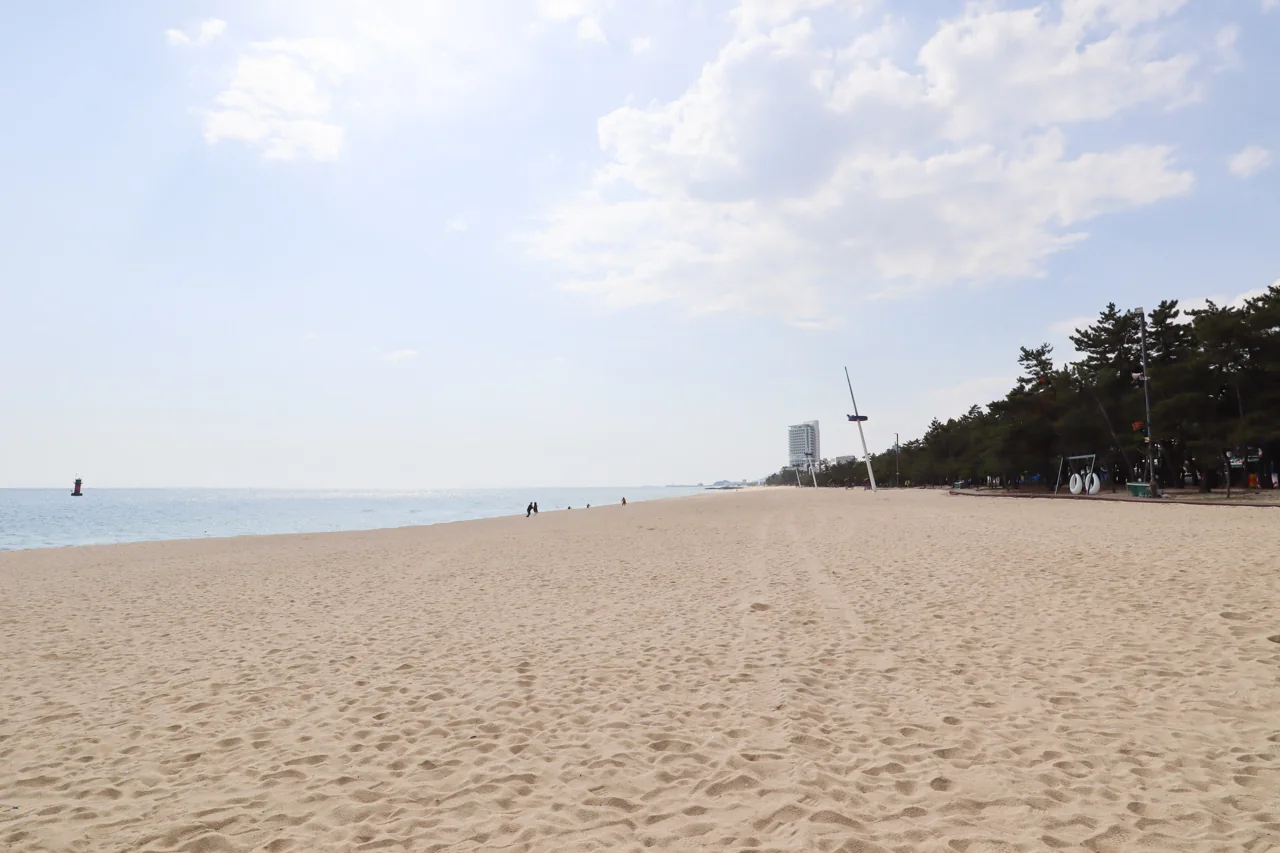
Gangneung sits halfway down Korea’s east coast, in Gangwon Province, with its built-up centre about two to three kilometres inland from the water. The population is a little over 200,000, so the city itself is compact. The coastline inside the city limits, however, stretches close to 40km from Jumunjin in the north to Okgye in the south.
That length is the single fact that shapes a trip here. Driving from the northern end to the southern end takes an hour. Doing it by city bus, with a transfer, takes about ninety minutes. Buying raw fish at Jumunjin market in the morning and watching sunrise at Jeongdongjin are not the same day’s plan. The two sit roughly 30km apart with the whole city in between.
Three layers stacked inland
Seen from above, Gangneung comes in three bands. The seaward band holds the beaches and fishing harbours, spread north to south. Two or three kilometres inland sits the second band, with Gangneung Station, the central market, and the old houses at Ojukheon and Seongyojang. Another thirty to forty minutes west and you reach the third band, the high ground around Daegwallyeong and Anbandegi. Moving between bands takes time, so a day that tries to cover two of them properly gets through neither.
Gangneung and Pyeongchang are different places
The sheep farms most travellers picture when they hear “Daegwallyeong” are not in Gangneung. Samyang Roundhill and Daegwallyeong Sheep Ranch both sit in Pyeongchang County, forty to forty-five minutes away by car. What does belong to Gangneung is Anbandegi, the high cabbage terrain in Wangsan-myeon, along with the Daegwallyeong Museum in Seongsan-myeon. A lot of English-language pages treat the two as one area, and the drive between them takes about forty minutes.
How much fits into one day
With a car, three coastal stops is realistic. Without one, two. Add half a day for the inland sights and a single day is full. Two nights lets you take the north or the south properly; three nights lets you add the mountains.
Gangneung is not a day trip from Seoul. The train ride alone is four hours return, and the sights are spread along 40km of coast. If you only have a day, pick one base and stay in it rather than trying to cross the city twice.
2. Getting there: the KTX and the intercity bus
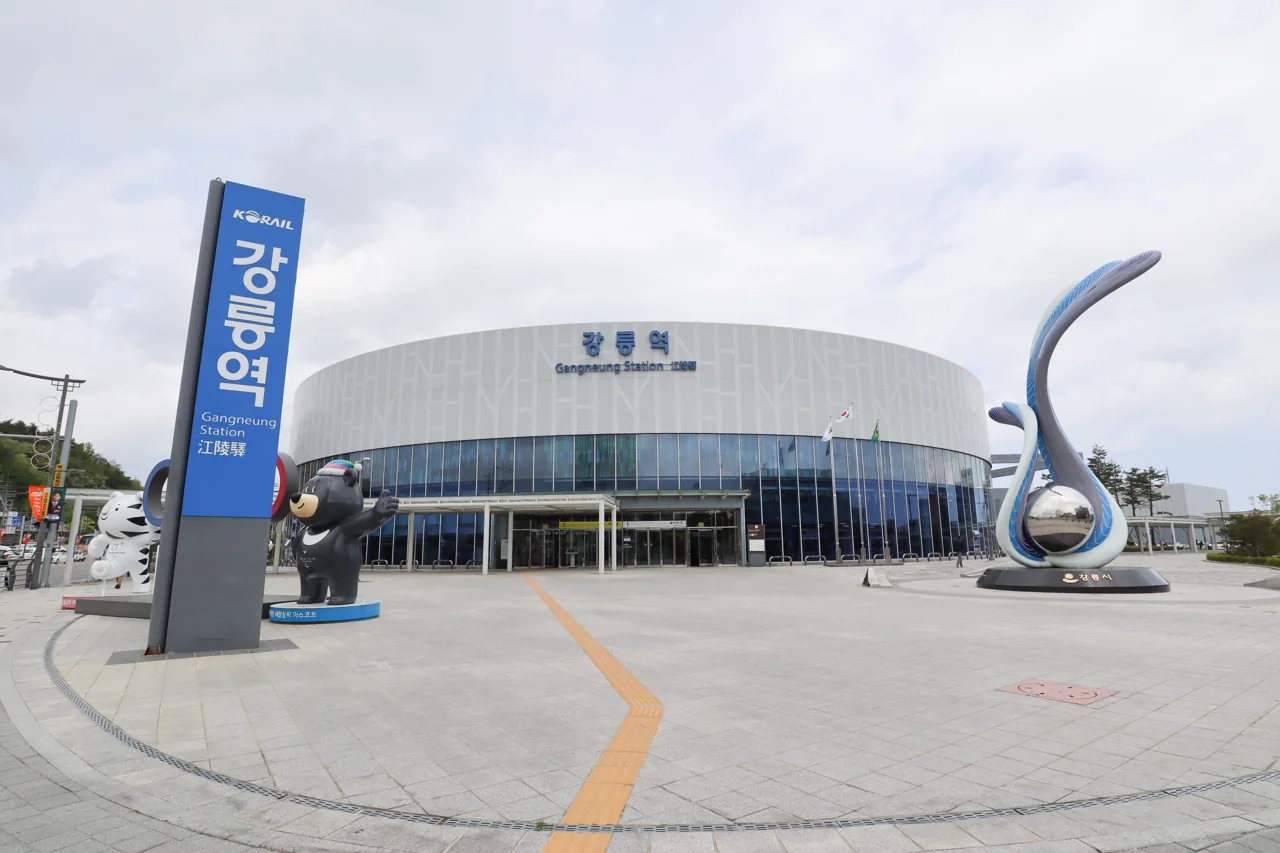
The KTX-Eum is the fastest way in. From Seoul Station it takes about 1 hour 50 minutes to 2 hours. From Cheongnyangni Station in eastern Seoul the run is shorter, around 1 hour 40 minutes. The Gangneung line calls at Sangbong, Yangpyeong, Seowonju, Manjong, Hoengseong, Dunnae, Pyeongchang and Jinbu on the way, though not every train stops at every station. Along the same coast, Sokcho has no railway station at all and is reached only by bus.
Fares by station
| To or from Gangneung | Standard | First class |
|---|---|---|
| Seoul | 27,600 won | 33,100 won |
| Cheongnyangni | 26,000 won | 31,200 won |
| Sangbong | 25,600 won | 30,700 won |
| Yangpyeong | 21,000 won | 25,200 won |
| Seowonju | 17,000 won | 20,400 won |
| Manjong | 16,300 won | 19,600 won |
| Hoengseong | 13,700 won | 16,700 won |
| Dunnae | 10,800 won | 13,800 won |
| Pyeongchang and Jinbu (Odaesan) | 8,400 won | 11,400 won |
Pyeongchang and Jinbu cost the same because the two stations are close together. Jinbu is the stop for Woljeongsa Temple and Odaesan National Park, which some travellers fold into the same trip by breaking the journey there on the way back to Seoul. The gap between a Jinbu ticket and a Gangneung ticket is 19,200 won, so splitting the trip costs very little extra.
Booking
Tickets go on sale about a month ahead through Korail’s site and app, and through resale platforms that handle foreign cards. Seats on Friday afternoons and Sunday afternoons disappear first, because most passengers are making a weekend round trip out of Seoul. Weekday trains rarely sell out.
No KTX to Jeongdongjin
There is no KTX service from Gangneung Station south to Jeongdongjin, Mukho or Donghae. That stretch is served by ordinary Mugunghwa trains, which run from Cheongnyangni on a different, much slower line. Travellers who book a KTX expecting to continue down the coast by rail find out at Gangneung Station. To reach Jeongdongjin from Gangneung, take city bus 112.
Bus and car
Intercity buses leave from Seoul Express Bus Terminal and East Seoul Terminal and take two and a half to three hours. They cost noticeably less than the train and run early and late, which the train does not. Driving takes about three hours on the Yeongdong Expressway, with heavy traffic through the Daegwallyeong section on Friday evenings and Sunday afternoons.
Weekend seats sell out. The Gangneung line runs roughly twenty services a day in each direction, and demand is concentrated on the Seoul run. Book as soon as your dates are fixed rather than waiting until you arrive in Korea.
3. Getting around once you arrive
Gangneung city buses charge one flat fare no matter how far you ride. By transport card that is 1,530 won for adults, 1,230 won for teenagers and 770 won for children. Paying cash costs a little more: 1,700 won, 1,360 won and 850 won. A forty-minute ride out to Jumunjin costs exactly the same as two stops in town, which makes the long rides good value.
Transfers
Two transfers are free within sixty minutes of tapping off. You have to tap the card again when you get off for the transfer to register. Transfers between two buses of the same route number do not count, even from different terminals. Some routes running south to Okgye also connect with Donghae city buses.
The dominant prepaid card in Gangwon is E-Zl, but T-money and Rail Plus both work on Gangneung buses, and so do the major Korean credit cards as postpaid transport cards. If you already bought a T-money card in Seoul, keep using it here.
Getting back to the station is harder than leaving it
Many routes call at Gangneung Station in one direction only. Buses coming in from their outer terminus pass the station on the way into town, but the number of routes that stop at the station heading outbound from the centre is small: 202, 223-1, 225-1, 314-1 and 314-2. Plan on a transfer when you are heading back to catch a train.
The busiest interchange stops in the centre are Sinyeong Theater, Kyobo Life, Bank of Korea and Yonggang-dong Seobu Market. Almost every route touches at least one of them, and both bus terminals are well served.
Taxis, rental cars and taxi tours
Taxis are usually easy to find, though not in peak summer or during festivals. If you want two or more coastal stops in a day, a rental car saves enough travel time to be worth the cost. Agencies cluster around Gangneung Station. A half-day taxi tour is the middle option: someone else drives, and you can string together places the buses do not connect.
Install a bus app before you go. Gangneung runs a real-time bus information system, and outlying routes can have gaps of an hour or more between services. Our guide to essential Korea travel apps covers the map and transport apps that work in Korea, since the ones you use at home mostly do not.
4. Pick your stretch of coast first
The first decision in Gangneung is which beach you sleep next to. Once that is set, most of the rest of the itinerary follows from it. Five distinct areas run from north to south, and each one is a different kind of day.
| Area | From the station | Character | Suits |
|---|---|---|---|
| Jumunjin | 40 min by bus | Working harbour, fish market, drama location | Seafood, morning markets |
| Gyeongpo | 20 min by bus | Widest beach, lake and pavilion, most hotels | First visits, families |
| Anmok and Gangmun | 20 min by bus | Coffee street, cafes, short beach | Coffee, quiet walks |
| Jeongdongjin | 40 min by bus | Sunrise, cliff trail, seaside station | Early mornings, walking |
| Okgye and Geumjin | 50 min by car | Surf breaks, empty sand | Surfing, solitude |
Gyeongpo and Anmok are close enough to combine. They sit about five kilometres apart along the shore road, fifteen minutes by bus, so one day covers both comfortably. The other three are far enough apart that pairing any two adds about two hours of travel.
First visit: Gyeongpo
Stay at Gyeongpo and walk or ride over to Anmok. This area has the most rooms at the most price points, the most frequent buses into town, and both Gyeongpo Lake and Ojukheon within easy reach, which makes it easy to split days into halves.
Second visit: the north or the south end
If you have already seen Gyeongpo, go to one of the ends. Jumunjin has a genuine working harbour and a market that is at its best early. Jeongdongjin puts the sunrise and the cliff trail side by side, which fills a morning properly. Rooms at both cost less than at Gyeongpo.
Skip the far south without a car
Okgye and Geumjin are where people go to surf. Buses reach them but slowly and infrequently. Unless surfing is the point of the trip, leave them out.
5. Gyeongpo: a beach with a lake behind it
Gyeongpo BeachMap is the widest beach in Gangneung. The sand runs long and a pine forest backs it, so even a crowded day leaves space. Hotels and restaurants sit directly behind the beach, which means you can spend a full day here without transport.
The swimming season is two months
Gyeongpo opens first among Gangneung’s beaches, in early July, and closes in late August. During the open season the beach is accessible from 6am to midnight, but swimming is only permitted between 9am and 6pm, because that is when lifeguards are on duty. The other seventeen beaches in the city, Jumunjin and Anmok among them, open together in mid-July and close on the same day in August.
More than 90,000 people came to Gyeongpo on opening day in a recent season, so peak summer here is not a quiet beach holiday. From September through June the sand is largely empty, which makes those months better for walking.
Gyeongpo Lake and the pavilion
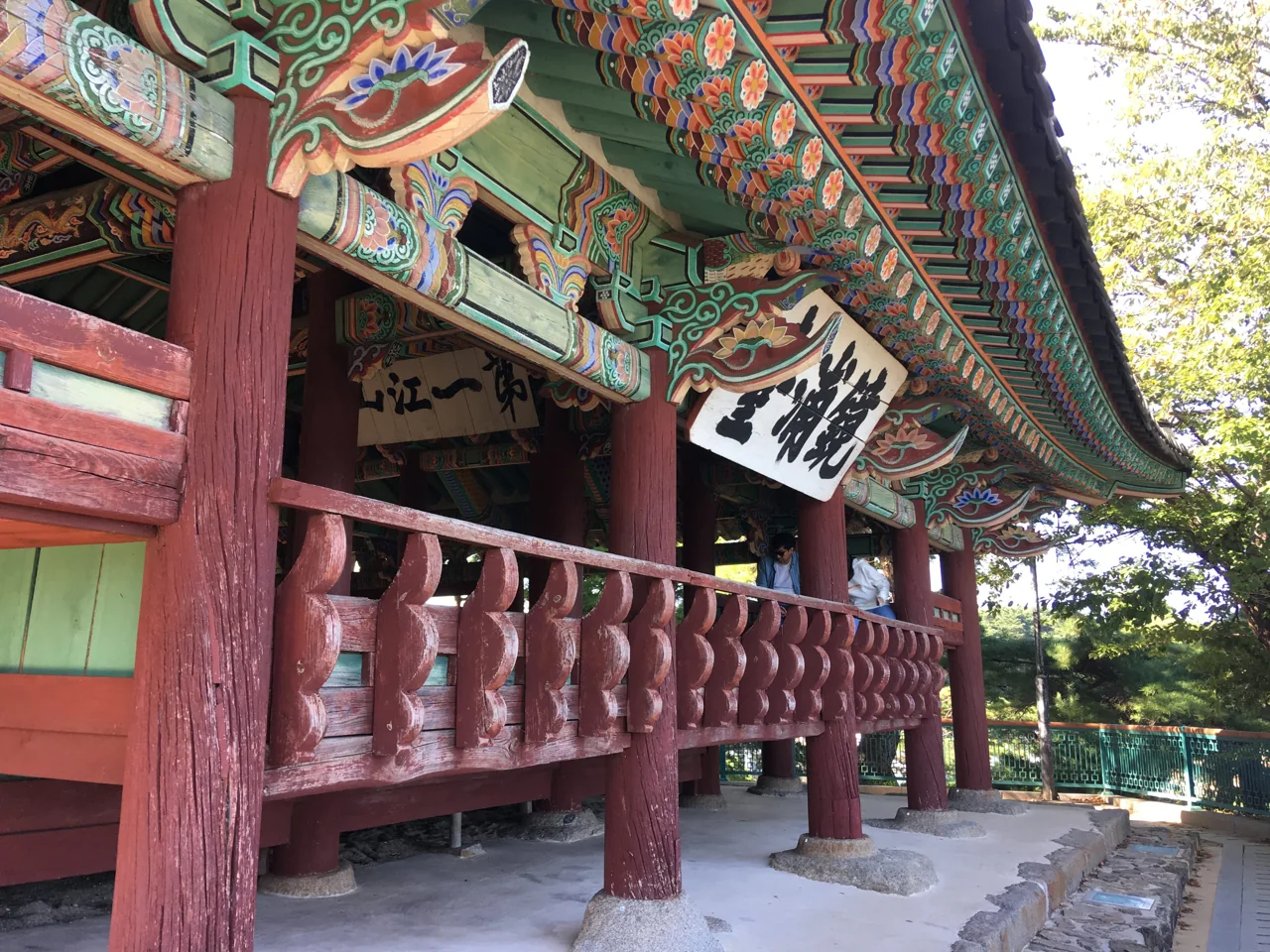
Immediately inland sits Gyeongpo LakeMap, a lagoon about four kilometres around. The path circling it is flat and takes roughly an hour on foot, less by rented bicycle. On the hill at the northern side stands Gyeongpodae, a Joseon-era pavilion where you can sit on the wooden floor and see the lake and the sea at once. In spring the lakeside becomes one of the region’s cherry blossom walks.
Indoor options nearby
Several indoor attractions cluster around Gyeongpo. The aquarium is close to the beach, and the Chamsori Gramophone and Edison Science Museum sits by the lake. These matter more than they sound: summer here is the cloudiest part of the year, and winter wind makes long beach walks short. Adult admission to the aquarium is 20,000 won, though there is a way to pay 14,000 won that we come to further down.
6. Anmok coffee street began with vending machines
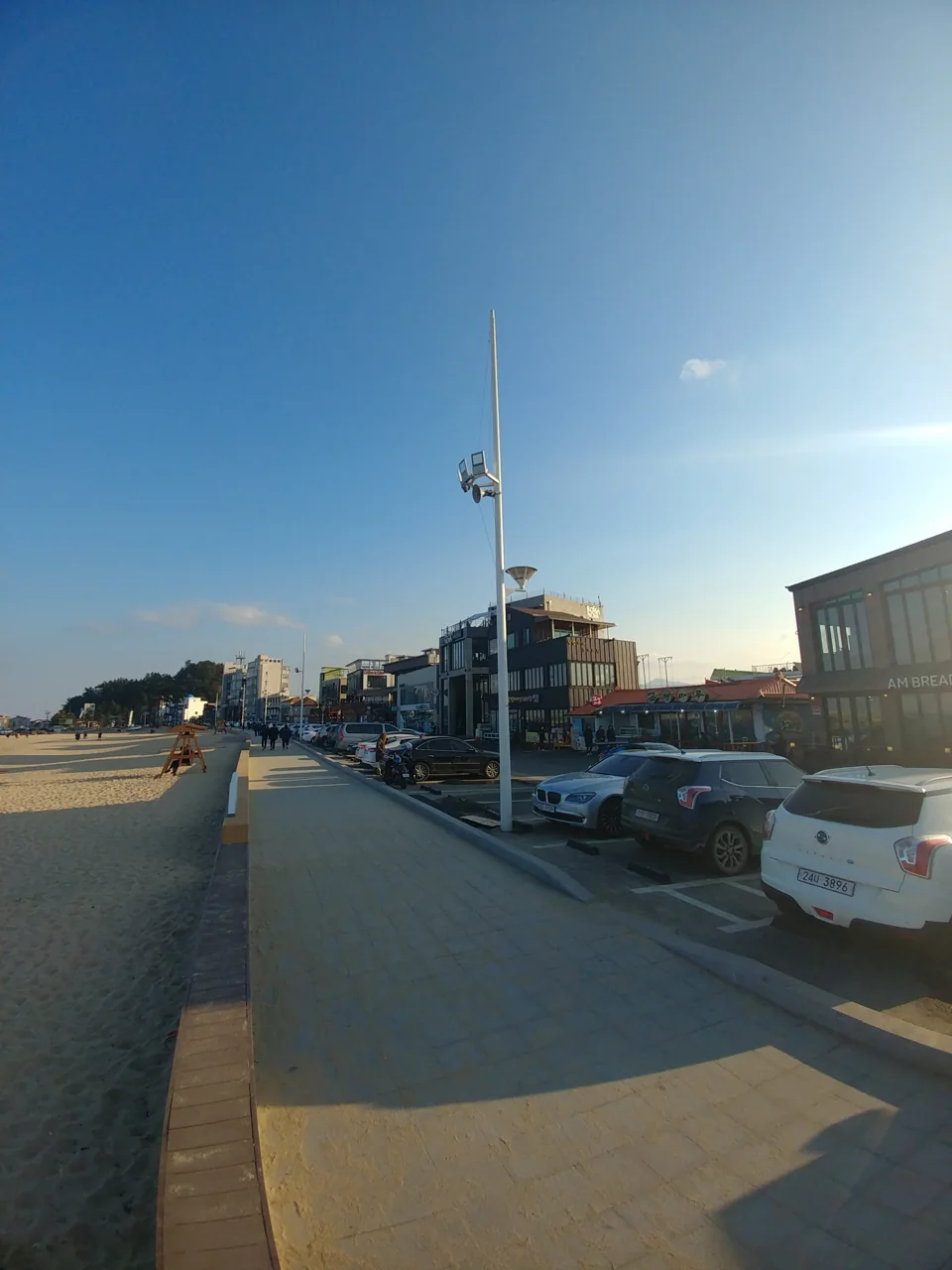
Anmok BeachMap is better known for coffee than for sand. It is a short beach next to Gangneung Port, and the road along it is lined with cafes. Walking from one end to the other takes about twenty minutes.
Fifty vending machines, then a cafe street
The coffee here started around forty years ago with seaside vending machines. People came to drink paper-cup coffee while looking at the water, the machines multiplied to about fifty, and the beach built a reputation on that. The first proper roastery cafe opened on Anmok Beach in 1998. Almost everything you see now came after. A few vending machines are still in place if you want the original version.
Two people made Gangneung a coffee city
Park Yi-chu is counted among the first generation of Korean baristas who introduced hand-drip brewing from the 1980s onward, and many of the people he trained opened their own cafes around the city. His shop, Bohemian, is not on Anmok Beach. It sits elsewhere in the area, which catches out visitors who go looking for it among the seafront cafes.
Terarosa is the roastery that started in Gangneung and spread nationwide. Its Gangneung roastery and cafe is out in Gujeong-myeon, inland and in a different direction from Anmok, so seeing both means splitting a day.
The coffee museum
Coffee Cupper Coffee Museum in Gangmun-dong charges 5,000 won for adults, or 4,000 won if you show an Ojukheon ticket from the same day. It displays brewing equipment and green beans and runs roasting demonstrations, which fills an hour well on a wet afternoon.
Think about parking before you drive to Anmok. The cafes are packed along a single road and weekend afternoons leave almost no kerbside space. Park in the public lot on the Gangneung Port side and walk in.
7. Three ways to drink coffee in Gangneung
The cafes are not all at Anmok. Where you drink changes what you get.
With a sea view
The shore road running through Anmok, Gangmun and Sacheonjin is lined with cafes whose windows face the water. They photograph well and turn tables quickly, and on weekend afternoons you will wait for a window seat. Prices run 1,000 to 2,000 won above town cafes.
At a roastery
Gangneung has an unusual number of cafes that roast their own beans, scattered through the town centre and out in Gujeong-myeon and Sacheon-myeon. You need a car to visit more than one or two. There is no sea view, but you can choose between single origins and buy beans to take home. If coffee itself is the reason you came, this is the more rewarding route.
During the festival
The Gangneung Coffee Festival runs for five days in late October. It used to happen only along the Anmok coffee street; recent editions split the main stages between Anmok and the Gangneung Arena, with linked programmes at Jumunjin, the central market, Ojukheon and Okgye. Bean shops, equipment displays, tasting zones, markets and street performances all run together, so you can taste a dozen local roasters without driving between them.
Room rates rise that week and parking around Anmok becomes difficult. If you are coming for a quiet stretch of coast, choose a different week.
Check the roast date if you buy beans. Gangneung roasteries print it on the bag. Within two weeks of roasting is where the coffee is at its best.
8. Jumunjin is a harbour that still works
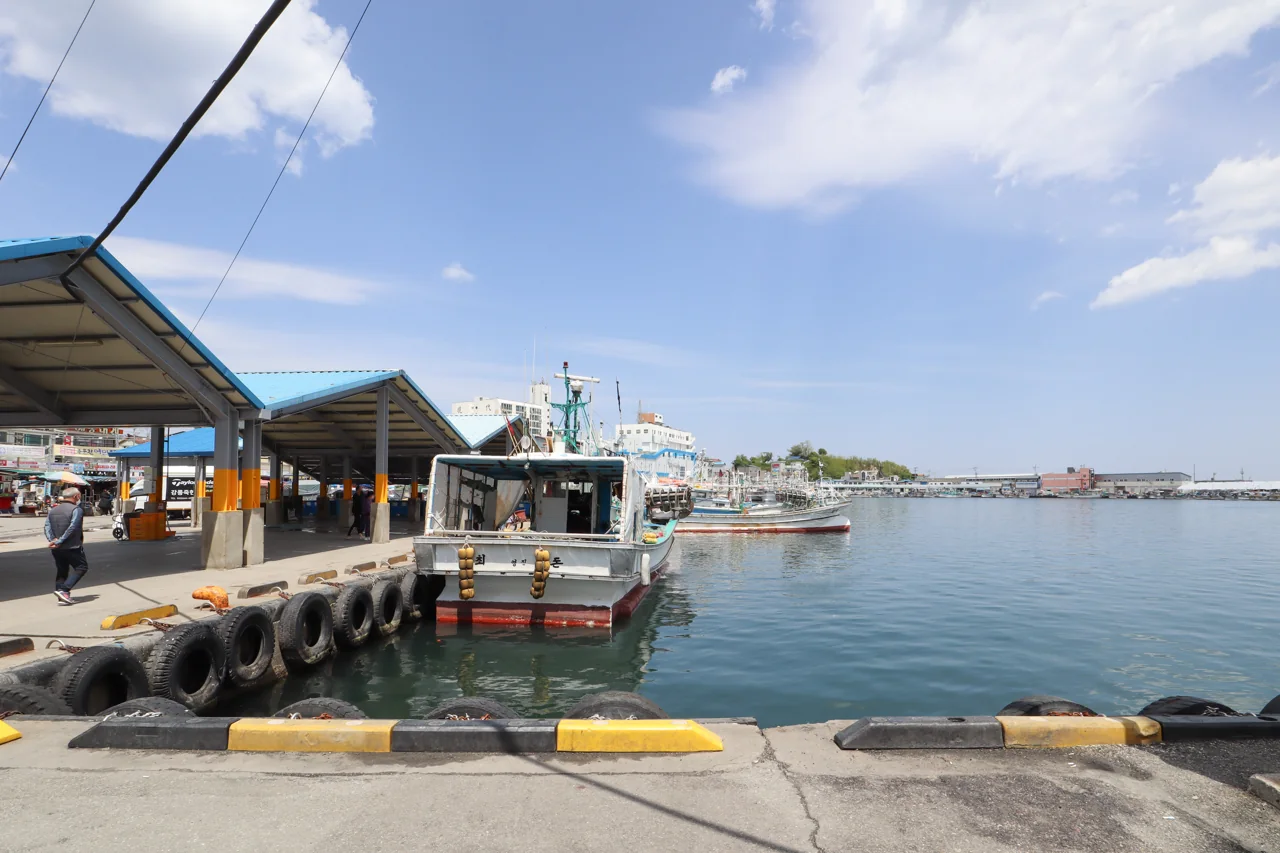
Jumunjin HarbourMap sits at the northern edge of Gangneung. Boats still come and go and the auction still runs at dawn. Going in the morning is the point.
The fish market
Jumunjin Fish Market is right beside the harbour. You can have fish sliced and eat it on the spot or take it away, and a separate lane sells dried seafood and salted preserves. Mornings have the widest selection; by late afternoon much of it is gone, even when the market is still busy in summer.
Agree on the price before anything is cut. It is common here to buy the fish at one stall and then pay a separate table charge to eat it, and that second amount varies from place to place. Asking first avoids the usual surprise.
The breakwater from the drama
The photograph everyone comes to Jumunjin for is taken at the Yeongjin Beach groyneMap, a short concrete arm running into the sea between Yeongjin and Jumunjin beaches. It is where the two leads first meet in the television drama Goblin. Korean pages usually call it the Jumunjin groyne even though it is on the Yeongjin side.
The city has named this groyne, the Jumunjin bus stop and the Sodol breakwater as recommended stops for its tourism year. They do not connect on foot, so plan on driving or riding between them.
Sodol Adeulbawi Park
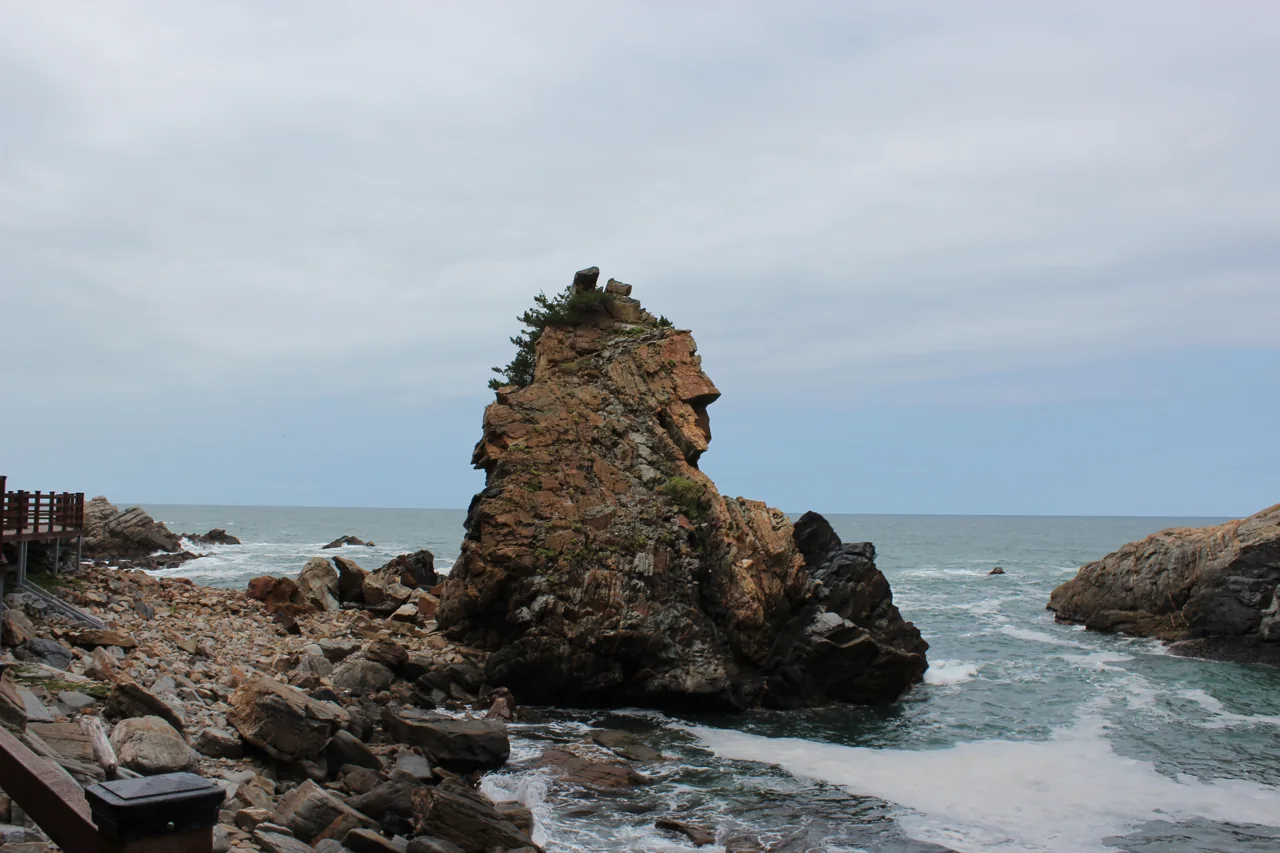
At the far north end of Jumunjin, a small park collects wave-cut rock formations. There is no admission charge and the loop is short enough to finish in half an hour, which makes it a reasonable add-on after the harbour and the market.
9. Jeongdongjin is a sunrise town
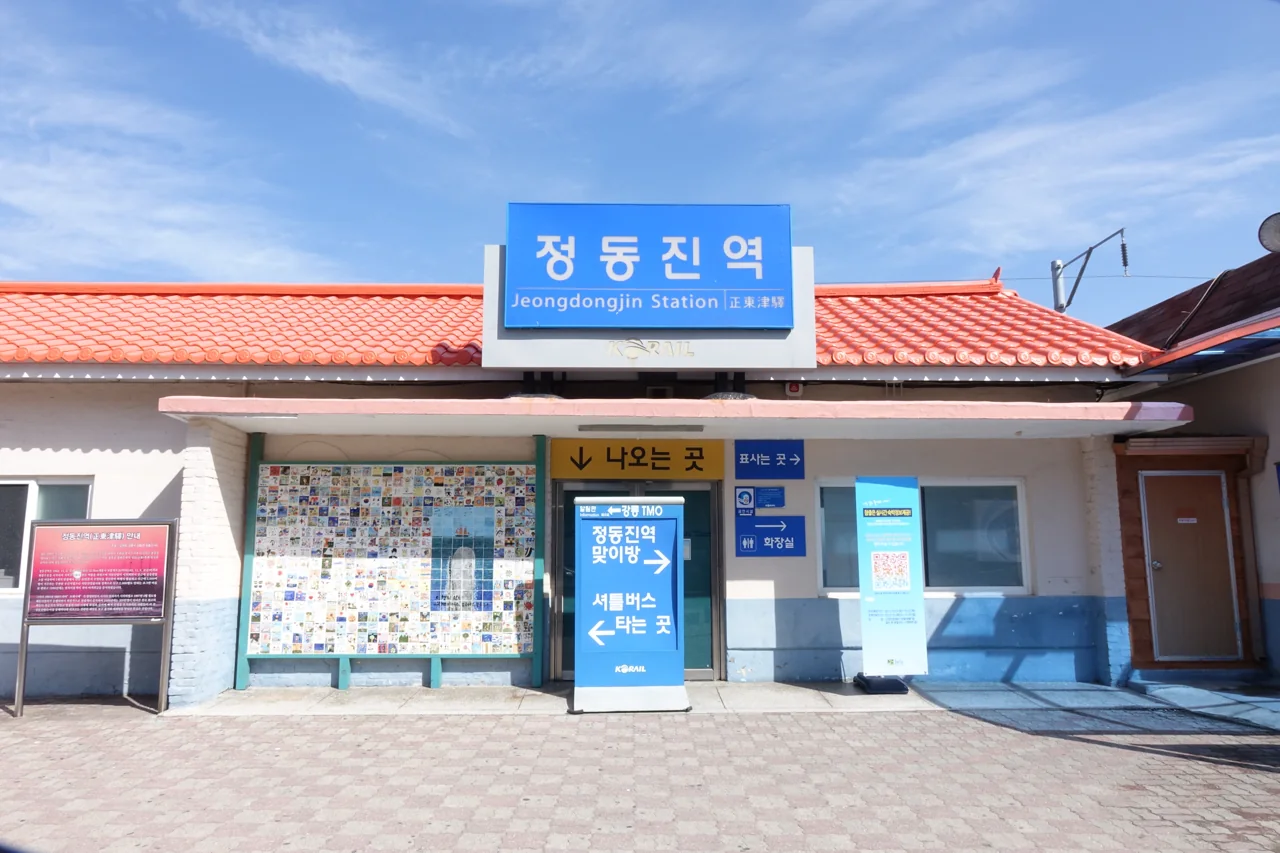
Jeongdongjin StationMap is generally described as the railway station closest to the sea in Korea. Walking from the platform to the sand takes under a minute. It is in Gangdong-myeon in the south of the city, and city bus 112 runs there from Gangneung Station.
Sunrise is what this place is for
The name comes from the town lying due east of the old royal palace in Seoul. On New Year’s Day the beach is shoulder to shoulder; on an ordinary weekday morning it is quiet enough to watch the sun come up alone. In winter sunrise falls after 7:30am here, so you do not have to get up in the middle of the night. In midsummer it is closer to 5:20am.
The hourglass park and the time museum
Next to the station is Hourglass Park, built after the drama Sandglass was filmed here, with a large sand timer that is turned once a year. There is no admission charge.
The Jeongdongjin Time Museum next door is built from linked railway carriages. Adult admission is 9,000 won, or 8,000 won with an Ojukheon ticket. The displays are about clocks and timekeeping, which works well enough with children.
The ship on the hill
A resort built in the shape of a cruise liner stands on the cliff above the town and is visible from a long way off. Non-guests can pay to enter the sculpture park on the headland, which is where most of the wide views over the coast are taken from.
Consider sleeping in Jeongdongjin. There is no useful public transport from central Gangneung before dawn. If you want the sunrise, either stay the night here or have a car.
10. The Badabuchaegil, a 3km cliff walk
The Jeongdong Simgok Badabuchaegil is a 3.01km trail along the cliffs between Jeongdongjin and Simgok Harbour. It runs across a marine terrace designated Natural Monument No. 437, a landform pushed up by tectonic movement two to two and a half million years ago, and it is the only place in Korea where you can walk one. For decades the route existed only as a military patrol path along the coast.
Tickets and hours
| Category | Adult | Teen and soldier | Senior and child |
|---|---|---|---|
| Individual | 5,000 won | 4,000 won | 3,000 won |
| Group of 30 or more | 4,500 won | 3,500 won | 2,500 won |
| Reduced | 3,000 won | 2,500 won | 1,500 won |
Opening hours change with the season. From April to October the trail is open 9am to 5:30pm and the ticket windows close at 4:30pm. From November to March it closes at 4:30pm with ticket sales ending at 3:30pm. Sales stop one hour before closing in both seasons, so arriving late in the afternoon means being turned away rather than rushed through.
A child here means ages 7 to 12 and a teenager means ages 13 to 18 or anyone in middle or high school. People with disabilities, national merit recipients, single-parent families and basic livelihood recipients enter free.
Things to know before you start
There are no toilets on the trail. The walk takes about an hour across three kilometres and the operator’s own notice asks visitors to use the facilities at the ticket offices before entering. Sections of the walkway are steel plate, and the official advice is not to wear hard-soled or heeled shoes, which slip and catch.
Military installations stand along the route. Photographing them or posting images of them online is prohibited under Korean law protecting military facilities, and signs mark the sections concerned. Dogs are not allowed except guide dogs, and neither are bicycles.
High wind warnings close the trail. When a strong wind advisory or warning is in force, entry is stopped for safety, and this happens more often in winter when average wind speeds here are at their highest. Check the operator’s site for the day’s status before making the trip.
It is one way, so plan the return
There is a ticket office at each end, Jeongdong and Simgok. Walking the trail leaves you three kilometres from where you started, which matters if you drove. By bus, take 112 from opposite Gangneung Station to the Hourglass Park car park and walk about 800m to the Jeongdong office; for the Simgok end, ride 112 to the Gangdong free car park and change to the 958 Masil bus, then walk 450m.
There is no car park beside the Jeongdong ticket office itself. You park in one of the free lots nearby and walk up to twenty-five minutes. Coaches cannot enter or turn around at the Jeongdong end at all.
11. What to do in the water
The east coast is not only a two-month summer destination. Surfing runs from spring into late autumn, and the fishing-village programmes operate year round.
Surfing at Geumjin and Sacheon
Most Gangneung surf lessons happen at Geumjin BeachMap in Okgye-myeon, at the southern end of the city, where several surf shops sit together. Lessons normally include the board and the wetsuit. Beginners also do well at Sacheon Beach in the north, which has gentler water and is closer to town.
A lesson usually runs two to two and a half hours and is followed by free surfing time. Wetsuits are optional in high summer but necessary in spring and autumn. The East Sea warms late, so the water is still cold well into June.
Fishing village programmes and boats
At the Sacheonjin fishing village experience centre you can help haul nets or go out on a fishing boat. Yachts, jet skis and scuba operators work out of the Gangmun and Sacheon area. For families this is often a better option than a beach day.
A zip line over the water
Aranabi in Namhangjin-dong runs a zip line across the river mouth. The 600m ride costs 20,000 won, or 16,000 won with an Ojukheon ticket. It is over quickly, but children rate it highly.
Rip currents form on this coast. Lifeguards are only on duty during the official beach season. Outside those weeks there is no supervision at all, so read the flags, listen to announcements, and do not swim out alone on an empty beach.
12. The old houses inland
Several Joseon-era buildings survive in the town centre. They are close enough together to see in half a day, and all of them sit two or three kilometres back from the water.
Ojukheon
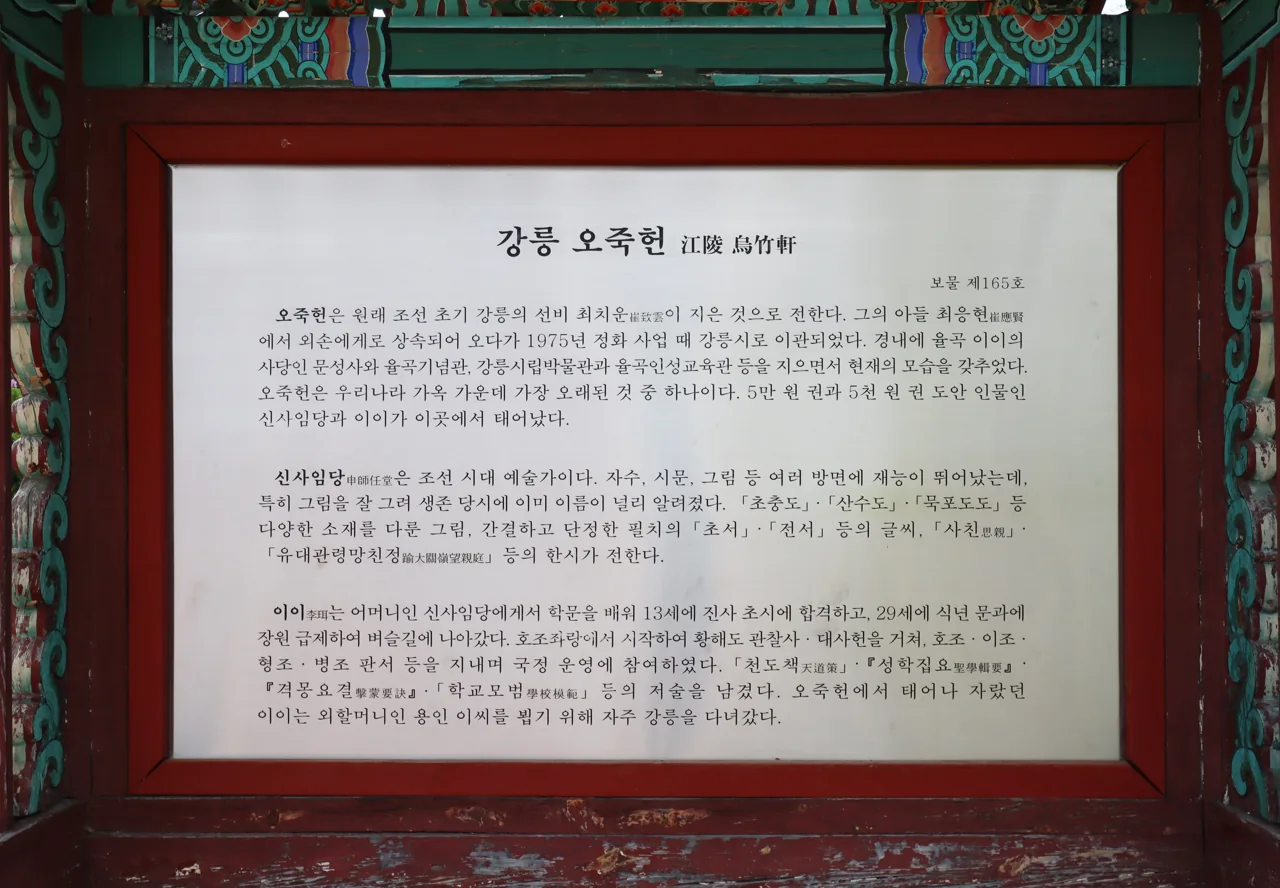
OjukheonMap is the house where the artist Shin Saimdang lived and where the philosopher Yulgok Yi I was born. Both figures appear on current Korean banknotes, which is why the site includes a currency museum alongside the city museum, all inside one ticket. Adults pay 3,000 won, teenagers and soldiers 2,000 won, children 1,000 won. Visitors aged 65 and over, children aged 6 and under, and Gangneung residents enter free.
The grounds are open 9am to 6pm, but the last admission is 5pm. That one-hour gap between last entry and closing catches people out. The site never closes for a rest day; on New Year’s Day and the Seollal and Chuseok holidays only the indoor galleries shut while the house itself stays open. Parking is free, with an overflow lot at the Gangneung Nongak Training Centre.
The last Wednesday of each month is Culture Day, when admission is half price. It cannot be combined with other discounts.
Seongyojang
SeongyojangMap is a 300-year-old aristocratic residence, National Folklore Cultural Heritage No. 5. The main quarters, the men’s quarters, the detached wing and the lotus pond pavilion all survive. Adults pay 5,000 won, discounted visitors 3,000 won and children 2,000 won. The discount covers teenagers, over-65s, soldiers, police, people with disabilities and national merit recipients; Gangneung residents are free.
Opening hours are 9am to 6pm in summer and 9am to 5pm in winter. The house runs a hanok stay in its actual rooms, and guests staying overnight do not pay admission. A short concert is held every Wednesday at 1pm in the Yeolhwadang hall.
Guided commentary starts on the hour between 9am and 4pm, pausing over lunch, and lasts thirty to forty minutes. Walking the site alone takes about fifteen minutes, so the tour is worth the wait even though the guides work in Korean.
Do not fly a drone at Seongyojang. The estate states that unauthorised aerial filming will be reported to the police, since the site is both private property and a public venue. The whole property is non-smoking and pets are not admitted.
The central market and Wolhwa Street
Gangneung Jungang Market is within walking distance of the station. It is known now for sweet-and-spicy fried chicken, fish cake croquettes and stuffed tofu pockets, but underneath it is still a neighbourhood market for fish and vegetables.
Wolhwa Street runs alongside it on the bed of a former railway line. A night market sets up there every Friday and Saturday from 6pm to 11pm, from May through October, with about forty stalls split between food and craft sellers. Recent seasons added English menus. Eating there, walking on to the lit Wolhwa Bridge and dropping back into the market lanes makes an easy evening.
13. One 3,000 won ticket that discounts nine places
The package ticket sold at the Ojukheon ticket office is the best-value thing in Gangneung and almost nobody outside Korea knows about it. Show your Ojukheon admission ticket at the same window on the same day and you can buy discounted entry to a list of other attractions across the city.
| Attraction | Normal adult | With Ojukheon ticket | You save |
|---|---|---|---|
| Haslla Art World | 17,000 won | 10,000 won | 7,000 won |
| Gyeongpo Aquarium | 20,000 won | 14,000 won | 6,000 won |
| Running Man & Muse Gangneung | 22,000 won | 17,000 won | 5,000 won |
| Aranabi zip line (600m) | 20,000 won | 16,000 won | 4,000 won |
| Gangneung Embroidery Museum | 6,000 won | 3,000 won | 3,000 won |
| Hwanhui Cup Museum and Jang Gil-hwan Gallery | 10,000 won | 8,000 won | 2,000 won |
| Jeongdongjin Time Museum | 9,000 won | 8,000 won | 1,000 won |
| Coffee Cupper Coffee Museum | 5,000 won | 4,000 won | 1,000 won |
| Jayeona Nolja | 12,000 won | 11,000 won | 1,000 won |
| Daegwallyeong Museum | 1,000 won | Free | 1,000 won |
The Balwangsan Mona Park cable car is discounted 20% rather than by a set amount. The arrangement also runs in reverse: showing a Running Man ticket or a Balwangsan cable car ticket at Ojukheon drops the 3,000 won admission to 2,000 won.
Three conditions
First, the package tickets are only sold at the Ojukheon and City Museum ticket office. The individual attractions do not sell them at these prices. Second, you must show that day’s Ojukheon ticket. Third, they are valid on the day of purchase only, with no refund the next day. The practical consequence is that Ojukheon belongs in your morning, with the afternoon decided at the ticket window.
Free admission for over-65s applies at Ojukheon and the Daegwallyeong Museum only, not at the other attractions on the list.
Distances from Ojukheon
Gyeongpo Aquarium is 3.2km away, the Coffee Cupper museum and the embroidery museum 5km, Aranabi 9km, the Daegwallyeong Museum 12.6km, Haslla Art World 18km and the Jeongdongjin Time Museum 21km. The Balwangsan cable car is 43km out, which makes it another day’s trip.
Two uses cover the ticket several times over. Haslla Art World and Gyeongpo Aquarium together save 13,000 won against a 3,000 won admission. For two travellers the saving doubles.
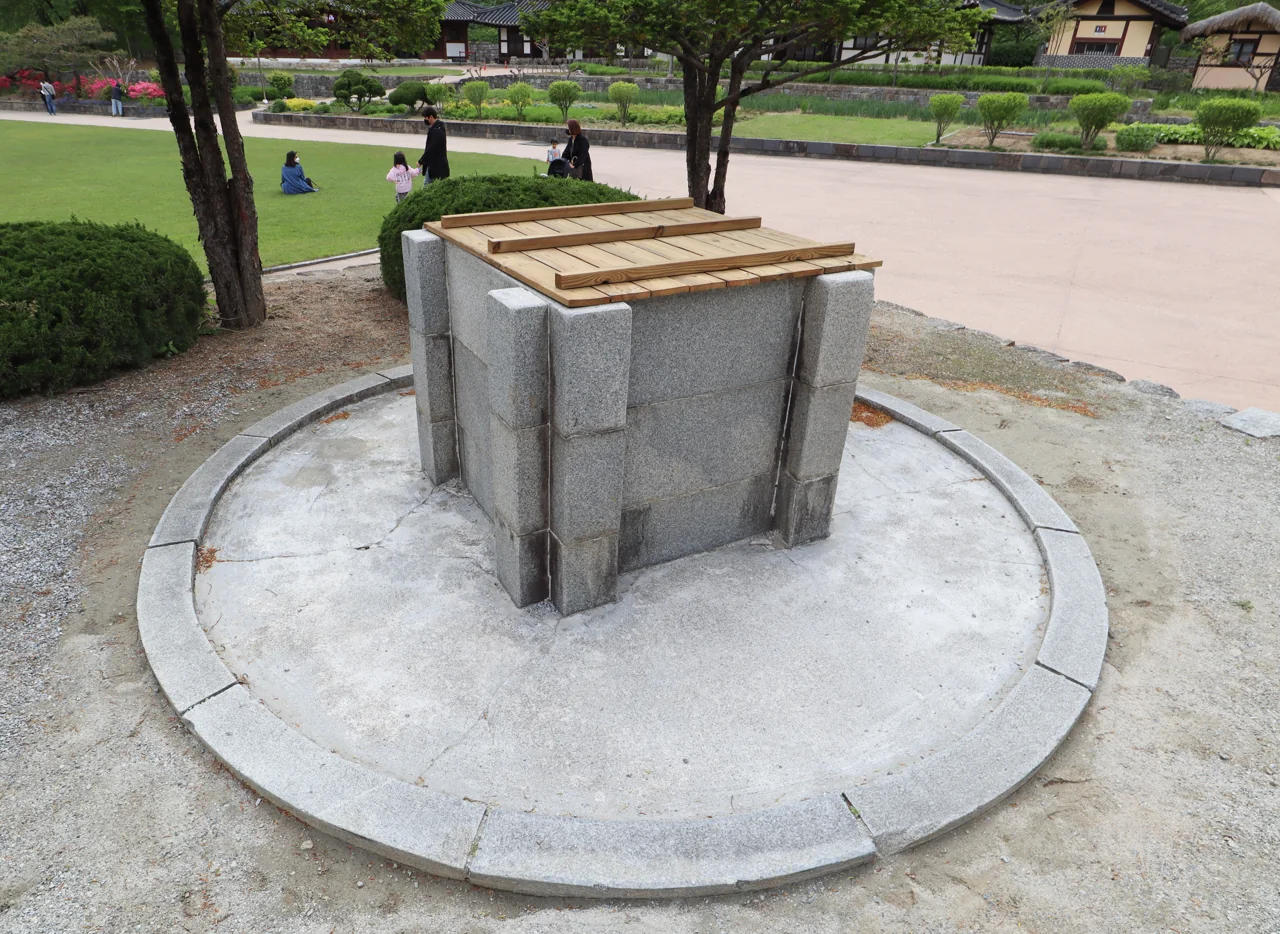
14. The high ground behind the city
Thirty to forty-five minutes west of the coast the land rises past 800 metres. Summer temperatures up there run five degrees or more below the town, and winter snow lies much deeper.
Anbandegi is in Gangneung
AnbandegiMap is a highland farming area in Wangsan-myeon, around 1,100 metres up, where cabbage fields cover an area often described as the size of 300 football pitches. There is no admission charge and no parking charge. Free car parks sit at the village entrance and at the Meonge Observatory.
The fields look their best just before harvest, in early to mid August, which is also when they are busiest. People come at night for the stars; the Milky Way is visible around the new moon between May and July. The area is also a known spot for sunrise photography.
Samyang Roundhill and the sheep ranch are in Pyeongchang
Neither of the two famous Daegwallyeong ranches is in Gangneung. Samyang Roundhill and Daegwallyeong Sheep Ranch both sit in Daegwallyeong-myeon, Pyeongchang County, forty to forty-five minutes away by car and awkward to reach without one.
Samyang Roundhill charges 12,000 won for adults, 10,000 won for children and students, and 9,000 won for visitors over 65, people with disabilities and national merit recipients. Gangwon residents get 30% off. From May to October it opens at 9am, stops selling tickets at 5pm and closes at 6pm; from November to April ticket sales end at 4:30pm and the gate closes at 5:30pm.
A number of English and Korean pages quote around 9,000 won as the Samyang admission. That is the concession rate. General adult admission is 12,000 won.
The Daegwallyeong Museum is free with your Ojukheon ticket
The Daegwallyeong Museum in Seongsan-myeon is a branch of the Gangneung City Museum. Adult admission is 1,000 won, and an Ojukheon ticket gets you in free. It is 12.6km from Ojukheon, sixteen minutes by car, which makes it a natural stop on the way up into the hills.
Take the mountain roads seriously in winter. The climb to Anbandegi is a narrow road that ices over. If you are driving up before dawn for stars or sunrise, carry chains, and skip it entirely after snow.
15. What to eat here
Gangneung food comes half from the sea and half from the hills behind it.
Chodang sundubu
Around twenty tofu restaurants cluster in Chodang-dong. Gangneung sets its tofu with seawater rather than the usual bittern. The result is faintly salted and softer in texture than tofu elsewhere in Korea. The restaurant village in its present form grew from the 1990s onward.
You will read that the name comes from Heo Yeop, a 16th-century scholar whose pen name was Chodang. The Encyclopedia of Korean Culture records that there is no documentary evidence for that story. Using seawater or brine to set tofu is recorded far earlier, in the Annals of King Munjong. Treat pages that state the origin as settled fact with some caution.
Sundubu comes either plain in a clear broth or with a spicy seafood jjamppong broth poured over it. The jjamppong version is a recent invention and now draws the longest queues in Chodang.
Mulhoe and raw fish
Mulhoe, raw fish in a chilled, sweet-spicy broth, is the local summer dish, served all along the coast at Jumunjin, Gangmun and Sacheon. For plain raw fish you either buy at the Jumunjin market and pay a table charge, or sit down in a restaurant and pay a single set price. The market is cheaper once you account for both parts, but only if you ask about the table charge first.
Potato dumplings and buckwheat noodles
Gamja ongsimi is a soup of hand-formed grated-potato dumplings, an inland Gangwon dish that several restaurants in central Gangneung make. Buckwheat makguksu noodles are the other inland staple. Both are useful when you have had enough seafood.
Market food
The central market covers fried chicken, croquettes and doughnut twists, and the Wolhwa Street night market adds forty stalls on Friday and Saturday evenings in season. Our guide to Korean food explains the dishes you will meet everywhere else in the country.
16. Two weeks when the city fills up
Gangneung holds events all year, but two of them move hotel prices noticeably.
The Danoje Festival
Gangneung Danoje is on the UNESCO list of Intangible Cultural Heritage and is a designated National Intangible Heritage in Korea. It centres on the fifth day of the fifth lunar month, so the Gregorian dates shift each year, generally landing between late May and late June.
The festival begins with rites that bring the mountain deity down from Daegwallyeong, and continues through the Gwanno mask drama, the Sintongdaegil street procession and the Seongjugut household rite. A large fairground sets up on the Namdaecheon riverbed alongside wrestling and swing competitions. It is a religious festival and a very large market at the same time.
The coffee festival
The coffee festival runs for five days in late October, with stages divided between the Anmok coffee street and the Gangneung Arena and linked events at Jumunjin, the central market, Ojukheon and Okgye. Expect bean sellers, equipment exhibitions, tasting zones, markets and live music.
New Year sunrise
Jeongdongjin and Gyeongpo both draw crowds on 1 January. Rooms sell out months ahead and the roads back up. If the exact date does not matter to you, the first weekdays of January are far easier, and Gangneung averages only 0.4 cold-wave days in January, so standing outside before dawn is manageable.
Summer events
Gyeongpo hosts a run of beach events through the open season, including busking competitions, beer events and the Gyeongpo summer festival. The city is running a designated tourism year with programming from spring blossom through to winter sunrise, so it is worth checking the city tourism site for what falls in your week.
17. The year in numbers
Thirty-year climate normals from the Gangneung observatory show what this coast is actually like month by month.
| Month | Mean | High | Low | Rainfall | Wet days | Sunshine |
|---|---|---|---|---|---|---|
| January | 0.9C | 5.3C | -2.7C | 47.9mm | 6.2 | 190.2h |
| February | 2.7C | 7.1C | -1.3C | 48.0mm | 5.7 | 182.2h |
| March | 7.0C | 11.7C | 2.6C | 65.1mm | 8.8 | 199.3h |
| April | 13.1C | 17.9C | 8.2C | 81.9mm | 8.9 | 209.6h |
| May | 17.9C | 22.7C | 13.3C | 79.2mm | 9.1 | 218.7h |
| June | 21.3C | 25.4C | 17.5C | 118.5mm | 10.8 | 176.9h |
| July | 24.7C | 28.1C | 21.6C | 250.2mm | 16.0 | 148.9h |
| August | 25.0C | 28.6C | 21.9C | 292.9mm | 16.4 | 151.3h |
| September | 20.5C | 24.6C | 17.0C | 229.3mm | 11.8 | 162.1h |
| October | 15.6C | 20.3C | 11.5C | 113.9mm | 7.8 | 192.5h |
| November | 9.5C | 14.0C | 5.6C | 81.1mm | 7.3 | 175.2h |
| December | 3.3C | 7.7C | -0.5C | 36.9mm | 4.6 | 189.7h |
Winter is the dry season
Most visitors picture deep snow. The measurements say otherwise. December brings 36.9mm of precipitation across 4.6 wet days, the lowest of any month, and January and February sit around 48mm. Heavy east-coast snowfalls do happen, but they are events rather than a pattern. December sunshine, at 189.7 hours, matches spring.
Summer is the cloudy season
Sunshine peaks in May at 218.7 hours and bottoms out in July at 148.9 hours. The main holiday season is the least sunny part of the year here. August brings 292.9mm of rain across 16.4 days, which is rain every other day. Plan an indoor option even if you are coming for the beach.
Wind matters more than cold
Cold-wave days average 0.4 in January and 0.2 in February, and zero in every other month. Gangneung winters are mild by Korean standards. The wind is the real factor: mean speeds of 3.4 m/s in January and 3.3 m/s in December against 1.9 m/s in summer. This is also when the Badabuchaegil closes for wind warnings. Dress for a wind chill well below the stated temperature.
Spring and autumn layers
April has 14.0 days with a diurnal range of 10C or more, the most of any month: afternoons reach 17.9C while dawn sits at 8.2C. Bring a layer you can take off. Our guide to the best time to visit Korea sets this against the rest of the country.
18. Where to stay and what it costs
Room rates in Gangneung sort themselves by which part of the coast you choose, and the gap between a sea view and no sea view is wide at every grade.
| Area | Price level | What you get |
|---|---|---|
| Gyeongpo and Anmok, sea view | High | Hotels and resorts, and the steepest summer premium |
| Gangneung Station and centre | Mid | Easy trains and buses, the widest choice of restaurants |
| Jeongdongjin | Mid | The only realistic base for sunrise |
| Jumunjin | Lower mid | Market and harbour on the doorstep, quiet evenings |
| Okgye and Geumjin | Low | Surf shops that run their own accommodation |
| Seongyojang hanok stay | Upper mid | A room in a 300-year-old estate, admission included |
In peak summer and during the coffee festival the same room can cost twice its usual rate. November, December and March are the cheapest months. Given that winter here is dry and rarely severely cold, those months offer the best value of the year.
Without a car, stay central
If you are relying on buses, base yourself near Gangneung Station or in the centre. Every coastal area has a service, and returning through town is simple. You lose the sea view and gain an hour a day.
With a car, stay on the water
If you are driving, a sea-view room at Gyeongpo or Anmok is worth the extra: coffee on the sand in the morning, sunset from the same window. Check parking arrangements for weekend evenings before you book.
A night in a hanok is a real option here. Seongyojang rents actual rooms in the 300-year-old estate, and guests do not pay the admission charge, which means you get the courtyards early in the morning with nobody in them. There are few rooms and they book out.
19. Budget for two days
These figures are per person for a two-day, one-night trip from Seoul, with accommodation costed as half of a twin room.
| Item | Lean | Typical | Comfortable |
|---|---|---|---|
| Return transport from Seoul | Bus, about 40,000 won | KTX, 55,200 won | KTX first class, 66,200 won |
| One night, per person | 40,000 won | 70,000 won | 150,000 won and up |
| Local transport | Buses, 6,000 won | Buses and taxis, 20,000 won | Rental car, 70,000 won |
| Four meals | 40,000 won | 70,000 won | 120,000 won |
| Admissions | 0 won | 10,000 won | 30,000 won |
| Total | about 150,000 won | about 230,000 won | 400,000 won and up |
Where the savings are
Accommodation is the biggest lever. Giving up the sea view for a room near the station or out at Jumunjin roughly halves it, even in summer. Transport is next: the intercity bus saves over 10,000 won each way and adds about an hour.
Admissions are not the problem
Much of Gangneung is free. Gyeongpo Beach and Lake, the Anmok coffee street, Anbandegi, Hourglass Park and Sodol park all cost nothing. The paid sights are modest: 3,000 won at Ojukheon, 5,000 won at Seongyojang, 5,000 won on the cliff trail, so 13,000 won covers all three. Add the package ticket and the indoor attractions stay cheap too.
The summer premium
The same itinerary between late July and mid-August costs close to double on accommodation alone. Shifting to June or September saves more than 50,000 won per person without changing anything else.
20. Two-day and three-day plans
Once you have chosen a base, the order of the days follows from it. These plans run on public transport.
Two days: Gyeongpo, Anmok and the centre
1 Take a morning KTX from Seoul and drop your bags at the hotel or in a station locker.
2 Bus to Ojukheon. See it in the morning and buy your package tickets at the window before you leave.
3 Move 3.2km to the Gyeongpo area for lunch. The Chodang tofu village is close by.
4 Walk the loop around Gyeongpo Lake and climb up to the pavilion. Allow about ninety minutes.
5 Follow the shore from Gyeongpo to Anmok, fifteen minutes by bus.
6 Take sunset from the coffee street. Window seats go early, so sit down before the light turns.
7 Eat at the central market, or at the Wolhwa Street night market if it is a Friday or Saturday in season.
8 Next morning, walk the beach near your hotel and then head into the centre.
9 Join the guided tour at Seongyojang. It starts on the hour, so time your arrival.
10 Buy fried chicken at the market to take home and head to the station, allowing for a transfer on the way.
Three days: add one end of the coast
11 On the second morning take bus 112 south to Jeongdongjin. You do not have to be there for sunrise.
12 Walk the Badabuchaegil, about an hour over 3.01km. Use the toilets before you go through the gate.
13 See Hourglass Park and the Time Museum, then eat nearby.
14 Return to town in the afternoon for either Haslla Art World or the aquarium. This is where the package ticket pays off.
15 Day three goes north: the Jumunjin fish market early, while the selection is widest.
16 Photograph the Yeongjin groyne, take a short look at Sodol, and head back to Gangneung Station.
With a car the shape changes
Driving lets you take one end of the coast per day: Jeongdongjin and the cliff trail on day one, Jumunjin and Anbandegi on day two. Anbandegi is worth seeing only around dawn or late afternoon, so hang it on the start or the end of a day rather than the middle.
If you are joining this to time in the capital, our Seoul travel guide and guide to getting around Korea cover the connections. For autumn colour near the capital, see the foliage spots around Seoul.
🎡Things to Do3
🧭All-Korea essentials135
Gangneung: frequently asked questions
See the full Korea travel guide
Images: Photographs via Wikimedia Commons: Mobius6 (CC BY-SA 4.0), Christophe95 (CC BY-SA 4.0), Altostratus (CC BY-SA 4.0), Choi Kwang-mo (CC0), Calvin500 (CC BY-SA 3.0).