
Incheon Airport Guide: Terminal 1 and 2, Departure, Duty Free, Lounges, Tax Refund, Arrival and Transfers
Which terminal your airline uses, when to arrive, how check-in, security and duty free work, where to rest at night, and what to expect on arrival and when changing planes.
| Which terminal does my airline use? | Korean Air, Asiana, Jin Air, Air Busan, Air Seoul and nine foreign airlines including Delta, Air France and KLM use Terminal 2, and every other airline uses Terminal 1. |
|---|---|
| How early should I arrive? | The airport operator says 3 hours before departure is enough, and airlines close check-in 50 to 60 minutes before. |
| What if my flight leaves before 6 am? | Use T1 departure gate 3 or 5, or T2 gate 1 or gate 2 (from 05:30), and expect most shops and the Matina lounges to be closed. |
| Do I need the electronic arrival card? | Paper or electronic both work and have the same effect, and a valid K-ETA replaces the card. |
| Can I use the automated entry gates? | UK, Canadian, Australian and New Zealand passport holders can after registering in arrivals, but US citizens cannot. |
| Where do I claim a tax refund? | At a kiosk on 3F before you check in any bags, with the money paid after passport control. |
| Can I leave the airport on a layover? | Free transfer tours run for layovers of 24 hours or less, from desks in the arrivals area. |
1. Which terminal your airline uses at Incheon Airport
2. How early to arrive, and leaving before 6 am
3. Night flights and what stays open 24 hours
4. Parking for drop-offs, pick-ups and rental cars
5. Check-in, kiosks and self bag drop
6. SmartPass, automated gates and priority lanes
7. City airport terminals and Easy Drop bag service
8. Security rules for power banks, liquids and lighters
9. Duty free shops and pickup desks
10. Lounges at Incheon Airport by terminal
11. Food at night and early in the morning
12. Resting, showering and sleeping at the airport
13. Money, pharmacies and other services
14. Winter coat storage
15. Tax refund at Incheon Airport
16. Arriving at Incheon: arrival card, K-ETA, e-gates and customs
17. Transfers, visa-free transit and free transfer tours
18. Airline name changes and mergers
19. Common mistakes at Incheon Airport
1. Which terminal your airline uses at Incheon Airport
Before you head to Incheon Airport
- Asiana Airlines flies from Terminal 2, the same terminal as Korean Air.
- A gate numbered 101 to 132 is in the Concourse, a separate building you reach by train after passport control.
- On a codeshare ticket, go to the terminal of the airline that actually flies the plane. Your e-ticket names it on the “Operated by” line.
- The two terminals are separate buildings, linked by free shuttle buses and a one-stop train ride.
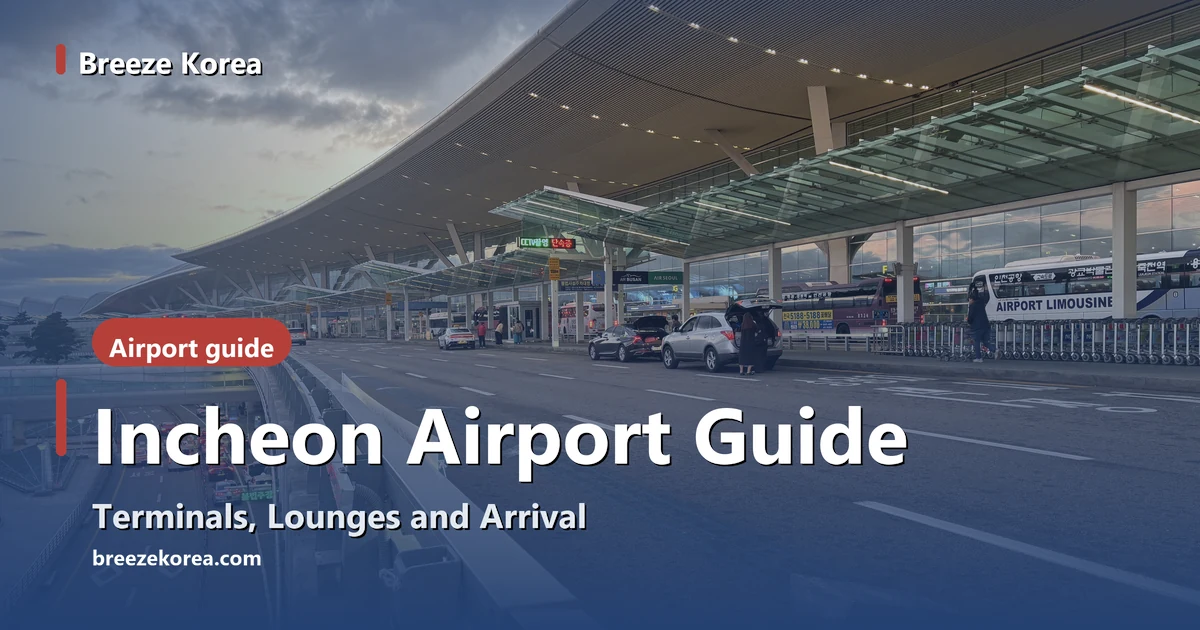
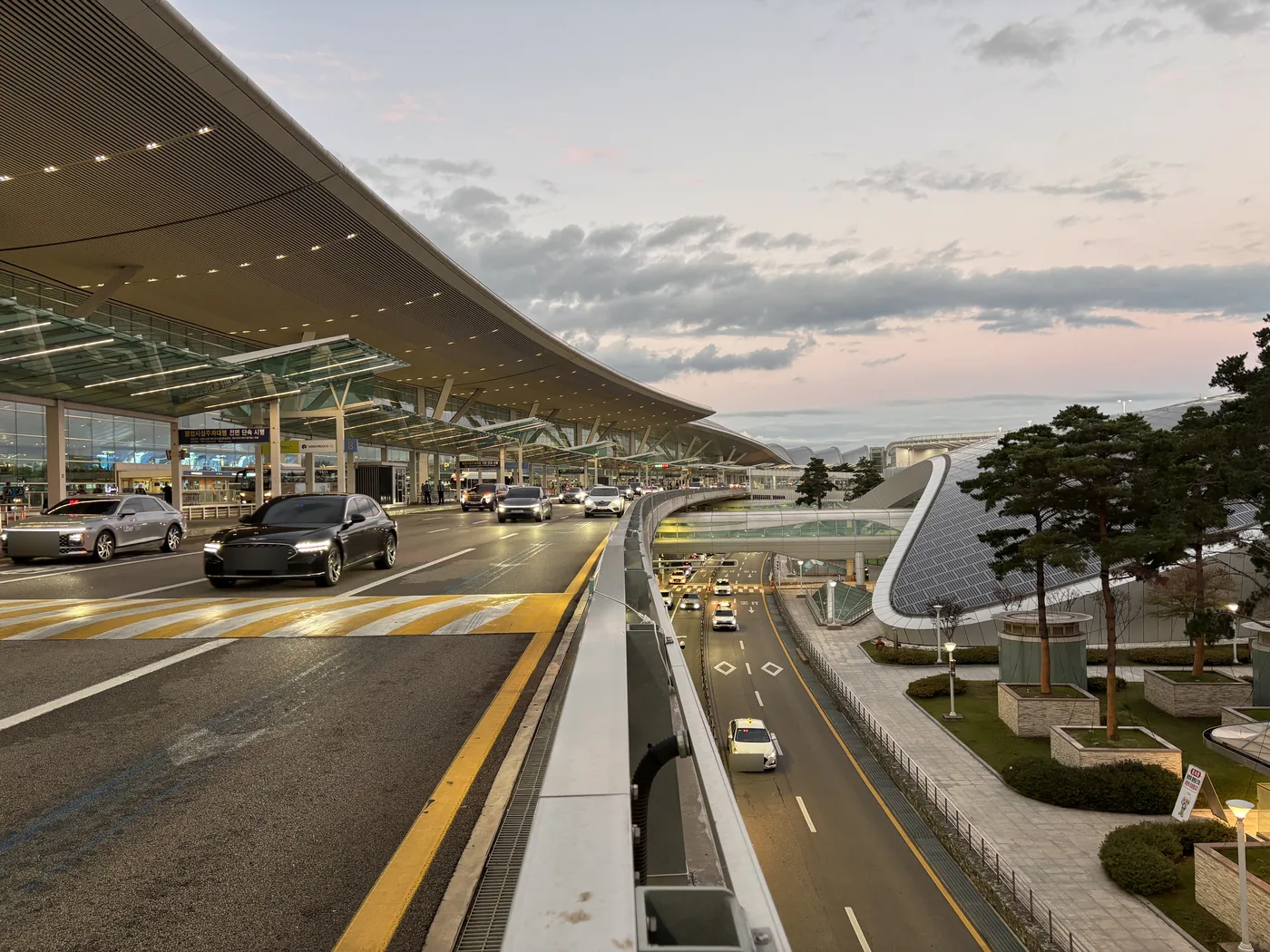
Incheon International Airport has two passenger terminals, Terminal 1Map (T1) and Terminal 2Map (T2), plus a third building called the Concourse. The Concourse is used by some T1 flights and is linked to T1 by an underground shuttle train. In both terminals the departures floor is 3F, and the check-in rows are lettered A to N. T2 skips the letter I.
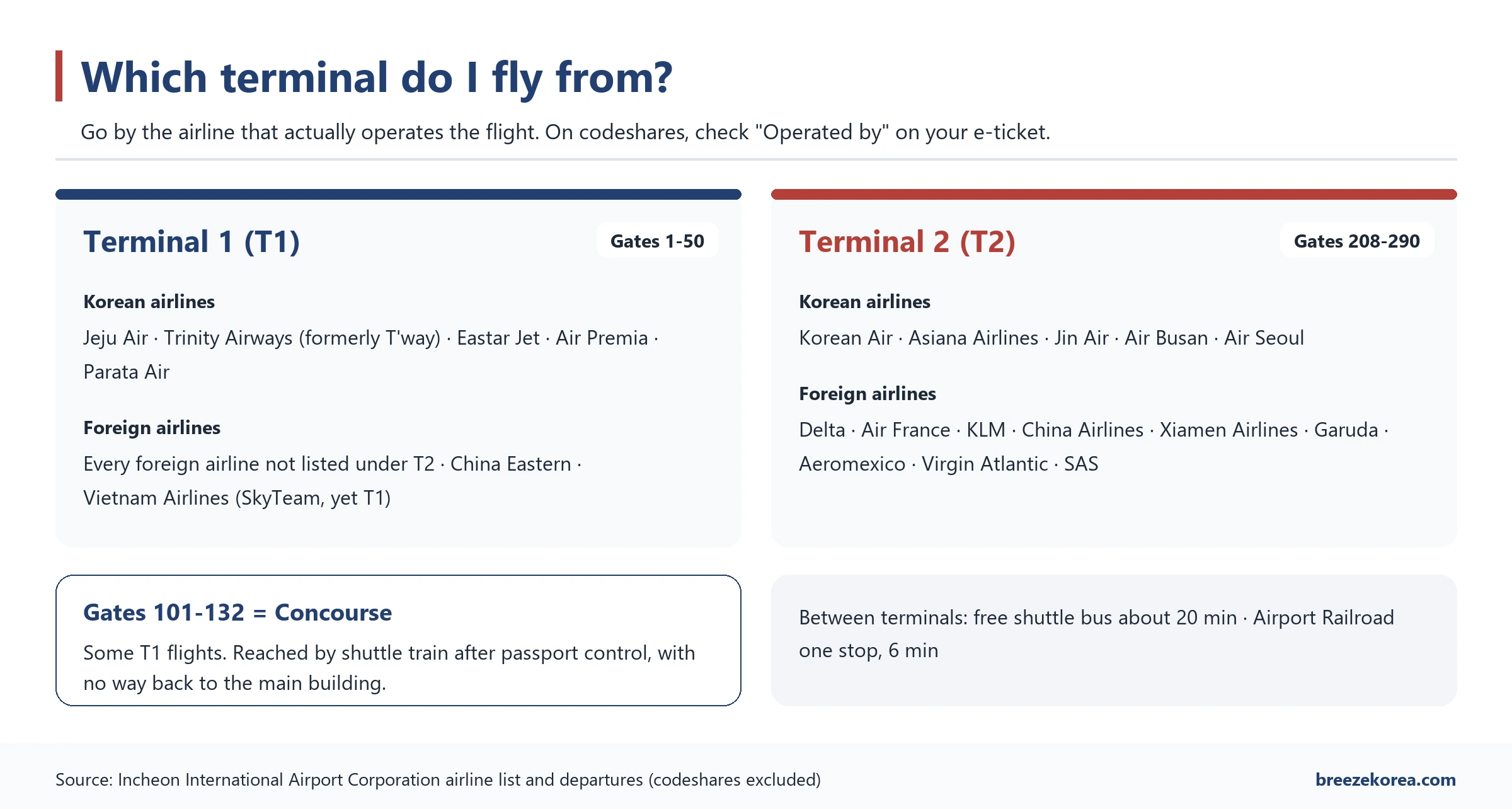
The terminals stand about 20 minutes apart by road, according to Incheon International Airport Corporation, the airport operator. Gate numbers follow the buildings: gates 1 to 50 are in T1, gates 101 to 132 are in the Concourse and gates 208 to 290 are in T2.
Which airlines use Terminal 1 and Terminal 2
T2 is used by Korean Air, Asiana Airlines, Jin Air, Air Busan and Air Seoul, and by Delta, Air France, KLM, China Airlines, Xiamen Airlines, Garuda Indonesia, Aeromexico, Virgin Atlantic and Scandinavian Airlines (SAS). Every other airline flies from T1. That includes the Korean low-cost airlines Jeju Air, Trinity Airways (formerly T’way Air), Eastar Jet, Air Premia and Parata Air, and foreign airlines such as United, American Airlines, Air Canada, Singapore Airlines, Cathay Pacific, Qatar Airways, Emirates, Lufthansa, Turkish Airlines, VietJet, Scoot and Jetstar. The airport operator keeps the full list on its airlines page.
Older blog posts and forum answers often put Asiana in T1. That information is out of date. Asiana checks in at the east end of T2, in rows G to J, and Korean Air at the west end, in rows A to D.
Airline alliances are a poor guide to the terminal. China Eastern and Vietnam Airlines are SkyTeam members like Korean Air, yet both fly from T1, while SAS flies from T2. Japan Airlines and ANA do not fly their own planes from Incheon. Their flight numbers are codeshares on other airlines, including Korean Air and Asiana in T2 and Peach and Ethiopian Airlines in T1, so check the operating airline on your e-ticket.
For any codeshare, the airport operator advises checking the terminal on your e-ticket, because the terminal you use can differ from the airline that sold the ticket. Find the “Operated by” line and go to that airline’s terminal.
Check-in rows by airline
The rows below are the ones in use for the main airlines. Foreign airlines in T1 shift between rows from day to day, so treat their letters as approximate and check the screens above the counters. The airport operator also lists rows on its check-in counter page.
| Terminal 2 airline | Row | Terminal 1 airline | Row |
|---|---|---|---|
| Korean Air | A to D (A first class and Prestige, B ticketing, B and C economy, web check-in and kiosks, D Morning Calm members) | Trinity Airways | A to B |
| Asiana Airlines | G to J | Parata Air | B |
| Air Seoul, Air Busan, Jin Air | E to F (Air Seoul at the front of E, then Air Busan, then Jin Air) | Air Premia | C |
| Delta, SAS, Virgin Atlantic, China Airlines | K | Eastar Jet | F to G |
| Air France, KLM | L to M | Jeju Air | L |
| Garuda Indonesia | M | ||
| Xiamen Airlines, Aeromexico | N |
Approximate rows for other T1 airlines: Vietnam Airlines and Turkish Airlines at D, China Southern and VietJet at E, Singapore Airlines at F, China Eastern and Emirates at H, Cathay Pacific and Lufthansa at J, United and Qatar Airways at K, and Thai Airways at M.
The Concourse and gates 101 to 132
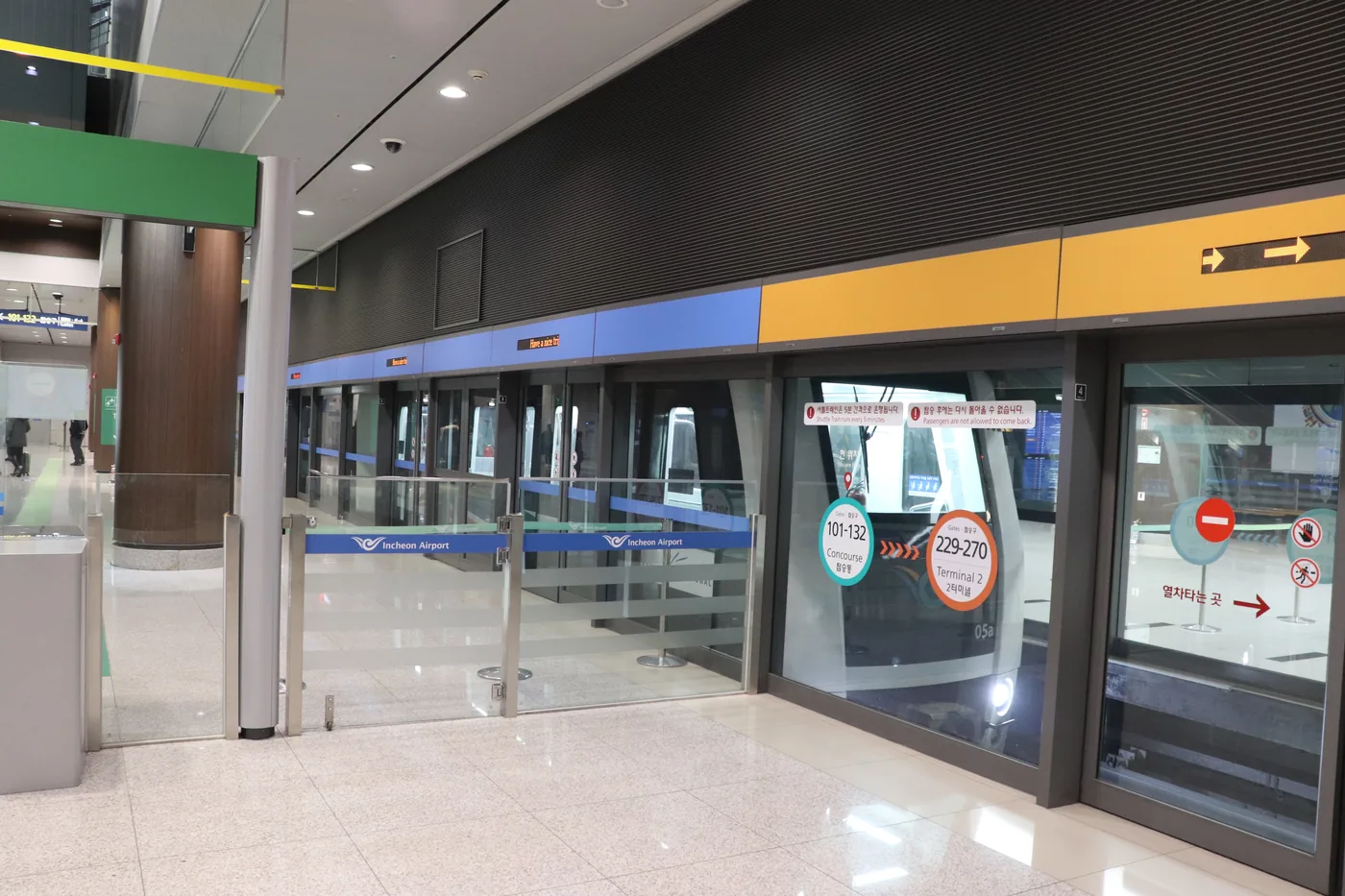
Only T1 airlines use the Concourse. You check in, go through security and clear passport control in the T1 main building, then ride the underground shuttle train. Trains come about every 5 minutes, and once you board one you cannot go back to the main building.
The Concourse is assigned flight by flight, so the same airline can use both buildings. Jeju Air, Trinity Airways and Eastar Jet split their flights roughly evenly between the main building and the Concourse. China Southern, China Eastern, Vietnam Airlines, VietJet, Peach, HK Express and Cebu Pacific board in the Concourse nearly every time. Korean Air, Asiana and the other T2 airlines never use it.
If your boarding pass shows a gate from 101 to 132, allow extra time for the train after passport control, and buy anything you want from the main building’s duty free shops before you get on the train. Gates can change on the day, so keep an eye on the departure screens. The Concourse has its own shops, restaurants, lounge and duty free pickup desk, covered in the sections below.
If you go to the wrong terminal
Free shuttle buses and the AREX airport railway link the two terminals. A departing passenger who has already cleared passport control cannot cross to the other terminal, so check the terminal before you go through.
| Option | Where to board | Service | Ride time | Fare |
|---|---|---|---|---|
| Free shuttle bus, T1 to T2 | T1 3F, in front of door 8 | 05:08 to 23:58, every 10 to 20 minutes | About 17 minutes | Free |
| Free shuttle bus, T2 to T1 | T2 3F, in front of door 7 | 04:48 to 23:48, every 7 to 20 minutes | About 20 minutes | Free |
| AREX all-stop train | Incheon Airport Terminal 1 Station and Terminal 2 Station, one stop apart | Train timetable | 6 minutes | ₩1,200 with a transport card |
Counting the wait, allow around half an hour for the bus. For the train, allow around 20 minutes including the walk to and from the platforms.
2. How early to arrive, and leaving before 6 am
Incheon International Airport Corporation says that arriving 3 hours before departure is enough, even in peak season, and it asks passengers not to come much earlier because early arrivals add to the crowds. Airline check-in deadlines are later. The official figures are collected below.
| Source | What it says |
|---|---|
| Airport operator, peak season advice | Arriving 3 hours before departure is enough |
| Airport operator FAQ | Check-in usually opens 3 hours to 2 hours 30 minutes before departure |
| Asiana Airlines | Arrive at least 2 hours before departure. International check-in at Incheon closes 50 minutes before departure (check the current deadline on Asiana’s site) |
| Korean Air | International check-in closes 1 hour before departure |
| Self check-in kiosks and self bag drop | Available until 1 hour before departure |
| Boarding gate (airport operator) | Boarding usually starts 30 minutes before departure and closes 10 minutes before. There are no individual calls for missing passengers |
| Waiting time at departure entrances, T1 only (airport operator) | On the busiest days, the average wait between 6 am and 10 am was a few minutes and the longest a little over 20 minutes. No T2 figures are published, and the operator does not say where the wait was measured from |
There is no official source for the “4 hours early” advice that circulates online. Some travellers do write that 3 hours felt tight on busy mornings and in peak season.
When the airport is busiest
Departures crowd together from 7 am to 10 am, and the airport operator’s forecasts show 8 am to 9 am as the heaviest hour. Korean residents leave in the largest numbers over the Lunar New Year (Seollal) and Chuseok holidays, and summer brings many foreign visitors.
Departure entrance hours
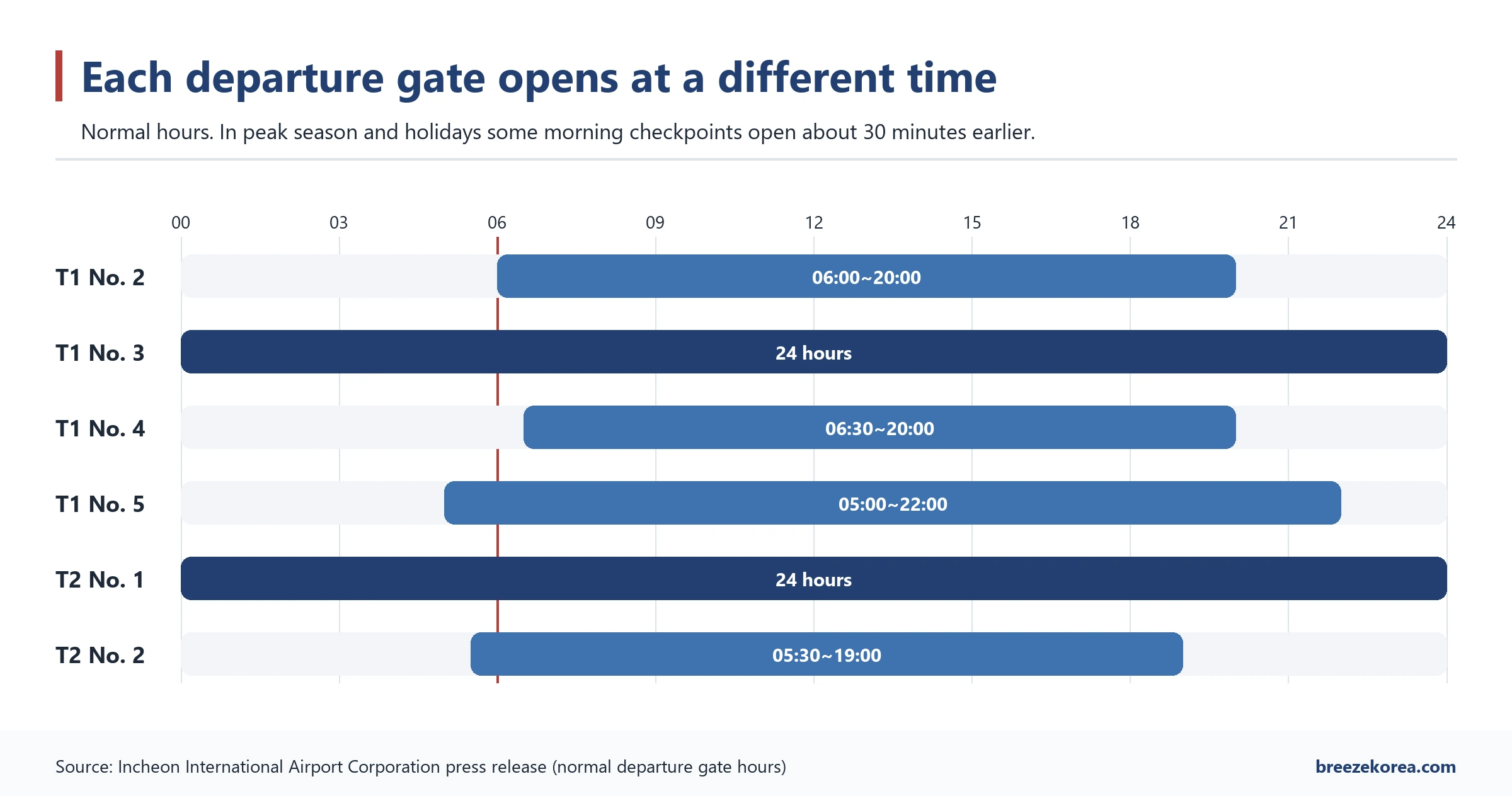
Each departure entrance on 3F, where you go into security, keeps its own hours. Only one entrance in each terminal stays open all night.
| Terminal | Departure entrance | Normal hours |
|---|---|---|
| T1 | Gate 2 | 06:00 to 20:00 |
| T1 | Gate 3 | 24 hours |
| T1 | Gate 4 | 06:30 to 20:00 |
| T1 | Gate 5 | 05:00 to 22:00 |
| T2 | Gate 1 (1A to 1D) | 24 hours |
| T2 | Gate 2 (2A to 2D) | 05:30 to 19:00 |
In peak seasons and over the big holidays, the morning entrances sometimes open about 30 minutes early, together with passport control. The airport announces the times when it does this.
Leaving before 6 am
Before 6 am, use gate 3 (24 hours) or gate 5 (from 05:00) in T1, and gate 1 (24 hours) or gate 2 (from 05:30) in T2. If the entrance nearest your check-in row is closed or crowded, the airport operator says you can use another nearby entrance.
Korean Air’s check-in counters open at 05:30 and Asiana’s at 05:00. Foreign airlines usually open their counters 2 to 3 hours before departure, and self bag drop machines open earlier than the staffed desks (see the check-in section). Opening times for the staffed counters of Korean low-cost airlines are not published, so check your airline’s app or booking confirmation.
Check the crowds before you leave. The airport operator publishes an airport congestion forecast every day at 17:00, covering departures up to two days ahead, by terminal, by departure entrance and by hour, coloured blue, yellow, orange or red. On the day, the real-time departure wait page gives the wait in minutes for the east and west side of each entrance. Inside T1, screens above the departure entrances show the expected time from the entrance through security and passport control, and the screens above the check-in rows show it for each entrance. The Incheon Airport+ app and Korean portals such as Naver show the same estimates.
3. Night flights and what stays open 24 hours
Incheon has no night-time limit on flights. Airport operations, immigration, customs and air traffic control all run 24 hours, as set out in the airport’s entry in the Korean Aeronautical Information Publication. Gimpo, Seoul’s other airport, and Gimhae in Busan both close to take-offs and landings from 11 pm to 6 am, as our Gimpo Airport guide and Gimhae Airport guide explain.
Flights between midnight and 5 am
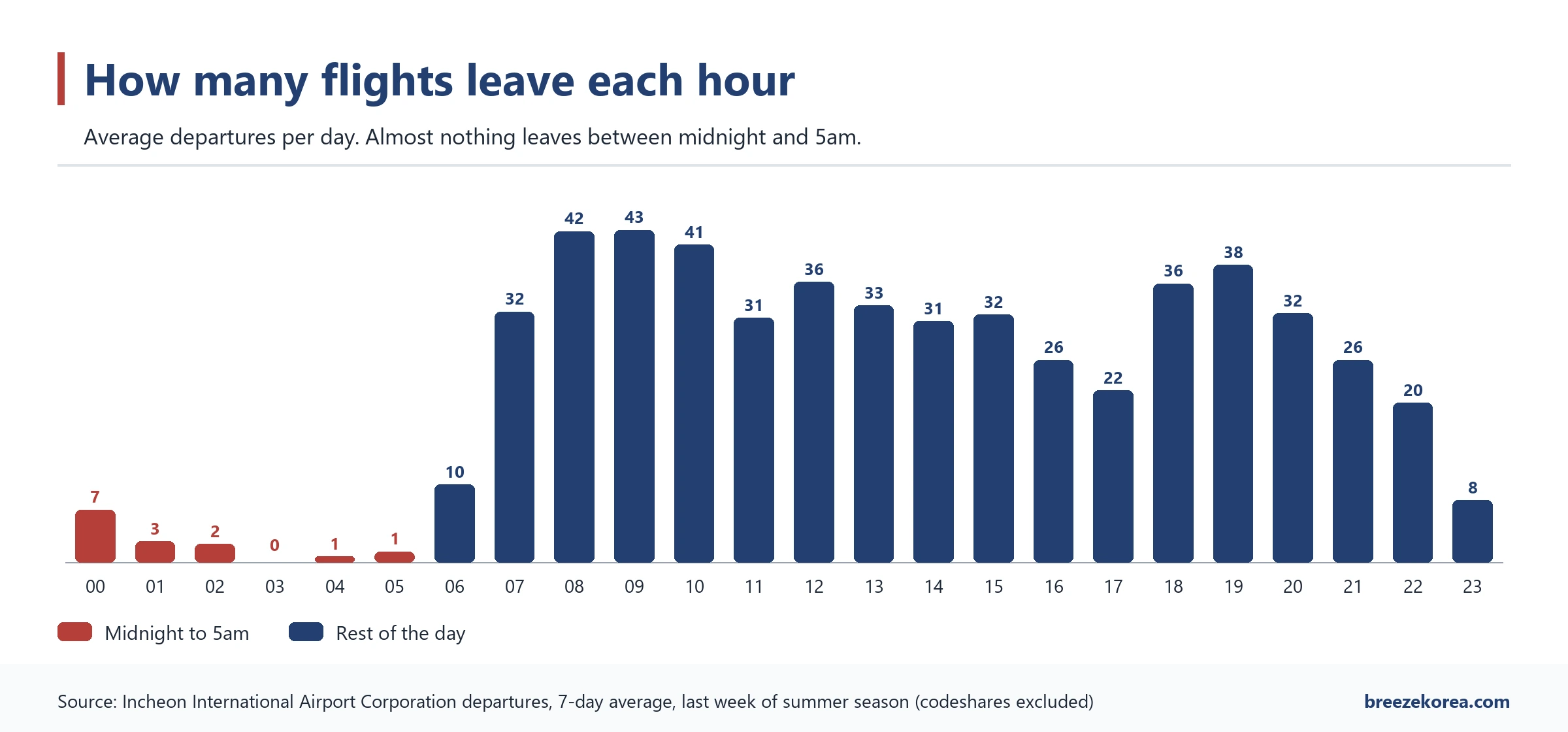
Few flights leave between midnight and 5 am, and the 3 am hour is almost empty. The ones that do leave include late-night flights to Phu Quoc, Ho Chi Minh City, Hanoi and Da Nang in Vietnam, flights to Kuala Lumpur, early flights to Hong Kong, Taipei and Manila, long-haul flights connecting through Doha, Abu Dhabi and Addis Ababa, and flights to Ulaanbaatar. Flights to the Americas and Europe do not leave in those hours.
Over the rest of the day, departures peak from 7 am to 10 am with flights to Japan, China, Europe and the eastern side of the Americas. Afternoons are calmer. Flights to Southeast Asia bunch together from 6 pm to 8 pm, and departures fall away quickly after 11 pm. Times move with each season’s schedule, so go by the time on your own booking.
When a late-evening flight is delayed past midnight, the departure boards show it with a Y added to the end of the flight number. If you cannot find your flight on the board after midnight, look for the number with a Y.
What stays open overnight
If your night flight boards in the ConcourseMap, the shuttle train to it runs through the night as well. The table lists the main places that stay open overnight. Each one is covered in more detail further down.
| What | Where | Night hours |
|---|---|---|
| Departure entrances | T1 gate 3 and T2 gate 1 | 24 hours |
| Restaurants and convenience stores | Several in each terminal, after security | 24 hours |
| Free nap zones | After passport control in both terminals | 24 hours |
| Spa at Home sauna | B1 of T1 and T2, before security | 24 hours |
| Darakhyu capsule hotel | Transportation Centres of T1 and T2, before security | Overnight stays |
| Currency exchange and ATMs | Both terminals | Some open 24 hours |
| Duty free pickup desks | After passport control | 24 hours |
| Long-term car park shuttle, T2 | T2 to the long-term car park | 24 hours, every 30 to 60 minutes at night |
| Long-term car park shuttle, T1 | T1 to the long-term car park | 04:30 to 24:00 |
| Reserved car park P5 shuttle, T1 | T1 to P5 | No service from midnight to 5 am; the walk takes about 30 minutes |
Trains and buses into Seoul stop for part of the night. Last and first services are listed in our guide to getting from Incheon Airport to Seoul.
4. Parking for drop-offs, pick-ups and rental cars
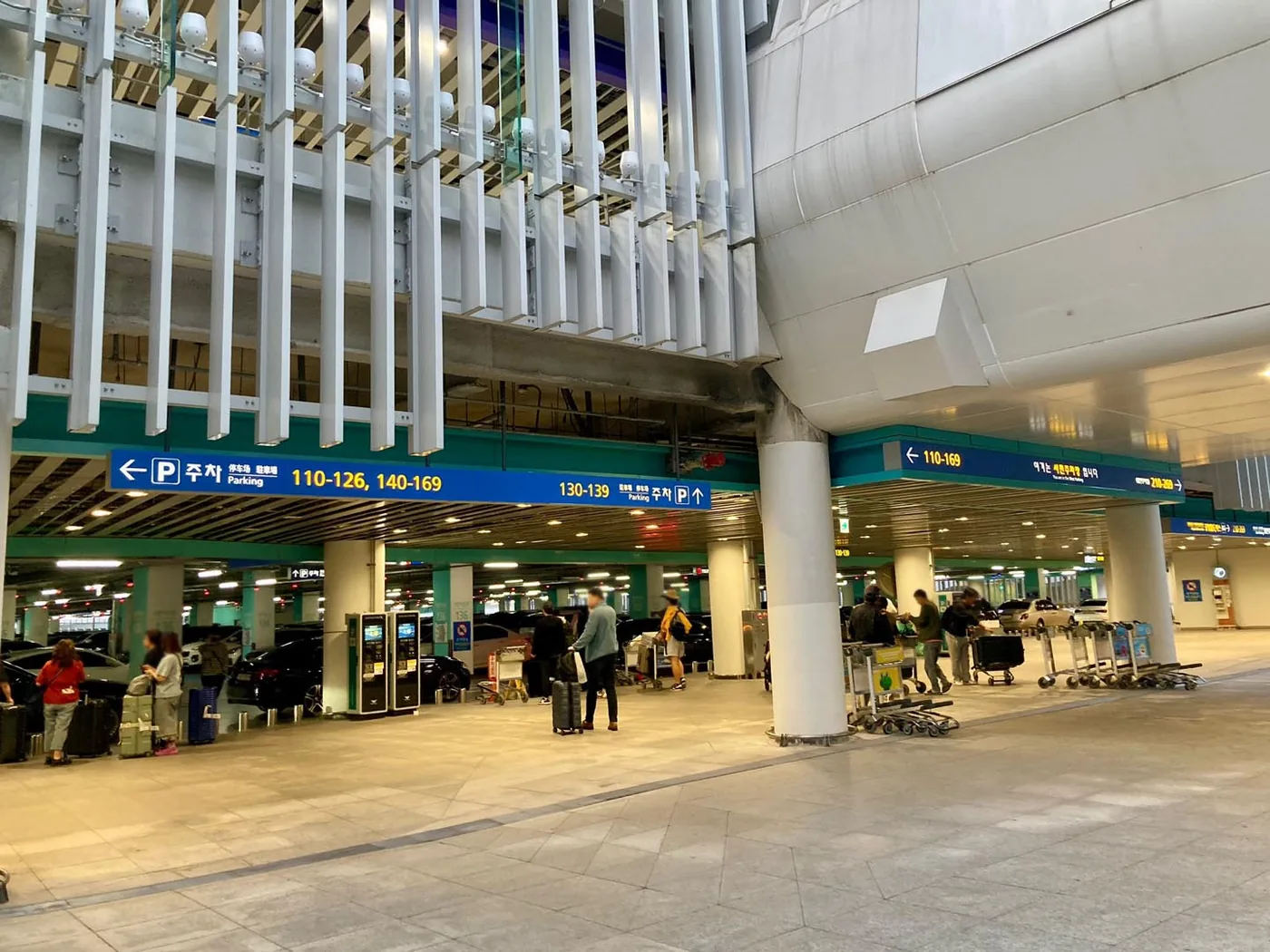
Most overseas visitors only meet Incheon’s car parks when friends or family drop them off or pick them up, or when they return a rental car. Park at the terminal your airline uses. Each terminal has a short-term car park next to the building, a long-term car park reached by free shuttle bus, and a reserved car park that only takes cars booked in advance. For a stay of a day or more, the airport operator recommends the Terminal 1 long-term car parkMap or the Terminal 2 long-term car parkMap.
Car parks and daily maximum rates
| Car park | Where | To the terminal | Maximum per day (small car) |
|---|---|---|---|
| Short-term | T1: indoors by the Transportation Centre, cars only, height limit 2.1 m. T2: parking building joined to the terminal | On foot | ₩24,000 |
| Long-term | T1: P1 to P4 and two parking towers. T2: zones A to E and two parking towers | Free shuttle bus | ₩9,000 |
| Reserved | T1: P5, outdoors opposite the Grand Hyatt. T2: a separate outdoor area | Free shuttle bus | ₩9,000, booking required |
The first 10 minutes are free in every car park, which covers a quick drop-off. After that, short-term parking costs ₩1,200 for the first 30 minutes and ₩600 for every 15 minutes after, and long-term parking costs ₩1,000 an hour. A day means 24 hours from the time the car goes in. There is no weekend or peak-season surcharge. Full rates are on the airport’s English parking fee page.
Paying when you leave
The airport operator’s parking fee page states that credit cards from overseas card companies cannot be used to pay. In a rental car or a friend’s car, have a Korean card or cash ready, as the staffed exit booths take cash. The pay machines inside take cards and transport cards, and the reserved car parks and T1’s P3 and P4 take cards only.
Hi-pass, Korea’s electronic toll card, cannot pay a parking bill of ₩50,000 or more. A stay of more than five days in long-term parking passes that amount, so the Hi-pass lane at the exit will not let it out.
Rental cars and valet offers
Return a rental car to the place the rental company gives in its instructions. People who approach drivers in front of the terminal offering to park the car are not part of any airport service. The airport operator says it takes no responsibility for loss or damage when a car is handed to them and parked outside the airport. The official valet service has to be booked in advance and is never arranged at the kerb.
5. Check-in, kiosks and self bag drop
The airport operator’s departure guide sets out the order below. You do not fill in a departure card when leaving Korea.
- Arrive at the terminal. Departures are on 3F in both terminals.
- Check in and drop your bags at the airline counter, a kiosk or a self bag drop machine.
- Declare what needs declaring, such as customs declarations, tax refund checks or cultural items you are taking out of Korea.
- Finish your errands on this side, such as changing money, taking out cash, mobile roaming and travel insurance.
- Go through security at a departure entrance.
- Clear passport control. After this point you cannot return to the public part of the terminal.
- Walk to your gate. For gates 101 to 132, take the shuttle train.
- Board the plane.
Online check-in and self check-in kiosks
Web and mobile check-in depend on the airline, and some airlines do not offer them. Passengers travelling with an infant under 2 and children flying alone cannot use web check-in, according to the airport operator.
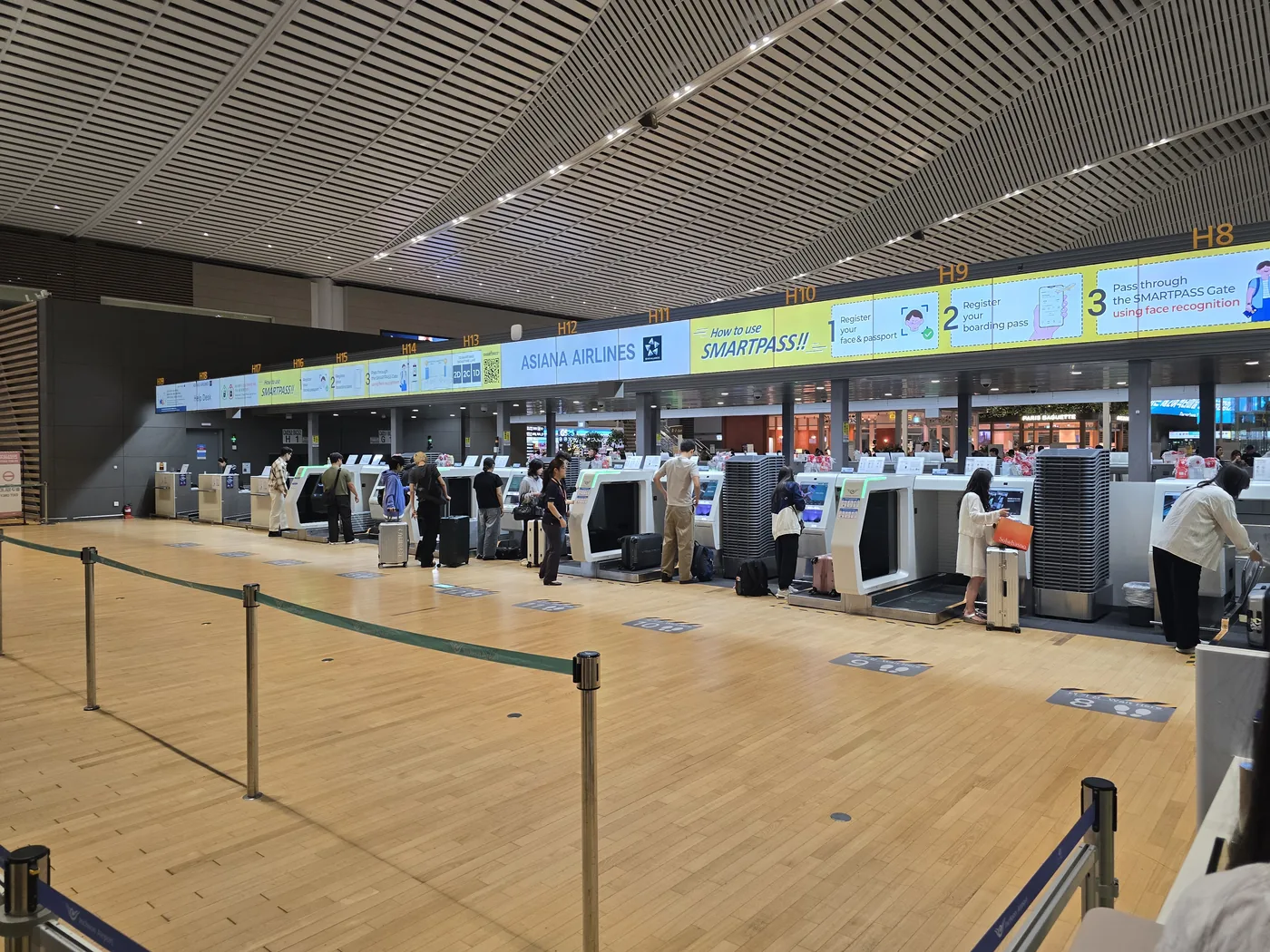
Self check-in kiosks run 24 hours and take passengers until 1 hour before departure. They generally turn away passengers flying to a country that needs a visa, codeshare passengers and passengers with infants, though each airline sets its own limits. The airlines on the kiosks are listed on the airport’s self check-in and bag drop page.
| Terminal | Airlines on the self check-in kiosks |
|---|---|
| T1 | Cathay Pacific, Turkish Airlines, Jeju Air, Trinity Airways, Eastar Jet, Air Premia, United, Singapore Airlines, Vietnam Airlines, American Airlines, Parata Air, Air Canada |
| T2 | Korean Air, Asiana Airlines, Jin Air, Air Seoul, Air Busan, Air France, KLM, Delta, China Airlines, Aeromexico, SAS |
Self bag drop machines
A self bag drop machine only takes bags, so you need a boarding pass first, from web or mobile check-in or a kiosk. Most machines close for a flight 1 hour before departure, and the KLM machines 1 hour 30 minutes before.
| Terminal | Airline | Row | Hours |
|---|---|---|---|
| T1 | Jeju Air | L | 04:00 to 21:30 |
| T1 | Eastar Jet | G | 04:30 to 19:00 |
| T1 | Trinity Airways | C | 05:00 to 20:00 |
| T1 | Air Premia | C | From 3 hours 30 minutes before departure |
| T1 | Singapore Airlines | G | From 4 hours before departure |
| T2 | Korean Air | B | 05:00 until 1 hour before the last flight |
| T2 | Asiana Airlines | G and H | 04:40 to 19:30 |
| T2 | Jin Air | F | 05:00 to 20:00 |
| T2 | Air Seoul | F | 04:30 to 12:30 |
| T2 | Air France, KLM | L | From 3 hours before departure (KLM until 1 hour 30 minutes before) |
The bag has to be your own and no longer than 90 cm, and you put bags in one at a time, lying flat. The machines cannot take bags for passengers with infants, connecting flights, overweight bags, special items such as golf bags and strollers, or passengers needing wheelchairs, travelling with pets or travelling as unaccompanied children. Each airline sets the exact list.
Korean Air sends some connections to row C, namely onward flights to Haneda, Taipei, Budapest or Fukuoka only, which its machines cannot tag, and members claiming extra elite baggage allowance. Jeju Air, Trinity Airways, Jin Air and Air Seoul also run bag drop machines that recognise the faces of SmartPass users.
A question that comes up often is whether the free limit is 23 kg or 25 kg. The airport does not set it. Your airline and fare decide the weight and number of free bags, so check the baggage line on your booking.
After you drop your bags
In T1, the airport operator asks you to stay near the counter for about 5 minutes while your checked bag is X-rayed, and to go through to departures once nothing has come up. In T2, if a checked bag needs opening, you are directed to the bag inspection area inside the departure area.
Oversized bags, meaning 50 kg or more, or 45 × 90 × 70 cm or larger, go a different way. You pay at the airline counter, make a customs declaration, then hand the bag in at the oversized baggage counter on 3F.
For cabin bags, the airport operator gives the usual economy limit as 55 × 40 × 20 cm (115 cm in total) and 10 to 12 kg. Each airline sets its own figures.
6. SmartPass, automated gates and priority lanes
Departing passengers at Incheon can use the SmartPass face recognition lanes, the Ministry of Justice’s automated passport gates and the priority lanes beside each departure entrance.
Incheon Airport SmartPass
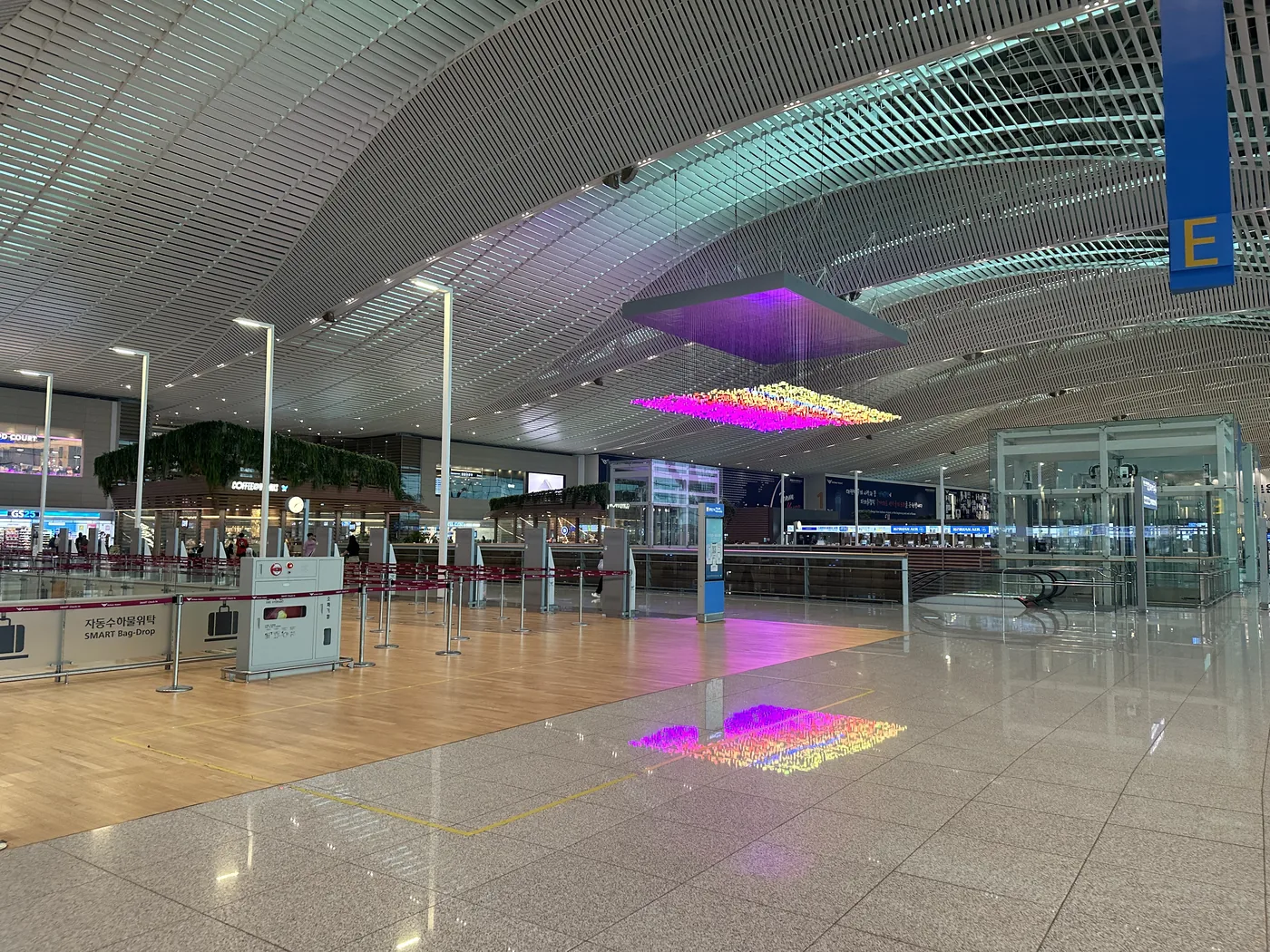
SmartPass links your passport, your face and your boarding pass, so you can go through the departure entrance and, on some airlines, the boarding gate by face. You register in the Incheon Airport SmartPass app by scanning your passport, taking a face photo and adding your boarding pass. Once registered, you can use the dedicated SmartPass entrances whatever airline you fly. Details are on the airport’s SmartPass page.
| Item | Detail |
|---|---|
| Age | 7 and over. Under 14 needs a parent or guardian’s consent |
| Face registration | Valid for 5 years. Register again when you get a new passport |
| Boarding pass | Added for each trip. It is added automatically when you check in with Korean Air, Asiana Airlines, Jeju Air, Trinity Airways, Air Premia, Eastar Jet, Air Busan or Jin Air |
| Dedicated entrances | T1: departure gates 2 and 5 on 3F. T2: 1D, 2C and 2D on 3F. Passengers who have not registered cannot use them |
| Boarding gates | Face readers at gates in both terminals, used as each airline decides. T1: Jeju Air, Air Premia, Eastar Jet, Trinity Airways, Cathay Pacific, EVA Air. T2: Korean Air, Asiana Airlines, Jin Air, Air Seoul, Air Busan |
SmartPass is separate from passport control, which still comes after security. Keep your passport and boarding pass on you, out of your checked bag.
Before 6 am, T1’s gate 2 is still shut, so gate 5 (from 05:00) is the only SmartPass entrance in T1. In T2, lane 1D sits inside gate 1, which is open 24 hours, and lanes 2C and 2D open with gate 2 at 05:30. Some travellers write that they found the dedicated lanes closed very early in the morning.
Automated passport gates when you leave
Short-stay foreign visitors aged 17 and over can use the automated departure gates without registering in advance, according to the airport’s automated immigration page. At the gate, follow the green arrow, put your passport photo page on the reader, step in when the door opens, place your finger on the scanner and look into the camera in front of you.
Foreign residents of Korea aged 17 and over who hold a residence card can also use the gates without registering. Children aged 7 to 13 must register first with a parent, at the centre on 3F of T1 (opposite row H, near departure gate 4) or at the Government Complex on 2F of T2, open 07:00 to 18:00 every day. Departing passengers can also register in the passport control area.
Priority lanes
Priority lanes sit beside the regular departure entrances: next to gates 2, 3, 4 and 5 in T1, and at 1D and 2A in T2. They keep the same hours as the entrance they belong to. The priority lane page lists who qualifies.
| Who | What to show |
|---|---|
| Aged 70 and over | Passport |
| Children under 7 | Passport |
| People with walking disabilities | Disability card |
| Pregnant women | Maternity record book |
| Passengers the airline is assisting, such as wheelchair users | Airline staff go with you |
| Holders of the Ministry of Justice priority card | The card |
| Families with three or more children, all under 19, with at least one parent and one child flying | Passports and a Korean family relationship certificate or resident registration copy issued within the last 3 months |
Older travellers, young children and large families show their passports and documents at the priority entrance and go straight in. Passengers with disabilities and pregnant women show their documents to the airline at check-in, receive a priority sticker and show it at the lane. Up to three companions can go through with the person who qualifies.
Travelling with a parent over 70 or a child under 7? The whole party, up to three companions, can use the priority lane together. Keep passports in hand as you walk up to the side door, and on a busy morning head there instead of joining the main queue.
7. City airport terminals and Easy Drop bag service
At Seoul Station City Airport TerminalMap and Gwangmyeong Station City Airport TerminalMap you can check in for an Incheon flight before you reach the airport. The terminal at Samseong (COEX) does not handle check-in and serves only as a stop for airport buses and the Easy Drop bag service. Details are on the airport’s city airport terminal page.
| Item | Seoul Station | Gwangmyeong Station | Samseong (COEX) |
|---|---|---|---|
| Services | Check-in, bag drop and passport control | Check-in and bag drop; passport control at Incheon | No check-in. Airport bus and Easy Drop stop only |
| Hours | Check-in 05:20 to 19:00, passport control 05:30 to 19:00 | 06:30 to 17:00 | |
| Deadline | 3 hours before departure for T1 flights, 3 hours 20 minutes for T2 flights | Same as Seoul Station | |
| Who can use it | AREX Express train passengers only, flying from Incheon the same day | Anyone flying from Incheon | |
| Airlines | Korean Air, Asiana Airlines, Jin Air, Trinity Airways, Jeju Air, Eastar Jet, Air Seoul, Air Busan (subject to airline policy) | Korean Air, Asiana Airlines, Jin Air, Trinity Airways, Jeju Air, Eastar Jet | |
| On to the airport | AREX Express train | Airport limousine bus from Gwangmyeong KTX station |
Seoul Station City Airport Terminal
Seoul Station check-in is only for passengers riding the AREX Express to the airport. Once you have checked in and cleared passport control there, you use a dedicated departure passage on 3F at Incheon, skipping the regular departure queue. The check-in hall gives out numbered queue tickets and has scales for weighing bags.
Keep any goods you plan to claim a tax refund on in your hand luggage. Bags checked at Seoul Station go straight to the plane, and customs at the airport may need to see those goods.
Gwangmyeong Station City Airport Terminal
Gwangmyeong is on the KTX high-speed line south of Seoul, and its check-in desks are open to anyone flying from Incheon, whatever way they continue to the airport. Passport control still happens at Incheon. From the station, an airport limousine bus runs to the terminals.
Easy Drop: hand in bags away from the airport
Easy Drop is a paid service run by the airport operator. You check in your bags at a pick-up point in the city or on Yeongjong Island, and at the airport you skip the check-in counter. Conditions are on the Easy Drop page.
| Item | Detail |
|---|---|
| Pick-up points | Myeongdong; Hongdae (1F of Holiday Inn Express Seoul Hongdae); Samseong Station City Airport Terminal, 2F; Inspire Resort and Paradise City on Yeongjong Island |
| Price | ₩35,000 per bag |
| Airlines | Korean Air, Asiana Airlines, Jeju Air, Trinity Airways, Jin Air, Cathay Pacific, Eastar Jet. Korean Air and Asiana passengers must check in online first. Flights to the United States, including Guam and Saipan, are excluded |
| Closed | All pick-up points close on Wednesdays and public holidays |
| Deadline | Differs by pick-up point. At the Seoul points, bags leave by van at set times, so some afternoon flights cannot be accepted. Check the times for your point on the Easy Drop page |
With heavy bags and an early flight, the other choice is a car from your hotel to the departures floor, which also works before the first trains of the day.
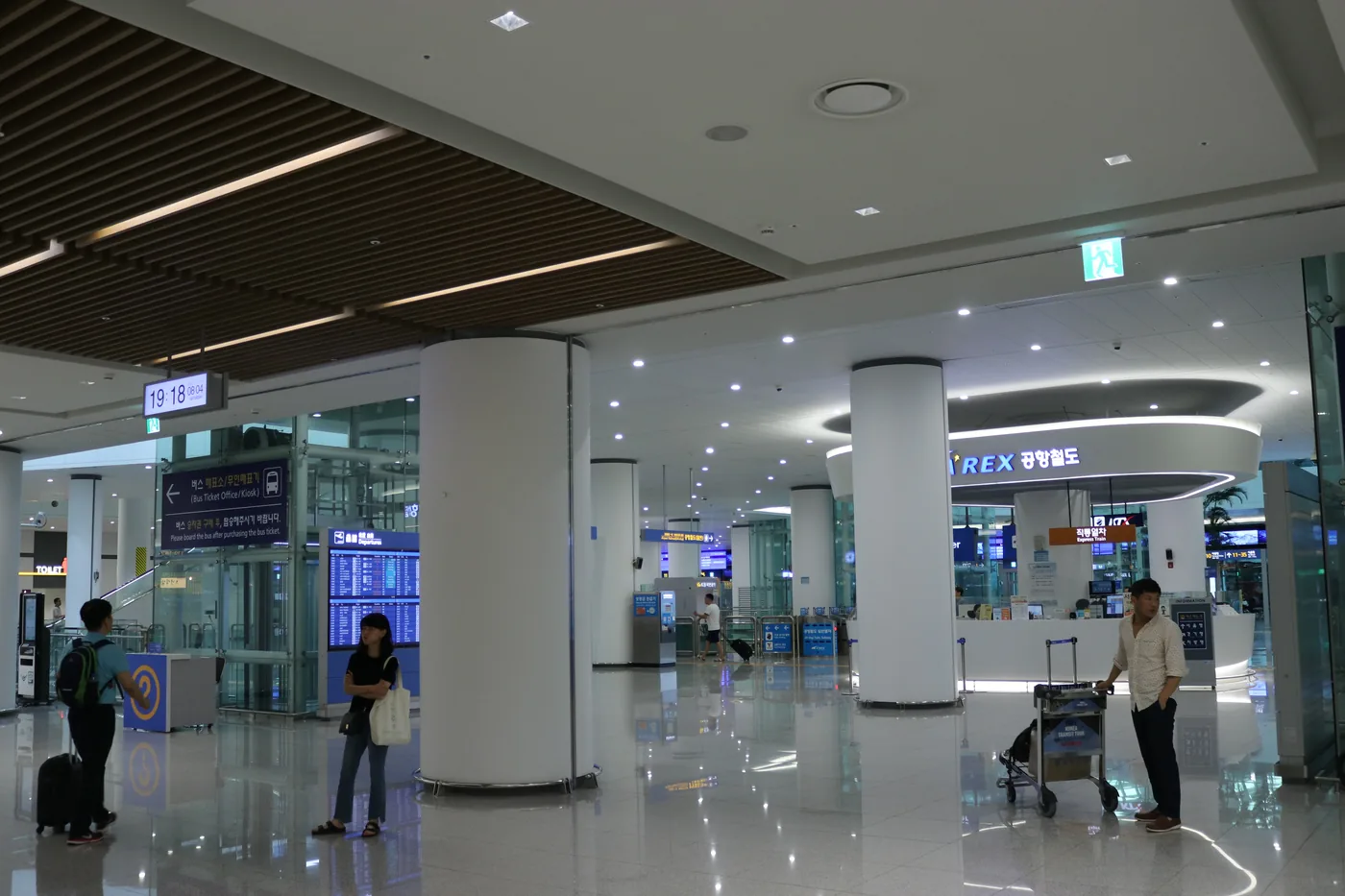
8. Security rules for power banks, liquids and lighters
Security screening at Incheon follows Korea’s rules for international flights. The rules on power banks, liquids and lighters are set out below, and the airport keeps the full list on its restricted items page.
Power banks
| Item | Rule |
|---|---|
| Checked bags | Not allowed. Carry power banks with you |
| Size and number | Up to 160 Wh, two per person. Those over 100 Wh and up to 160 Wh need airline approval |
| Short circuits | Tape over the terminals or put each one in its own plastic bag |
| On board | No charging, no using and no storing in the overhead locker. Keep them near you |
| At the security belt | Take them out of your bag and put them in a tray |
| Over 160 Wh | Not allowed on the plane |
Go by the Wh figure printed on the power bank. The airport’s power bank notice sets its limits in watt-hours. Read the Wh number on the casing and do not try to work it out from other units. For the flight home, the country you leave from and your airline may have stricter rules, and Hong Kong, Singapore and Japan have been reported as stricter, so check your airline’s advice.
E-cigarettes go in the cabin only and are not allowed in checked bags.
Liquids: the 100 ml rule still applies
On international flights each container in your cabin bag can hold up to 100 ml, and all containers must fit in one clear, resealable 1-litre bag, about 20.5 × 20.5 cm. The limit is the size of the container, whatever is left inside it. Liquid foods such as gochujang and kimchi count as liquids. Checked bags have no volume limit for liquids.
All departure entrances at Incheon use scanners that let laptops and tablets stay in your bag. The 100 ml rule is unchanged, though. Claims online that “CT scanners mean liquids are fine” come from other airports and do not apply at Incheon.
If you have no clear bag, the airport operator suggests the convenience stores and bookshop on 3F. Exceptions are baby milk and baby food for the journey and prescribed liquid medicine for use on the flight. Liquids bought in duty free go in a sealed security bag (STEB), which must stay closed until you board your final flight. Airports where you change planes can apply their own rules.
| Item | Rule |
|---|---|
| Alcohol under 24% | Cabin (within the 100 ml rule) or checked bags |
| Alcohol from 24% to 70% | Checked bags up to 5 litres per person. In the cabin only within the 100 ml rule, or duty free alcohol in a sealed bag (STEB) |
| Alcohol over 70% | Not allowed |
| Non-flammable sprays in checked bags | Up to 500 ml each, 2 kg (2 litres) in total |
Lighters, sharp items and extra checks
You can carry one lighter per person on your body. The one-lighter limit comes from the airport operator. The bans on lighters in checked bags and on torch (turbo) lighters come from press reports, so check with your airline as well. Lighters are reported to be the item travellers most often have to throw away at security.
Scissors with blades up to 6 cm, and wrenches or spanners up to 10 cm in total length, can go in the cabin. Other tools cannot, and knives cannot be carried in the cabin.
The airport operator lists extra checks for shoes with heels of 3.5 cm or more, liquids over 100 ml, and thick outer layers and what is in your pockets. Put jackets, phones and keys in the tray. Pregnant women can ask to be screened in a separate area, and pregnant women and young children do not go through the body scanner.
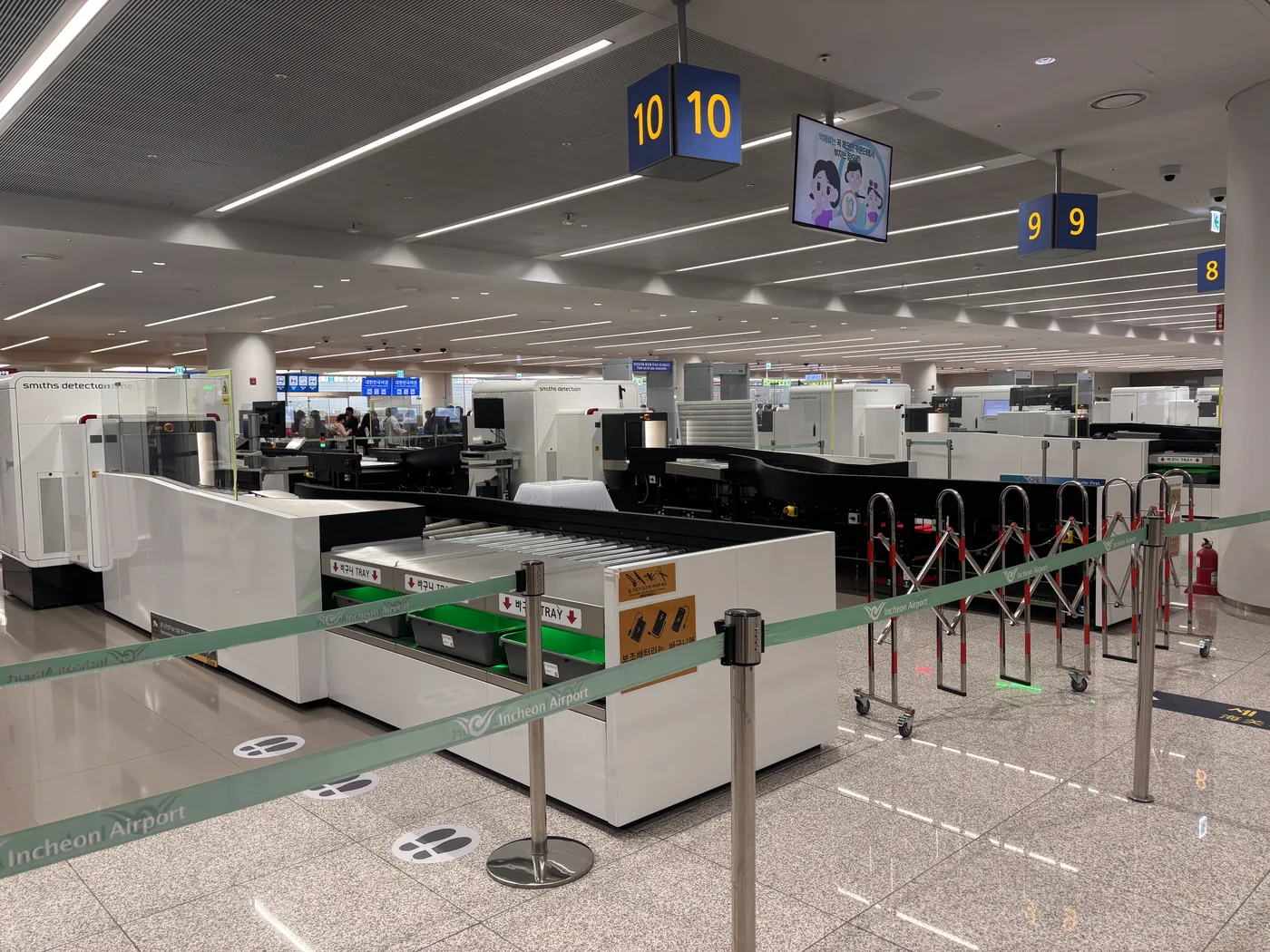
9. Duty free shops and pickup desks
The duty free shops are on 3F after passport control in both terminals, with a smaller group in the Concourse. The airport’s duty free page has maps and brand lists.
| Area | Duty free operators |
|---|---|
| T1, 3F after passport control | Shilla Duty Free, Shinsegae Duty Free, Hyundai Duty Free, Lotte Duty Free, City Duty Free, Gyeongbokgung Duty Free, Panpan Duty Free |
| T2, 3F after passport control | The same seven operators |
| Concourse, 3F | Shinsegae Duty Free, Hyundai Duty Free, Lotte Duty Free |
Who sells what
Perfume, cosmetics, alcohol and tobacco are sold by Lotte Duty Free and Hyundai Duty Free. Luxury brands, fashion and watches are in boutiques run by Shilla, Shinsegae and Hyundai. City, Gyeongbokgung and Panpan sell cosmetics, food and souvenirs.
Opening hours and early flights
Most shops open 06:30 to 21:30, and a few stay open 24 hours, more of them in T1 than in T2. On a flight before the shops open, most of the duty free area is closed. Buy online or at a duty free shop in the city instead, and collect your goods at a pickup desk.
Duty free pickup desks
Goods bought at online or city duty free shops are handed over at pickup desks after passport control. All of them are open 24 hours.
| Building | Pickup desk location |
|---|---|
| T1 | 4F, near gate 43 |
| T2 | 3F east, near gates 267 to 273; 3F west, near gates 227 to 230 |
| Concourse | 4F, near gate 119 |
When you buy, you choose your departure terminal and the pickup desk. Pick the desk in the building you will fly from, since no official answer exists on collecting goods in a different terminal.
The Incheon Airport Duty Free app has a smart duty free option. You order in the app before your flight, within the cut-off the app shows, and collect at a shop in the perfume, cosmetics, alcohol and tobacco area, without going to a pickup desk.
When you fly back in, Gyeongbokgung Duty Free runs 24-hour shops in the baggage claim halls: two on 1F of T1, near belts 6 and 7 and belts 16 and 17, and one on 1F of T2, near belt 11.
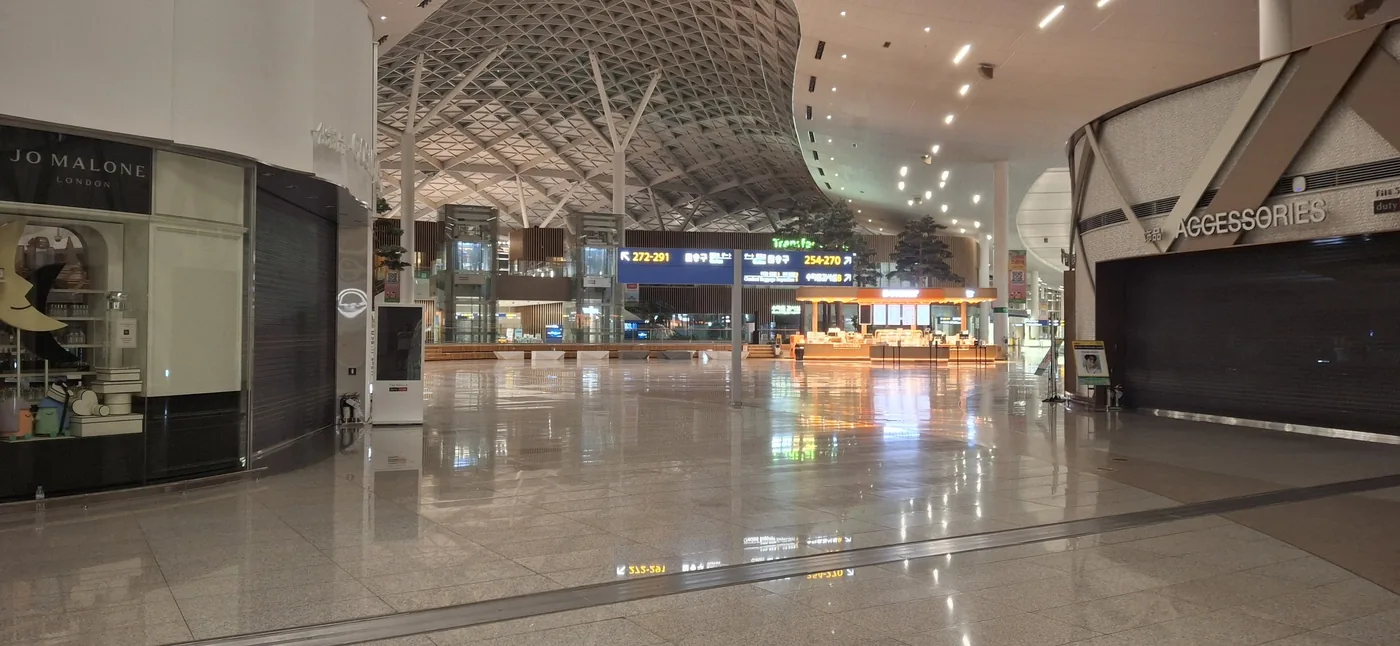
10. Lounges at Incheon Airport by terminal
All lounges at Incheon are after passport control, on 4F. Matina lounges take paying guests on any airline, Sky Hub lounges take membership cards and lounge passes, and the airline lounges admit passengers by class, membership or card.
Lounges you can pay to enter
Matina lounges are run by Walkerhill, which posts prices and hours on its Matina lounge page. Prices are in US dollars and cover a stay of up to 3 hours.
| Lounge | Location (4F) | Hours | Price |
|---|---|---|---|
| Matina, T1 east | Near gate 11 | 06:00 to 22:00, with showers | Adult USD 45, child USD 19 |
| Matina, T1 west | Near gate 43 | 06:00 to 22:00 | Adult USD 45, child USD 19 |
| Matina, T2 | Opposite gate 252 | 06:00 to 22:00 | Adult USD 45, child USD 19 |
| Matina Gold, T2 | Opposite gate 249 | 06:00 to 22:00, with showers | Adult USD 55, child USD 22 |
| Sky Hub lounge | Location (4F) | Hours |
|---|---|---|
| T1 east | Near gate 11 | Listed as 24 hours, closed 21:30 to 22:00 |
| T1 west | Near gate 42 | 24 hours, closed 21:30 to 22:00 |
| T2 west | Near gate 231 | 24 hours, closed 21:30 to 22:00 |
| T2 east | Near gate 268 | Listed as 24 hours, closed 21:30 to 22:00 |
| Concourse | Centre of 4F | 06:00 to 22:00, last entry 21:30 |
The airport operator lists the Sky Hub lounges in both terminals as open 24 hours, with a break from 21:30 to 22:00. Matina opens at 06:00. Some airport pages give shorter hours for the east lounges, so check before an early flight.
Lounge membership cards such as Priority Pass are accepted at Sky Hub and most Matina lounges, and at part of Asiana’s business lounge in T1. Card and lounge partnerships change often, so check your card provider’s list before you fly. Lounge passes are also sold in the Incheon Airport Duty Free app.
Airline lounges in Terminal 2
Korean Air runs the T2 airline lounges, and Asiana passengers use them too. The two Prestige Garden lounges are at the far east and west ends of the extended part of T2.
| Korean Air lounge | Location (4F, upper level) | Hours |
|---|---|---|
| First Class Lounge | Opposite gate 249 | 06:00 to 23:00 |
| Miler Club | Opposite gate 248 | 06:00 to 23:00 |
| Prestige Lounge west | Opposite gate 248 | 04:00 to 23:30 |
| Prestige Lounge east (left and right) | Opposite gate 253 | 06:00 to 22:00 |
| Prestige Garden Lounge west | Opposite gate 218 | 04:00 to 22:00 |
| Prestige Garden Lounge east | Opposite gate 281 | 06:00 to 22:00 |
Press reports say guests entering with vouchers or miles need to book ahead, while higher classes and SkyTeam Elite Plus members do not. Korean Air’s own pages set the entry conditions.
Airline lounges in Terminal 1 and the Concourse
| Lounge | Location (4F) | Hours |
|---|---|---|
| Asiana Business Lounge Suite | Near gate 11 | Varies by day of the week |
| Asiana Business Lounge Central | Near gate 26 | 06:00 to 21:00 |
| Asiana Business Lounge West | Near gate 42 | 06:00 to 00:30 |
| oneworld lounge | Near gate 28 | 05:30 to 01:30 |
| KE Lounge (for passengers of foreign airlines) | Near gate 28 | 06:30 (Sundays 06:00) to 21:30 |
| Singapore Airlines SilverKris | Near gate 29 | Check with the airline |
| China Eastern lounge | Concourse, centre of 4F | Check with the airline |
The Asiana lounges in T1 serve passengers of Star Alliance airlines. The airport operator has announced that the West lounge near gate 42 is run as a Star Alliance lounge once Asiana leaves Star Alliance. Asiana lists current access rules on its lounge page.
A pass bought in advance gets you into Sky Hub or Matina without a membership card. On a flight before 06:00, when Matina is still closed, a Sky Hub lounge is the paid option.
11. Food at night and early in the morning
Most restaurants at Incheon open from 06:00 to 22:00. After security, the food courts are on 4F of T1 near gates 12 and 30, on 4F of T2 near gates 227, 249, 252 and 274, and on 3F of the Concourse near gates 114 and 122. Before security, there are restaurants on B1 in the Transportation Centre and on 4F. The airport’s food and drink page lists every outlet.
Restaurants open 24 hours after security
| Building | 24-hour restaurants |
|---|---|
| T1 | 4F: Ontangjip, Jayeon Dameun Hansang, Lotteria. 3F: KFC (near gates 10 and 11) |
| T2 | 4F near gates 249, 252 and 274: Hyoja Gomtang, Hoho Katsu, Yuksu Gojip, and Jayeon Dameun Hansang near gates 249 and 274 (its branch near gate 252 closes at night). Near gate 227: Soul Bowl, Lotteria |
| Concourse | Jayeon Dameun Hansang (near gate 114), Sodam Bansang and Byeolmiga (near gate 122) |
Each terminal has several more food and drink outlets open around the clock. Starbucks branches that open 24 hours close briefly from 23:50 to 00:30 to prepare.
Places that open before 6 am
Apart from the 24-hour places, a handful open early: in T2, Coffee Bean (3F public area, near door 12), Paris Croissant (3F after passport control, near gate 277) and Misojeong (4F centre, before security) from 05:00, and Jamunbak (before security) from 05:30. In T1, Seoul Street on 4F, before security, opens at 05:30.
Convenience stores
All CU and GS25 convenience stores at the airport are open 24 hours. After security, there are a GS25 near gate 45 and a CU near gate 10 in T1, a GS25 near gate 232 and a CU near gate 254 in T2, and a CU near gate 124 in the Concourse.
The F&B+ menu in the Incheon Airport Duty Free app shows menus, prices and locations of airport restaurants, and some outlets take orders and seat bookings through it.
Eating before a dawn flight. Go through security first and eat after. The 24-hour restaurants on 4F of each terminal and the convenience stores near the gates are open while most other outlets are shut, and you will not have to rush back to the queue.
12. Resting, showering and sleeping at the airport
Incheon has a capsule hotel, a sauna, free nap areas and showers, spread across both terminals. Some are before security and some after passport control, which matters for when you can use them.
Darakhyu capsule hotel
Darakhyu is run by Walkerhill and sits before security, on 1F of the T1 Transportation Centre and on B1 of the T2 Transportation Centre. Prices and booking are on the Darakhyu T1 site and the Darakhyu T2 site.
| Stay | Single | Single with shower (T1 only) | Double | Double with shower |
|---|---|---|---|---|
| Day (08:00 to 20:00), 3 hours | ₩32,000 | ₩38,000 | ₩41,000 | ₩48,000 |
| Night (20:00 to 08:00), 12 hours | ₩69,000 | ₩79,000 | ₩85,000 | ₩94,000 |
Each extra hour costs ₩10,000. These are weekday rates, and Walkerhill says they can change at weekends and on public holidays. Day rates apply between 08:00 and 20:00, and other hours are charged at the night rate.
Before you plan around Darakhyu in T1, check on the official site that it is taking bookings for your dates.
Transit hotels
The transit hotels after passport control, near gate 11 in T1 and opposite gate 252 in T2, are only for passengers changing planes at Incheon. Departing passengers cannot use them, according to Walkerhill.
Free rest areas
Free rest areas are all after passport control and open 24 hours. T1 has a Nap Zone with reclining chairs and beds in the east transfer lounge on 4F, a Cozy Zone and a Refresh Zone on the east side, and a Relax Zone with phone charging on the west side. T2 has Nap Zones near gates 231 and 268 and public lounges with seats and chargers on the east and west sides.
Lounges for travellers who need extra help are on 3F of T1 near gates 25 and 29, and on 3F of T2 inside the west transfer lounge, open 07:00 to 21:00. The T2 lounge has a quiet room for anxious travellers near gate 231.
Paid showers and the sauna
The airport showers are paid, and the fee is not published. They are after passport control on 4F, near gates 25 and 29 in T1 and near gates 231 and 268 in T2. They open 05:00 to 23:00, each use is based on a 30-minute session, and towels and toiletries are provided. You can also shower in the Matina T1 east and Matina Gold lounges if you are a lounge guest, in Darakhyu rooms with showers, and at Spa at Home.
Spa at Home is a sauna on B1 of both terminals, before security. It is open 24 hours, with a cleaning break from 23:30 to 00:00, and has separate saunas for men and women and a shared sleeping room with no private rooms. It also stores coats and suitcases.
Sleeping near the airport
Hotels near the airport are on Yeongjong Island, mostly around Unseo StationMap, in Airport New Town and near Eurwangni Beach. Unseo is two stops from Incheon Airport Terminal 1 Station on the AREX all-stop train, with Airport Cargo Terminal Station in between. Our Incheon travel guide covers the island and the city across the bridge.
To spend the night inside the airport instead, your choices are Darakhyu, Spa at Home, or the free nap areas after passport control.
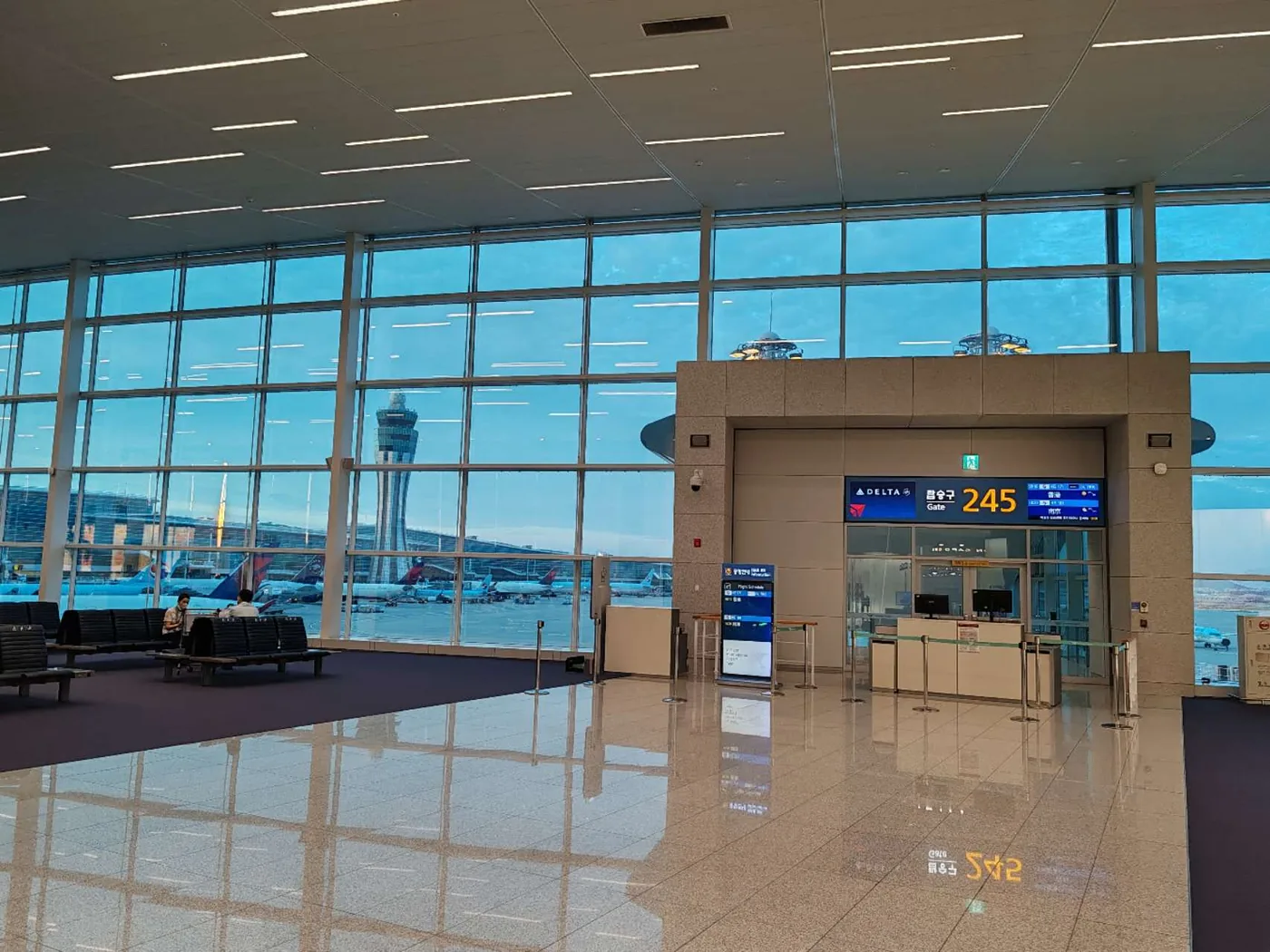
13. Money, pharmacies and other services
Once you clear passport control you cannot come back to the public area of the terminal. Change money, take out cash and sort out your phone before you go through. The airport’s facilities page maps everything below.
| Service | T1 | T2 |
|---|---|---|
| Currency exchange open 24 hours (departures) | Woori Bank, 3F near departure gate 4. KB Kookmin Bank, 3F near row F. Woori Bank after passport control, near gate 11 | KB Kookmin Bank, 3F between doors 4 and 5. Woori Bank after passport control, near gate 249 |
| Shared ATMs, 24 hours | 3F near rows C, E, J and L | 3F between rows J and K and between C and D |
| Foreign currency ATMs | KB Kookmin Bank, 3F near rows M and F | KB Kookmin Bank, 3F between rows C and D |
| Pharmacies | Skywell (3F, row H) and Star Pharmacy (3F, row G), 06:00 to 22:00. Annyeong Pharmacy after passport control near gate 28, 06:00 to 22:00. The Concourse has a pharmacy in the centre of 3F | Sky Pharm (3F centre), 05:30 to 21:30. Prime Pharmacy after passport control opposite gate 251, 06:30 to 22:00 |
| Medical centre | Inha University Hospital Airport Medical Center, B1 east, 08:00 to 20:00 | B1 west, 08:30 to 19:00 |
| Luggage storage and delivery | Jimcarry, 3F near row B (07:00 to 21:00) and 3F near row N (24 hours) | Hanjin Express, 3F west near door 1 (24 hours) |
| Post | Post office, 2F, 09:00 to 18:00 | Postbox only |
| Nursing rooms and play areas | Several after passport control, 24 hours | Several after passport control, 24 hours, plus Family Lounges on 2F after passport control (east and west) |
| Prayer rooms | 3F after passport control near gate 24, and the west transfer lounge on 4F | 3F after passport control near gates 231 and 268 |
Money before you fly
If you need cash for the trip, the 24-hour exchange counters and ATMs on 3F are the places to get it before security. The KB Kookmin Bank foreign currency ATMs dispense other currencies. For changing back leftover won, see the tax refund section, and for cards and cash in Korea in general, see our guide to money in Korea.
Bags and medical help
Jimcarry and Hanjin Express store bags and send them on, and their storage fees are not published by the airport, so ask at the counter. The medical centres in B1 are before security in both terminals.
The pharmacies after passport control are useful if you remember something at the last minute, since the 3F pharmacies in the public area are behind you once you go through.
14. Winter coat storage
Korean Air and Asiana Airlines have run free coat storage from December to February for passengers flying to warm places, so that you can leave a winter coat at the airport and pick it up when you come back. The conditions below are those of the last winter and can change, so check each airline’s notice every winter: the Korean Air coat room page and the Asiana coat room page.
Airline coat rooms
| Item | Korean Air (run by Hanjin Express) | Asiana Airlines (run by Cleanup Air) |
|---|---|---|
| Who can use it | Passengers on international flights from Incheon with a flight number starting KE, after check-in. Codeshares under other airlines’ flight numbers are excluded | Passengers on international round trips from and back to Incheon who are Asiana Club or Star Alliance members (business class passengers need no membership). Codeshares are excluded |
| Drop off | Hanjin Express at the “Delivery, Storage and Packing” area beside door 1, 3F of T2 | Cleanup Air at the entrance to the Transportation Centre, B1 of T2 |
| Collect | Hanjin Express beside door 1, 1F of T2, even if you land at T1. Home delivery is available for a fee | Where you dropped it off |
| Free period | One coat per person for 5 days, counting the drop-off day | One coat per person for 5 days |
| After that | A daily fee per coat, or miles, as set out on Korean Air’s page | The company’s own rates |
Asiana’s conditions may change as it merges with Korean Air, so read its winter notice before you rely on them. The Korean Air service goes by the flight number on your ticket, so a Korean Air plane booked under another airline’s flight number does not qualify. Asiana’s service needs a return trip through Incheon.
Paid coat storage for any airline
If you fly with another airline, Cleanup Air also stores coats for a fee on B1 west of T1 (06:00 to 19:00) and B1 of the T2 Transportation Centre (07:00 to 22:00). Spa at Home also keeps coats. Fees for these are not officially published, so ask at the counter.
Both Cleanup Air counters are before security, so drop the coat off before you check in or right after.
15. Tax refund at Incheon Airport
Visitors who live outside Korea can claim back the VAT on shopping when they leave. Foreign visitors qualify if they have stayed in Korea for less than 6 months. Each purchase must be ₩15,000 or more, and the goods must leave Korea within 3 months of the purchase date. The airport’s tax refund page and Incheon Airport Customs explain the process.
Instant refunds in shops and city refunds
Many shops deduct the tax at the till. This works when a single purchase is under ₩1,000,000 and your instant-refund purchases since arriving in Korea total ₩5,000,000 or less. City refund counters can also pay you before you reach the airport, but the export check at the airport is the same either way.
There is no official amount above which customs must see your goods. The refund kiosk decides, and if it flags your purchase for inspection, you take the goods to customs. Ignore figures quoted online for this threshold.
Claiming at the airport, step by step
- Go to a refund kiosk on 3F first, with the goods and receipts in your hand luggage. Do not check them in yet.
- If the kiosk flags your goods for inspection, take them unused, with your passport and the sales receipt for tax refund, to the customs desk before you check in any bags.
- Check in. If refund goods are in a bag you plan to check, tell the airline at check-in. The tagged bag is handed back to you, and after customs has seen it you take it to the oversized baggage belt.
- After passport control, collect the money at a refund desk or machine in the duty free area.
| Building | Before passport control (3F) | After passport control |
|---|---|---|
| T1 | Kiosks near rows B, E, J and L, 24 hours | Staffed desk and refund machines near gate 28 |
| T2 | Kiosks near rows F and G, 24 hours | Staffed desks near gates 249 to 253 and near gate 270 (07:00 to 21:30), refund machines 24 hours |
| Concourse | Refund machine in the centre of 3F, 24 hours |
Leftover won
Exchange counters before and after passport control change won back into other currencies, and one after passport control in each terminal is open 24 hours (see the facilities section for locations).
16. Arriving at Incheon: arrival card, K-ETA, e-gates and customs
On arrival at Incheon, foreign visitors follow the same route in both terminals. The airport’s immigration page covers the details.
- Leave the plane and follow the arrival signs.
- Immigration. Koreans and foreigners use separate lines. Foreign visitors aged 17 and over give fingerprints and a face photo. Travellers aged 70 and over, those with children under 7, pregnant women and people with walking disabilities can use the priority desks.
- Collect your bags from the baggage claim hall.
- Customs. Declare anything that needs declaring, or walk through the “nothing to declare” lane.
- Come out into the arrivals hall on 1F.
The arrival card: paper or online
Korea’s official wording is that a traveller who has submitted the electronic arrival card does not need to fill in a paper one, and that the two have the same effect. The paper arrival card is still in use. You can fill one in on the plane or in the immigration hall, or submit the electronic version on the e-Arrival card site.
In principle every foreign visitor submits an arrival card. A valid K-ETA replaces it, except for travellers who enter on a visa. Nationals of countries on the temporary K-ETA exemption list do submit one, and so do travellers aged 17 and under or 65 and over from countries that need a K-ETA, since they are exempt from the K-ETA itself. Foreign residents registered in Korea do not.
The electronic card can be submitted from 3 days before arrival, counting in Korean time, and it is free. A submission stops being valid 72 hours after you send it. One phone can submit for up to 9 people at once, and the site asks you to confirm a verification code. Your receipt number arrives by email, and you do not need to show it at immigration. The site is in Korean, English, Simplified Chinese, Japanese, Vietnamese, Thai and Russian.
K-ETA and the temporary exemption
The US (including Guam), the UK, Canada, Australia, New Zealand and Singapore are among the countries whose nationals are temporarily exempt from the K-ETA, along with Japan, Taiwan, Hong Kong, Macau and a group of European countries. If you are on the list, you enter without a K-ETA and submit an arrival card. Whether the exemption continues is posted on the official K-ETA site, and our K-ETA guide explains who needs one.
Exempt travellers can still apply for a K-ETA if they want one, and then they skip the arrival card. Where a K-ETA is required, it costs ₩10,000 plus a 3% online payment fee, and the result usually comes within 72 hours. Apply only on the official site or the official app, and avoid agency sites that charge extra.
Automated entry gates
Incheon’s automated entry gates are open to travellers from the UK, Canada, Australia, New Zealand, Singapore, Japan, Taiwan, Hong Kong, Macau, the UAE, Mexico, Germany, France, Italy, the Netherlands, Spain and the rest of the EU, Norway, Switzerland, Iceland and Liechtenstein. US citizens are not eligible, unless they have separately enrolled in Korea’s automated immigration programme.
To use them, you register on arrival at the registration points in the arrivals area, on the east and west sides of both T1 and T2, and follow the instructions there, even on a first visit. Official reports show children going through the staffed family desks, so with children, use the staffed desks.
| Nationality | Visa-free stay | K-ETA | Arrival card | Automated entry gates |
|---|---|---|---|---|
| United States | 90 days | Temporarily exempt (including Guam) | Submit one | Not eligible |
| United Kingdom | Check the visa portal | Temporarily exempt | Submit one | Eligible after registering |
| Canada | Check the visa portal | Temporarily exempt | Submit one | Eligible after registering |
| Australia | Check the visa portal | Temporarily exempt | Submit one | Eligible after registering |
| New Zealand | Check the visa portal | Temporarily exempt | Submit one | Eligible after registering |
| Singapore | Check the visa portal | Temporarily exempt | Submit one | Eligible after registering |
The length of a visa-free stay depends on your passport. Korea’s official visa portal gives the figure for each nationality.
Customs allowances
If you have nothing to declare, walk through the “nothing to declare” lane without a form. Declarations can also be made in advance through the Traveller Customs Declaration app or website, and Incheon Airport Customs sets out the rules.
| Item | Rule |
|---|---|
| Duty-free allowance | USD 800, including anything bought in Korean duty free shops and the arrivals duty free shops |
| Alcohol | 2 litres, up to USD 400 in value, on top of the USD 800 |
| Tobacco | 200 cigarettes |
| Perfume | 100 ml |
| Under 19 (counted by year of birth) | No duty-free alcohol or tobacco |
| Cash over USD 10,000 per person | Including won and cheques. Declare it and get a foreign exchange declaration certificate. You cannot get one after leaving the arrivals area |
| Declaring voluntarily | 30% off the duty, up to ₩200,000 |
| Not declaring | A 40% penalty on top |
Meat, fruit and plants
Meat products need a quarantine certificate, and fresh fruit cannot come into Korea. Meat, sausages, ham, jerky and cheese need an export quarantine certificate from the country they come from, or they cannot be brought in. Not declaring them brings a fine: for pork products from countries with African swine fever, ₩5,000,000 for a first offence and ₩10,000,000 for a third, and ₩1,000,000 for a first offence with other meat products without a certificate. Fresh fruit and fruiting vegetables are banned. Cooked or processed foods such as kimchi and rice cakes are not inspected. Failing to declare plants brings a first fine of ₩100,000. See the airport’s quarantine page.
The quarantine declaration desks are on the left of zones A and B and the right of zone E in T1, and on the left of zone A and the right of zone B in T2.
First things to do in the arrivals hall
| What | T1 | T2 |
|---|---|---|
| SIM and eSIM counters, 24 hours | West side near arrivals exit F (by door 13): SKT, KT, LG U+ | SKT at door 7; KT and LG U+ at door 4 |
| SIM counters, 06:00 to 22:00 | East side near arrivals exit A | |
| Currency exchange, 24 hours | Woori Bank at doors 6 and 11 | Woori Bank at door 7 |
| Shared ATMs, 24 hours | Doors 4, 6, 9 and 11 | Doors 3 and 7 |
| Transport card (T-money) | CU convenience store on 1F (24 hours) | CU convenience store on 1F |
| Sending bags to your hotel | Jimcarry on 3F, same-day delivery to hotels (ask for the hand-in cut-off) | Hanjin Express, 1F west |
SKT sells a prepaid airport SIM for short-stay foreign visitors, and our Korea SIM and eSIM guide compares the options. The airport does not say which 1F ATMs take overseas cards, so look for the foreign card sign on the machine.
The Seoul Climate Card is sold as short passes for 1, 2, 3, 5 or 7 days and works only within Seoul. At Incheon Airport station it can be used to get off a train, but not to start a journey. For help in English, the 1330 tourist helpline takes calls all year.
For trains, buses and taxis from the airport into the city, see our Incheon Airport to Seoul transport guide.
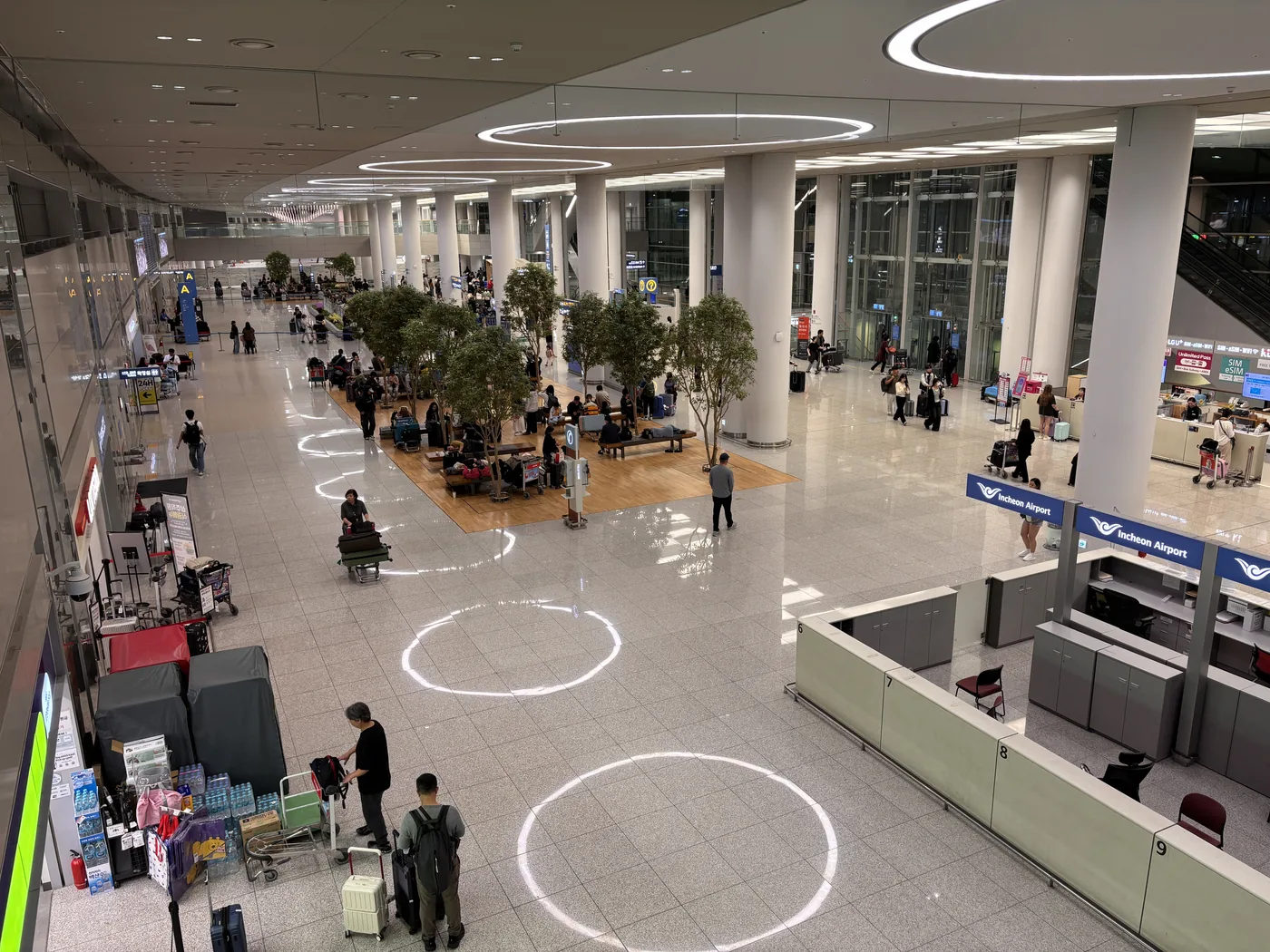
17. Transfers, visa-free transit and free transfer tours
Passengers changing between international flights at Incheon stay inside the secure area and do not go through immigration. The airport’s transfer page shows the routes in each terminal.
International to international
Within one terminal, follow the green Transfer signs after you leave the plane to the transfer security check on 2F, then go up to the departures level on 3F and on to your gate. Transfer security is on 2F of T1 near gates 12 and 30, on 2F of the Concourse, and on 2F of T2 near gates 248 and 253.
To change between T1 and T2, you stay inside the secure area and ride the underground shuttle train, changing trains at the Concourse. Once you board the train you cannot turn back. The airport operator does not publish a minimum connection time, which is set when your ticket is issued.
Liquids are screened again at transfer security. Liquids over 100 ml bought at another airport or on board pass only in a sealed security bag (STEB) with the receipt.
If you booked two separate tickets and your bags are not checked through, you have to enter Korea, collect your bags and check them in again. In that case Korea is your destination and K-ETA and arrival card rules apply to you, as stated in the K-ETA FAQ. The transit hotels after passport control take only transfer passengers and charge by the hour.
Visa-free transit for travellers who need a visa
Some nationalities that would otherwise need a visa can enter without one while in transit. Holders of a visa for the US, Canada, Australia, New Zealand or one of 32 European countries who are travelling to or from that country can stay up to 30 days. Passengers joining an Incheon transfer tour can enter for up to 3 days. A list of nationalities is excluded, and the Ministry of Justice sets out the conditions on HiKorea.
Free transfer tours
The airport operator runs transfer tours for passengers with a long layover. The tour itself is free, and you pay only admission fees of USD 3 to 4 at places such as Gyeongbokgung Palace, the Third Tunnel and Seoul Botanic Park. The golf course is paid. Courses and booking are on the transfer tour page.
To join, you must be able to enter Korea in one of these ways: visa-free, with a K-ETA if your country is not on the temporary exemption list; under visa-free transit; or as a regular transfer passenger. Your layover at Incheon must be 24 hours or less. Bring your passport and your arrival and onward boarding passes, and reach the desk at least 30 minutes before the tour starts. Places go first come, first served. Part of the seats can be booked online, and there may still be room on the day when the online seats are sold out.
| Item | Detail |
|---|---|
| Tour desks | T1: 1F after immigration, counters 19 and 20 near exits 1 and 2. T2: transfer tour desk on 1F. Both 07:00 to 18:00 |
| Example courses | Gyeongbokgung Palace and Insadong (5 hours, Tuesday to Sunday; Changdeokgung Palace on Tuesdays); Imjingak and Odusan Unification Observatory (Wednesday and Friday); DMZ (Thursday); Aegibong; Wolmi Park ferry; Hongdae; Sinpo Market; Seoul Botanic Park (in rain or snow, in place of an outdoor course); K-Culture Zone inside the airport (30 minutes) |
| Limit | One entry into Korea per visit, so one tour per layover |
Days of the week follow the official timetable and can change.
Connecting to a domestic flight
Korean Air runs transfer-only flights between Incheon and Gimhae (Busan) and Daegu from T2. They are sold only on the same ticket as an international flight. Arriving from abroad on this route, you do not clear immigration at Incheon. Immigration and customs happen at Busan or Daegu, and you cannot use Incheon’s duty free shops, in departures or in arrivals. Korean Air sets the minimum connection time for these flights when you book. Details are on the Korean Air site.
Korea is still your destination on these routes, so K-ETA and arrival card rules apply. When flying out from Gimhae or Daegu through Incheon instead, passengers from Busan go straight to the departures level on 3F without transfer security, and passengers from Daegu go through transfer security. In this direction you can shop in Incheon’s departure duty free.
For other domestic flights from Incheon, you clear immigration and customs, then check in at the domestic counter on 1F of T1 near door 3, with ID. Incheon has very few domestic flights, so most travellers move to Gimpo, as our Gimpo Airport guide explains. Going the other way, if you fly into Gimpo on a domestic flight to connect to an international flight at Incheon, the airport operator advises allowing about 40 minutes between the airports and about 2 hours for check-in and waiting at Incheon.
18. Airline name changes and mergers
Several Korean airlines are changing names or merging. The terminal for each stays the same through the changes, and airlines announce flight number changes to passengers who have bookings.
Asiana Airlines and Korean Air
Asiana Airlines flies from T2, in rows G to J at the east end. It is going through the process of merging into Korean Air, and its terminal is T2 both before and after the merger. Press reports say that after the merger Asiana miles and member tiers move to Korean Air and SkyTeam benefits apply. Check Korean Air and Asiana notices for miles and lounge access.
The lounge changes in T1 that come with the merger are in the lounge section above.
Jin Air, Air Busan and Air Seoul
Jin Air, Air Busan and Air Seoul sit side by side in rows E and F of T2. The three are going through the process of combining into one airline, so flight numbers may change. Go by the flight number and the operating airline in your latest booking email.
Trinity Airways (formerly T’way Air)
T’way Air has changed its name to Trinity Airways. Only the name has changed: the TW flight numbers and existing bookings stay the same, and the airline still flies from T1, rows A and B. Departure boards list it as Trinity Airways.
When an airline changes a flight number or terminal, it notifies passengers. Check the airline’s notice before you go to the airport.
19. Common mistakes at Incheon Airport
These are the mistakes first-time travellers make most often at Incheon, taken from the questions people ask before a trip.
Terminals and gates
Going to T1 for Asiana is a common mistake. Asiana flies from T2. A gate number from 101 to 132 means the Concourse, and once you ride the train there you cannot come back to the main building. After passport control you also cannot go back out to the public area, so change money, take out cash and sort out your phone first.
Not every departure entrance is open before dawn. Only gate 3 in T1 and gate 1 in T2 run 24 hours.
Bags and security
Never pack a power bank in a checked bag, and do not use it on the plane. The 100 ml limit on liquids in cabin bags still applies, even though laptops stay in the bag at security. Goods for a tax refund must go past the kiosk, and customs if flagged, before you check them in.
Parking and the car
The airport’s parking page says overseas credit cards cannot be used to pay, so bring a Korean card or cash. Hi-pass cannot pay a bill of ₩50,000 or more. People offering valet parking in front of the terminal are not the airport’s official service.
Arriving in Korea
The paper arrival card is still accepted and has the same effect as the electronic one. Meat products and fresh fruit cannot be brought in. The transit hotels after passport control are for transfer passengers only and cannot be booked by departing passengers.
🎡Things to Do13
🚇Getting Around4
🧭All-Korea essentials119
Incheon Airport FAQ
Images: Photographs via Wikimedia Commons: Choikwangmo25 (CC0), Narubaru7 (CC BY 4.0), AirportTerminalGuy (CC BY 4.0), Twotwo2019 (CC BY 4.0), *Youngjin (CC BY-SA 3.0), Vitsuha (CC BY-SA 4.0), Andrzej Otrębski (CC BY-SA 4.0). Charts by Breeze Korea from Incheon International Airport Corporation data.