
Jeju Airport Guide: Floors, Duty Free Limits, Arrival Rules for Foreigners and Flight Cancellations
Domestic and international departures, JDC duty free, entry rules for overseas visitors and what to do when the wind grounds flights, all in one place.
| Where do domestic departures start? | On the 3rd floor: check in, go through security entrance A or B, then walk down to the boarding gates on the 2nd floor. |
|---|---|
| Where do international flights leave from? | Use entrance door 5 at the western end, where check-in, security and passport control are all on the 3rd floor. |
| Can foreigners shop at JDC duty free? | Yes, whenever you leave Jeju on a domestic flight, by showing your passport and boarding pass in the shops after security. |
| How early should I arrive for a domestic flight? | Most airlines close check-in 30 minutes before departure, so give yourself more time if you are checking bags, shopping or returning a rental car. |
| Why are Jeju flights cancelled so often? | Sudden wind shifts off Hallasan, strong wind and winter snow ground flights, and weather cancellations fall outside airline compensation rules. |
| Does Jeju visa-free entry work if I fly in through Seoul? | No, it only covers travellers who land in Jeju straight from an airport outside Korea. |
| Where should a friend wait to pick me up? | Inside the car park, where the first 10 minutes are free, because stopping on the crossings and bus stops outside arrivals draws a fine after one minute. |
1. Domestic and international sides of the terminal, floor by floor
2. Where you can fly from Jeju and how often
3. Night flights and the early cut-off for Seoul
4. Flight cancellations: why they happen and what to do
5. Boarding a domestic flight step by step
6. How early to arrive and how to check wait times
7. Security rules for power banks, liquids and sharp items
8. Taking tangerines and other Jeju goods home
9. JDC duty free for domestic passengers, foreigners included
10. Airline lounges at Jeju Airport
11. Food and coffee from early morning to late evening
12. Pharmacy, luggage storage, nursing rooms and other facilities
13. Observation deck and places near the airport to watch planes
14. Parking for pickups, drop-offs and short stays
15. Arriving at Jeju: exits, pickups, buses, taxis and rental cars
16. Flying out of Korea from Jeju’s international terminal
17. Arriving from abroad: visas, K-ETA, arrival card and customs
18. Reaching Jeju on a domestic flight from Seoul or Busan
1. Domestic and international sides of the terminal, floor by floor
Quick orientation
- Domestic departures: go up to the 3rd floor, check in, then pass security at entrance A (beside entrance door 1) or entrance B (beside entrance door 3).
- JDC duty free is on the 2nd floor after security, among the domestic boarding gates.
- Both airline lounges are on the 3rd floor before security.
- International flights use entrance door 5 at the western end of the building.
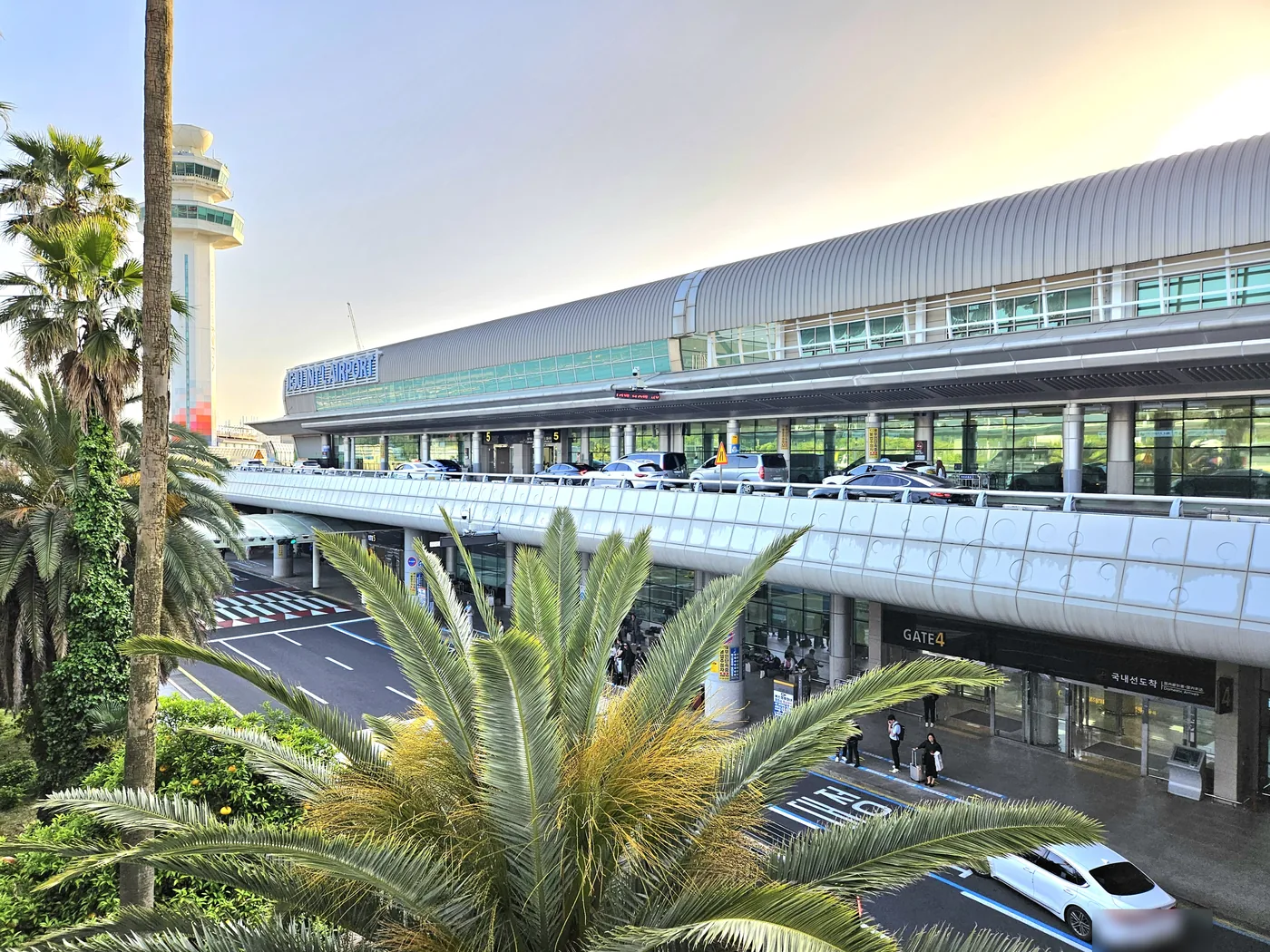
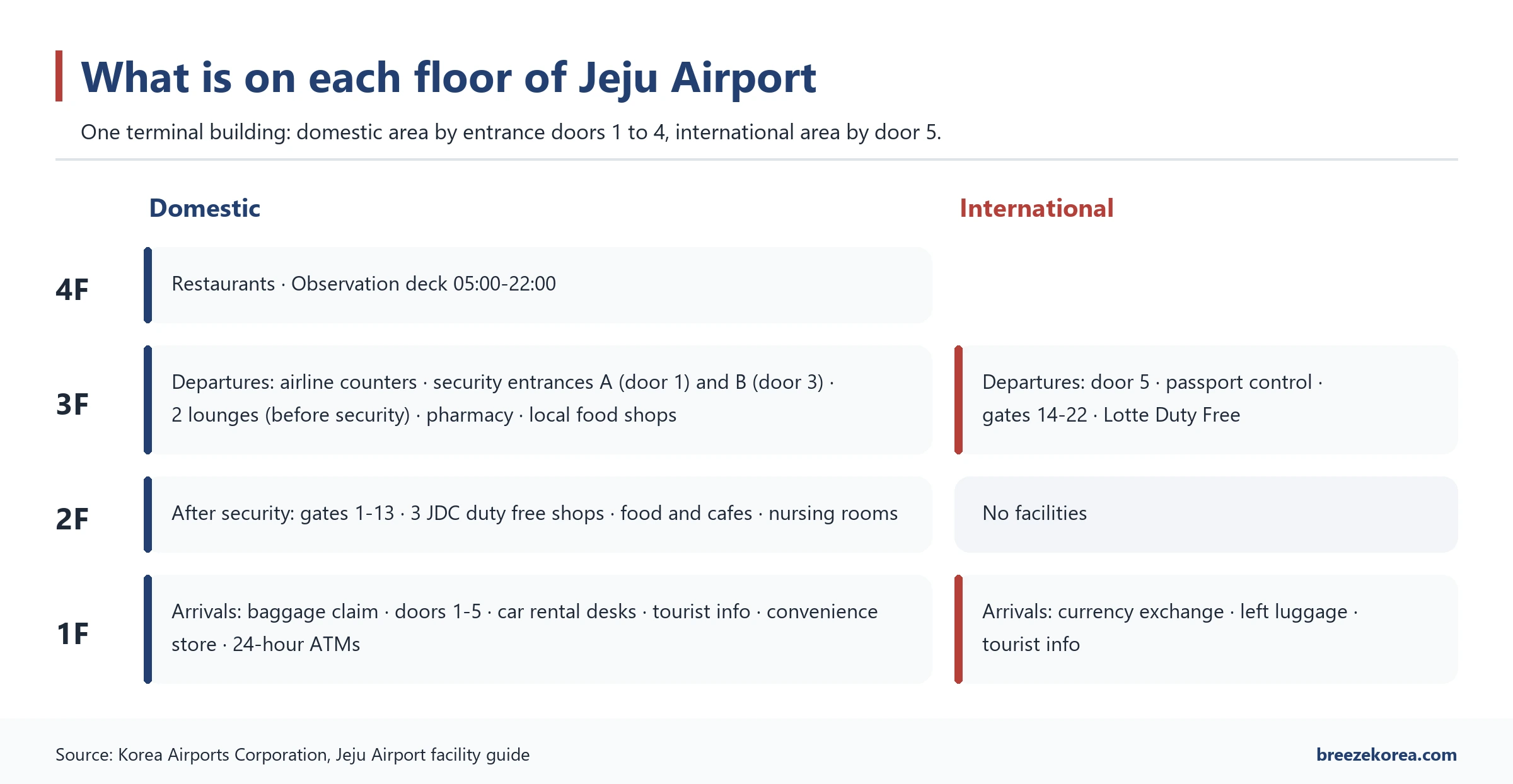
Jeju International AirportMap is run by Korea Airports Corporation (KAC) and sits right on the sea, just under 4 km west-northwest of Jeju City Hall. The domestic area and the international area sit side by side in the same passenger terminal. Domestic flights use the part of the building served by entrance doors 1 to 4, and international flights use the western end beside entrance door 5.
The street doors on the 1st floor are numbered 1 to 5, and both areas share that one set of numbers. The signs above the doors say GATE 1 to GATE 5. To keep things clear, this guide calls those “entrance doors” and keeps the word “boarding gate” for the numbered gates where you get on the plane: boarding gates 1 to 13 (plus 1A and 3A) for domestic flights and boarding gates 14 to 22 for international flights.
The airport has two runways, a main one of 3,180 m and a secondary one of 1,900 m. The domestic side has four floors and the international side has two, so the layout below is worth a quick look before you go. In Korea the 1st floor is street level.
What is on each floor
| Floor | Domestic area | International area |
|---|---|---|
| 1st | Arrivals. Entrance doors 1 to 5. Rental car desks (Lotte, SK, Jeju, Tamra), tourist information centre, Jeju Olle trail desk, CU convenience store, Olive Young, food court and cafes, two WOWPASS machines, 24-hour ATMs, post office counter, lost and found, airport clinic near entrance door 5 | Arrivals from abroad. Currency exchange (Jeju Bank, Shinhan Bank), baggage storage, tourist information desk (open for arriving flights), SKT roaming counter to the left of entrance door 5 |
| 2nd | Boarding area after security. Boarding gates, three JDC duty free shops, Jeju Tourism Organization duty free pickup counter, 7-Eleven, food (Guksu Namu, Lotteria, Plating food court, Paris Baguette, Cafe Ogada, Angel-in-us), two nursing rooms | No public facilities |
| 3rd | Departures and check-in. Airline counters, security entrance A (entrance door 1) and B (entrance door 3), Korean Air and Asiana Airlines lounges, pharmacy, ATMs, Jeju products (Citriang, Ijejuseom), cafes (Jamba, Paris Baguette, Paul Bassett, Woomu), main information counter with wheelchair and stroller loans, biometric registration booth near entrance door 3 | Departures abroad. Entrance door 5, CU, Global Tax Free; after passport control two Lotte Duty Free shops, duty free pickup counters, food, cafes and a currency exchange |
| 4th | Restaurant floor (hangover soup, Korean, Chinese, burgers, food court) and the airport observation deck | None |
Busy terminal, busy route
The terminal is close to the number of passengers it was built to handle, and the domestic hall in particular gets crowded. KAC is studying how to give passengers more space. The Seoul Gimpo to Jeju route is also the one that the aviation data company OAG ranked first in the world for the number of seats flown.
The planned second airport
A second Jeju airport is planned for Seongsan on the east coast. The plan has been confirmed, but the environmental review and public consultation are still going on and the government has not given an opening year. Every flight to and from Jeju will keep using this airport for the foreseeable future.
KAC’s facilities page lists every shop and counter floor by floor, and a separate page for pregnant travellers and families with babies covers the help available to them. Both pages are in Korean.
2. Where you can fly from Jeju and how often
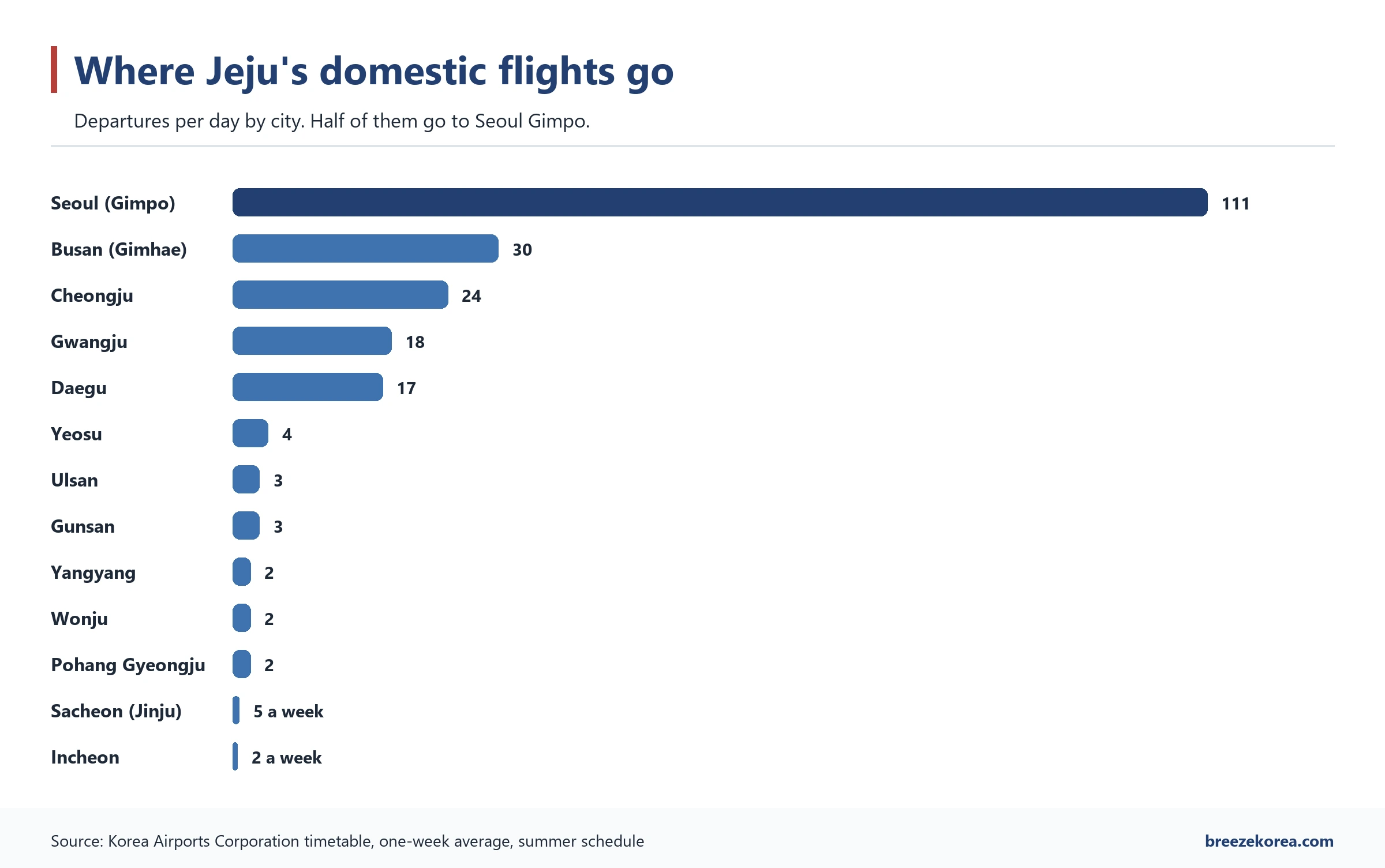
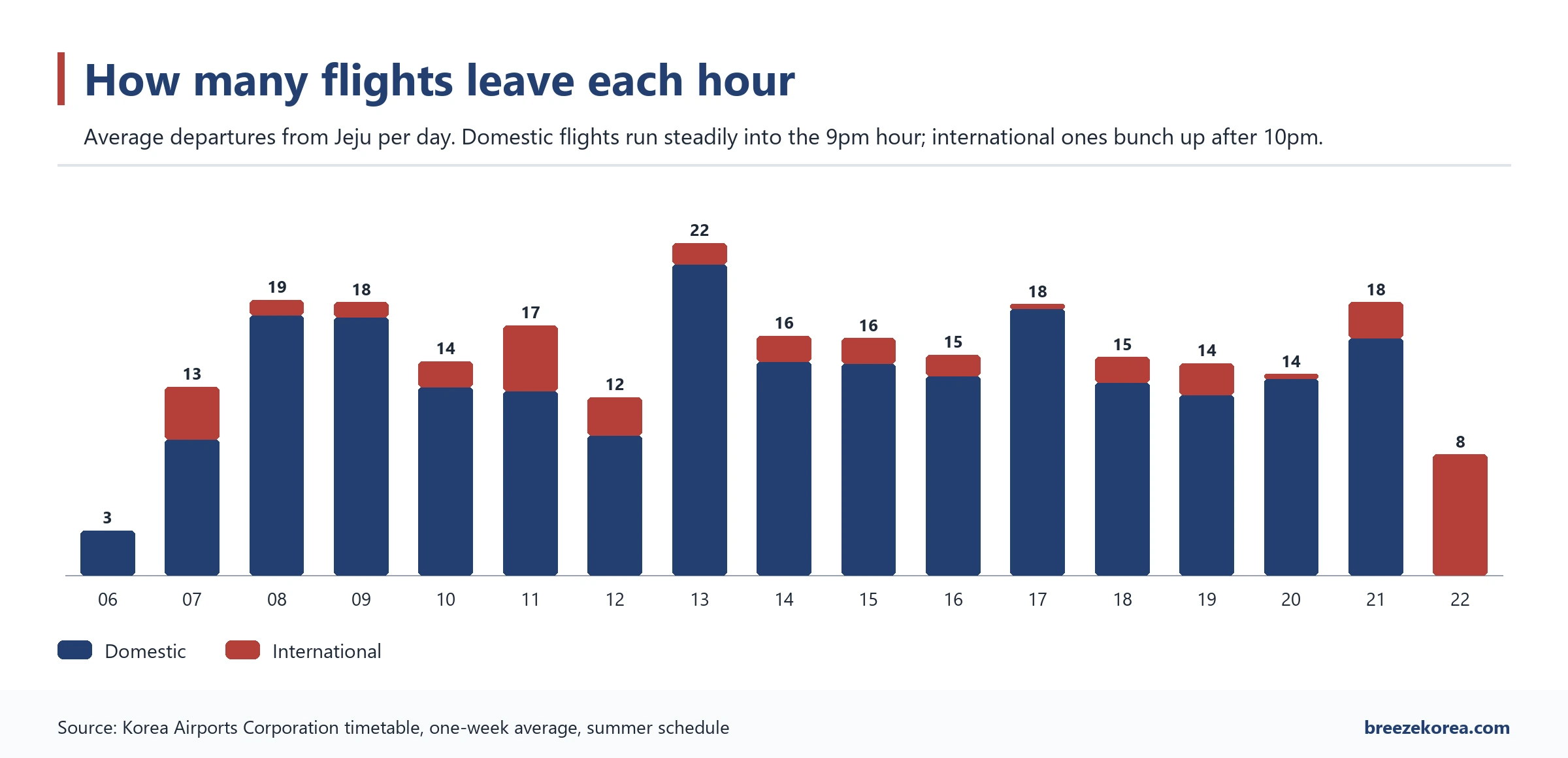
Domestic flights connect Jeju with most mainland cities that have an airport, and Seoul Gimpo has far more flights than anywhere else. Departures are spread evenly through the day. Only the 6 am hour is thin, and there is little difference between weekdays and weekends in the number of flights.
Domestic routes
| Destination | Departures a day (approx.) | First / last departure | Scheduled flight time | Airlines |
|---|---|---|---|---|
| Seoul Gimpo | a little over 110 | 06:25 / 21:20 | 75 to 80 min | Korean Air, Asiana, Jeju Air, Jin Air, Trinity, Eastar Jet, Air Busan, Air Seoul, Parata Air |
| Busan Gimhae | 30 | 07:50 / 21:05 | 60 to 75 min | Korean Air, Air Busan, Jeju Air, Jin Air, Eastar Jet |
| Cheongju | 24 | 07:20 / 21:50 | 70 to 80 min | Korean Air, Asiana, Aero K, Eastar Jet, Jeju Air, Jin Air, Trinity |
| Gwangju | 18 | 07:25 / 18:50 | 55 to 65 min | Korean Air, Asiana, Jeju Air, Jin Air, Trinity |
| Daegu | 17 | 07:55 / 21:20 | 65 to 70 min | Korean Air, Asiana, Jeju Air, Jin Air, Trinity |
| Other cities | Yeosu 4, Ulsan 3, Gunsan 3, Yangyang 2, Wonju 2 and Pohang-Gyeongju 2 a day; Sacheon 5 a week; Incheon very rare (Jeju Air, only in some periods) | |||
The Korean airlines on domestic routes are Korean Air, Asiana Airlines, Jeju Air, Jin Air, Trinity Airways, Air Busan, Eastar Jet, Air Seoul, Aero K and Parata Air. Trinity Airways is the airline formerly called T’way Air. Its flights still carry the TW code, and the departure boards show the new Trinity name, which can confuse you if your booking still says T’way. Flight times in the table come from the timetable and include taxiing.
The figures above are from the summer timetable. The winter timetable starts on the last Sunday of October and runs to late March, and the number of flights and even some routes can change with it. Check the airline’s own timetable before you book, or see the live KAC flight schedule.
International routes
| Country or region | Cities | Airlines |
|---|---|---|
| Taiwan | Taipei Taoyuan (several flights daily), Kaohsiung, Taichung | Tigerair Taiwan, Trinity, Eastar Jet, Jin Air |
| Japan | Tokyo Narita (4 a week), Osaka Kansai (daily), Fukuoka (daily) | Korean Air (Narita), Trinity (Kansai, Fukuoka) |
| Hong Kong and Macau | Hong Kong (2 daily), Macau (3 a week) | HK Express, Jin Air, Trinity |
| Singapore | Singapore | Scoot, Trinity |
| Mainland China | Shanghai (most flights), Beijing Capital and Daxing, Hangzhou, Nanjing, Ningbo, Wuxi, Shenyang, Shenzhen, Guangzhou, Qingdao, Wenzhou | Spring Airlines, Juneyao Air, China Eastern, Air China, Shenzhen Airlines, Qingdao Airlines, Beijing Capital Airlines, Loong Air, Korean Air, Jeju Air, Eastar Jet |
Singapore is the only city in Southeast Asia with a direct flight to Jeju, flown by Scoot and Trinity on the summer timetable. There are no scheduled direct flights from Thailand, Vietnam, the Philippines, Malaysia, the Americas or Europe, and Asiana Airlines runs no international flights from Jeju at all. Travellers from those places either connect in Seoul or Busan and take a domestic flight, or change planes in a nearby hub such as Shanghai, Hong Kong, Taipei or Singapore and land in Jeju directly.
International traffic is growing quickly. Most of it comes from mainland China, followed by Taiwan, Japan and Hong Kong. International departures bunch up in the 7 am hour and again around 10 pm, because Chinese and Taiwanese airlines tend to arrive in the evening and fly back at night. The first international arrival lands around 6 am on overnight flights from Hong Kong and Taipei.
Some international routes may change on the winter timetable (late October to late March), so check the airline’s timetable for your dates before you plan around a route. KAC keeps a list of airlines serving Jeju.
3. Night flights and the early cut-off for Seoul
Jeju has no published night-time ban on take-offs and landings. The Korean aeronautical information publication for Jeju lists the airport as open around the clock. Seoul Gimpo and Busan Gimhae are different: both block take-offs and landings from 11 pm to 6 am, as our Gimpo Airport guide and Gimhae Airport guide explain.
Scheduled hours
Even without a night ban, the scheduled day at Jeju runs from the 6 am hour to about 10:40 pm. The first domestic departure leaves at 06:25 and the last international departure at about 22:40. Delayed flights sometimes take off after 11 pm.
The chart in this section shows how the day fills up. Domestic departures build through the morning, peak around early afternoon and taper off in the evening. After 10 pm only international flights are left on the board.
Why the last Seoul flight leaves so early
The last flights to Seoul Gimpo leave in the 9 pm hour because Gimpo itself closes to landings at 11 pm. This matters on bad-weather days. If wind or snow holds flights all day and conditions clear at night, Jeju could send planes out but Gimpo cannot take them after its cut-off. On some of those nights the government has extended Gimpo’s hours or let Gimpo-bound flights land at Incheon instead. That does not happen every time, so do not count on it.
Landing late in Jeju
The last domestic flights land between about 10:20 and 10:40 pm. By then most of the terminal’s restaurants and shops have closed, so plan your late meal and your ride before you fly. The food section below lists what stays open longest, and the arrivals section covers the late-night buses and taxis.
4. Flight cancellations: why they happen and what to do
Hallasan, the volcano in the middle of the island, disturbs the air over the airport. Wind direction and speed often change suddenly over a short distance, which pilots call wind shear. The airport weather office issues wind shear warnings hundreds of times a year, sensors around the airfield measure the wind in several places, and when a warning is out, planes hold, go around or divert.
When cancellations hit hardest
Winter, from December to February, brings the biggest disruptions. Heavy snow and strong wind can close the runway for snow clearing, and on those days nearly everything stops. Spring and summer have bad days too: strong wind, heavy rain and wind shear have each grounded well over a hundred flights in a day in April and in July.
| When | What happened | Scale |
|---|---|---|
| Winter snow and cold snap (January) | Runway closed for more than two days | About 80,000 people stranded |
| Winter wind and snow (January) | Every departure and arrival cancelled for a day | About 480 flights, about 40,000 people stranded |
| Winter snow (February) | Runway closed for a morning | Around 170 flights cancelled, over 10,000 people stranded |
| Spring wind and rain (April) | Several weather warnings at once | About 200 flights cancelled |
| Summer wind shear and strong wind (July) | Wind warnings | A little over 100 flights cancelled |
On a calm, clear day only a handful of flights are cancelled, and those are mostly individual foreign airline issues. Weather is behind the large majority of cancellations. Delays are far more common than cancellations. Jeju departures tend to run later as the afternoon and evening go on, because a late arrival pushes back every flight that plane is due to fly after it.
How to check whether your flight is going
KAC’s live departures and arrivals board marks flights as cancelled or delayed. Your airline’s app and text messages, sent to the phone number on your booking, usually tell you first. Asiana Airlines, for example, says it contacts passengers by text, email or phone when a flight is cancelled or more than 30 minutes late, and uses airport announcements when departure is less than 30 minutes away. For the weather itself, the aviation weather page for Jeju shows current airport warnings.
What to do when your flight is cancelled
- Check the app before joining a queue. Seats on replacement flights go first to passengers whose flights were cancelled earliest. The government set that rule, so standing at the counter early does not move you up. The airline texts you once your new flight is fixed.
- Choose a new flight or a refund. A refund for a cancelled flight carries no fee, but it does not happen automatically. You have to request it.
- Expect emergency measures on the worst days. The airport steps up its response as the number of stranded passengers grows. If many people are still there at night, it hands out blankets, mats and bottled water and keeps some shops open late. This help is meant for people who could not find a room.
- Look for the emergency taxis after 9 pm. When the airport is on alert level “caution” or above and it is past 9 pm, Jeju Province brings in volunteer taxis to take stranded passengers to their accommodation, with part of the fare covered by the province.
- Watch for extra flights. Extra flights and longer operating hours are decided by the government on the day. They are not guaranteed.
Compensation and travel insurance
Korea’s Fair Trade Commission sets consumer dispute guidelines for domestic flights. When an airline cancels for its own reasons, they suggest compensation of 20 to 30 percent of the fare depending on how late the replacement flight is, plus meals and a room if you need to stay. Delays of one to two hours suggest 10 percent, two to three hours 20 percent, and over three hours 30 percent.
Weather cancellations are excluded. If the airline can show the cause was bad weather, an airport problem or something else it could not foresee, the compensation and the meals and room rules do not apply. Since most Jeju cancellations are weather, expect to pay for your own extra night. The government itself suggests travel insurance; check what your policy says about delays and cancellations.
Before you fly in winter or typhoon season
- Avoid the very last flight on your last day. If it is cancelled at night, you are stuck until the next day.
- Read the return terms for your rental car and the cancellation terms for your hotel, in case you need one more night. Our Jeju car rental guide covers the rental side.
- If you entered on Jeju’s visa-free scheme as a national of one of the 64 restricted countries, a cancellation can be a reason to apply for permission to leave from another Korean airport. The arrival section below explains how.
- For a room close to the terminal, see the hotel box at the end of the observation deck section.
5. Boarding a domestic flight step by step
Foreign visitors flying from Jeju to Seoul, Busan or any other Korean city go through the same domestic process as everyone else, with a passport as ID. KAC’s domestic departure page sets out the order below.
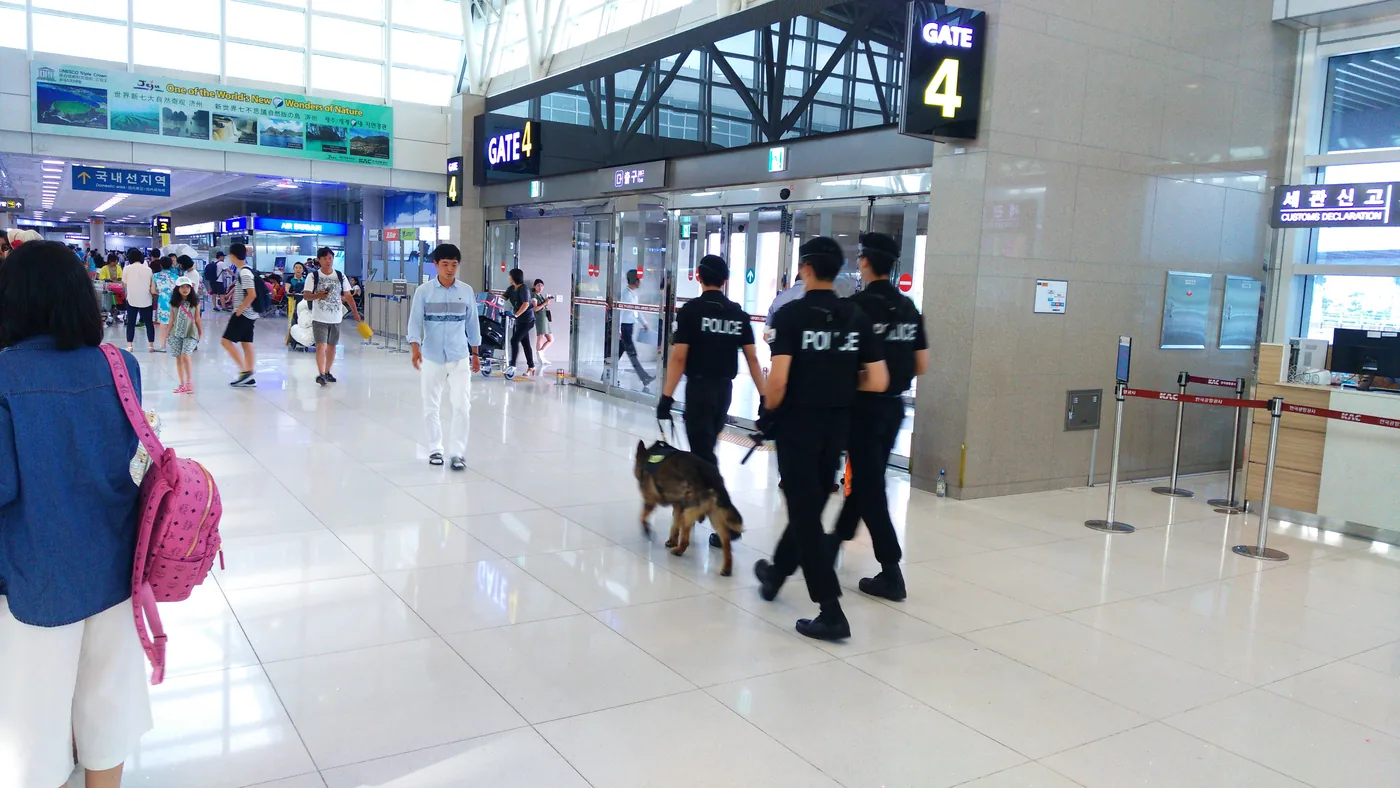
- Go to the 3rd floor. Taxis and cars drop you on the elevated road outside the departures level.
- Check in. Use your airline’s counter to check in and drop bags, or check in on the airline app or a kiosk.
- Show ID and boarding pass. Staff check both at the security entrance. Take off your mask, hat or sunglasses for a moment.
- Pass security screening.
- Wait and board on the 2nd floor. The boarding gates and duty free shops are one floor down.
Security entrances A and B
There are two ways into the departure area. Entrance A is by entrance door 1 on the 3rd floor and entrance B is by entrance door 3. Use whichever is closer to your check-in counter. Carry-on bags generally have to fit within 55 × 40 × 20 cm (115 cm in total) and weigh no more than 10 kg, though each airline sets its own rule.
ID for domestic flights
| Document | Accepted |
|---|---|
| Passport (the only option for most foreign visitors), Korean resident card or driving licence | Yes |
| Korean mobile ID issued through government, telecom, Samsung Wallet or banking apps | Yes |
| A photo, screenshot or photocopy of an ID | No |
A photo of your passport on your phone will not get you through, so keep the real one handy. KAC’s valid ID notice lists every accepted document. You will also see special gates for palm vein registration; they are only for Korean nationals, so foreigners use the regular lanes and show a passport.
Mobile boarding passes and kiosks
If you check in on the app, the mobile boarding pass opens the automatic gates at the security entrance directly. Korean Air, Asiana, Eastar Jet, Air Busan, Jeju Air, Trinity and Jin Air all support this. Turn up your screen brightness, because a dim screen may not scan. Self-check-in kiosks for domestic flights serve Korean Air, Asiana, Jeju Air, Air Busan, Jin Air, Trinity, Eastar Jet and Air Seoul, but they cannot take bags, so you still drop luggage at your airline’s counter. There is an accessible kiosk on the 3rd floor too. KAC’s fast check-in page has the details.
Check-in deadlines by airline
| Airline | Check-in closes | Boarding gate closes | Airline’s suggested arrival |
|---|---|---|---|
| Korean Air | 30 min before departure | 10 min before | No figure given |
| Asiana Airlines | 30 min before | 5 min before (boarding starts 15 min before) | At least 1 hour before |
| Air Busan | 30 min before | 10 min before | 40 min before |
| Eastar Jet | 30 min before (counters open 1 hour 30 min before) | 10 min before | None given |
| Jin Air, Jeju Air, Trinity, Air Seoul, Aero K, Parata Air | Usually 30 min before | See airline | See airline |
For the airlines in the last row, confirm the exact cut-off on your booking confirmation. Free checked baggage is 20 kg in economy on Korean Air and Asiana and 15 kg on Eastar Jet. On the low-cost airlines it depends on the fare you bought.
6. How early to arrive and how to check wait times
KAC does not publish a recommended arrival time for domestic flights at Jeju. The airlines that do give one suggest at least an hour before departure (Asiana) or 40 minutes (Air Busan). The three-hour rule you may know from Incheon’s international flights does not carry over to a domestic hop from Jeju.
Working out your own timing
The question first-time visitors ask most is whether arriving one hour ahead is enough. Count backwards from the 30-minute check-in deadline, then add the queue to drop bags, the ID check and security, and any time you want for the duty free shops on the 2nd floor. One hour usually works for a light traveller with a mobile boarding pass on an ordinary weekday.
Come earlier if you plan to shop at JDC duty free, have several bags to check, are flying on a public holiday or have a rental car to return first. Returning the car, riding the company shuttle and walking into the terminal takes a different amount of time at each rental company, so ask yours. The Jeju car rental guide goes through the return process.
Live wait times
The front page of KAC’s Jeju Airport website shows the average time for each stage of the domestic departure area: check-in and bag drop to ID check, ID check to security, and security to boarding. It labels each stage as smooth, normal, busy or very busy. The figures appear only between 06:30 and 21:30. Naver, Kakao T and the Smart Airport app show the same data.
On one weekday afternoon the board showed the three stages adding up to about half an hour, and most of that was the wait between bag drop and the ID check. Holidays are a different story. KAC adds ID check and security lanes and opens counters earlier on public holidays, and it announces the busiest days ahead of each holiday.
Check the stage times before you leave your hotel. If the board shows “busy” or “very busy” for the bag drop to ID check stage, leave earlier or check in on the app so you can skip the counter if you have no bags.
For international departures there is no official figure either. Go by the check-in opening time on your airline’s booking confirmation, and see the international departures section for the steps.
7. Security rules for power banks, liquids and sharp items
KAC publishes a list of banned items, and the Aviation Security 365 site lets you search item by item. Liquids are where domestic flights in Korea differ most from what you may be used to.
Power banks
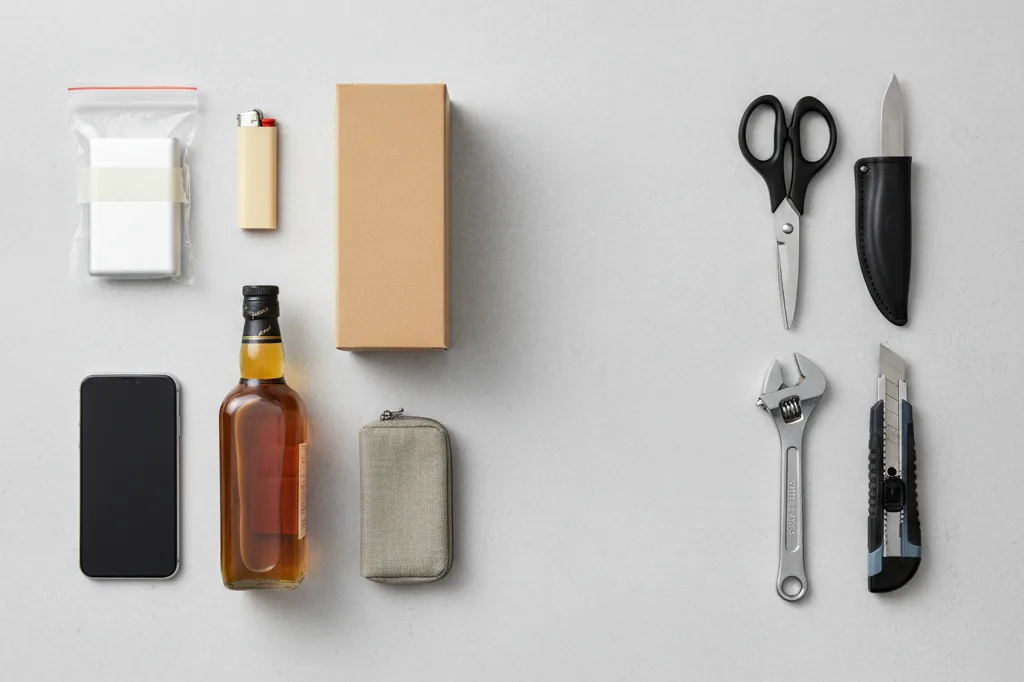
Power banks go in your hand luggage, never in checked bags. You can carry up to two per person, each 160 Wh or less, and those over 100 Wh need airline approval. Cover the terminals with insulating tape or put each one in its own plastic bag. Do not charge or use a power bank during the flight, and keep it with you rather than in the overhead bin. Power banks under a recall cannot be carried at all.
Older notices on the airport website still quote limits in milliamp hours. Go by the watt-hour figure printed on the battery, which is what airlines use.
Liquids on domestic flights
Korea’s 100 ml liquid rule applies only to international flights. On a domestic flight out of Jeju you can carry drinks, alcohol, cosmetics and even a jar of kimchi without a size limit. Dangerous goods such as flammable liquids and alcohol stronger than 70 percent are still restricted. This is why whisky bought at JDC duty free can go straight into the cabin with you.
Lighters, knives, scissors and tools
You may carry one lighter on your person. Torch lighters are not allowed, and a lighter found in checked baggage is thrown away. Knives of any kind (fruit knives, box cutters, multi-tools) and golf clubs must go in checked baggage. Scissors with blades longer than 6 cm and wrenches, spanners or pliers longer than 10 cm also go in the hold, though the screening officer has the final say.
If something is stopped at screening, you can throw it away or leave the security area, check it in as baggage and come back through. Most airlines will not hold items for you, although Eastar Jet keeps small restricted items for a fee, so ask at its counter. When in doubt, ask the Mureoboan (“ask security”) chatbot on KakaoTalk or search Aviation Security 365 before you pack.
Priority lanes
Passengers aged 80 and over, pregnant travellers, people with a baby under two and passengers with disabilities can use the priority ID check and security lanes at both entrance A and entrance B, together with a small number of companions.
8. Taking tangerines and other Jeju goods home
No public rule stops travellers from flying a box of Jeju tangerines or hallabong to the mainland. Treat the box as normal checked baggage and pack it within your airline’s weight allowance.
Fruit, fish and dry ice
A tangerine box counts toward your free checked baggage, which is 20 kg in economy on Korean Air and Asiana and 15 kg on Eastar Jet. Weigh it before you go, because anything over the allowance costs extra at the counter. If you pack fish, meat or anything else that spoils with dry ice, Korean Air and Eastar Jet allow up to 2.5 kg of dry ice per person.
Pine is banned
All of Jeju is a quarantine zone for pine wilt disease. Moving any pine material, whether trees, bonsai or timber, out of Jeju without a permit is a criminal offence, so leave any pine souvenirs behind.
Where to buy Jeju products at the airport
Before security on the 3rd floor, Citriang sells tangerine products and Ijejuseom sells salted seafood, black pork and other Jeju foods, alongside a general Jeju products shop. There is another Jeju products shop in the 2nd floor boarding area. The JDC duty free shops do not sell Jeju farm or sea produce, so buy edible gifts before you pass security or in the boarding area shop.
To send heavy things ahead, the post office counter on the domestic 1st floor (09:00 to 18:00) takes parcels. Zimcarry offers luggage storage, packing and delivery at the airport, and there are services that carry bags between the airport and your hotel so you can sightsee without them. Zimcarry’s Air Pass works in the other direction, delivering bags from flights out of Gimpo, Gimhae or Gwangju to your accommodation in Jeju.
9. JDC duty free for domestic passengers, foreigners included
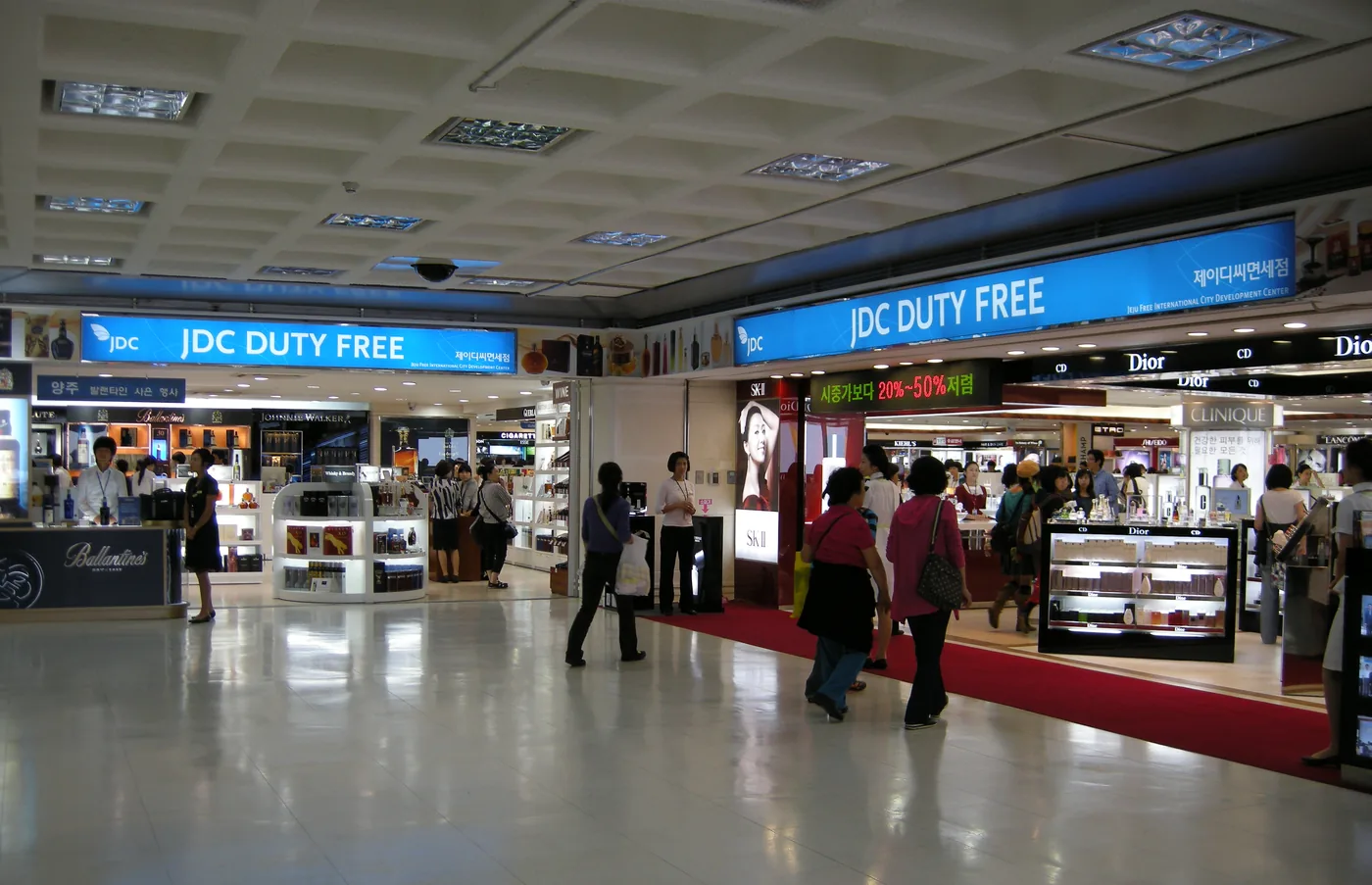
JDC Duty Free is a special kind of duty free shop for people leaving Jeju for another part of Korea by plane or ferry. It is run by the Jeju Free International City Development Center. Foreign visitors can use it too whenever they fly out of Jeju on a domestic flight, as can Korean residents and Jeju locals. Show your passport (or Korean residence card) and your domestic boarding pass at the till.
Passengers on international flights cannot use JDC Duty Free. They shop at Lotte Duty Free after passport control instead, which the international departures section covers.
Purchase limits
| Item | Rule |
|---|---|
| Each visit | Up to US$800 per person, and no single item over US$800 |
| Visits per year | Up to 6 |
| Alcohol | Counted separately from the US$800: up to 2 litres in total and up to US$400, with no limit on the number of bottles |
| Tobacco | Counted separately: 200 cigarettes (one carton) or the equivalent in one type of tobacco |
| Age | 19 and over for alcohol and tobacco; no age limit for other goods |
| Shared count | Purchases at JDC and at Jeju Tourism Organization (JTO) designated duty free shops are added together |
The alcohol limit is set by volume and price together. Two 1-litre bottles or two 700 ml bottles of whisky fit within the two litres, as long as the bottles together cost no more than US$400, so the number of bottles you can take depends on their size and price. These limits come from Korea’s Restriction of Special Taxation Act.
The shops sell alcohol, tobacco, watches, cosmetics, perfume, bags, wallets, belts, sunglasses, snacks, ginseng, ties, scarves, accessories, stationery and toys. The whisky section is large, and you buy within the alcohol limit above. Prices and stock change, so check the JDC website if you have a particular bottle in mind.
Where the shops are and how collection works
All three shops are on the domestic 2nd floor in the boarding area after security: the main shop between boarding gates 6 and 7, the east shop between boarding gates 2 and 3, and the west shop between boarding gates 11 and 12. There is no JDC shop before security. They are open from 06:00 to 21:20.
You take your purchases with you at the till. You cannot carry them back out of the departure area once you have bought them. Bottles go into the cabin with you, as the security section explains. Goods bought at the JTO duty free shops in Jungmun and Seongsan are collected at the duty free pickup counter on the domestic 2nd floor, open 05:00 to 21:00.
Reserve online to save time. JDC’s online reservation opens 10 days before your flight and closes at 1 pm the day before. You pay and collect at the shop’s payment desk on the day. A reservation you do not collect that day, including because of a cancelled flight, is cancelled automatically.
Buying in someone else’s name or reselling goods gets you banned from the shops for a year. JDC’s airport shopping guide sets out the rules in full.
10. Airline lounges at Jeju Airport
The Asiana Airlines and Korean Air lounges are both in the domestic departures hall on the 3rd floor.
| Lounge | Location | Hours | Who can enter |
|---|---|---|---|
| Asiana Airlines lounge | Domestic 3rd floor, to the right of the Asiana domestic counters, before security | 05:25 to 20:40 | Asiana and Star Alliance business class, Asiana Club and Star Alliance elite members plus one guest. Partner credit cards work only on Asiana-operated flights. No showers |
| Korean Air lounge | Domestic 3rd floor near the check-in counters, before security | During flight hours | First and Prestige class, and mileage lounge coupons for same-day Korean Air flights |
Both lounges are before security
Since both lounges sit before the security entrances, leave the lounge with enough time to queue for the ID check and screening and then walk down to your boarding gate. Check the live wait times described above before you settle in.
No pay-in or card lounges
There is no credit card lounge and no lounge that anyone can pay to enter. There is no lounge after passport control in the international area either. Both Jeju lounges appear in the Priority Pass listings. Priority Pass limits the Asiana lounge to passengers on Asiana-operated flights, while its Korean Air lounge entry names no airline condition and only warns that access can be refused when the lounge is full, so check the Korean Air conditions in the Priority Pass app before you go. Asiana Airlines is in the process of merging into Korean Air and leaving Star Alliance, so the Asiana lounge rules may change; any change appears in the airlines’ own notices. Details are on Asiana’s lounge page and Korean Air’s lounge page.
You may also see a “business lounge” on the KAC floor plan. It is a meeting room rented by the hour. The airport’s paid VIP waiting room has to be booked by phone a day ahead. Neither is a place to relax before a flight.
Places to rest instead
The 4th floor observation deck is open from early morning to late evening and has a view of the runway and the sea. Downstairs, the seats near the 2nd floor boarding gates and the cafes on both levels are the other options.
11. Food and coffee from early morning to late evening
Opening hours below come from KAC’s facility list. Most restaurants are on the domestic side, spread over the 1st, 2nd, 3rd and 4th floors.
| When or where | Places | Hours |
|---|---|---|
| Earliest opening | Jamba (3rd floor, before security): coffee, sandwiches, salads | From 05:30 |
| Breakfast after security | 2nd floor: Guksu Namu, Lotteria, Plating food court, Paris Baguette, Cafe Ogada | From 06:00 |
| 3rd floor | Paris Baguette (before security) from 06:00, Woomu (pudding) from 08:00; Paul Bassett, also on the 3rd floor, 06:00 to 22:00 | Varies |
| 4th floor restaurants (before security) | Jingobok Sikdang (Korean) 06:30 to 21:00; Daechun Haejangguk, Frank Burger and Plating from 07:00; Midoin and a Chinese restaurant from 08:00 | Most close between 20:00 and 21:00 |
| 1st floor arrivals | Ourhome food court, Egg Drop and Angel-in-us from 07:00; CU 06:30 to 22:30 | Varies |
| Latest closing | 2nd floor Plating food court, 3rd floor Paul Bassett and 1st floor Ourhome food court until 22:00; 1st floor CU until 22:30 | Up to 22:30 |
Arriving late at night
If you land on one of the last domestic flights, between about 10:20 and 10:40 pm, almost every restaurant will have closed, and the 1st floor CU convenience store shuts at 10:30 pm, so even that may be dark by the time you collect your bags. Eat before you board in Seoul or Busan if you can.
Early departures
The 4th floor restaurants are popular for a Korean meal before a midday flight: hangover soup, Korean set meals, Chinese dishes and burgers. They sit before security, so finish eating with time to spare for the queues.
On a 6 am flight, eat before security. The 2nd floor restaurants after security open at 6 am, so if you need coffee earlier, stop at Jamba on the 3rd floor, which opens at 5:30.
International area
After passport control on the international side there is a Paris Baguette, Uptown and the Asian Cook food court, open from about 6 am to 10 pm, plus a CU whose hours follow the flight schedule.
12. Pharmacy, luggage storage, nursing rooms and other facilities
KAC’s airport tips page lists the services below. Most of them are on the domestic side.
| Facility | Location | Hours |
|---|---|---|
| Pharmacy | Domestic 3rd floor near entrance door 2 | 06:00 to 21:00 |
| Airport clinic | 1st floor near entrance door 5, next to lost and found | 07:00 to 22:00 (doctor 10:00 to 17:00) |
| ATMs | Domestic 1st and 3rd floors | 24 hours |
| Luggage storage | International 1st floor baggage storage; Zimcarry counter (storage, packing, delivery) | 06:00 to 22:00; Zimcarry from 06:00, closing at 21:20 by KAC’s listing or 21:30 by Zimcarry’s |
| Post and parcels | Domestic 1st floor post office counter | 09:00 to 18:00 |
| Nursing rooms | 3rd floor left of departure entrance B; 1st floor next to the cafe; 2nd floor near boarding gate 9; 2nd floor near boarding gate 3 | 06:00 to 23:00 |
| Wheelchair and stroller loans | 3rd floor main information counter (leave ID, return before security) | Not posted |
| Wheelshare (free power kit for manual wheelchairs) | Booth by entrance door 4 on the 1st floor | Not posted |
| Free charging | 3rd floor by the pharmacy at entrance door 2; 2nd floor near boarding gates 2, 5, 11 and 12; international side by boarding gate 16 (bring your own cable) | Not posted |
| Wi-Fi | “Jeju_Airport Free Wi-Fi” across the waiting areas | Not posted |
| Lost and found | 1st floor near entrance door 5 | 06:30 to 21:30 |
| Tourist information | 1st floor Jeju Tourism Association information centre | 07:00 to 22:00 |
Zimcarry’s counter location is listed differently by KAC (international 3rd floor) and by Zimcarry itself (domestic 1st floor, by entrance door 5), so check Zimcarry’s own instructions for where to find it on the day. Storage prices are set at the counter.
Help for travellers with reduced mobility
There is a dedicated drop-off and pick-up area with a help phone in front of entrance door 3 on the 3rd floor. KAC’s accessibility page explains the assistance available, and the information counter on the 3rd floor lends wheelchairs and strollers.
Travelling with pets
Inside the terminal, pets must be in a carrier. If that is impossible, a pet stroller or a short leash of about 50 cm is accepted. Five breeds classed as dangerous dogs are not allowed, and pets must stay off the waiting area seats. Cabin and hold rules are set by each airline, so check yours before you book.
Overnight in the terminal
KAC publishes no information about staying in the terminal overnight on a normal night, so plan on a hotel if your flight is very early. The blankets and extended hours mentioned in the cancellation section are emergency help for days when many flights are grounded.
13. Observation deck and places near the airport to watch planes
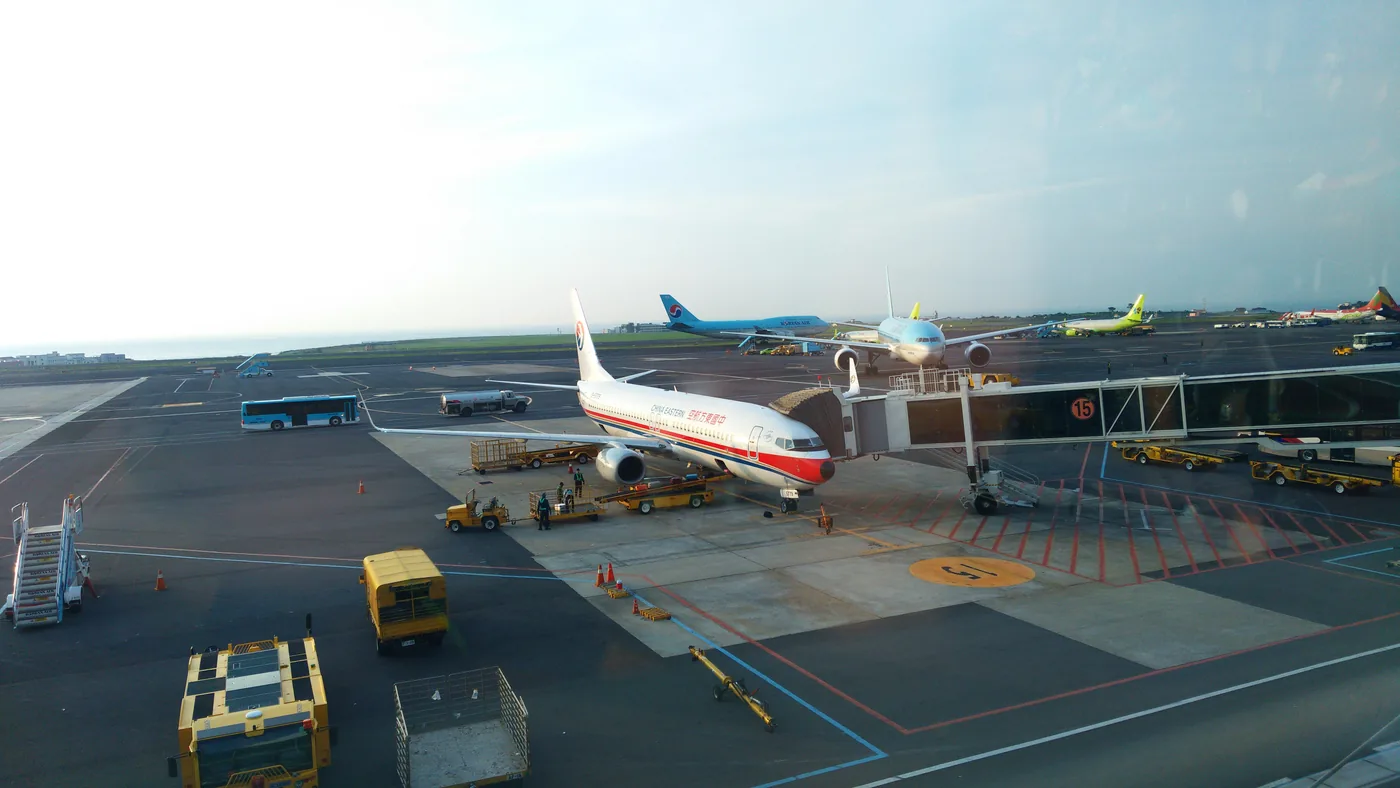
The airport observation deck is on the domestic 4th floor and is open from 05:00 to 22:00, with shorter hours during typhoons and snow. It looks out over the runway and the sea. It is the easiest place to watch take-offs and landings, since you never have to leave the building.
Spots a short taxi ride away
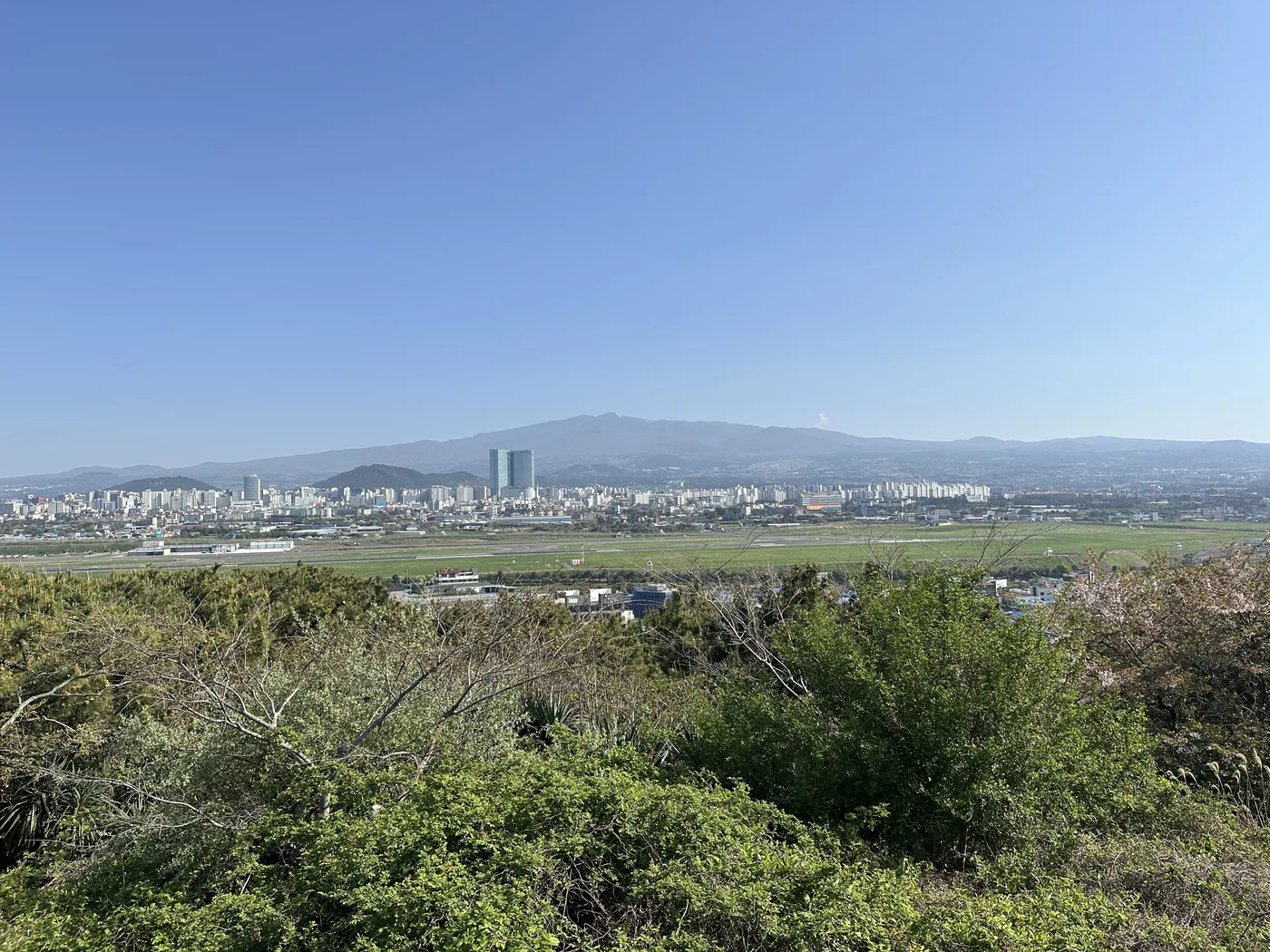
Several places along the coast near the airport are about 10 minutes away by taxi. DodubongMap is a small, easy hill just west of the airport, and VisitJeju notes that you can watch planes take off and land from the top. To the northeast, the lava rock of YongduamMap stands at the water’s edge, and to the west, Iho Tewoo BeachMap has its red and white horse-shaped lighthouses.
| Place | What it is | Note |
|---|---|---|
| Dodubong | Low volcanic hill just west of the airport, with a view of planes taking off and landing from the top | Check where to park before you drive there |
| Dodu-dong Rainbow Coastal Road | Seaside road east of Dodubong with a sea wall painted in rainbow colours | Do not take photos from the road edge; cars have crossed the centre line to avoid people with tripods |
| Yongduam | Dragon-head lava rock on the shore northeast of the airport | Free guided commentary |
| Yongdam Coastal Road (Eoyeong Park) | Seaside road from Yongduam toward Dodubong, lined with cafes, restaurants and hotels | Busy in the evening too |
| Iho Tewoo Beach | The closest swimming beach to central Jeju City, with red and white horse lighthouses |
Drones need a permit anywhere within 9.3 km of the airport, which covers Dodu, Yongdam and Iho. Flying one there without permission is an offence.
Using a spare hour or two
With an hour or two to spare and a rental car, the coastal roads and Dodubong are the obvious detour before you return the car. Work backwards from the return time and the shuttle ride. If you are carrying bags, leave them at the luggage storage first.
Where to stay for an early flight or a late landing
No hotel is attached to the terminal. The neighbourhoods closest to it are Yongdam, on the coast toward the old city centre; Dodu, a small area west of the airport with mostly guesthouses and pensions; Yeon-dong in Shinjeju, with lots of restaurants and places to stay; and Nohyeong, also in Shinjeju, with the big hotels and shopping.
14. Parking for pickups, drop-offs and short stays
Most overseas visitors arrive by rental car shuttle, bus or taxi, so parking matters mainly to friends picking you up. The P1 car park is in front of the terminal and includes a parking building. The P2 long-term car parkMap is to the west beside the control tower. There is also a cargo terminal car park charged at P1 rates.
Daily maximum charges
| Small car, daily maximum | P1 (and cargo) | P2 long-term |
|---|---|---|
| Monday to Thursday | 10,000 won | 9,000 won |
| Friday to Sunday and public holidays | 15,000 won | 13,500 won |
The first 30 minutes cost 600 won and each 10 minutes after that 200 won, up to the daily maximum. The day is counted in 24-hour blocks from the time you drive in. Full parking rates are on the KAC site.
Paying
Number plates are read automatically, and there are pay machines near entrance doors 1 and 2 on the 1st floor, under the overpass and in the parking building. After paying at a machine you have 15 minutes to drive out. Drivers meeting a flight get a short free period, explained in the arrivals section below.
Things you cannot book
Jeju has no parking reservations and no official valet service. Car parks open at 05:30 and run until the last flight. On busy days the live space counter shows how many spaces are left, and even ordinary weekday mornings can fill up. On holidays KAC opens temporary car parks and advises taking a taxi or public transport instead.
15. Arriving at Jeju: exits, pickups, buses, taxis and rental cars
Domestic arrivals come down to the 1st floor, collect bags and walk out through entrance doors 1 to 5. International arrivals reach the 1st floor arrivals hall at the western end after immigration and customs. Which door you leave by depends on how you are travelling on.
Which entrance door to use
| Going by | Entrance door |
|---|---|
| Rental car company shuttles (at the Rental Car House) | Entrance door 3 or 5, then cross at the crossing in front and follow the “way to Rental Car House” signs under the canopy to your company’s shuttle stop number |
| Limousine buses 600 and 601 (Jungmun and Seogwipo hotels) | Entrance door 5, turn right |
| Limousine buses 800 and 801 (Pyeonghwa-ro to Seogwipo) | In front of entrance door 4 |
| Express and trunk buses | Entrance door 1 (east: Seongsan, Pyoseon, Namwon, the 5.16 Road), entrance door 2 (Yongdam, City Hall), entrance door 4 (Pyeonghwa-ro, Daejeong, and toward Nohyeong and Yeon-dong) |
| Taxi | Entrance door 3, then across the crossing |
Our Jeju travel guide explains the bus routes from the airport to Jeju City and Seogwipo, and the Jeju bus information site has the limousine timetable. Have a T-money or other transit card ready, or a bank card that works as one, because the official guidance on cash payment varies. KAC’s public transport page lists the stops by entrance door.
Late arrivals
Limousine 800-1 runs two late trips from the airport to Seogwipo at 10:30 pm and 11 pm, which suits the last domestic arrivals. Taxis use the island-wide fare, with a base fare of 4,300 won for a mid-size taxi and 20 percent more between 11 pm and 4 am. A ride into central Jeju City usually costs around 10,000 won.
Rental cars
Most rental companies meet you at the Rental Car HouseMap, a waiting building beside the shuttle bus stops, a short walk across the road from entrance door 5. Each company’s shuttle bus then takes you from there to its own office to collect the car. Lotte, Jeju, Tamra and SK also have desks inside the terminal on the 1st floor between entrance doors 2 and 3, so follow your company’s own instructions. Our Jeju car rental guide compares companies, insurance and the shuttle, and KAC has a rental car page too.
Being met by friends or a driver
Outside entrance doors 1 to 5 on the 1st floor, cars that stop on the pedestrian crossings, at the bus stops, in the fire engine lanes and similar spots are fined after one minute. Jeju City reduced the limit from five minutes, watches it by CCTV between 07:30 and 23:00 and fines 40,000 won for a car and 50,000 won for a van. Your friends should wait in the car park, where the first 10 minutes are free. Taxis booked through apps such as Kakao T pick up from their own designated area.
16. Flying out of Korea from Jeju’s international terminal
International departures use entrance door 5 on the 3rd floor at the western end of the building. KAC’s international departures page describes the same order of steps as below.
- Enter through entrance door 5. Check in at your airline’s counter at the time on your booking confirmation. There is no airport-wide opening time.
- Collect pre-ordered duty free. If you bought from a city or online duty free shop, the pickup counters open 2 hours before each international flight.
- Pass security. The 100 ml liquid rule applies here: containers of 100 ml or less in one clear 1-litre bag.
- Go through passport control. Then head to your boarding gate, numbered 14 to 22, on the same floor.
Automated departure gates for foreigners
Foreign visitors aged 17 and over on a short stay who gave fingerprints and a face photo when they entered Korea can use the automated departure gates without registering in advance, according to the Ministry of Justice.
After passport control
There are two Lotte Duty Free shops, one to the right of boarding gate 14 and one between boarding gates 15 and 16, plus duty free pickup counters for Lotte and Shilla orders. You will also find food, cafes and a Jeju Bank exchange counter open 06:00 to 23:00. There is no duty free shop in the arrivals hall and no lounge after passport control.
Tax refunds
Global Tax Free has a counter on the international 3rd floor, open 04:00 to 23:59 before security and during flight hours after passport control. If you leave Jeju on a domestic flight and fly home from Seoul or Busan, confirm your tax refund at that last airport, since the check happens where you actually leave Korea.
17. Arriving from abroad: visas, K-ETA, arrival card and customs
International arrivals come into the western end of the terminal and finish on the 1st floor. Most US, UK, Australian and Singaporean travellers enter Korea without a visa and can travel anywhere in the country afterwards. Travellers who normally need a Korean visa have one extra option that only Jeju offers.
- Health check. Only if it applies to you (see quarantine below).
- Immigration. Foreigners aged 17 and over give fingerprints and a face photo.
- Baggage claim on the 1st floor.
- Customs. With nothing to declare, take the “nothing to declare” lane.
- Arrivals hall on the 1st floor.
Entry rules by nationality
| Passport | Visa | K-ETA | Arrival card |
|---|---|---|---|
| US, UK, Australia, Canada, New Zealand, Singapore and other temporarily exempt countries | Not needed | Temporarily exempt | Required (paper or electronic) |
| Thailand, Malaysia | Not needed | Required | Not needed once you hold a K-ETA |
| Vietnam, the Philippines, Indonesia, India | Needed, except under Jeju visa-free entry when landing in Jeju directly from abroad | Not applicable | Required on Jeju visa-free entry |
Jeju visa-free entry for Vietnamese, Filipino, Indonesian and Indian travellers
Nationals of countries that normally need a Korean visa can stay in Jeju for up to 30 days without one for tourism or transit, as long as they fly into Jeju directly. Nationals of 23 listed countries are excluded. “Directly” means Jeju has to be the first Korean airport you land at, after changing planes outside Korea in a city such as Shanghai, Hong Kong, Taipei or Singapore. If you fly into Seoul or Busan first and take a domestic flight, the scheme does not apply and you need a Korean visa. HiKorea sets out the rules.
Visitors from 64 listed countries, including ordinary passport holders from China, Vietnam, the Philippines, Indonesia, Mongolia, India, Cambodia and Laos, cannot leave Jeju during their stay. Airlines are required to refuse them boarding on a domestic flight to Gimpo or anywhere else. The exceptions are having to depart Korea from another airport because of a cancellation, or needing hospital treatment elsewhere. In those cases, apply to the Jeju Immigration Office for permission to extend your area of stay. Going to the mainland without it is a criminal offence that can mean a prison term or a fine. In practice, if you need a visa for Korea and come in on this scheme, plan to stay on Jeju.
K-ETA
Nationals who need a K-ETA must have one even if Jeju is the only place they visit. Thai and Malaysian travellers need it; children aged 17 and under, adults aged 65 and over and cruise passengers are exempt. Travellers from the US, UK, Australia, Singapore and the other temporarily exempt countries are excused; how long the exemption runs is posted on the official K-ETA website. Visa-required nationals such as Vietnamese do not apply for a K-ETA at all. Our K-ETA guide walks through the application.
Arrival card
Korea still accepts the paper arrival card. If you submit the free electronic arrival card from up to three days before you land, you skip the paper one. Travellers holding a K-ETA do not need either. Travellers from temporarily exempt countries such as the US, UK and Australia, and individual visitors using Jeju visa-free entry, do need one. The electronic form is available in Korean, English, Simplified Chinese, Japanese, Vietnamese, Thai and Russian.
Customs and quarantine
If you have nothing to declare, walk through the “nothing to declare” lane without filling in a form. The duty free allowance is US$800, plus 2 litres of alcohol up to US$400, 200 cigarettes and 100 ml of perfume. The alcohol and tobacco allowance goes by year of birth: it starts from 1 January of the year you turn 19. To declare, use the paper form or the Traveler Customs Declaration app. Jeju Customs has the full list.
Leave meat products and fresh fruit at home. Sausages, jerky and other processed meat and fresh fruit cannot be brought into Korea. Getting caught without declaring them means a fine, and for pork products from countries with African swine fever the fine can reach 10 million won.
Travellers who have stayed in designated areas, such as the Chinese provinces of Jiangsu (including Nanjing and Wuxi) and Guangdong (including Guangzhou and Shenzhen), must submit a health declaration through Q-CODE or on paper even without symptoms. That can apply if you connected through mainland China. The list changes every quarter, so check the notice on Travel Health Alert e before you fly. Travellers coming through Japan or Hong Kong only need to declare if they have symptoms.
Registering for automated immigration
Jeju is one of only two airports (with Incheon) where foreign visitors can register for automated immigration in the arrivals area and use it straight away. It is open to visa-free visitors aged 17 and over from 42 eligible countries. UK, Australian, New Zealand, Canadian and Singaporean passport holders qualify; US, Thai and Vietnamese passport holders do not. You scan your passport, give fingerprints and have your face photographed, then walk straight through the automated gate.
What to sort out on the 1st floor
| Task | Where and when |
|---|---|
| Currency exchange | Jeju Bank exchange inside the international baggage claim area, 06:00 to 23:00; bank counters on the 1st floor on weekdays 09:00 to 16:00 |
| Cash machines | None on the international side; the domestic 1st and 3rd floors have 24-hour ATMs (whether foreign cards work is not posted) |
| Transit card | Two WOWPASS machines on the domestic 1st floor (05:00 to 23:00) and the CU store there; there is no convenience store on the international 1st floor |
| SIM or eSIM | SKT roaming counter on the international 1st floor, open according to international flights, so it may be closed for an evening arrival |
| Tourist information | International 1st floor tourism association desk (during arrivals); domestic 1st floor information centre 07:00 to 22:00; 1330 phone line with interpreting in English and other languages |
| Luggage storage | International 1st floor baggage storage, 06:00 to 22:00 |
| Wi-Fi | Jeju_Airport Free Wi-Fi |
Since the roaming counter keeps flight hours, setting up a data plan before you leave home is the safer choice. Our Korea SIM and eSIM guide compares the options. For cash, cards and exchange rates, see our guide to money in Korea, and our Korea travel apps guide covers maps, taxis and translation.
18. Reaching Jeju on a domestic flight from Seoul or Busan
Most travellers from the US, UK, Australia and Europe reach Jeju by flying into Seoul and taking a domestic flight. If you land at Incheon, you will usually transfer to Gimpo for the Jeju flight, because domestic flights between Incheon and Jeju are very rare: Jeju Air flies the route only in some periods. Our Incheon Airport guide covers getting from Incheon to Gimpo, and the Gimpo guide linked above covers the domestic terminal there. Flying into Busan and connecting at Gimhae works too.
Immigration happens at your first Korean airport
You go through immigration and customs where you first land in Korea, collect your bags, then check them in again at the domestic counter for Jeju. Korea treats the two flights as separate journeys, so the K-ETA transit exemption does not apply and neither does Jeju visa-free entry. Visa-required nationals need a Korean visa to take this route. For the domestic flight, your passport is your ID.
The domestic leg itself is short: 75 to 80 minutes from Gimpo and 60 to 75 minutes from Gimhae on the timetable. Arriving in Jeju, you come down to the domestic 1st floor and leave through entrance doors 1 to 5 like any other domestic passenger.
Leaving Jeju the same way
Travellers who entered Korea visa-free in the usual way can fly from Jeju back to Seoul or Busan and leave Korea from there. The tax refund note in the international departures section applies to you. Before your domestic flight out of Jeju you can also shop at JDC duty free after security, as described in the duty free section.
This route is closed to visitors from the 64 restricted countries who entered on Jeju visa-free status. They have to fly out of Korea from Jeju unless they get permission to extend their area of stay.
Landing in the evening
A connection that lands in Jeju in the evening arrives as the buses thin out and the terminal shops close. If you have heavy bags or are heading to Jungmun or Seogwipo, a pre-booked car to your hotel saves working out bus routes in the dark. Our guide to getting around Korea has more on domestic flights and transport.
🧭All-Korea essentials136
Jeju Airport questions
Images: Photographs via Wikimedia Commons: Kimhs5400 (CC BY 4.0), song songroov (CC BY 3.0), Bohao Zhao (CC BY 3.0), Grapesurgeon (CC BY-SA 4.0). Charts by Breeze Korea from Korea Airports Corporation data. Carry-on illustration: AI-generated image.